
It’s a Tuesday in October, just past nine, and the alley off Oudezijds Achterburgwal is so narrow you can almost touch the walls on both sides. A woman in a window two metres away is reading a paperback under a soft red bulb. Three Italian men try to take a photo and the guide shuts it down in two languages before they’ve even raised the phone. No pictures. We talked about this on the bridge. One of them apologises. The reader hasn’t looked up. She turns a page.
That’s De Wallen at the start of an evening, before the bachelor crowds arrive and after the lunch tourists have left. It is also, by accident of geography and a 14th-century port economy, the oldest neighbourhood in Amsterdam. The same square that holds the windows holds the Oude Kerk, consecrated in 1213, the city’s oldest building. It is the most photographed and most misunderstood quarter of the country, and the only respectful way to see it is on a guided walk that explains what you’re looking at.
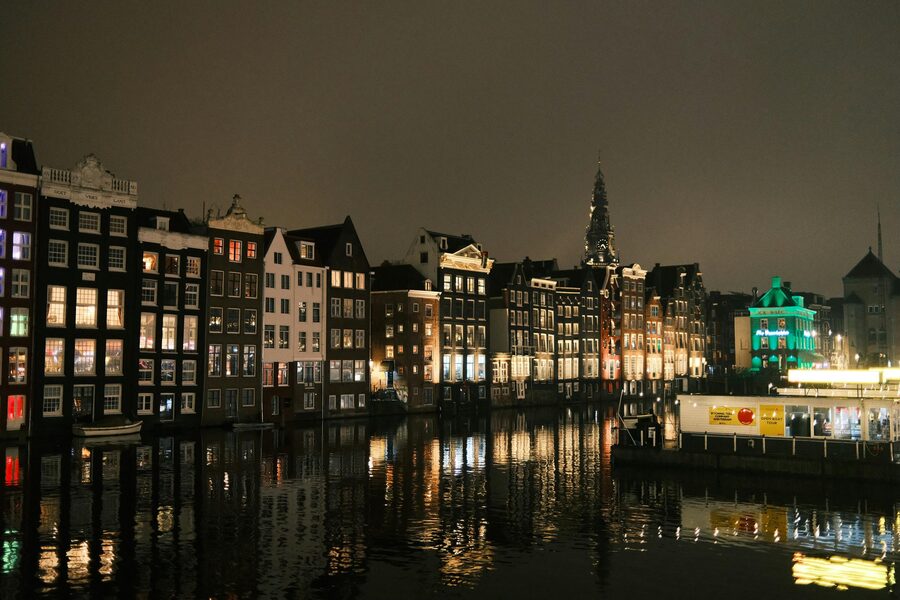
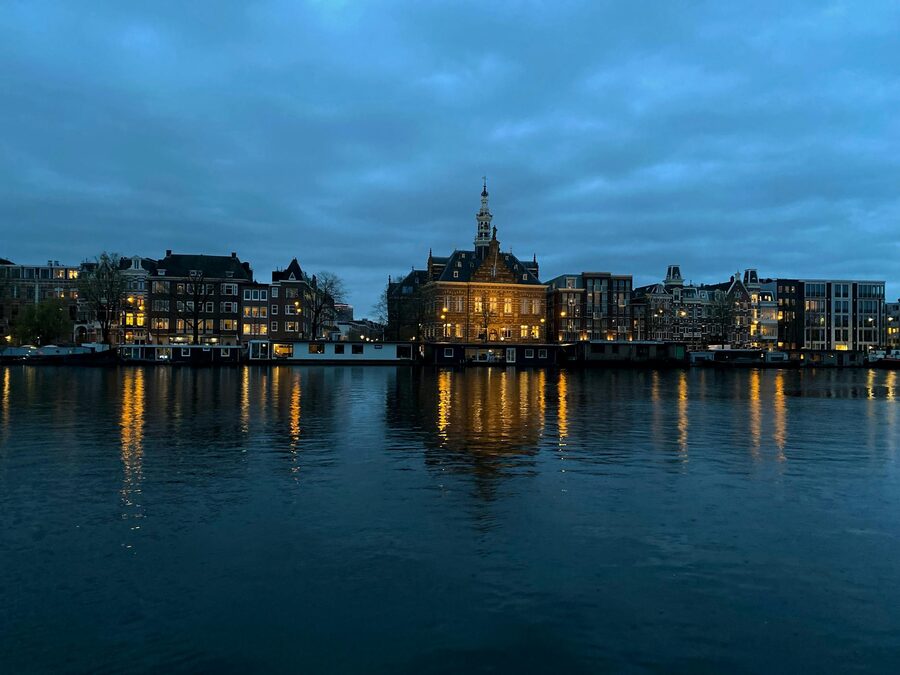
The canal facades around De Wallen at blue hour. Tours start once it’s dark enough that the windows are working, around 7pm in winter and 9pm in summer.
In a Hurry: Three Tours Worth Booking
- Multi-language Red Light District walk ($28): 90-minute history-first tour in English, German, or Italian, the most-booked option on the market. Check availability
- German or English Red Light District tour ($28): same product, German/English language pair, smaller groups some evenings. Check availability
- Red Light District + Coffee Shop combo ($29): two hours, adds the legal-cannabis context to the legal-sex-work context. Check availability
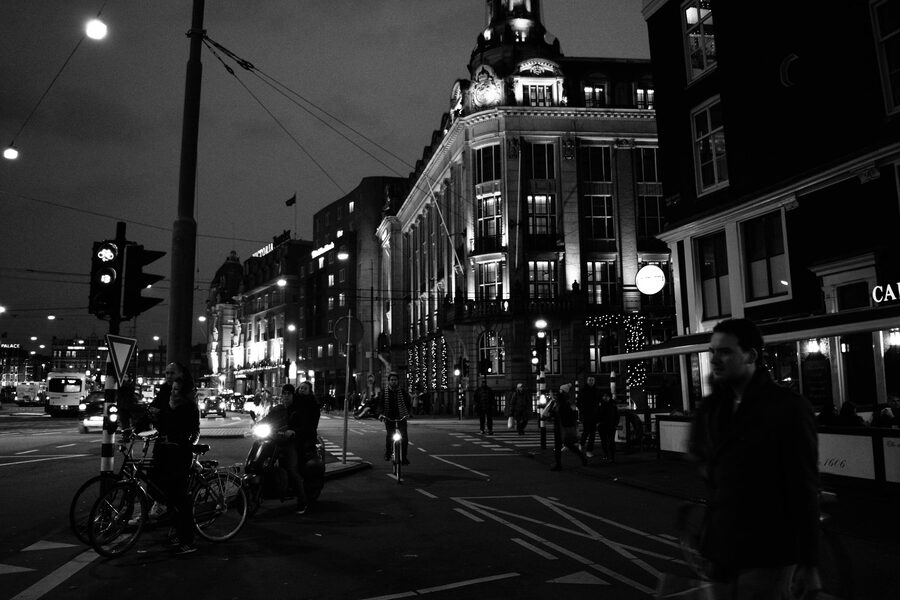
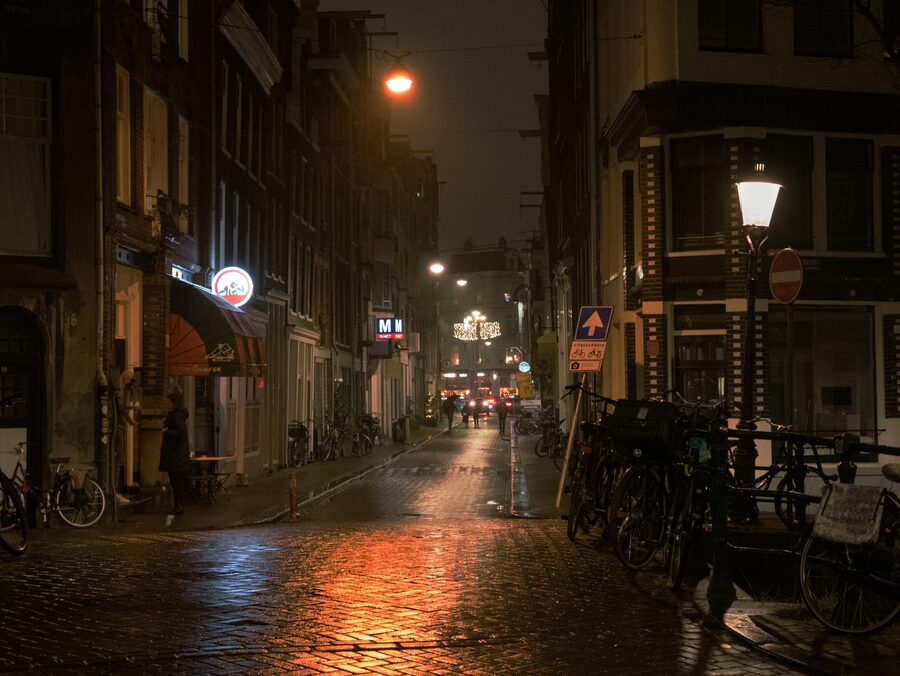
Central Amsterdam at night, looking toward De Wallen. The brick streets, the bicycles, the closed shops on either side, the orange streetlight. The walk in is part of the experience.
Why a guided tour and not a self-guided wander
This is the part that needs saying first. De Wallen is a working neighbourhood. The women in the windows are independent contractors who are paying rent on those windows by the shift, and a slow tourist crowd standing across from a window staring is the same thing as standing in front of someone’s office and watching them work. They’ve said publicly, repeatedly, that it makes the job harder.
A guided tour gives you a reason to be there other than gawking. The guide leads, sets the pace, gives you something to listen to and look at that isn’t the windows, and steers the group around the parts of the alleys where lingering would be a problem. You also get the actual history, which is the part that justifies the visit at all.
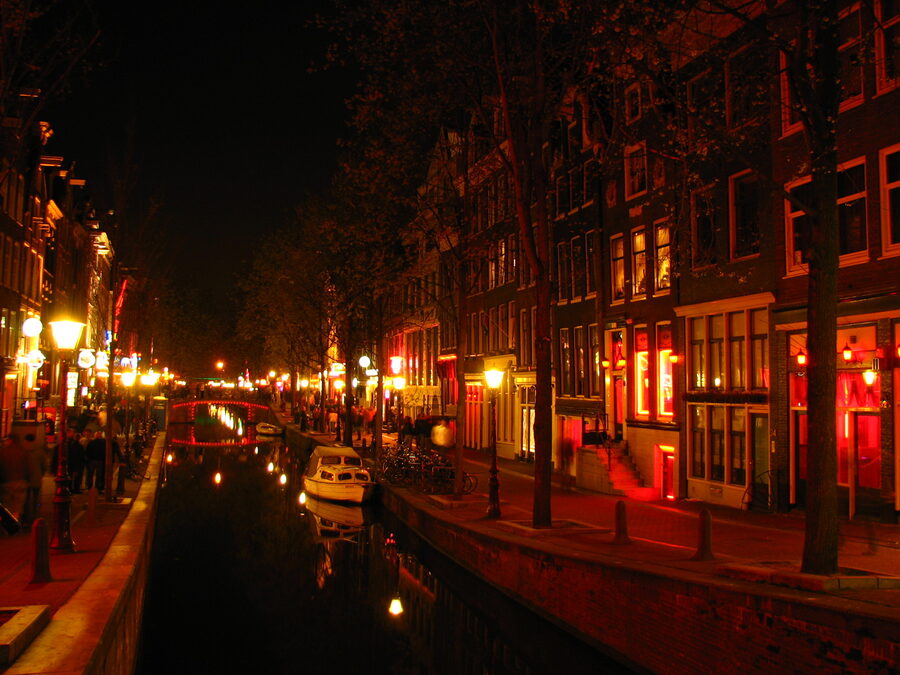
De Wallen at street level. The “wallen” in the name means walls or quays, the medieval embankments that define the district’s geometry.
The closest comparison in our run so far is the Spanish Quarters in Naples, another working-class neighbourhood that became a tourist attraction without anyone asking the residents first. The lesson there held in Amsterdam too. Visit, but visit with someone who lives there or works there or has spent twenty years walking those streets, not with a phone in your hand and a list of TikTok shots to recreate.
The other comparison, less obvious, is the Moulin Rouge in Paris. They are sometimes mentioned in the same breath as if they were the same thing. They are not. Moulin Rouge is theatre, a cabaret with a script and choreography and a hundred-year tradition of the can-can. De Wallen is a real, working sex-work district where real people pay real rent and go home to real apartments at the end of a real shift. If you book the Moulin Rouge expecting Amsterdam you’ll be disappointed. If you book a De Wallen walking tour expecting a show you’ll be lost. Different products entirely.
What the tour actually covers
I’ve taken the standard 90-minute walk twice, both times in English with a different guide, and the structure barely varied. You meet at the National Monument on Dam Square, walk five minutes east into the district, and then loop slowly through the alleys for an hour and a half while the guide stops at four or five specific spots and unpacks the layered history.
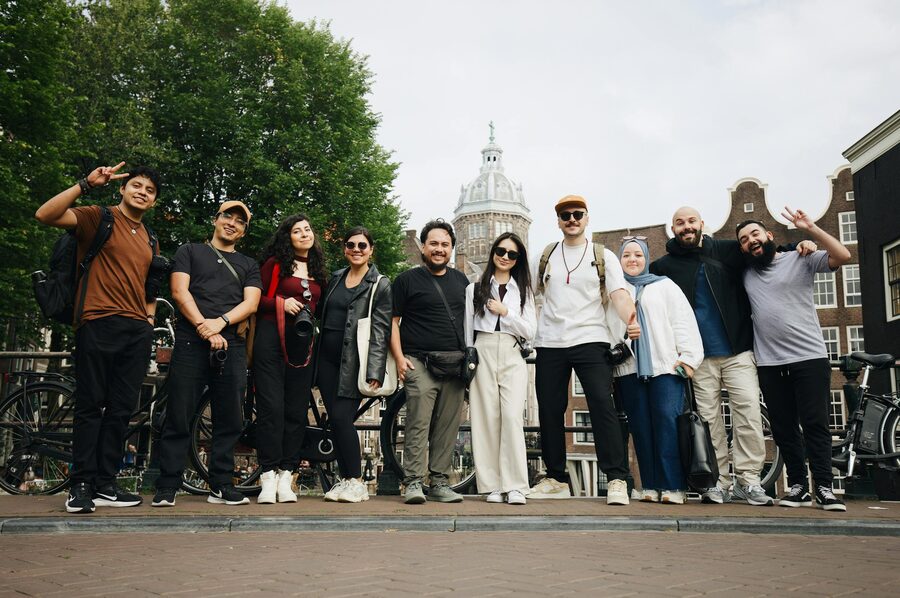
A typical small-group walking tour in Amsterdam. Most Red Light District tours cap at twelve to fifteen guests so the guide can actually be heard in the alleys.
The four anchor stops, give or take depending on the guide, are:
- The Oude Kerk square, where the medieval church stands twenty metres from the oldest stretch of windows. The proximity is the entire story of the district in one image.
- The narrow alley behind the church, where the windows date from the formalisation under Napoleonic law in the 1810s.
- The Belle statue on Oudekerksplein, installed in 2007 to honour sex workers worldwide. We get to that statue below.
- The “1012” zone, which is the postcode the city used in its 2019 plan to relocate the windows out of De Wallen. The plan is mostly halted now, but the politics are still live.
Some tours add a fifth stop at one of the licensed peep shows or at a coffee shop, depending on the operator. The combo tour we cover below adds the cannabis-policy half explicitly.
Three Tours Worth Booking
1. Amsterdam Red Light District Walking Tour (multi-language): $28
This is the most-booked Red Light District tour on the GetYourGuide marketplace, and the language flexibility (English, German, or Italian on the same booking page) is the reason. Our full review covers what the 90 minutes actually look like with a strong guide versus a tired one, and which mistakes the busier evenings tend to surface. Pick this one if you want the canonical history-first walk and don’t need the coffee shop add-on.
2. Red Light District Tour in German or English: $28

Same product, narrower language pair, sometimes a smaller group depending on the night. If you only need German or English and you’re seeing the multi-language slot full, check this listing instead, the calendars run separately. The full review has notes on which guides on this listing are particularly good with the labour-rights material. Same price, same 90 minutes, same start point at the National Monument.
3. Red Light District & Coffee Shop Tour: $29
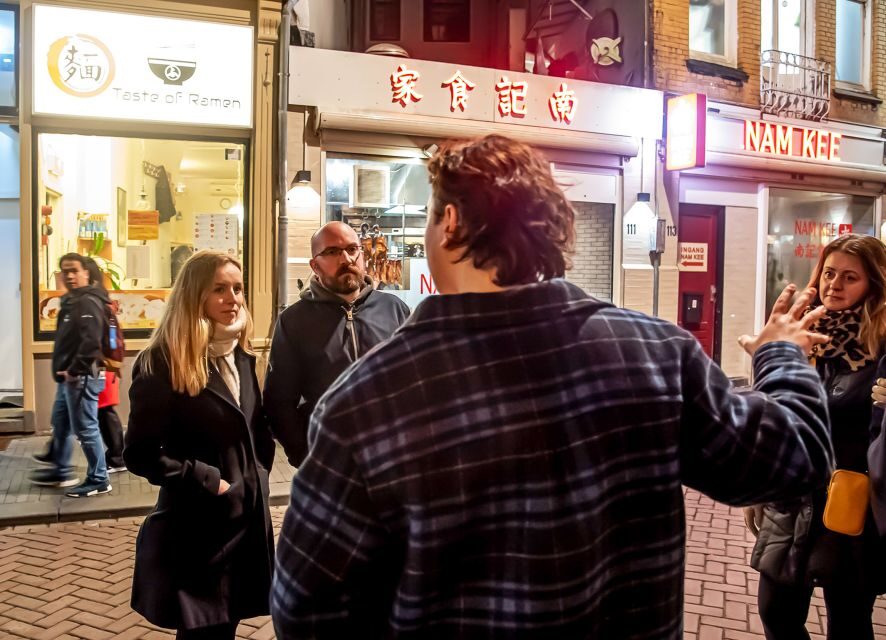
The combo runs two hours instead of 90 minutes and uses the extra half hour to step into a licensed coffee shop and explain the gedoogbeleid (tolerance policy) that’s kept cannabis legally available in regulated venues since 1976. The review notes a small bag of edible samples is sometimes included, sometimes not, and you should ask at booking if that matters to you. Pick this one if you want both halves of Amsterdam’s progressive-policy story in one walk.
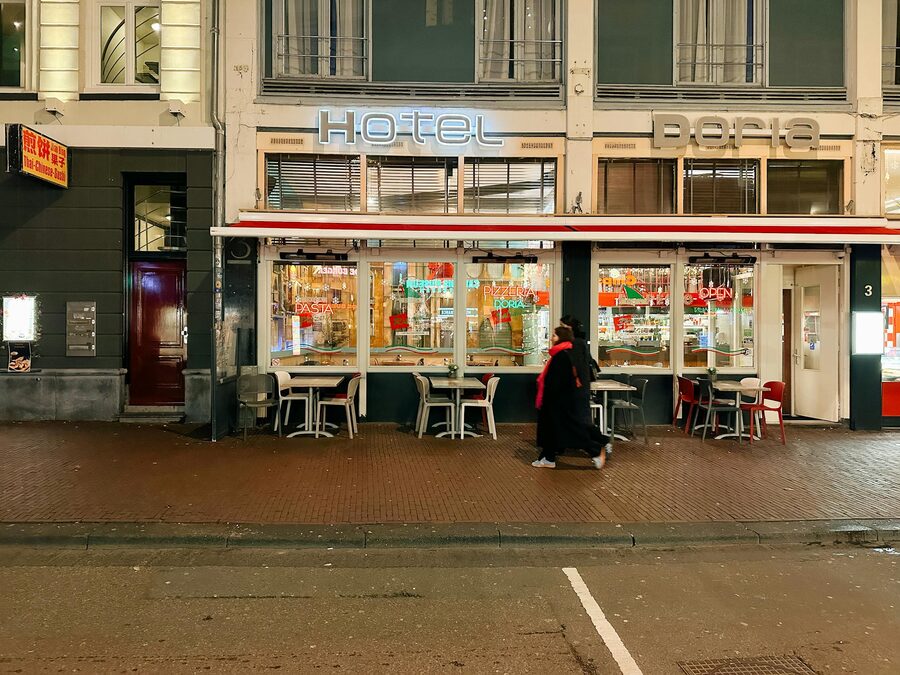
The blocks just outside De Wallen. Bistros, side-street bars, the regulars. Most tour pickups happen on this kind of street.
The medieval port nobody talks about
De Wallen is older than the rest of the city. By a lot. While the canal ring you cruise on a canal cruise is 17th-century Golden Age planning, this neighbourhood was already three hundred years old when those canals were dug. The “wallen” in the name are the medieval quay walls, the embankments along Oudezijds Voorburgwal and Oudezijds Achterburgwal that defined the harbour mouth in the 1300s.
The Damrak in 1890. The Damrak was the inland harbour basin where ships unloaded; from here, sailors walked five minutes east into the alleys that became De Wallen. Public domain via Rijksmuseum.
This is where ships came in. The Amstel river met the IJ inlet right here. Sailors came off the ships at the Damrak with months of pay in their pockets and roughly forty-eight hours before the next departure, and the economy that grew up around them was exactly what you would predict. Bars, cheap lodging, women working out of windows. The pattern is the same as it was in any medieval port from Lisbon to Lübeck. The difference in Amsterdam is that the original buildings are still standing.
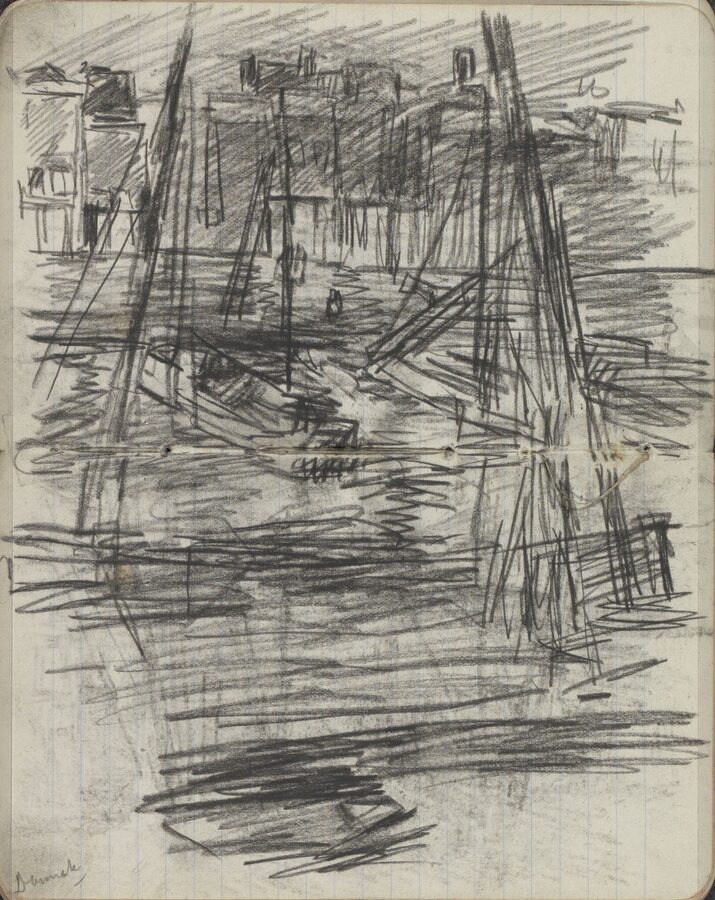
A sketchbook page of boats at the Damrak, c.1890. By the time this was drawn the harbour function was fading, but the alleys behind it had already been working as a sex-work district for nearly seven hundred years. CC0 via Rijksmuseum.
Walk the route on a tour and the guide will point at brick courses and door lintels and tell you which ones are pre-1450. The tilt of the canal houses is real. The wooden piles underneath have been settling for six centuries. Anne Frank’s family lived in a 17th-century canal house ten minutes’ walk from here, and that’s a different era of the city; if you’re booking the Anne Frank walking tour as well, treat it as a separate Amsterdam, not the same one.
The Oude Kerk: 1213, and a brothel next door by 1380
This is the moment on every tour where the group goes quiet for a second. You walk into Oudekerksplein, the small square that wraps around the Oude Kerk, and the guide gestures at the church and then turns ninety degrees and gestures at a row of red windows perhaps fifteen metres away. The juxtaposition is what people came for. It is also, historically, the entire point.
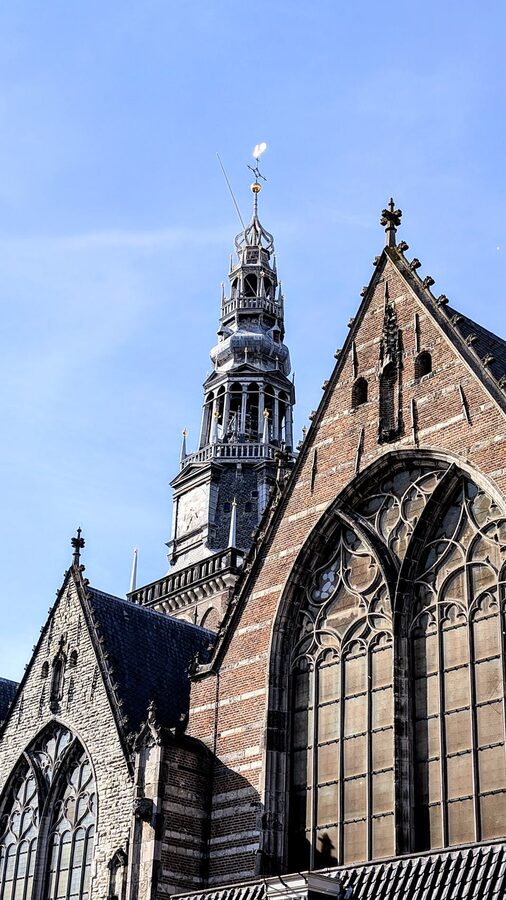
The Oude Kerk, consecrated in 1213. Amsterdam’s oldest building, and the literal centre of the medieval port economy, sex work and all.
The Oude Kerk was consecrated as a wooden parish church in 1213, rebuilt in stone over the next three centuries, and finished as the Gothic structure you see now around 1565. By 1380 there were already brothels documented within fifty metres of the church door, and the city authorities of the time treated this as a regulatory matter, not a moral one. They licensed houses, taxed the income, and used the receipts to maintain the church. Records from the 14th and 15th centuries describe sex workers being required to attend mass on Sundays and being fined if they didn’t.
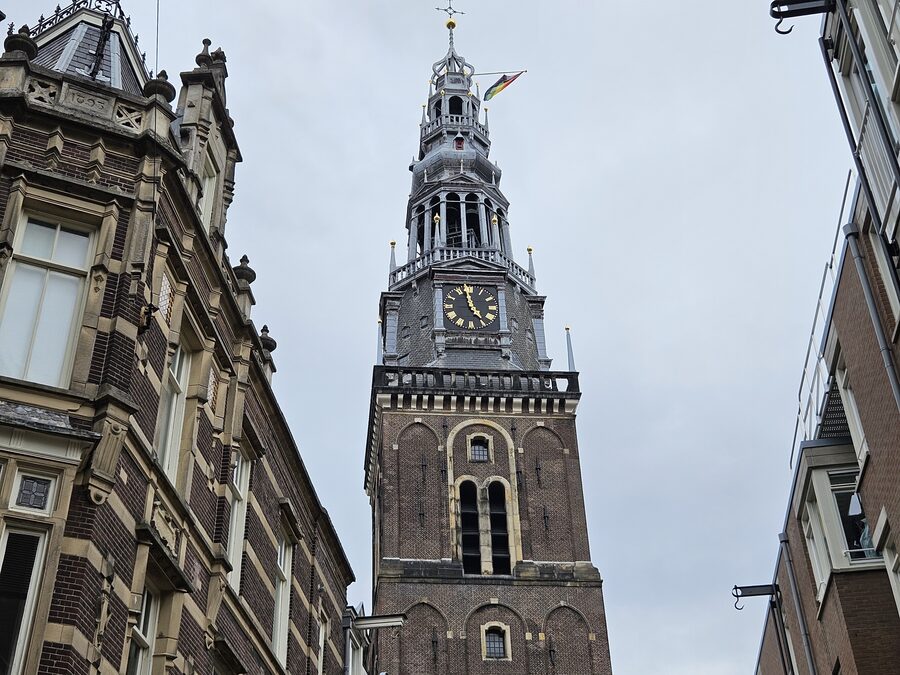
The belfry tower. The Oude Kerk is the only building in Amsterdam still standing from the city’s first century. The bells in the tower are tuned to a 16th-century carillon scale.
This is the layered Catholic-and-Calvinist-and-civic-pragmatism stack that defines Dutch policy on these questions even now. The same instinct that produced the medieval license-and-tax system produced the 2000 Prostitutie-Act that legalised sex work as labour. The Oude Kerk is the single visual that ties seven hundred years of policy together. If you’ve stood in front of Rembrandt’s Night Watch at the Rijksmuseum and noticed how Calvinist and how civic the painting feels at once, this is the same Dutch double-take, just in stone instead of paint.
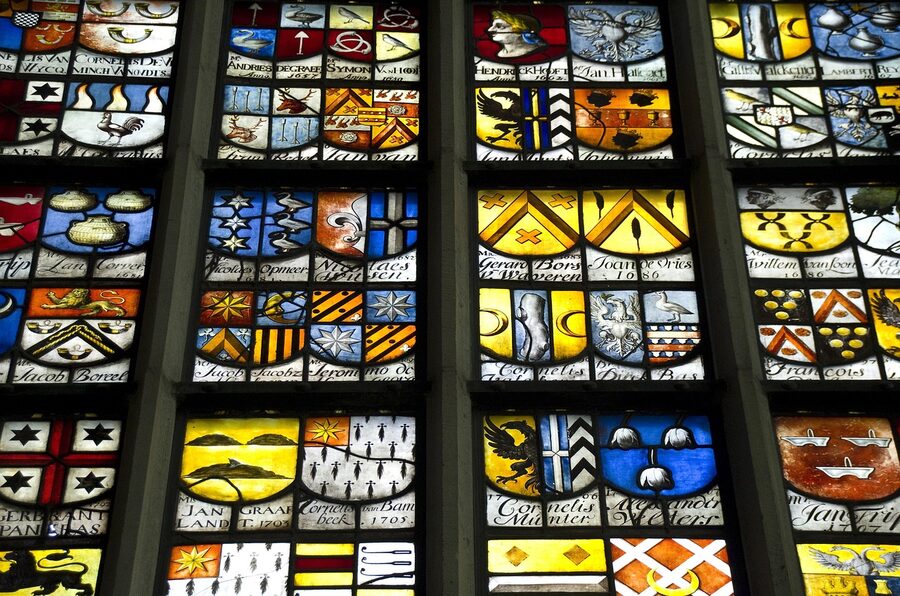
Stained glass inside the Oude Kerk. Most tours don’t enter the church (admission is separate, around eighteen euros), but the windows are worth a daylight return visit on a non-tour morning.
Most walking tours don’t go inside the church. Admission is around €18 and would blow up the schedule. If you want the interior, plan a separate daytime visit. The Old Master pull on the wider city is the Van Gogh Museum and the Rijksmuseum for the canon, but the Oude Kerk’s permanent collection is more interesting than its tourist position suggests, and World Press Photo runs an annual exhibition there each spring.
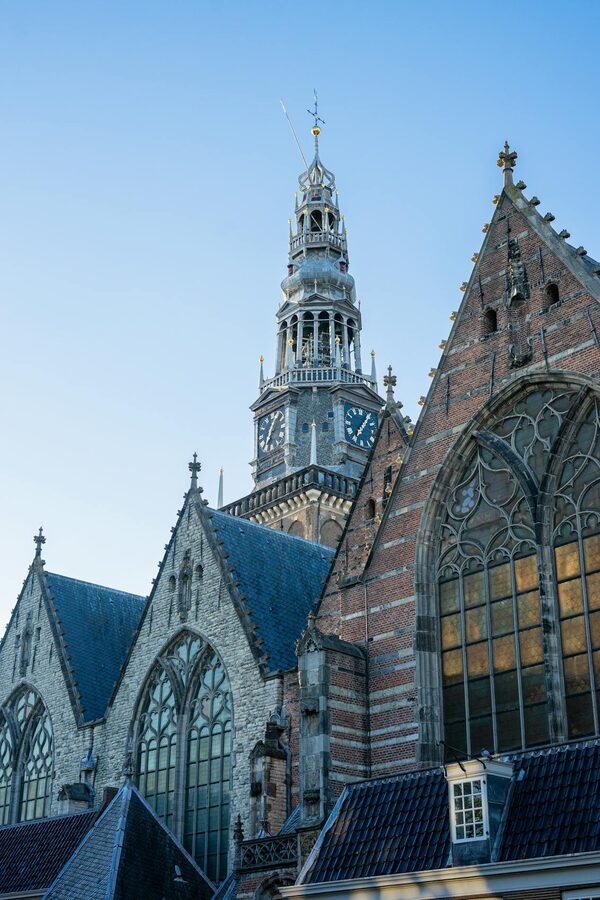
The Oude Kerk from a slightly wider angle, with the alleys leading off either side. The geometry of the medieval district is preserved almost completely.
Napoleon, 1810, and the formal red windows
The windows you see now date as a system from the 1810s. Napoleon annexed the Netherlands in 1810, imposed the Napoleonic Code, and that code formalised sex work as a regulated profession with mandatory medical examinations and registered houses. The window-as-storefront format, the red light, the rented-by-the-shift structure, all of that is post-1810 Napoleonic infrastructure laid on top of a medieval district.
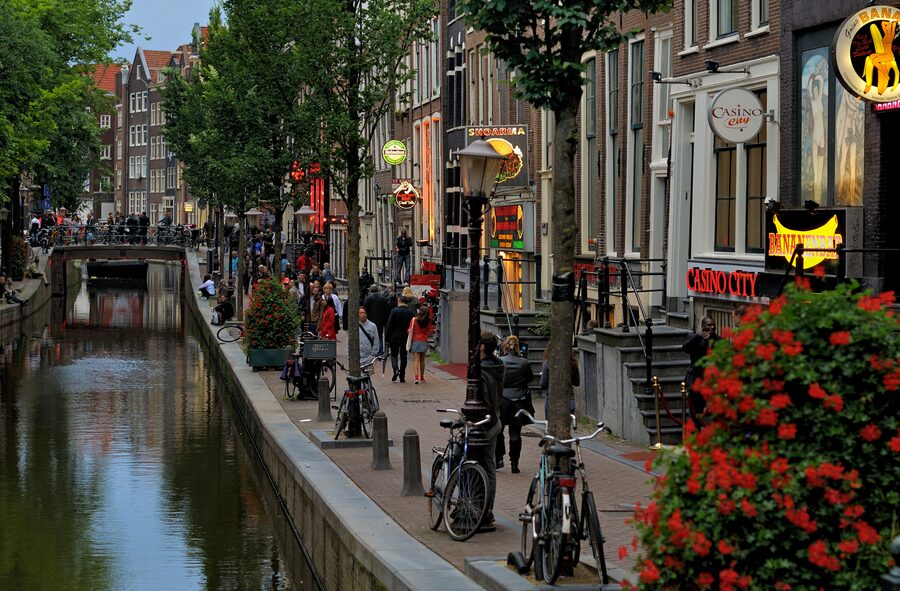
The same alleys by day. The windows are dark, the canals quiet, the architecture is just architecture. The neighbourhood is a different place at 11am than at 11pm.
What changed in 2000 was the formal legalisation of sex work as labour rather than as a tolerated grey-zone activity. The Prostitutie-Act of 2000 lifted the ban on brothels, treated sex workers as independent contractors, brought them into the tax system, and required brothels and window operators to be licensed. In practice this means a woman renting a window pays around €100 to €150 for an eight-hour shift, paid directly to the building owner, and the income is taxable in the same way a freelance designer’s invoices would be.
This part is worth absorbing slowly. The women you see in the windows in De Wallen are not employed by anyone. They are running their own micro-business, paying rent on their workspace, paying tax on their income, and signing the same contracts a yoga teacher renting a room above a café would sign. That framing is what makes the photo ban not a polite request but an actual labour-rights question. You wouldn’t take a photo through someone’s office window in Zaandam or Lisse or anywhere else; the rule is the same here.
The Belle statue and what it’s saying
Halfway around the loop, the guide stops at a bronze statue on Oudekerksplein, just outside the south wall of the church. A woman stands in a doorframe with one hand on the jamb, looking out, life-size. The plaque at her feet reads Respect sex workers all over the world. She was installed in March 2007 by sculptor Els Rijerse, paid for by the local sex-worker advocacy organisation. This is the only public memorial to sex workers in Europe.
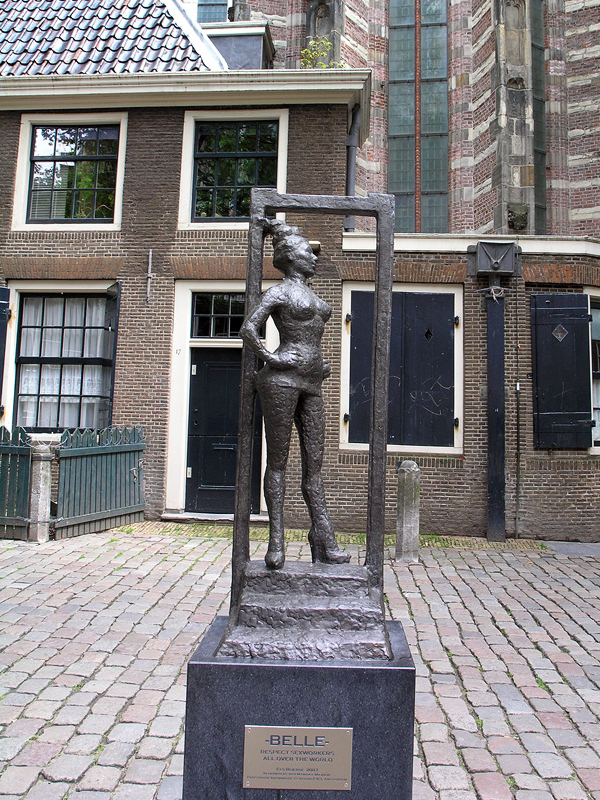
Belle, Oudekerksplein. Installed March 2007 by Els Rijerse, paid for by sex-worker advocates. The first and only public memorial to sex workers in Europe. CC BY-SA via Wikimedia Commons.
The statue is small, it sits low, and it would be easy to walk past if you didn’t know what you were looking for. Which is exactly why a tour matters. The guide will tell you Belle is positioned facing the Oude Kerk on purpose, and that the workers who funded the statue specifically wanted that line of sight. Church and worker, eight hundred years of side-by-side, both still here.
People leave flowers at her feet. They leave them quietly, not as a photo op, and most tours pause for thirty seconds and let the group take that in before moving on. It is one of the better moments in Amsterdam tourism, and you will only get it if you are with a guide who knows the statue is there.
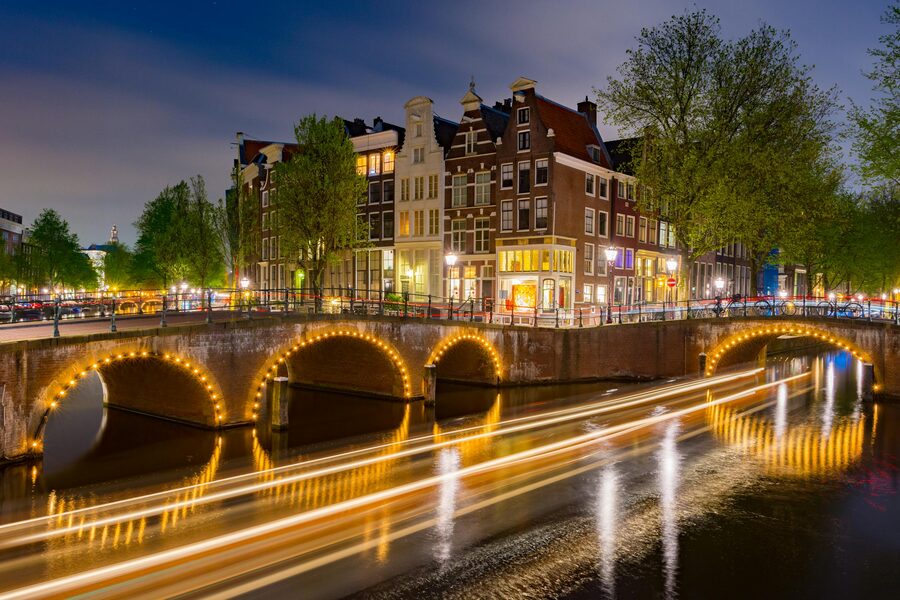
Long exposure on a working evening. The light streaks are bicycles and the occasional tram on the canal-side road. Photo: Pexels, Andrew Hawkes.
The 2019 Erotic Zone debate
This part is the live politics. In 2019 the Amsterdam city council, under mayor Femke Halsema, proposed moving the windows out of De Wallen entirely and into a new purpose-built “Erotic Zone” at Sloterdijk in the north of the city. The argument was that mass tourism had made the district unworkable for actual sex work, that the gawking and the bachelor parties were a labour-conditions problem, and that a less central location would professionalise the industry.
The sex workers themselves opposed the plan. Vehemently. Their argument was that De Wallen has been their workplace for centuries, that the safety infrastructure (cameras, panic buttons, neighbourhood cops who know the regulars) is built into the existing alleys and would have to be rebuilt from scratch in Sloterdijk, and that an industrial estate at the edge of the city would isolate them from each other and increase the risk of violence. Multiple worker collectives ran a sustained campaign against the move, including silent demonstrations in front of the Belle statue.
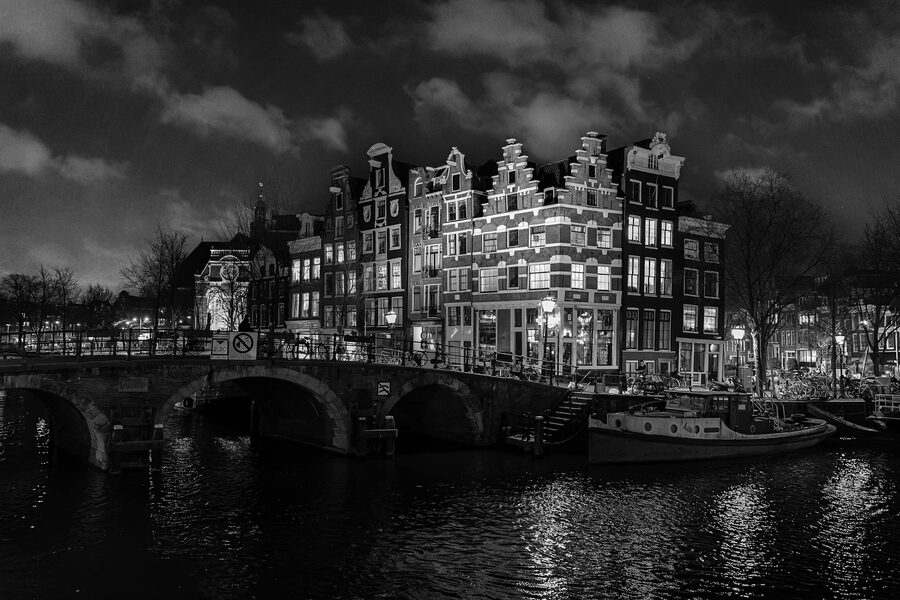
Oudezijds Voorburgwal at night. The canal frontage is what the 2019 plan would have hollowed out. Photo: Pexels, Jeroen Peters.
By 2024 the Erotic Zone proposal had been mostly halted. The Sloterdijk site was abandoned after community resistance from the residents of that neighbourhood combined with the worker advocacy. A reduced version of the plan, moving a smaller number of windows to a city-centre erotic centre, has resurfaced periodically and is technically still on the table. The number of active windows in De Wallen has dropped from over 480 in 2010 to around 300 to 400 today, partly through the city’s window-reduction policy and partly through gentrification pressure. Every guide will have a current count and an opinion on it.
The point of telling you this on a tour is that nothing about the district is settled. The walk you do in 2026 is a snapshot of an active negotiation between the city, the workers, the residents, and the tourists. The other ongoing negotiations in Amsterdam (the Heineken Experience queue overflow into the residential blocks of De Pijp, the Anne Frank House tickets impossible to book) are versions of the same tension. Tourism volume versus livability for actual residents.
The photo ban, in detail
Photography of the windows is forbidden. Not discouraged, not bad form, forbidden. There are signs at the entrances to every alley making this explicit, in five languages, and the signs are not new and not a polite request. They are the rule.
The reasoning is the same as the labour-rights frame above. The women in the windows are at work. Their face appearing on someone’s Instagram is the same problem as your face appearing on a stranger’s Instagram while you’re at your desk in Amsterdam, except worse, because the social and family consequences for them in their home countries (many are from elsewhere in Europe) can be severe.
The rule is also enforced. The windows have men working as bouncers in many of the buildings, and they will come out and confront a tourist with a phone in seconds. Phones get taken, photos get deleted, occasionally tourists get walked out of the district by the bouncer or the local police. Tour guides specifically warn the group on the bridge before entering the alleys and most groups self-police after that warning.
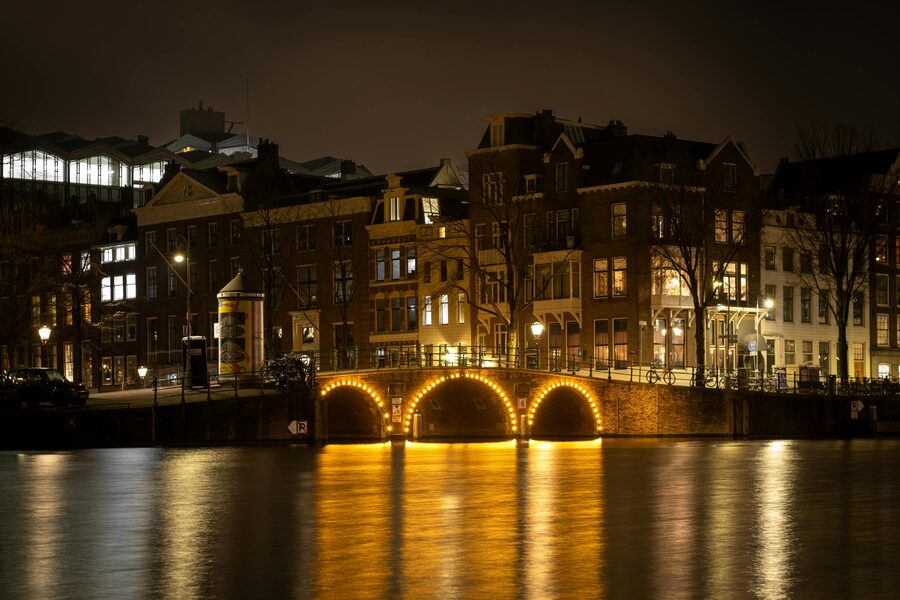
The bridges are fine. The canal architecture is fine. The neon signs of bars and the Old Church and the streetscape generally is fine. Everything except the windows is fine. Photo: Pexels, James Colasacco.
What you can photograph is everything else. The canal architecture, the bridges, the Oude Kerk, the bars and coffee shops, the alleys themselves when no window is in frame, the Belle statue. The only sensitive composition is one where a worker’s window or a worker’s face is in the shot. That’s it. Stay off that one composition and you are a normal tourist with a phone in a beautiful canal district.
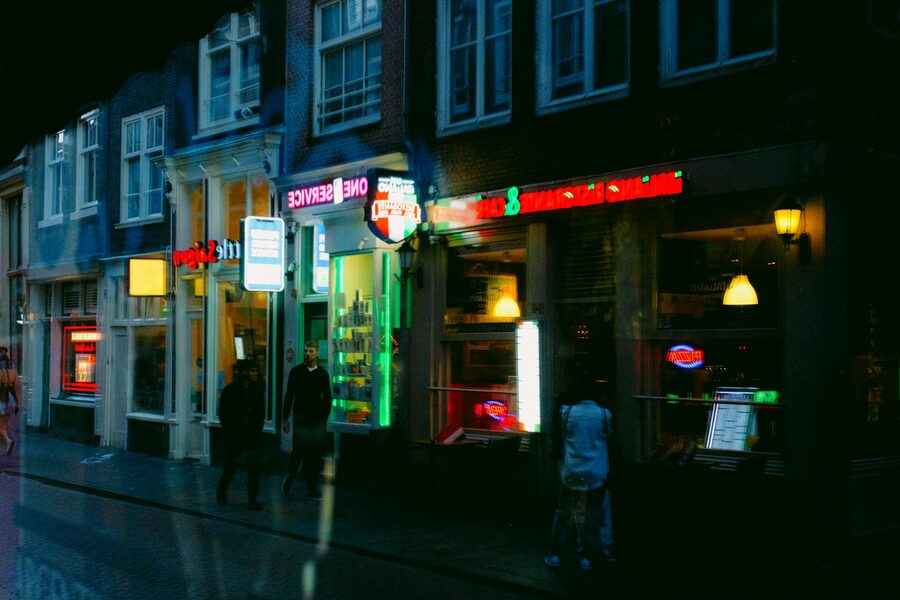
The streets just outside the alleys. Neon over the storefronts, pedestrians spilling into the road, the orange glow that reads as Amsterdam at night anywhere in the world.
Coffee shops and the legal-cannabis half
The combo tour above adds a coffee shop visit to the standard walk, and it’s worth a paragraph on its own because the policy is more nuanced than people coming from elsewhere assume. Cannabis is not technically legal in the Netherlands. It is tolerated under a long-standing policy called gedoogbeleid, in force since 1976, which says that prosecutors will not prosecute possession or sale of small amounts in licensed coffee shops. The shops themselves are licensed and regulated. The supply chain feeding them is officially still illegal, which is the famous “back door problem” Dutch policymakers have been arguing about for forty years.
The practical version: in De Wallen and elsewhere in central Amsterdam there are licensed coffee shops with green Bulldog Mascot stickers in the window. Inside, you can buy small amounts of cannabis or cannabis edibles, no alcohol allowed (it’s one product or the other, never both), and there is a menu like a tea menu. As of 2024, non-resident tourists can still legally enter Amsterdam coffee shops, even though Maastricht and other border cities have restricted entry to Dutch residents only. Amsterdam has resisted that restriction so far.
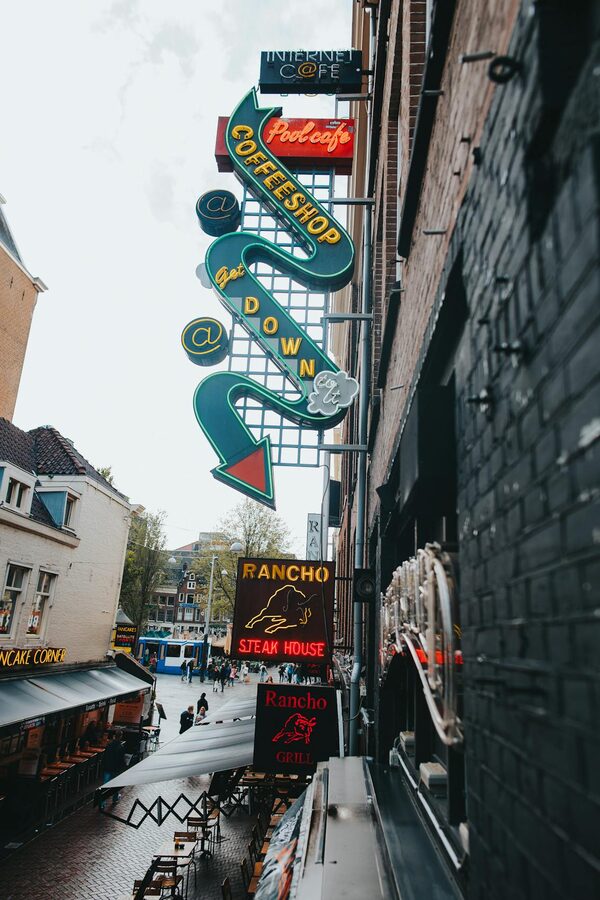
The other half of Amsterdam’s regulated-vice story. Coffee shops sell cannabis under the gedoogbeleid tolerance policy that’s been in force since 1976. Photo: Pexels.
The combo tour walks you into one licensed coffee shop, the guide explains the menu and the policy, and then you continue. You don’t have to consume anything. Many people on the tour just listen and look. If you’ve been thinking about sampling and want a low-pressure introduction with someone who knows what they’re doing, the combo tour is a much better way to do that than walking in cold. You’ll also get a real explanation of THC strength differences (Dutch coffee shops sell some of the strongest cannabis in Europe, and the typical American or Australian gummy is a fraction of the strength of a Dutch space cake).
When to go: time of day, time of year
After dark is the standard. Tours typically start between 7pm and 9pm depending on the season, because the windows aren’t lit during the day and the visual the tour leans on requires the windows to be working. Winter tours (December to February) start as early as 6.30pm because it’s already dark. Summer tours don’t start before 9pm because it’s still light at 8.30pm at midsummer in Amsterdam.
The 7pm slot is a good compromise most of the year. The district is starting to wake up, the worst of the bachelor-party crowds haven’t arrived yet (they typically peak between 11pm and 2am), and you can still get dinner before or after.
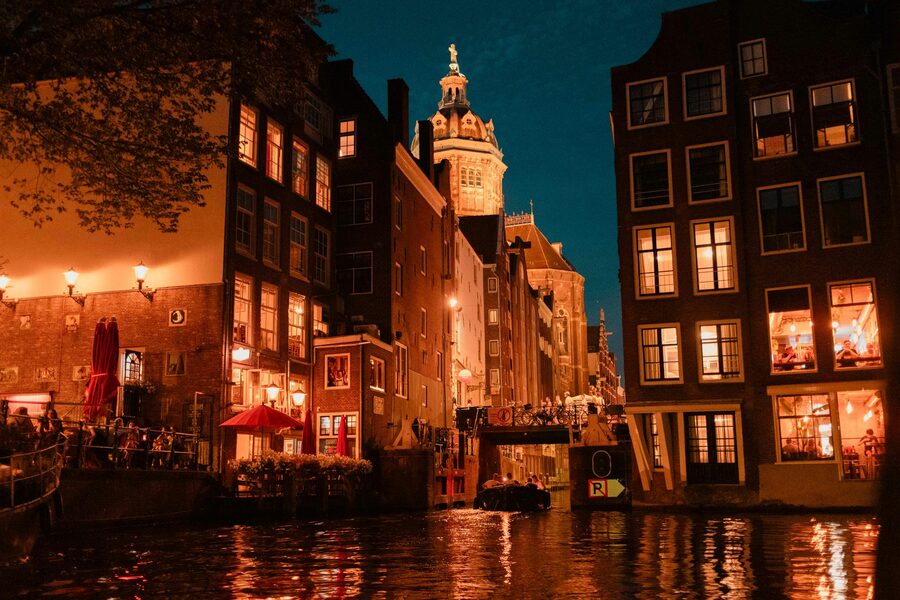
Late evening on the canals near De Wallen. The 7-9pm window is the sweet spot, busy enough to feel like the district is operating, not yet at peak crowd density.
Avoid Friday and Saturday nights if you can. The bachelor parties peak then, the alleys are uncomfortably crowded, and the workers are at their busiest. A Tuesday or Wednesday evening is calmer for the worker side and easier to actually hear the guide on the alley side. If you’re on a tight schedule and only have a Friday night, take the tour earlier (7pm rather than 10pm) and you’ll miss most of the rowdiness.
Time of year barely matters for the tour itself, since you’re walking and listening more than you’re seeing canal sunsets. But for the wider Amsterdam visit, March to May (tulip season at Keukenhof) and September to October are the comfortable months. Avoid August unless you have to be there then; the city is at its most crowded and the De Wallen alleys are at their worst.
Practical booking notes
The 90-minute tours run €25 to €30. The two-hour combo tours run €28 to €45 depending on whether they include cannabis samples. Group sizes cap at twelve to fifteen people for the standard walks, and you want a small group in De Wallen because the alleys are narrow and a guide trying to talk over a group of twenty is going to be hard to hear.
Book ahead, but not as far ahead as some Amsterdam attractions need. A day or two in advance is usually enough, even in summer. The supply of slots is generous because the route is short, the operators run multiple time slots per evening, and there are several competing companies. Compare this to the Anne Frank House walking tour (which itself doesn’t enter the museum, that requires a separate ticket booked weeks ahead) or Van Gogh Museum tickets, both of which need real advance planning.
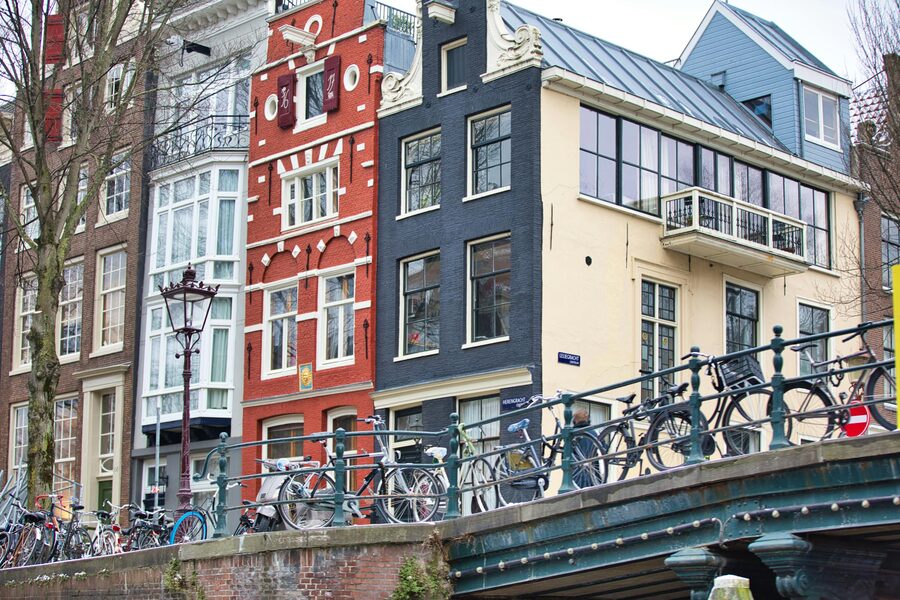
The wider Amsterdam tour calendar is generous; the Red Light walks run multiple times most evenings and rarely sell out more than a day ahead.
Cancellation policies are usually 24 hours full refund, which matters in Amsterdam where the weather can turn at short notice. The tours run rain or shine but the experience in steady rain is genuinely worse, and most operators will let you reschedule for free if you call by lunchtime on the day. Comfortable shoes, the cobblestones get slick after rain. A jacket is sensible nine months of the year.
Tipping is not expected but is appreciated. The local norm for a good guide is €5 to €10 per person at the end of the walk if you thought it was good. A bad guide gets nothing. Dutch service culture is honest about this in a way that British or American culture often isn’t.
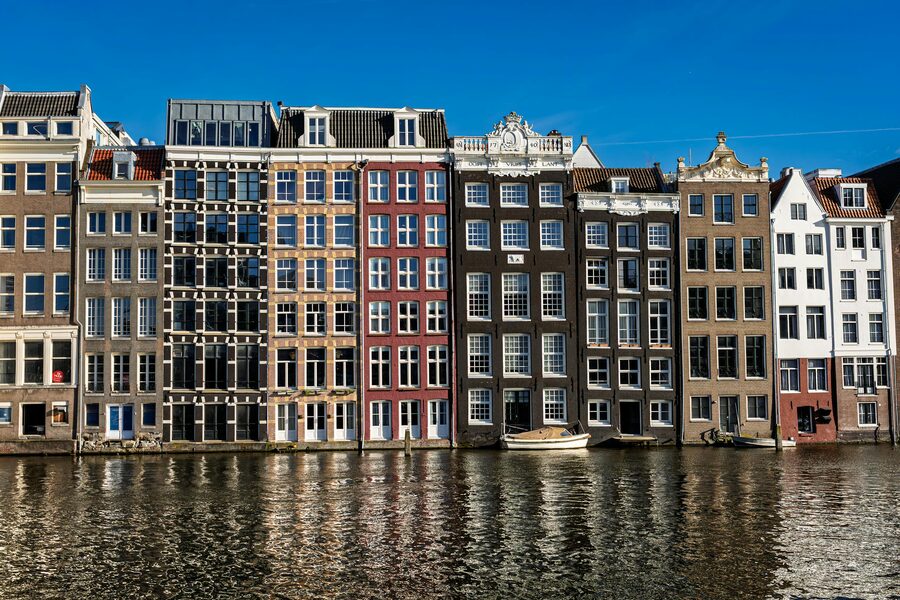
The same canal frontage by day. The district reads as just another beautiful Amsterdam neighbourhood between perhaps 10am and 6pm. The change at dusk is one of the more vivid experiences in European tourism.
Other Amsterdam tours that pair well with this one
If you’re in Amsterdam for two or three days and you’ve done the Red Light District walk, the next logical pieces are very different from each other. The canal cruises are the classic Amsterdam visual, and a daytime cruise is a different city entirely from the De Wallen evening you just did. The canal ring is 17th-century planned wealth; De Wallen is medieval working-class. Both are Amsterdam, neither is the other.
The Anne Frank walking tour is the heaviest emotional pairing. It does not enter the Anne Frank House (those tickets must be booked separately weeks ahead and they sell out the moment they release), but it covers the Jordaan neighbourhood, the Resistance Museum context, and the wider Jewish history of Amsterdam. After De Wallen, which is about labour rights and policy, the Anne Frank walk is about the city’s deepest moral test.
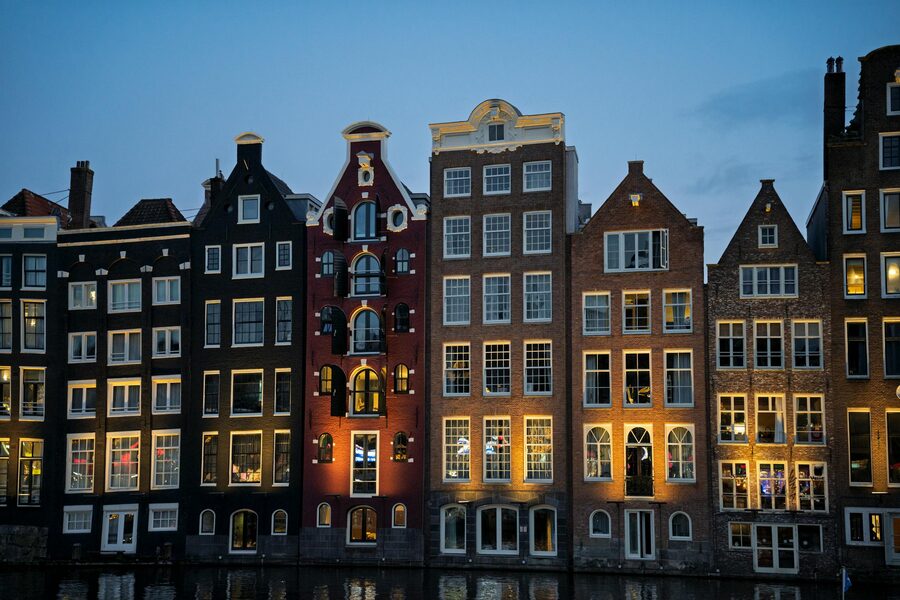
The canal ring at twilight. Most Amsterdam itineraries put the canal cruise on day one and the Red Light walk on day two, which works well as a contrast.
The Rijksmuseum and Van Gogh Museum are the daytime art canon, both Museumkwartier, both bookable through the I amsterdam City Card if you’re stacking museums. The Heineken Experience on the way to the Museumkwartier is the lighter daytime activity, the closest equivalent to the coffee-shop combo tour in terms of regulated-vice tourism.
For the family-attraction crowd, Madame Tussauds on Dam Square is five minutes from where the Red Light tour starts, and you can do both on the same day with a dinner break between. Same for Moco Museum in the Museumkwartier, the Banksy-and-Warhol one. The Icebar Amsterdam is a 45-minute novelty if you want a cold-room shot before bed. None of these need pairing decisions, they just slot in around the more substantive walks.
If you have a fourth day, the Zaanse Schans windmill day trip or the spring-only Keukenhof tulips get you out of the city. The Upside Down Museum, Fabrique des Lumières projection venue, and the NEMO Science Museum are the rainy-day backup plans for families. The Royal Palace on Dam Square is across the street from where the Red Light tour starts and is genuinely interesting in a quiet, formal way that makes a good contrast to the alleys you just walked. The Johan Cruijff Arena tour in Bijlmer (Ajax’s stadium) is the niche pull for football tourists. The Amsterdam hop-on bus covers the wider city if you’re moving fast and want to mark off the headline sights between deeper walks.
And for the day-out outside Amsterdam, the Rotterdam Harbor cruise is the second-city contrast: industrial, post-war modern, the opposite of medieval De Wallen. Anyone with an interest in how the Netherlands works as a port country gets value from doing both.
The respectful version
End of the walk, the guide brings you back to the bridge at Oudezijds Voorburgwal where the alley meets the canal, and the group pauses to ask questions. This is the moment most groups need, after 90 minutes of dense history and live politics. Someone usually asks the question everyone is half-thinking, which is some version of so should we even be here?
The answer most guides give is yes, but this way. With someone explaining what you are looking at. With your phone in your pocket. With twenty minutes of attention paid to the Oude Kerk and the Belle statue and the centuries-deep policy story before you spend any attention at all on the windows themselves. The visit then is not gawking but witness, and the workers, when asked in the surveys their advocacy organisations run, distinguish clearly between the two.
The walk back to Dam Square, perhaps 10pm. The district carries on without you. Photo: Pexels, Nikola Pavlackova.
Compared with how De Wallen was visited even ten years ago (the bachelor parties, the open photography, the souvenir-shop cannabis-leaf t-shirts) the guided-tour-and-no-photos approach is much closer to what the workers and the residents have been asking for. The neighbourhood is a working district, not a theme park, and a respectful 90 minutes spent learning what you are looking at is the version of this visit you can describe later without flinching.
The other comparison worth making is the Ibiza beach version of nightlife tourism. Ibiza is a different question (the regulars who actually live there are tired of the club tourism in much the same way) but the core ethic is the same. Be where the locals work, but don’t make the locals’ job harder while you’re there. Walk slowly. Don’t shout. Don’t film. Tip the guide. Buy the round of drinks at the bar afterwards, not at the window.
Take the tour, do it once, do it well.