
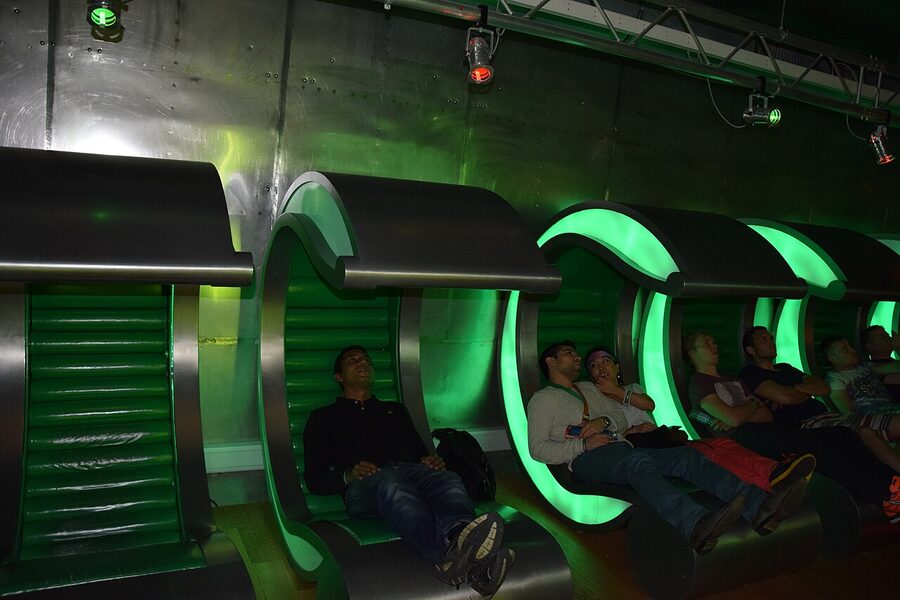
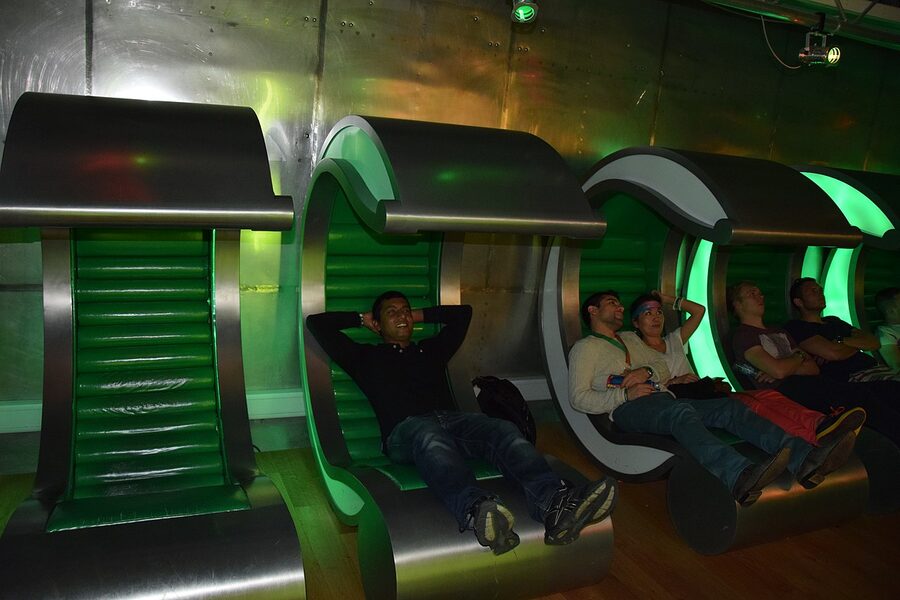
The 360° “Brew U” ride is the moment most travellers either fall in love with the Heineken Experience or quietly decide they want their 90 minutes back. You walk into a small dark room. The doors close. A floor moves under you, jets of warm air hit your face, you get sprayed with a fine mist of “water” being added to the mash, and then a screen all the way around the room tells you that you, personally, are now becoming a Heineken. Hops are added. You ferment. You’re chilled. Three minutes and forty seconds later you stumble out into the bottling exhibit and you already know whether the rest of the visit is going to land.
The framing nobody gives you upfront: this is not a brewery tour. Heineken stopped brewing on Stadhouderskade in 1988. The beer in your hand at the rooftop bar comes from Zoeterwoude, 40 minutes south. What you’re paying $28 for is a 19th-century brewery building that’s been turned into a Heineken-branded interactive marketing space, plus two Heinekens at the end. Knowing that going in changes the visit. Most travellers don’t, and feel slightly cheated when they realise.
In a Hurry? The Three Picks
- Standard Heineken Experience ticket ($28): the flagship. 90 minutes self-guided, 2 free Heinekens, the gift glass at the end. Book the standard entry.
- Heineken + canal cruise combo ($47): the most-bundled Amsterdam combo. 75-minute classic canal loop plus the full Heineken visit. Book the canal + Heineken combo.
- Alternate canal + Heineken ($44): same combo from a different operator. Cheaper by $3 if the flagship combo is sold out. Book the alt combo.
What you’re actually buying
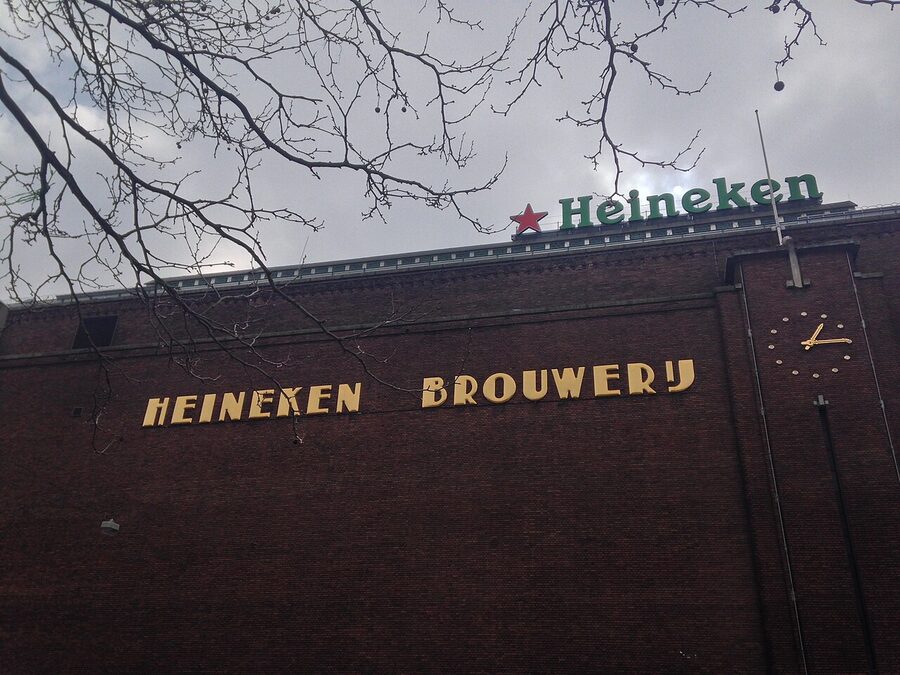
The basic visit is 90 minutes, self-guided, through 18 themed sections. There’s no human guide unless you book the V.I.P. tour ($52, 10-person max). You move at your own pace. The route is one-directional, so you don’t get lost.
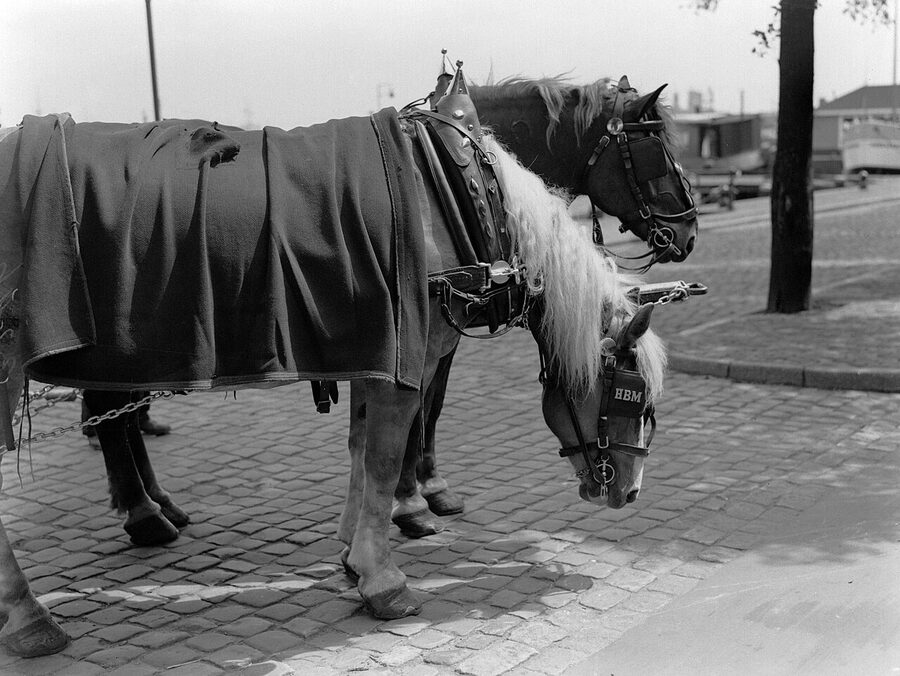
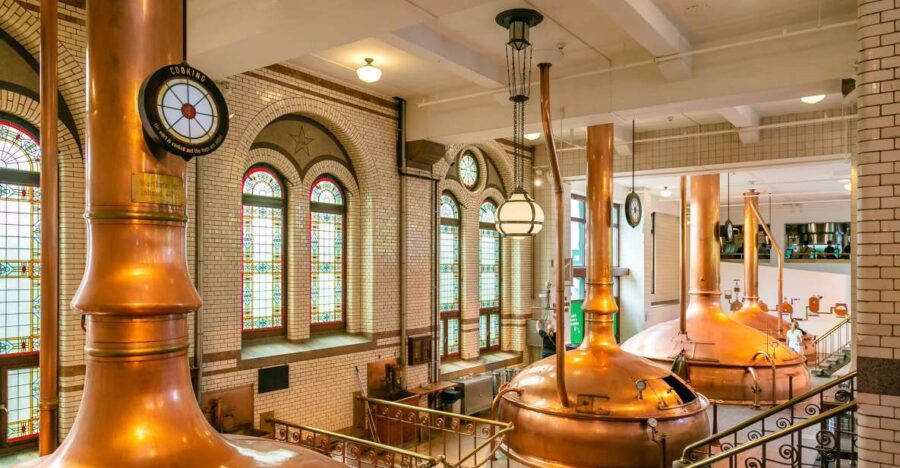
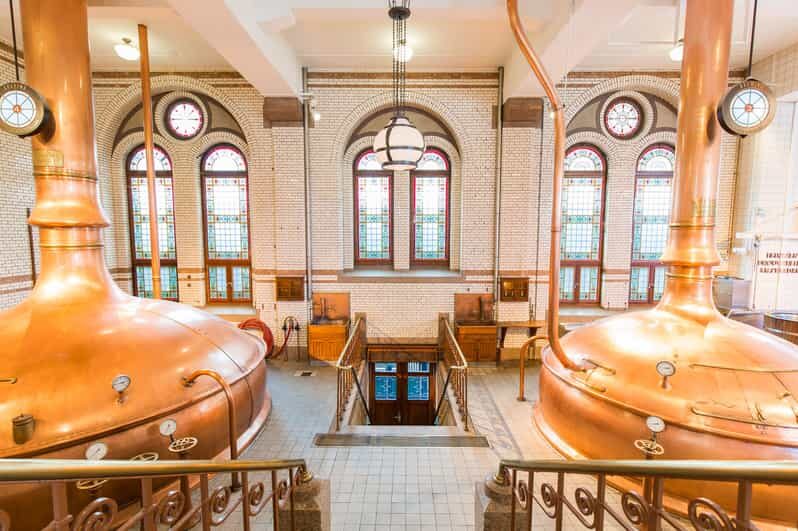
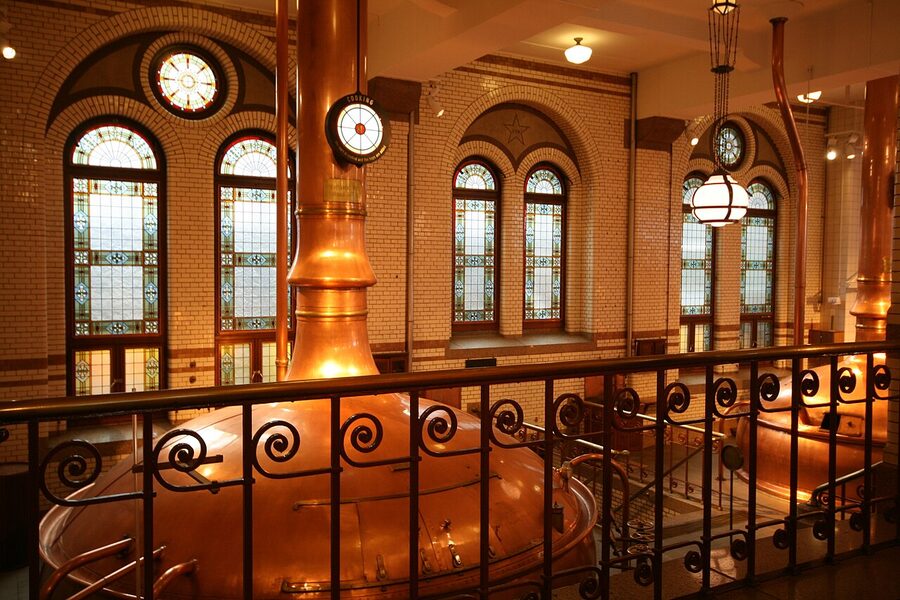
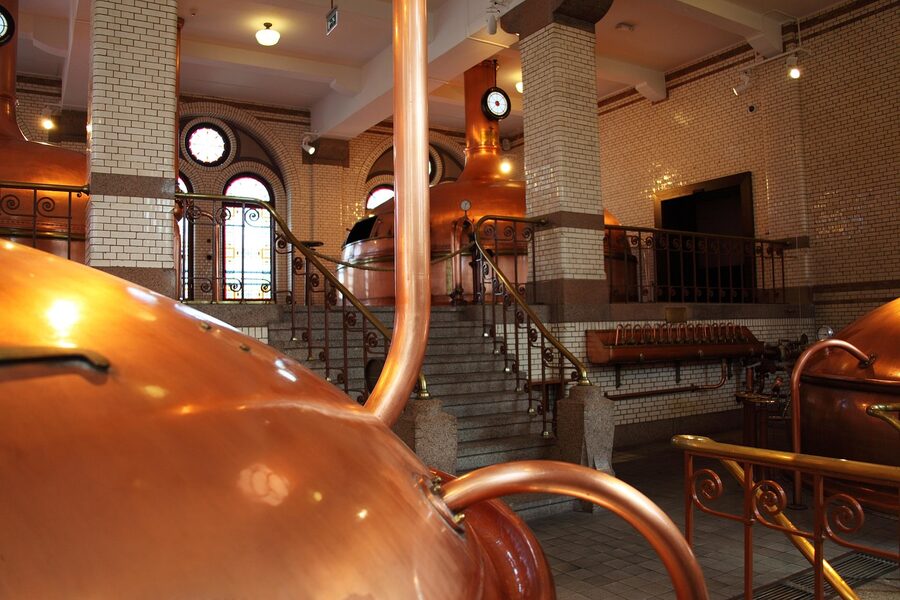
You walk through the original 1867 brewhouse with its enormous copper kettles still in place. You see the bottling line. You learn how Pilsner-style lager was a Bavarian invention that Gerard Heineken adopted in the 1870s when most Dutch breweries were still making top-fermented ales. You watch a short film about the marketing. You sit on a saddle to “feel like a Heineken horse” delivering kegs around 19th-century Amsterdam, which is exactly as silly as it sounds. Then Brew U. Then the tasting room. Then the rooftop bar. Then the gift shop, which you cannot avoid because the route forces you through it.
That’s it. That’s the visit. If you’ve already done the proper working-brewery tour at the Cité du Vin in Bordeaux or a real Champagne house cellar tour on a Champagne day trip from Paris, the Heineken Experience will feel a step lighter. It’s brand experience, not industry. The marketing video sections lean further into “the world’s most international beer brand” than any real brewery tour does. The same gap shows up if you’ve done a working Bordeaux wine tour or a Saint-Émilion tasting: the production-floor versions teach you something concrete; the brand versions package the same content as content.
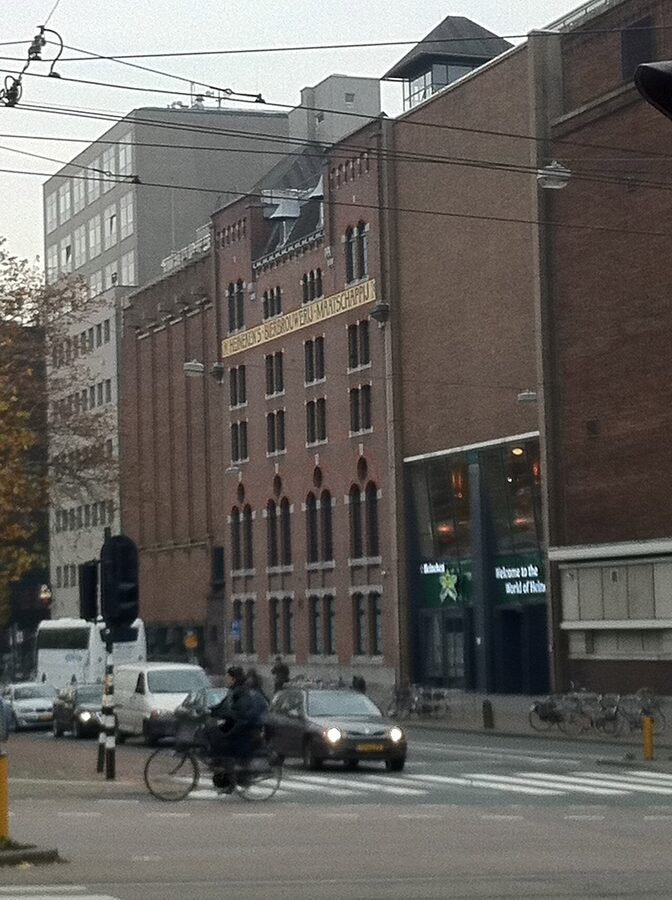
The building itself
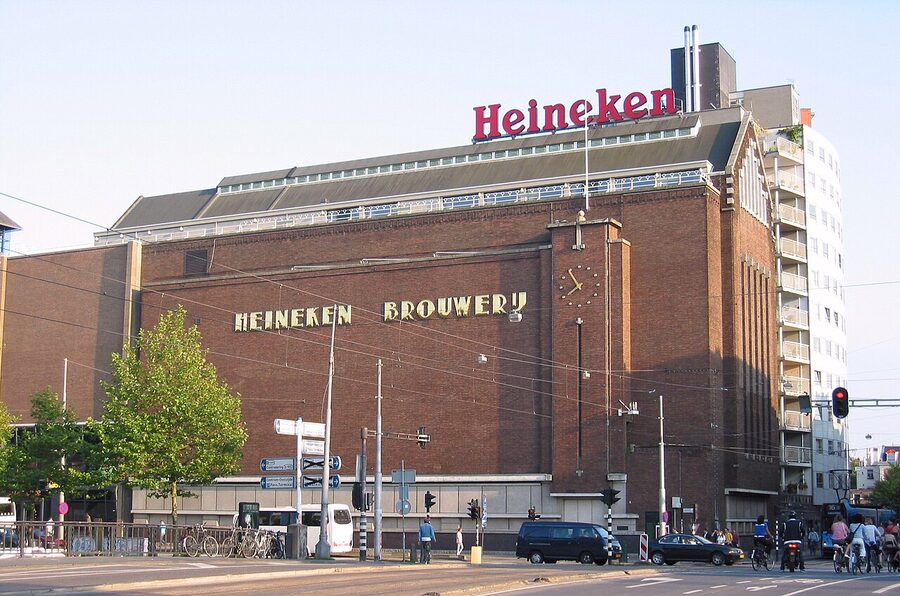
Gerard Heineken bought a brewery called De Hooiberg (“the haystack”) in 1864, then in 1867 built this new plant on what was then the southern edge of Amsterdam. It operated for 121 years. By 1988, the city had grown around it and the brewing capacity needed had outgrown the site. Production moved to Zoeterwoude near Leiden, where it still happens today.
The Stadhouderskade building sat largely empty for a decade. Heineken converted it into a brand museum in 2001, expanded the visitor route in 2008, added the rooftop bar floor a few years later, and now runs it as a flagship marketing site. About 800,000 people pass through it every year, which puts it in the same visitor-volume bracket as the Rijksmuseum wing-by-wing if not the headline halls. The Heineken Experience is consistently the third or fourth most-booked Amsterdam attraction on the major aggregators, behind the canal cruises, the Van Gogh Museum, and the Anne Frank House. If you’ve already booked any of those, Heineken is the natural fourth slot in a three-day Amsterdam itinerary, with the Keukenhof Gardens day trip filling the fifth in spring or the IceBar filling the same slot off-season.
The Brew U thing, which is the real test
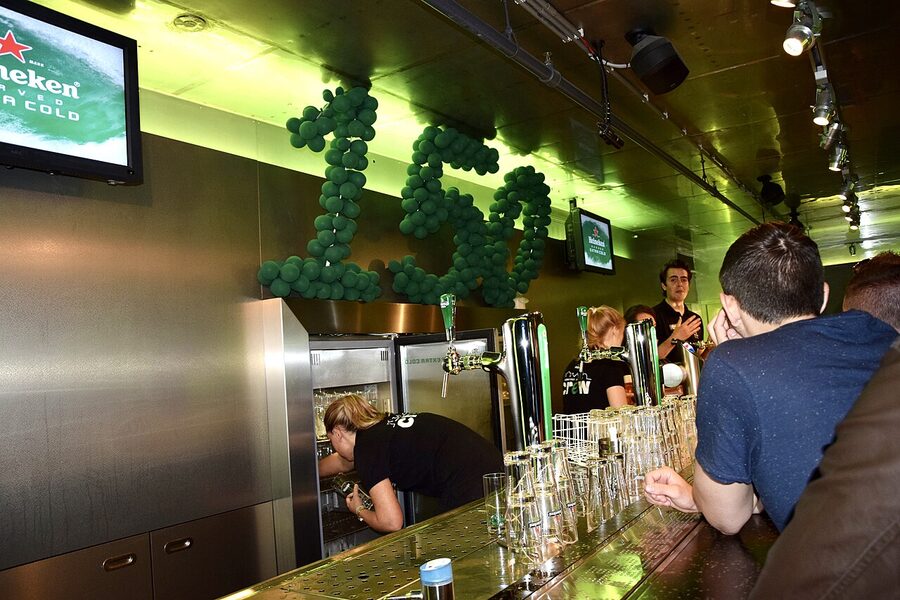
About 35 minutes into the route you reach Brew U. There’s a queue at the door even on quiet days, because each ride takes 12 people and runs every four minutes or so. You wait, you go in, the doors close, and for three minutes and forty seconds you experience the brewing process from the perspective of the beer. Water gets added (the floor lurches). Hops get tossed in (a smell hits the room). The temperature drops (cold air across the back of your neck). You ferment for what’s meant to be six days but on the ride is about thirty seconds. Then you’re chilled, packaged, and the doors open.
It’s silly. It’s also the part of the visit that anyone under 14 will tell their school friends about for six months. It’s the part adults who pre-loaded a couple of beers at lunch will laugh through. It’s also the part that childless 34-year-olds doing a sober afternoon visit will find embarrassing on behalf of all involved. The same ride, three different reactions, all valid.
If you’re travelling with kids, Brew U is a yes. If you’re travelling solo and not particularly sold on the brand, it’s the moment you start thinking about whether you’d rather be at a real museum like the Rijksmuseum or even doing the immersive thing better at the Last Supper viewing in Milan, where the brand is the painting and the immersion is the painting and there’s no marketing layer between you and what you’re looking at. The closest hands-on-but-fun comparison in Amsterdam itself is the Madame Tussauds on Dam Square: same age-band appeal, same immersion-as-attraction premise, no beer.
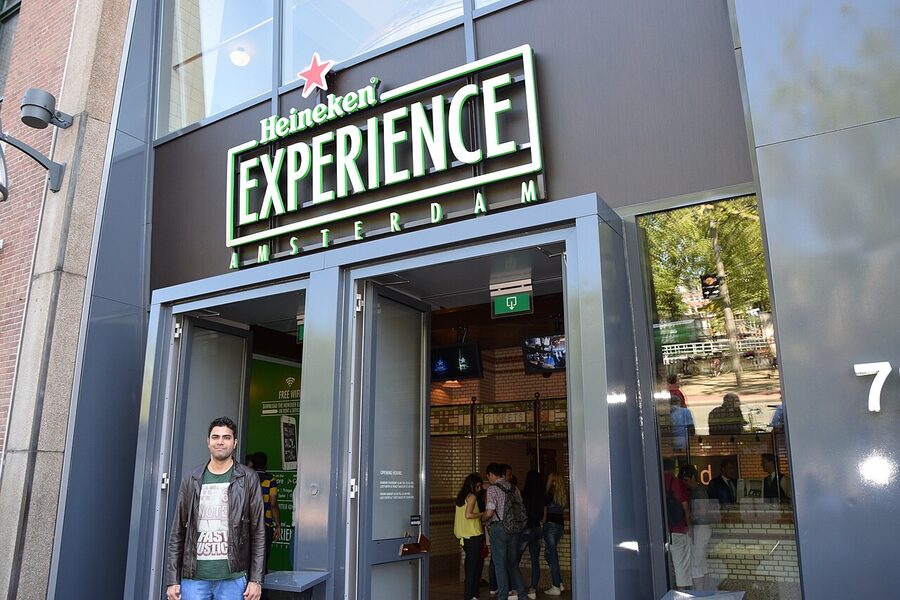
The rooftop bar, which is genuinely good
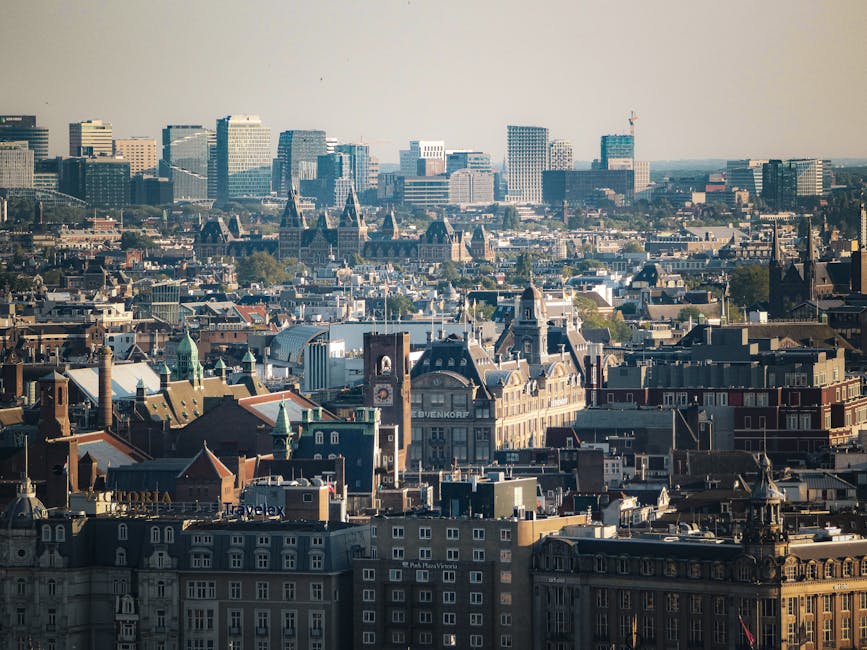
This is the part of the visit nobody warns you is good. The 12th-floor rooftop bar is the last stop on the route, you walk in with your second free Heineken token still in your hand, and you sit out on a sun deck that overlooks the Amstel river, the De Pijp neighbourhood rooftops, and on a clear day all the way across to the Westertoren tower in the Jordaan. The view is second only to the A’DAM Lookout (the 22nd-floor observation deck across the IJ on the NDSM ferry side).
You get a Heineken-branded frosted gift glass to take home and the second beer is poured into a fresh proper Heineken glass. Sit out there for half an hour. This is where the $28 starts to feel earned: 12 floors up, two cold beers, a free souvenir glass, the Amstel running below. It’s also the part of the experience least people skip because they’re tired by the time they reach it. Don’t. The bar is the payoff.
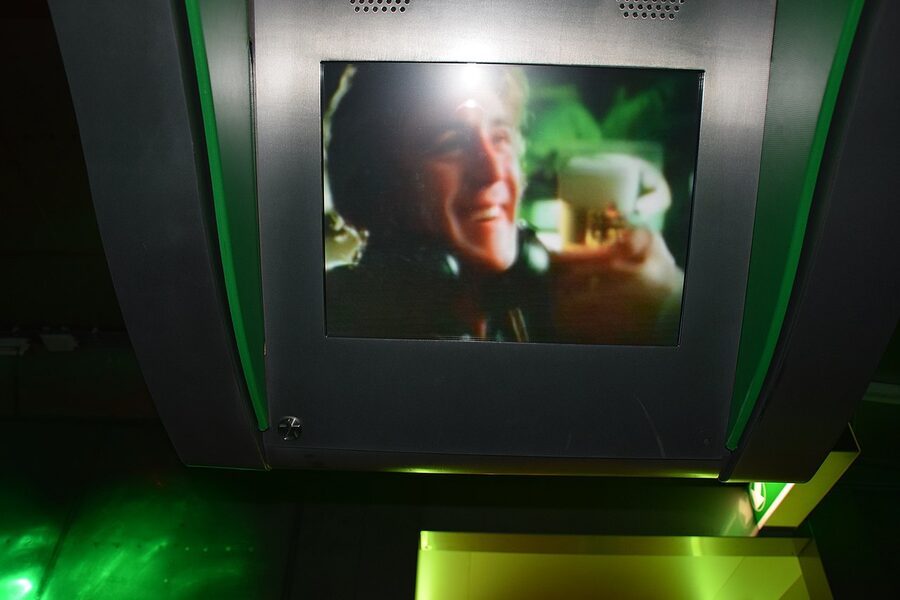
One small warning: the rooftop bar gets cold and windy. It’s open year-round and partially covered, but if you’re visiting in November or February, take the jacket up there with you. The view is unchanged in winter and the bar is half-empty, which is its own argument for an off-season visit.
The 5-step Heineken pour
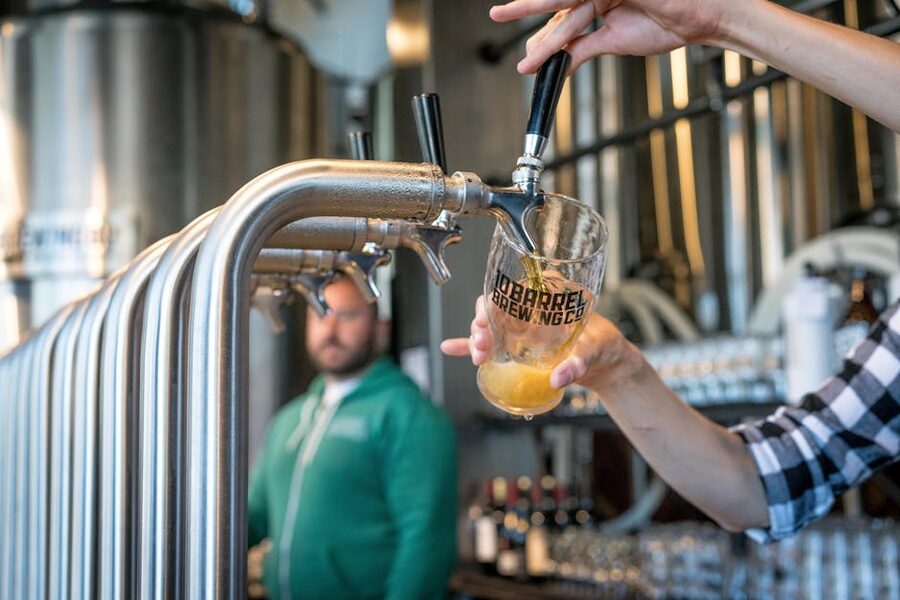
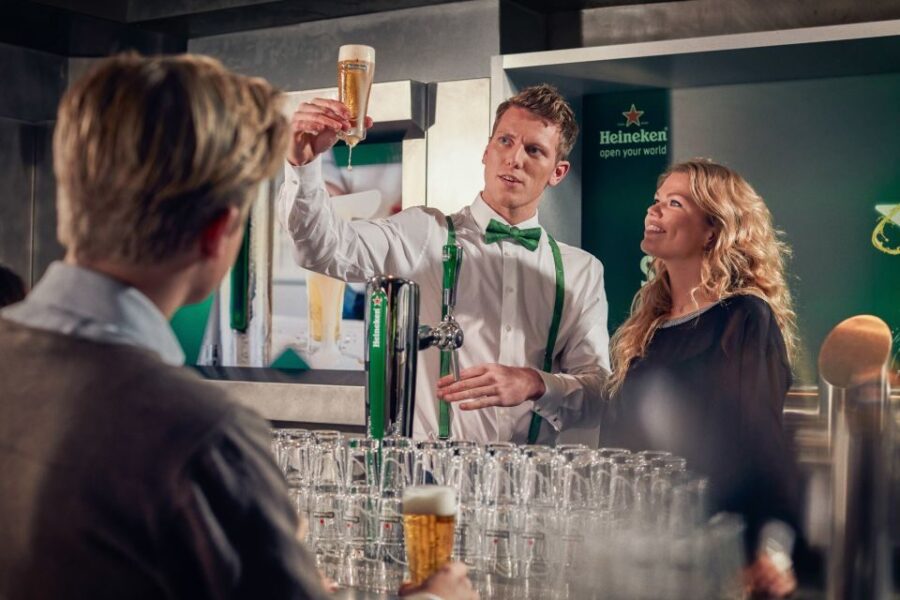
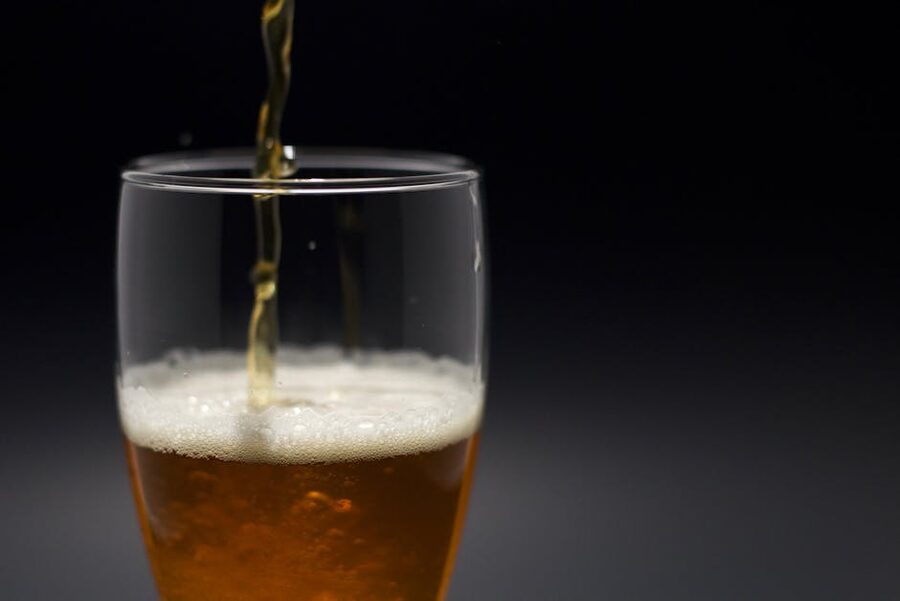
Halfway through the route, before the rooftop, there’s a tasting room where a guide in a green polo will teach you how to pour a Heineken. Sounds gimmicky. Is actually the single most useful thing in the building. The Dutch take this seriously enough that there’s an unofficial test for it. Five steps:
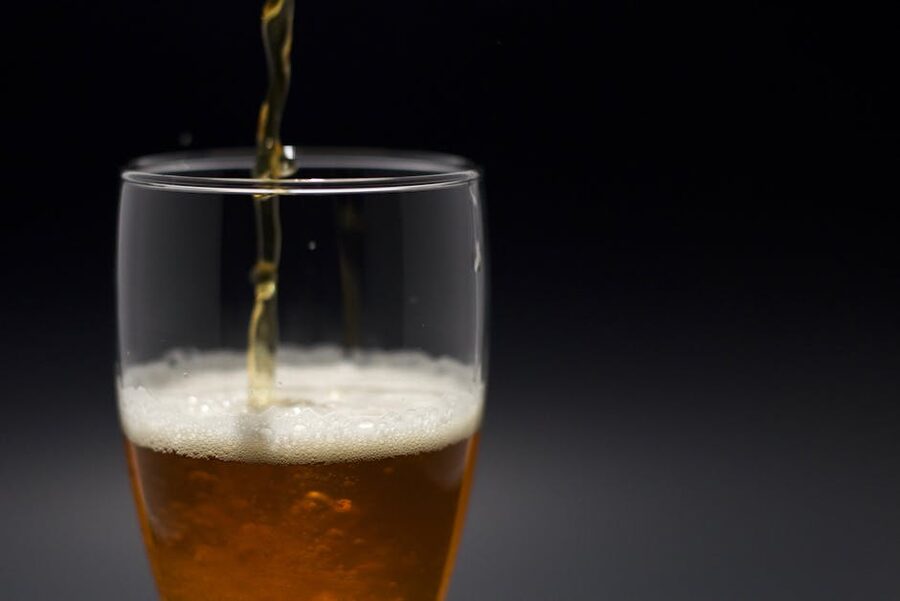
- Tilt the glass at 45°. Not 30°, not 60°. Forty-five.
- Open the tap fully and pour into the side of the glass. No half-pulls. Foam comes from a half-pulled tap.
- Level the glass off when it’s two-thirds full. Foam will rise above the rim, which is fine.
- Top up the foam. Pour again, more gently this time, until the head sits about a centimetre above the rim.
- Slice the foam with the foam knife. A flat plastic knife, dragged across the top of the glass, cuts the head clean and removes the bubbles that bartenders call “fish eyes.” The result is a domed white head exactly two fingers above the glass rim.
You will use this once a year for the rest of your life and feel obnoxiously continental every time. Free. Worth the entry on its own if you’re a beer person. Same energy as the wine-pouring lesson on a Bordeaux wine tour or learning to taste Sangiovese properly on a Chianti wineries day trip from Florence, just a third the price and a quarter the time commitment. Spain’s nearest cousin is the order-of-eating walkthrough you get on a Barcelona tapas tour, where the lesson is what to put in your mouth and in what sequence. None of the wine, beer, or tapas variants are the same; all of them teach a small piece of muscle memory you carry home.
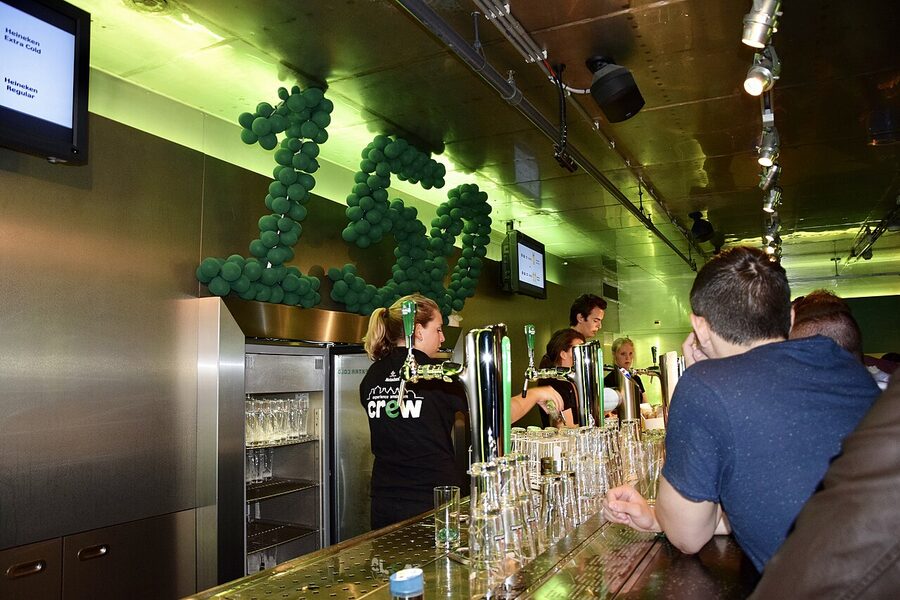
What’s actually included
For your $28 standard ticket, here’s the math:
- 90-minute self-guided visit through 18 themed sections
- The Brew U immersive ride
- One small Heineken (~100ml) in the tasting room as part of the pouring lesson
- Two full Heinekens (or Heineken 0.0, or Lagunitas IPA, the American craft beer Heineken bought) at the rooftop bar, redeemed via two tokens
- One Heineken-branded frosted gift glass to take home
That’s roughly three beers and a glass for $28, which works out to about $5 per beer if you put zero value on the building, the ride, or the pouring lesson. Amsterdam bar prices are about €6.50-€7.50 for a small Heineken, so the beer math actually almost works on its own. The Heineken Experience is overpriced for what the visit is, but the beer-plus-glass component is fairly priced for what you get. That’s a different way of saying the building is essentially free if you wanted the souvenir glass anyway.
Recommended Tours
1. Heineken Experience standard ticket: $28
This is the right pick if you don’t already have a canal cruise booked. It’s the cheapest way through the door and our full review of the standard entry ticket covers the time-slot question. Aim for a 14:00 weekday slot and avoid Saturday afternoon.
2. Canal cruise + Heineken combo: $47
This is the right pick if you haven’t already booked a separate Amsterdam canal cruise and you’d otherwise pay $18 standalone plus $28 for Heineken anyway. You’re paying $1 to bundle the booking, and our combo review walks through the timing. Do the cruise first, then walk to Heineken.
3. Alternate canal + Heineken combo: $44
This is the right pick if the flagship combo is sold out for your time slot and you’re flexible on the cruise length. Our alternate combo review notes the small catch: the canal boat boards a 12-minute walk from the Heineken building, so plan for the gap. Worth the $3 saving if your slots line up.
How to actually book it
Tickets sell out for the popular afternoon slots in summer. They almost never sell out completely on a given day, but your preferred 14:00 entry on a July Saturday will be gone if you book the night before. Book three to four days ahead in summer, day-of is fine in November.
You book a time slot, not just a day. You get a 30-minute entry window. You can stay inside as long as you want once you’re in: 90 minutes is the average, but I’ve spent 2.5 hours on a quiet weekday once you factor in the rooftop. The route is one-way, so once you go forward you don’t go back, but the building has plenty of seats inside if you need to slow down.
Tickets cost the same direct from heinekenexperience.com as they do via the affiliate booking platforms. The reason to book through GetYourGuide or similar is the cancellation policy: GYG offers free cancellation up to 24 hours before, the official site is non-refundable. If your Amsterdam plans are firm, book direct. If they’re not, book through a flexible aggregator.
Best time to go (and worst)
I’ve tried four different time slots and the sweet spot is consistent: weekday, 14:00 entry. The morning groups have cleared, the lunch crowd is at lunch, and the afternoon coach groups don’t start hitting until 15:30 or so. You walk through with breathing room. The Brew U queue is two minutes rather than fifteen.
The worst slots, in order:
- Saturday 13:00-16:00. Coach groups, stag parties, and overlap with the morning canal cruise finish. The Brew U queue runs 25 minutes. The rooftop bar runs out of seats.
- Friday after 16:00. Locals come in for the cheap beer-and-skyline-view combination as a happy-hour. The route slows.
- Sunday 11:00-13:00. Cruise-day groups doing Amsterdam in eight hours pile in. Same scrum as Saturday, slightly less rowdy.
If your only option is a Saturday, take the earliest morning slot you can stomach (10:30) and you’ll be back outside before the lunch wave hits. The Heineken Experience opens at 10:30 daily. Last entry is 19:00 (later in summer; check the day you’re going).
Where it sits in De Pijp
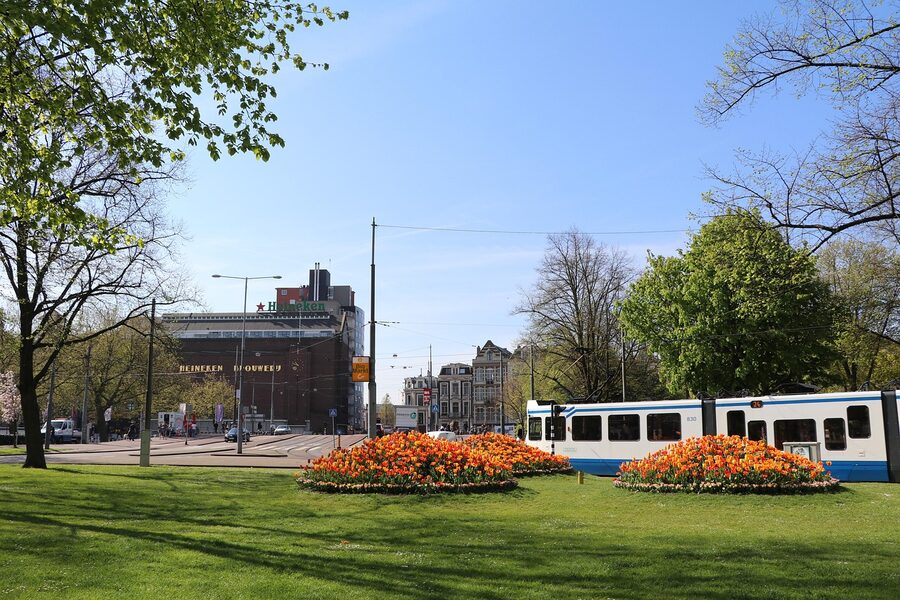
The Heineken Experience sits at the edge of De Pijp, the neighbourhood directly south of the museum quarter. It’s a five-minute walk from the south end of the Rijksmuseum (cross the Singelgracht canal, you’ll see the brick brewery on your right) and a fifteen-minute walk from the Van Gogh Museum.
Combine the visit with one of the museums and Heineken doesn’t feel like an isolated detour. The natural sequence is: Van Gogh in the morning (book the 10:00 entry), walk south to the Rijksmuseum for an hour or two on the headline pieces, lunch in De Pijp at the Albert Cuypmarkt, then 14:00 Heineken. You’re done by 16:30 with three Amsterdam tier-one attractions in your day. That’s the densest paid-attraction afternoon Amsterdam offers, with two rest stops and a market lunch built in.
For the evening, walk back across the Singelgracht into the central canal belt for either a Red Light District walking tour or, if you’re travelling with kids who survived the Brew U immersion, the family-friendly Madame Tussauds Amsterdam on Dam Square.
The view question
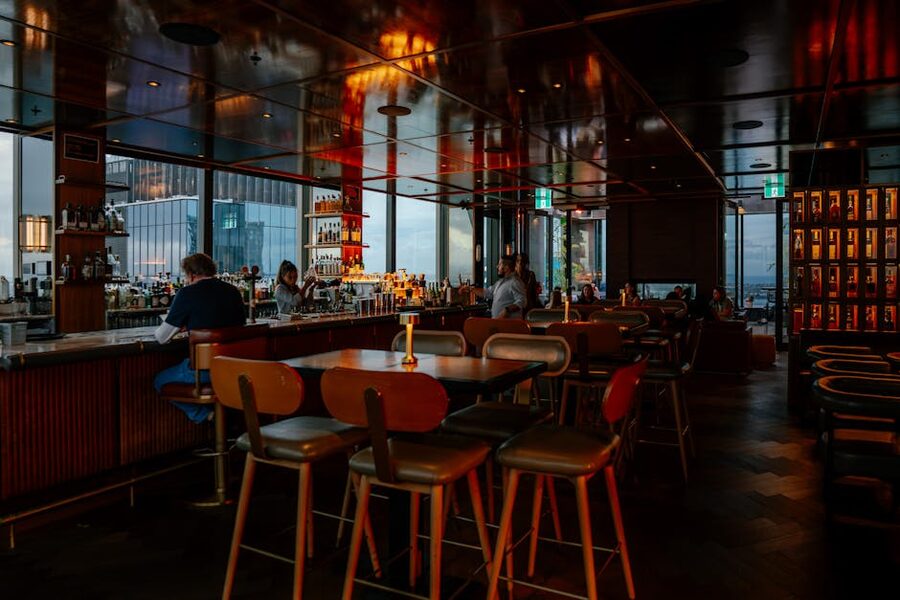
The Heineken rooftop is on the 12th floor. The A’DAM Lookout, across the IJ on the NDSM ferry side, is on the 22nd floor and has a glass-floor giant swing for the people who want their adrenaline with their view. The Heineken view is lower, but it’s also pointed in the better direction: south and east, looking down the Amstel and over the museum quarter. The A’DAM looks back at the city, which sounds like the same thing but isn’t. You’re further away.
If you have one rooftop slot in your Amsterdam trip and you want pure city skyline, the A’DAM Lookout wins on altitude. If you want a beer, a view, no separate ticket, and the Vondelpark and Rijksmuseum visible below you, the Heineken rooftop is genuinely the better afternoon. It’s also free with your $28 entry, which the A’DAM is not (entry is about €17.50, the swing is another €5).
Who should book it (and who should skip)
Book it if:
- You’re travelling with teenagers. The Brew U ride lands perfectly with this age group.
- You want to learn the proper pour. It’s the single most practical takeaway.
- You’re doing the Museumplein-De Pijp afternoon described above and want a third stop after Van Gogh and the Rijksmuseum.
- You like Heineken specifically as a beer brand. There is content here for you.
- You’re in Amsterdam for three or more days and the major museums are already booked.
Skip it if:
- You’ve already done a real working brewery tour somewhere else (Pilsner Urquell, Carlsberg’s Copenhagen tour, any German lager tour). The Heineken Experience is shallower than all of them.
- You don’t drink. The pouring lesson is gestural for you, the rooftop tokens become a drag, and the brand-experience layer feels like marketing fed back at you.
- You’re doing Amsterdam in 36 hours. Use those 90 minutes on Anne Frank or a third museum.
- You’re a beer-snob craft-IPA person. The exhibit treats macro-lager as a global cultural achievement, which is technically true but not what you want to hear for 90 minutes.
- You’d rather drink Belgian beer in a Belgian-beer bar. Amsterdam has dozens. Café Gollem, In de Wildeman, Arendsnest. Skip Heineken and walk to those.
A note on the Heineken family
One thing the museum mentions briefly and you might want to know: the Heineken family still owns roughly half the company. Charlene de Carvalho-Heineken, daughter of Alfred Heineken, inherited the controlling stake in 2002 when her father died. She’s currently the wealthiest woman in the world by net worth. The Heineken Experience museum is therefore not a public-trust cultural institution. It’s a flagship marketing site for a company controlled by a single family that owns about 50% of a global beer business.
That doesn’t change the visit. It does shape how you read the marketing. The “global brand of beer” sections are a family company telling you about itself. The Stadhouderskade brewery is a corporate flagship, not a Dutch national heritage site, even though it’s housed in a 19th-century building that arguably has both qualities. Walk in knowing which is which.
Practical bits
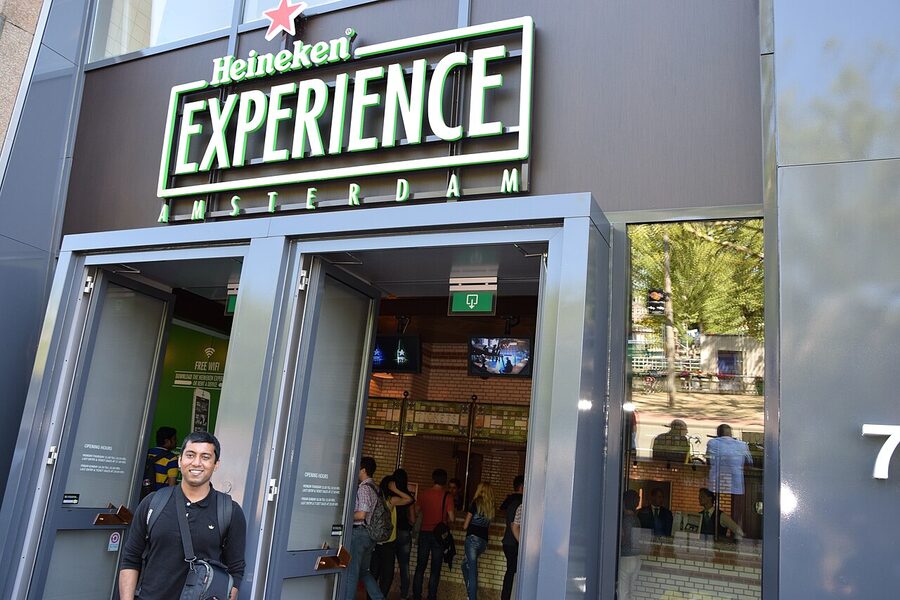
- Address: Stadhouderskade 78, 1072 AE Amsterdam.
- Nearest tram: Weteringcircuit (lines 1, 7, 19). About 30 seconds from the entrance.
- From Centraal Station: 12 minutes by tram, 18-20 minutes on foot via the Singel canal.
- From Schiphol Airport: 25 minutes by direct train to Centraal then tram.
- Hours: Daily 10:30 to 21:00 (last entry 19:00). Slightly extended in summer.
- Age limit: 18 and over to enter unless accompanied by a parent. Children under 12 enter free with a paying adult; the museum recommends 14+ to actually enjoy the visit.
- Bag policy: Free coat and bag check at the entrance. Bring a light layer for the rooftop.
- Languages: All exhibits in English, Dutch, German, French, Spanish, and Italian. Audio guide free via QR code on the wall.
- Accessibility: Lifts to all floors. The Brew U ride is wheelchair-accessible.
- Photography: Allowed throughout, except inside the Brew U ride itself.
Tickets, the simplest version
If you’re trying to decide which of the three options to book, here’s the cleanest framing:
- If you don’t have a canal cruise booked, get the $47 combo. Cruise + Heineken is the natural Amsterdam afternoon and you save almost nothing booking separately.
- If you already have a canal cruise, get the standard $28 ticket. Don’t double up.
- If the flagship combo is sold out for your slot and you’re flexible, the alternate $44 combo saves $3.
The V.I.P. tour ($52, smaller groups, 10-person max) is the fourth option not in our card stack: it adds a guide, the V.I.P. tasting, and skip-the-line at the busy moments. It’s worth the $24 premium over the standard if you’re a Heineken person specifically. Otherwise the standard ticket gets you 90% of the visit.
Comparable drink-and-history visits across Europe
The Heineken Experience sits in a clear category across Europe: branded heritage visits that anchor a city’s drink-and-museum afternoon. France does this with wine, Italy does this with espresso and chocolate, Spain does this with sherry and cava, Germany does it with proper working breweries. Pairs that work across the four-country map:
If you’re touring Europe and want one drink-experience-as-tourism per country, the Heineken Experience is your Netherlands pick. In France, the equivalent visit is the Cité du Vin in Bordeaux, which is the same brand-experience template but for wine and run by the city of Bordeaux, with a far better view from its 8th-floor tasting room. In Italy, the closest analog is a pizza-making class in Naples: same brand-equity-as-tourism, different product, more hands-on. In Spain, the Jerez horse show with sherry tasting is the only branded sherry-experience product that holds together as a tourist visit.
Spain also has the Barcelona tapas tour as a pure food-and-drink walking experience, which is the small-format version of what Heineken is doing on a museum scale. France has its own broader templates: the Saint-Émilion wine tasting from Bordeaux, the Champagne day trip from Paris, the proper Bordeaux wine tour. All of those are working-cellar visits, not brand experiences. They’re better than Heineken if you want to taste rather than be marketed at.
One Italian comparison worth making: the Chianti winery system around Florence. A Chianti winery and wine tour from Florence is the closest in price-and-time to a Heineken visit ($40-60, four to six hours including transit) and gets you a working-vineyard tasting rather than a brand presentation. If your trip includes both Italy and Amsterdam, you’ll feel the format gap clearly. The Italian visit is a place. The Heineken visit is a building, in the marketing sense as well as the architectural one.
The day after question
Most travellers do the Heineken Experience in the middle of an Amsterdam stay, not on the first or last day. The reason is logistical: by day two you’ve done the canal cruise, you’ve done a museum, you’ve eaten too much rijstafel for dinner, and you’ve earned a sit-down afternoon that ends with a beer. Heineken is the perfect day-two or day-three slot.
If you’ve got a fourth or fifth day in Amsterdam, the natural follow-on after Heineken is one of the day trips: Keukenhof Gardens in spring (March 21 to mid-May only), or for the kids who survived Brew U the family-friendly IceBar Amsterdam, which is the city’s other branded immersive drink-experience and pairs neatly. Same template (cold sensory shock plus a drink token plus a souvenir glass), different temperature.
What to bring
- Photo ID. The 18+ rule is checked; under-18s need a parent.
- A light jacket for the rooftop, especially October to April.
- A printed or phone-screen booking confirmation. The QR scanner at the entrance reads either.
- Cash for tips at the rooftop bar (optional). Tipping isn’t standard in Amsterdam, but the bartenders work the rooftop hard.
- A bag for the gift glass. They give you a paper bag at the rooftop, but it tears.
If you’re going further north
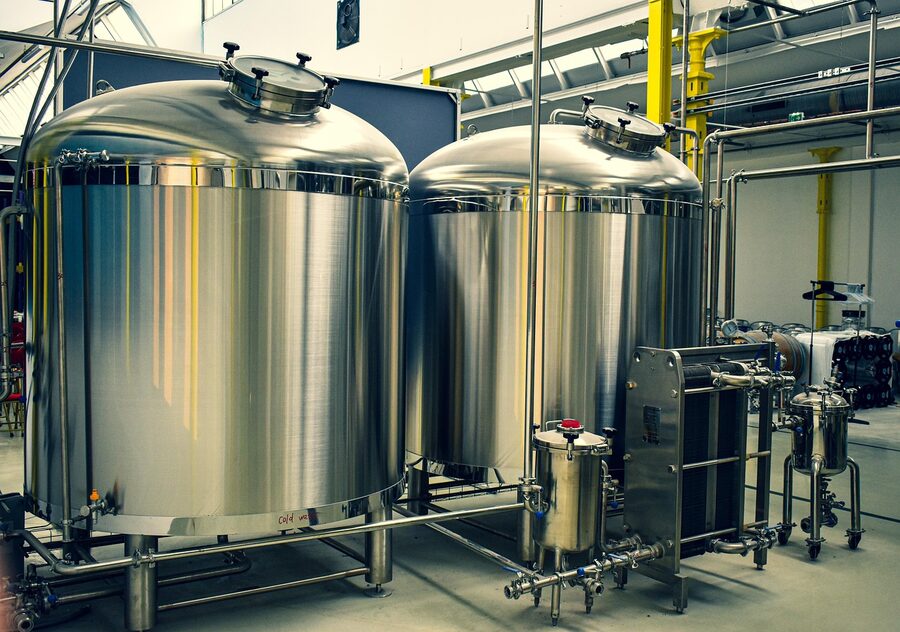
One question that comes up: can you tour the actual working Zoeterwoude plant where Heineken is now made? The short answer is no, not unless you’re a corporate visitor or a beer industry professional doing a scheduled site visit. The Stadhouderskade museum is the public-facing version. Heineken doesn’t run a Zoeterwoude visitor centre and there’s no walk-up access. The “experience” branding on the Amsterdam site is partly a workaround for that absence.
If a real working-brewery tour matters to you, fly to Prague rather than Amsterdam. Pilsner Urquell in Plzeň runs a 90-minute production-line tour that ends with a pour from the unfiltered tank. It’s the brewery tour the Heineken Experience is consciously not.
Tipping and beer etiquette
Tipping isn’t standard in the Netherlands. Round up at the rooftop bar if the bartender did the proper foam-knife pour. €1-€2 is plenty.
One more etiquette thing: if you finish your Heineken before your friend, don’t slide a fresh one toward them across the bar. Dutch drinking pace is steadier than most travellers expect, the rooftop staff will wait until both glasses are below the foam line before offering the next round, and the unwritten rule is that you finish what’s in front of you before another arrives. Same in Amsterdam bars generally. Two-drink-deep bar conversation moves at half the speed of an American taproom.
Some more drink-experience reading
If you enjoyed Heineken and want to push further into European drink-experience tourism, three directions worth looking at. The wine cluster is the obvious one: a Bordeaux wine tour from the city, the Cité du Vin as the museum-format equivalent, and the Saint-Émilion wine tasting for the village-format. These are the trio that a Heineken-style visitor often does next, and they go deeper into the production side. The Champagne day trip from Paris is the same idea via the Reims chalk caves: a working cellar at 12°C with bottles aging in racks. The food cluster is shorter but punchier: a pizza tour in Naples or a Chianti winery day from Florence are the working-Italian-product version of what Heineken is doing in marketing format. Spain’s Barcelona tapas tour sits between, and the Jerez horse show is the strangest sherry-related visit on the continent.
And if you’re staying in Amsterdam, the natural pair across that two-day window is a morning at the Rijksmuseum or Van Gogh Museum, an afternoon at Heineken with a 14:00 entry, and an evening boat on one of the Amsterdam canal cruises during the bridge-light golden hour. That’s a clean Amsterdam day with rest stops built in. Don’t try to add Anne Frank into the same day; book her separately.