
The trumpet calls from a corner of the arena, four bars in 3/4 time. Twelve grey horses come on at a slow, lifted trot, riders in 18th-century broadcloth and tricorns, the bay of the indoor school silent except for hooves on sand. They split into two columns of six, cross at the centre, peel back into a single line. And then the front horse stops, gathers, and lifts both forelegs off the ground. He stands, perfectly still, on his back legs, at maybe a 45-degree angle. Holds it for three or four seconds. The whole arena, all 1,600 of us, makes a sound that is not quite a cheer and not quite a gasp. That move is called the levade, and it’s the calmest of the three “airs above the ground” you’ll see at the Royal Andalusian School of Equestrian Art in Jerez.
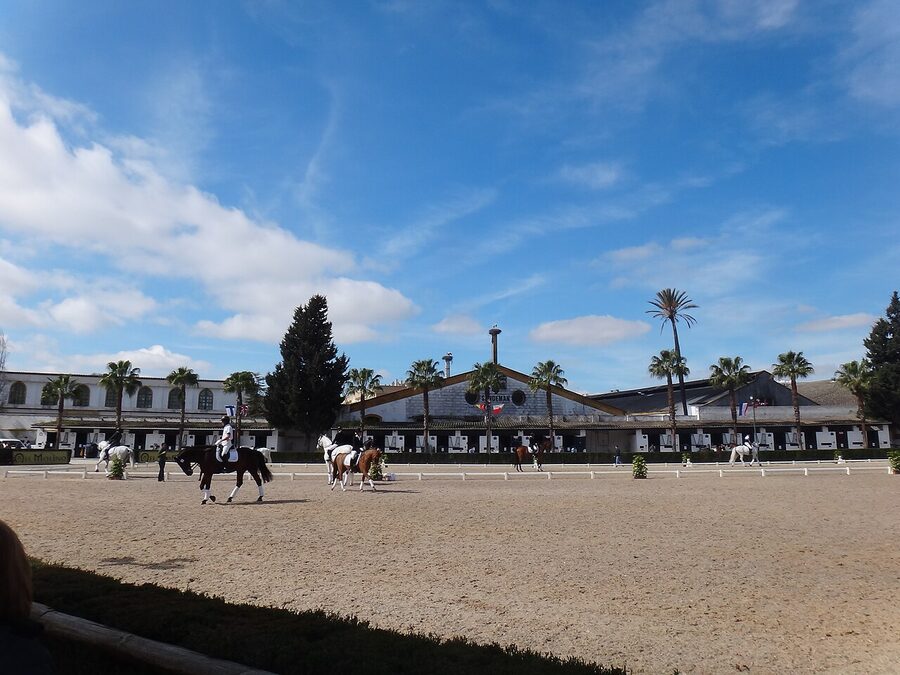
This isn’t a horse circus. The Real Escuela Andaluza del Arte Ecuestre is a working classical riding school, founded in 1973 to preserve the doma clásica tradition and the Pura Raza Española breed itself. The show, “Cómo Bailan los Caballos Andaluces” (How the Andalusian Horses Dance), is what they let the public see twice or three times a week. The rest of the time these horses are in training, in lessons, in the breeding programme. The performance is the school’s window onto the work, not the work itself.
Quick picks if you’re booking now
- The show, standalone: the cheapest and most popular ticket, around $31, gets you a seat at “How the Andalusian Horses Dance”. Book the standard ticket.
- Show plus the museums: for $38 you get the same show plus access to the carriage museum and the equestrian art museum on the school grounds, which fills the morning before the 12:00 performance. Book the combo.
- The Cartuja Stud alternative: for $22 you can visit the Yeguada de la Cartuja, where the original Carthusian-monk-bred bloodline is kept, and watch a smaller working dressage exhibition. Book the Cartuja tour.
What the show actually is
The performance runs about 90 minutes. There’s no narrator, no announcer, no commentary. The lights go down, the orchestra (live, on the side of the arena) plays an overture by an 18th-century Spanish composer, and the horses come on, with the same kind of disciplined Belle Époque show-discipline you get at the Moulin Rouge in Paris, just with hooves instead of feathers. The choreography is in seven parts. Each part isolates one of the disciplines the school teaches: classical doma (the rigid, geometric dressage that came out of the Renaissance Italian and French riding traditions), doma vaquera (the Spanish stockman style, much looser, single-handed reins, a working-cattle origin), the airs above the ground, the long reins (the rider walks behind the horse, controlling it from the ground with extended reins), the carriage driving, the pas de deux, and the final group passage.
What surprised me on the first visit was how short some of the set pieces are. The big airs above the ground sequence, the part everyone remembers, runs maybe eight minutes. The school doesn’t pad. They show you the discipline, the horse holds the position long enough for you to register it, and then the next piece starts. There’s a confidence in that pace that’s missing from a lot of equestrian tourist shows I’ve sat through elsewhere.
The airs above the ground, decoded
If you only remember three Spanish words from the show, make them these: levade, courbette, capriole. They are the so-called airs above the ground, the most technical movements in classical dressage, and the school will perform all three.
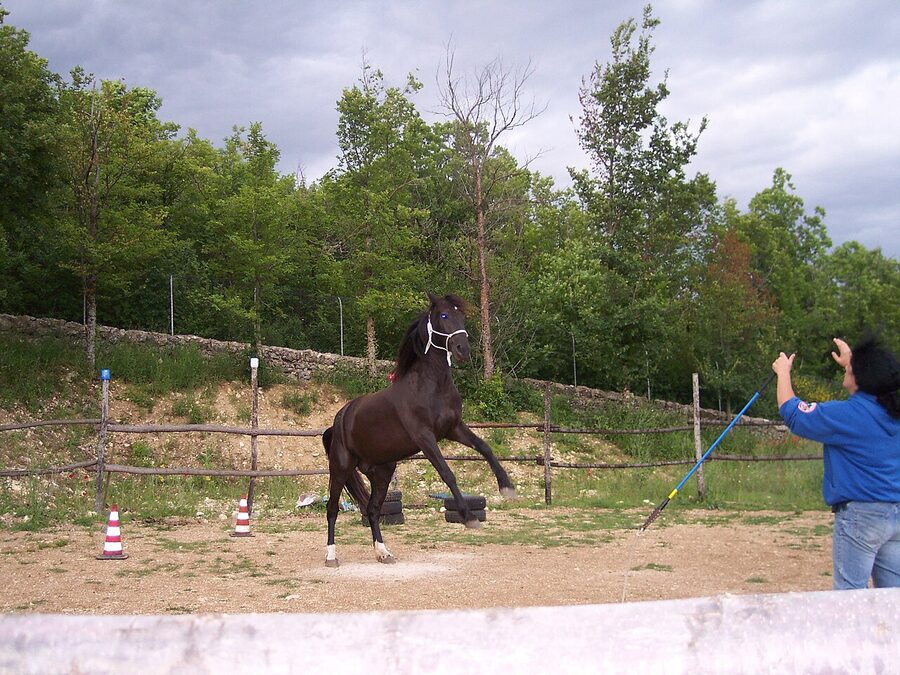
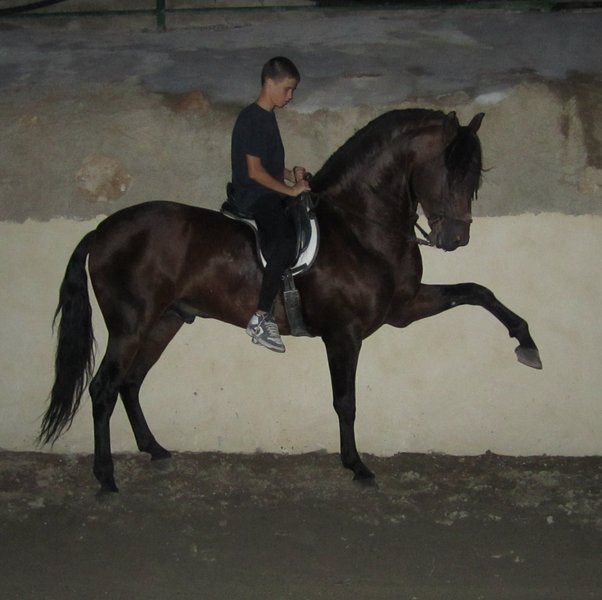
The levade is the static one. The horse rears up, brings the forelegs in tight, and holds at a 30 to 45-degree angle for several seconds. This is a conditioning movement, pure muscle. A horse that can do a clean levade has years of slow, careful work behind him.
The courbette is the levade in motion. The horse rears, stays on the hind legs, and hops forward. Two hops, three hops, four if the rider asks. It looks impossible the first time you see it because horses are not built to bear weight on their hind legs alone, much less to walk on them. They do it anyway because the school’s training has made it possible.
The capriole is the explosive one. The horse leaps off all four legs at once, fully airborne, and at the apex of the leap kicks both back legs out behind him in a straight line. He lands, all four feet, in the same spot. In the original Renaissance manuals this was a battlefield move: a knight’s horse could clear a footsoldier off the ground or kick out at attackers behind. The school is one of four institutions in the world that still teaches it. The others are the Spanish Riding School in Vienna, the Cadre Noir in Saumur, and the Portuguese School of Equestrian Art in Lisbon, all of them rooted in the same 17th- and 18th-century court tradition that built the royal stables at Versailles.
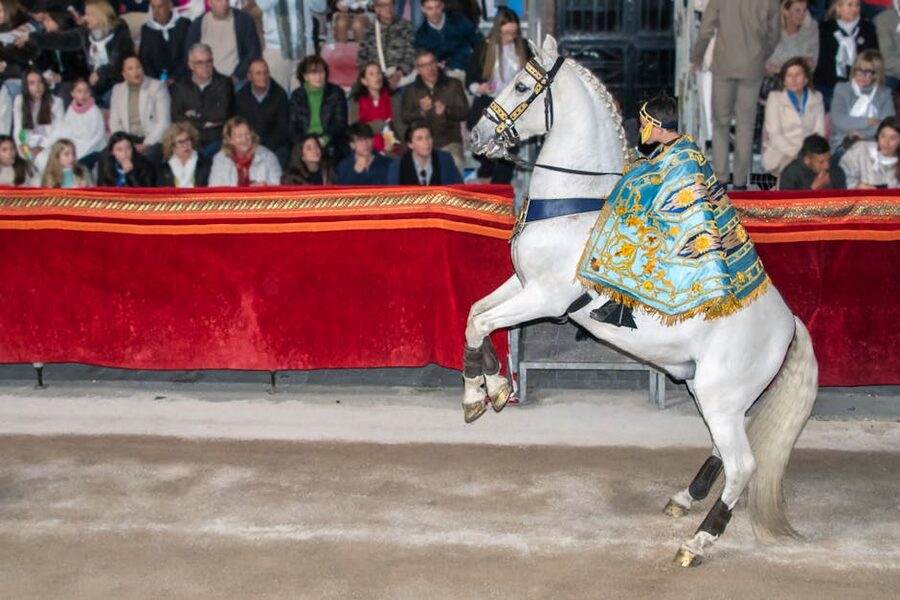
One thing the school is careful about: they don’t perform the airs as a continuous sequence. A capriole demands huge strength from the horse, and you’ll typically see one or two horses do one or two leaps each, then they walk off. The school will not push a horse for the audience. If you’ve come expecting six caprioles in a row, that’s a Hollywood version of what classical dressage is, which is closer to what a wraparound projection room like Fabrique des Lumières in Amsterdam does with art history: turn it up to spectacle.
Doma vaquera, the working-cattle style
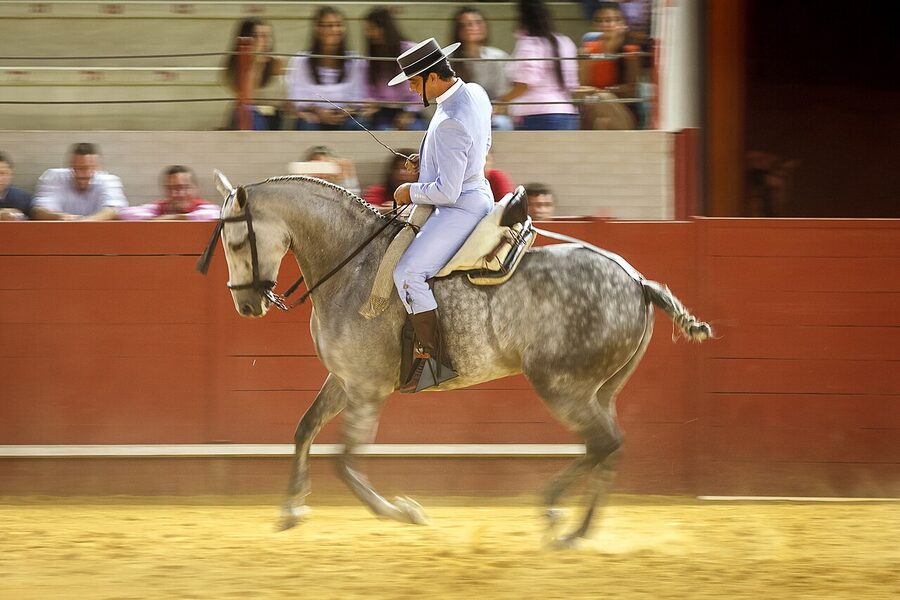
About a third of the show is doma vaquera, and it’s the half most travellers don’t expect. Where doma clásica is geometric, slow, and ritualised, doma vaquera is loose, fast, and rooted in the working cattle ranches of the dehesa, the oak grasslands of Extremadura and Andalusia. The rider holds the reins single-handed (the other hand was historically used for the garrocha, a long lance for sorting bulls), the saddle is the Spanish stockman saddle with the high cantle, and the horse turns on a dime.
You’ll see piaffe and Spanish walk in this section, both of which are also part of the classical canon, but the body language is different. The horse and rider look like they’re still working a cow, even when there’s no cow.
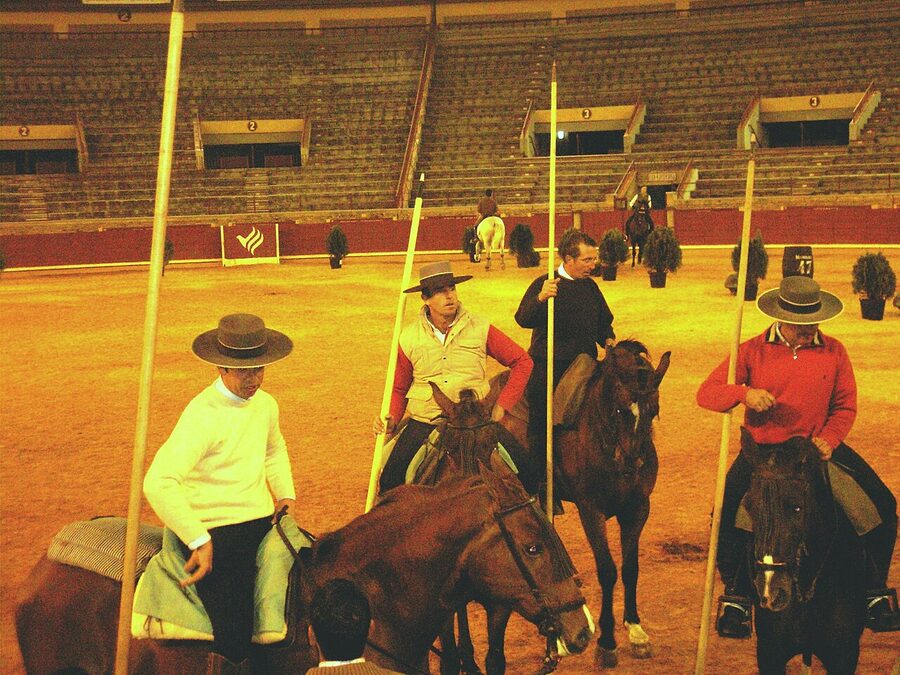
The Andalusian horse, in this section, finally looks like what he was bred for. He’s not built for the very high collection of dressage. He’s built for short bursts, sharp turns, and standing his ground in front of a half-tonne Spanish fighting bull. Watching him in vaquera mode you see why people in Andalusia talk about the breed the way Texans talk about Quarter Horses.
The horses themselves
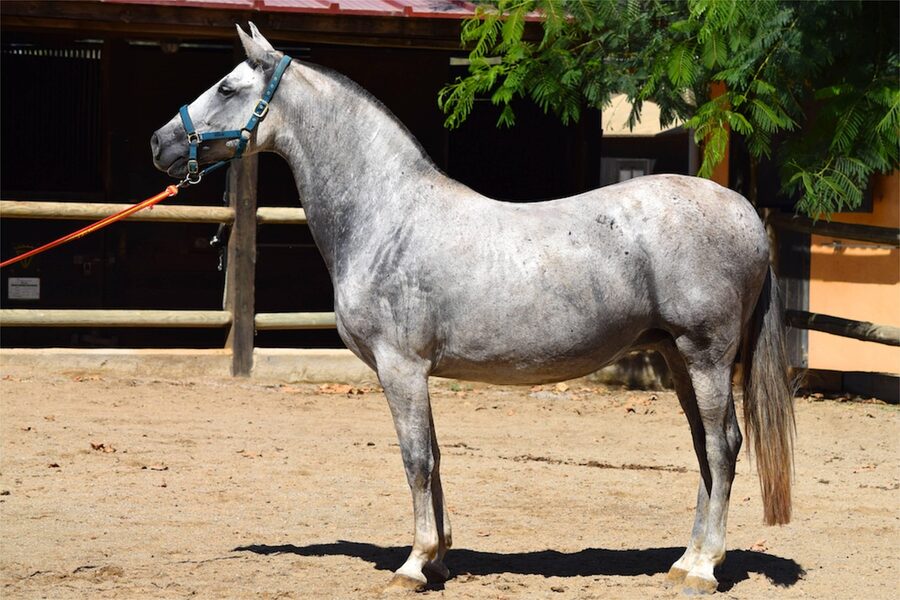
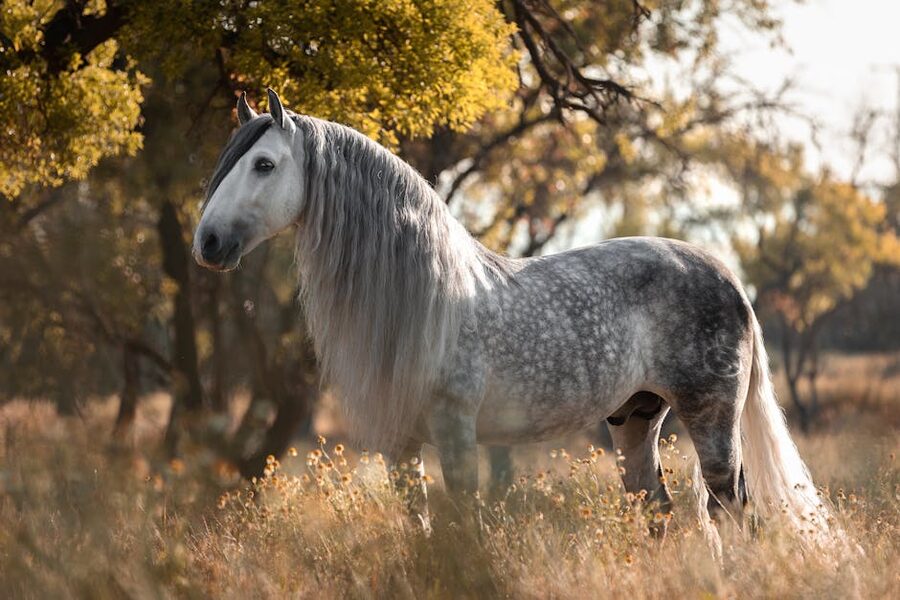
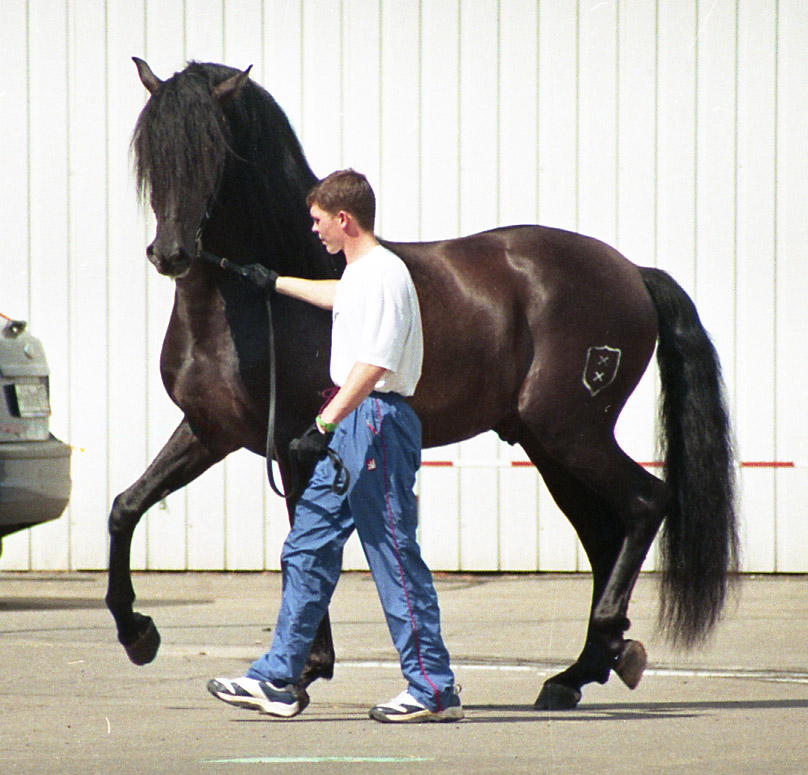
The Pura Raza Española is one of the oldest documented horse breeds in the world. Cave paintings of broadly the same conformation date to the Iberian Peninsula in the second millennium BC. By the 15th and 16th centuries, when European royal courts were obsessed with horsemanship, the Andalusian was the prestige breed. Velázquez painted them. Rubens painted them. Most of the great riding schools in Europe were originally drilled on Andalusian or Andalusian-cross stock.
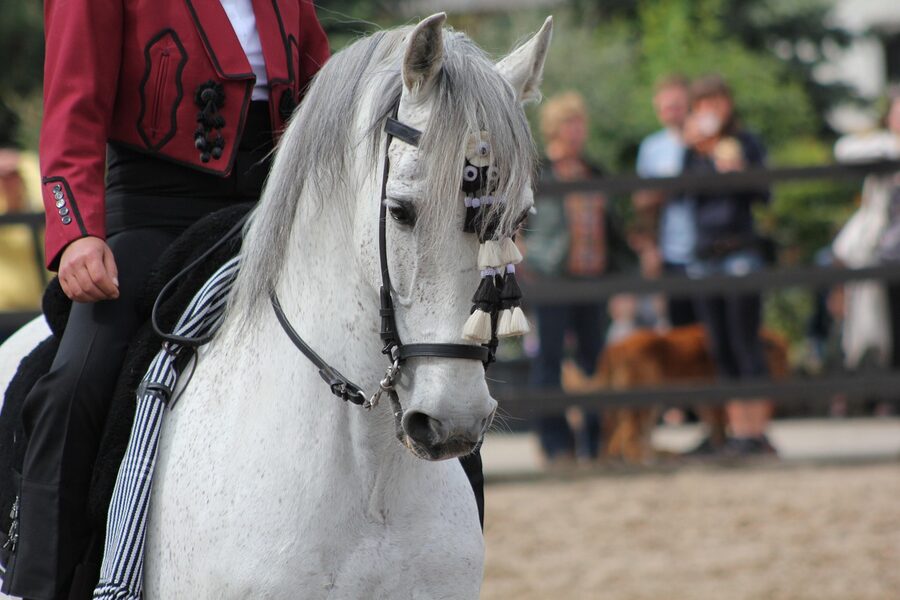
The breed nearly died out. In the 19th century the wars on the peninsula and the rise of the Thoroughbred for racing collapsed the Andalusian’s market. By the 1960s, when Álvaro Domecq Romero (of the Domecq sherry family) started lobbying for a national equestrian school, the registered population was a fraction of what it had been a century before. The school was founded in 1973 partly as a research institution to consolidate the breed’s pedigree records and a partly as a stud farm. The shows came later, when the school needed funding.
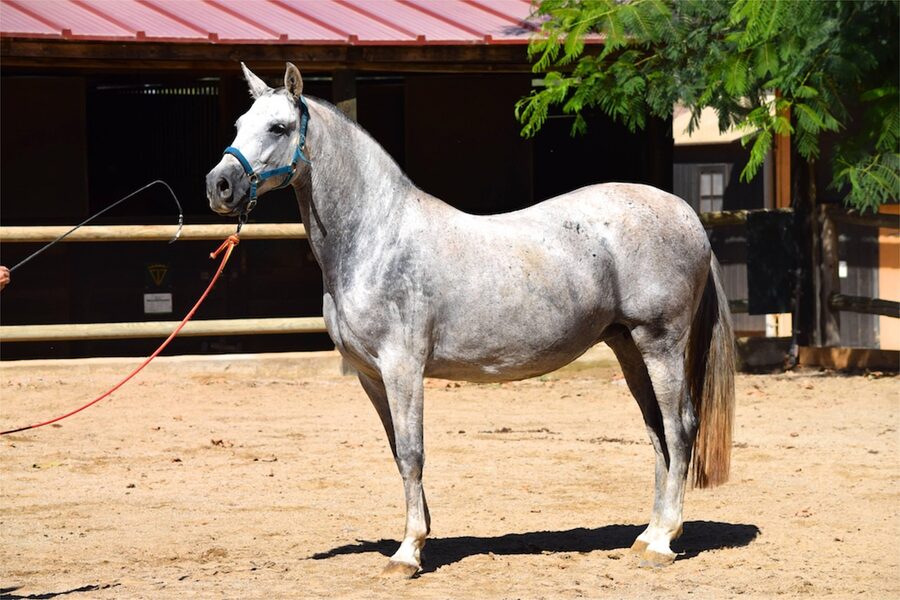
That history is why the school cares about which Andalusian you’re watching. The horses you see in the arena are bred at the school’s own stud, on grounds across the road from the show arena, and the bloodlines are documented back to specific 18th-century sires. If you’ve spent any time around horses, that’s the kind of provenance you don’t get at most equestrian shows. Madrid’s Royal Palace still keeps a small ceremonial herd of Andalusians, and the Royal Guard ride them at state occasions, but the breed’s working core lives here in Jerez.
The arena, the seating, and what you actually see from each row
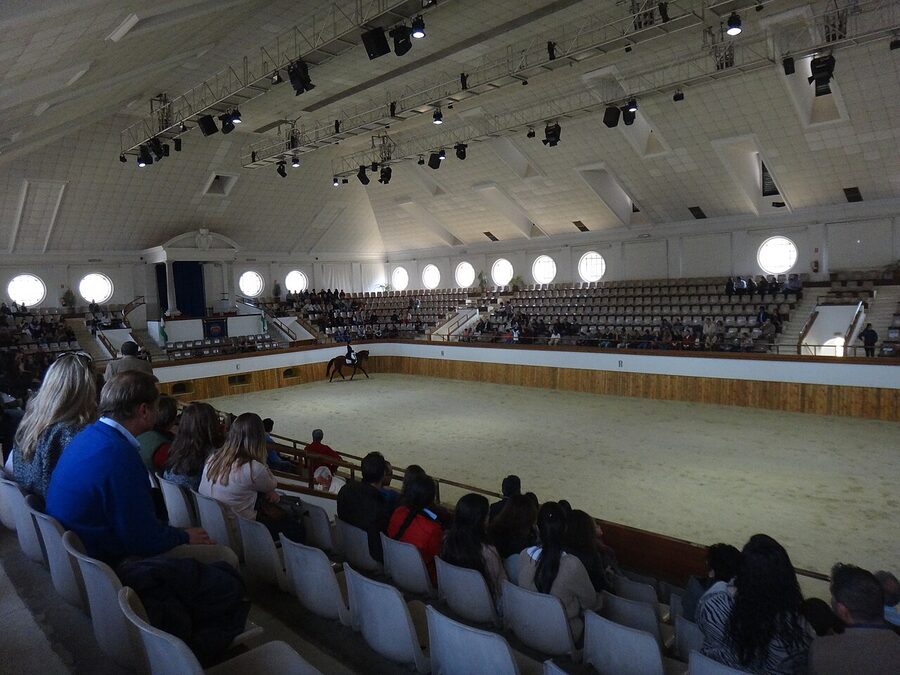
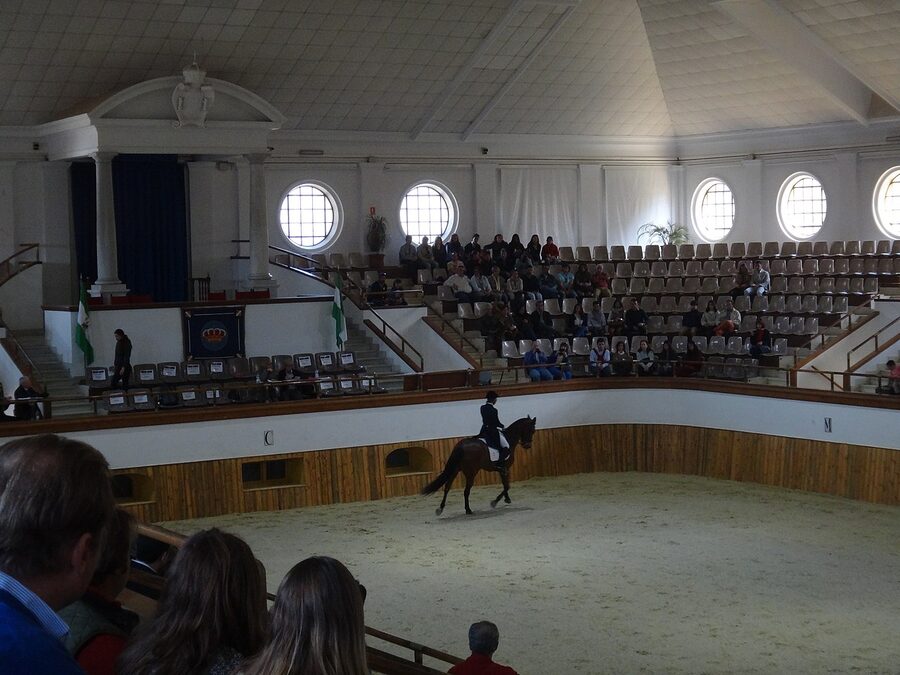
The covered arena seats about 1,600 across two horseshoe-shaped tiers. The ticket structure is simpler than it looks at first.
General seating (€21 standard, around $23 once converted with fees) is rows 3 to 7 in the upper tier. This is where I’d send most people. You’re up high, you see the full floor pattern, and the geometry of the choreography only becomes visible from a certain height. The pas de deux and the long-rein work look completely different from up here than from ground level.
Preference seating (€27, about $30) is rows 1 and 2, plus the front section of the lower tier. Closer, louder, you can see the riders’ faces. The downside: the airs above the ground happen at the centre of the ring and from row 1 the horse is sometimes facing away from you when he goes up. If you’re a photographer or you’ve been before, sit closer; if it’s your first time, go general.
Tribuna seating (around €45) is the gallery box on one of the long sides. It exists, the GetYourGuide ticket sometimes routes you here, and it’s not worth the upgrade unless you’re paying for the view from a specific seat your group has booked. The schools’ floor patterns are designed for the audience facing the riders’ entry gate, not the long side.
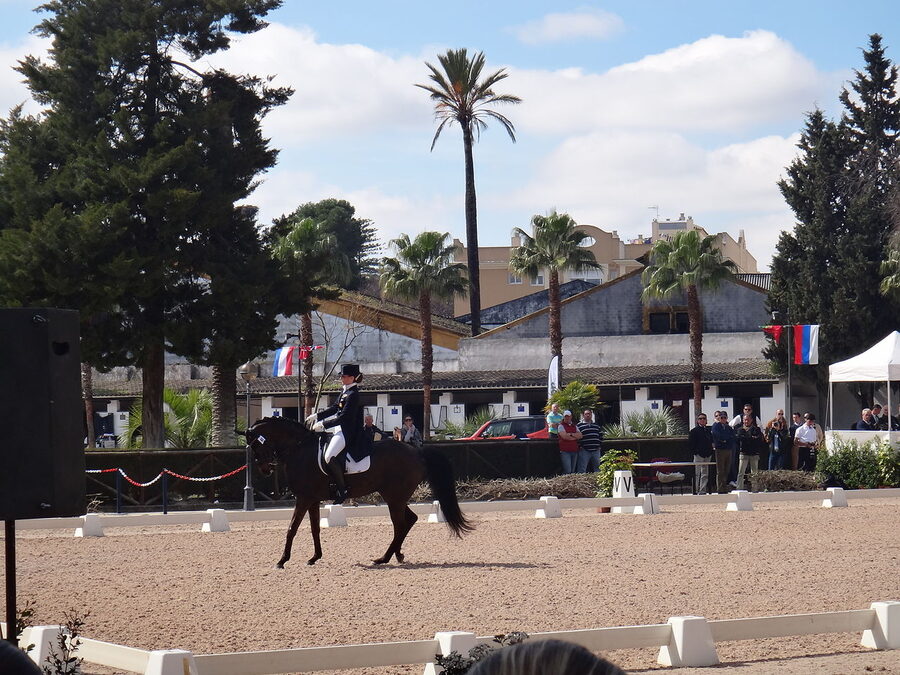
Photography is banned during the performance. Phones, cameras, anything with a screen. Security walks the rows the moment lights go down and they will tap you on the shoulder if you forget. This rule has improved the experience for me every time. There’s nothing on a phone screen that beats watching a horse balance for four seconds on his back legs at row 7.
Show schedule, ticket tiers, and when to book
The show runs three times a week through most of the year. Tuesdays, Thursdays, and Fridays at 12:00 noon. No evening shows. No matinees. The school adds extra performances during Feria del Caballo in May (the city’s annual horse fair) and during Christmas season. They occasionally cancel for school holidays or for international competitions when the riders are abroad, so the official calendar at realescuela.org is the only authoritative source.
Tickets sold through GetYourGuide and Viator are the school’s own seats, resold. The price difference compared to the school’s box office is small ($31 versus €21) and what you get is mobile-friendly booking, English-language confirmation, and the ability to swap dates if the weather changes your plans. If you’re booking inside Jerez and want to save the booking fee, walk in to the box office (open 9:30 to 11:45 on show days). They’re rarely sold out for the noon performance more than 24 hours ahead, except in May during the Feria, when you should book at least a fortnight ahead.
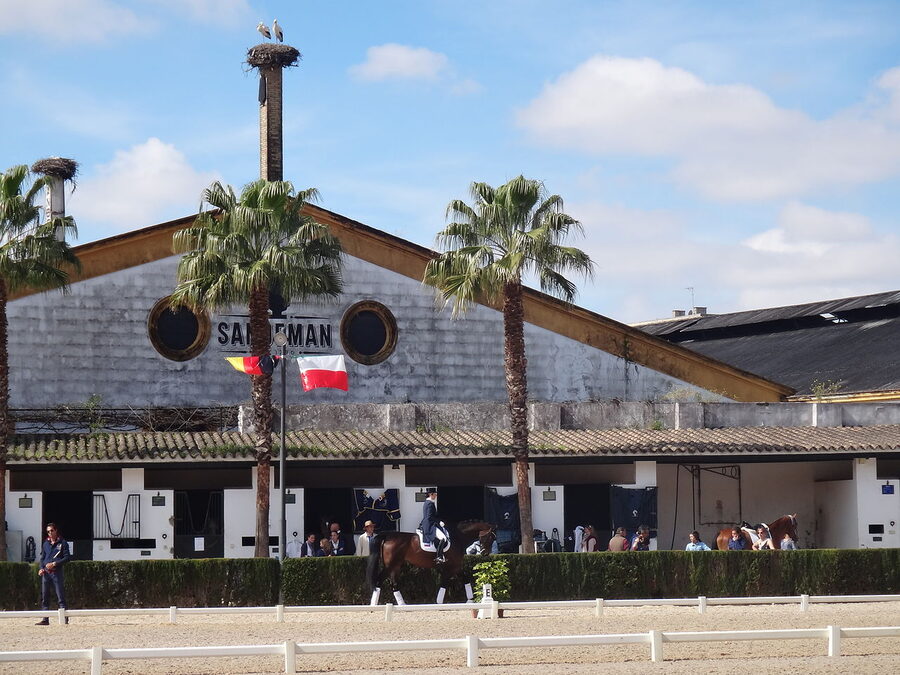
Plan to be at the gate by 11:30. The 12:00 start is firm. Doors close at the bell. Late arrivals do get seated but usually in the last row of the upper tier, regardless of which ticket you bought. The grounds open at 10:00 if you’re combining the show with the museums (more on that below).
The show plus the museums: what’s actually in there
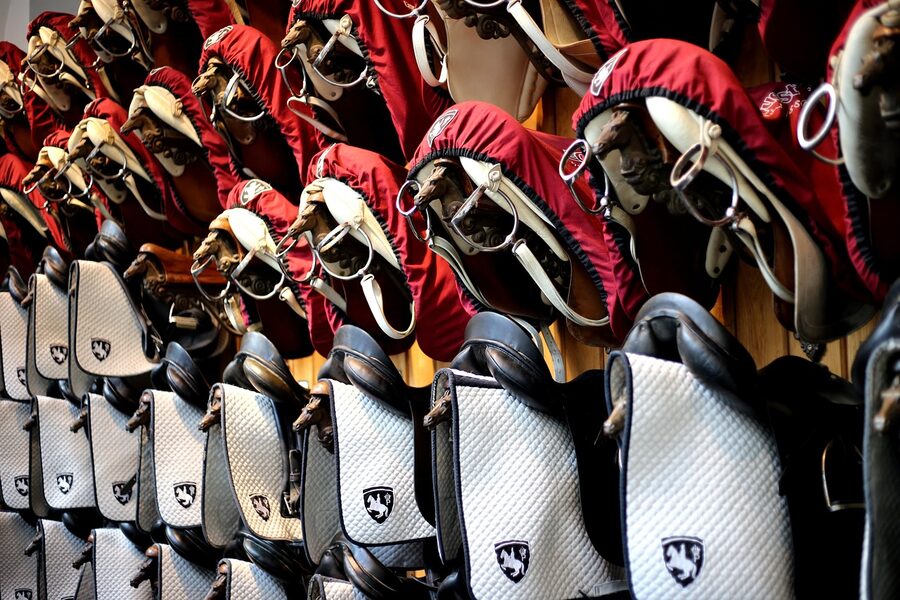
The school has two museums on site. The Carriage Museum (Museo del Enganche) holds about 50 historical carriages, most of them used by the school in actual public processions. There are two early 20th-century mail coaches, a few state berlins, and an extraordinary 1880s parade carriage built for the Domecq family that’s still wheeled out for Feria. The Equestrian Art Museum (Museo del Arte Ecuestre) is broader: tack and bridles from the 17th century forward, riding manuals, breed pedigree records, and a room of paintings, mostly 19th-century academic stuff but some excellent.
The combo ticket is $38 versus $31 for the show only, so the museums cost you $7. That’s fair value if you have the morning free. If you arrive in Jerez at 11:30 expecting to do the noon show and leave, skip the combo. If you’re spending the day, do both. The museums in isolation are worth maybe an hour and a half; with the show they’re a coherent half-day.
The Cartuja alternative: the original Carthusian bloodline
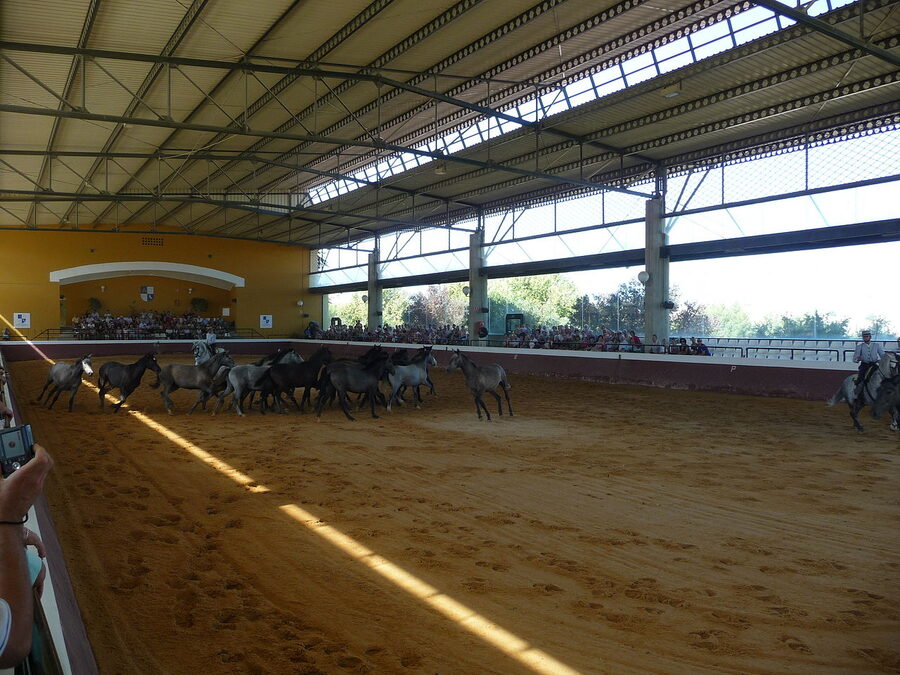
If you want to see Andalusian horses but the school’s show is sold out, or you’d rather see the working stud than the polished performance, head 10 km north of central Jerez to the Yeguada de la Cartuja. This is a different operation. The Carthusian monks of the nearby monastery began breeding their own line of Andalusians in 1476, and that bloodline (the cartujano) has been maintained, with some interruptions, for five and a half centuries. It’s the oldest closed bloodline in horse breeding anywhere.
The tour is a Saturday-only thing, two and a half hours, $22. You walk through the stables, see the breeding stallions, watch a short presentation in the field, and finish with a 15-minute dressage exhibition by two or three of the school’s senior horses. It’s smaller-scale and more granular than the school’s show. You’ll talk to the trainers, see the foals, and get a sense of what a working Andalusian stud actually looks like day to day.
For a horse-obsessed traveller I’d do both: the Cartuja tour on Saturday morning, the school’s show on Tuesday or Friday. They complement each other. The school is the polished public-facing institution; the Cartuja is the slow, behind-the-scenes breeding programme that keeps the bloodline alive.
Where Jerez fits in an Andalusian itinerary
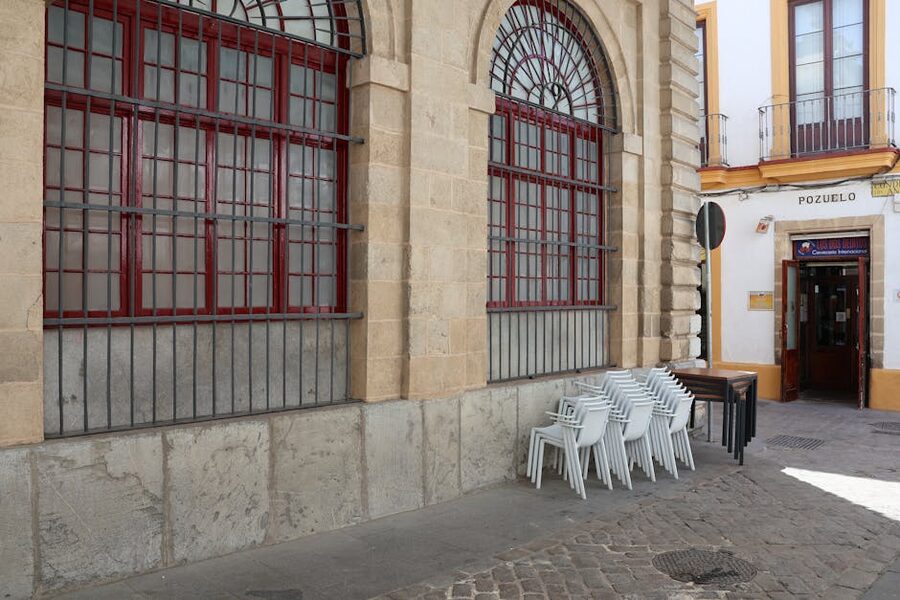
Jerez de la Frontera sits between Seville and Cádiz, 90 km south of the former and 36 km north of the latter. The city’s population is about 215,000, big enough that you can spend two days here, small enough that you can walk anywhere central in 25 minutes. From Seville the train takes 70 minutes, from Cádiz about 40 minutes. The Renfe Media Distancia services run several times a day in both directions and the station is a 12-minute walk from the cathedral.
If you’re already in Seville for the Royal Alcázar and the Cathedral and Giralda, treating Jerez as a day trip is the cleanest plan. Catch the 9:30 train down, you’re at the noon show, lunch in the Plaza del Arenal afterwards, train back at 16:00 or 17:00. That’s a long day but it works and you’ve seen one of the great Spanish spectacles. The other approach, which I prefer, is to do Jerez on the way south to Cádiz, sleep one night in Jerez, do the show plus a sherry bodega tour the next morning, and continue down the coast.
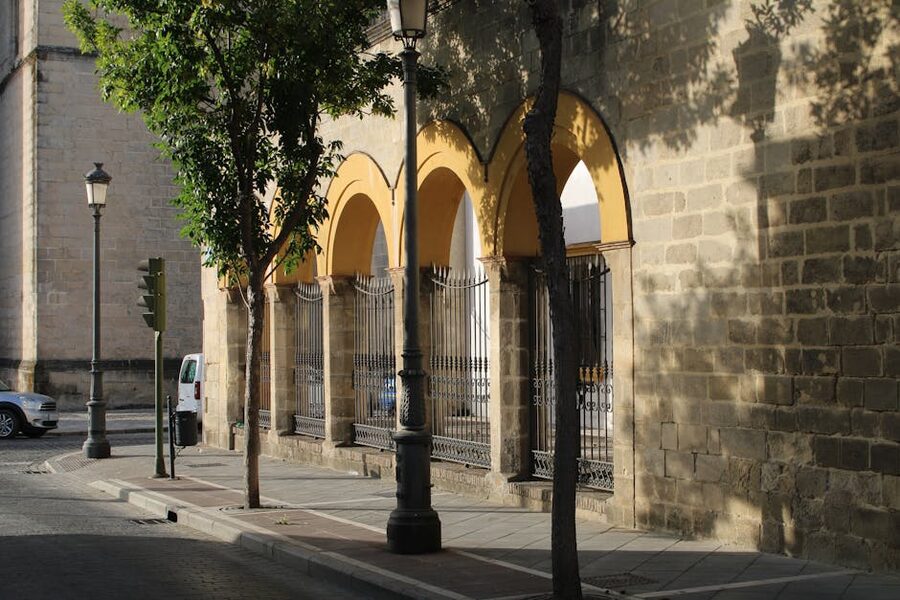
The other Andalusian destinations within a day’s travel of Jerez include Ronda and the white villages (about 90 minutes east by car, doable from Jerez but more naturally done from Seville), Córdoba and the Mezquita (two and a half hours by train, full day from Jerez), the Caminito del Rey (a hike-only day from this side of Andalusia), and Gibraltar (closer than you think, about 90 km south, doable as a long day from Jerez but more typically done from Málaga or Cádiz).
Sherry, flamenco-bulería, and what to do with the rest of the day
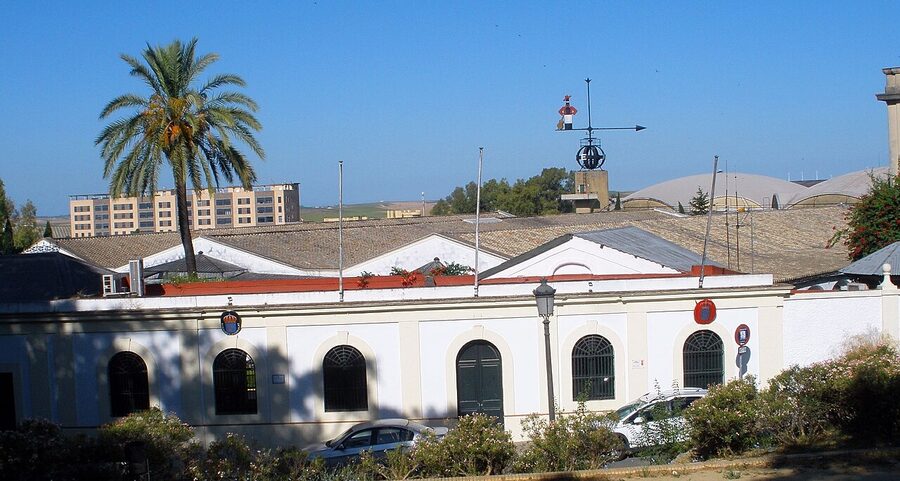
Jerez is the sherry capital. The word sherry is just the English mangling of Jerez (Old English sherris). Three big bodegas dominate central Jerez: González Byass (the Tío Pepe brand), Lustau, and Sandeman. González Byass runs the most polished tour, Lustau is more serious about the wines and less about the photo-op, Sandeman is the most touristy. After a noon horse show, my preferred move is the 14:30 Lustau tour, which finishes about 16:00, gives you tasting notes for fino, amontillado, oloroso, and palo cortado, and lets you walk back to the train station via the cathedral.
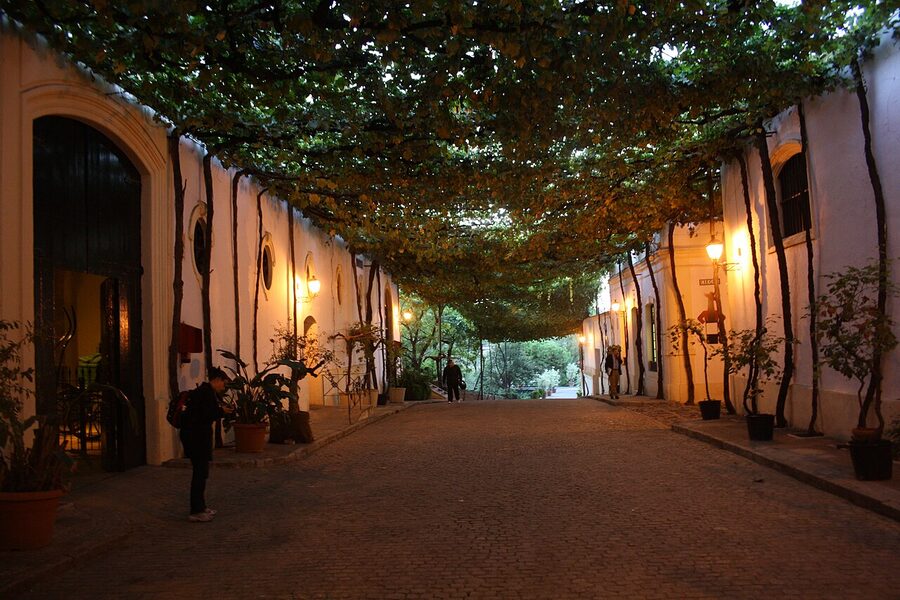
The other thing Jerez is famous for is flamenco. Specifically, the bulería: a Jerez-born subgenre, faster than the soleá, more rhythmically chaotic, the form most flamencos consider the technical pinnacle of the art. The two great Jerez flamenco neighbourhoods, Santiago and San Miguel, are within a short walk of the centre. There are tablaos and peñas (smaller, more authentic flamenco social clubs) all over both barrios.

The big city flamenco shows you’d see in Seville, Granada, Málaga, Madrid, or Barcelona are professional, polished, and increasingly tailored to the tourist circuit. The Jerez peñas are different. They’re smaller, the audience knows the form, and what you’ll hear is closer to the original. If you only see one flamenco performance on your trip and you happen to be in Jerez, see it here.
The three classical spectacles of Andalusia
Spend any time in Andalusia and you’ll notice the region has three living classical performance traditions, all of which trace back to the same 16th to 18th-century overlap of Moorish, Spanish, and Romani culture. They are the three things to see if you want to understand what Andalusia was as a cultural production centre.
Cante jondo in Seville. The “deep song” form of flamenco, the most serious and technically demanding subgenre, is at its highest at the small tablaos and peñas of Triana and Santa Cruz. The shows you’d find at Casa de la Memoria are the closest thing to what flamenco was a century ago. The full Seville-flamenco walkthrough is in our Seville flamenco guide.
Cave flamenco in Granada. The Sacromonte caves, dug into the hillside opposite the Alhambra, are the original setting for the zambra, the Romani wedding-form of flamenco. The shows here are theatrical (the venues sell tickets, the dancers perform a set) but the cave acoustics and the visual setup are unique. See our Granada flamenco walkthrough for booking specifics.
Doma clásica in Jerez. Where flamenco preserved the song and dance traditions of Romani Andalusia, the Royal Andalusian School preserves the riding and breed traditions of the same period. All three of these are working classical art forms in 2026, all three are still performed by people who learned them from teachers who learned them from teachers, and all three are best seen in their hometowns. If you can do all three on one Andalusian trip, you’ll have a sense of the region nobody who only does the Alcázars and the cathedrals can build.
Feria del Caballo: when the city becomes the show
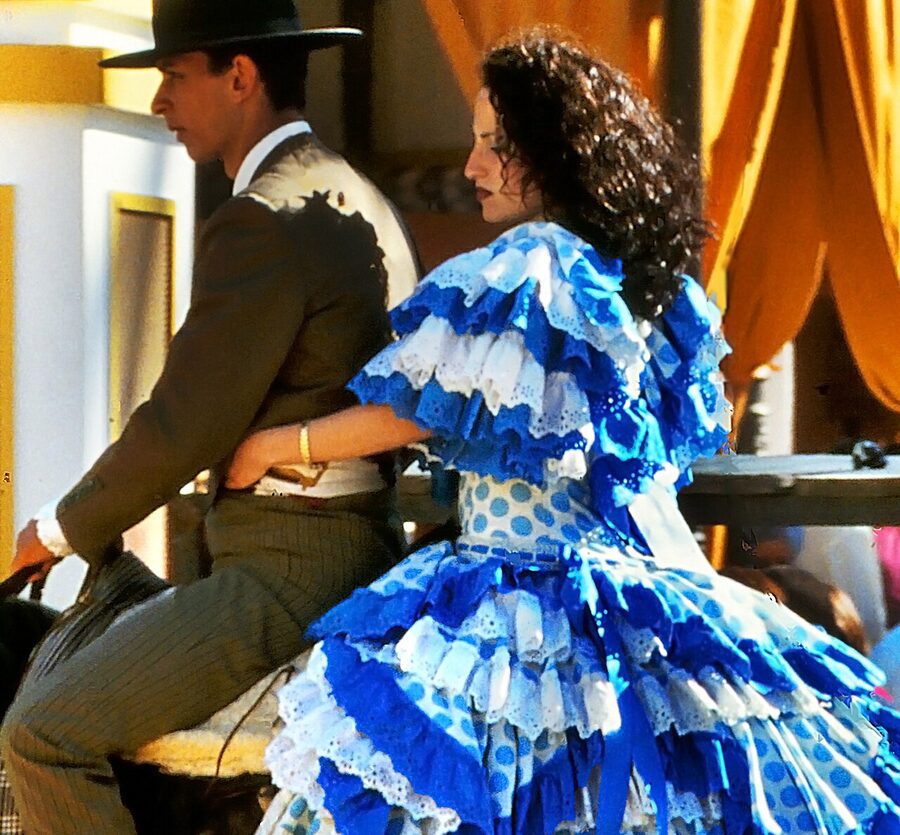
Once a year, in the second week of May, Jerez throws the Feria del Caballo. This is a full-week horse fair (declared a Festival of International Tourist Interest by the Spanish government in 1980) and it’s the moment when the city’s horse culture pours out of the school and into the streets, the same kind of one-week-only national pilgrimage that fills the fields at Keukenhof in tulip season. There are riders in full Andalusian traje corto, women in trajes de gitana on horseback or on carriages, parades on the Avenida del Caballo, and a non-stop flamenco-bulería party in the casetas at the fairgrounds.
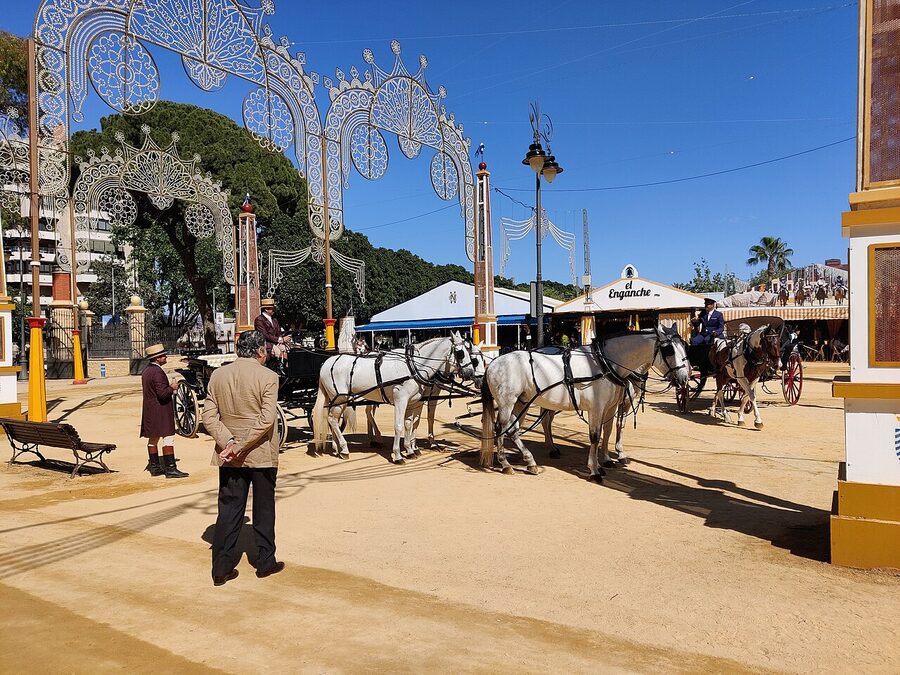
The school adds extra performances during Feria week, including evening shows, and tickets sell out at least two weeks in advance. If you can get to Andalusia in the second week of May, this is an extraordinary thing to land in. If your trip dates are flexible, plan around Feria. If they’re not, the regular Tuesday-Thursday-Friday show year-round is still the show, with a slightly less crowded feel.
What to wear, what to bring
The arena is air-conditioned in summer. In winter (December through February) the indoor temperature is fine but the walk from the gate to the arena, plus any time in the museums, can be cold for southern-Spain standards. Bring a light layer year-round.
Footwear: closed-toe is fine, the school doesn’t have a dress code, but you’ll cross gravel courtyards between the museums and the arena. Heels are a bad idea. Smart casual to casual is the dominant register. Spanish audiences dress slightly nicer than tourist audiences but nobody’s looking.
What to leave at home: drinks (not allowed in the arena), large bags (the school checks them at security and there’s a small fee for the locker), and any expectation of taking photos during the show itself. You can photograph the grounds, the museums, and the entrance area before and after.
Getting to the school from anywhere in Jerez
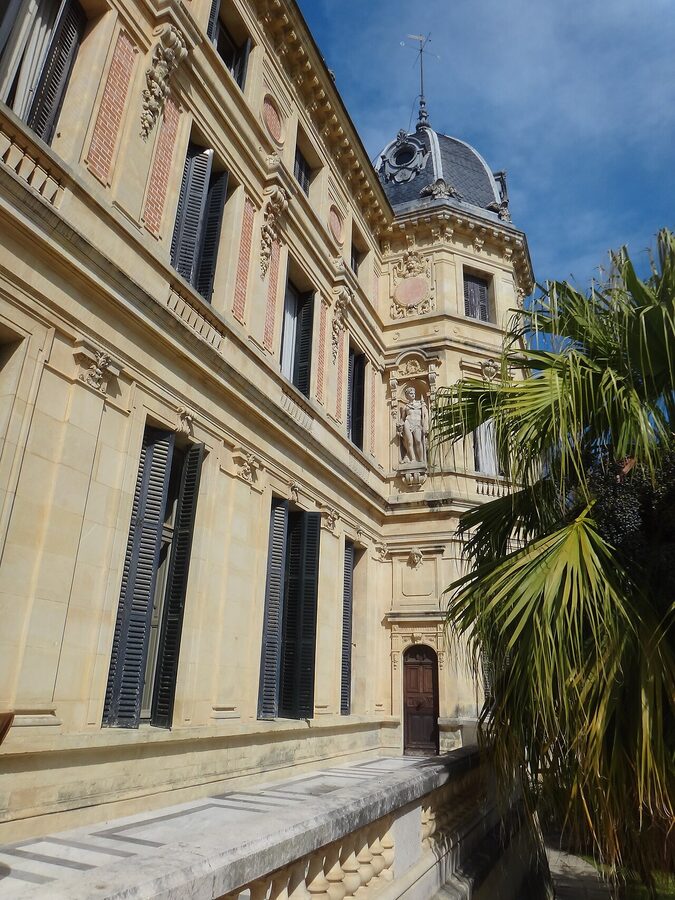
The Real Escuela is at Avenida Duque de Abrantes s/n. From the cathedral it’s a 22-minute walk north, mostly on flat sidewalks past Plaza de Mamelón and through the Parque González Hontoria. From the train station, 25 minutes by foot or 7 minutes by taxi (around €6). Jerez doesn’t have a metro and the city bus connections to the school are infrequent, so most travellers walk or taxi.
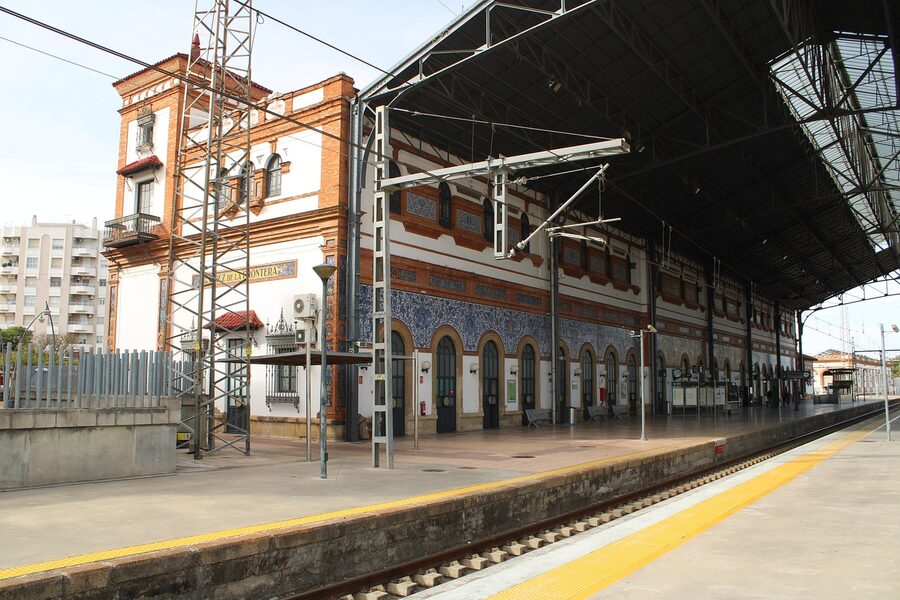
If you’re driving: the school has a small free car park on Avenida Álvaro Domecq (about 50 spaces) which fills up by 11:30 on show days. The Plaza del Arenal underground car park (about 12 minutes’ walk) is your fallback. Driving in central Jerez is mostly fine outside of Feria week; in May, don’t.
The Jerez airport route, if you’re flying in
Jerez has its own airport (XRY), 8 km north-east of the centre, with seasonal connections to London Stansted, Dublin, Frankfurt, and a handful of Spanish cities. Most international travellers arrive into Seville (SVQ), 90 km north, or Málaga (AGP), 200 km east. From either airport the train via Seville-Santa Justa station is the cleanest route to Jerez. From Málaga the journey is closer to four hours including the change in Seville; consider just renting a car if you’re spending a few days touring Andalusia.
Recommended bookings
These are the three tickets I’d actually consider for a trip to the Real Escuela, ranked by what makes sense for which traveller. All three are bookable online with free cancellation up to 24 hours ahead.
1. How the Andalusian Horses Dance, the show ticket: $31
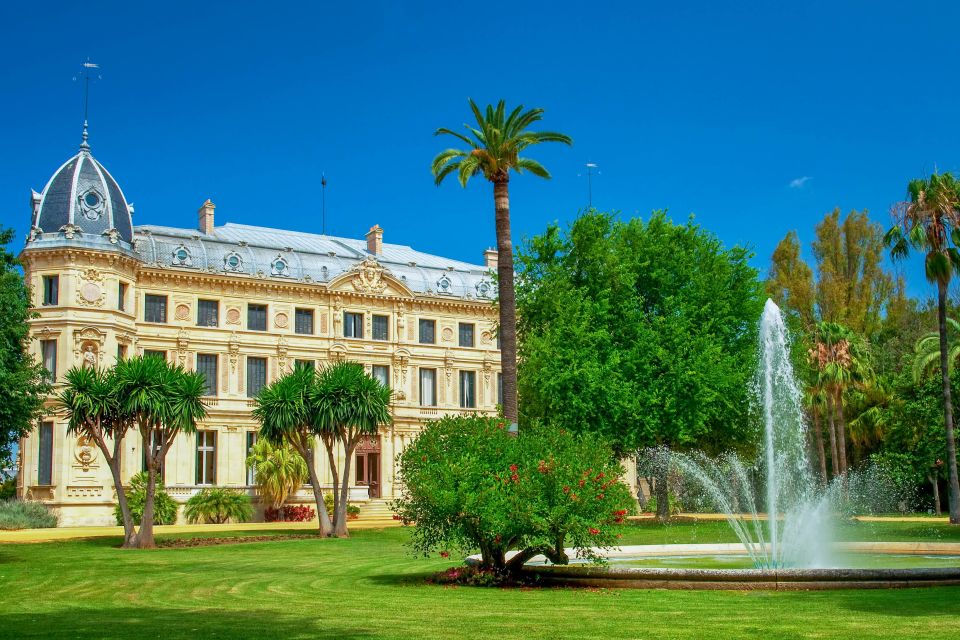
This is the right pick if you have a half-day in Jerez and want the show without the museum visit. The standard seat is in the upper general tier, which is also the section I’d choose anyway. Our full review of the show ticket covers what to expect from each price tier and how to choose between rows.
2. Andalusian Horse Dance and Museums combo: $38
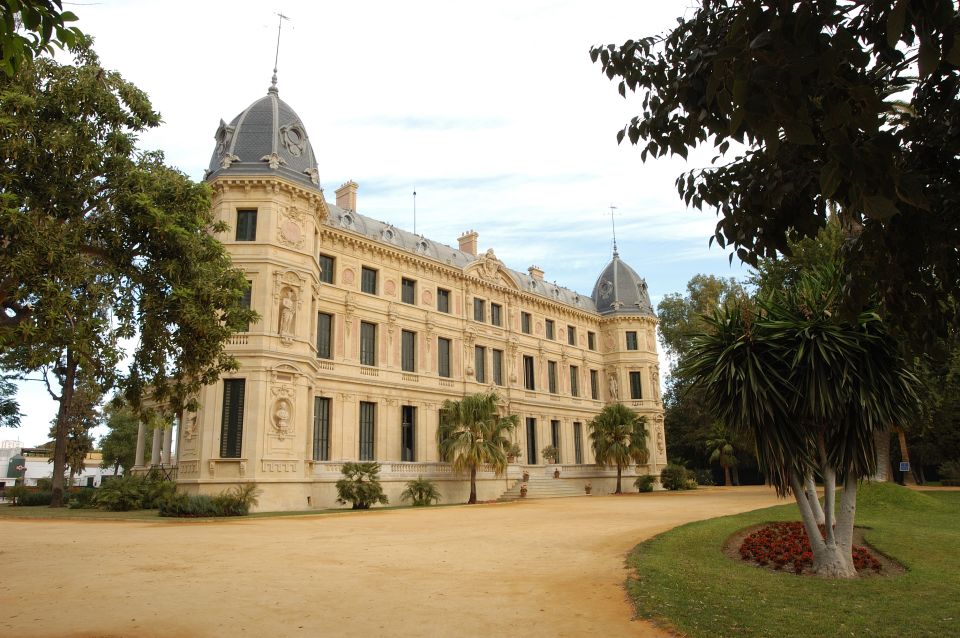
This is the right pick if your morning’s free and you’d like the broader context before the noon performance. Our full combo review walks through which exhibits are worth the slow read and which to glance and move past. The carriages and the 19th-century riding manuals are the highlights.
3. Cartuja Stud Carthusian Horses Tour: $22
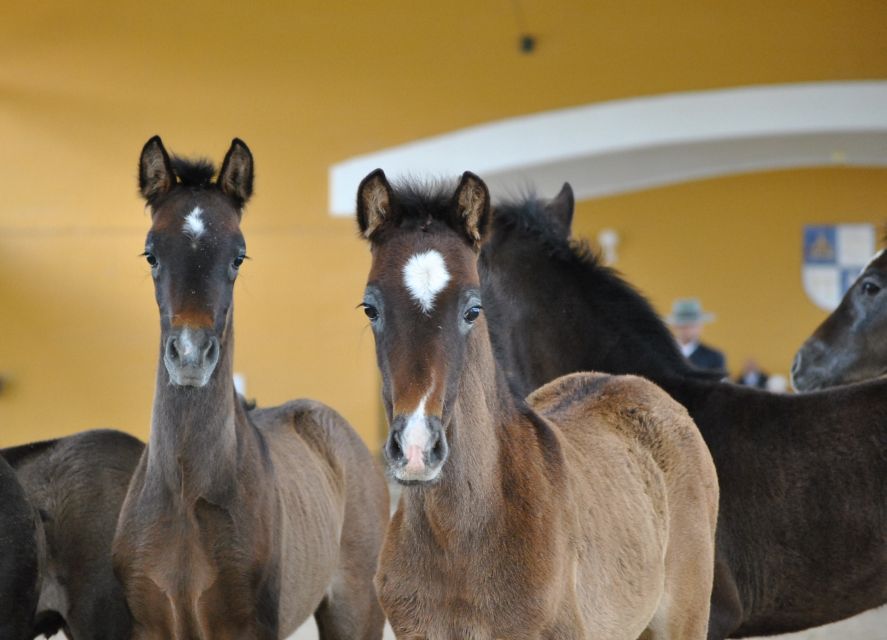
The right pick if you’re already a horse person, you’d rather see the breeding work than the polished show, or the Royal School is sold out for your dates. Our Cartuja review notes that this is Saturday-only and runs about 2.5 hours, which makes pairing it with the school’s Friday show the natural two-day plan.
One final framing
The reason the Royal Andalusian School matters, beyond the spectacle, is the same reason that a small group of Italian violin makers in Cremona still hand-build instruments to a 17th-century template. The work isn’t more efficient than the modern alternative; it’s better, in a measurable, hard-won way that takes a generation of practice to reproduce. The school has chosen to keep the practice alive at a moment when most of the equestrian world has moved to faster, more commercial, more easily-replicated forms. The 90 minutes you spend in the arena is the visible end of an enormous, patient, deeply Spanish project. Worth showing up for.
If you’re building a longer Andalusian itinerary, the natural pairings are the Alcázar of Seville for the Mudéjar architecture that Jerez has in smaller doses, the Mezquita-Catedral of Córdoba for the era when this part of Spain was a Caliphate, the Caminito del Rey for a hike day, and a flamenco-bulería evening anywhere in Triana or right here in Santiago and San Miguel. For the Italian-spectacle parallel, the closest thing in Europe is the historic-venue classical music tradition at La Fenice in Venice: same idea of a working classical institution that lets the public in for a single 90-minute window. Both are best understood as practices first, performances second.