
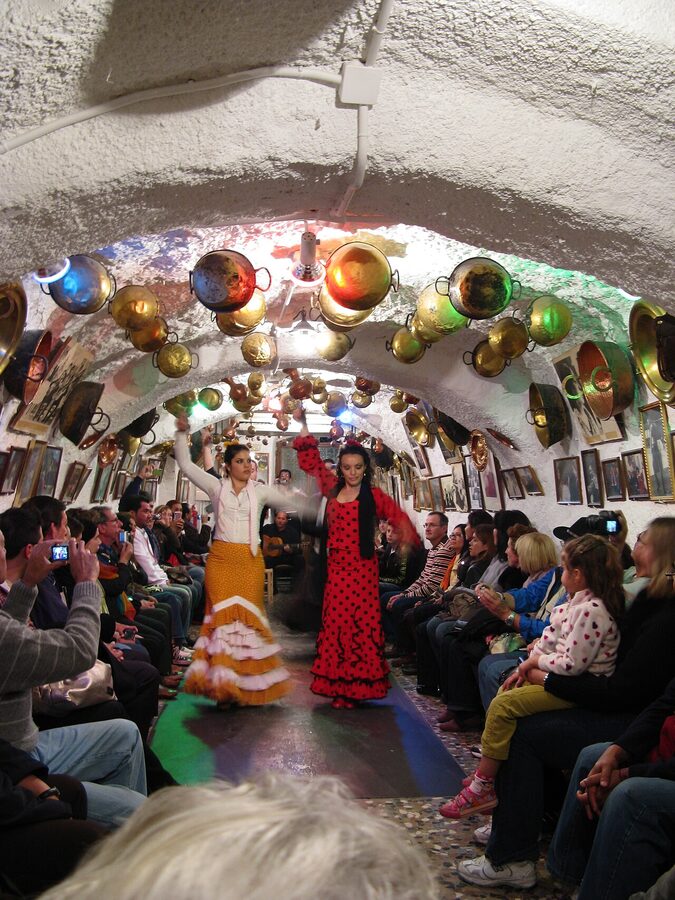
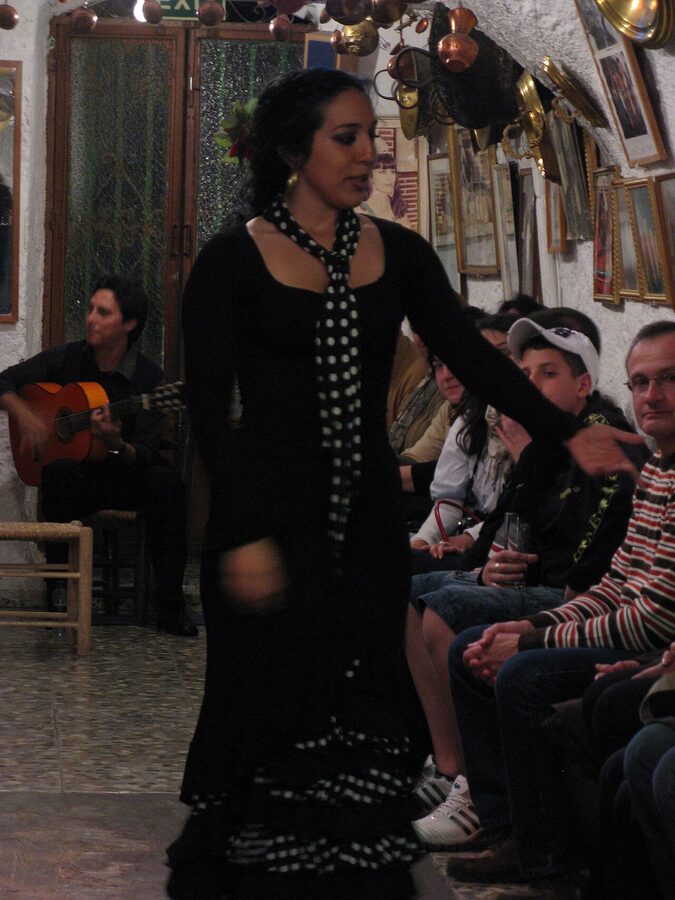
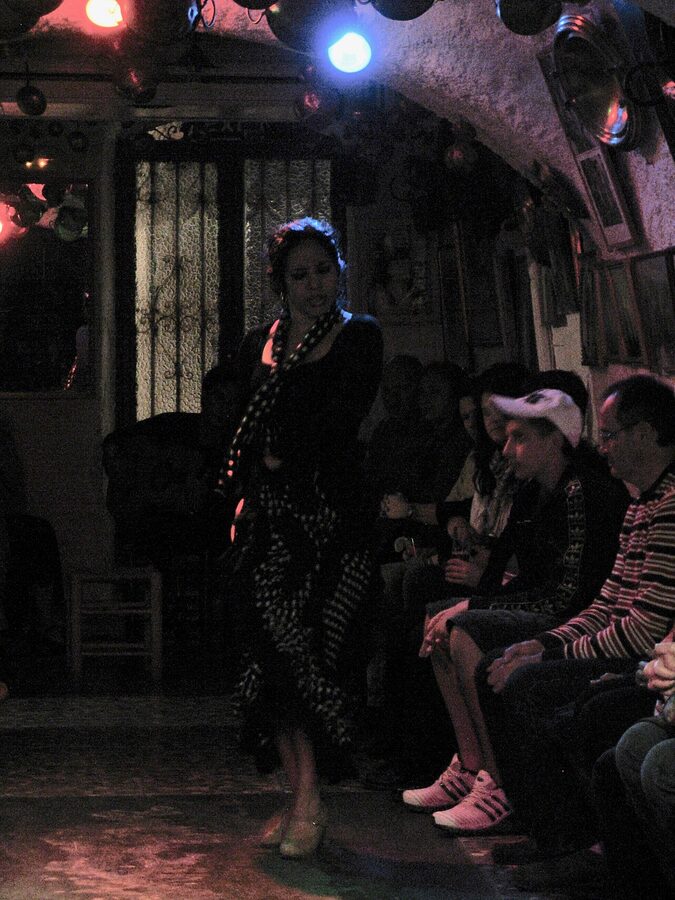
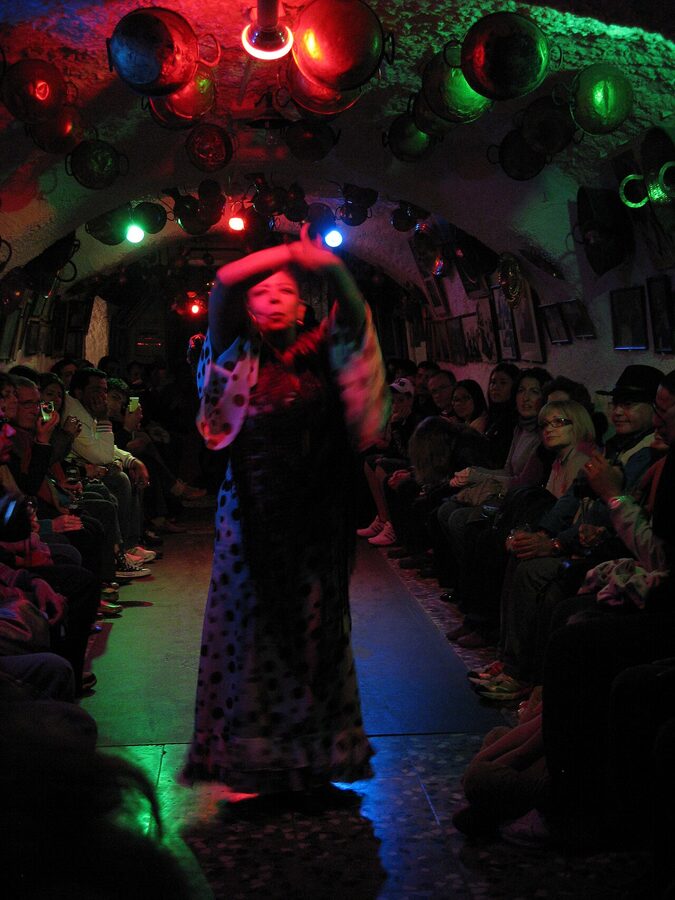
The dancer is twenty centimetres in front of you. The platform under her heels is a single board, maybe a metre square, raised about ten centimetres off the cave floor, and when she starts to hammer it the sound moves up through your shins before it reaches your ears. There is no microphone. There is one guitarist on a wooden chair, two singers clapping palmas at the wall, a string of dried garlic and copper pans nailed above the row of plastic stools where you are sitting, and a single bare bulb in a wire cage. The ceiling is white-painted rock about a hand’s-width above your hairline. The whole room smells of dust and warm plaster.
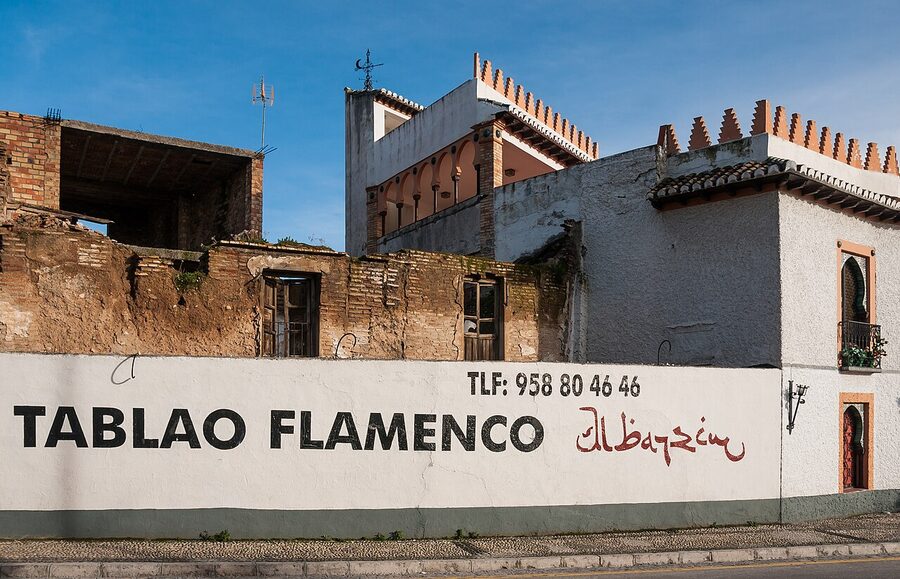
That’s flamenco in Sacromonte. Not flamenco in a tablao. Not flamenco in a theatre. Flamenco in a cueva, in the Romani neighbourhood opposite the Alhambra, with the genre that only exists here.
What flamenco in Granada actually is, and why it’s not Seville
If you’ve already seen flamenco in Seville, throw out the template before you book. Seville is the homeland of the cantes flamencos puros, the canonical solo forms (soleá, siguiriya, alegrías) performed in the great tablaos of Triana and Santa Cruz and increasingly in restored 18th-century palaces. Big stage, theatrical lighting, a programme that walks you through the styles in order. It is, for what it’s worth, the technically purer art form. The same template applies in Madrid’s tablao circuit, just with more touring stars and less of a Triana neighbourhood feel.
Granada is a different animal. The flamenco performed in Sacromonte is called zambra mora, and it’s a Romani-Andalusian-Berber fusion that doesn’t exist anywhere else in this form. The “mora” part is the Moorish lineage. Zambra was originally a Romani wedding ritual that absorbed elements from the Moors who lived in the same hillside before the 1499 expulsion, and the word itself comes from Arabic zamra (wind instrument). What you see now is a compressed three-act ritual: la cachucha, la alboreá, la mosca. Wedding dance, dawn dance, departure dance. It’s older than what they sing in Seville, and it’s faster, and it’s louder, and it’s much, much closer to your face.
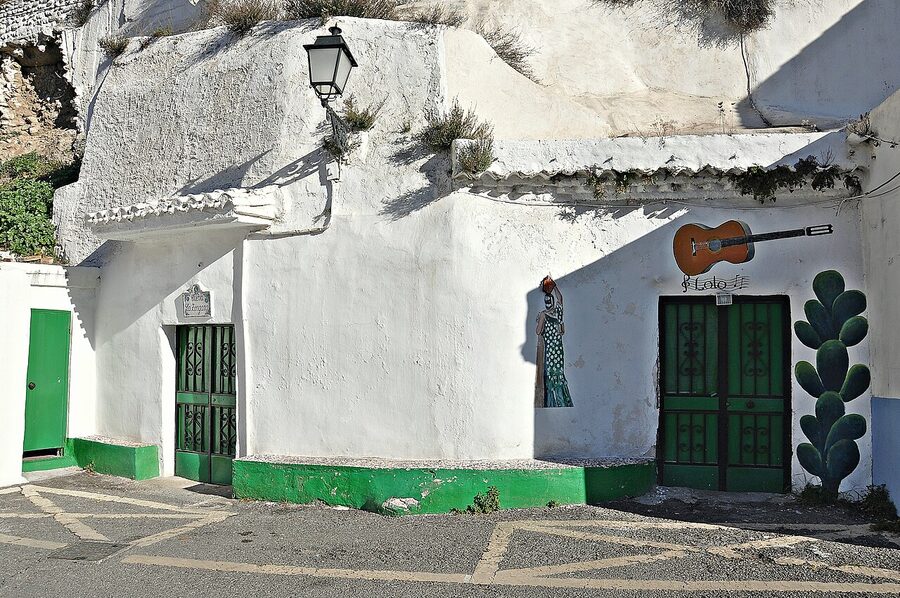
The other big difference is the room. In Seville the performance is on a raised stage with stadium seating. In Sacromonte the “stage” is a wooden plank ten centimetres off the floor, the audience sits on plastic or wooden chairs lined up against the cave walls in a long L or U, and the dancer’s heels are sometimes literally between two punters’ knees. Capacity is forty to sixty. There’s no curtain. The performers walk in through the same door you came through, often clutching a coffee.
So if your question is “where do I see better flamenco” the answer is genuinely Seville. If your question is “where do I sit two metres from a bailaora and feel the floor shake when she stamps”, that’s Granada.
In a Hurry: My Top 3 Sacromonte Picks
- La Alboreá ($21): Cheapest cave-show ticket in Granada with a tasting plate; near-perfect for first-timers. Book on GetYourGuide
- Cuevas Los Tarantos ($33): The classic Sacromonte zambra venue, in business since 1972, includes a complimentary drink. Book on GetYourGuide
- ZINCALÉ in the Sacromonte Caves ($23): Romani-led ensemble with an explicit zambra programme; 50 minutes, no padding. Book on GetYourGuide
Why Sacromonte exists at all
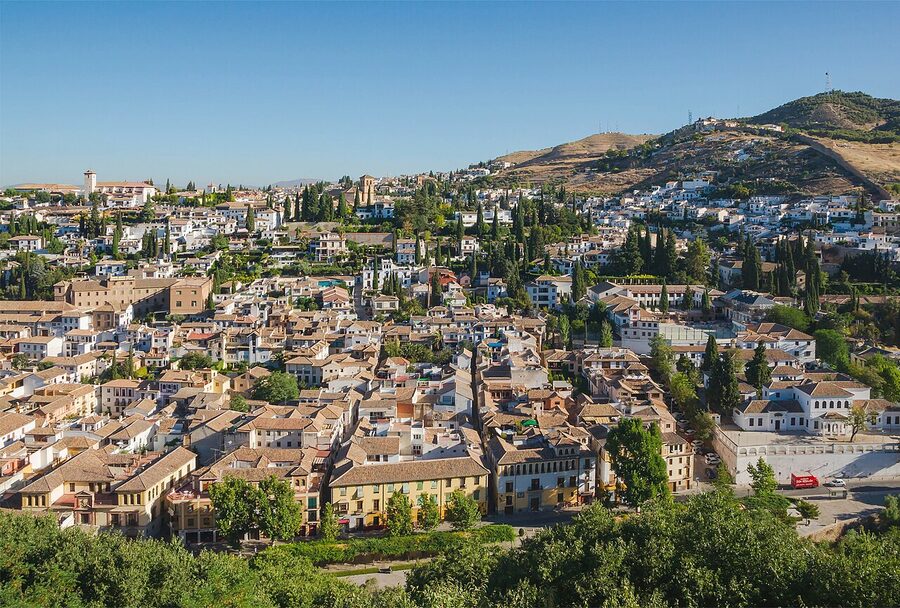
You can’t separate the show from the neighbourhood, so it’s worth understanding what you’re sitting inside. Sacromonte is a hillside opposite the Alhambra, on the north slope of the Valparaíso valley. Roma communities settled there in the 15th and 16th centuries after being pushed out of central Granada following the 1499 expulsions, and they did what poor people do when they can’t afford a house: they dug into the hill. The clay subsoil is soft enough to cut by hand and stable enough to hold a roof. By the 19th century there were perhaps two thousand cave dwellings on the slope. Romantic-era travellers like Washington Irving and Théophile Gautier wrote about them with the usual mix of fascination and condescension, the same condescension you’ll see in 19th-century English accounts of the Alhambra and the Nasrid Palaces just across the valley, and in the same generation’s Belle Époque dancer paintings now hung at the Musée d’Orsay.
Two events almost ended the place. The first was the floods of 1963, which collapsed dozens of caves overnight and pushed most of the population into apartment blocks down in the city. The second was the slow grind of tourism, which from the 1950s on commercialised the surviving zambras until they became a kind of self-parody: feathered headdresses, castanets snapping at the back of the room, a hard sell on a “free” sherry. By the 1980s “Sacromonte flamenco” was the cliché your guidebook warned you off, the same way Catalan tourist tablaos get warned off today, and the same warning runs on a red-light walking tour in Amsterdam if you book the wrong operator.
The current generation pulled the form back. Around the year 2000, a clutch of Romani families went back to teaching zambra as ritual rather than spectacle, most famously the descendants of Manolete (Manuel Santiago Maya) and the Maya, Heredia, and Amaya clans. The cave I described in the opening is what most of them look like now: small, plain, lit by one or two bulbs, no microphones, no programme of “greatest hits”, the opposite of the wraparound projection rooms at Fabrique des Lumières in Amsterdam. The floor is wood. The wall is rock. That’s it.
Where the cave shows actually are
The active zambras are clustered along two parallel streets running east up the Sacromonte hill: the lower one is Camino del Sacromonte, the upper one is Vereda de Enmedio. From central Granada, you walk up Cuesta del Chapiz from the Albaicín, past the Casa del Chapiz, and the road forks. Lower fork, lower zambras. Upper fork, the older Romani caves higher up. The whole walk from the cathedral takes about twenty-five minutes, and it’s uphill, and you’re going to be doing it in the dark on the way back.
The names you’ll see most on booking sites:
- Cuevas Los Tarantos: the granddaddy, on Camino del Sacromonte, opened 1972, runs three or four shows a night.
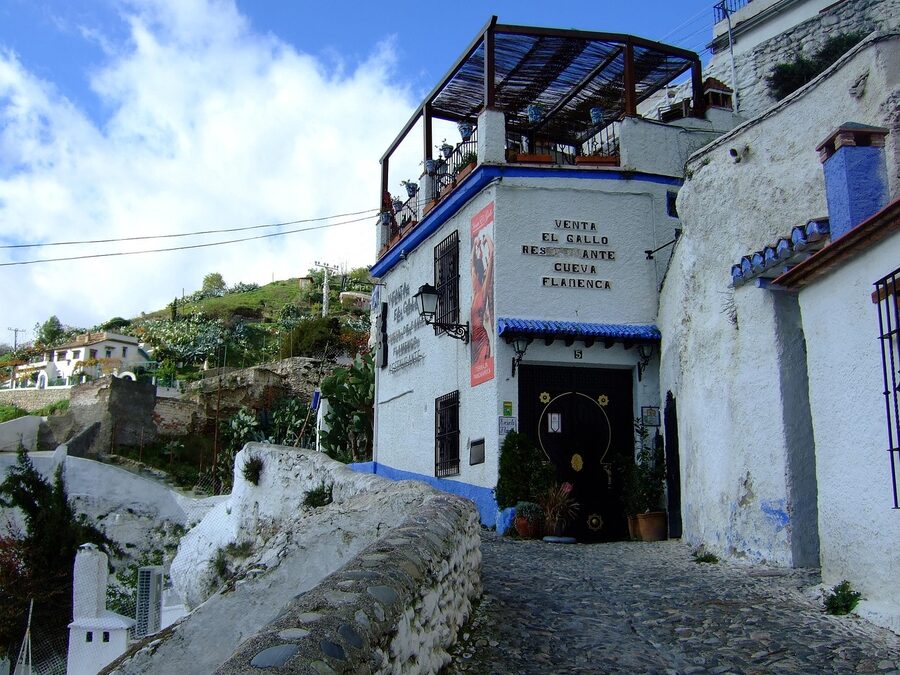
- Venta El Gallo: slightly more polished, with a restaurant attached, sits opposite the Sacromonte Abbey end of the road.
- María La Canastera: named for the Romani matriarch who hosted Frank Sinatra and Brigitte Bardot in the 1960s; the family still runs it.
- Cueva de la Rocío: older Romani zambra higher up the hill, smaller, more atmospheric, a bit harder to find.
- Templo del Flamenco: newer venue, more theatrical staging, broader programme.
- Casa Ana and Tablao Casa Ana: sits between zambra and tablao; Albaicín side rather than full Sacromonte.
- La Alboreá: the cheapest entry point, more of a tablao than a true cave but very close.
- Jardines de Zoraya: Albaicín-based with garden seating; not technically a cave show.
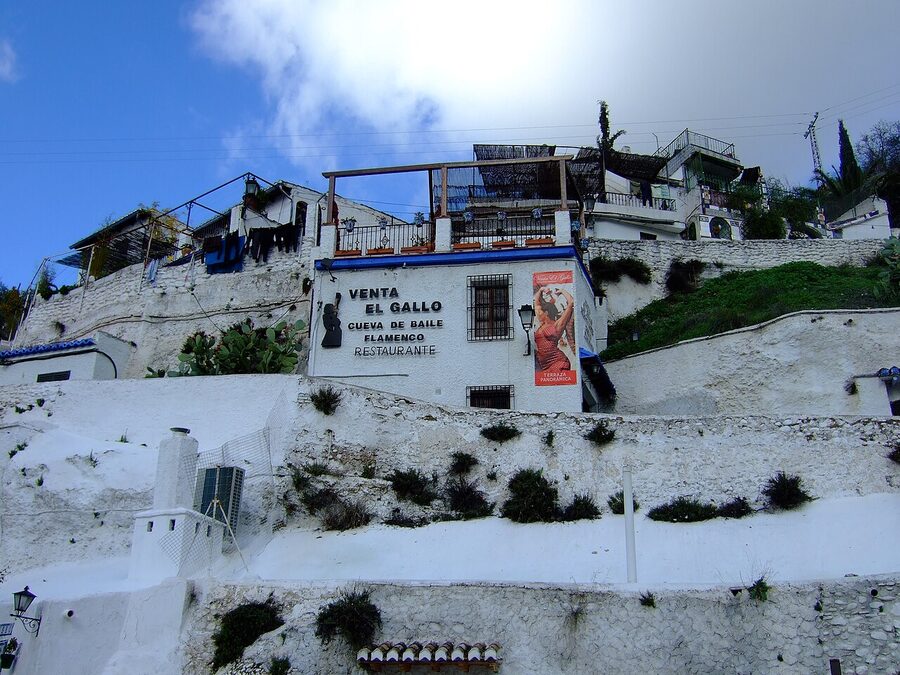
So the choice. Los Tarantos is the safest first bet because it’s what zambra looked like in the 1970s, frozen, and that’s not a bad thing. ZINCALÉ at the Sacromonte Caves is the most “current” of the Romani-family shows. La Alboreá is the cheapest because it’s not a true cave and the room is bigger, but the dancers are working musicians and the price is unbeatable. María La Canastera and Cueva de la Rocío are the connoisseur picks. Smaller rooms, harder to book, and the night I went to Rocío there were eleven people in the audience and the singer made eye contact with each of us in turn.
The three picks I’d actually book
Three tours, in order of “cheapest workable option” to “real Sacromonte cave with a Romani lineage”. Pick one. They’re all about an hour, they all run multiple times a night, and any of them will give you the Granada experience. I’ve put the cave-shows-proper second and third because the Sacromonte address is the whole point, but the cheap option is real flamenco performed by working professionals. It’s not a tourist trap, it’s just not a cave.
1. Flamenco Show at La Alboreá: $21
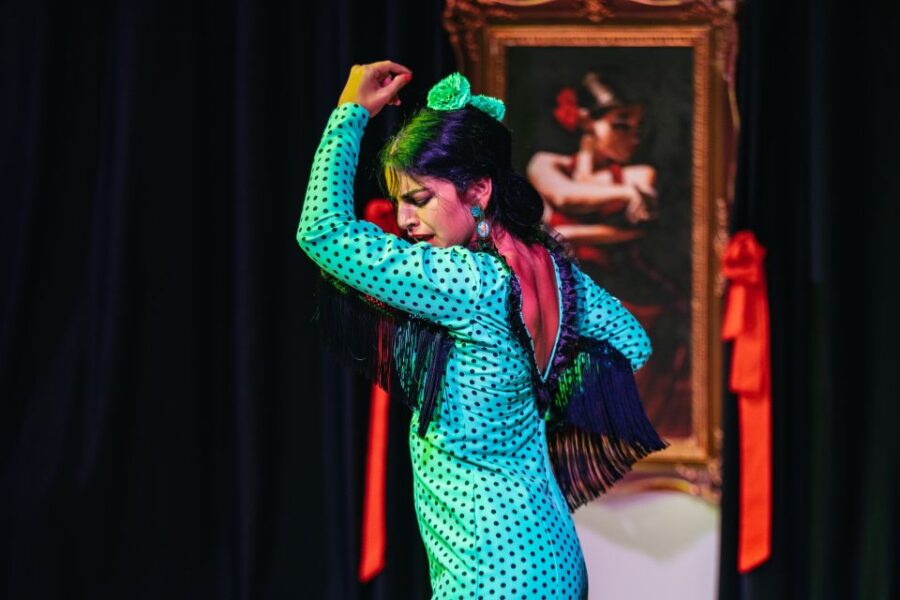
This is the right pick if it’s your first night in Granada and you don’t want to commit to the Sacromonte uphill walk. It’s a tablao on the Albaicín edge rather than a zambra in the caves, which our full Alboreá listing is upfront about, but for $21 with a tasting plate it’s the best value flamenco show in the city. Book the early slot if you also want to do dinner afterwards.
2. ZINCALÉ Show in the Sacromonte Caves: $23
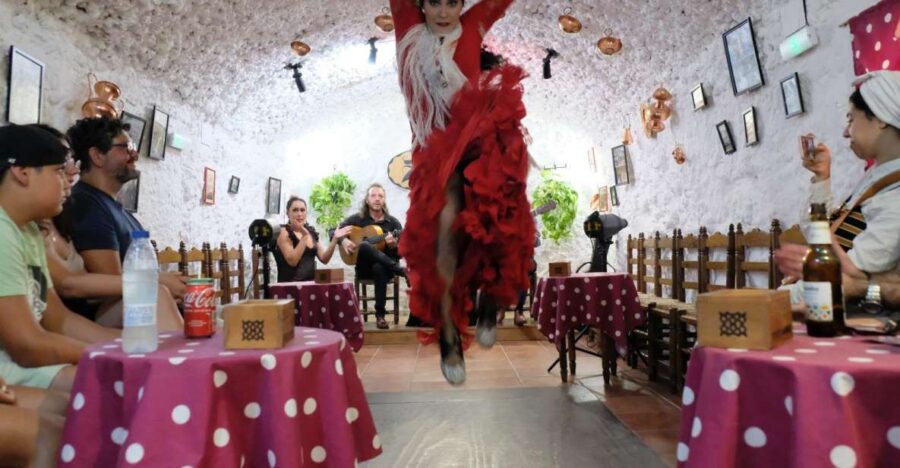
This is the value pick for a real cave on the hill. The ZINCALÉ programme is explicitly the zambra trio (la cachucha, la alboreá, la mosca) performed by a Romani-family ensemble in a low-ceilinged cave on Camino del Sacromonte. The ZINCALÉ booking includes the show only; arrive fifteen minutes early because the cave is small and the front row goes fast.
3. Cuevas Los Tarantos in Sacromonte: $33
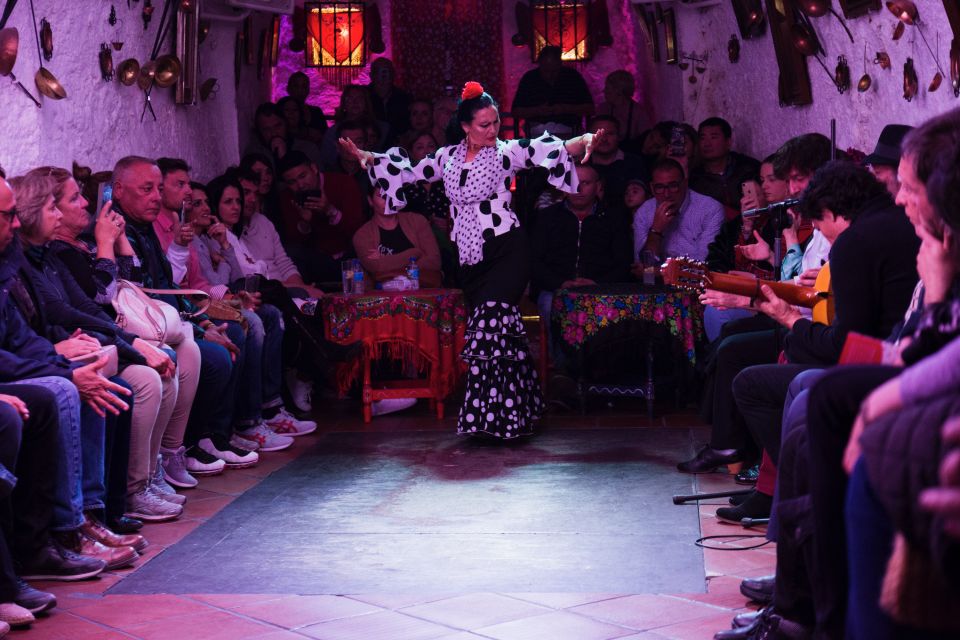
This is the pick if you want the textbook Sacromonte experience: rocking-chair seating against the cave wall, garlic strings overhead, copper pans on the rock, the works. Includes a complimentary drink, and our Tarantos guide covers the three-show schedule and which slot to book. Splurge a few euros for the front row.
What zambra mora actually contains
Most flamenco genres are solo turns. Zambra is a sequence. Three movements. They’re not interchangeable and you can’t shuffle them, because the sequence reproduces a Romani wedding ritual in compressed form.
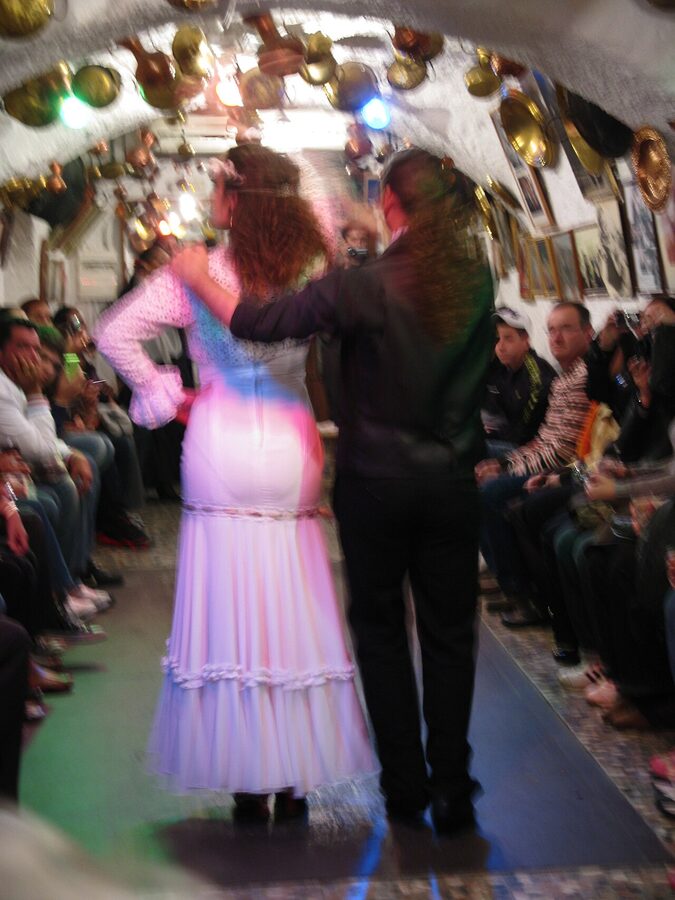
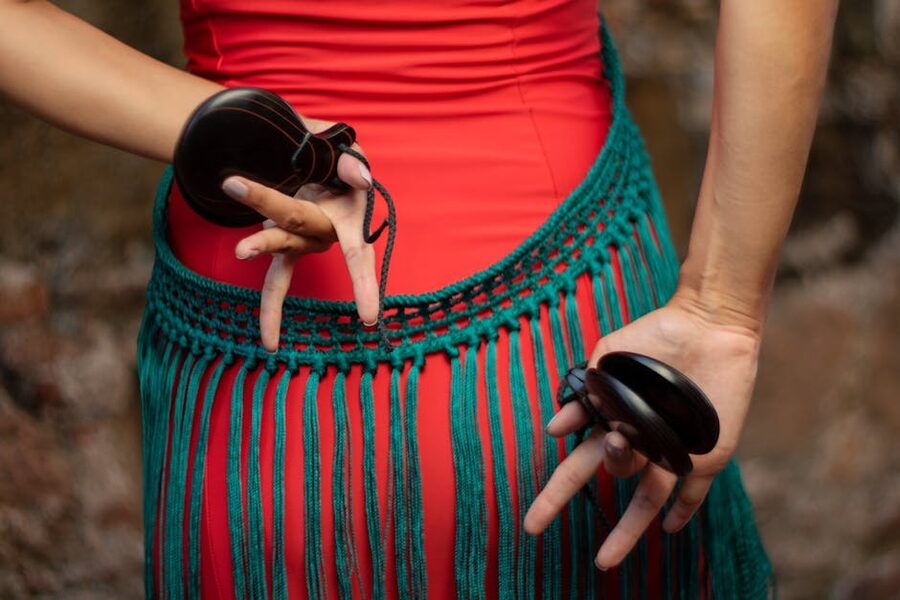
La cachucha is the bride’s first dance, slow and serpentine. It’s danced with raised arms and a lot of arm work. The Romani word for it is la mecedora, “the rocker”, because the body sways back and forth from the hips. Castanets are sometimes used here, sometimes not. There’s no zapateado (heel work) yet. It looks deceptively simple. It’s the hardest part to do well.
La alboreá is the dawn dance, performed by the bride and the groom together. It’s the only sacred song in flamenco and is traditionally never sung outside a wedding. In a tourist zambra it’s compressed and stylised, and yes, the Romani families are aware of the irony of singing it for paying foreigners every night. They sing it anyway. It’s the centrepiece. The sung text is in caló, the Romani-Spanish creole, and you will not understand the words even if your Spanish is fluent.
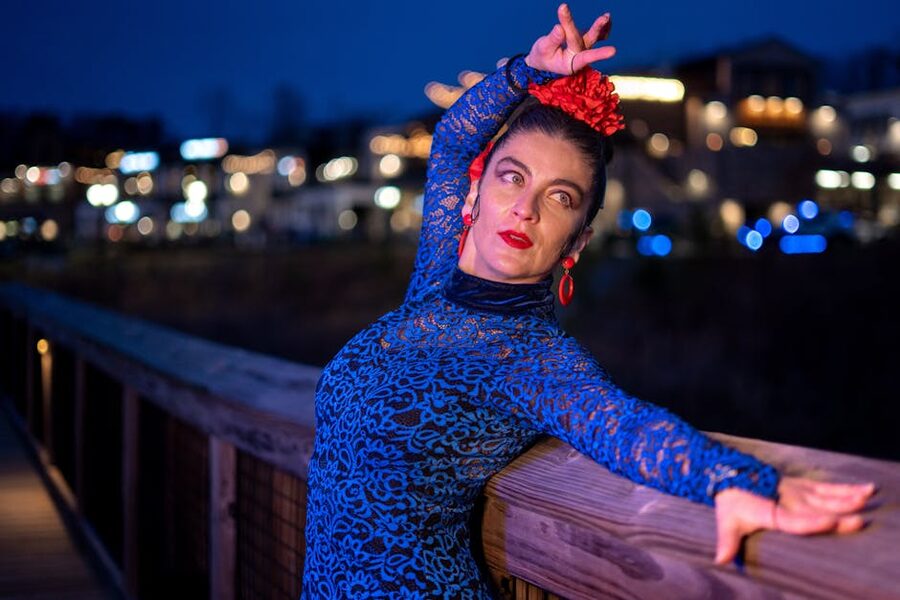
La mosca is the departure dance, fastest of the three, and this is where the heels finally come in. The dancer’s feet hammer the wooden plank in cross-rhythms against the palmas, and you’ll see why the platform is wood and not concrete. The whole point is the sound. A concrete floor swallows it. Wood, especially wood that’s been beaten by heels for thirty years, gives back a deep crack that resonates the whole cave.
The cave itself, and why it sounds like that
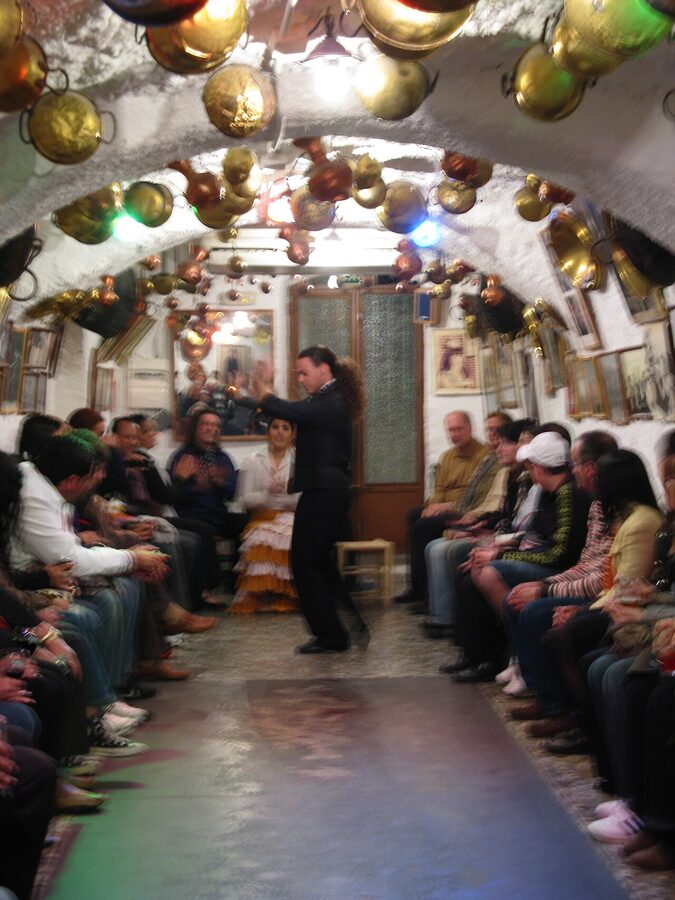
Most zambras are between fifteen and twenty-five metres long, two to three metres wide, and the ceiling at the deepest point is about two-twenty. The shape is roughly a tunnel that bends. You sit along the long walls, the platform is at the far end or the bend, and you face inward. The acoustics are why the whole thing works without amplification.
White-painted limestone walls reflect mid-frequencies but soak up bass (which is why the heels read as percussive crack rather than rumble) and the bend in the cave creates a single reflective focus where the bailaora stands. You can feel where it is when you sit down: there’s a specific spot in the room where the sound clarifies, and it’s always within a metre of the platform. Twelve people in the front row get the optimal acoustic. The next twelve get the experience anyway, but slightly muffled.
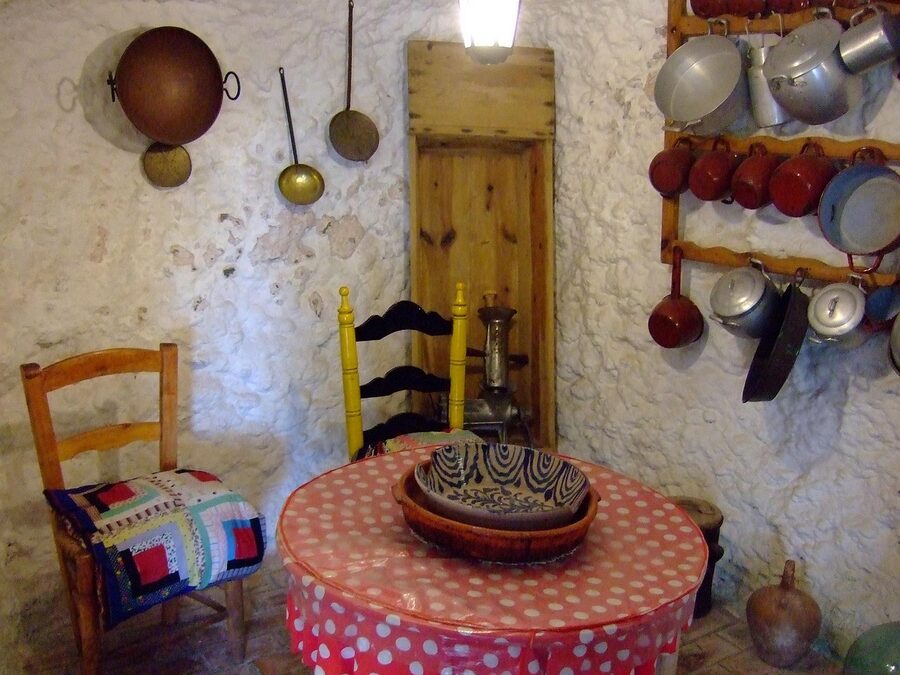
The decoration is functional, not theatrical. The copper pans on the wall above the platform are real cooking pans because the cave used to be a kitchen. The garlic strings are real because garlic stores well in cool, dry caves. The bare bulb in the wire cage is the one electrical concession. Older zambras used oil lamps until well into the 1960s, which is why the smoke stains on some ceilings are darker at the platform end than at the door.
One detail you only notice halfway through: there’s no air conditioning. There can’t be. Drilling into a cave wall destabilises the lime-wash and risks the ceiling. In summer it’s hot. In winter it’s surprisingly mild because the rock holds 16°C year-round. Bring a fan in July. Don’t bother with a coat in December.
How to get to Sacromonte and back
From the cathedral, walk Calle Elvira to Plaza Nueva, then take Carrera del Darro along the river. After about ten minutes you’ll pass under Cuesta del Chapiz; turn left there. Continue uphill to the Casa del Chapiz, then keep going as the road narrows and the surface turns to cobble. You’re now on Camino del Sacromonte. The first zambras are about three minutes further on the right.
The whole walk is about twenty-five minutes and the last fifteen are uphill. There’s no taxi rank at the Sacromonte end. Taxis can drop you at the abbey and you walk down to your venue, but flagging one back at midnight is hard. The C2 microbus runs from Plaza Nueva up Cuesta del Chapiz and along Camino del Sacromonte every fifteen minutes until about 11pm. It’s €1.40, you pay the driver in coins, and it stops by the door of most of the named zambras. After 11pm you walk.
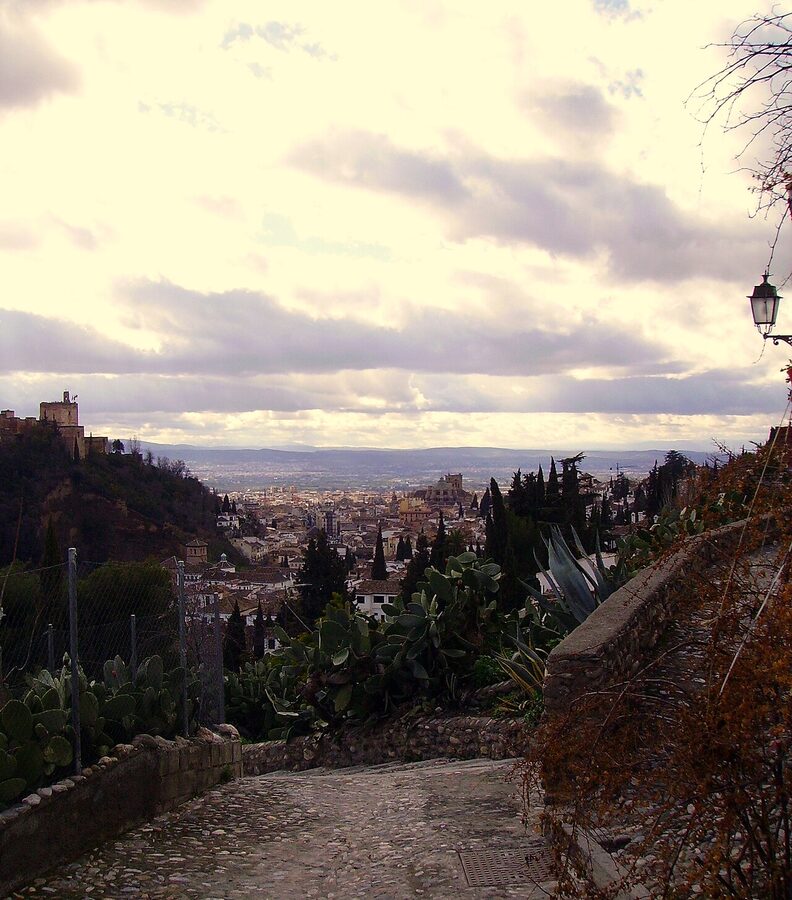
The walk back at night is fine. The road is well-lit at least as far as the Casa del Chapiz, there are usually other show-goers walking the same route, and Granada’s old centre is one of the safer European tourist quarters. Wear shoes that can handle cobble. Don’t wear heels yourself. The downhill is steeper than the uphill felt.
What to do that day before the show
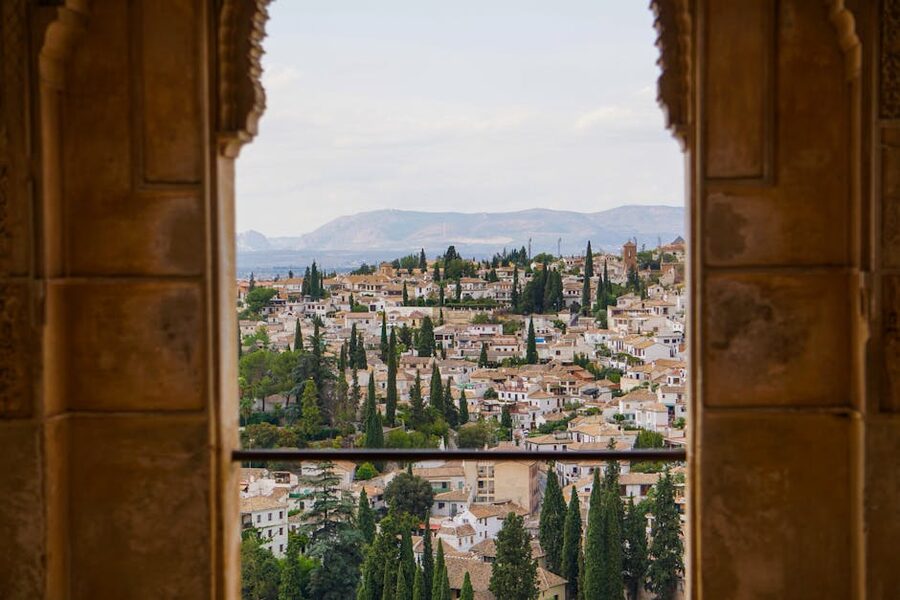
If you’re spending the day in Granada anyway, you’ve already booked the Alhambra and Nasrid Palaces, and the smart move is to time it so the morning is the Alhambra and the evening is Sacromonte. The Nasrid Palaces are best with a 9am or 10am Spanish-time entry slot, so you’re inside before the heat lands and you’re back in town for lunch. That gives you the afternoon to walk the Albaicín, climb to the Mirador de San Nicolás for the postcard view of the Alhambra, and come down through the Sacromonte side at sunset.
If you’ve got two evenings in town, I’d split it differently. The Granada equivalent of a relaxed first evening is the Albaicín tapas crawl: walk Calle Elvira, stop at any bar that’s busy, pay for one drink and you get a tapa free. That’s a Granada-specific custom that doesn’t exist in Barcelona’s tapas culture or even in Madrid. Two or three stops gets you a full meal. (If you’re doing the round-trip Andalusian loop after Granada, the equivalent in the next city is a Guadalquivir river cruise in Seville, but that’s a different evening.) Do the tapas crawl the night before the show, then the show is the second evening’s main event.
What times work, and when to skip
The standard show schedule is three slots a night: roughly 7:30pm, 9pm, and 10:30pm. The 7:30 is the family slot, often a bit perfunctory because the dancers are warming up. The 9pm is the main event and the one I’d book by default. The 10:30 has the smallest audience and often the loosest, most authentic atmosphere because the bailaoras have been performing all night and have stopped trying to please anyone. If you’re not tired by 10:30, that’s the one with the best stories.
Skip the dinner-show packages unless you really want one. The food at most zambras is mediocre. The kitchen’s an afterthought, the dishes are heated up rather than cooked, and you pay €30 to €40 more for what you could get at any tapas bar in town for €10. The exception is Venta El Gallo, which has a real chef and the Sacromonte view from the terrace, and even there I’d treat the dinner as the experience and the show as the dessert.
Also skip booking more than one show in a single night. Flamenco doesn’t work as a two-venue crawl. The first show locks the rhythm in your head and the second feels derivative even if it’s better. One show, one venue, one evening. Walk back through the Albaicín for a copa de manzanilla afterwards and call it.
The Sacromonte Caves Museum (and whether it’s worth it)
Up the hill past most of the active zambras is the Cuevas del Sacromonte ethnographic museum: eleven preserved cave dwellings showing how the Romani families actually lived, plus a small flamenco-history room. Entry is €5, it takes about forty-five minutes, and the views from the upper terrace are arguably better than the Mirador de San Nicolás because there are no other tourists.
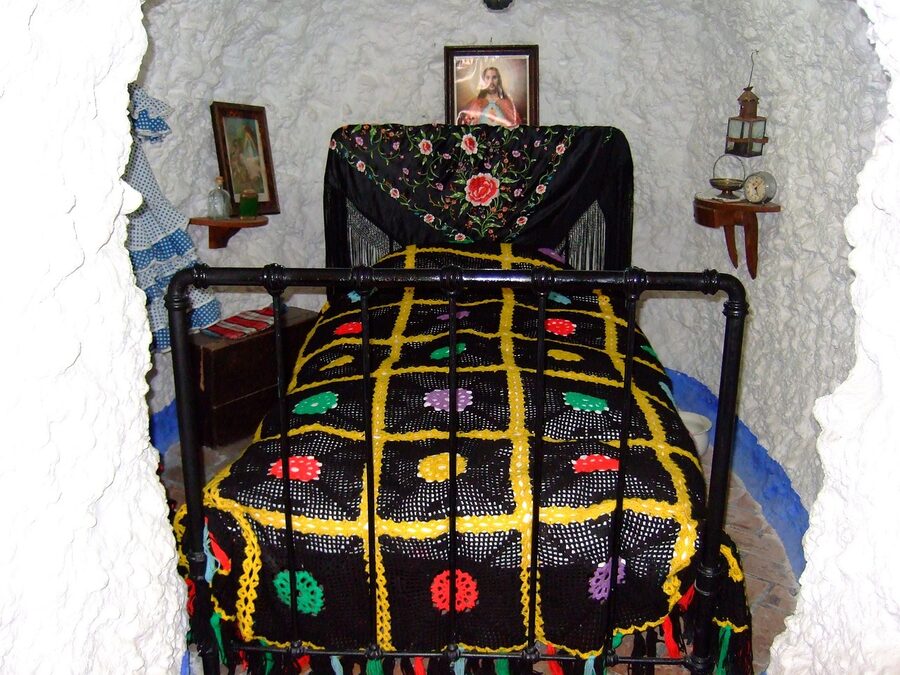
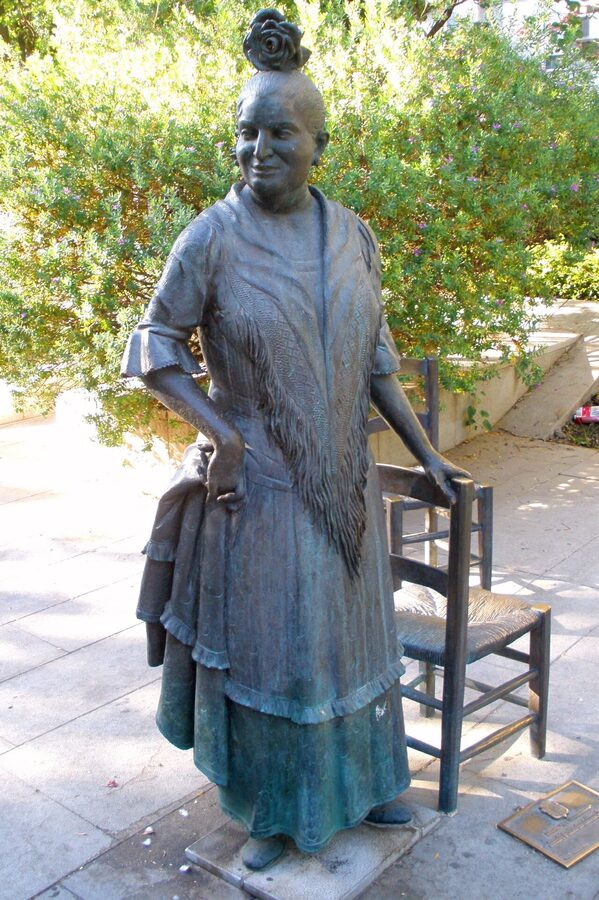
It’s worth doing if you’re going to a show that evening, because the museum context makes the show land harder. You see the cooking caves, the weaving caves, the basket-making caves (Sacromonte was famous for basketwork; María “La Canastera” got her stage name from the basket-weaver trade) and you understand that the zambra cave is a multi-purpose room that happened to have a wooden floor at one end. It’s not a theatre. It’s somebody’s grandmother’s kitchen, with the table moved.
The other flamenco circuits across Spain (and how Granada compares)
Granada is one of five major flamenco hubs and they each have a different argument for being where you should spend your evening. The argument for flamenco in Seville is that it’s the homeland of the canonical solo cantes and the technical bar is highest. The argument for flamenco in Madrid is that the touring circuit goes through the capital so the bailaores you see are more famous, even if they’re performing in a less atmospheric venue. The argument for flamenco in Barcelona is the weakest of the four. Catalonia isn’t flamenco country, the venues are tablaos built for tourists, and the Catalan-speaking locals don’t really go.
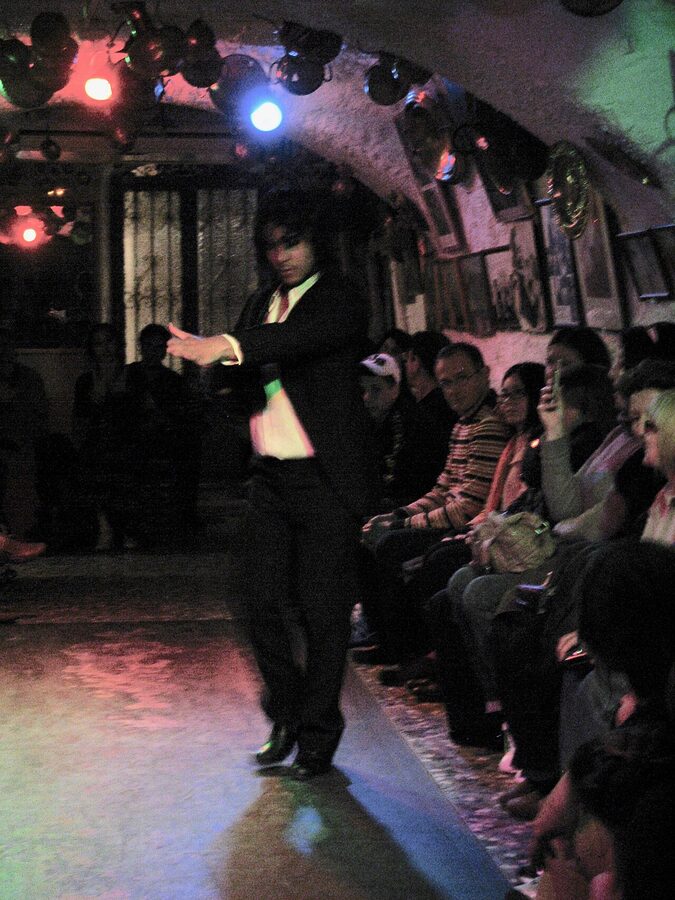
The argument for Granada is none of those things. It’s the room. Nowhere else in Spain do you sit two metres from a bailaora in a cave with no microphone and watch a Romani family perform a wedding ritual that’s six hundred years old. It is, in pure technical terms, not the best flamenco. In experiential terms it’s not even close. Once you’ve done a Sacromonte zambra, the Seville tablao reads as a stadium concert and the Moulin Rouge in Paris reads as full theatre: technically superior, emotionally further away.
Booking, prices, and the practical bits
Most Sacromonte zambras sell tickets through GetYourGuide and Viator at the same price as the venue’s own door. The platforms don’t add a markup the way they do for the Alhambra. Book online so you have a seat reservation; cave shows do sell out, especially on Friday and Saturday at the 9pm slot.
Front-row seats are sometimes a separate ticket tier, sometimes first-come-first-served. If your booking doesn’t specify, arrive twenty minutes early and ask. The host usually walks people in based on order of arrival. A €5 cash tip after the show, handed directly to the bailaora or the guitarist, is appreciated and not expected. It’s the difference between a transactional and a relational evening, and the performers remember it.
Photography in most caves is fine before the show and during the curtain call but explicitly not during the performance. Phone cameras flash will earn you a stare. The reason isn’t precious. It’s that the bailaora is doing physical work in tight space and a flash at the wrong moment can break a heel turn. Put it down. You will not get a good photo from a cave anyway. The lighting is wrong and your phone will give you blurry orange smears. Buy a postcard.
What to wear and what to bring
Anything. Tourists turn up in jeans and trainers, locals in shirt sleeves and skirts, the occasional couple in their fanciest clothes for the experience, and none of it is wrong. The cave doesn’t care. The one thing I’d avoid is anything bulky (coats, big bags, hats) because the seats are narrow and packed and there’s nowhere to put a backpack except under your knees.
Bring a small bottle of water in summer. Bring nothing in winter. Cash for the tip and the bus. A pen if you want to scribble down the names of the cantes in the order you heard them, because the host will introduce them in fast Spanish and you will forget by the time you leave the cave. Don’t bring earplugs. The whole point is the volume.
Common mistakes and how to dodge them
Booking the dinner-show package because it sounds romantic. The dinner is mediocre and you’re paying €40 extra for it. Eat tapas in the Albaicín first, then go to the show.
Booking a Sacromonte show on your last evening because you want the “memorable finale”. The walk back is uphill and at midnight, and you’ve got a 7am train. Book it on the second or third night and use the last night for an early dinner near your hotel.
Booking two shows in two consecutive nights at different venues. By the second show you’ll be comparing the bailaoras’ technique rather than feeling the music. Pick one venue. If you really want to see two, do them three nights apart.
Believing a tout in Plaza Nueva who tells you he can get you a cheaper ticket. He can’t. The marked-down price is for a different show, often at a venue that’s not even on Sacromonte, and the tout takes a cut. Book through GYG or Viator at the listed price. The €2 difference isn’t worth the hassle.
Trying to do an Alhambra evening visit and a Sacromonte show on the same night. The Alhambra night ticket starts at 8pm in winter, 10pm in summer. The Sacromonte 9pm slot doesn’t fit either. Pick one or the other for the evening, do the other in daylight.
What zambra teaches you about flamenco
The thing you take away from a Sacromonte cave is the realisation that flamenco was never a stage art. It’s a domestic ritual that became a stage art only in the 19th century, and the further back you push it the more it looks like what you’re seeing in the cave: a small group of people in a small room performing for each other, taking turns leading, the audience clapping along when they know the rhythm. Zambra is the closest thing left to that pre-stage form, and Sacromonte is the only place it survives in any quantity.
That changes how you watch every other flamenco show afterwards. You start noticing the spaces: how far the front row is from the dancer, whether the floor is wood or laminate, whether the cantaor is mic’d or not, whether the palmas are coming from inside the ensemble or from a recorded track. Most tourist tablaos fail at least two of those tests. The Sacromonte caves pass all four. That’s not nostalgia. It’s an acoustic and architectural argument about what flamenco was meant to be.
If You Have More Time in Andalusia
If you’re heading west after Granada, the obvious next stop is Seville for a proper canonical flamenco evening at one of the older tablaos. The contrast with Sacromonte is the entire point. From Seville the loop continues to Córdoba (the Mosque-Cathedral is the architectural argument the Alhambra started, finished a few centuries earlier and a few hundred kilometres further west) and Málaga, which has its own smaller flamenco scene growing around the Picasso museum and Alcazaba district. If you’ve got a free day from Málaga, the Caminito del Rey cliff walk is the natural counterpoint to a flamenco evening: physical exposure after intimate cave. And if you started in Madrid, the Madrid flamenco circuit is worth comparing on the way home, partly because the bailaores you’ll see there are the touring stars, partly because it’ll let you say what makes Granada Granada and Madrid Madrid.