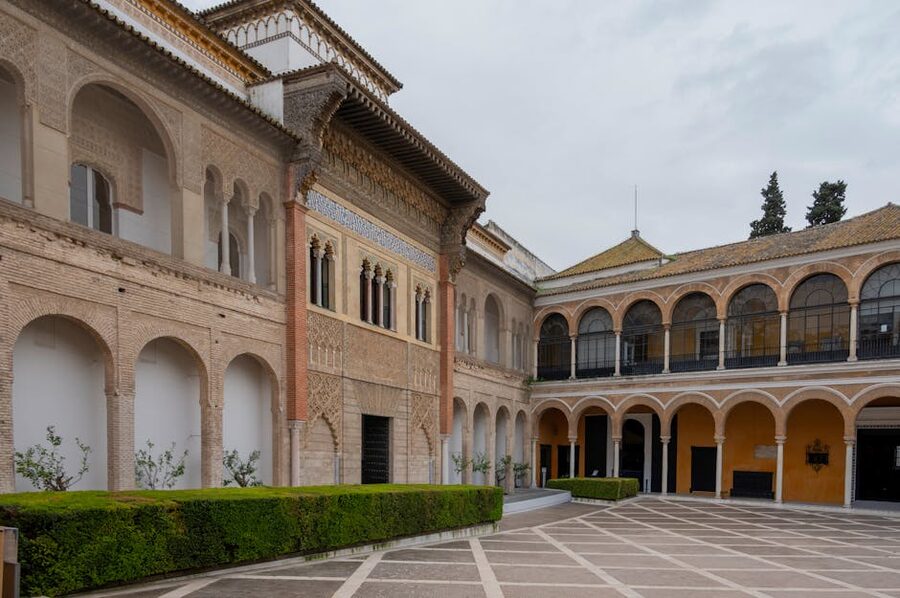
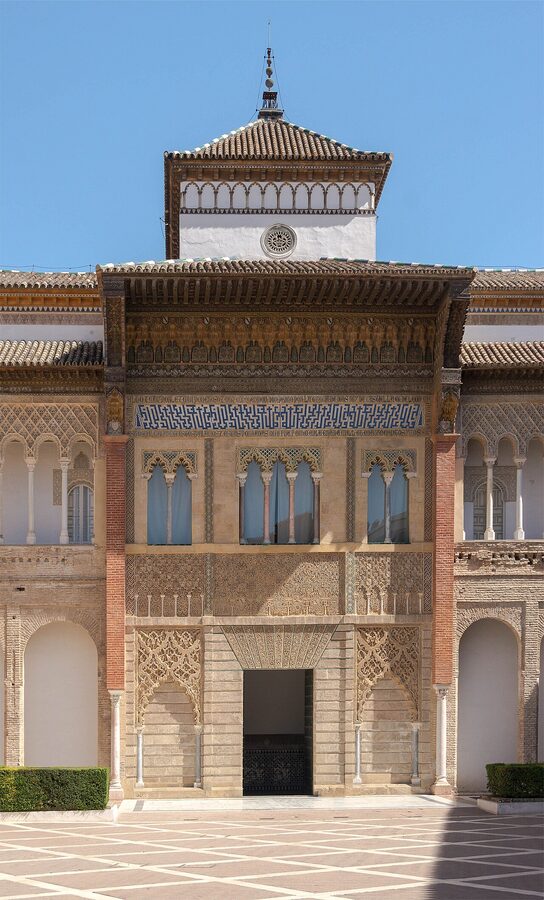
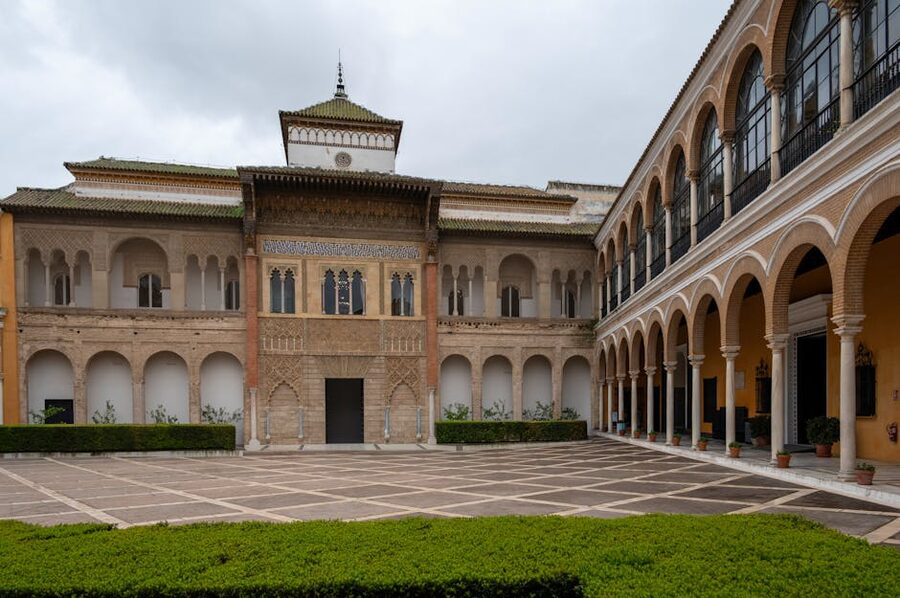
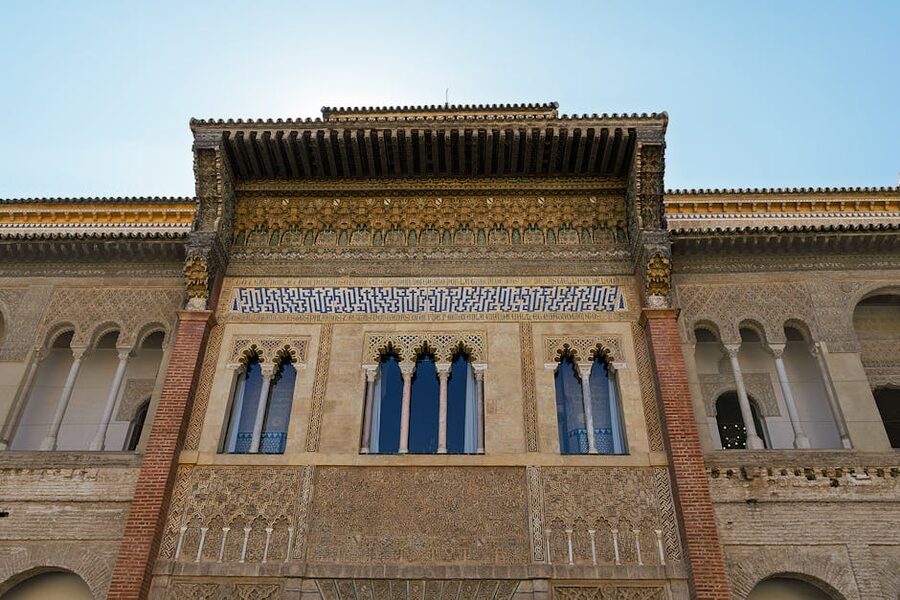
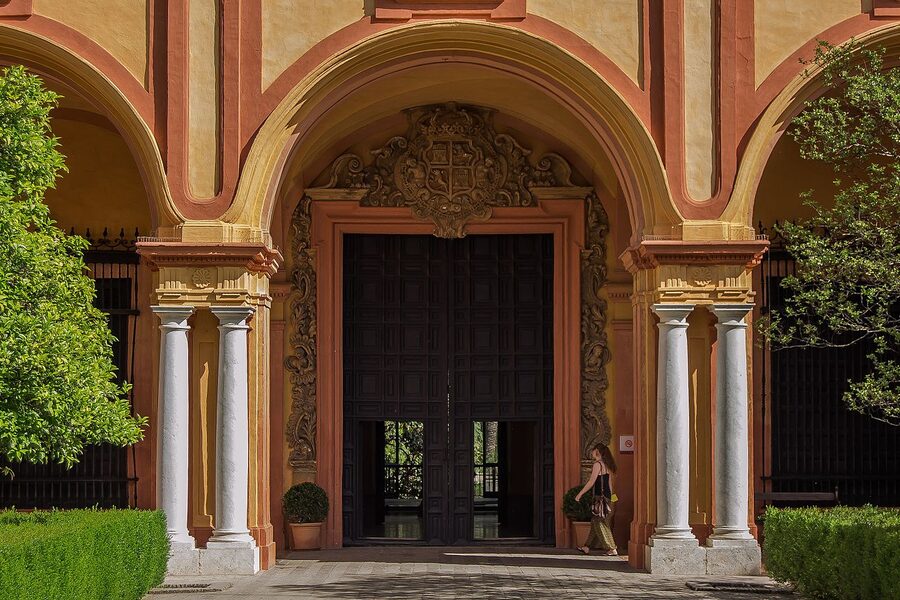
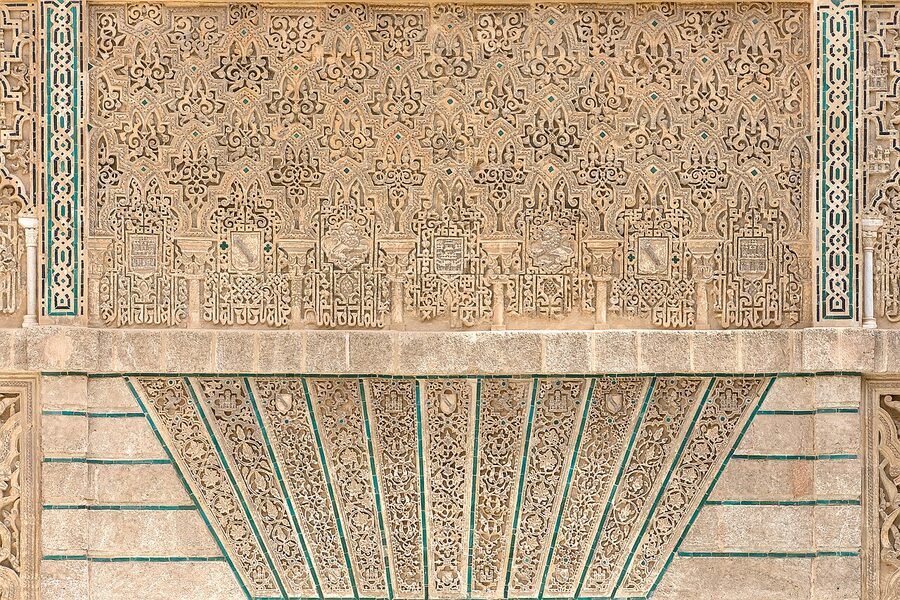
You walk through a low Almohad gate, cross the Patio de la Montería, and the first thing you see is the façade of Pedro I’s palace. It looks like a Nasrid surface from the Alhambra, all stucco lacework and tile, but the inscriptions running across it praise a Castilian Christian king in Arabic. Stop there for a second before you go inside. The whole rest of the visit makes more sense once you’ve understood what that one wall is doing.
The Real Alcázar is a working royal residence and Europe’s oldest palace still in use, in the same continuously-used civic-royal sense as the Royal Palace on Dam Square. Felipe VI’s family stays in the upper floors when they’re in Seville, which is also why visitor numbers are capped at 750 inside the complex at any one time. You’ll see signs of the cap before you see the architecture: a queue, a time slot on your ticket, a guard in a green jacket counting heads.
This guide walks you through the Alcázar the way a visit actually happens, patio by patio, with the booking practicalities up front. The historical layers (Almohad foundation, Mudéjar palace under Pedro I, Hapsburg additions, modern royal use) are the reason every courtyard looks different.
In a Hurry
Cheapest entry, ~$23: Royal Alcázar Entry Ticket. Time-slot entry, audio app on your phone. The default for solo travellers.
Best guided combo, ~$69: Cathedral, Giralda & Royal Alcázar Guided Tour. Three monuments, one morning, fast-track entry to all three.
Alcázar-only with guide, ~$44: Alcázar Skip-the-Line + Guided Tour. 90 minutes of walking commentary; the right pick if your trip is two days.
The Booking Reality
The Alcázar oversells itself. Online slots for the next day or two routinely show “sold out” two weeks ahead in spring and autumn, and the on-the-day queue at the Puerta del León gets long enough that you can hit the 750-visitor cap and not make it in before closing. Book online. Ideally a week ahead in low season, two to four weeks in high season.
The official site (alcazarsevilla.org) sells the cheapest direct ticket, but it sells out first. Third-party platforms get a separate inventory allocation, which is why you can find a same-day GetYourGuide slot when the official site is showing red. The price difference is a euro or two; the certainty is worth it.
What you pay
- General admission: €20
- EU students 14–30 and seniors 65+: €11.50
- Children under 14: €1.70 (still need a booked slot)
- Royal Apartments add-on (Cuarto Real Alto): roughly €5.50 extra, separate timed slot, very small group
- Evening visits (April to October): ~€14, four sessions per night, smaller groups
Skip the third-party “discount” sellers that promise the same thing for 35 euros. They’re reselling general admission with their own commission. The only real discount is the EU student card if you’ve got one.
When to go
First slot of the day (9:30am) or the last hour before closing. The middle of the day in summer is genuinely brutal: the gardens have shade but the queue at the Patio de las Doncellas can back up out into the sun. October to March it’s open until 5pm; April to October 28 it stays open until 7pm. Closed January 1, January 6, Good Friday, and December 25.
If your trip is squeezed and you can only do one big monument, do the Alcázar over the cathedral. The cathedral is grand and full of Columbus’s tomb (we wrote about it in where Columbus is buried in Seville), but the Alcázar gives you the city’s whole layered history in a single afternoon.
Audio guide vs. live guide
The official audio guide (an app you download to your phone, headphones essential) is fine. It does the job for the named patios and tells you who Pedro the Cruel was. A live guide on a small-group tour like the 90-minute Skip-the-Line + Guided is a different experience. They walk you to a wall, point at a band of stucco above eye level you’d otherwise have missed, and translate the Arabic. If you only do one royal palace on this trip and you also did the Royal Palace in Madrid, take the live guide here. There’s more to read.
The Top Three Tours
1. Royal Alcázar Entry Ticket: $23
This is the right pick if you’ve already read up on the building or you’re doing the audio app. Our review walks through what the ticket includes and what’s gated behind add-ons. The trade-off is that the named rooms have small placards but no real interpretation.
2. Cathedral, Giralda & Royal Alcázar Guided Tour: $69
This is the right pick for a one-day Seville stop. Our full review covers what the three-hour pace feels like and which guides we rated. Pace is brisk, you cover ground; the trade-off is less time inside any single building.
3. Alcázar Skip-the-Line + Guided Tour: $44

Pick this if you’re staying two or more nights and want depth on one monument. The guided walk covers the Mudéjar inscriptions, the Pedro/Maria de Padilla story, and the Columbus history without the cathedral pull-along.
The Patios, in the Order You’ll See Them
The visit isn’t a free walk. The route is one-way and most of the time you’ll move with the flow of your time-slot crowd. Here’s what you’re looking at, in the rough order it happens.
Patio del León (the entry court)
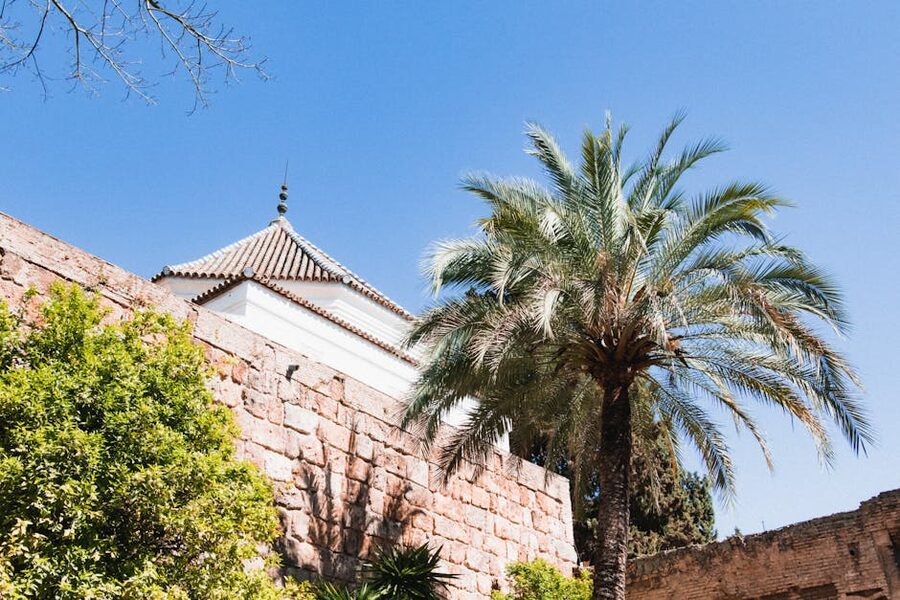
You come in through the Puerta del León, which is a double-walled Almohad gate from the late 12th century, and step into a wide gravel courtyard. The wall on your right is the original Almohad fortification: thick rammed earth, no decoration, military. Look up at the lion mosaic over the gate before you walk on. This first patio is doing nothing fancy. It’s the security check between the city and the palace, and twelve hundred years ago that was a real distinction.
Patio de la Montería
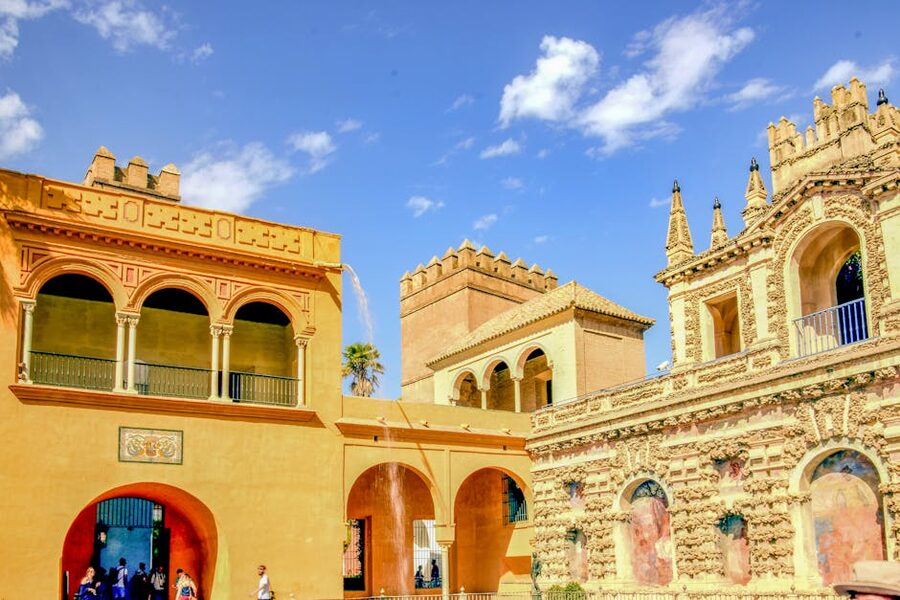
This is the one where most people stop and pull out their phones. It’s the open courtyard in front of Pedro I’s palace façade, and the façade is what you came for. The full stucco surface dates to 1364. The inscription band running across the top is in three languages: Castilian, Latin, and Arabic, all praising “the most high, noble and powerful conqueror Don Pedro.” The Arabic also includes a Quranic phrase: “There is no victor but God.” This was the calling card of a Christian king who wanted Nasrid craftsmen, hired them from Granada, and let them build a façade that read like a Muslim palace.
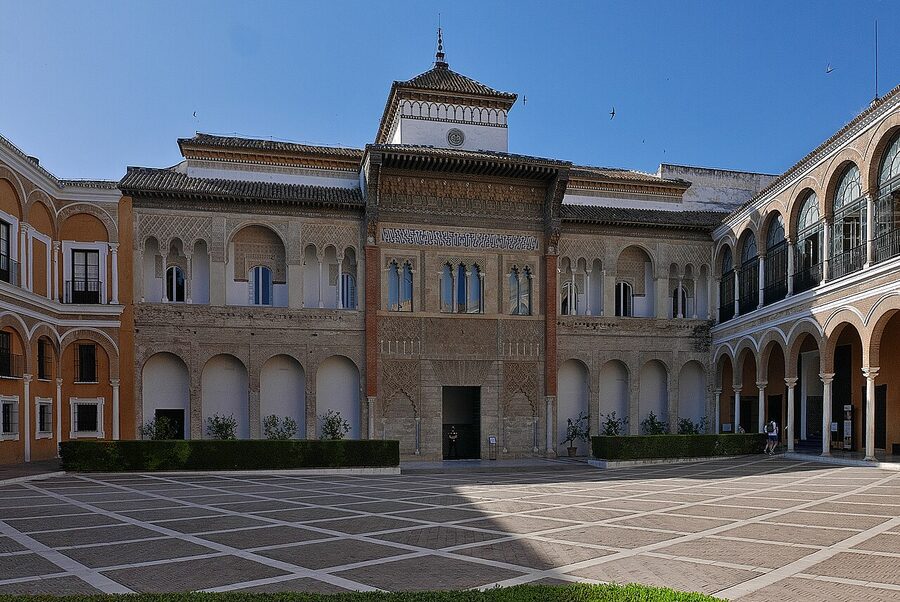
If you’re taking notes, the Mudéjar style means “Moorish craftsmanship under Christian patronage,” and Pedro I (1334-1369) is the king everyone’s talking about for the rest of the visit. He had a complicated romantic life, ordered several murders that earned him the nickname “El Cruel,” and was eventually killed by his own half-brother in a tent. He also commissioned this palace, which is why his name comes up so often.
Patio de las Doncellas (Maidens’ Courtyard)
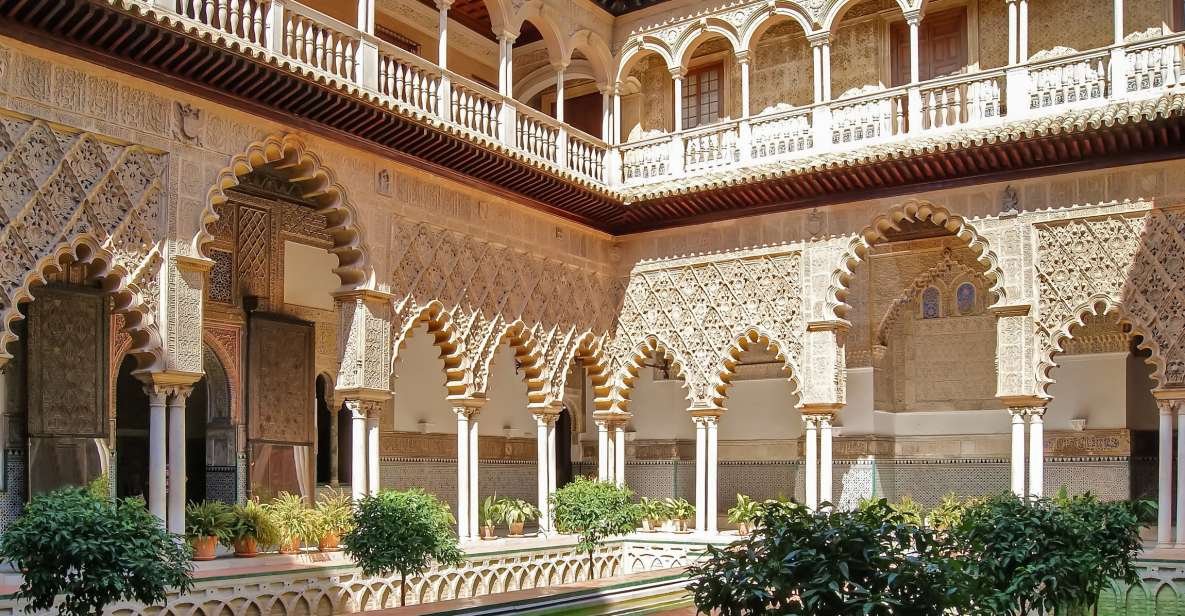
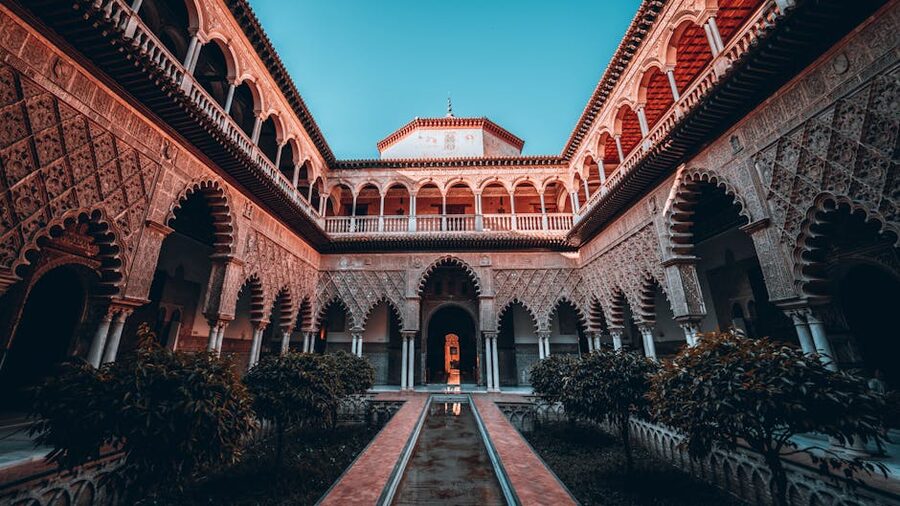
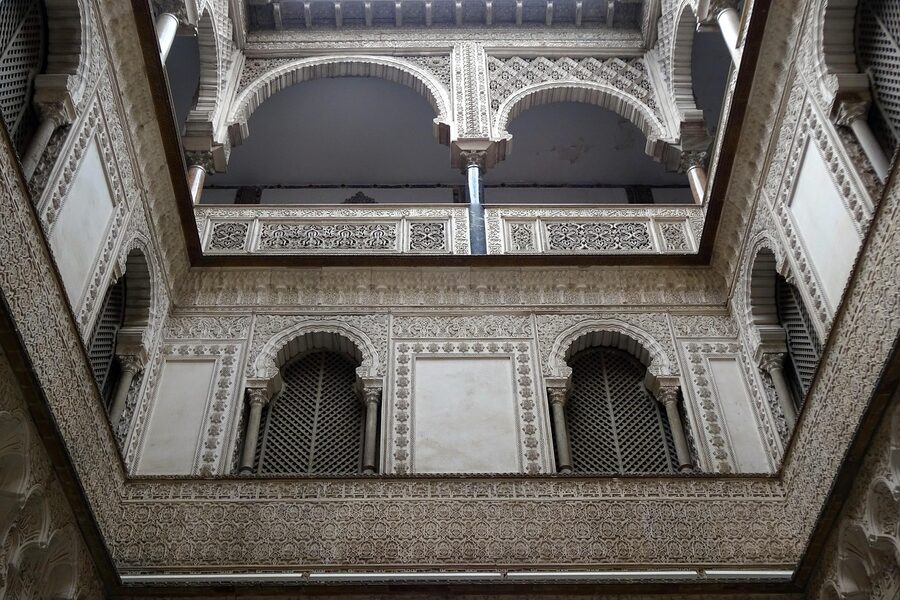
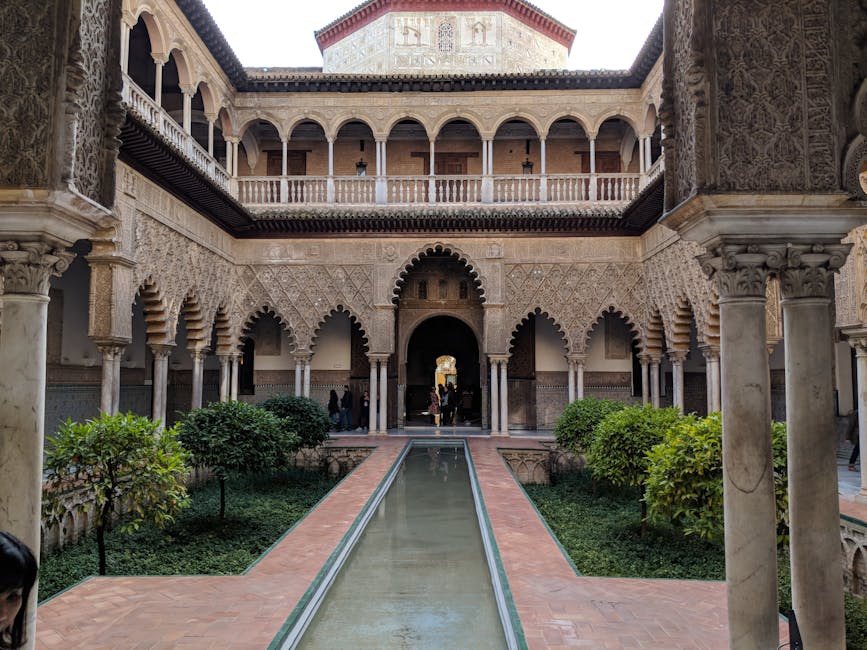
And this is the room you came to see. You go in through a low passage, your eyes adjust, and the proportions hit you all at once. About 50 metres long by 23 wide. A long sunken garden down the middle with a reflecting pool. Multifoil arches around all four sides, marble columns from Italy, stucco lacework above the arches that goes up two storeys. The upper floor is a Renaissance addition by Charles V; ignore that for now and just look at the ground level.
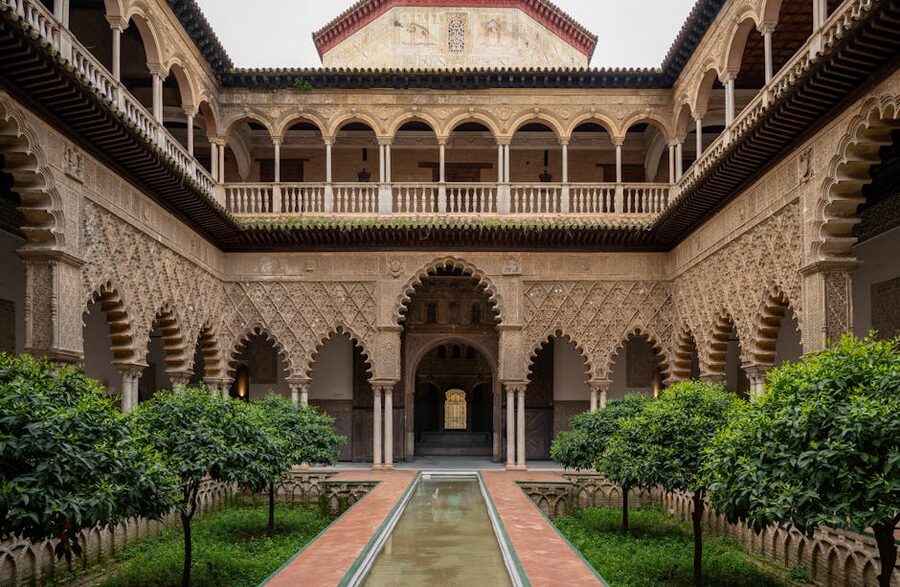
The name (Patio of the Maidens) comes from a legend that the Almohad emirs demanded an annual tribute of 100 Christian maidens from the Iberian kingdoms, and that the ceremony happened here. The legend is medieval propaganda; the courtyard is genuinely beautiful regardless. The reflecting pool was buried under a paved floor for centuries and only excavated in 2002, which means most of the older photos and paintings show the patio without it. Worth knowing if you’ve seen 19th-century engravings of the place and feel like something looks different.
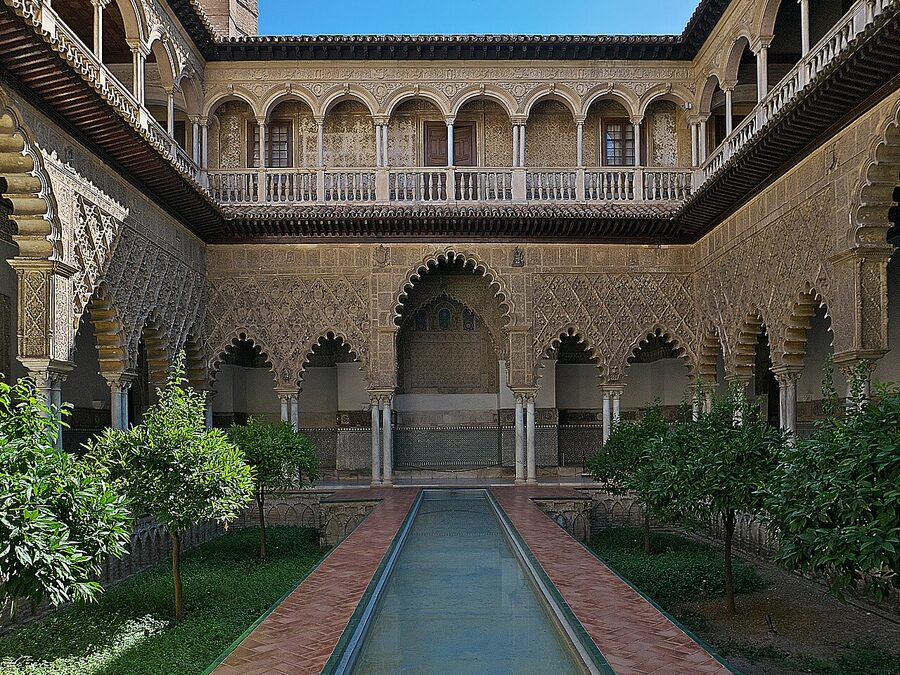
If your visit is rushed, the rest of the palace can blur. This room is the one to slow down for. Stand off to one side, let the time-slot crowd flow past, give it five minutes. The way the stucco frames the sky changes as you move; the upper galleries throw shadow patterns across the lower walls. This is the room they used in Game of Thrones as the Water Gardens of Dorne, but you’ll spot that quickly enough on your own.
Salón de Embajadores (Hall of Ambassadors)
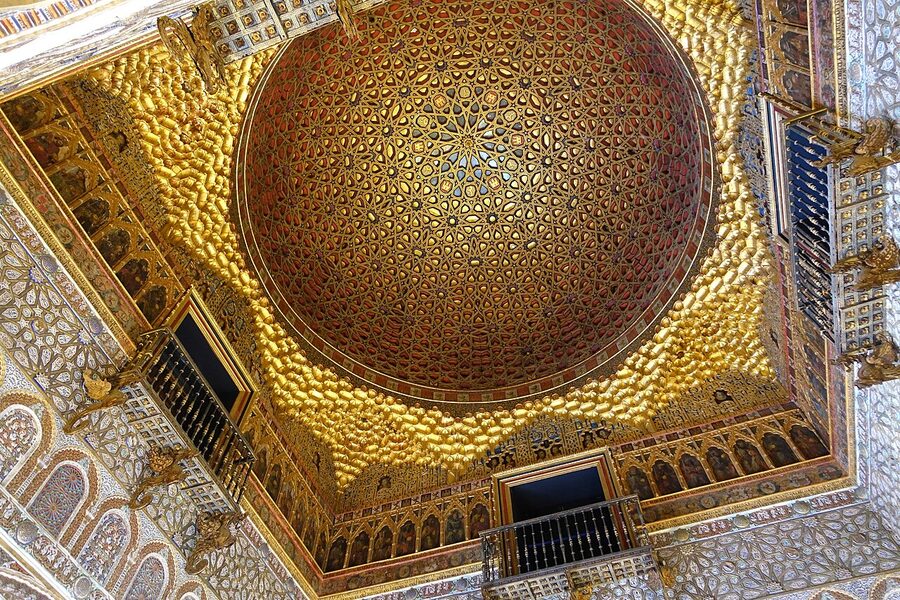
The throne room. You enter from the Patio de las Doncellas through a triple horseshoe arch, and the ceiling is the thing. A half-orange dome of carved cedar wood, gilded, finished in 1427 by a master carver named Diego Ruiz. The dome is meant to represent the universe: the gilded eight-pointed stars are the heavens, the bands of muqarnas are the spheres of the planets, and the stalactite work in the corners is the architecture of the cosmos. The throne sat on a low platform under the centre of the dome.
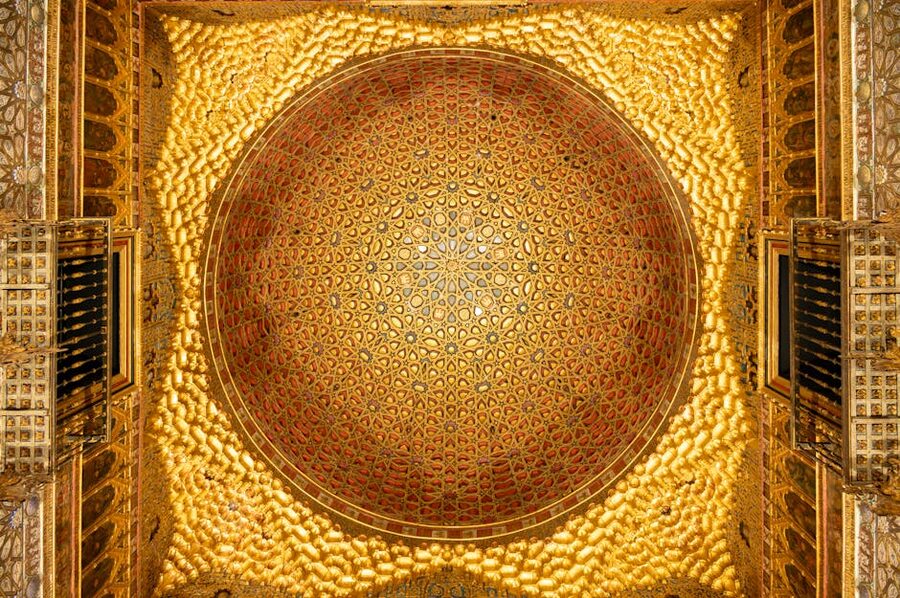
The walls below are tiled in azulejo to about head height, then stucco above that, then the dome above the stucco. Every visible surface is decorated and the geometric patterns don’t repeat once. This is also the room where, in 1526, Charles V married Isabella of Portugal. They held the wedding here because the ceiling already looked imperial enough.
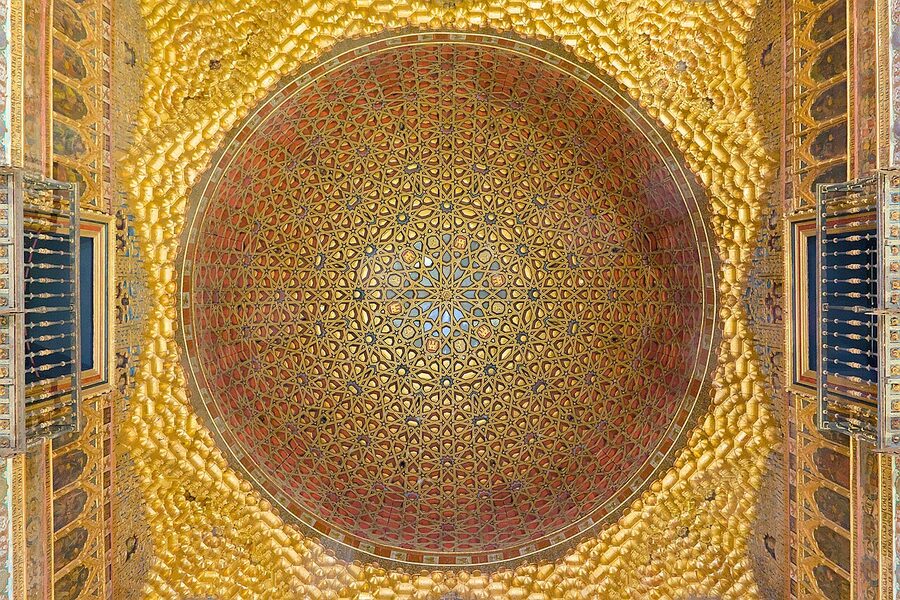
If you’re standing under the dome and the room feels familiar, that’s because the Doge’s Palace in Venice uses a similar trick: the throne room ceiling does the visual heavy lifting and the rest of the architecture supports it. Different style, same idea.
Patio de las Muñecas (Dolls’ Courtyard)
Smaller, more intimate, and the place where most visitors miss the actual famous detail. The “doll” in the name comes from two tiny carved faces hidden among the column capitals. They’re maybe a centimetre and a half across each. People used to think they were tiny dolls, hence the name; the most popular guess now is that they were the master mason’s signature, hidden in plain sight. Bring a phone with a zoom or you won’t find them.
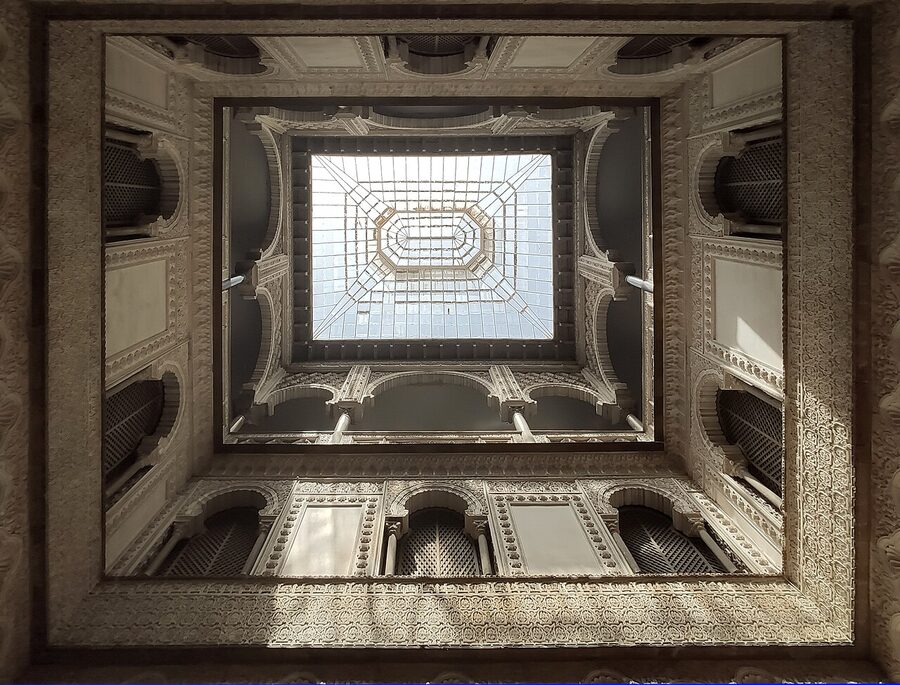
This is also the patio where Pedro I had his half-brother Don Fadrique murdered in 1358. Pedro got the nickname “El Cruel” partly from this, partly from later episodes; some chroniclers later started calling him “El Justiciero” (the Just) instead, depending on their politics. Either way it happened in this courtyard, near the column with one of the doll faces. Worth a moment of imagination.
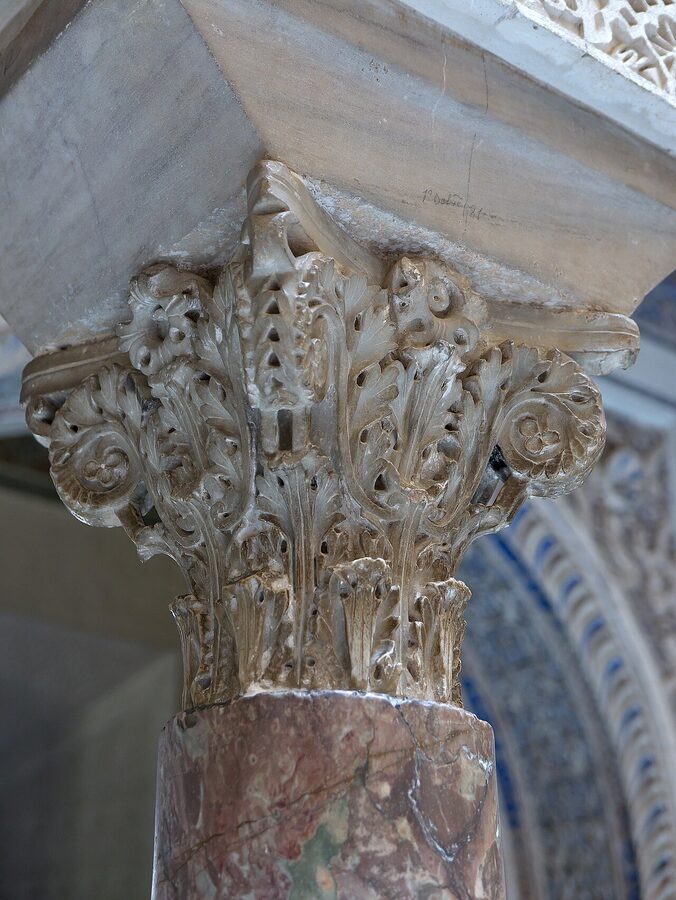
The columns themselves are recycled, taken from older Roman and Visigothic buildings around Andalusia. The capitals don’t all match because of that. If you’ve already done the mosque-cathedral in Córdoba, you’ll recognise the trick: the Umayyads did the same thing with Roman columns there four hundred years earlier.
Cuarto Real Alto (the Royal Apartments)
Upstairs, separate ticket, separate timed slot, group capped at fifteen. This is the part the Spanish royal family actually uses when they’re in town. The tour walks you through six or seven rooms (the throne hall, the Hapsburg dining room, the audience chamber where Felipe VI receives guests) and a few corridors with photographs of various 20th-century state visits. The art and furniture are Hapsburg and Bourbon; the Mudéjar core is mostly downstairs.
It’s not the strongest part of the visit. If you’re a royal-residence completionist (you’ve already done the Royal Palace in Madrid, Versailles, and Pitti Palace in Florence), book it. If your time is tight, skip and spend the extra 45 minutes in the gardens.
Casa de Contratación and the Sala de los Almirantes
This is the room that turned the rest of Spain’s history into an Atlantic story. From 1503 to 1717, every voyage to the Americas, every cargo manifest, every gold shipment, every pilot’s chart was registered here. Ferdinand and Isabella received Columbus in this building after his second voyage. Vespucci ran the navigation school out of a room down the hall. Magellan got his contract here.
The retable on the back wall is by Alejo Fernández, finished around 1535. It shows the Virgin Mary sheltering navigators under her cloak, and you can pick out portraits of Charles V, Columbus, the Pinzón brothers, and a group of Indigenous Americans on the lower right. It’s a strange object: Marian devotion, Atlantic empire, and the first painted appearance of New World people, all in one painting in a room where most visitors give it about 30 seconds. Look at the bottom right corner before you walk on.
Patio del Crucero and the lower garden
You exit the Pedro I palace, climb a few steps, and find yourself in a long walled patio with a sunken garden. This is the Patio del Crucero, originally a 12th-century Almohad design (a cross-shaped raised walkway over a sunken orchard). The Lisbon earthquake of 1755 collapsed most of the original lower level, so what you see now is the upper walkway as it was, and the sunken garden as it was rebuilt afterwards.
Most visitors blow past this on the way to the gardens proper. Worth a couple of minutes. The 1755 earthquake also did a number on Lisbon itself, and on parts of Catalan religious architecture you’ll see on the same trip; the same shockwave shows up in different buildings across Iberia.
The Gardens
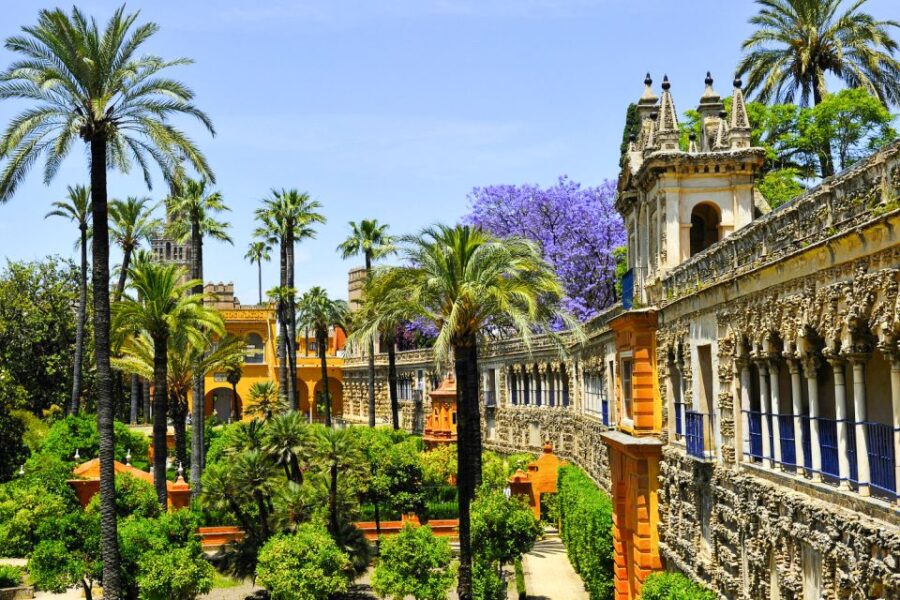
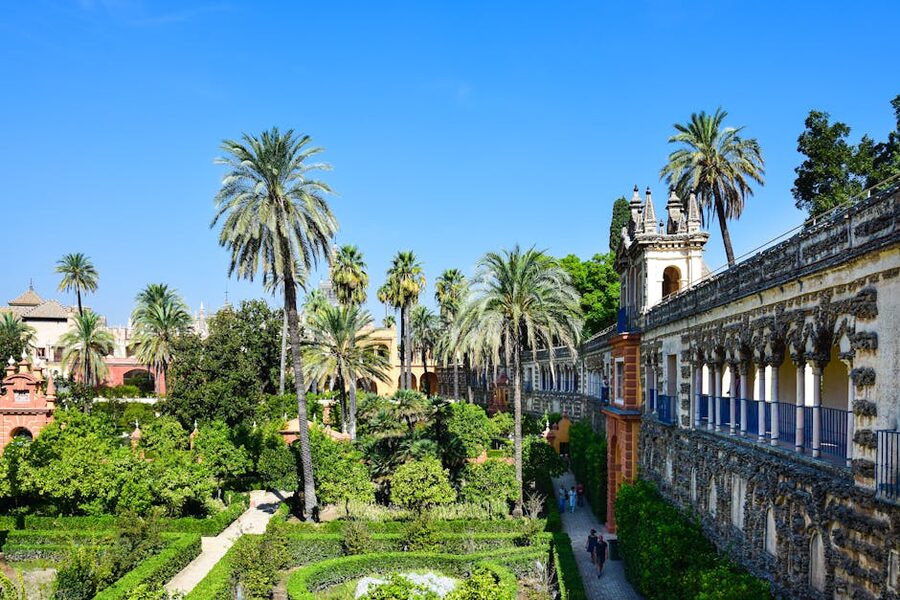
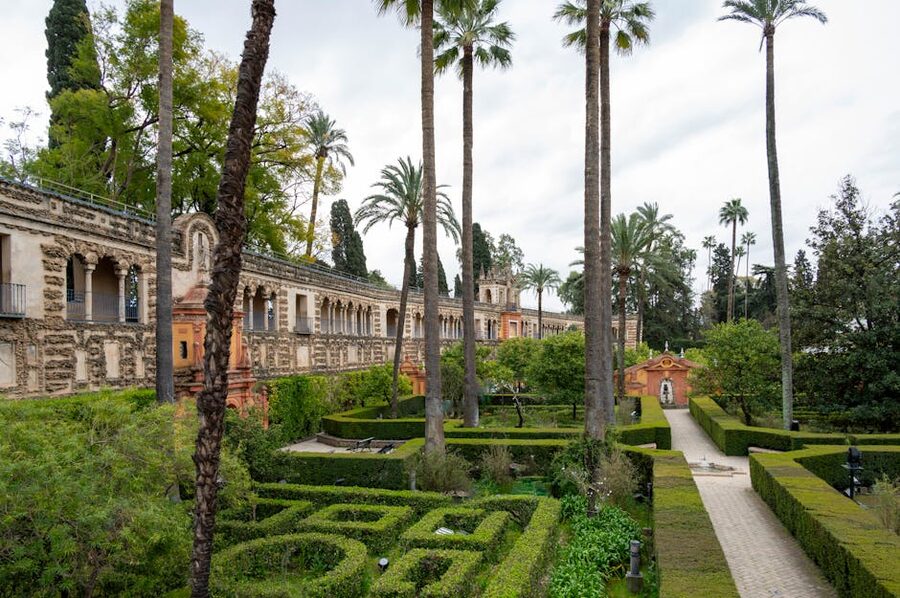
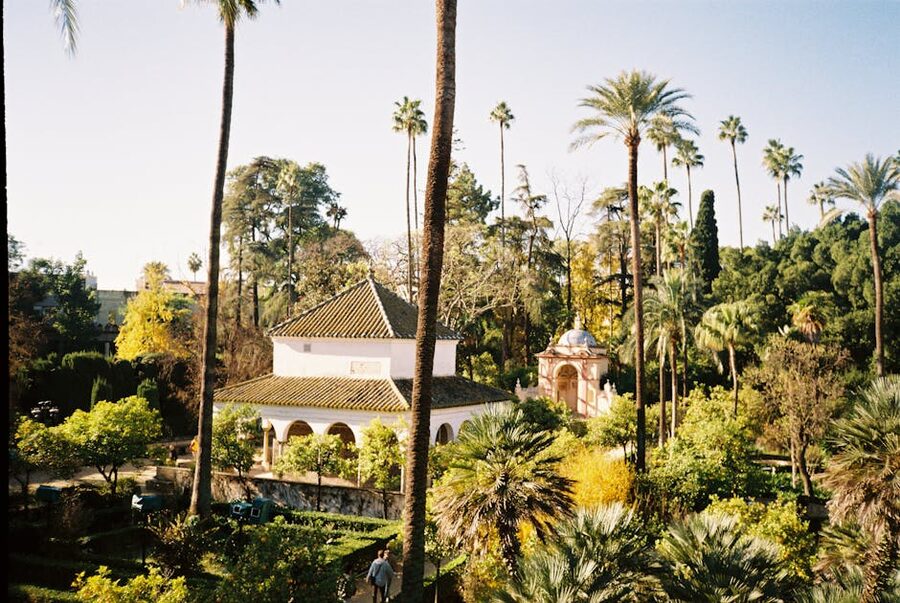
The gardens take up about half the total walking distance and most of the second half of your visit. They aren’t one garden, they’re seven or eight, layered on top of each other across six centuries. The general flow is Almohad orchards at the bottom (the ones with the fruit trees and underground irrigation channels), Renaissance and Mannerist gardens in the middle (the formal hedges and the grotto), and 19th-century English-style additions further out (the lawns, the pavilions, the labyrinth).
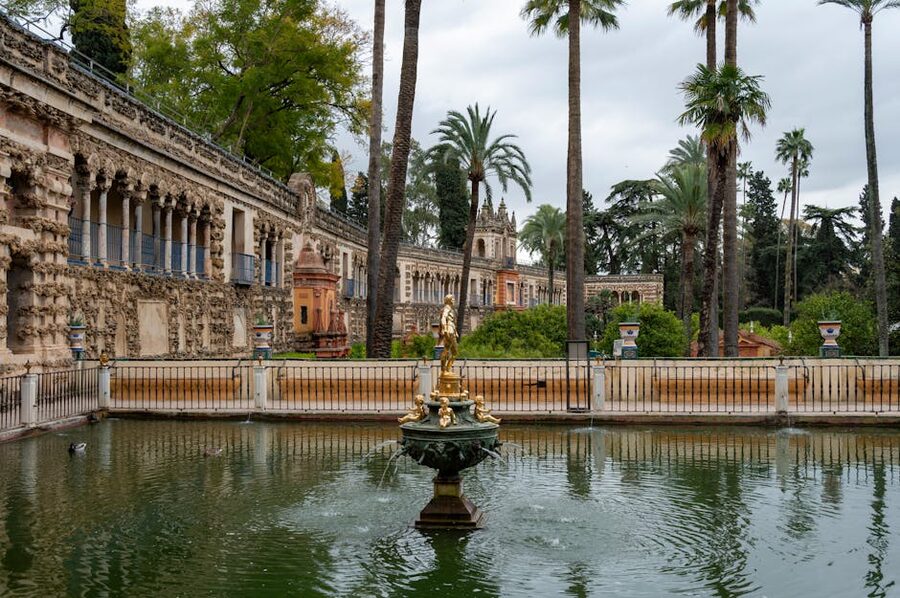
Galería de Grutescos and the Mercury Pond
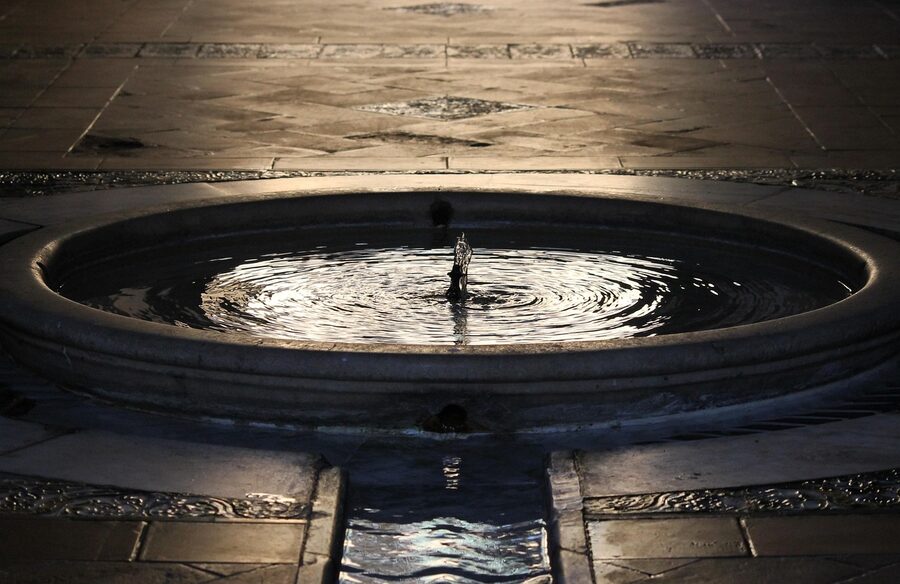
Walk left out of the Patio del Crucero and you’ll hit the Mercury Pond, a square reflecting pool with a small bronze of the god Mercury at the centre, and behind it a long Mannerist wall called the Galería de Grutescos. The wall runs maybe 150 metres along the upper terrace. It’s full of niches, fountains, painted scenes, and grotesque carvings; the higher you walk along it, the better the view back over the lower gardens.
Jardín de las Damas and the Pavilion of Charles V
Past the grotto wall is the formal Renaissance garden, the Jardín de las Damas, with hedges in geometric beds and a small tiled pavilion at the far end. The pavilion was built for Charles V in 1543 and is one of the few buildings in the gardens you can actually go inside. The interior tile work is original 16th-century azulejo. Stand inside, look up, listen for the trickle from the small fountain in the centre of the floor.
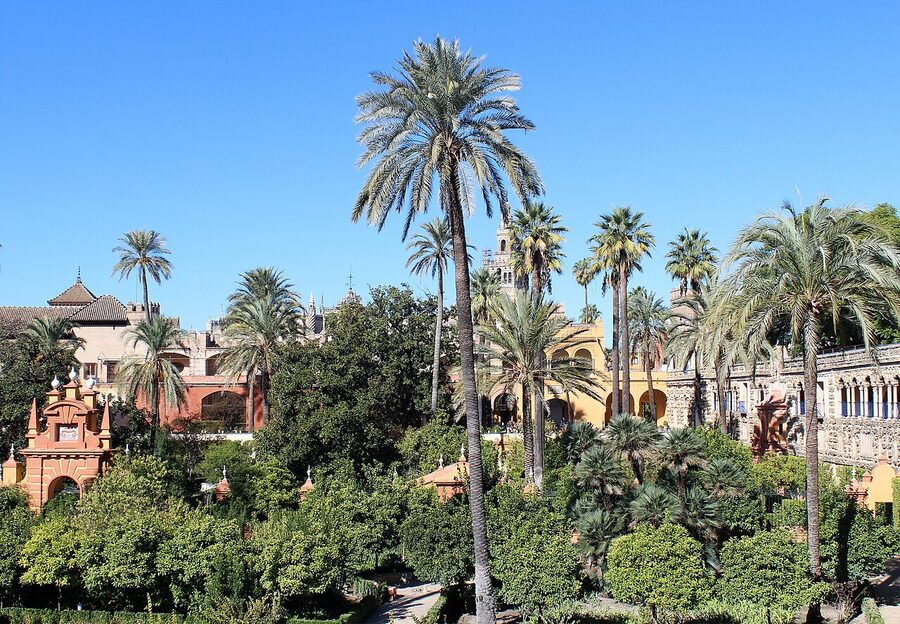
If you’re a gardens person and you’ve already done Boboli in Florence or the Diane and Catherine gardens at Chenonceau, the comparison is interesting: Boboli is a hillside; the Alcázar gardens are flat and walled. The two work on completely different organising principles. Boboli is built for vistas and processions; the Alcázar gardens are built for shade, water, and seclusion.
Baths of Doña María de Padilla
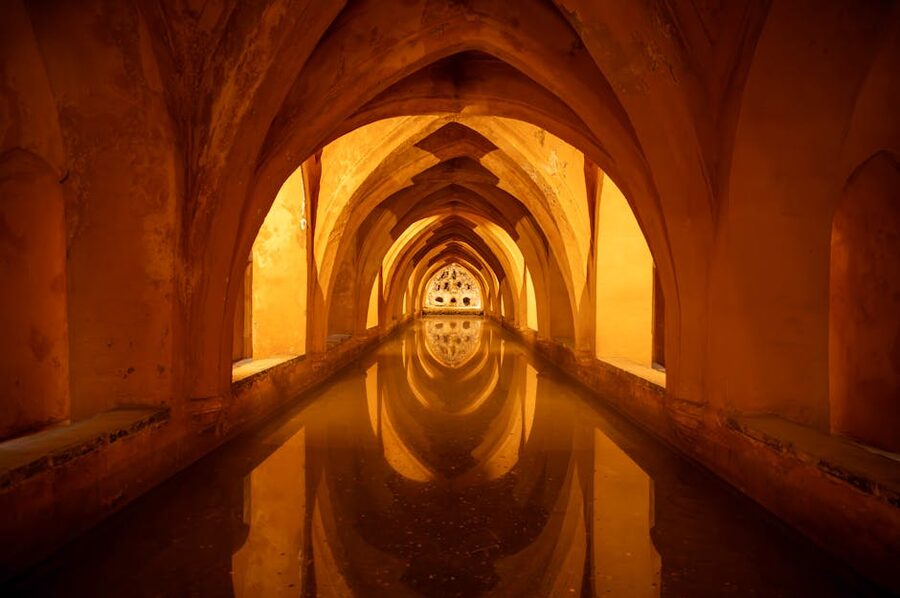
Underneath the Patio del Crucero you’ll find a long vaulted underground hall flooded to about ankle depth, with a row of horseshoe arches reflecting in the still water. This was originally a 12th-century Almohad rainwater cistern, repurposed in the 14th century into a private bath. The “Doña María de Padilla” name comes from Pedro I’s mistress, who supposedly bathed here. There’s no documentary evidence she did. The space is genuinely atmospheric regardless.
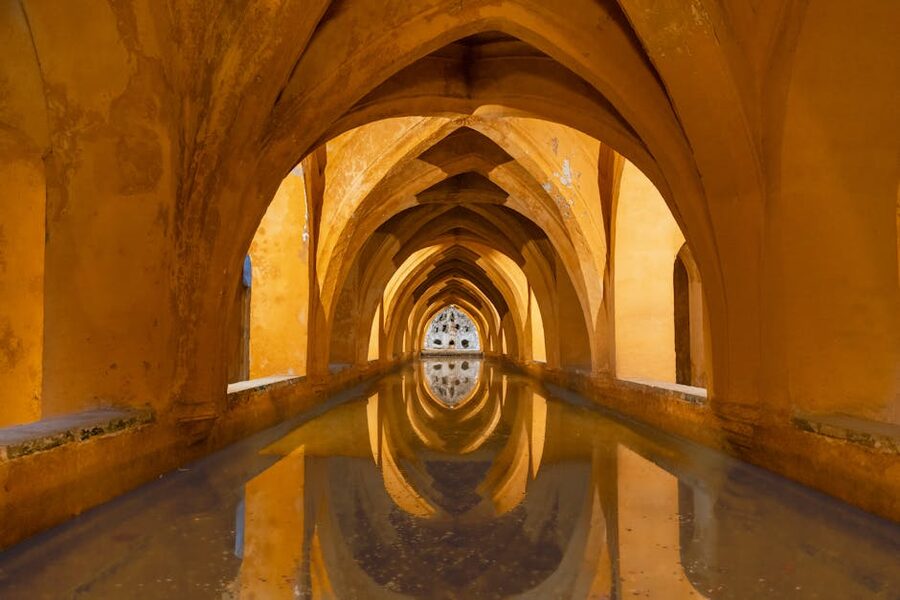
The acoustics are strange: low ceiling, lots of water, almost no ambient noise. Stand at the far end and your voice carries forward in a way that doesn’t happen in the rest of the palace. Easy to miss because the entrance is unmarked from the upper level; look for a small staircase descending under the Crucero garden.
The far end: gardens that get skipped
Past the Mercury Pond and the formal gardens, the Alcázar gardens stretch on for another 300 metres or so into the Jardín de los Poetas, the Jardín del Laberinto (a small hedge maze that sometimes has the gates locked), and the Jardín Inglés. Most visitors run out of energy and turn back at the Pavilion. If you’re not on a guided tour, push on. The far gardens are quieter, the benches are empty, and the orange grove you walk through smells extraordinary in February when the trees are in flower, on the same scent-of-spring level that pulls people to Keukenhof in tulip season.
Practical Things You’ll Wish You’d Known
Time it
Plan two hours minimum, three is better. The Alcázar website says 90 minutes; that’s the minimum walking time and it doesn’t include the gardens. Most visitors do roughly 45 minutes in the palace and the rest in the gardens. If you’re doing the cathedral the same morning, give yourself a buffer; the cathedral is 90 to 120 minutes on its own.
Photography
Allowed everywhere except the Cuarto Real Alto upstairs apartments, where it’s banned. No flash, no tripods. Phones are fine. The Salón de Embajadores dome and the Patio de las Doncellas reflecting pool are the two shots most people queue for; the doll faces in the Patio de las Muñecas need a phone zoom.
Accessibility
The palace is mostly flat, with a few small staircases. The gardens are flat with gravel paths. Wheelchair users get a slightly modified route that misses the upper galleries of the Patio de las Doncellas and the Cuarto Real Alto. The visitor entrance has step-free access; ask at the ticket counter if you need the modified map.
What’s not allowed
Big bags (over 40cm in any dimension), tripods, drones, food, drinks other than water, selfie sticks. There’s a left-luggage at the entrance that costs about €1.50.
Combining with the cathedral
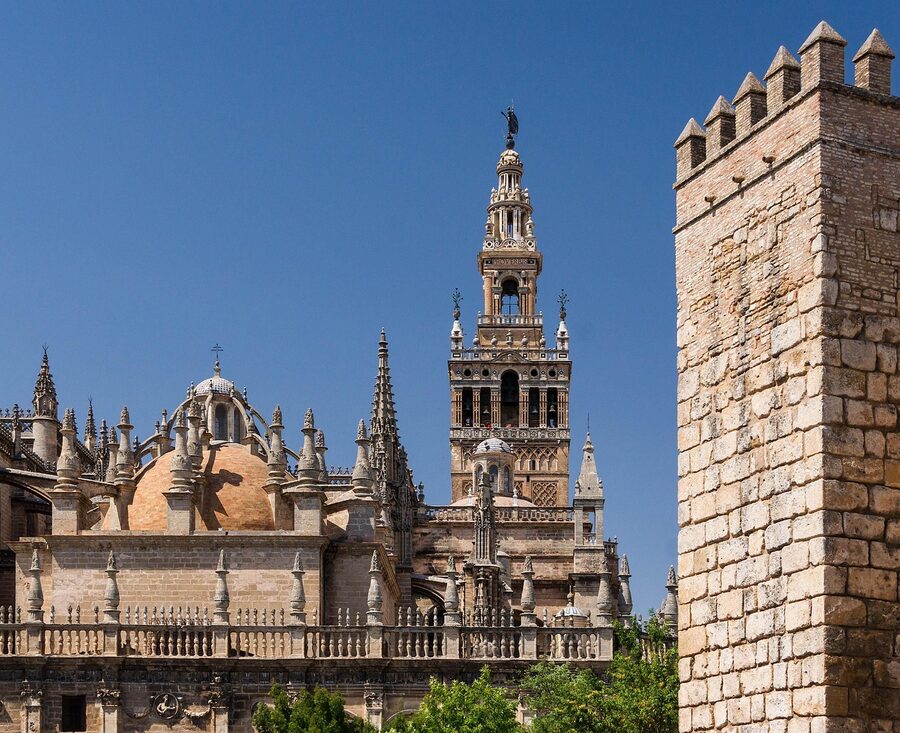
The cathedral entrance is a 90-second walk across the Plaza del Triunfo. If you’re doing both the same day, book the cathedral first (it opens earlier) and the Alcázar second. The cathedral’s walk-through pace is faster, and the Alcázar gardens are where you want to spend your remaining energy. We covered the cathedral in where Columbus is buried in Seville.
Bringing kids
Under-14 tickets are €1.70, and the gardens are good for them: the labyrinth, the peacocks (yes, there are peacocks, they wander loose, mostly in the lower gardens), the small grottos. The palace itself can blur if you’re moving fast. The Patio de las Muñecas is the room kids actually engage with: tell them about the doll faces and they’ll spend ten minutes looking for them.
The Layered History, Briefly
Worth knowing because every patio you walk into makes more sense in context.
913: the Almohad foundation
Caliph Abd ar-Rahman III ordered the original castle on the site, built on the foundations of an even older Roman fortress. The walls of the entry courtyard (Patio del León) and the Patio del Yeso are the surviving 12th-century Almohad layers.
1248: Christian reconquest
Ferdinand III takes Seville from the Almohads and the palace becomes a royal residence. Alfonso X (his son) builds the Gothic Halls (Salones Góticos) on top of part of the old Almohad palace. You walk through these on your way to the Patio del Crucero.
1364: Pedro I’s Mudéjar palace
The big rebuild. Pedro hires craftsmen from Granada (Nasrid) and Toledo (Mudéjar), and they build the Pedro I palace inside the old Almohad shell. The Patio de las Doncellas, the Patio de las Muñecas, the Salón de Embajadores, the entire interior route, all dates from this campaign. The palace is finished within a few years; Pedro is murdered in 1369 and never sees it fully decorated.
1500s: Hapsburg additions
Charles V adds the upper floor of the Patio de las Doncellas, the Sala de los Tapices (where state tapestries hang), and his own pavilion in the gardens. Philip II expands further; the Casa de Contratación gets its current form. The palace becomes the administrative centre of Spain’s Atlantic empire while still being a royal residence.
1755: earthquake damage
The Lisbon earthquake collapses much of the lower Patio del Crucero. The reconstruction takes decades and the proportions are slightly different from the original.
1910s onwards: restoration
A long programme of careful restoration begins, continuing today. The 2002 excavation of the Patio de las Doncellas reflecting pool is part of this campaign. Most of what you see in the named patios is original; the polychrome on the stucco is what hasn’t survived.
Today: still a working palace
Felipe VI uses the upper floors when in Seville. Foreign heads of state are received in the Cuarto Real Alto. The 750-visitor cap is partly preservation, partly because parts of the building are still in active royal use. You don’t see this from the visitor route; you do see signs of it (closed corridors, off-limits doors, a guard who’ll quietly turn you back).
What I’d Do With Half a Day
If your time in Seville is short and the Alcázar is the only big monument you’ll do:
9:30am: First slot. Through the Patio del León in five minutes, slow down at the Patio de la Montería façade, and into the Patio de las Doncellas before the second wave arrives.
10:00: Patio de las Muñecas, Salón de Embajadores, the Casa de Contratación retable. Half an hour, no rushing.
10:45: Through the Patio del Crucero into the gardens. Mercury Pond, the grotto wall, the Pavilion of Charles V.
11:30: The Baths of Doña María de Padilla. Sit in there for ten minutes; the temperature drop is welcome.
12:00: Push to the far gardens, find a bench, eat oranges. Walk back out through the Puerta del León around 1pm.
That gets you the full Mudéjar route, the Casa de Contratación, the historic gardens, and the Baths, in roughly three and a half hours. The cathedral fits the afternoon if you’ve still got energy.
Pairings
If the Alcázar got you interested in Mudéjar architecture and Moorish-Christian crossover, the natural follow-up is the Alhambra in Granada: same craftsmen tradition, more intact stucco, completely different setting. Going further south, Córdoba’s mosque-cathedral is the most extreme version of the Christian-on-top-of-Islamic story (a literal cathedral built inside the prayer hall of an Umayyad mosque). Stay in Seville and the natural pair is the cathedral and Giralda, where the bell tower used to be the mosque’s minaret and Columbus’s tomb sits in the south transept. If you’ve got a slow afternoon and want to end on the river, a Guadalquivir cruise shows you how the city connected to the Atlantic empire from the water side.