
The Spanish king does not live in the Royal Palace of Madrid. He never has, and neither did his father. Felipe VI lives at the Palacio de la Zarzuela, a much smaller residence on the city outskirts, and only comes here for state banquets, ambassador receptions, royal weddings, and the occasional photo with a foreign minister.
So what you are buying a ticket to is something stranger than a palace tour. It is a 3,418-room state machine that operates as a museum on the days the king is not using it for ceremony. Bigger than Versailles. Bigger than Buckingham Palace. And nobody actually sleeps here.
In a Hurry: The Three Tickets That Actually Matter
Quick picks:
- Cheapest entry: Royal Palace Fast-Access Admission ($26): skip the security line, walk the standard route, no guide.
- Best guided pick: Expert Guided Tour with Skip-the-Line ($46): two hours, English, the Throne Room story explained properly.
- Add the Royal Collections: Royal Palace + Optional Royal Collections Gallery ($40): the new gallery on Cuesta de San Vicente; pair it with the palace and skip the queue at both.
The rest of this guide is for people who want to choose properly between those three, understand what is actually inside the building, and avoid the two or three rookie mistakes that ruin the visit.
Why Nobody Lives Here Anymore
Spain’s royal family moved out of the Royal Palace in 1962. Juan Carlos I, then crown prince, decided that raising his children in 3,400 rooms with formal staff was a bad idea, and he pushed for a smaller working residence at La Zarzuela, a hunting lodge on the outskirts that had been in royal hands since the seventeenth century. Felipe VI grew up there. He still lives there now with Queen Letizia and the two princesses. They drive into the Royal Palace for ceremonies the way American presidents drive into the West Wing. It’s the office, not the home.
This matters for the visit because it changes what you should expect. There are no signs of life. No half-finished newspapers, no kicked-off shoes, no smell of cooking. Other royal residences I have walked through (the apartments at the Doge’s Palace in Venice, the upper floors at Pitti Palace in Florence) were also state buildings rather than family homes, and they read the same way. Polished. Frozen. Slightly inhuman. The Royal Palace of Madrid is the same logic taken to a much larger scale.
The trade-off: what you lose in lived-in atmosphere you gain in spectacle. The state rooms are kept in active ceremonial use, which means the silver gets polished, the velvet gets restored, and the Tiepolo ceiling in the Throne Room is in better shape than almost any baroque ceiling I have seen in Italy.
Tickets, Times, and the One Thing That Catches People Out
Standard admission is €14 at the door. The fast-access ticket I linked above is cheaper than that on most days because the operator pre-bulks them. The catch is what’s called cierre por acto oficial, closure for official events. The palace shuts to visitors when the king is hosting a banquet or a state reception, which happens roughly thirty to forty days a year, often announced only days in advance.
This is the rookie mistake. People book a non-refundable ticket six weeks ahead, fly to Madrid, and arrive to find the gates closed because there’s a Saudi delegation coming in that afternoon. The fast-access and guided operators reschedule for free. The palace’s own ticket office does not always.
Opening hours are 10am to 6pm in winter, 10am to 7pm April through September. Last entry an hour before closing. Mondays are open (this surprises people coming from the Vatican Museums or the Prado, both of which close one weekday). The slowest hours are 10am sharp at opening or after 4pm. Avoid 11am to 2pm in summer; the queue at the security check is what kills you, not the queue at the ticket booth.
Spaniards visit free between 4pm and 6pm in winter, 5pm and 7pm in summer, on weekday afternoons. EU citizens and under-25s get a discount with ID. If you fit either, do not buy a fast-access ticket; the queue moves and you save money. If you don’t fit either, the fast-access pays for itself the moment you see the line on Plaza de la Armeria.
The Building You Are Walking Into
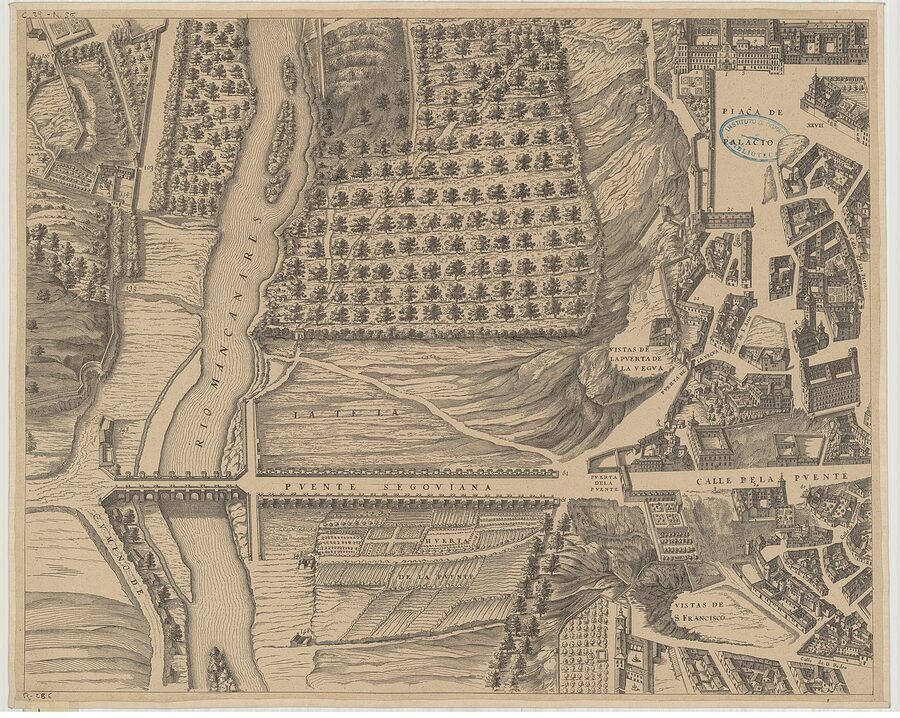
This is not the building Habsburg Spain ruled from. The original was the Alcazar of Madrid, a Moorish fortress that the Habsburgs converted into their main royal residence over the sixteenth and seventeenth centuries. On Christmas Eve 1734 it caught fire and burned for four days. Around five hundred paintings were lost, including many of the Velazquezes that had hung in the king’s apartments. The fire is the reason a Madrid royal collection feels lighter on Velazquez than the Prado later turned out to be. The surviving works went to what eventually became that museum.
Felipe V, the first Bourbon king, decided to start over and build something to outdo Versailles. He hired the Italian architect Filippo Juvarra, who promptly died. The job passed to Giovanni Battista Sacchetti, who built the bones, and then to Francesco Sabatini, who finished it and added the gardens that now bear his name. Construction ran from 1738 to 1755. Carlos III moved in in 1764, the first king to occupy the new building.
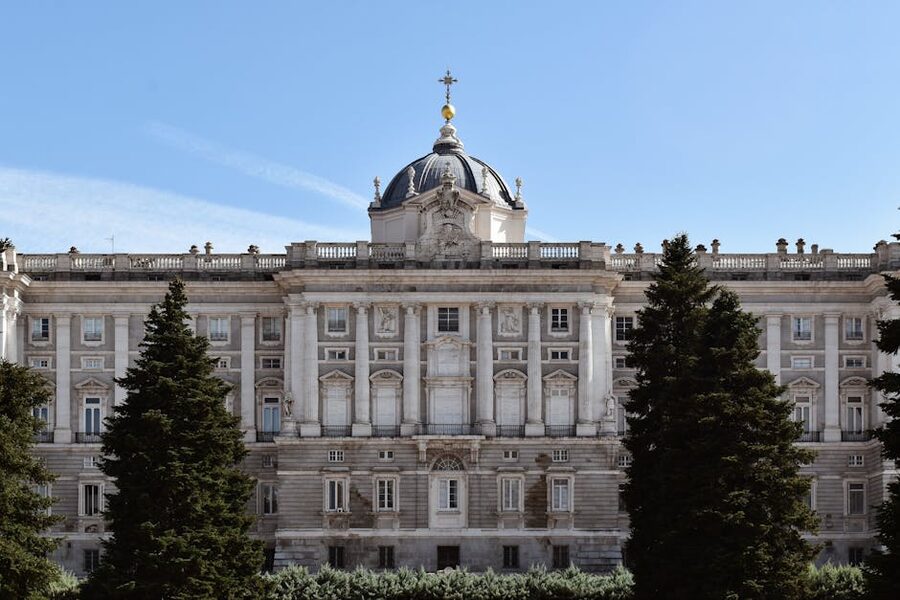
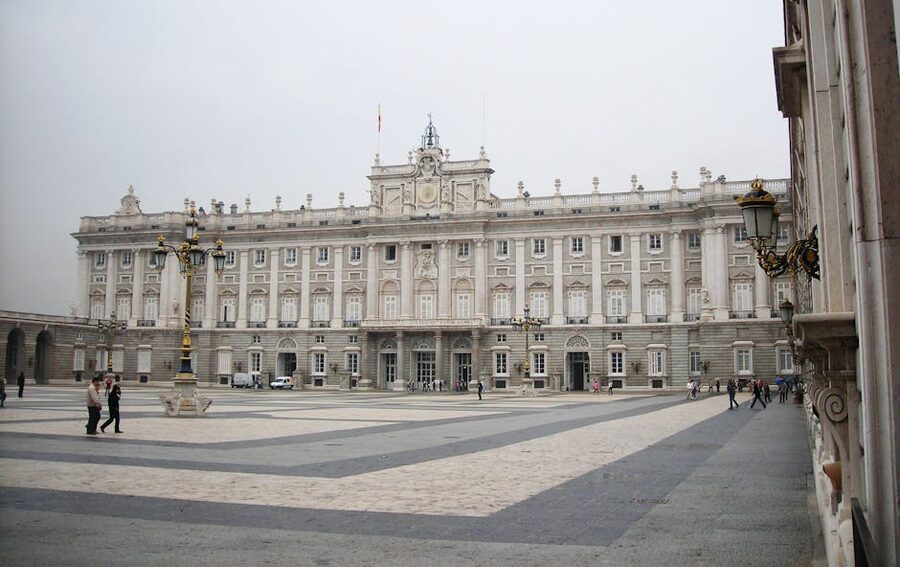
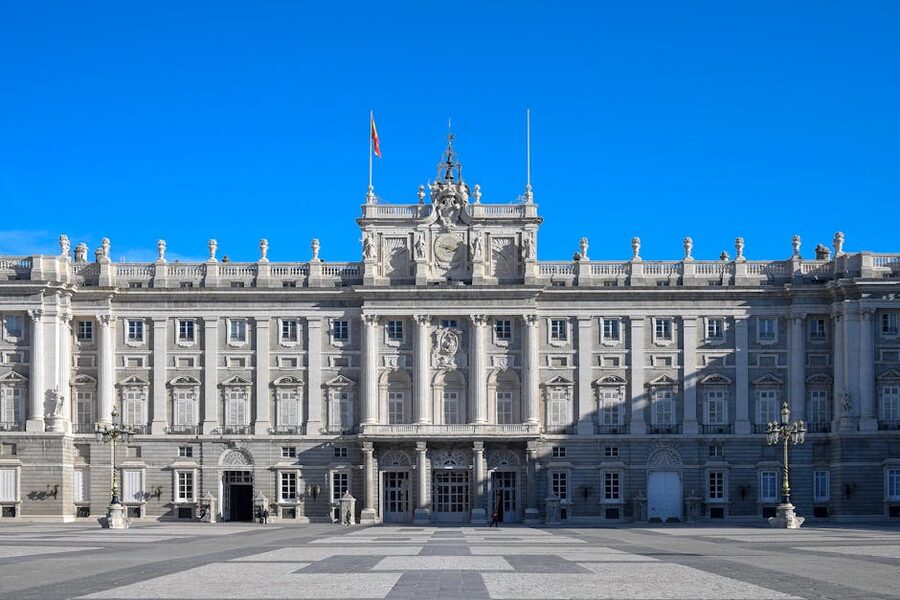
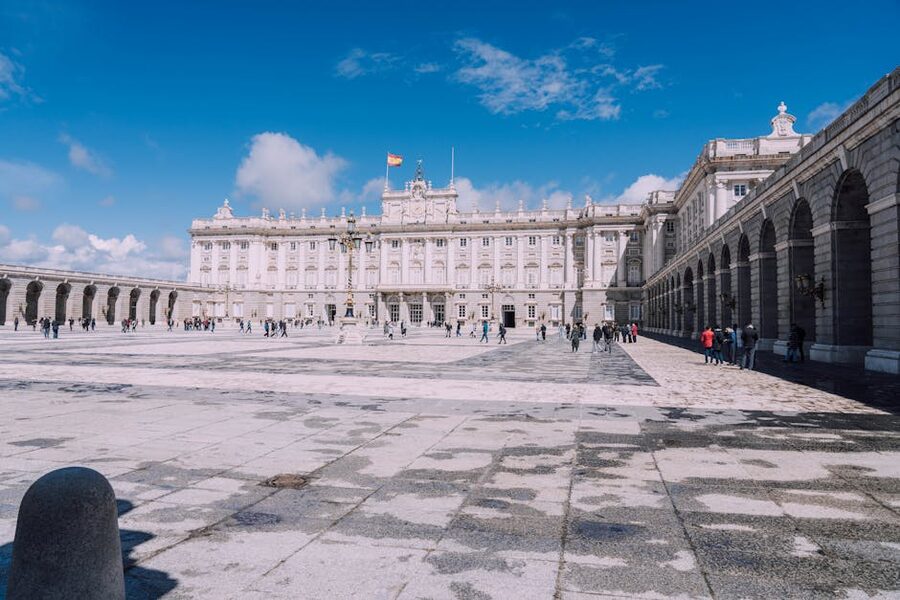
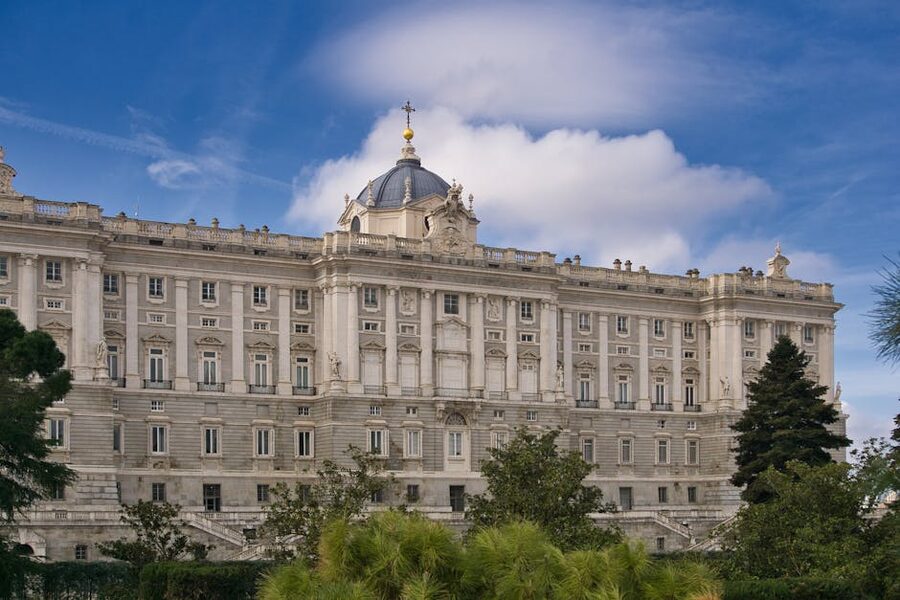
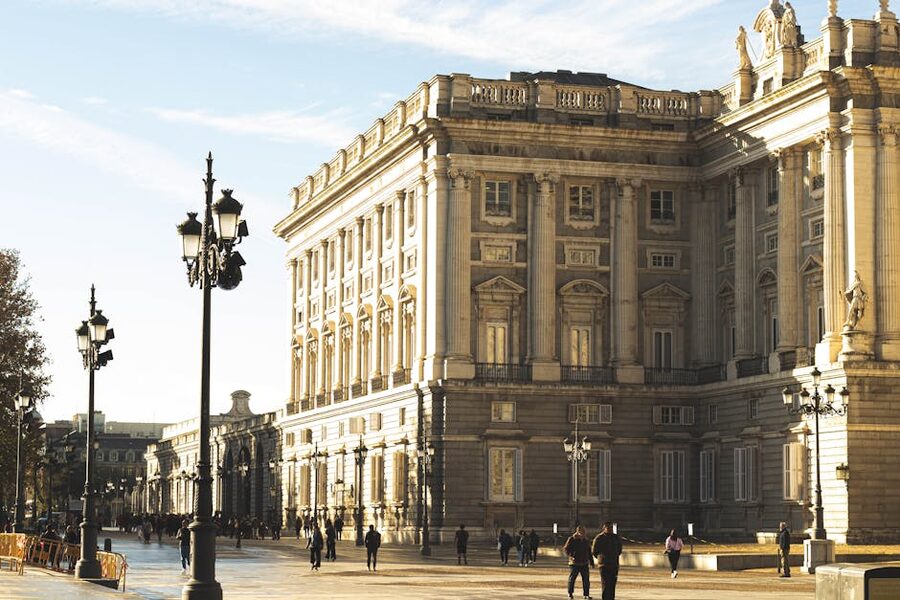
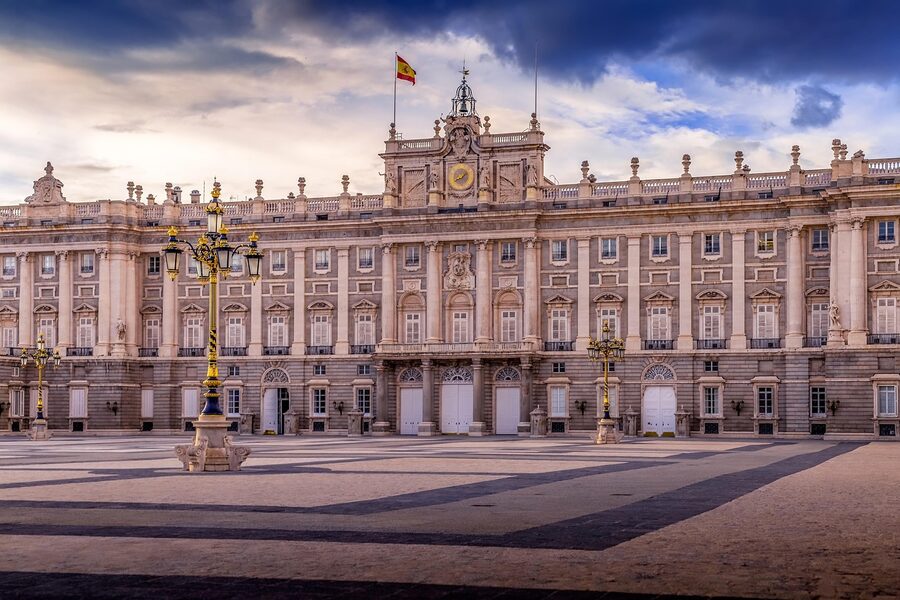
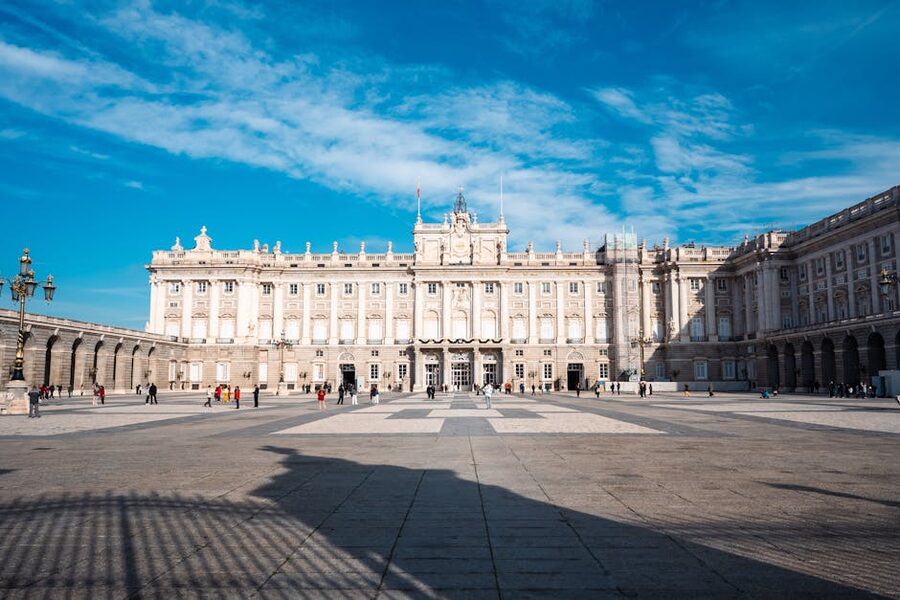
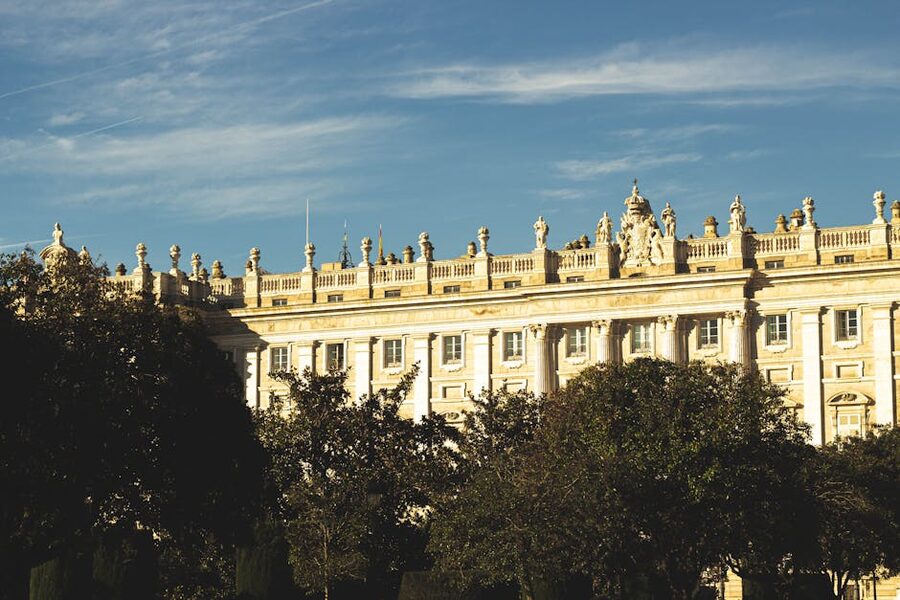
The proportions read as colder than most European palaces because they are. Sabatini was working from Roman models (Bernini’s late projects, Juvarra’s plans for Turin) rather than the French Versailles tradition. You feel it most when you cross the Plaza de la Armeria and the building reveals its full width: 135 metres on the south face, three storeys plus a substantial attic, a continuous balustrade with sculpted figures of Spanish kings. It is geometric and measured. It does not show off.
What’s Actually Inside: The Route You’ll Walk
The standard visit is a one-way circuit through about twenty-five state rooms on the main floor (planta principal). You enter through the Grand Staircase, follow the ceremonial route through the Halberdiers’ Room, the Hall of Columns, the Throne Room, the King’s apartments (Carlos III’s bedroom and the Porcelain Room are highlights), the Banqueting Hall, the Royal Chapel, and finally the Royal Armoury. You exit on the south side back into the Plaza de la Armeria.
The route runs roughly an hour and a half if you stop to read the panels. Two hours if you take the audio guide (€7 extra). Three hours if you book a guided tour and listen to everything. Most people rush. The rooms reward sitting down for a moment in each one, and there are benches.
The Grand Staircase: Your First Real Moment
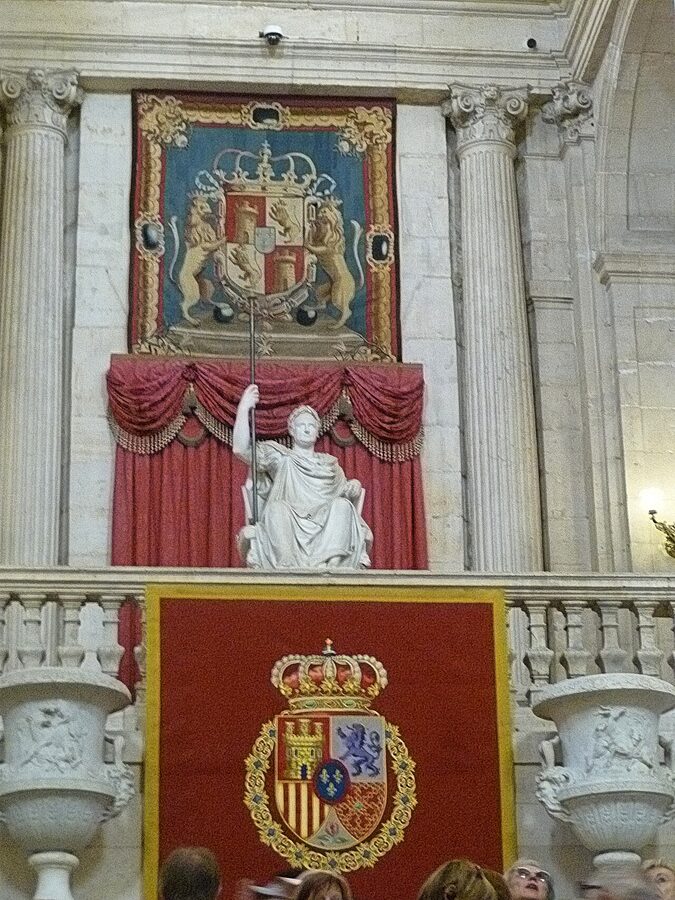
This is the first interior space and the architects knew it would set the tone, so they spent a disproportionate amount of money on it. A single block of San Agustin marble for each step. A barrel-vaulted ceiling painted by Corrado Giaquinto with a fresco called The Triumph of Religion and the Spanish Monarchy, which is exactly as on-the-nose as it sounds, and exactly as good as that level of confidence usually produces.
Stand at the foot of the staircase and look up. Then walk it slowly. The fresco only resolves properly at three or four points along the climb because Giaquinto designed it to be experienced in motion.
The Halberdiers’ Room and Hall of Columns: The Warm-Up
You pass through two large rooms before the Throne Room proper. The Halberdiers’ Room (Saleta de Alabarderos) is named for the royal guard who used to stand here in dress uniform. There’s a Tiepolo ceiling (The Triumph of Venus and Vulcan) that visitors regularly walk past without looking up. Don’t.
The Hall of Columns is bigger and emptier than it looks in photos. It’s used for state receptions; when there are no guests, it can read as cavernous. Felipe VI’s accession ceremony in June 2014, when Juan Carlos abdicated, was held here.
The Throne Room: Skip Nothing in This One
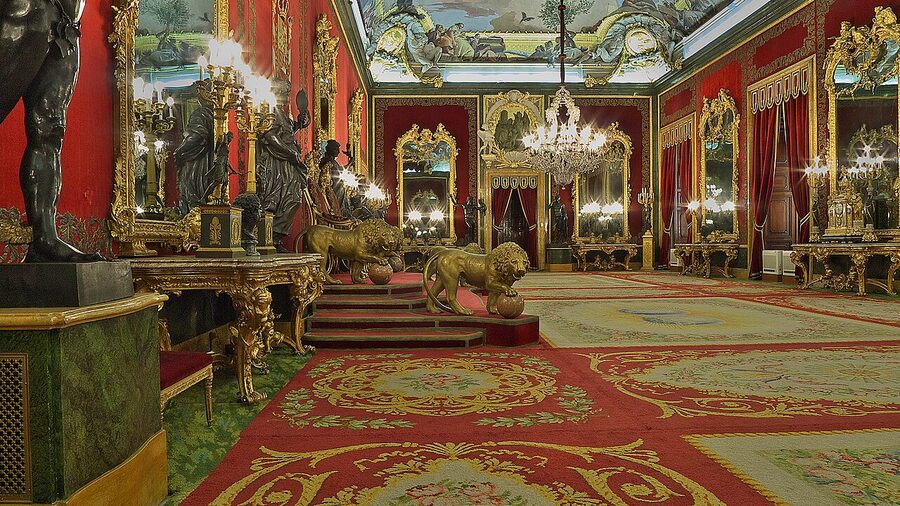
This is the room. Pause here. The Throne Room (Salon del Trono) is the only room in the palace that has not been substantially reconfigured since Carlos III commissioned it in 1763, which means you are looking at almost exactly what an ambassador to the Spanish court would have seen at the height of Bourbon power.
The ceiling is by Giambattista Tiepolo: The Apotheosis of the Spanish Monarchy. Tiepolo was around seventy when he started it, having been brought from Venice expressly for the commission. He spent the last years of his life in Madrid working on this and the Halberdiers’ ceiling. The figures along the cornice represent every region of the Spanish empire as it stood in the 1760s (Asia, the Americas, Africa, Europe), which is why some of the iconography reads as uncomfortable today; the Bourbons commissioned a literal map of imperial dominion and Tiepolo painted it.
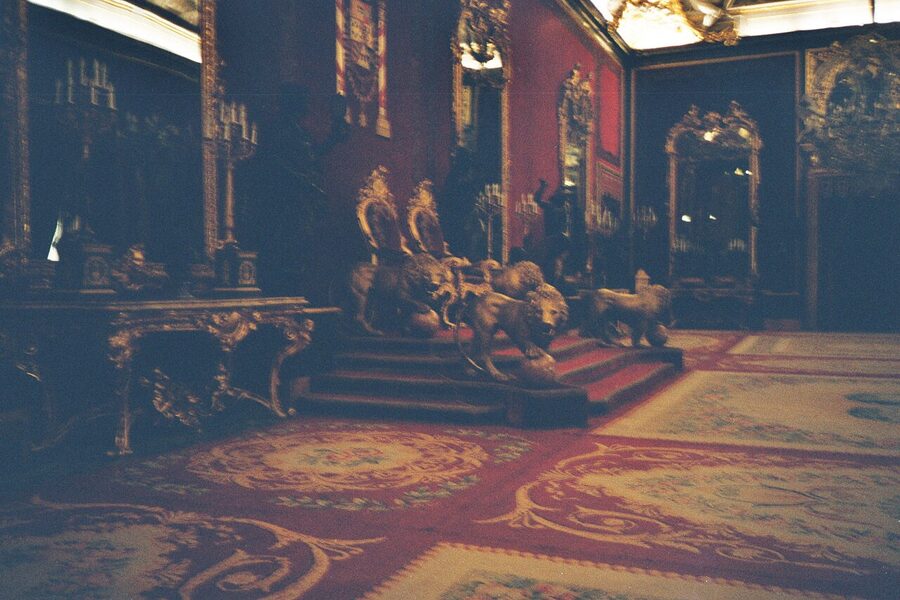
The walls are red velvet (replaced in the 1980s; the original was unsalvageable). The bronze lions guarding the throne are sixteenth-century, salvaged from the old Alcazar before the 1734 fire. They are some of the only surviving objects from the Habsburg-era palace.
Carlos III’s Apartments and the Porcelain Room
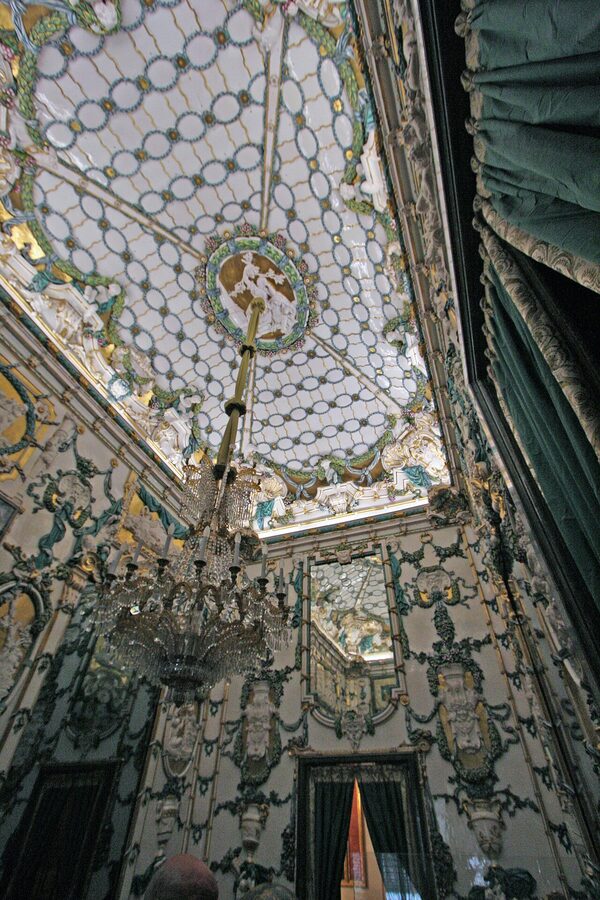
The route then takes you through the king’s private apartments. Carlos III’s bedroom is preserved largely as he left it at his death in 1788. The bed is the original. Most striking, though, is the Sala de Porcelana, the Porcelain Room, which is what the name suggests: every wall surface and most of the ceiling tiled with Buen Retiro porcelain, painted in pastoral scenes and rococo motifs. It is the kind of decorative gesture that a king who has truly run out of things to spend money on commissions, and it is worth lingering in for a couple of minutes.
Photographs do not work in here. The light is too low and the surfaces too reflective. You have to be inside it.
The Banqueting Hall: Where the Modern State Eats
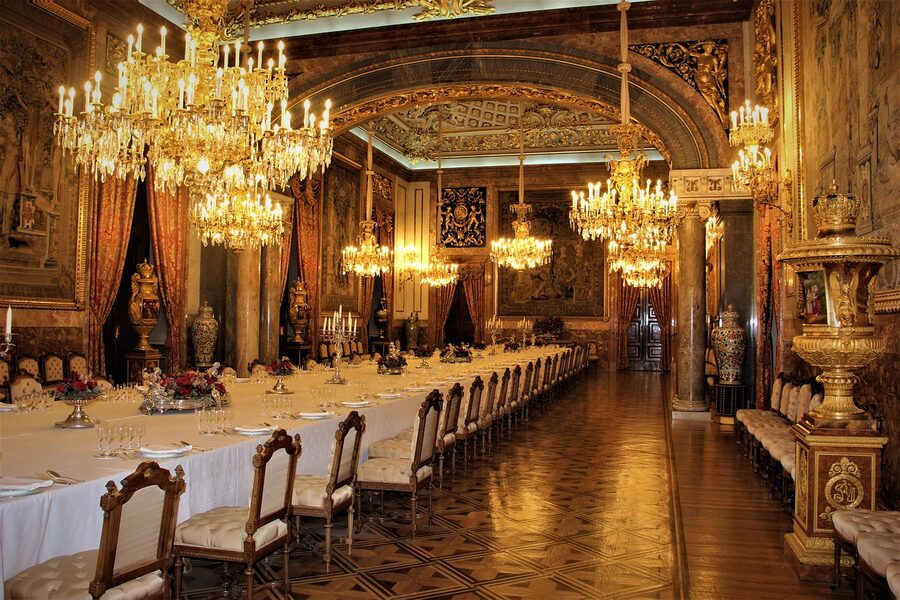
If you only see the Royal Palace once, the Banqueting Hall is the room that links the building to the present. The huge oak table, the silver service, the Sevres porcelain: all of it is still used. When the king hosts a state dinner, this is where it happens. The chandeliers are lit. The Goya tapestries on the walls (woven at the Real Fabrica de Tapices in Madrid) are pulled back from their protective covers.
The audio guide will tell you the table seats 144. Worth knowing that the practical maximum, for an actual served dinner with proper space between guests, is closer to 120; the higher number is for receptions where people stand.
The Royal Chapel
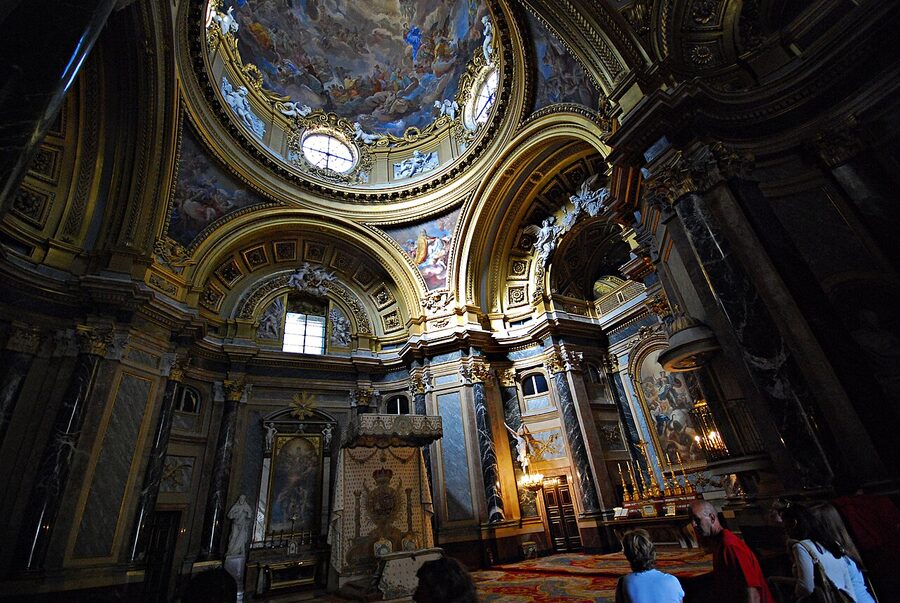
The Royal Chapel sits at roughly the midpoint of the route. It is small relative to the rest of the building, intentionally so. Bourbon religious practice favoured intimate chapels over basilica-scale spaces. The frescoes are by Giaquinto and Mengs. The most interesting piece, though, is the Stradivarius collection in the side cases: a quartet (two violins, a viola, a cello) made by Antonio Stradivari himself between 1700 and 1720, acquired by the Spanish crown in the eighteenth century, and considered the most important set of decorated Stradivari instruments in the world.
They are still played, very occasionally, at state concerts. Otherwise they sit here in conditioned cases.
The Royal Armoury: The Other Big Highlight
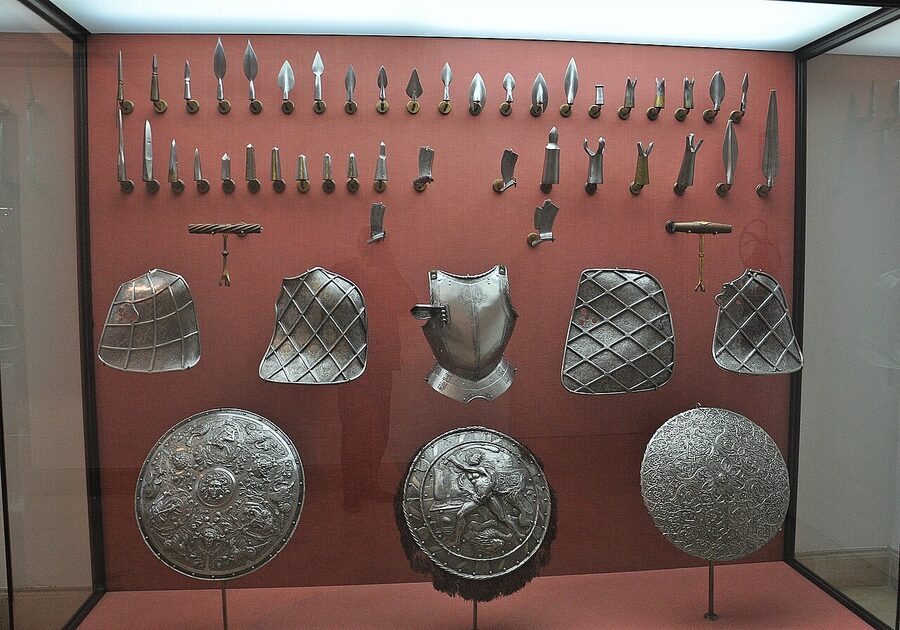
The Royal Armoury (Real Armeria) is in a separate wing on the south side of the Plaza de la Armeria. It is included in the standard ticket. About a third of visitors skip it because they have run out of time on the main palace route, and that is a real loss.
This is one of the two great royal armouries in Europe (the other is in Vienna). It holds the personal armour of Charles V, Philip II, and Philip III, plus a substantial collection of tournament harness from the sixteenth century. The most photographed piece is the equestrian armour of Charles V, made by the Negroli workshop in Milan around 1545: fluted, etched, and gilded. He wore it at the 1547 Battle of Mühlberg, in the painting by Titian that hangs in the Prado.
The painting and the armour are in two different museums in Madrid, ten minutes apart. Most visitors see one and not the other. If you have time, see them on the same day. They are made for it.
Sabatini Gardens and the Plaza de Oriente: Free, and Worth Your Time
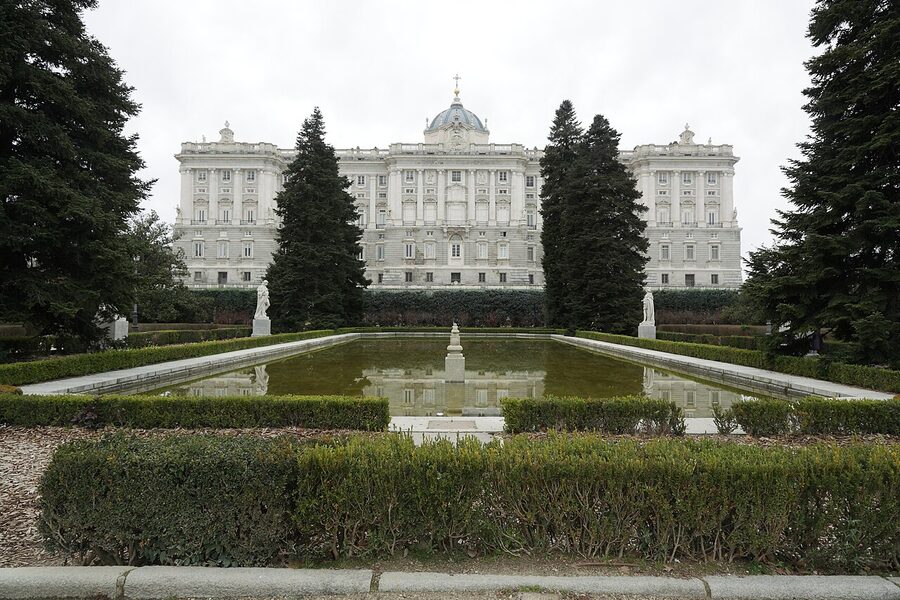
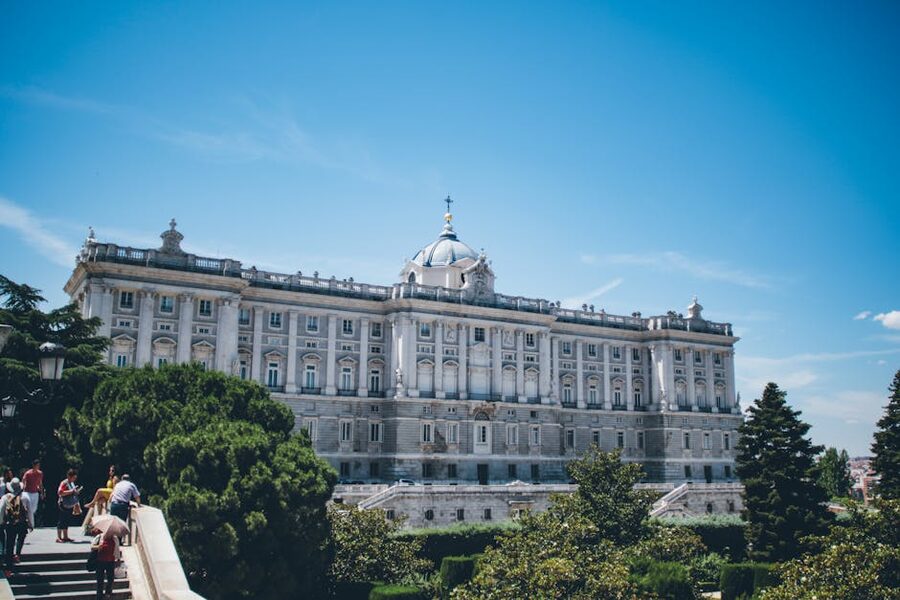
The Sabatini Gardens are on the north side of the palace and were laid out in 1933 on the site of the eighteenth-century royal stables. They are formal in the French style: clipped hedges, a central reflecting pool, classical statues of Spanish kings in the niches. Free admission. Open 9am to 9pm in summer, 9am to 6pm in winter.
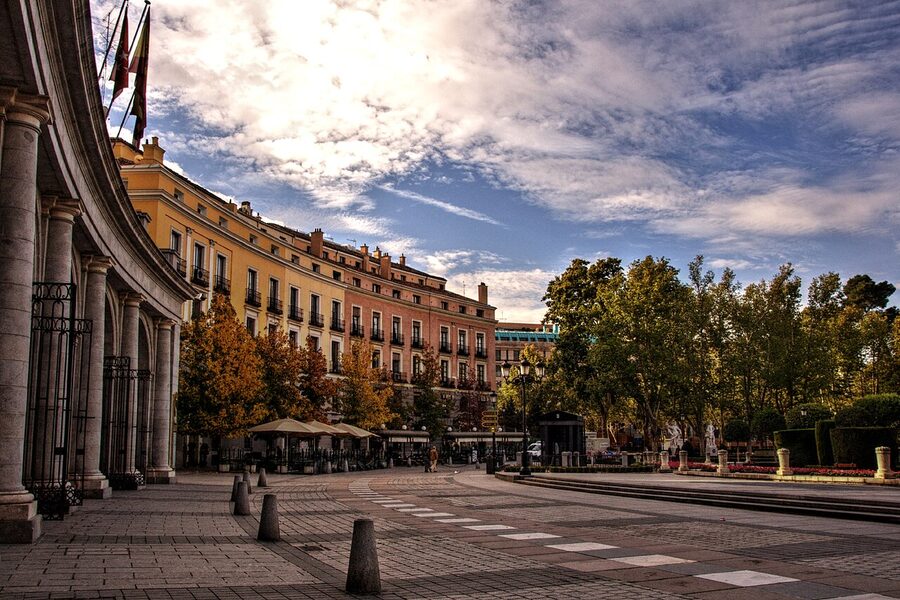
On the east side, between the palace and the Royal Theatre, sits the Plaza de Oriente. This is the formal forecourt: semi-circular, with twenty statues of Visigothic and early Castilian kings ringing the central garden, and an equestrian statue of Felipe IV at the centre. The statue was modelled by Pietro Tacca in 1640 to a Velazquez sketch and has the distinction of being the first equestrian statue in the world to balance entirely on the rear hooves of the horse. Galileo did the maths for it.
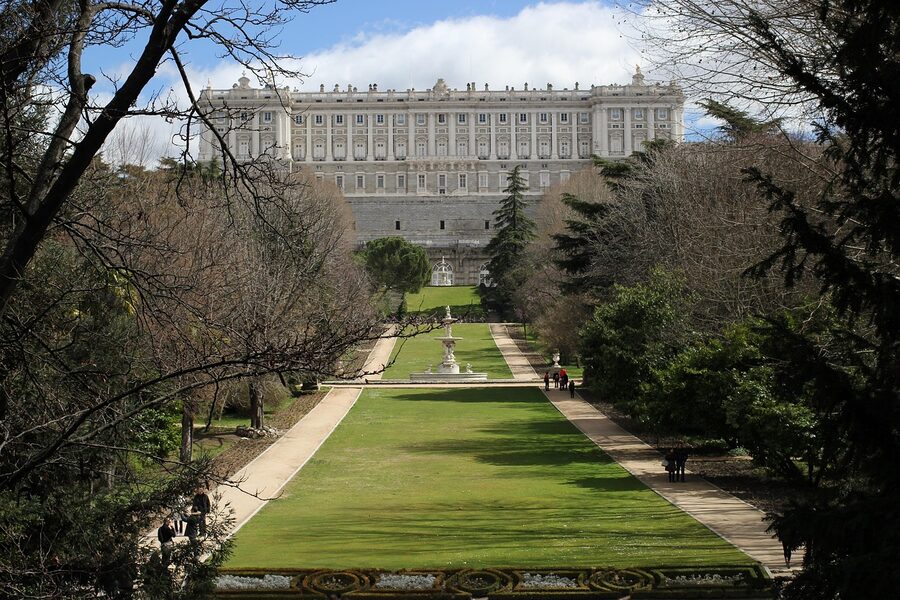
The Campo del Moro gardens (on the west side, below the palace) are also free, also worth doing if you have an extra hour. They are larger and less manicured than Sabatini, with mature trees, peacocks, and a different angle on the building. Entry is from the far side of the palace via Cuesta de San Vicente, which is a fifteen-minute walk from the main entrance.
The Royal Collections Gallery: The New Bit Most Tourists Don’t Know About
The Galeria de las Colecciones Reales opened in June 2023 after almost twenty-five years of construction delays. It is a separate building tucked into the slope just below the palace, accessible from Cuesta de San Vicente, and it holds the works that the Royal Palace itself does not have room to display: tapestries, carriages, more armour, paintings from the Prado that came originally from royal collections.
The architectural thing alone is worth the ticket. Mansilla and Tunon designed it to almost vanish into the topography. You don’t really see the building from above; you walk down a long ramp into a series of double-height halls. The Velazquez and the Goya rooms are the headline. The carriage hall, which has the eighteenth-century state coaches that the king still uses for the opening of parliament, is the underrated one.
The combined ticket from the third tour I linked above is the simplest way to do both palace and gallery in one trip: same morning, no second queue.
The Three Tickets, Properly Compared
Here is how to choose. The fast-access is the right call for most independent travellers, the guided tour is the right call for first-timers and history people, and the collections combo is the right call if you have a serious interest in the decorative arts or you have a full day and want to make it count.
1. Royal Palace Fast-Access Admission: $26
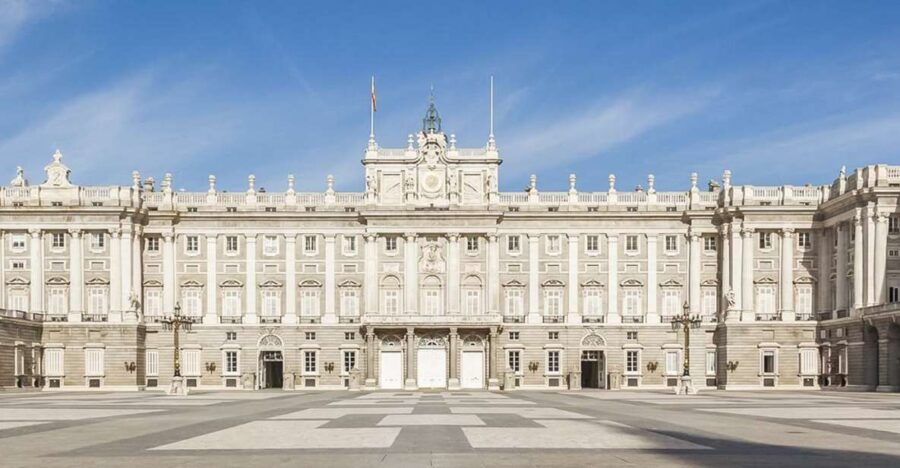
This is the cheapest non-queue option and what I’d buy for a return visit; our full review breaks down what’s included and the practical entry route from Plaza de la Armeria. You skip the security line on the south side, walk in, and follow the standard one-way circuit with no guide. Bring your own reading or rent the official audio set inside for €7.
2. Royal Palace Expert Guided Tour with Skip-the-Line: $46
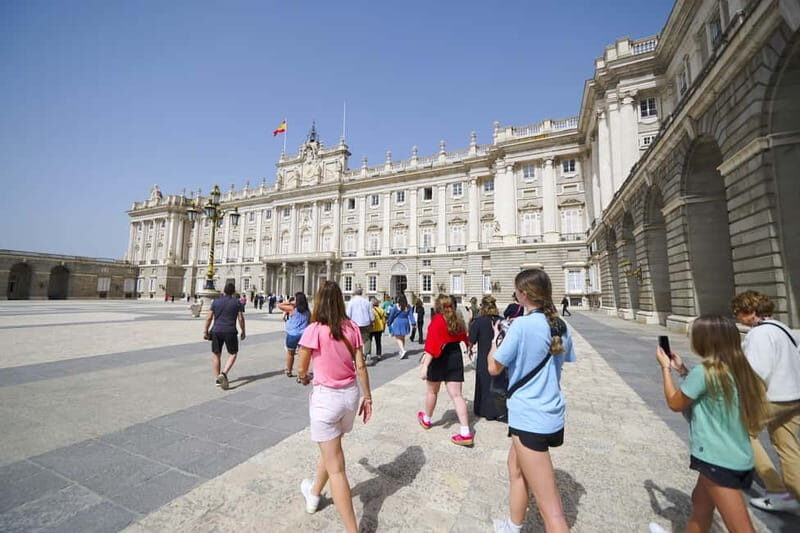
This is the right pick for first-timers and anyone who actually wants the Tiepolo ceiling explained without squinting at a panel; our review covers what the guide actually delivers. The price reflects two hours of explanation plus the skip-line. Worth it on the first visit; less worth it on the second.
3. Royal Palace Tour with Optional Royal Collections: $40
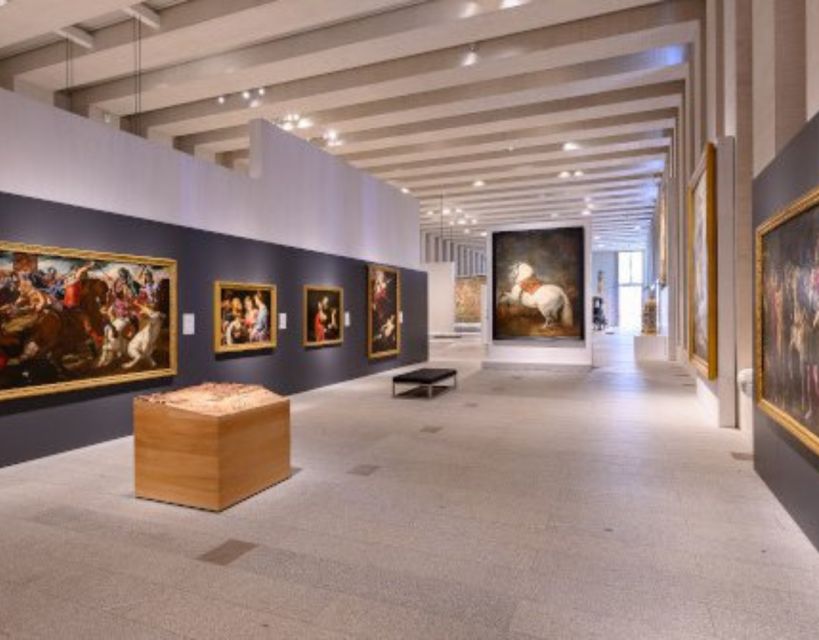
The smart choice for serious art and decorative-arts visitors who want both the working palace and the new collections building done in one morning; our full review explains exactly which collections are included. The collections add-on is the differentiator and the reason this beats the cheapest fast-access for anyone planning to do both.
Getting There and Where to Stand for the Best Photo
The closest Metro is Opera, on Line 2 (red) and Line 5 (green). It is a four-minute walk from the station to the gate. The Opera stop is also on the Cercanias C-3 line if you are coming in from outside the centre. From Atocha or Chamartin you can be at the gate in about fifteen minutes.
Walking from Plaza Mayor takes about ten minutes through Calle Mayor. From Sol it’s eight or nine minutes. From Gran Via fifteen. There is no parking near the palace and the surrounding streets are pedestrian-only or one-way; do not drive.
The best external photo is from the south-east corner of Plaza de la Armeria, looking north-west. Almudena Cathedral frames the left edge. Late afternoon light hits the limestone on the south facade and gives it warmth that mid-day flattens. For the north side (the side most photographers miss) go up into Sabatini Gardens and shoot from the central reflecting pool. Around an hour before sunset is the best window.
What to Pair It With
Madrid’s three big hits (the Royal Palace, the Prado, and the Reina Sofia) are not next to each other, and trying to do all three in a day is a known mistake. The Prado and the Reina Sofia are both on the Paseo del Prado, fifteen minutes’ walk apart, so they pair naturally. The Royal Palace is on the other side of Sol, and it pairs better with the Plaza Mayor / Almudena / Mercado de San Miguel triangle for a half-day in old Madrid.
If you have two full days in the city, the rough pattern that works: Day 1 morning Royal Palace, afternoon walking the centro and tapas in La Latina; Day 2 morning Prado, afternoon Reina Sofia. Both city passes worth comparing if you’re doing more than two paid sites.
Day Trips That Pair Well With This One
The Royal Palace is a half-day commitment at most. If you’ve built a Madrid trip around it, the spare afternoon or the next day works well for a day trip out. Segovia and Avila together, with the Roman aqueduct in Segovia and the medieval walls in Avila, is the standard combination: half-day from Madrid by tour bus, full-day by train. Toledo, half an hour south on the AVE, is the medieval-city-on-a-hill option that everyone says they should do and most don’t.
If you want a stadium tour instead, the Bernabeu is on Metro Line 10, twenty minutes from Opera. It pairs surprisingly well with the Royal Palace as a Madrid-icons day; both are close-tour, both are about ninety minutes inside, both photograph well from outside.
Comparing It to Other Royal Palaces in Europe
I’ve walked through most of the comparables. Here’s the honest ranking from a visitor’s perspective.
Versailles is the gold standard for grounds (the gardens are simply bigger and better) but the building is sparser inside than Madrid. Buckingham only opens in summer and what you get is a fraction of the rooms. The Doge’s Palace in Venice is a different kind of building, civic and Gothic, and a closer parallel to Palazzo Vecchio in Florence than to Madrid. The Hofburg in Vienna is the most natural comparison: same Habsburg dynasty origins, similar scale of state ceremony, similar mix of museum and active palace. If you’ve done the Hofburg, the Royal Palace will read as bigger in some ways and less varied in others. The bookend French version of the day-trip royal palace is Versailles, with Les Invalides doing the urban-Madrid-equivalent job in Paris (large state building, military spine, royal family no longer in residence).
For a smaller-scale Italian palace + garden combination that the Royal Palace echoes, the closest is Pitti Palace and Boboli Gardens in Florence. Same logic: Bourbon-Habsburg royal residence, formal terraced gardens, large but unloved by tourists relative to the headline museums in the same city.
Practical Things That Catch People Out
- Photography: permitted in most rooms but no flash and no tripods. The Throne Room and the Porcelain Room are the two where staff watch closely.
- Bag size: nothing larger than airline-cabin allowed. Free cloakroom at the entrance for jackets and small bags. No left-luggage for big suitcases.
- Strollers: permitted but the Grand Staircase has no lift; you carry up. Once on the main floor it’s flat.
- Wheelchairs: accessible via a separate entrance and lift. Book ahead via the official site so they have someone meeting you.
- Food and water: no food allowed inside. There is a small cafe in the south wing of the Plaza de la Armeria and decent terraces on Calle Bailen.
- Toilets: at the entrance and exit only. Plan accordingly.
- Re-entry: not permitted. Once you leave the circuit you’re done.
- Audio guide: €7. Worth it on a self-guided visit. The official one is in eight languages and runs about ninety minutes if you listen to everything.
The Honest Verdict
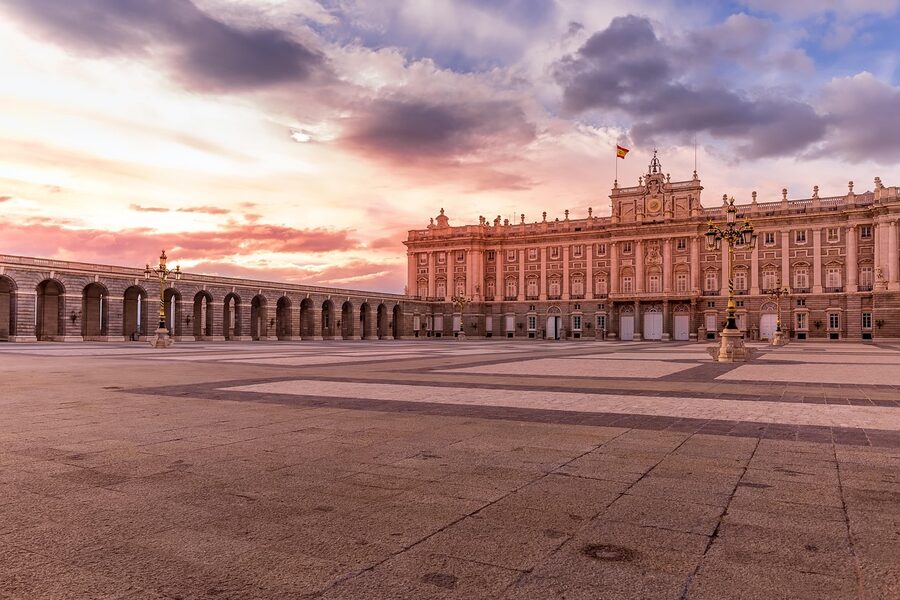
The Royal Palace of Madrid is a strange building. Bigger than it needs to be, emptier than its architecture promises, and ceremonial in a way that can read as theatre rather than history. But the Throne Room, the Royal Armoury, and the Sabatini Gardens are individually as good as anything in their categories in Europe, and seeing them in the same building, in the same morning, for €14 to €46 depending on how you want to do it, is one of the genuine bargains of central Madrid.
The fact that no one lives here is the framing that matters. This is not a home pretending to be a museum. It’s a state machine doing both jobs at once, and the visit makes more sense once you understand which job each room is doing.
Where to Go Next in Madrid and Beyond
If you’re spending more than a weekend in Madrid, the natural next moves are the two big art museums: the Prado on the Paseo del Prado and the Reina Sofia just down the road from it. The Bernabeu is the alternative if you’d rather a stadium than a state museum, and it pairs well with the Royal Palace as a Madrid-icons day. For a full-on flamenco evening that isn’t a tourist-trap dinner show, the standalone tablaos at Casa Patas or Cardamomo are what locals would tell you to book, covered in our piece on where real flamenco plays in Madrid.
For day trips, Toledo, Segovia and Avila are the three obvious ones, and we’ve covered the Segovia and Avila combo separately because the Roman aqueduct alone is worth the train fare. If your trip is also taking you north to Barcelona, the Gaudi cluster (Sagrada Familia, Park Guell, Casa Batllo) is the obvious pairing, and Casa Vicens is the under-visited Gaudi piece worth adding if you have a day. Different city, different king-king-king lineage. Same instinct that builds something to outdo the neighbours. The Amsterdam version of an unoccupied royal palace is the Royal Palace on Dam Square, which started life as the city’s town hall and now sits inside a working capital the way the Madrid palace does, and the formal-gardens-of-aristocracy thread carries on in spring at Keukenhof.