
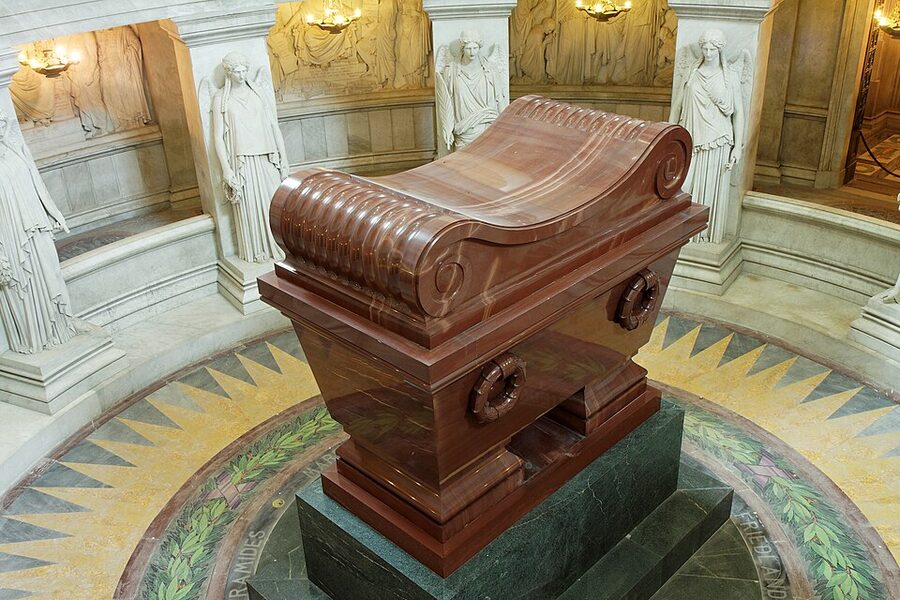
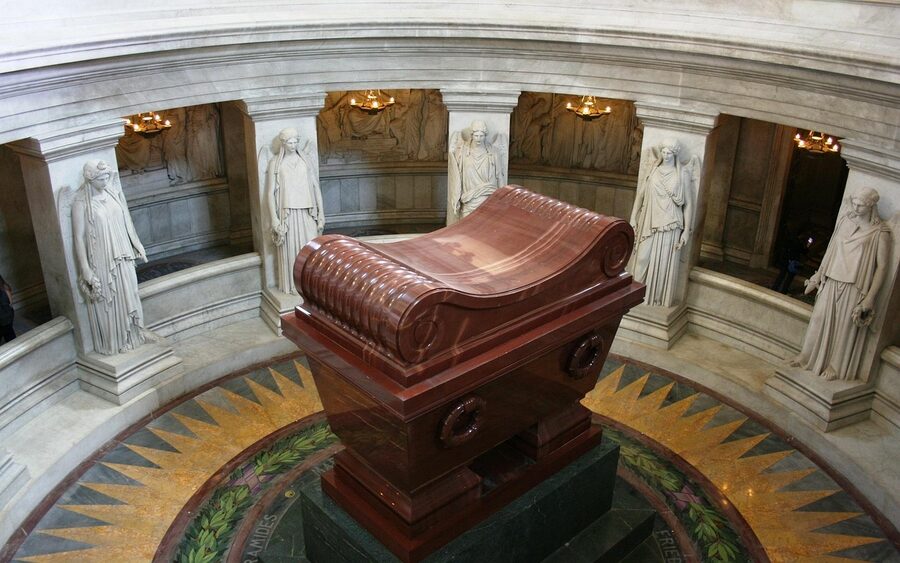
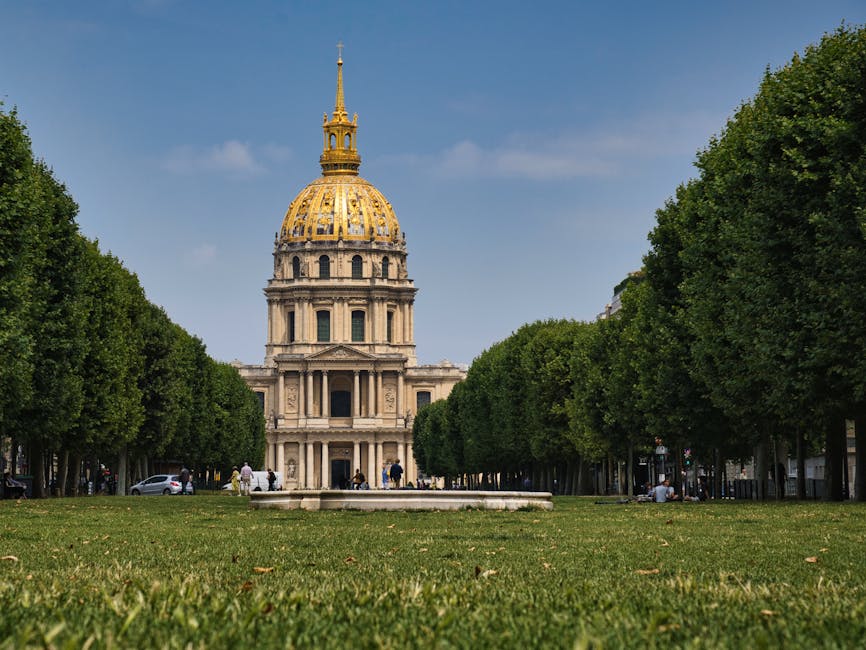
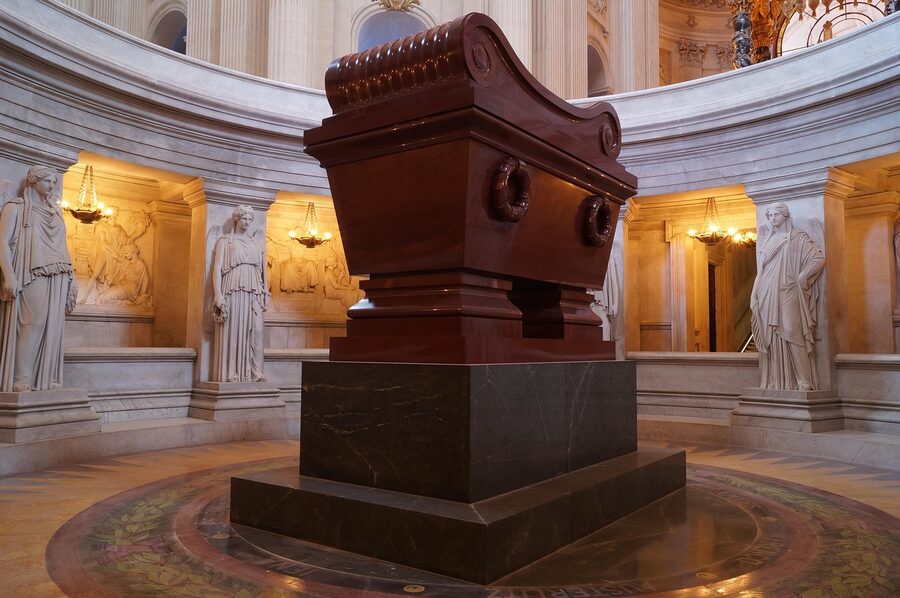
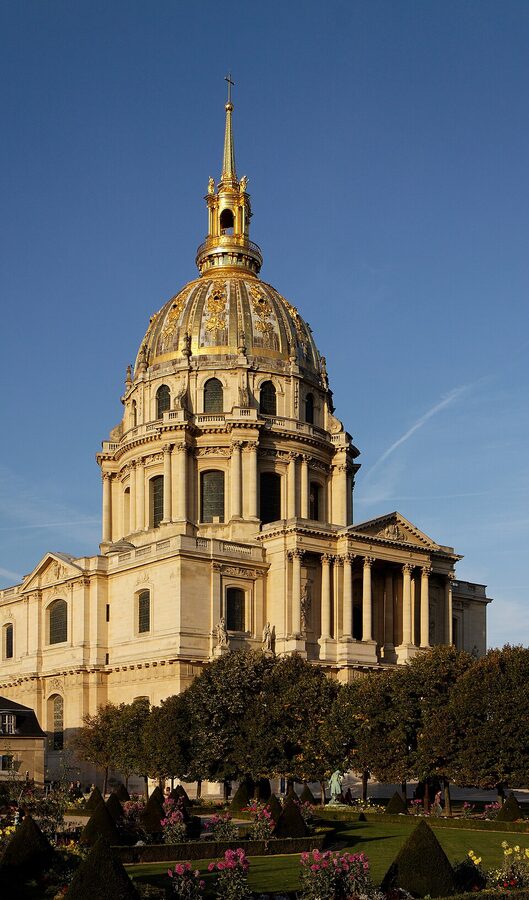
You walk into the Église du Dôme expecting another Paris church and instead find a circular hole in the floor. Six metres down, in a well of green granite ringed by twelve giant women carved in marble, sits a sarcophagus the size of a small car, made of red porphyry that catches what light reaches it from the dome 107 metres above. That’s Napoleon, and the rail you’re leaning on is the only thing between you and a 200-tonne block of Russian stone.
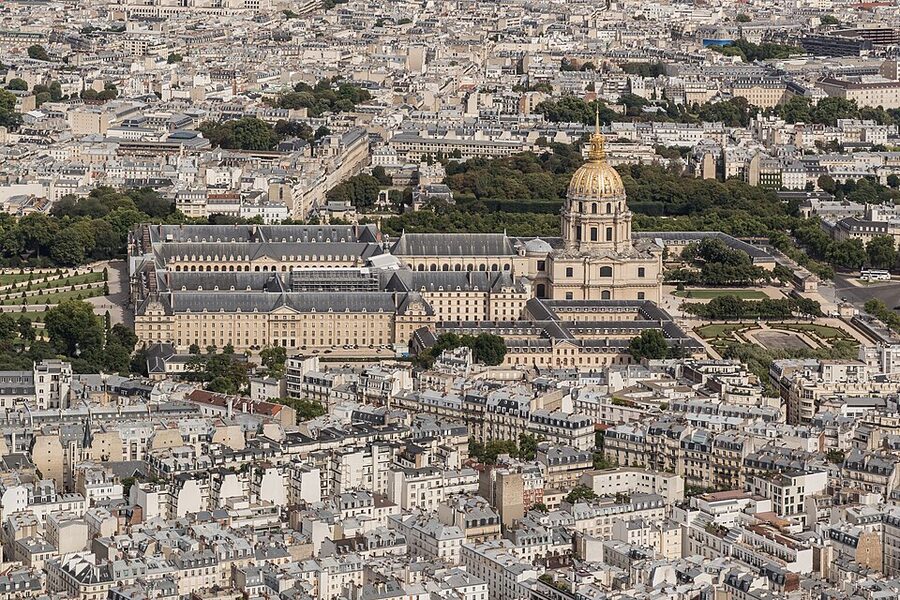
Most travellers come here for the Tomb and leave thirty minutes later. They miss the building entirely. Les Invalides was built as a 4,000-bed retirement home for wounded soldiers. It became a national mausoleum almost by accident. And the Army Museum next door, the one nobody seems to talk about, holds 500,000 objects across half a kilometre of galleries that go from medieval armour to a working De Gaulle audio installation in the basement.
In a Hurry? Top Picks
- Tomb and Army Museum entry ($20): the standard ticket. Covers everything that matters and nothing extra.
- Aura Invalides night light show ($33): 50-minute projection-mapping show inside the Dôme after dark. Worth it on a second visit.
- Private skip-the-line guide ($144): two hours, your own historian, the version where the building actually makes sense.
What This Place Actually Is
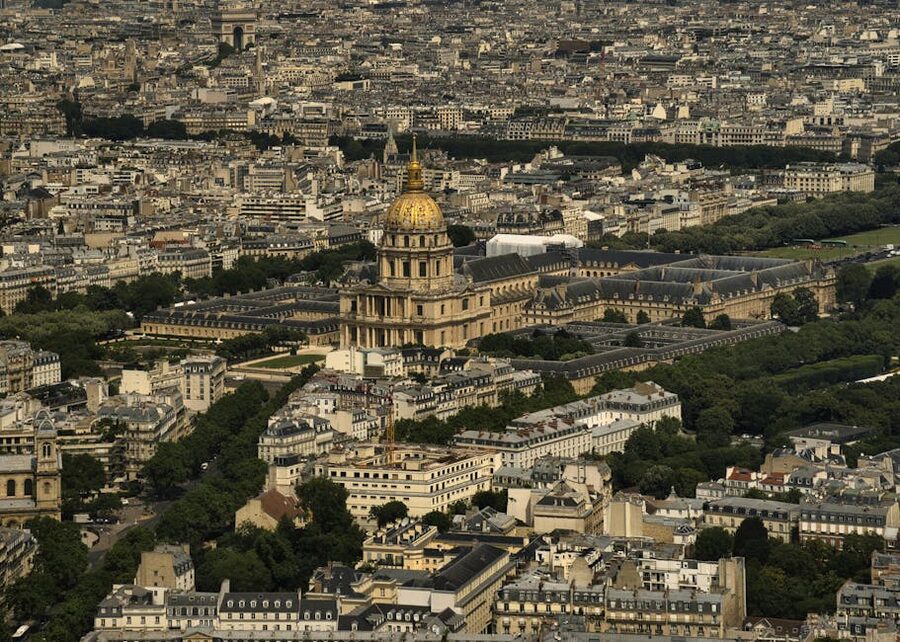
Louis XIV commissioned the Hôtel des Invalides in 1670 because he had a problem. France had been at war for most of his reign, and Paris was full of veterans with no pensions, no homes, and a lot of grievances. The Sun King’s solution was to build them a hospital so big it could house 4,000 of them at once, with a chapel attached, all paid for by the crown.
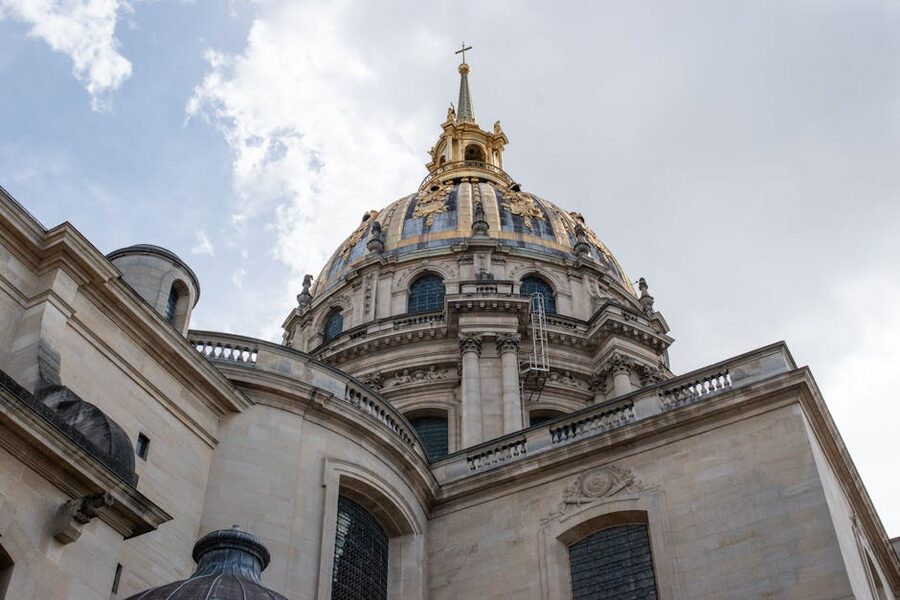
Libéral Bruant drew the original plans. Jules Hardouin-Mansart, who finished the job at Versailles for the same king, took over the church and added the gilded dome you see today. The Église du Dôme was completed in 1706. The whole complex went up in about thirty-six years, which is fast for the seventeenth century.
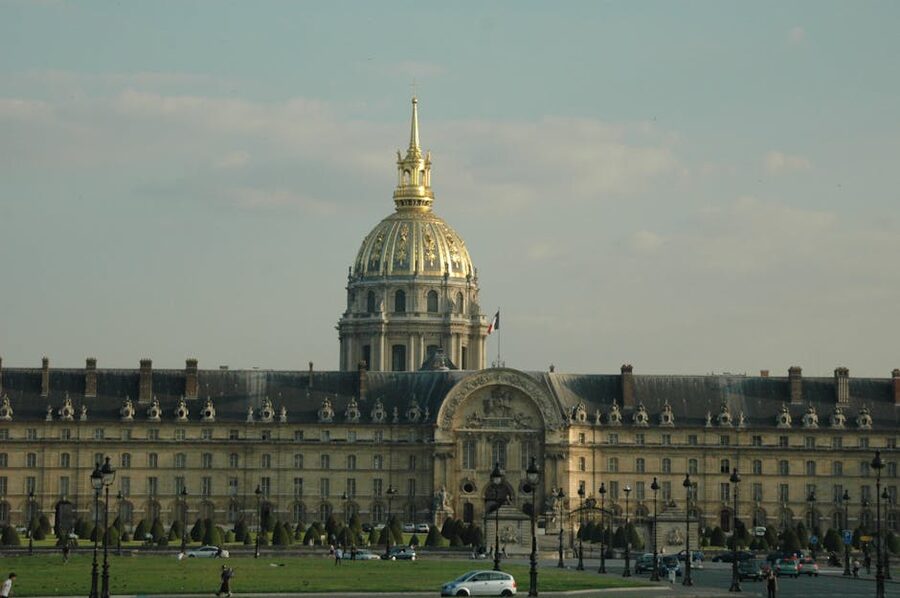
The point worth holding onto: this was not built as a tomb. It was built as a place for wounded soldiers to live out their last years. The dome was a chapel for the king to attend mass without mixing with the residents. The two big churches on the site, the Église des Soldats for the soldiers and the Église du Dôme for the king, share a single altar but were originally separated by a glass wall so the social order stayed intact even at communion.
Napoleon’s tomb arriving in 1840, 134 years after the dome was finished, is what changed the building’s identity. Before that it was a hospital with a fancy chapel. After, it became the place where French military identity got concentrated into one address. The veterans kept living here until 1972, by the way. The hospital wing is still active, just smaller.
The Moment at the Rail
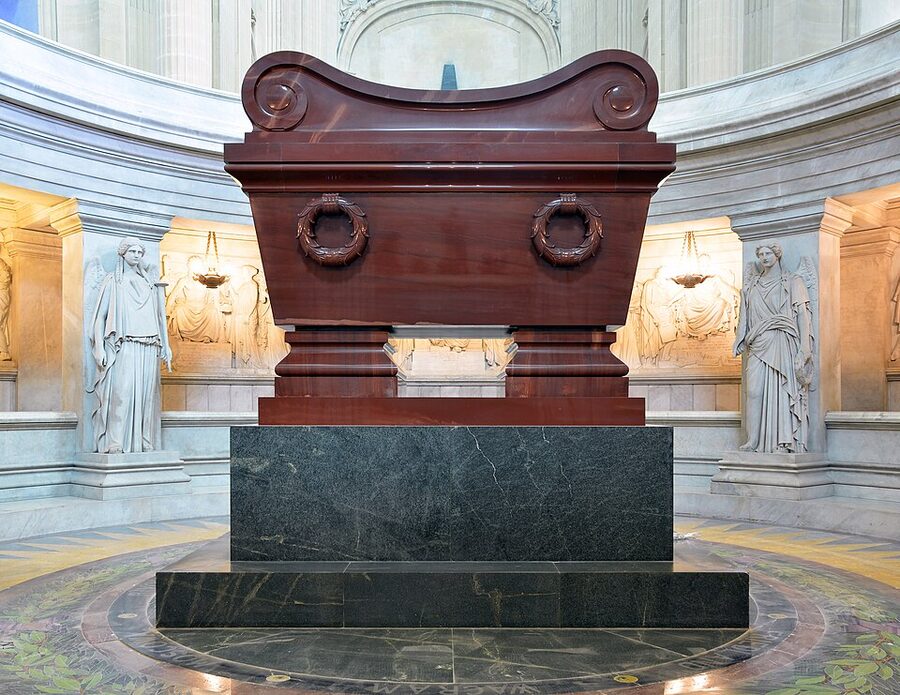
You enter the Église du Dôme from the south side, walk into the central rotunda, and the floor opens. There’s no warning, no signage build-up, just a circular rail and the drop. The sarcophagus is below you, about six metres down, and the engineering of it is what makes the moment work. You’re not standing in a crypt, you’re standing on the chapel floor, looking down into one.
The sarcophagus itself is red Carelian porphyry, quarried in what’s now Russian Karelia, gifted to France by Tsar Nicholas I in 1840. Two hundred tonnes. It took fourteen years to carve and another seven before the whole monument was inaugurated in 1861. The base is green granite from the Vosges in eastern France. The colours weren’t accidental: red imperial porphyry was the stone Roman emperors used for their tombs, and the green base reads as French soil holding the imperial body up.
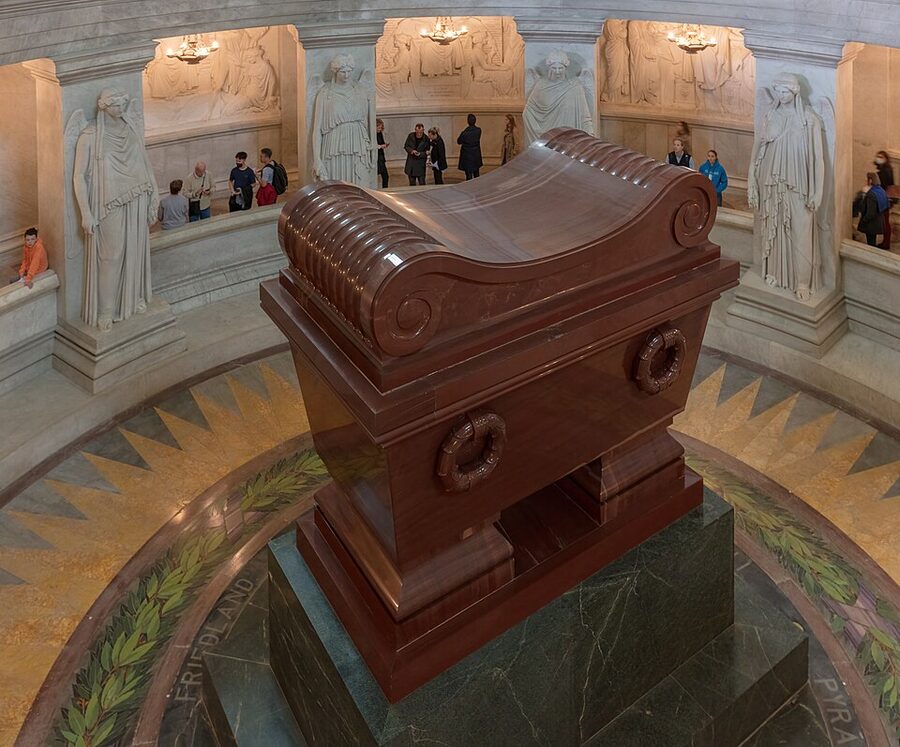
The twelve Victories ringing the well, by Jean-Jacques Pradier, each carry a different attribute and stand for one of Napoleon’s major campaigns. Marengo, Austerlitz, Jena, Friedland, Wagram, Moskowa, and so on. They’re not signed. You can spend a long time circling the rail trying to guess which battle each one is, and it’s a much better game than reading the wall labels in the Army Museum.
Stand at the rail and look up. The dome is 107 metres above you, the highest point in the seventh arrondissement, and the gilding was last redone in 2018-2019. Twelve kilos of gold leaf went on the exterior. The interior is painted with Charles de la Fosse’s Saint Louis Presents His Sword to Christ, which was meant for Louis XIV’s chapel and ended up over the body of the man who became, briefly, the next emperor of France. There’s a comparison sentence available with the Panthéon, the secular mausoleum across the river, but I’ll come back to that.
How Napoleon Actually Got Here: the Retour des Cendres
This is the part most guidebook copy skips, and it’s the part that makes the whole site cohere. Napoleon died on Saint Helena on 5 May 1821. He was buried in a valley on the island, in a grave the British called the Valley of the Tomb, marked with a plain stone. He stayed there for nineteen years.
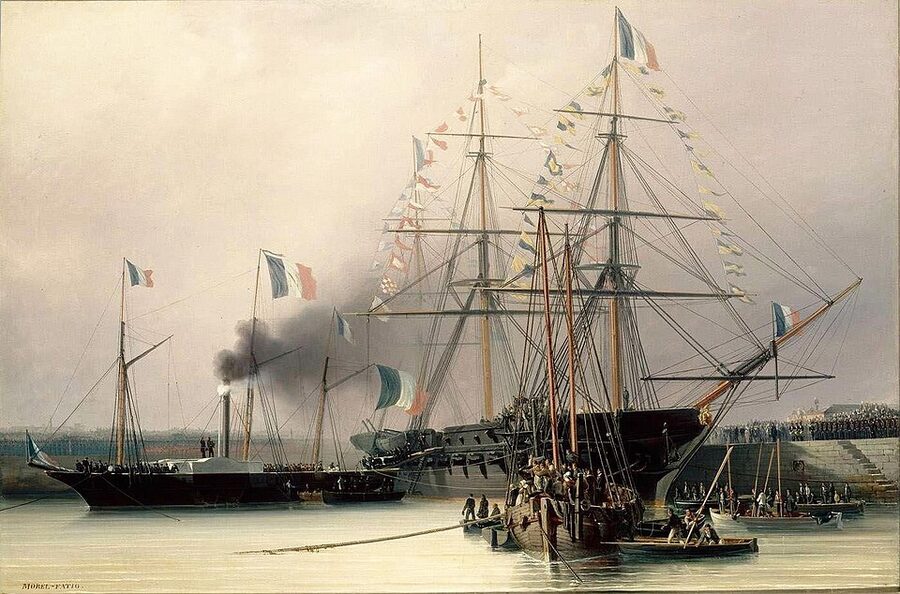
In 1840 King Louis-Philippe wanted a populist gesture and Adolphe Thiers, his prime minister, had the idea: bring the body back. The British, surprisingly, agreed. The expedition sailed from Toulon on the frigate Belle Poule in July 1840, painted black for mourning, captained by the king’s son the Prince de Joinville. They reached Saint Helena in October. The exhumation took place on 15 October 1840, twenty-five years to the day after Napoleon had landed on the island.
What the witnesses recorded is the part that still feels strange to read. When they opened the inner coffin the body was, by the accounts of the doctor and the priest who were present, remarkably preserved. Skin still on the face. The uniform mostly intact. He’d been dead nineteen years. People crossed themselves and a few of the older soldiers in the party, who’d known him in life, had to step away. Whether the preservation was due to the lead-and-tin coffin, the cold ground, or some combination, no one’s quite sure. The body was transferred to a new sealed coffin and taken aboard the Belle Poule.
The frigate reached Cherbourg on 30 November 1840 and the body moved up the Seine on a smaller vessel. Paris went into something close to national hysteria. On 15 December, in twenty-degrees-below freezing weather, the funeral cortege moved from the Pont de Neuilly down the Champs-Élysées, under the Arc de Triomphe Napoleon had commissioned in 1806 after Austerlitz, across the Place de la Concorde, and along the quais to Les Invalides. A million people lined the route. Victor Hugo, who watched from the Place de la Concorde, wrote one of the strangest accounts in nineteenth-century French literature: he described the cold, the silence, the way the cortege seemed to move through “a city of statues.”
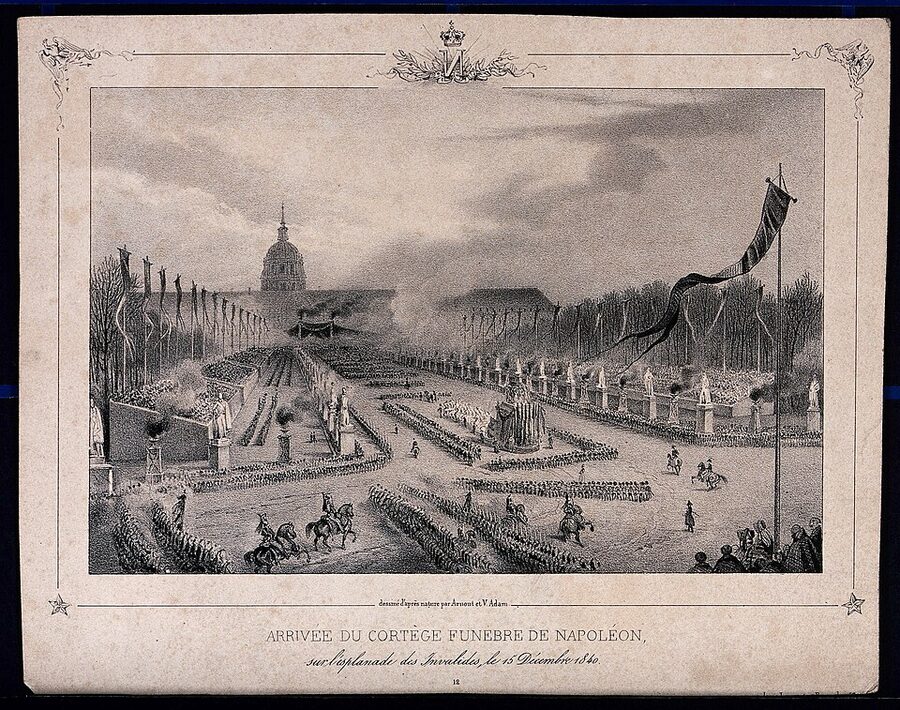
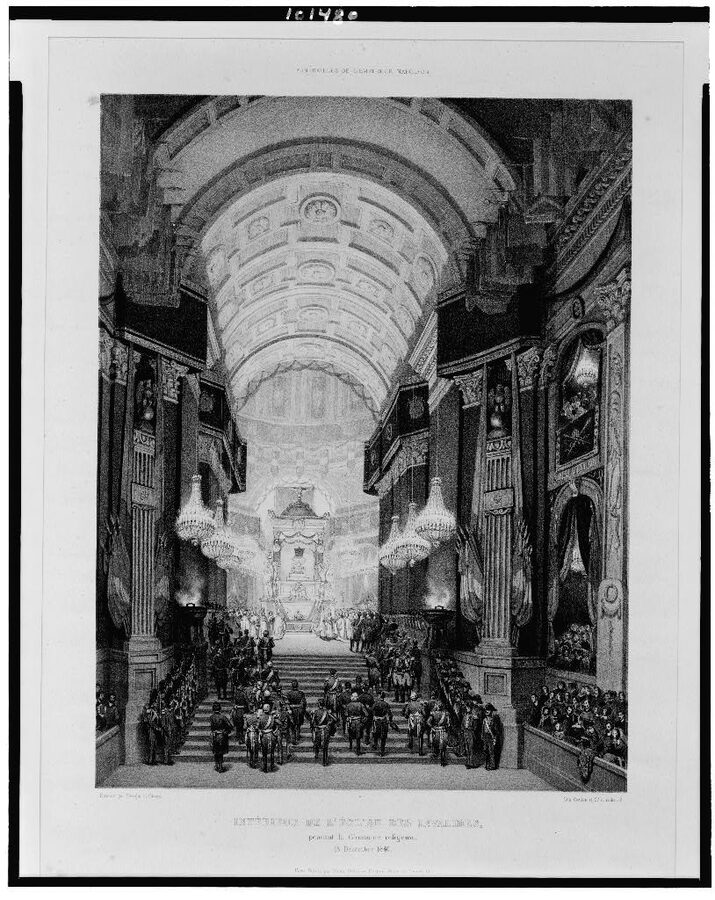
The body was placed in the temporary tomb at the Église du Dôme that day. The permanent monument wasn’t ready: it took another twenty-one years to build. The current sarcophagus and crypt were inaugurated on 2 April 1861, with Napoleon III, the original’s nephew, presiding. So when you look down at the porphyry, you’re looking at something that was placed there in its final form 161 years ago. Not as old as the building, much younger than the dome, but old enough to feel finished.
The Army Museum Most People Skip
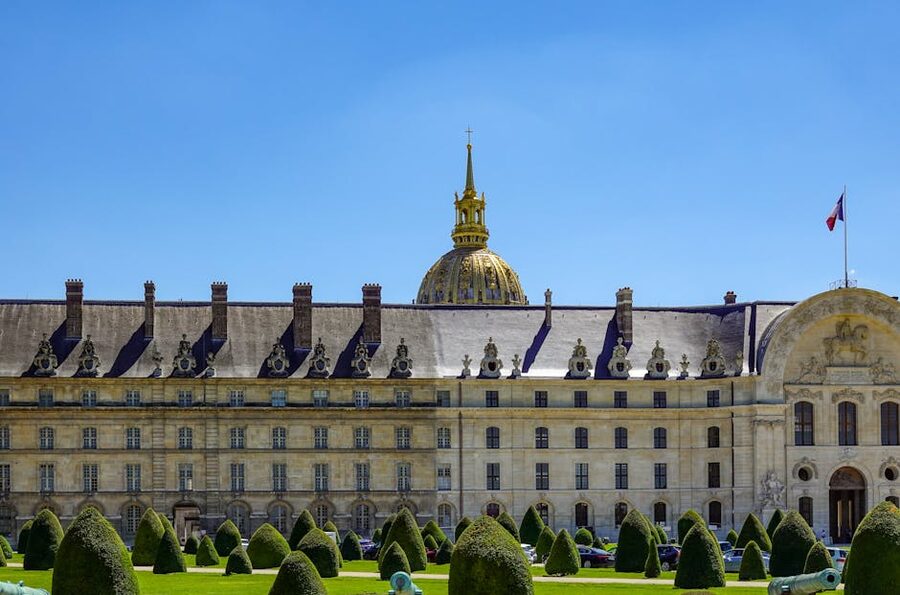
The Musée de l’Armée is, by holdings, the third-largest military museum in the world and the largest in Europe. About 500,000 objects across the wings of the original veterans’ hospital. The collections fall into three rough groups, and they’re in three different parts of the building, which is part of why people get lost and leave.
The medieval and Renaissance armoury sits on the top floor of the west wing. This is the part most people don’t even know is there. Plate harness from the fifteenth and sixteenth centuries, including some pieces that belonged to François I and Henri II. Tournament armour for horse and rider. Crossbows, halberds, two-handed swords. There’s an entire row of carved breastplates with Italian renaissance work that wouldn’t look out of place in the Louvre’s sculpture galleries. On a weekday at 10:30am you can have it almost to yourself. Most tour groups stop at the Tomb and never come up here.
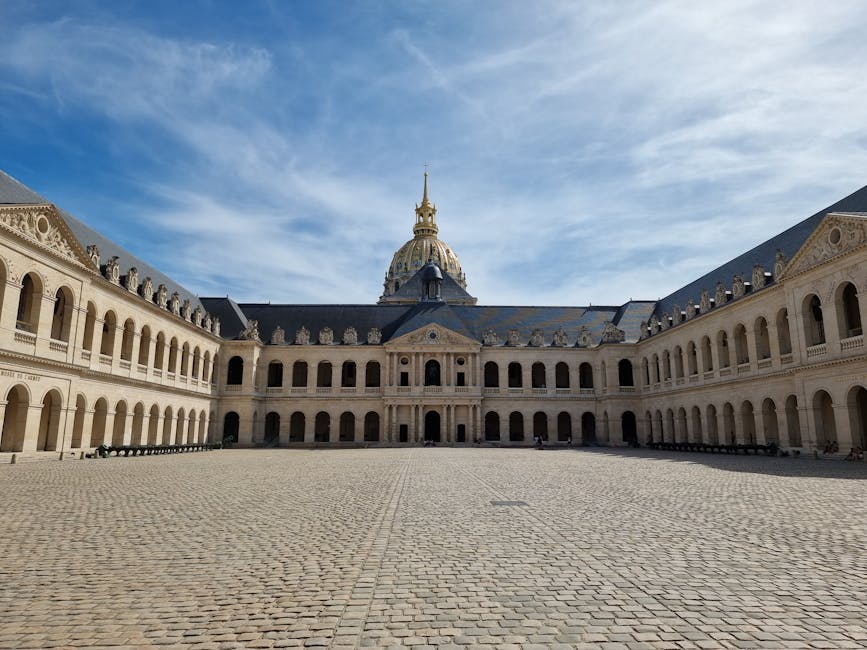
The Napoleon-and-Empire galleries are in the east wing, and this is where most casual visitors spend their museum time after the Tomb. His grey overcoat is here. His bicorne hat from Marengo. The death mask, taken on Saint Helena. His personal sword from the Italian campaign. A surprising number of small personal items, all of which read as bigger than they are because of the man who owned them. The gallery is well lit and well labelled, which means it’s also well populated. Try to come early or late.
The 1914-1918 galleries, on the lower level, were entirely reinstalled for the centennial in 2014 and they are the best modern history museum in Paris. Trench artefacts, soldier letters, gas masks, an entire reconstructed section of trench wall, the actual railway carriage in which the Armistice was signed represented in scale model. The galleries don’t romanticise the war. They show it as the industrial slaughter it was, and the curators were not interested in flattering anyone. Take an hour in here, minimum.
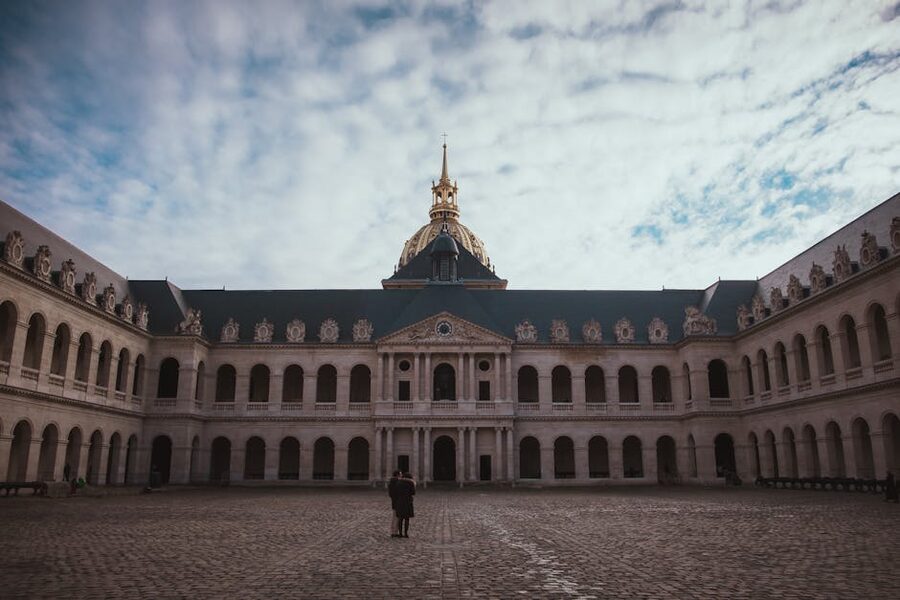
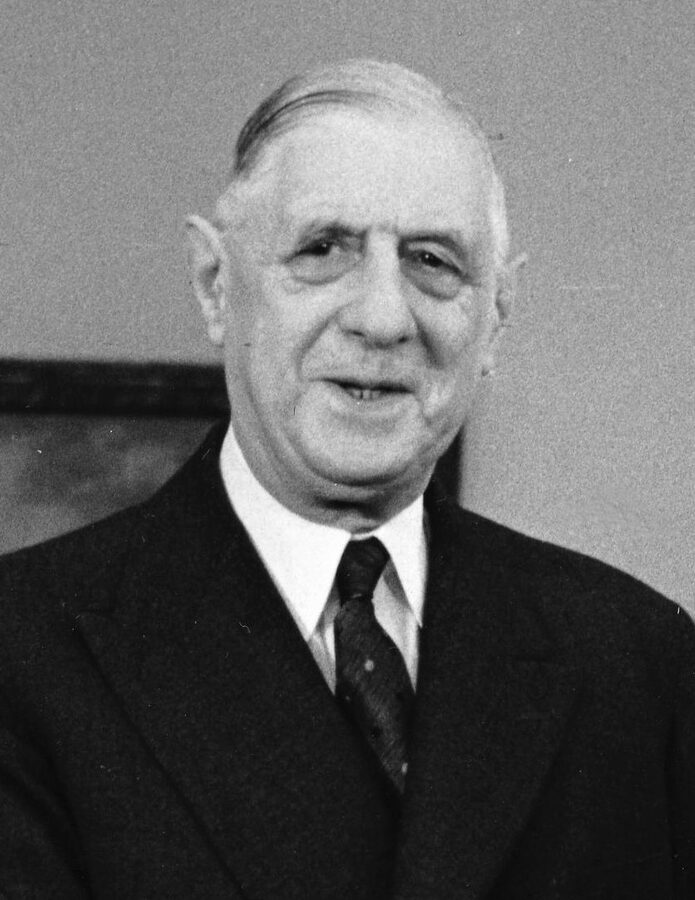
The Charles de Gaulle Historial is in the basement, and this is the surprise. It’s an audio-visual installation built in 2008, twenty rooms with films, voice recordings, archival footage, and his actual desk. It traces de Gaulle from his Free France radio broadcast on 18 June 1940 through the founding of the Fifth Republic in 1958 and his resignation in 1969. You sit in the dark, you listen to his voice, and you come out understanding why every French politician for fifty years has been measured against him. It takes about forty-five minutes if you do it properly. The first time I went I came up blinking and disoriented and had to sit on a bench in the courtyard for ten minutes.
Tickets, Hours, and the Right Way In
The standard ticket is around $20 (€15 at the door, sometimes a euro or two cheaper depending on the booking platform). It covers the Tomb, the Army Museum, the Napoleon galleries, the de Gaulle Historial, and the temporary exhibitions. That’s the only ticket most people need. The site doesn’t sell a “Tomb only” ticket because the Tomb is technically inside the Église du Dôme, which is part of the museum.
Children under 18 are free, EU citizens under 26 are free, and the first Sunday of the month is free for everyone in November-March (that doesn’t help in summer). The Paris Museum Pass covers Les Invalides at no extra charge. If you’re already buying the Pass for the Louvre, Versailles, and Sainte-Chapelle, the Invalides admission is essentially free.
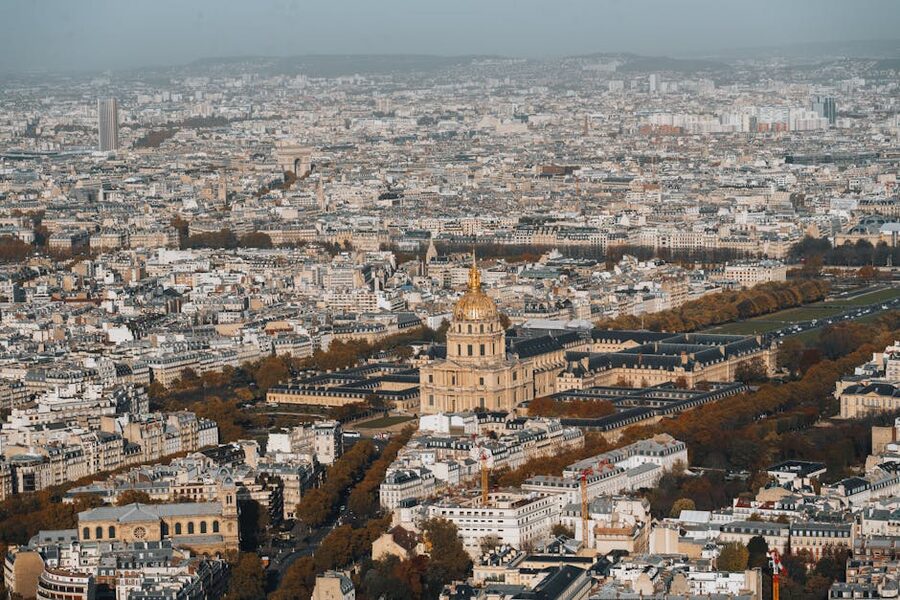
Hours are 10:00 to 18:00 daily, with the Tomb section closing at 17:30. The Aura night show runs in evening slots after the museum closes, typically 19:00 to 22:00 in waves of fifty minutes. Both the museum and the Aura have separate ticketing, so check carefully if you want both on the same evening.
Two ticket offices exist, the South office (Vauban, next to the dome) and the North office (Cour d’Honneur, on the Esplanade side). The North office is consistently faster and the line is usually under ten minutes even in summer. I have stood in the South line for forty-five minutes watching the same line at the North office stay empty. Go to the north entrance.
The fastest combination if you’re starting from the centre: take the metro to Invalides on Line 8 or 13, walk south through the Esplanade des Invalides (a five-minute green stretch), enter at the Cour d’Honneur, do the Army Museum first, finish at the Tomb. Save the Tomb for last because it’s the emotional anchor of the visit and you don’t want to walk into it cold and then trudge through 500,000 objects of armour afterwards.
Three Ways to Book
The site doesn’t oversell. The standard entry ticket covers more than 90% of what you’d want to see, and a guided tour only adds value if you genuinely want to understand the building’s architecture and history rather than just its highlights. Below are the three I’d actually recommend, in order of how most travellers should approach them.
1. Les Invalides: Napoleon’s Tomb & Army Museum Entry: $20
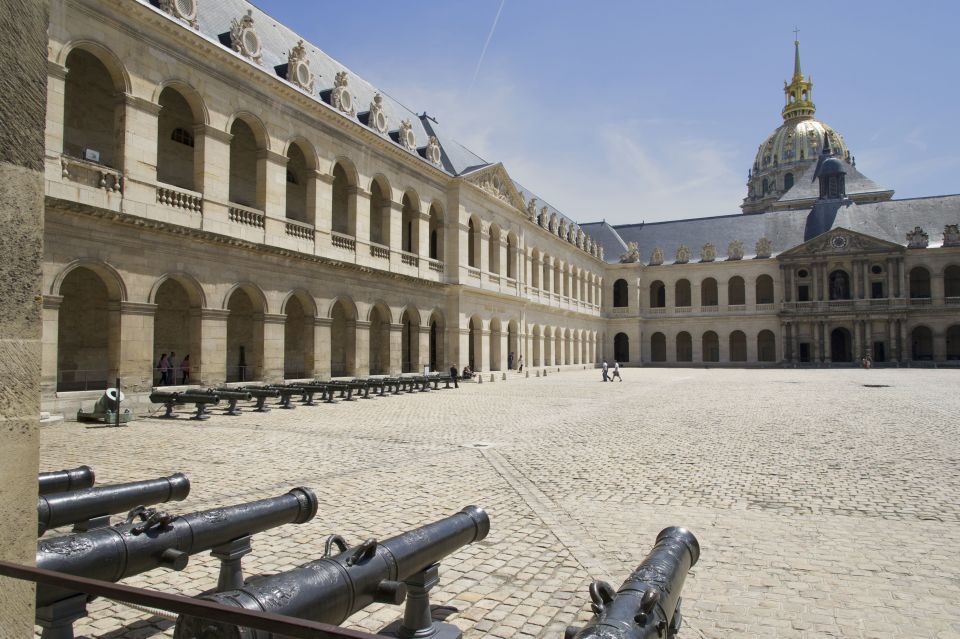
This is the right pick if you want one ticket that covers the whole site. The reserved slot lets you walk past the door queue, and once inside the ticket is valid for the full day so you can wander, leave for lunch on Rue Cler, and come back. Our full review covers the line-skip mechanics and which sections actually need a guide versus self-guided.
2. Aura Invalides Immersive Experience: $33

This is the right pick if you’ve already done the daytime visit and want to see the building transformed. The walking format means you can stand directly above the tomb while the dome above you turns into projection-mapped sky, and that experience is genuinely unique to this venue. Our full review covers the timing windows and what to expect from the soundscape.
3. Skip-the-Line Dôme & Napoleon Private Guided Tour: $144
This is the right pick if you want the building to make sense, not just the Tomb. Two hours with a private historian who can compare the iconography here with the rooms at Versailles and explain why Louis XIV’s chapel ended up over Bonaparte’s body. Our full review covers what to ask the guide and which sections work best for the depth treatment.
Bourbons, Bonapartes, and a Building With Two Identities
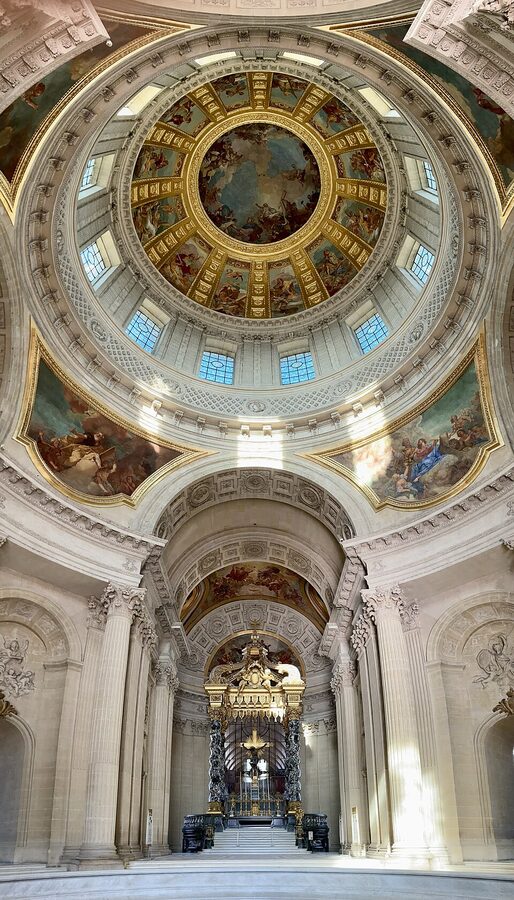
The thing nobody tells you about the Dôme is that it was built by the Bourbons and ended up holding a Bonaparte. Louis XIV would not have been amused. He spent his reign establishing absolute monarchy and the legitimacy of divine-right kingship, and the man whose body now lies under his chapel ceiling spent his career dismantling the same idea.
This is why the iconography of the Tomb gets weirder the longer you look. The twelve Victories around the rail are pagan, classical, more Roman than Catholic. The reliefs in the lower ring of the crypt show Napoleon as a lawgiver, an emperor, an administrator: not the Christian king the chapel was built for. The Bourbon chapel ceiling, painted with saints and apostles, looks down on a sarcophagus designed in the language of Roman emperors. The whole composition is a kind of architectural argument the building can’t fully resolve.
If you’ve already done Sainte-Chapelle and the Conciergerie, you’ll have seen this dynamic from the other side: a thirteenth-century royal chapel that stayed religious throughout the revolutions, and a medieval royal palace that became a revolutionary prison and held Marie Antoinette before her execution. Together with Les Invalides, those three sites are the long argument French architecture is having with itself about what royalty, religion, and the state mean.
The other comparison worth holding in your head is the Panthéon, the secular national mausoleum across the river in the fifth arrondissement. The Panthéon holds Voltaire, Rousseau, Victor Hugo, Émile Zola, Marie Curie, Alexandre Dumas. The Panthéon is for civilians: writers, scientists, philosophers, the men and women who made France through ideas. Les Invalides is for the military emperor, alone in his porphyry, surrounded by the army that followed him. France keeps its civic genius and its imperial ambition in two different buildings on two different sides of the Seine. Once you notice the split, you can’t un-notice it.
Beyond the Tomb: What’s in the Galleries
I want to give you a route through the Army Museum that actually works, because the official one is bad. The official suggestion is to start in chronological order in the medieval armoury and work forward to the World Wars. Don’t do this. By the time you reach 1939 you’ll have museum fatigue and skip the parts that matter.
Here’s the order I’d recommend. Start with the 1914-1918 galleries on the lower level, because they’re emotionally heavy and you want to be fresh for them. Then the De Gaulle Historial in the basement, which is sit-down audio-visual and gives your legs a break. Then back up for the medieval armoury on the top floor, which is light entertainment after the heavier modern history. Then the Napoleon and Empire galleries. Save the Tomb for last. The 20th-century galleries pair well with an Amsterdam stop a few days later: the Anne Frank walking tour is the personal-scale counterpart to Les Invalides’s institutional WWII record, and walking the Jordaan after standing in Invalides’s 1939-45 wing turns the abstract into a single canal-house door.
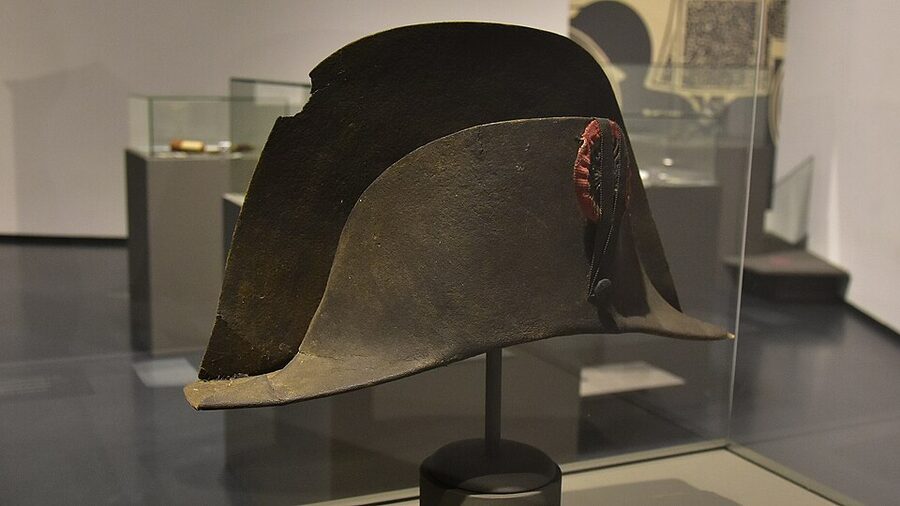
The Napoleon galleries hold the items most people remember. The grey overcoat, worn at multiple campaigns including Russia, frayed at the cuffs. The bicorne hat that he wore “en bataille” (sideways) rather than “en colonne” (front-to-back) like other officers, which is the thing every French schoolchild learns. The death mask, taken at Saint Helena and authentically his face. His travel writing desk. His sword from the Italian campaign of 1796, when he was twenty-six years old and the Republic’s most successful general.
The medieval armoury, on the top floor of the west wing, is where the genuine surprise is. France was the dominant European power throughout the late medieval and early modern period and the kings collected armour the way modern wealthy collectors collect art. There’s a complete tournament harness for both horse and rider that takes up most of one room. There’s an Italian Renaissance breastplate engraved with mythological scenes that’s essentially a piece of Renaissance sculpture you happen to be able to wear. There’s a row of crossbows from the Hundred Years War, the actual machines that won and lost the battles you read about as a kid.
I’ve put two hours in this section before and I haven’t seen all of it. Most of the people I’ve shared the room with were there for fifteen minutes or less. It’s the most under-visited part of the entire site and probably the densest collection per square metre.
Aura: The Night Show, Plainly
The Aura Invalides is a 50-minute projection-mapping show inside the Église du Dôme after museum hours. The dome’s interior, the De la Fosse fresco, the columns, and the central rotunda all become projection surfaces. There’s a live-orchestrated score, video mapping, and you walk freely around the church as the show plays out.
Real take: it’s worth doing if you’ve already done the daytime visit and you want to see the building transformed, but it’s a terrible substitute for the daytime visit if you only have one slot. The show treats the architecture as a screen rather than as a building, and the screen happens to be a building you couldn’t otherwise see this way. If you’ve stood at the rail in daylight, the show adds a layer. If you haven’t, you’ll miss the layer entirely.
The format is “free movement,” which means you can stand directly above the tomb while the dome above you turns into a projection-mapped sky. That moment is the show’s best one. The pacing is slow and the score is heavy on strings. About 50 minutes total. If you’re travelling with kids, the recommended age is seven and up, and I’d say nine and up is more realistic given how much you’re standing.
Combining With What’s Around
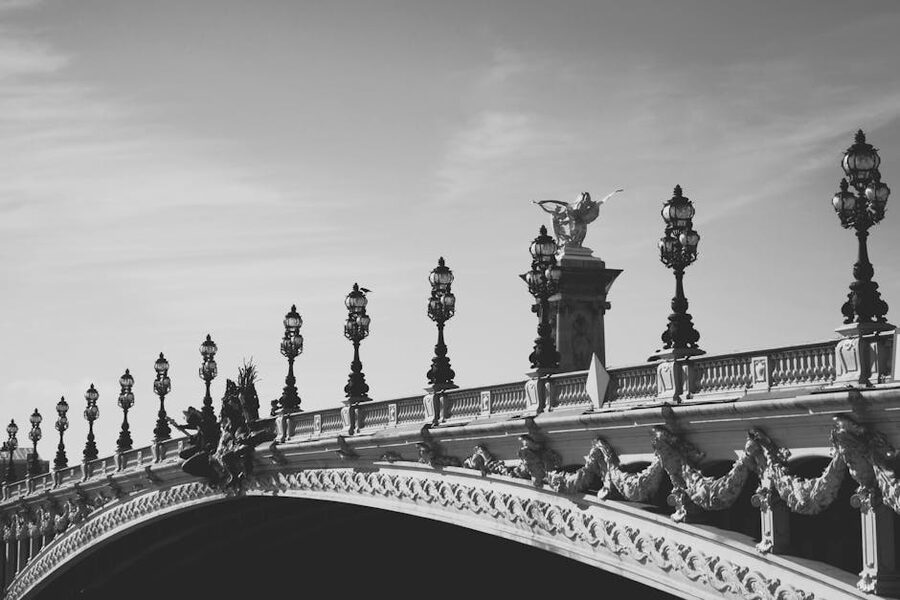
The Esplanade des Invalides runs north for about 500 metres to the Pont Alexandre III. That’s a five-minute walk, and on the bridge you can connect to a Seine river cruise from the Port des Invalides dock if you want to combine the morning at the museum with an afternoon on the water. The Bateaux Parisiens dock and the Vedettes du Pont-Neuf dock are both within walking distance.
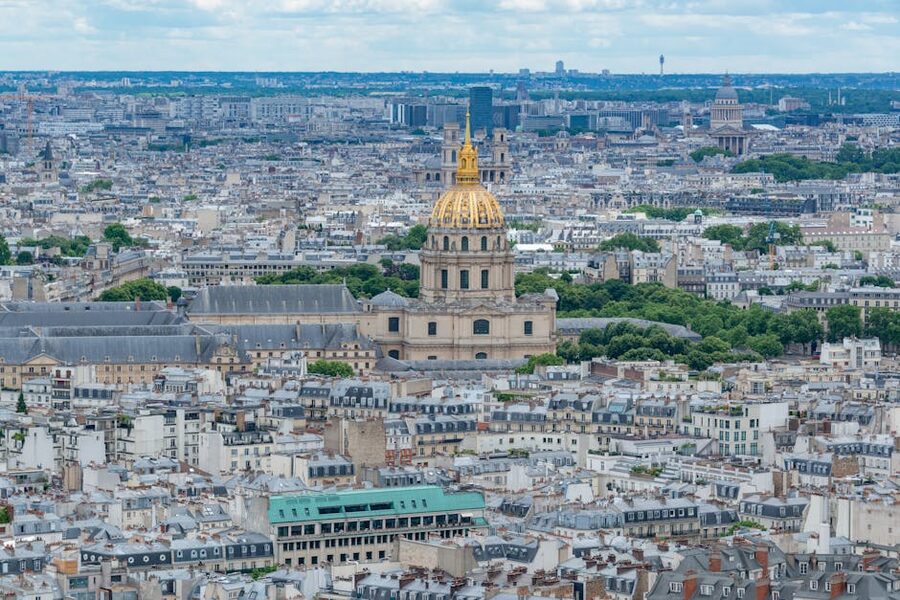
South-west of the dome, about a five-minute walk, is the Eiffel Tower. You can do both in a single morning if you start at Les Invalides at opening, spend two and a half hours, then walk along Avenue de la Bourdonnais to the tower for an early lunch booking. Most travellers do them in the opposite order and end up rushed at Les Invalides because the tower took longer than they expected. Don’t do that.
East of the dome, fifteen minutes on foot or a few stops on the metro, is the Musée d’Orsay. Pair the morning at Les Invalides (military, imperial, masculine) with an afternoon at Orsay (Impressionist, intimate, full of light) and you have one of the better contrast days in Paris. The two museums together cost less than a Paris Museum Pass would for two days.
If you’ve got time and you’re already buying the Paris Museum Pass, the day-long combination that actually makes sense is Les Invalides in the morning, lunch on Rue Saint-Dominique, then Sainte-Chapelle and the Conciergerie on the Île de la Cité in the afternoon. That gives you the imperial military mausoleum, the medieval royal chapel, and the revolutionary prison all in one day. The architectural argument I mentioned earlier becomes legible when you do the three back to back.
State Palaces Across Europe: How Les Invalides Sits in the Family
One of the things that makes Les Invalides legible is comparing it to the other state-and-palace buildings in Europe. The Doge’s Palace in Venice was the seat of a republic, not a monarchy, and the architecture is correspondingly horizontal: chambers, corridors, debating halls, an enormous Maggior Consiglio room where 2,000 patricians voted on shipping policy. Venice’s state was distributed power. Les Invalides, the Bourbon hospital that became the Bonaparte tomb, is concentrated power, vertical, single-emperor.
The Spanish equivalent is the Royal Palace of Madrid, the largest royal palace in Western Europe by floor area and the seat of the Spanish crown until Juan Carlos moved out in the 1970s. Three thousand-plus rooms, used for state ceremonies but no longer for daily royal life. Madrid’s palace is theatre. Les Invalides is mausoleum. Both rely on scale to do their work, but they’re using the scale to say opposite things.
The most interesting comparison is probably the Alhambra in Granada, the Moorish palace-fortress that the Catholic monarchs took over in 1492. The Alhambra is a fortress that became a palace, then a Christian palace, then a museum. Les Invalides is a hospital that became a chapel, then a mausoleum, then a museum. Both buildings have absorbed multiple ideologies and let their architecture record the layering. You can read the entire history of each one in the surfaces if you know what to look for.
The Dutch counterpart is the Royal Palace on Dam Square, which started life as the 17th-century Stadhuis of a merchant republic and was promoted to a royal residence under Louis Bonaparte (Napoleon’s brother) in 1808. The Bonaparte family installed itself in Amsterdam’s town hall the same way Bonaparte himself ended up under the Invalides dome: by accident of empire. The Amsterdam building is the civic-republican mirror of the imperial-monarchical statement Les Invalides has become.
If state palaces interest you generally, doing all four in a single trip across France, Spain, and Italy gives you a kind of comparative curriculum on how European power chose to embody itself. Each one answers a slightly different question about what the building is for.
Practical Bits
Let me bullet a few things that are easier to scan than to read in prose.
- Best time to arrive: 10:00 sharp at the north entrance. The first ten minutes inside the Dôme are the quietest you’ll get all day.
- How long to budget: three to four hours if you do the Tomb and one of the museum wings properly. A full day if you want to see all three Army Museum sections plus the de Gaulle Historial.
- Photography: allowed throughout. Tripods need a permit. Phone photography of the Tomb is fine and most people use a low angle from the rail to get the sarcophagus and the dome above in a single frame.
- Food: there’s a small café in the courtyard and a slightly nicer restaurant called L’Esplanade just outside the gate. For better lunch, walk five minutes to Rue Cler, the famous market street, and pick anywhere with a queue.
- Lockers: available at the north entrance, free for the day. Use them. The galleries are long and you don’t want to carry a bag through the medieval armoury.
- Wheelchair access: all main galleries are accessible, including the Tomb (a lift goes down to the lower ring of the crypt). The medieval armoury on the top floor is the only section with restricted access.
- Audio guide: €6 extra in seven languages. Worth it for the Napoleon galleries, where the labels are in French and English only and many objects have meaningful provenance.
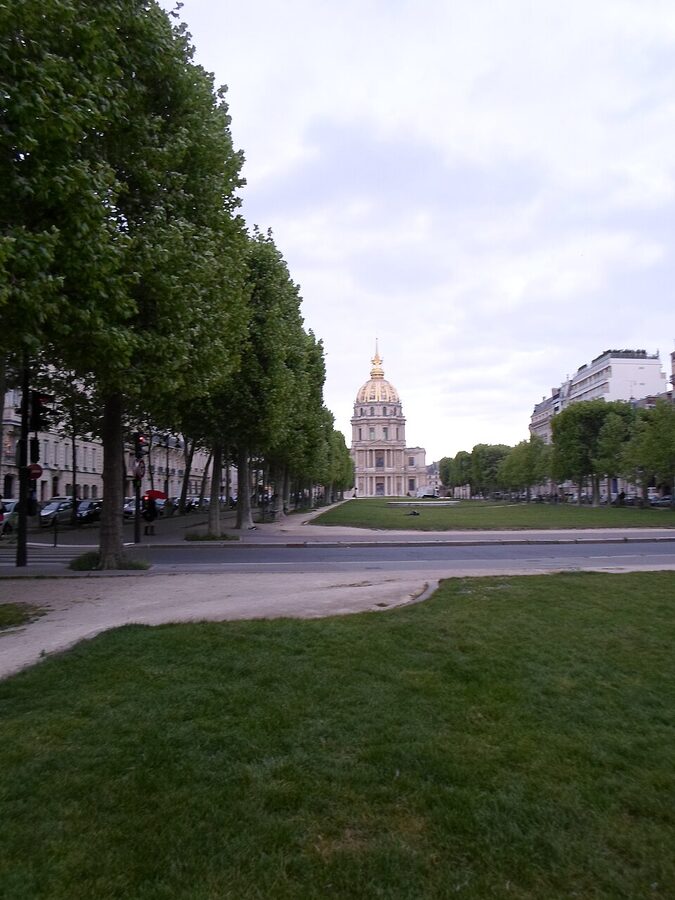
The metro is straightforward. La Tour-Maubourg on Line 8 puts you at the south end, ten metres from the Vauban entrance. Invalides on Lines 8 and 13 puts you at the north end of the Esplanade, which is the better approach. RER C also stops at Invalides for travellers coming in from Versailles or central Paris.
Worth It or Not
The Tomb on its own is worth the trip if you have any interest in Napoleon or in nineteenth-century French history. It’s one of the most concentrated single experiences in Paris. The setting, the materials, the iconography, and the scale of the moment work together in a way that very few monuments achieve. You will remember standing at the rail. I have been four times and the moment has not lost its weight.
The Army Museum is worth the trip if you have any interest in military history or in seeing one of Europe’s great encyclopedic collections. The medieval armoury alone justifies the ticket. The 1914-1918 galleries are world-class. The de Gaulle Historial is the surprise nobody warned me about and the one I’d recommend most strongly to first-time visitors who think they don’t care about French politics.
The thing that doesn’t quite work is doing the visit fast. Forty-five minutes for the Tomb only is a missed opportunity. If your day is that short, do something else and come back to Les Invalides on a longer trip. Three to four hours is the right minimum. A full day, with a Rue Cler lunch in the middle, is how the site is supposed to be done.
If you’re in Paris for a week and you’re trying to figure out what’s worth your time after the obvious icons, this is one of the better second-tier choices. Not a tourist box-tick, not a casual hour, but a real morning that leaves you knowing more than you did when you walked in. That’s the Rick Steves test, in a way. Did the building teach you something. Yes, this one does.
While You’re In Paris
If Les Invalides has put you in a French history mood, the natural next stops are the Arc de Triomphe, which Napoleon commissioned the year after Austerlitz and which the funeral procession passed under in December 1840, and the Panthéon, the secular mausoleum across the river that holds Voltaire, Rousseau, and Marie Curie. Doing the three together over a couple of days gives you both halves of how France remembers itself. The military emperor in his porphyry. The civilian thinkers in their plain stone tombs. Versailles on a separate day completes the trio: Bourbons, Bonapartes, and the Republic, in three buildings.
For a different kind of afternoon, a Seine river cruise from the Port des Invalides dock takes you past most of the central monuments without the legwork, and the angle on Notre-Dame from the water is better than any angle from the bank. If you’re staying longer and want a full week of museum days, the Paris Museum Pass covers Les Invalides, the Louvre, Orsay, Sainte-Chapelle, the Conciergerie, the Arc de Triomphe, and the Panthéon, and pays for itself in two days if you pick well. The hop-on bus is the laziest way to connect the dots between Invalides, the Eiffel Tower, and the Champs-Élysées if you’re tired of walking. And Disneyland Paris is an entirely different kind of day if you’ve got kids who’ve had enough monuments by Wednesday.