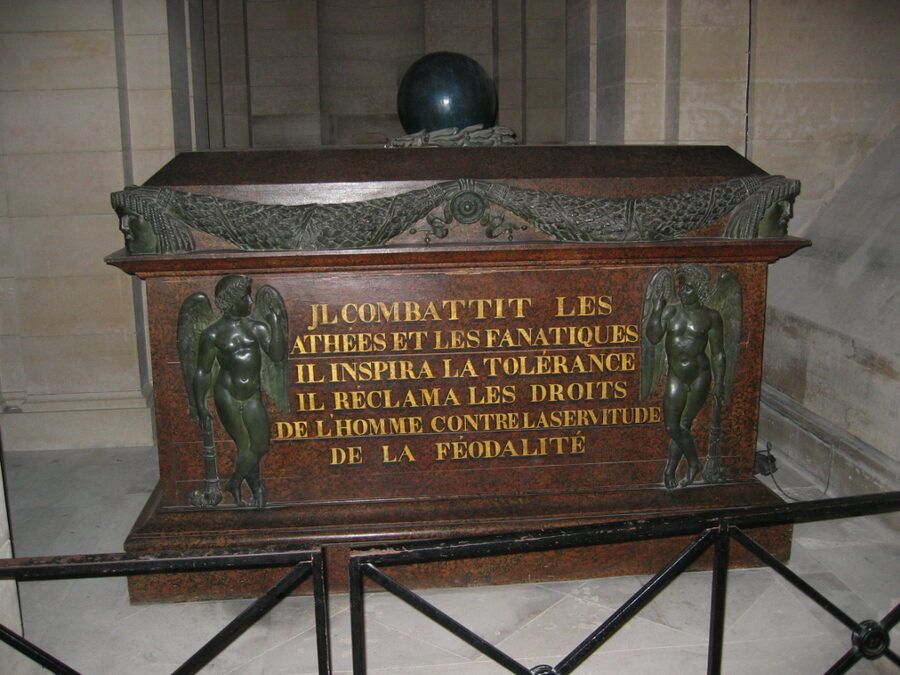
The black sarcophagus 30 feet underneath the dome belongs to Voltaire. He died in 1778 still officially excommunicated by the Catholic Church, smuggled out of Paris in a coach propped upright as if alive so the priests wouldn’t refuse the burial. Thirteen years later the National Assembly carried his body back, in a procession that took six hours, and laid him in the crypt of a building Louis XV had ordered built as a church. That building is the Panthéon, and the trick of visiting it is understanding that the conversion from royal abbey to secular mausoleum happened so fast it left the architecture half-finished.
Five minutes from the Sorbonne, on the highest point of the Left Bank, in the fifth arrondissement. Open every day, 10:00 to 18:30. Tickets €13 (about $15) for an adult, free for under-18s and EU citizens 18 to 25. About ninety minutes if you do it properly. Three hours if you read the wall texts.
In a Hurry: Top 3 Picks
- Panthéon Admission Ticket ($15): the cheapest option, covers nave + crypt + temporary exhibitions. The only one you actually need.
- Panthéon Ticket + Seine River Cruise ($37): pairs the visit with a one-hour Bateaux-Mouches cruise from Pont de l’Alma. Worth it only if you were going to do a Seine cruise anyway.
- Old Town & Latin Quarter Walking Tour ($41): 2.5 hours through Saint-Germain, Luxembourg Gardens and the Latin Quarter, ending near the Panthéon. Useful first-day orientation.
The first thing to know: Louis XV vowed to build a church here
In 1744 Louis XV came down with typhoid in Metz and thought he was dying. He vowed that if he recovered he’d rebuild the crumbling abbey of Sainte-Geneviève, the patron saint of Paris, as a great church on the hill where her relics were kept. He recovered. The abbey was crumbling. Construction started in 1758 with Jacques-Germain Soufflot as architect.
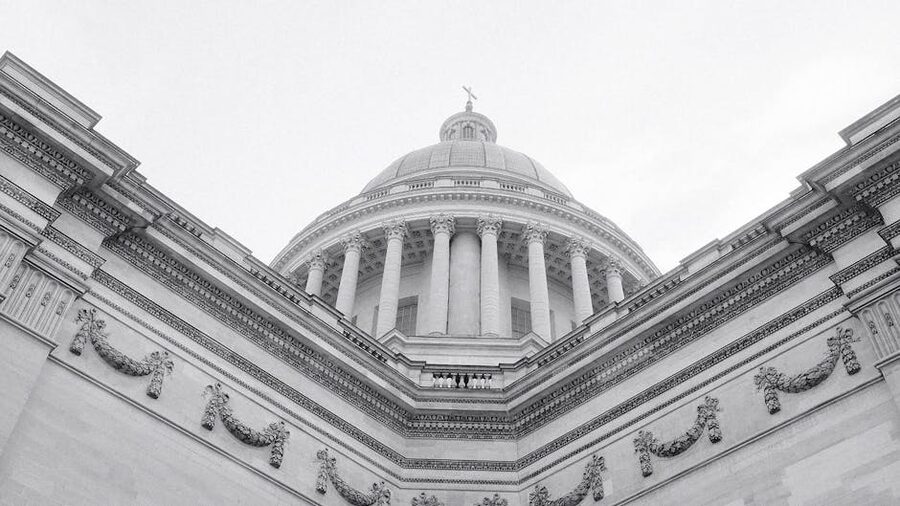
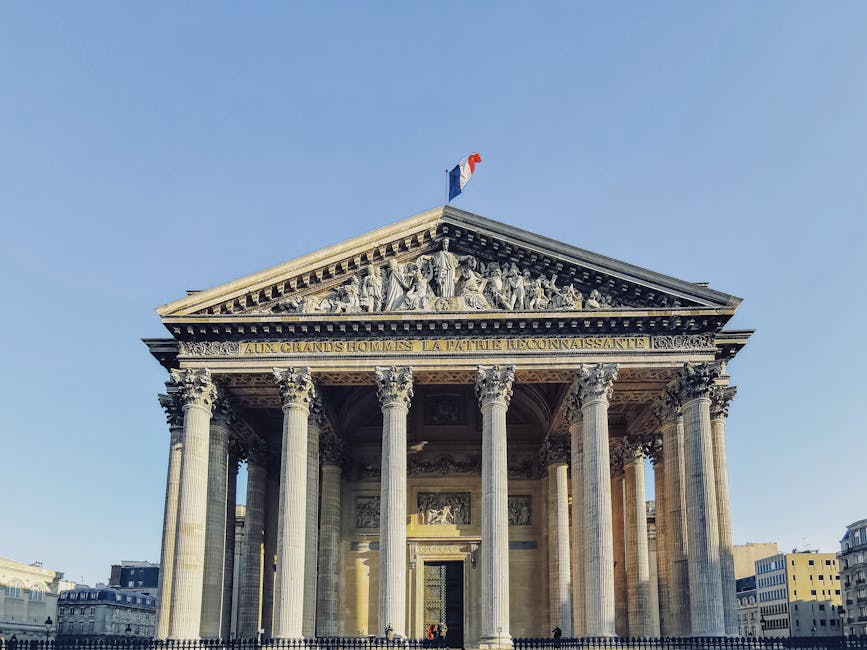
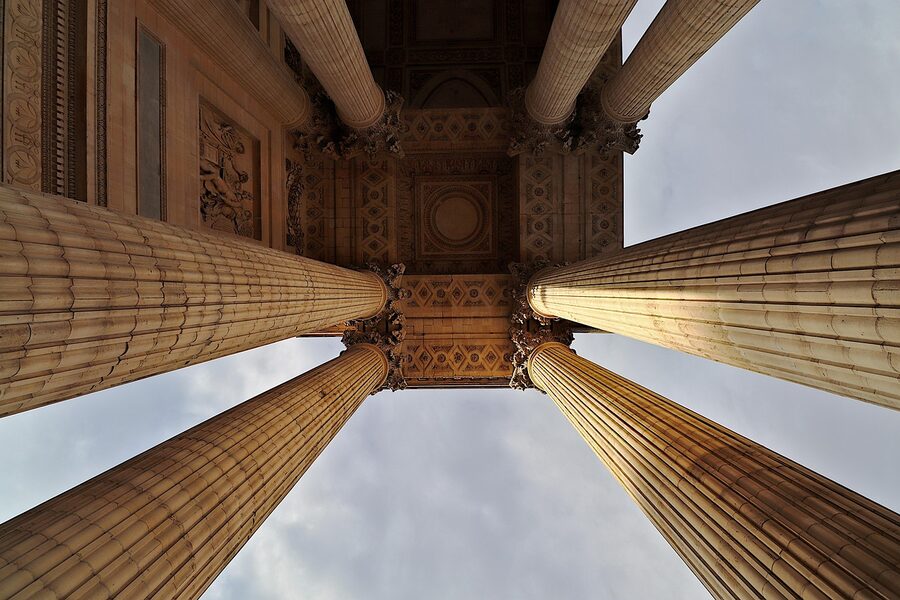
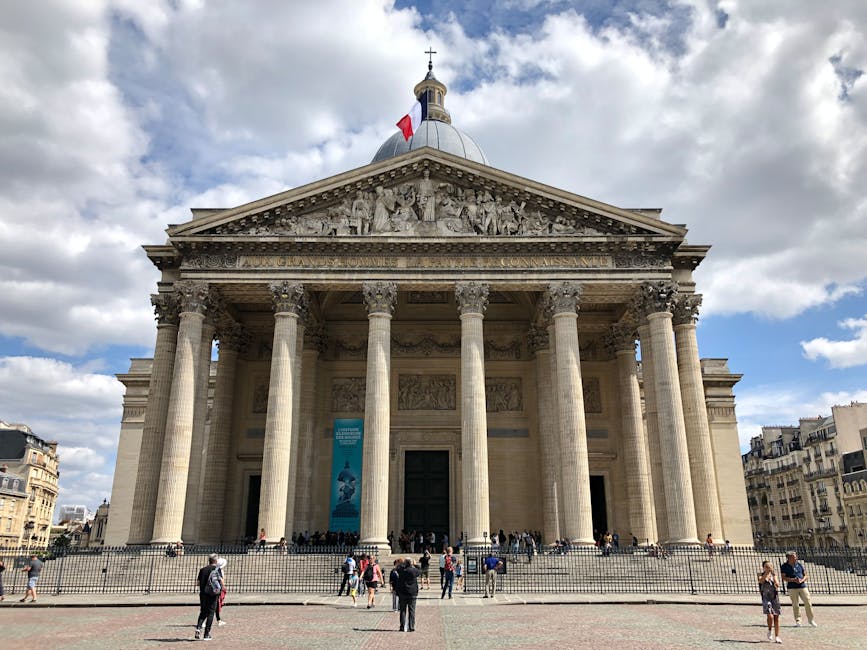
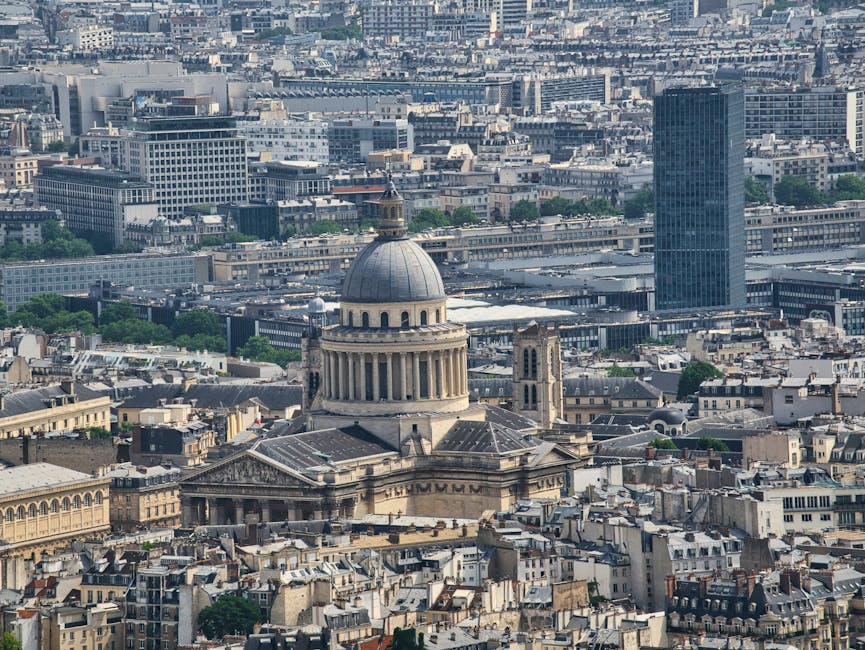
Soufflot’s brief was to combine the lightness of a Gothic cathedral with the geometry of a Greek temple. He designed a Greek-cross plan, 110 metres long by 84 wide, with four arms meeting under an 83-metre dome. Walk the nave today and you can see what he was after: massive Corinthian columns where Gothic piers would have been, a flat Greek pediment outside, and inside, an open space with no rood screen and almost no statuary.
Soufflot died in 1780, ten years before the building was finished. His student Jean-Baptiste Rondelet completed it. By 1789 the exterior was done; by 1790 the interior was almost finished. It was scheduled to be consecrated as the abbey church of Sainte-Geneviève.
The Revolution arrived first.
The conversion: Mirabeau in, Sainte-Geneviève out (April 1791)
On 2 April 1791 Mirabeau died. Mirabeau was the National Assembly’s first great orator, the man who’d talked Louis XVI into accepting the Constituent Assembly. The Assembly wanted a national funeral for him, and they wanted somewhere to bury him. Two days later, on 4 April, they decreed that the unconsecrated abbey of Sainte-Geneviève would become “the temple of the patrie”: the burial place of “great men of the era of French liberty.”
Mirabeau was the first interred. By July, Voltaire’s body had been brought back from where the monks at Scellières had hidden him in 1778, and laid in the crypt to a procession of 100,000 Parisians. Soufflot’s church was a mausoleum within seven months of being finished.
The architectural changes were mostly cosmetic but they tell you everything. The forty-two large windows in the nave were bricked up to make the interior darker and more solemn (you can still see the outlines from outside). The crosses on the cupolas were replaced with classical figures. The crypt, which Soufflot had designed for monks, was reorganised for tombs.
Mirabeau didn’t last. In 1794 his secret correspondence with Louis XVI was discovered and the Convention had him removed. He’s the only person ever expelled from the Panthéon for political reasons. Voltaire stayed.
Five identity changes in 60 years
This is the back-and-forth that explains why the building feels structurally confused.
- 1791: National Assembly converts it to a secular Panthéon
- 1806: Napoleon restores it as a Catholic church (the crypt stays a mausoleum)
- 1830: Louis-Philippe re-secularises it after the July Revolution; David d’Angers carves the new pediment
- 1851: Napoleon III hands it back to the Church for the third time
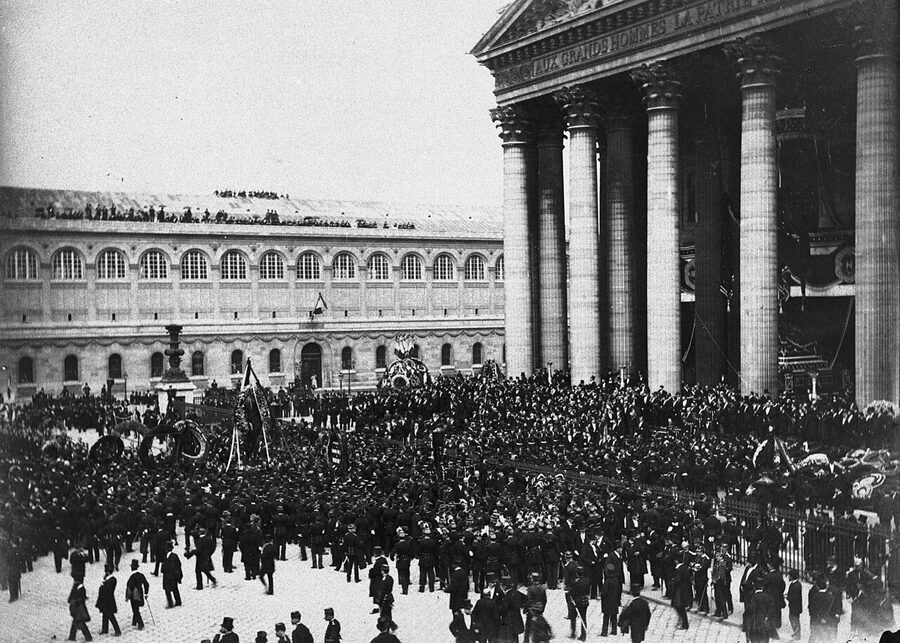
- 1885: Victor Hugo dies; the funeral is so massive that the Republic re-secularises it permanently
The 1885 fix took. The Panthéon has been a national mausoleum without interruption for 141 years. But the inside still carries the scars: there are 19th-century Christian frescoes on the walls (commissioned 1874-1885 under the Catholic phase) sharing space with the secular pediment outside and the Republican statue group at the centre. It’s the only major Paris monument where you can walk forty paces and pass through three different ideologies of the French state.
What the pediment says (and why it matters)
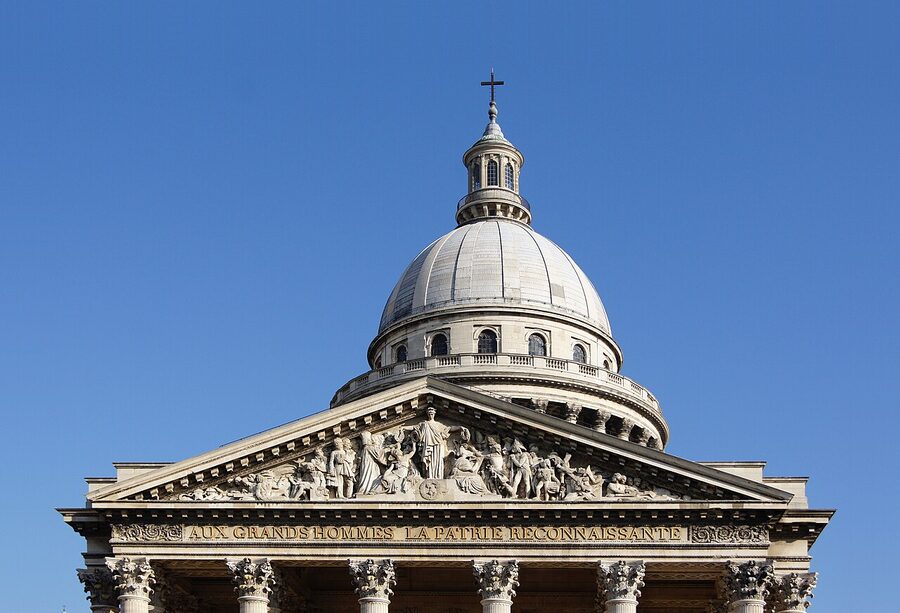
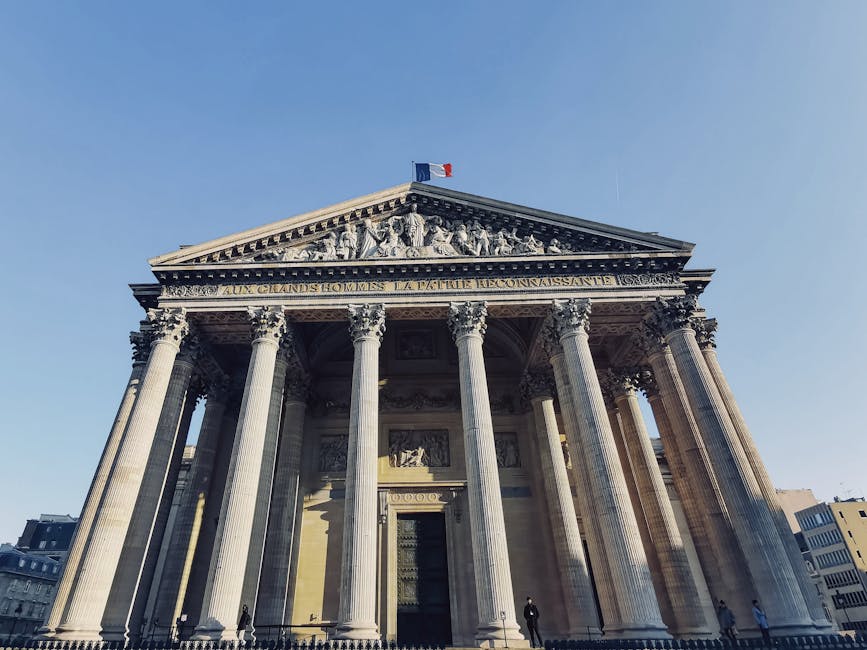
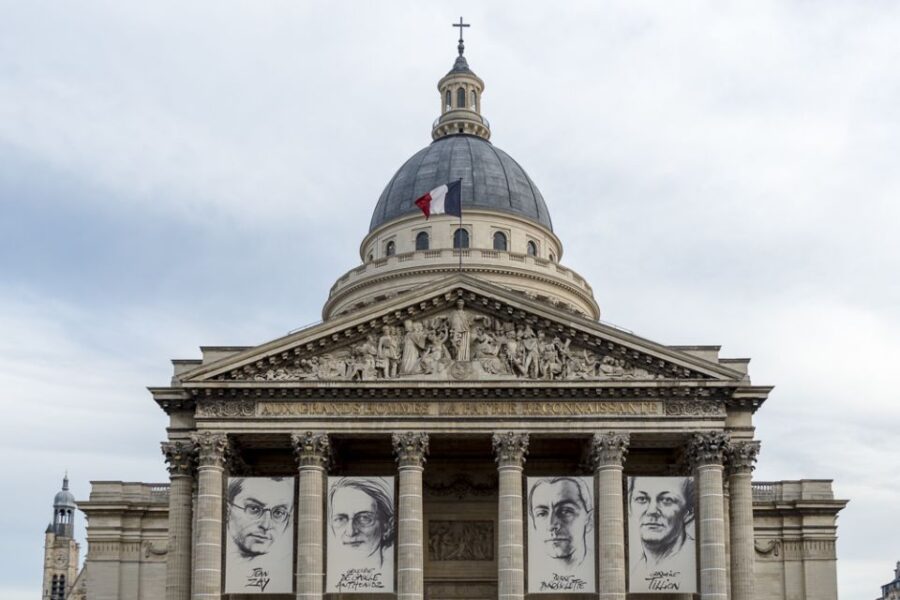
“AUX GRANDS HOMMES LA PATRIE RECONNAISSANTE.” To the great men, the grateful homeland. The inscription is the promise of the building. Everything else is consequence.
The pediment sculpture, carved by David d’Angers in 1837, has the Patrie at the centre, distributing wreaths. To her left, holding scientific instruments and pen and ink: Voltaire, Rousseau, Lazare Carnot, the Marquis de Lafayette, the painter David, the chemist Berthollet, scientists, philosophers, men of letters. To her right, holding swords and military insignia: Bonaparte, Mirabeau, Manuel, the soldiers and officers of the Revolution.
The split is the Republic explaining itself. Equal honour for the pen and the sword. Walk inside the crypt and you find the same ratio in who’s actually buried: writers and scientists outnumber generals about 2 to 1. Les Invalides is for the soldiers; the Panthéon is for the civilians who built the Republic. The Dutch civic equivalent is the Royal Palace on Dam Square: a 17th-century Stadhuis built by a merchant republic to enshrine its own civic virtues, the same way the Panthéon enshrines French civic genius, except the Dutch building did it a century and a half earlier and never lost the original Republican framing.
How to actually visit: the route I’d take
You enter through the main portico under the pediment. There’s a security screen, then ticket scanners, then you’re in the nave. Here’s what you do in the order that makes sense.
1. Stand in the centre of the crossing first
Walk to the middle of the nave, directly under the dome. Look up. The pendulum is hanging right there: a brass bob the size of a child’s head suspended on a 67-metre wire from the dome’s apex, swinging slowly back and forth across a circular platform on the floor. Watch it for two minutes. The plane of swing rotates clockwise, about 11 degrees per hour at this latitude. That rotation is the visible proof that the Earth turns.
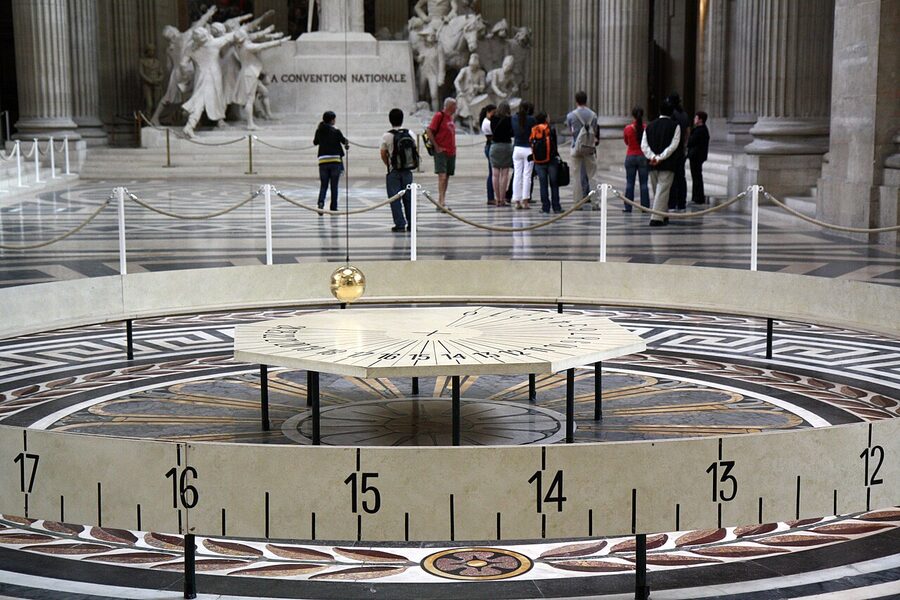
This is the part that surprises people. The Panthéon is the only major Paris monument with a working physics demonstration in the middle of it. The 1851 demonstration was the first direct visual proof that the Earth rotates on its axis. That’s why it’s installed under this specific dome: the height was needed for the slow swing.
2. Walk the four arms of the nave
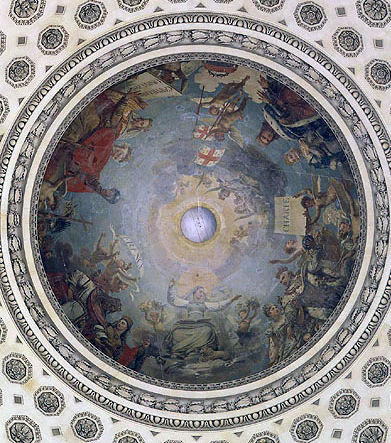
Each arm has its own painting cycle. The right transept is the Saint-Geneviève cycle. Puvis de Chavannes painted the first scenes 1874-1878, and they’re some of the best 19th-century murals in Paris. The left transept is Joan of Arc, painted 1886-1890. The choir is Charlemagne and Saint Louis. The entry arm is the Apotheosis of Sainte-Geneviève.
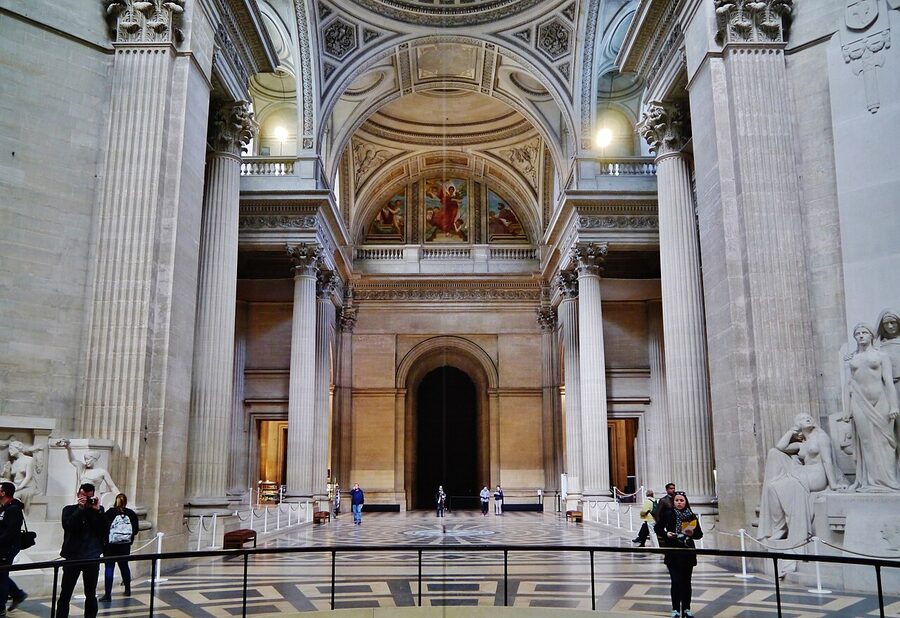
Most visitors walk past the murals without registering them. They’re commissioned during the Catholic phase (1874-1885), so the iconography is religious (Saint Geneviève turning back the Huns from Paris in 451, Joan of Arc at Reims), but the painters are secular masters of the late 19th century. Puvis de Chavannes is the standout. If you’ve seen his work in the Musée d’Orsay, the Panthéon is where he was working at the same time at much larger scale.
3. Take the stairs down to the crypt
The entrance is in the right rear of the nave. A wide marble staircase, then a long barrel-vaulted corridor running the full length of the building. The crypt is colder than the nave, about 8 to 10 degrees Celsius even in August. Bring a layer.
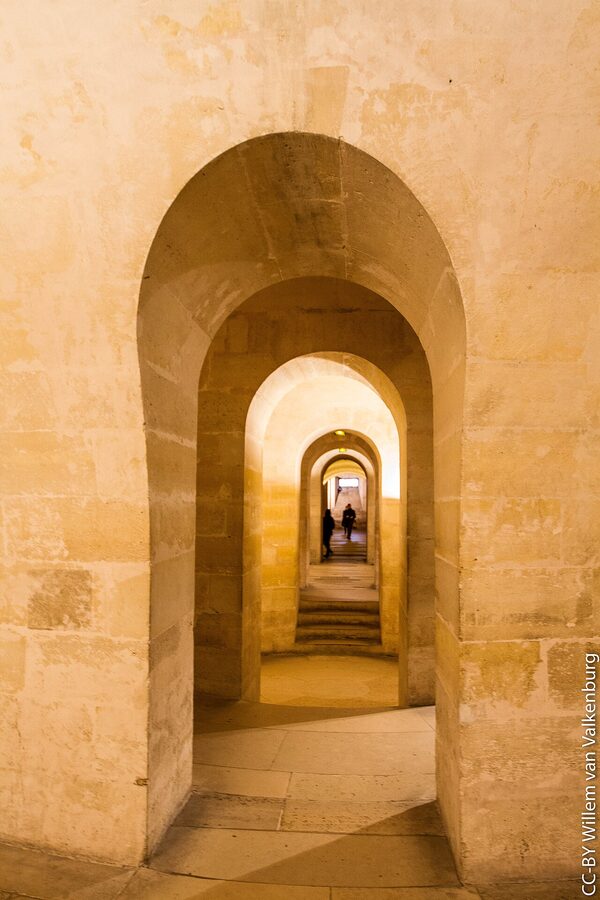
78 people are buried here. I’ll cover the ones you actually want to find.
The tombs worth finding
Voltaire and Rousseau, 5 metres apart
Walk left from the staircase. The first chamber on your right has Voltaire’s sarcophagus with the Houdon statue on top. Walk further into the same chamber and you reach Rousseau’s, on the wall directly opposite. They are, by my count, about five metres apart.
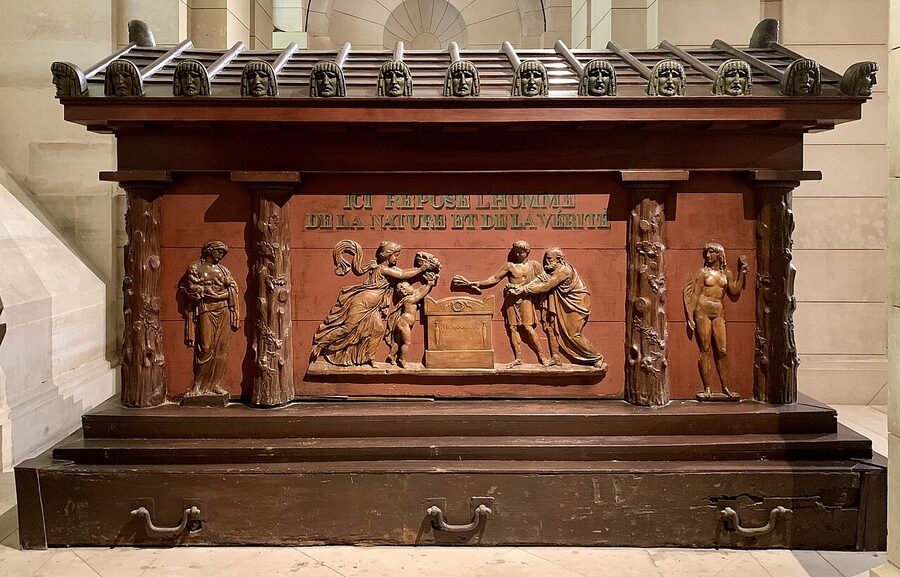
The pairing is the Panthéon’s editorial joke. Voltaire and Rousseau spent their adult lives publicly disagreeing about almost everything: religion, the social contract, whether the arts improved or corrupted humanity. Voltaire wrote that Rousseau wanted to put humanity back on all fours. Rousseau wrote that Voltaire was a corrupt cynic. They lie 5 metres apart.
Voltaire was transferred here on 11 July 1791. Rousseau followed on 11 October 1794. They’ve been across the room from each other for 232 years. If you only had ten minutes in the crypt, this is what you’d come to see.
Marie Curie and the lead-lined coffin
Continue left, into the next chamber. Marie Curie was transferred here in 1995, the first woman moved into the Panthéon on her own merit (Sophie Berthelot, the only previous woman, was buried with her chemist husband Marcellin in 1907 because his will requested it). Pierre Curie was transferred at the same time.
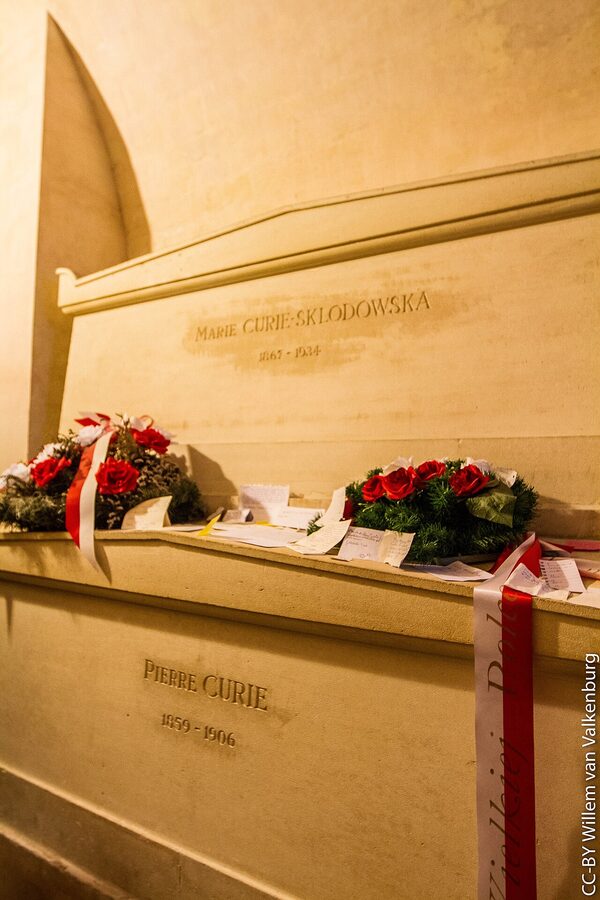
Stand in front of her tomb. There is a Geiger counter reading taped to the wall on a French monuments info card: ambient radiation levels are about double the background level outside. Not dangerous (you’d need to lie on top of the slab for years to absorb a measurable dose) but a real number, on a real card, in a public crypt. That detail is what tells you Curie’s science was the kind that kept doing things to her body even after she stopped doing things to it.
The three writers’ chamber: Hugo, Dumas, Zola
Cross to the right side of the crypt. The chamber here holds Victor Hugo, Émile Zola, and Alexandre Dumas. They share the same vault.
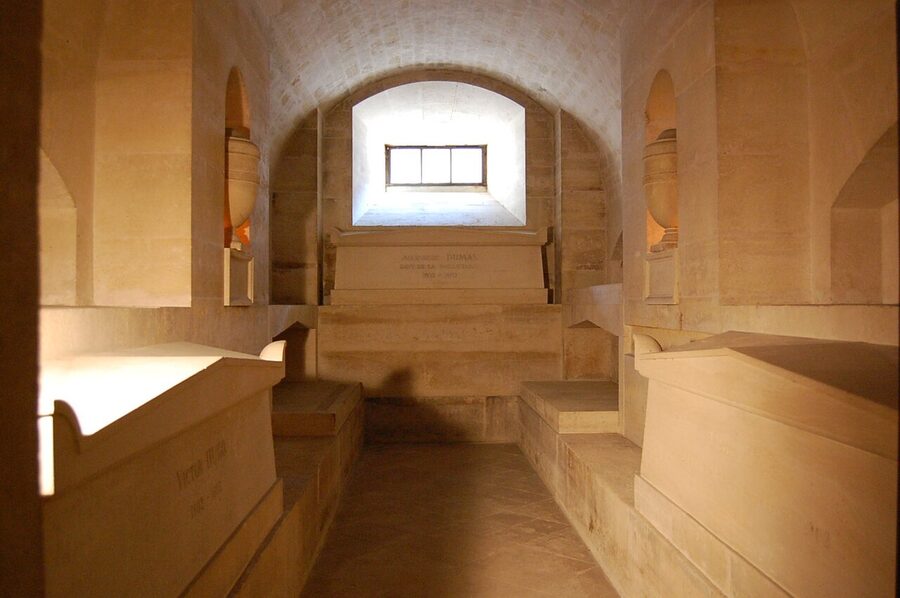
Hugo’s funeral on 1 June 1885 was the largest gathering in Paris in the 19th century: about 2 million people on the Champs-Élysées and Rue Soufflot. The Republic ordered the Panthéon stripped of crosses and re-secularised the night before so Hugo could be buried as a Republican rather than a Catholic. He has been here ever since. The arrival of Hugo’s body is what made the Panthéon’s identity stick.
Dumas is the back-of-the-vault story. He died in 1870 and stayed buried in his hometown of Villers-Cotterêts for 132 years because his mixed-race ancestry (his grandmother was a Black Haitian, his grandfather a French marquis) made successive Republics squeamish. Jacques Chirac transferred him in 2002 with a speech that admitted the delay had been “an unworthy act.” The transfer ceremony was televised. Worth ten minutes of any visit.
Jean Moulin: the Resistance vault
Further along the right corridor: a chamber holding Jean Moulin, André Malraux, Simone and Antoine Veil, René Cassin, and Jean Monnet. The modern French state, more or less. Moulin was the head of the unified Resistance, captured by Klaus Barbie in 1943 and tortured to death without giving up names. André Malraux gave the speech when Moulin was transferred in 1964: “Enter here, Jean Moulin, with your terrible cortège…”
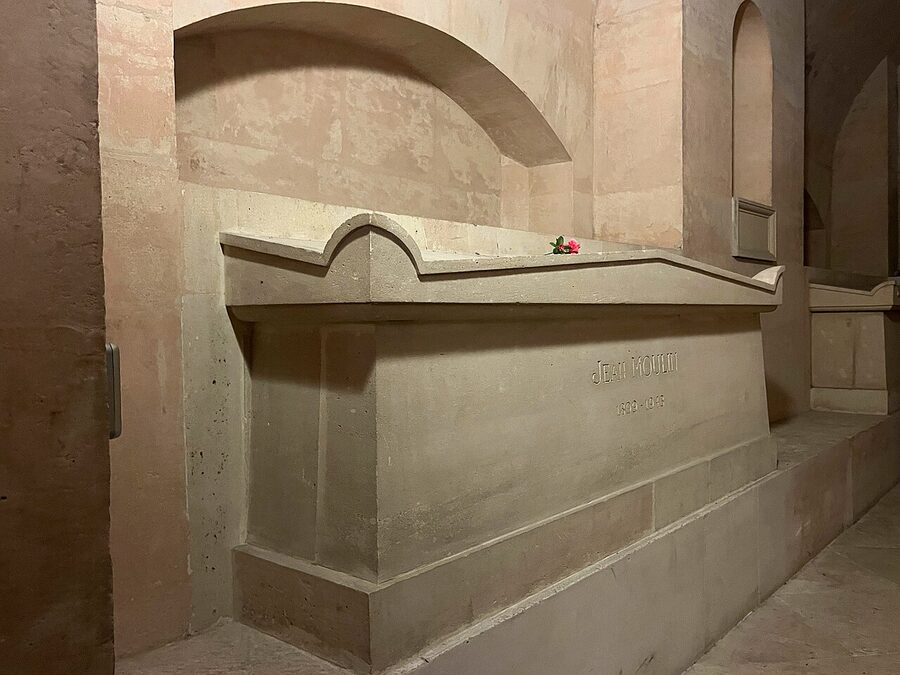
Simone Veil was transferred here in 2018, the fifth woman ever, transferred with her husband Antoine. Veil survived Auschwitz, became Minister of Health under Giscard d’Estaing, legalised abortion in France in 1975. The Panthéon’s recent admissions tell you what the Republic now thinks it wants to remember.
The pendulum: don’t skip this
Back upstairs. If you went down to the crypt first, the second visit to the central nave reads differently. Stand directly underneath the bob and watch it for a full minute.
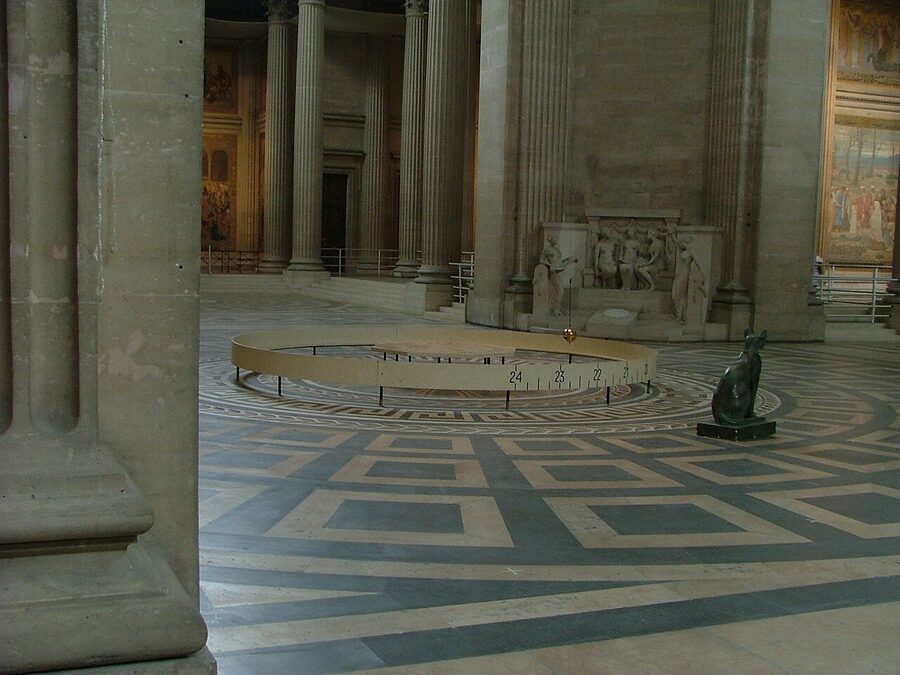
The Panthéon is the only place in the world where you can stand in a building converted three times for opposing ideologies and watch a piece of brass demonstrate that the planet is rotating. The combination is what makes the visit feel different from Sainte-Chapelle or St Mark’s in Venice, both of which stayed religious. Sainte-Chapelle is sublime as a cathedral. The Panthéon is sublime as an argument.
Should you climb the dome?
Yes, between April and October. The dome climb is a separate ticket bundled into the standard €13 admission, but it’s only open in the warm half of the year for safety reasons (the upper galleries are exposed to wind and the stairs are stone and frequently wet in winter).
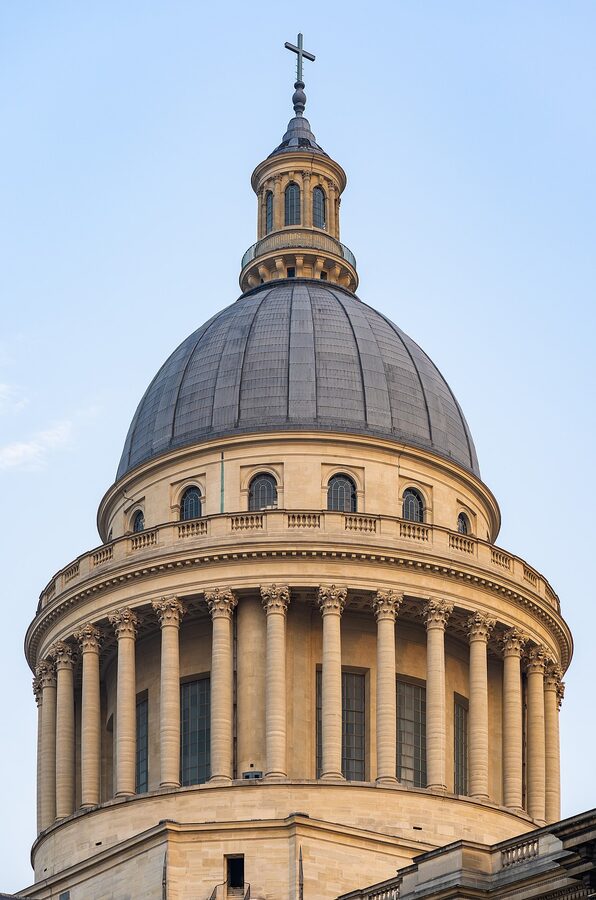
It’s worth doing once. It’s not the best Left Bank view (that’s Montparnasse Tower, which is taller and has the Panthéon in its panorama), but the Panthéon dome is the only one of the great Paris domes you can climb. The Sacré-Cœur dome is similar but is in the 18th arrondissement, not central. The Panthéon climb also gives you the only realistic look at the structural genius of Soufflot’s three-shell dome from the inside.
The three-shell dome (briefly)
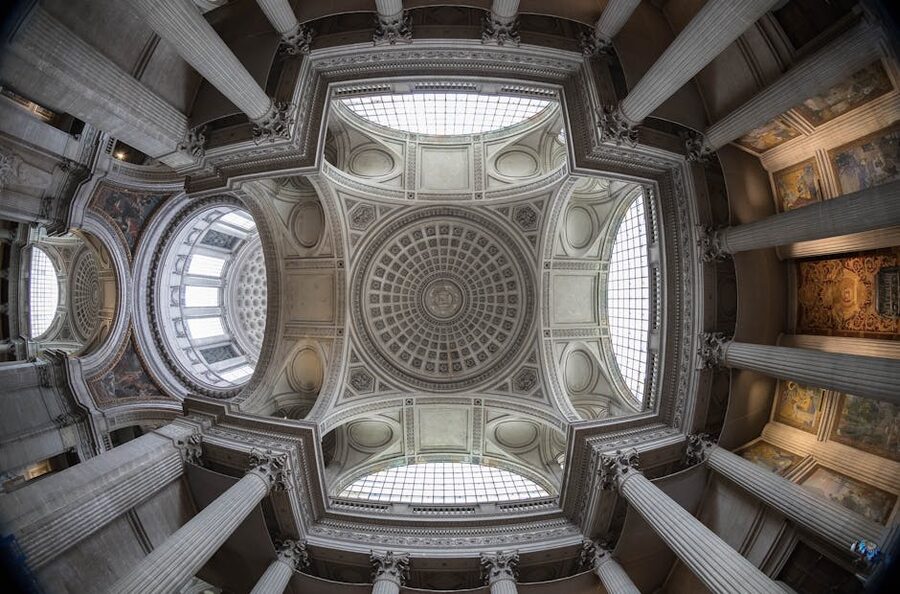
Soufflot’s dome is structurally three concentric domes nested inside each other. The innermost is what you see from the nave below: a coffered hemisphere with the Apothéose de Sainte Geneviève fresco. The middle dome carries the structural load. The outermost is the lead-clad dome you see from outside, with the lantern on top.
The point of the three-shell design was to allow a low, beautiful inner ceiling AND a tall, dramatic exterior silhouette without an absurd weight load. It worked. It’s also the design Christopher Wren used at St Paul’s a century earlier, and the design Mansart used at the Église du Dôme of Les Invalides in 1690. Soufflot was working in a tradition. What was new was the iron reinforcement hidden in the masonry, a structural innovation that the Académie d’Architecture criticised at the time as risky and that turned out to be a hundred years ahead of its peers.
Your three picks
The Panthéon is one of those visits where there is only one real ticket and the question is what you pair it with. The flagship admission ticket is the only one that includes everything you came to see: nave, crypt, dome (in season), all temporary exhibitions. The other two are package deals worth considering if your day is structured around them.
1. Panthéon Admission Ticket: $15
This is the one to book unless you specifically want a combo. Our full review covers what’s actually included and why the cheaper municipal ticket office line is not worth saving 30 cents on. Reserved entry from a 30-minute slot, free cancellation up to 24 hours before.
2. Panthéon + Seine River Cruise: $37
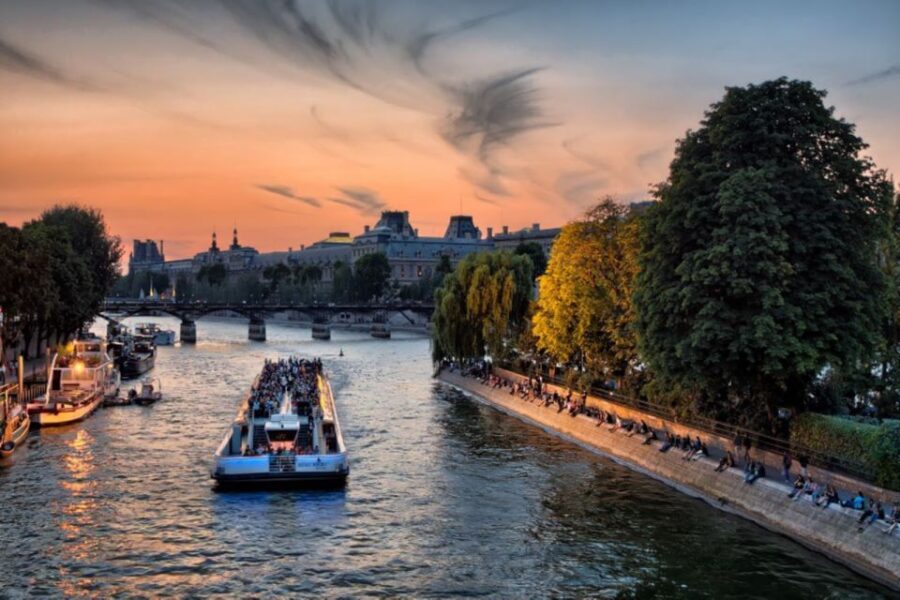
The combo only saves you a couple of euros over buying both separately, so it’s worth it only if you were already planning a Seine river cruise. The two activities aren’t geographically near each other (the Panthéon is in the 5th, Pont de l’Alma is in the 7th), so build at least 30 minutes of metro time between them.
3. Old Town & Latin Quarter Walking Tour: $41
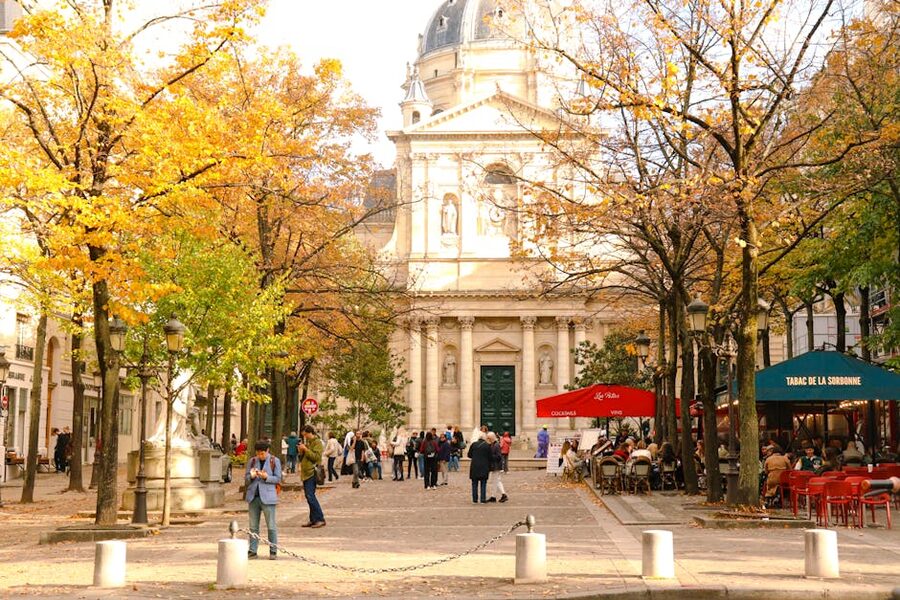
This is the right pick if it’s your first or second day in Paris and you want a guided orientation that lands at the Panthéon. The tour doesn’t enter the building (book the admission ticket separately for that), but the walk through the 6th and 5th arrondissements puts the Panthéon in the context of the university quarter, the way Voltaire’s Paris was actually arranged. Our overview of the Panthéon visit handles the inside.
Practical info
Tickets are €13 for an adult (about $15 USD as of mid-2026). Free for under-18s, EU citizens 18 to 25, regular non-European residents under 25, disabled visitors, and one accompanying person per disabled visitor. Free for everyone on the first Sunday of the month between November 1 and March 31, plus during European Heritage Days the third weekend of September.
Hours are 10:00 to 18:30 every day, year round (last admission 17:45). Closed January 1, May 1, November 1, November 11, December 25.
The dome climb is open April through October only, weather permitting. It’s included in your standard ticket but you must reserve a time slot for it on the day, at the desk near the entrance. Lines for the dome get long after 14:00 in summer; do it as soon as you arrive.
Getting there
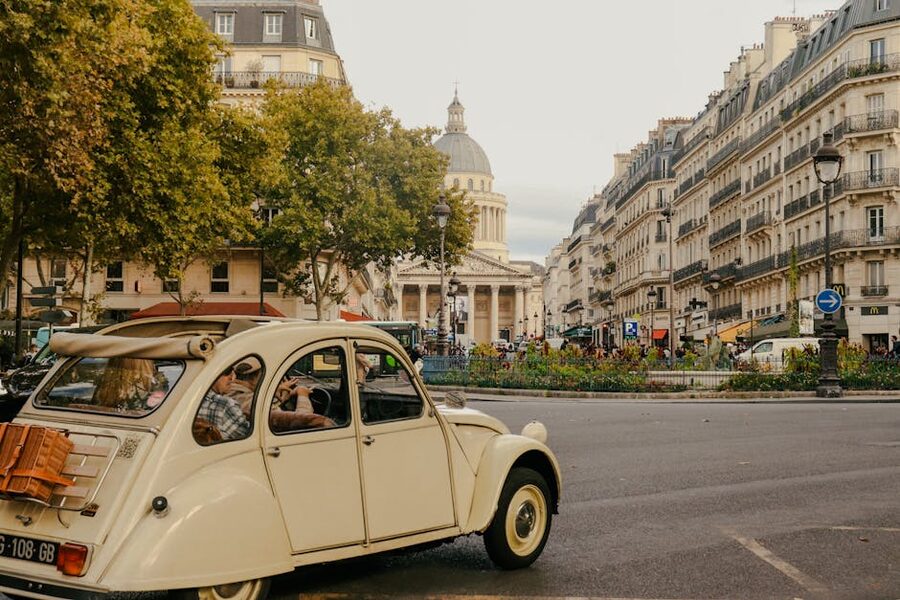
It’s in the 5th arrondissement, on the Place du Panthéon at the top of the Montagne Sainte-Geneviève. About 1.2 km southeast of Sainte-Chapelle and the Île de la Cité, walkable in 18 minutes if you cross via the Pont au Double.
Metro: Cardinal Lemoine (line 10) is the closest, 5 minutes’ walk. Maubert-Mutualité (line 10), Cluny-La Sorbonne (line 10), and Place Monge (line 7) are all 8 to 10 minutes. RER B: Luxembourg, also 8 minutes.
Bus 21, 27, 38, 82, 84, 85, 89 all stop within a couple of minutes of the Panthéon’s steps. The 21 from Saint-Lazare runs through the heart of the Left Bank, useful if you’ve come from the right bank.
What’s on around it (in walking distance)
The Panthéon is in the academic heart of Paris and the surrounding streets are full of buildings that explain its context. The Sorbonne is two minutes downhill: the original 13th-century university the Panthéon used to belong to spiritually and now sits next to ideologically. The Église Saint-Étienne-du-Mont, three minutes east, holds what’s left of Sainte-Geneviève’s original shrine; the Revolution moved her body but the empty reliquary is still there.
The Jardin du Luxembourg is six minutes’ walk west: the Senate building, the gardens, the Medici Fountain, all linked culturally to the Panthéon as a Republican-era reading of the same neighbourhood. The Musée de Cluny (medieval art, including the Lady and the Unicorn tapestries) is eight minutes north on the same street.
If you have a free afternoon, the natural pairing is to visit Père Lachaise later in the day. Père Lachaise is the bourgeois cemetery for the famous dead the Republic didn’t want to enshrine: Chopin, Wilde, Édith Piaf, Jim Morrison. Together the two sites tell you everything about how Paris ranks its dead. The Panthéon is the state mausoleum; Père Lachaise is the popular one. Different lists. Different rules. The Amsterdam analogue is the Anne Frank walking tour, a single-person memorial at canal-house scale: the Republic builds a domed mausoleum to canonise Voltaire, the Netherlands lets a single attic door do the same emotional work for one teenager.
How long does the visit actually take?
If you race through, 60 minutes. The brochure says 90 minutes. Realistic for a thorough visit: about 2 hours, broken roughly as follows.
- Nave + pendulum: 25 minutes
- The four mural cycles (Saint Geneviève, Joan of Arc, Charlemagne, Apothéose): 25 minutes
- Crypt: 35 minutes (longer if you read the wall texts on each tomb)
- Dome climb (April to October): 30 minutes round trip
- Misc: queues, security, ticket scanning, sitting on a bench when your legs get tired: 15 minutes
If you have only an hour, skip the dome and the four mural cycles. Do the pendulum, then go straight to the crypt. The crypt is the building’s signature.
The Panthéon in two lines
The Panthéon is the building Louis XV ordered as a Catholic shrine, the Revolution converted to a secular mausoleum within seven months of its completion, and the Republic spent the 19th century arguing about. It is, today, the cleanest expression in stone of the French claim that nation-states make their own gods.
Where to go next in Paris
If the Panthéon convinced you, the natural next visit is Sainte-Chapelle on the Île de la Cité, 18 minutes’ walk north. The contrast is the point: Sainte-Chapelle stayed religious, never converted, and the Revolution couldn’t bring itself to deconsecrate it. The Panthéon switched sides; Sainte-Chapelle didn’t. If you want the military counterpart, Les Invalides is across the river, holding Napoleon’s tomb under another great dome from the same Mansart-Soufflot tradition. The Panthéon is for the writers and scientists; Les Invalides is for the generals.
For the museum-pass holders, the Louvre and the Musée d’Orsay both include the Panthéon on their pass. So does Versailles. If you’re spending five days seriously in central Paris, the museum pass is the obvious move. For the lighter visits, a Seine cruise at sunset still pairs better with the Panthéon than the combo ticket suggests, just done as a separate evening rather than a strict bundle.
Outside Paris, the church-as-state-monument theme has a few siblings worth visiting if you’re touring further: St Mark’s in Venice (the doge’s church, never converted, the religious-monument equivalent of Sainte-Chapelle), Gaudí’s Sagrada Família in Barcelona (still being built, which is the Panthéon’s reverse problem), Seville Cathedral (the largest Gothic cathedral in the world, built on the bones of a mosque), and Córdoba’s Mosque-Cathedral (the most direct architectural conversion in Europe, mosque to cathedral inside the same shell). The Panthéon is the post-religious endpoint of that sequence: a building that ended up serving the state after switching gods three times.