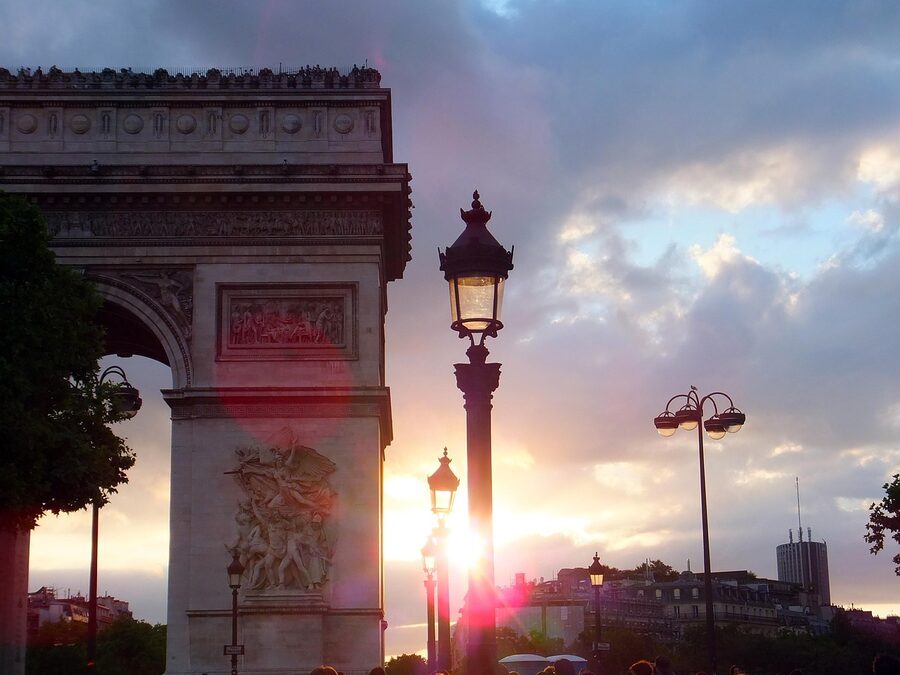
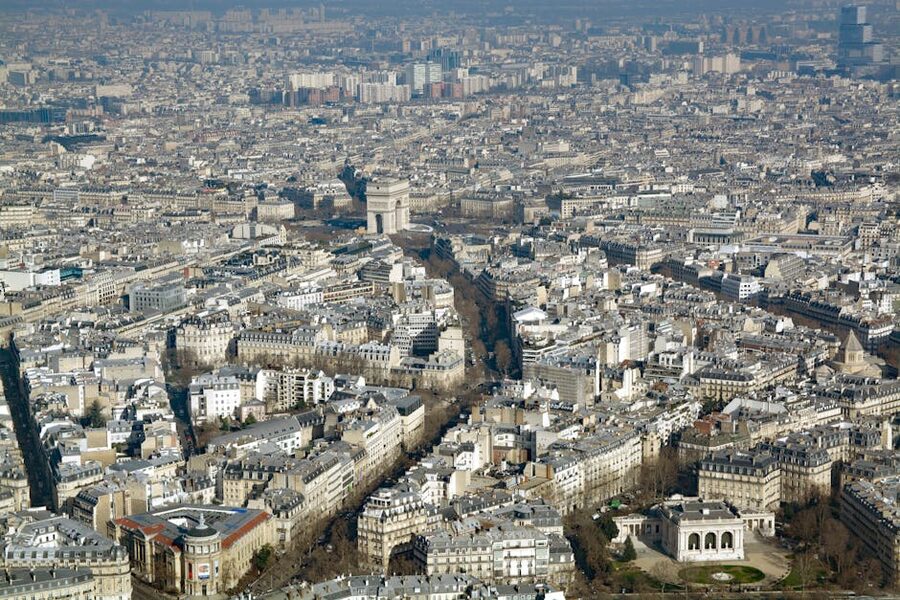
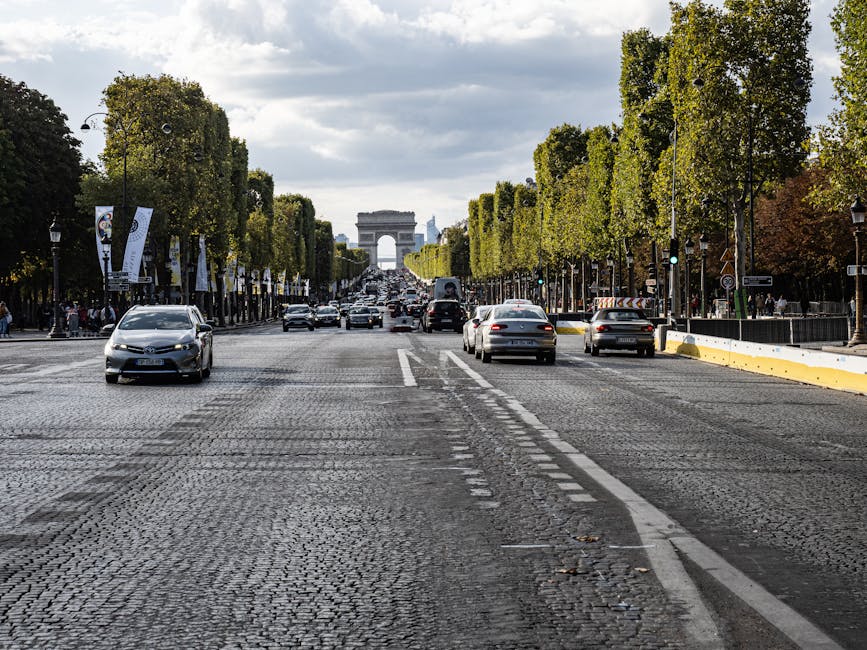
You climb 284 steps in a stone spiral inside the wall of the Arc de Triomphe, you push through the small door at the top, and the city flattens out at your feet in every direction. Twelve avenues come straight at you like spokes. The Eiffel Tower is right there to the south. The Champs-Élysées runs east in a perfect 1.9 kilometre line down to the Tuileries and the Louvre. Most travellers walk past this monument, take a photo from the traffic island, and never go up. They are missing the best central-Paris view there is.
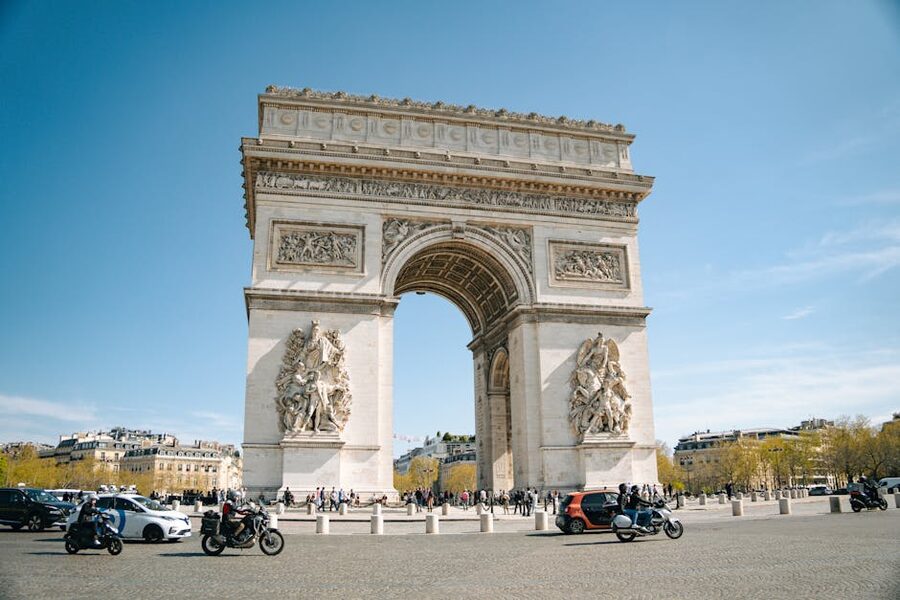
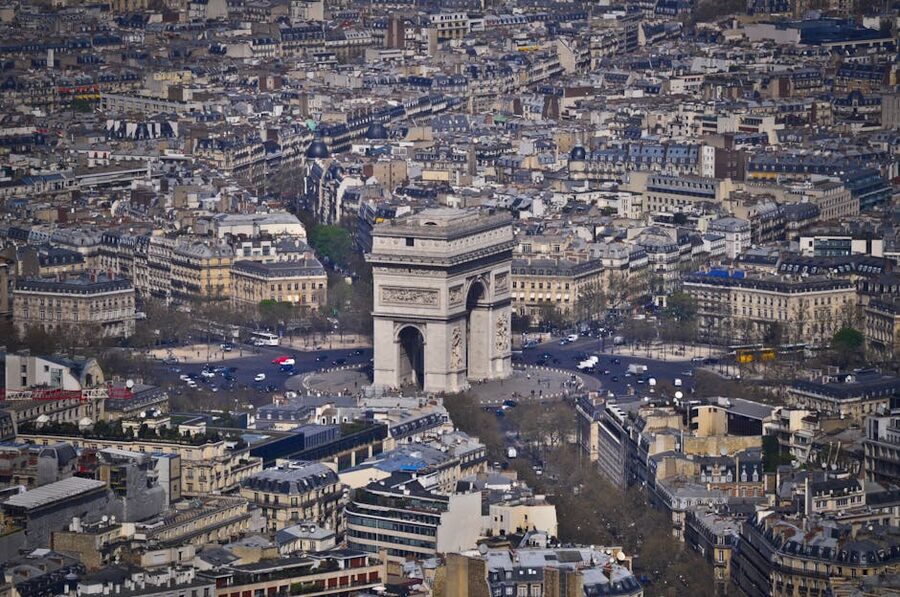
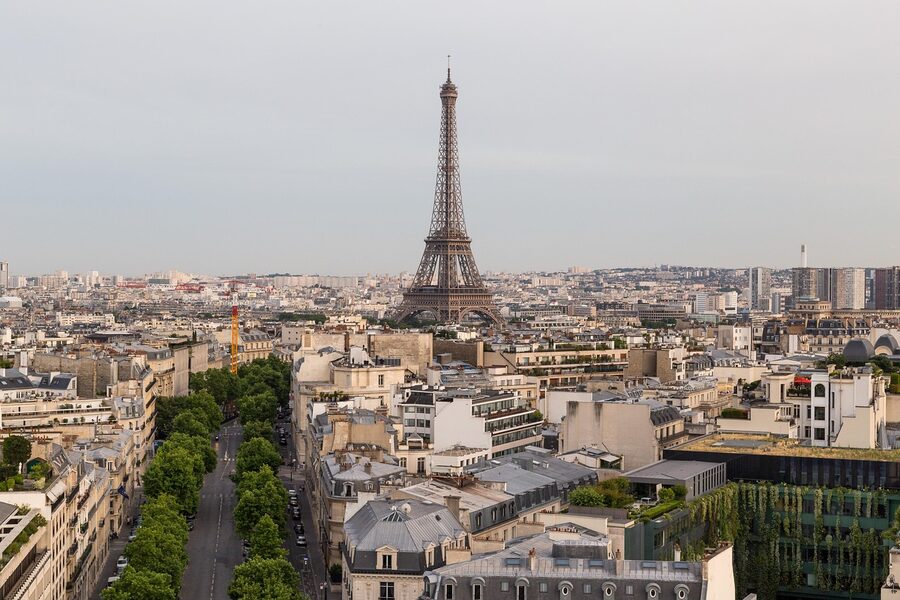
The roof sits at 50 metres. From the Champs-Élysées side that doesn’t sound high. Stand on it and you realise nothing else in central Paris reaches up to it. There’s no tall city around the Arc, just a flat 19th-century skyline of seven and eight-storey Haussmann blocks. So the view is pure axis. You can see the Eiffel Tower with no buildings cutting into it. You can see Sacré-Cœur on its hill in Montmartre. And looking east, you stand at the centre of the Voie Triomphale, the 8 km Grand Axis that runs Louvre → Tuileries → Concorde → Champs-Élysées → Arc → La Défense, every single landmark on it lined up to the metre.
In a hurry
- Arc de Triomphe Rooftop Ticket ($18): the standard ticket. Skips the on-site queue, gets you the rooftop. This is the right one for 90% of visitors.
- Arc de Triomphe + Seine Cruise ($45): pair the rooftop with a one-hour boat down the river. The cruise is hop-on every 30 minutes from a dock near the tower.
- Arc + Big Bus + Seine Cruise ($63): the 1-day combo if you want a full sightseeing day stitched together by an open-top bus.
Why the rooftop, not the monument
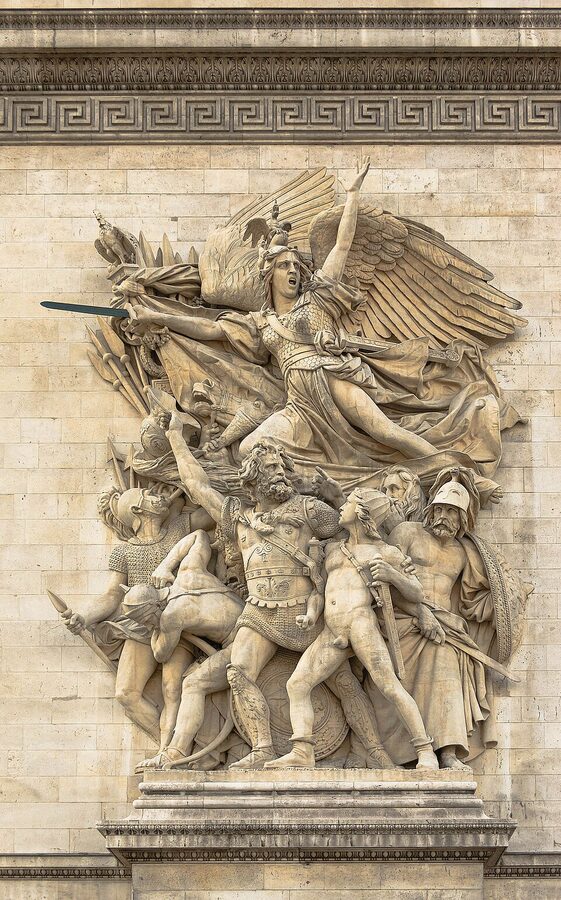
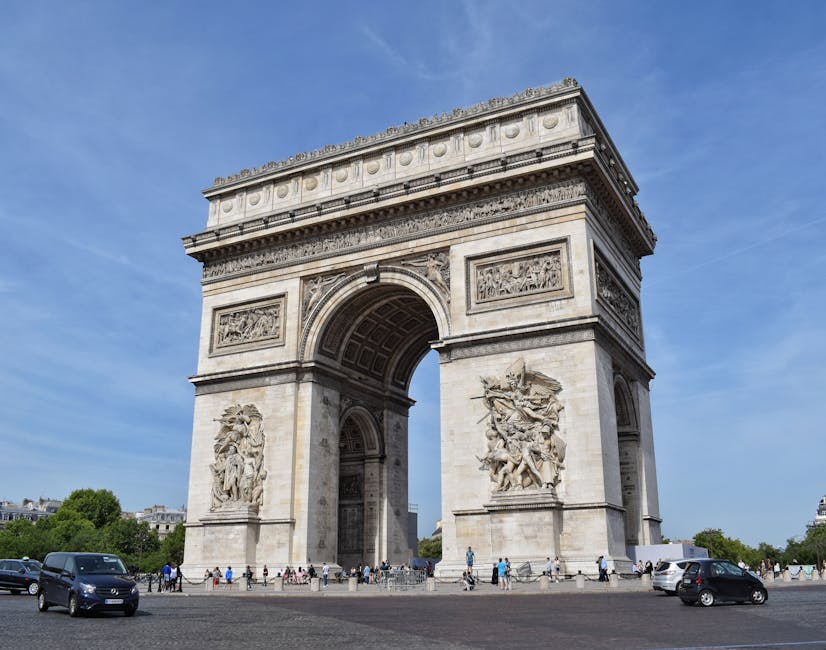
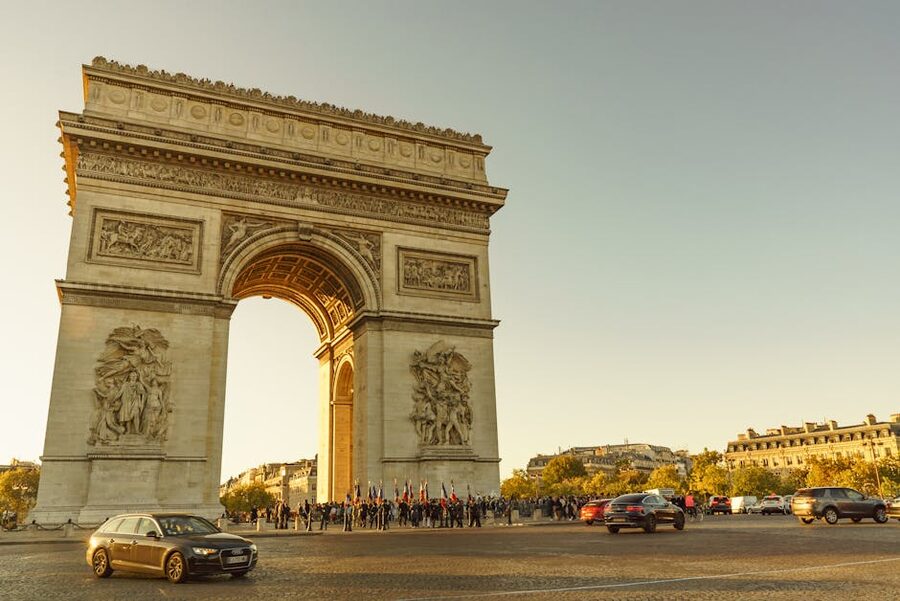
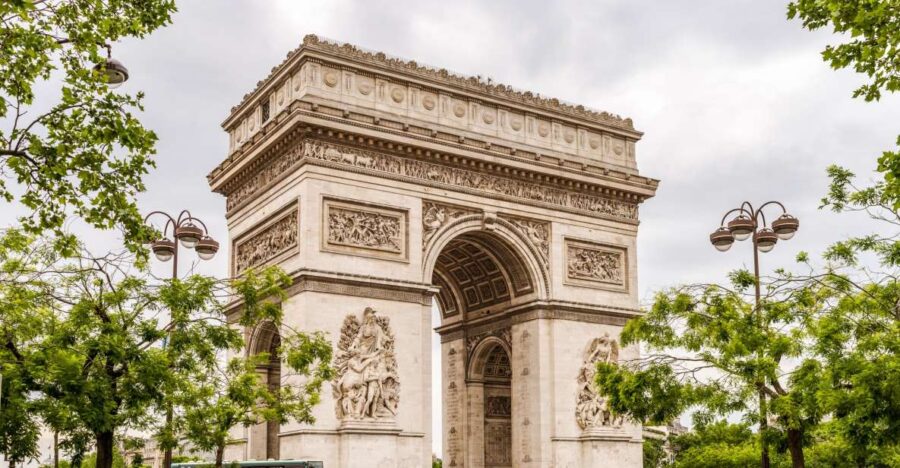
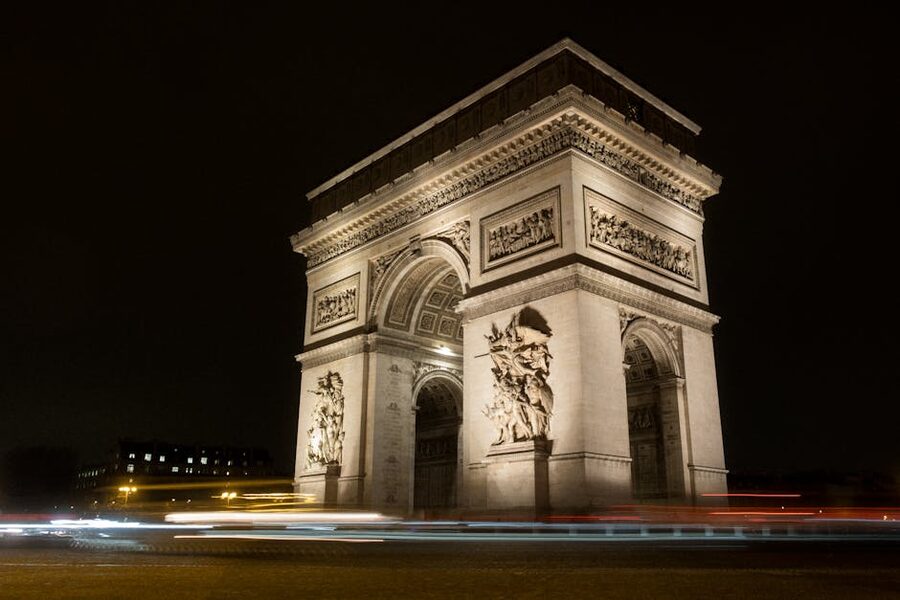
The Arc de Triomphe is two attractions stacked on top of each other and the city does a bad job explaining that. The monument at street level is free. You can walk around the four pillars, read the names of Napoleonic generals carved into the stone, see the four giant high reliefs (Rude’s Marseillaise on the right Champs-Élysées-side pillar is the famous one), stand at the Tomb of the Unknown Soldier, and watch the eternal flame. That part costs nothing. Most tourists do that, take a few photos, and leave.
The ticket gets you the rooftop. That’s the part you buy. There’s a small museum room at the mezzanine level with display cases on the construction history and a short film, then the spiral staircase carries on up to the open-air terrace at 50 metres. From down on the Champs-Élysées you can’t really tell there’s a usable space up there. There is. It’s flat, paved, and all the way around the perimeter you have a low parapet to lean on for photos.
So when I tell people the rooftop is the reason to go, I mean it literally. If you only walk around the base, you have done the historical bit and you have skipped the only part of the monument tourists are paying for. €13 (currency-converted to about $18 on the booking platforms) for one of the best views in Paris is the cheap end of the major Paris viewpoints. The Eiffel Tower summit ticket runs about €30. The Montparnasse Tower observation deck, which is arguably the best of the three because it’s the only one that includes the Eiffel Tower in the frame, runs about €22. The Arc is the cheapest, the most central, and the only one that puts you on the editorial spine of the city.
The Voie Triomphale: what you’re actually looking at
This is the part nobody explains and it’s the whole reason the view from the Arc rooftop is special. The Champs-Élysées is not a random important street. It’s the central segment of an 8 km perfectly-aligned axis that runs from the Louvre in the east to La Défense in the west. Stand on the Arc rooftop and look east and you are looking down a straight line that passes through, in this order: the Tuileries gardens, the Place de la Concorde with its Egyptian obelisk, the full length of the Champs-Élysées, the gates of the Louvre’s Cour Carrée. Every monument is lined up to the metre. It’s deliberate. It started under Louis XIV with the planting of the Tuileries axis in 1640, was extended through Concorde in the 18th century, the Champs-Élysées was widened, the Arc was placed at the western end of that view in 1806 specifically to terminate it.
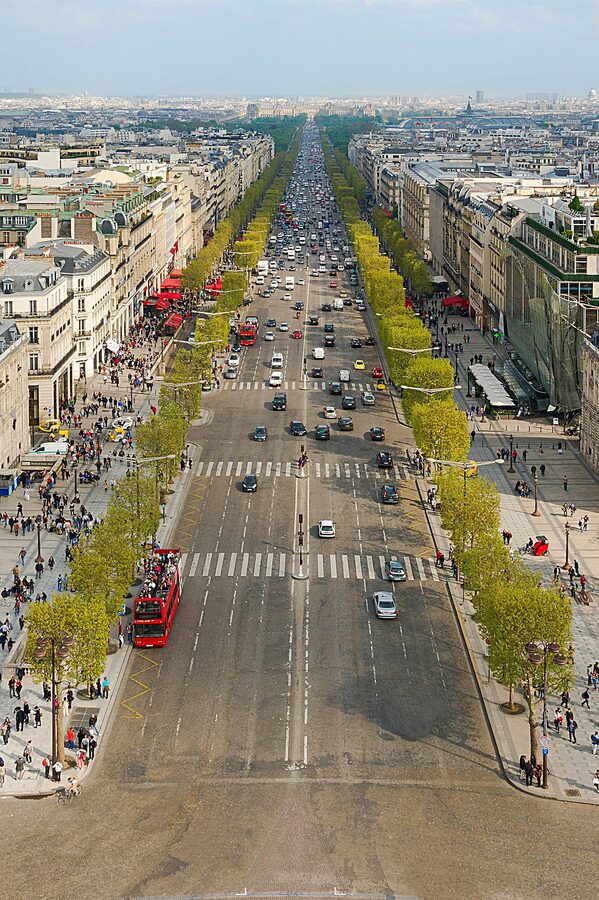
Then look west. The line continues. Same axis. It runs across the Avenue de la Grande Armée, drops slightly into the Pont de Neuilly across the Seine, climbs the hill of La Défense, and ends at the Grande Arche, a 110 metre cubic arch finished in 1989 that was designed deliberately to echo the Arc de Triomphe at the modern end of the same line. Same axis. Three centuries apart. You can see the Grande Arche on a clear day from the Arc rooftop, sitting straight ahead between the office towers of La Défense.

Most visitors stand on the rooftop, look around, and don’t realise this. The terrace has small bronze plaques pointing out individual landmarks (Sacré-Cœur, Eiffel, Invalides), but they don’t connect them into the axis story. So the trick to making the visit pay off: stand at the eastern edge of the roof, look down the Champs-Élysées, and notice that the obelisk in Concorde, the dome of the Tuileries-Carrousel arch, and the Louvre are all on one line. Then walk to the western edge and find the Grande Arche framed by La Défense. That’s the editorial reveal. After that, every other Paris view feels accidental compared to this one.
The war monument under your feet
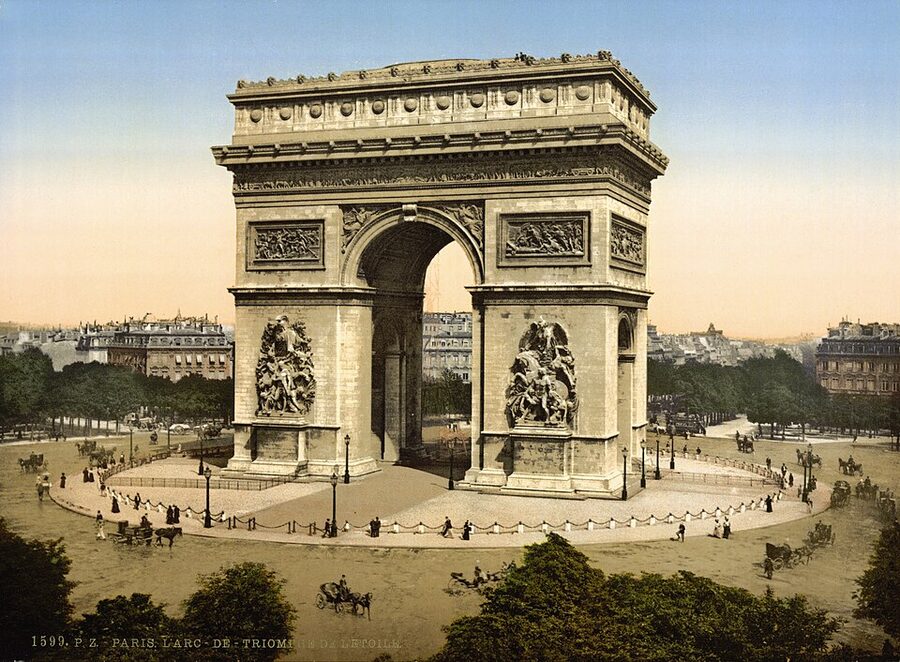
The Arc itself is a war monument and the rooftop sits on top of one of the most charged civic spaces in France. Napoleon commissioned it in 1806, the year after his victory at the Battle of Austerlitz. The idea was a triumphal arch in the Roman tradition, on a scale Rome itself never managed: 50 m tall, 45 m wide, 22 m deep, with the names of every general and every battle of the Revolutionary and Napoleonic wars carved into the inside walls. Jean Chalgrin won the commission. He died in 1811 with the foundations in. Construction stopped after Napoleon’s fall in 1815. The Bourbon Restoration didn’t want a Napoleonic monument finished, so the half-built arch sat in the middle of Place de l’Étoile for fifteen years. Louis-Philippe finally completed it in 1836 under his July Monarchy, three decades after the original commission.
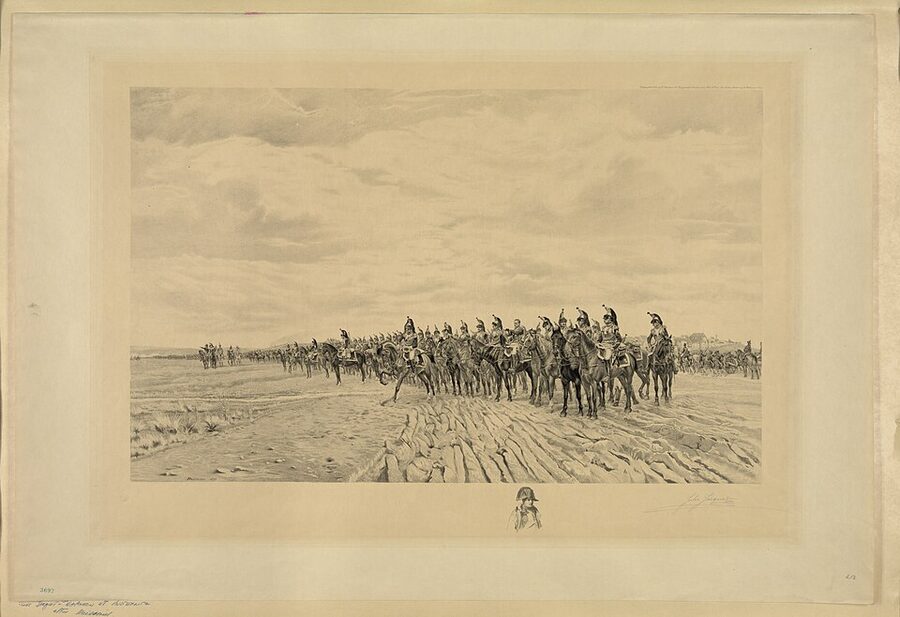
By 1840 Napoleon’s body had been brought back from Saint Helena and paraded under the Arc on its way to Les Invalides. By 1885 Victor Hugo’s funeral cortège passed under it. By 1919 the French Army victory parade after the First World War ended at it. The Arc is where the country comes to mark its biggest moments. The structural cousin in Amsterdam is the Royal Palace on Dam Square, a civic monument the Dutch state uses for the same kind of national-stage moments, except the Dutch building started life as a 17th-century town hall and only became a royal residence under a Bonaparte. If you want the Napoleon legacy in full, Les Invalides is the other half of the story, two kilometres south, where Napoleon is actually buried under the gold dome.
The Tomb of the Unknown Soldier
Under the central arch, on the ground, a slab of black stone reads “Ici repose un soldat français mort pour la patrie 1914 – 1918”. The translation: here lies a French soldier dead for his country, 1914 to 1918. Underneath is the body of an unidentified French infantryman pulled from the battlefield at Verdun. He was selected by lottery on 8 November 1920. Eight coffins of unidentified soldiers were lined up in the citadel of Verdun and a young soldier from the 132nd Infantry Regiment, Auguste Thin, picked the second coffin from the left. The other seven were buried in Verdun. The selected coffin was brought to Paris and interred under the Arc on 28 January 1921, the third anniversary of the founding of the General Staff in 1918.
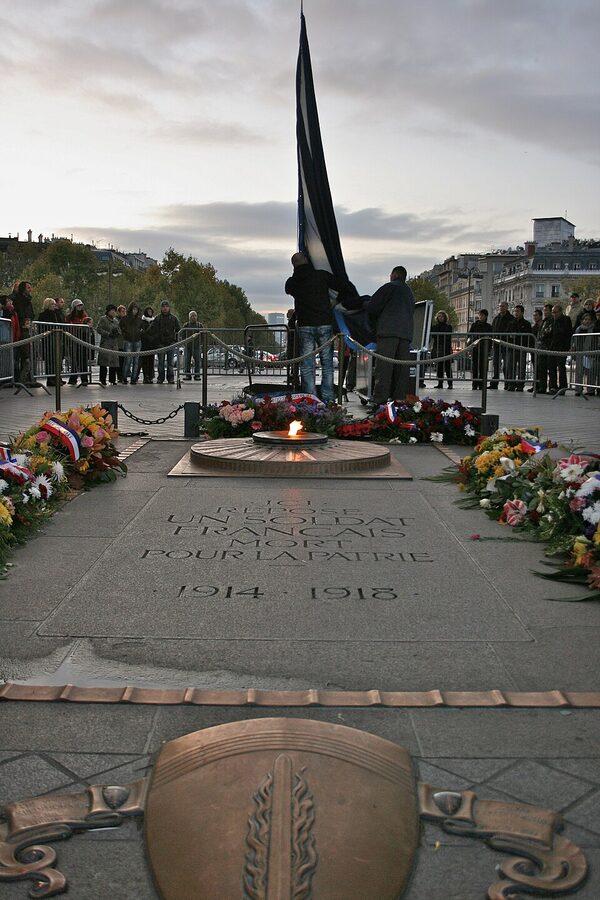
The eternal flame above the tomb was lit on 11 November 1923, Armistice Day, by André Maginot. It has burned continuously since. It is the only flame in Paris that has not gone out. Every evening at 18:30, a delegation from a veterans’ association comes to the Arc and ceremonially rekindles the flame. They lay a wreath, salute, sound the bugle, hold a minute of silence. The whole thing lasts maybe twelve minutes. It is open to the public, free, and almost nobody knows about it. If you time your rooftop visit to come down at 18:15 you can stand at the edge of the ceremony.
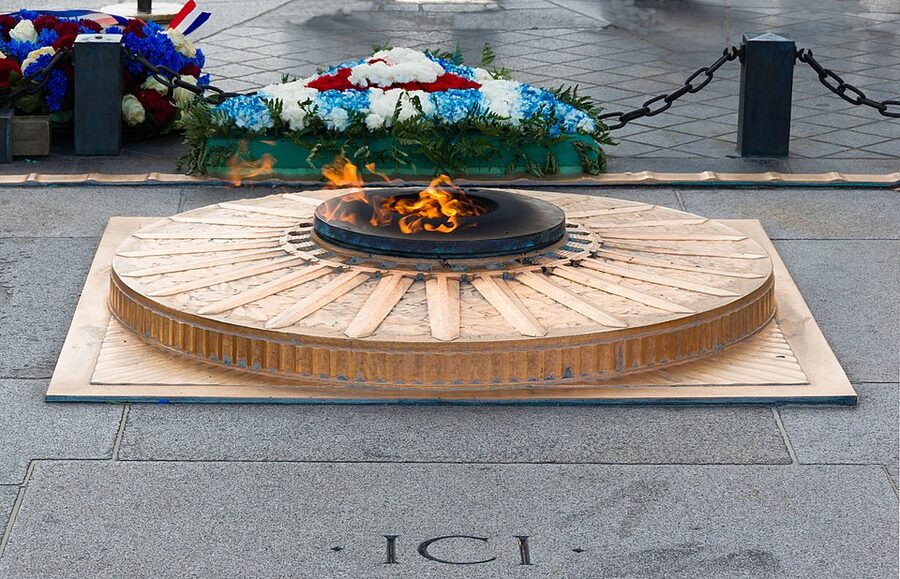
If you’ve already done the Invalides Napoleon tour, the Tomb here closes the arc of French military remembrance: Napoleon’s empire over there in his red porphyry sarcophagus, and here the anonymous soldier of the next century’s war. They are the two most-visited military memorials in the country, fifteen minutes apart on foot.
The 12 avenues, the roundabout, and why nobody drives across it confidently
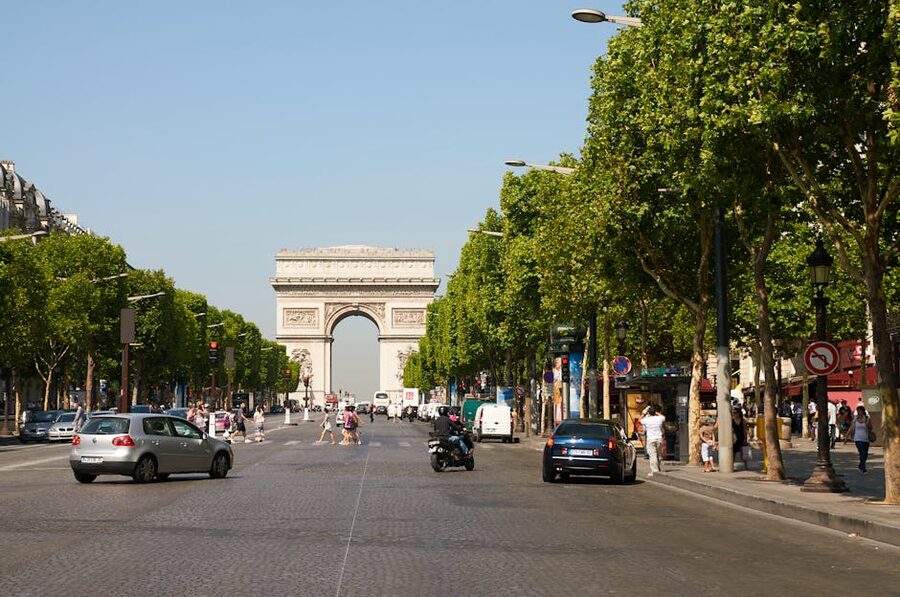
Place Charles de Gaulle, which everybody still calls Place de l’Étoile, is the roundabout the Arc sits in the middle of. Twelve avenues come into it. Champs-Élysées (east), Avenue de la Grande Armée (west, towards La Défense), Avenue Foch, Avenue Kléber, Avenue d’Iéna, Avenue Marceau, Avenue de Wagram, Avenue Hoche, Avenue Friedland, Avenue Carnot, Avenue MacMahon, Avenue Victor-Hugo. The Star. It’s a planned 19th-century imperial gesture by Baron Haussmann under Napoleon III, and it’s still the most chaotic roundabout in Europe.
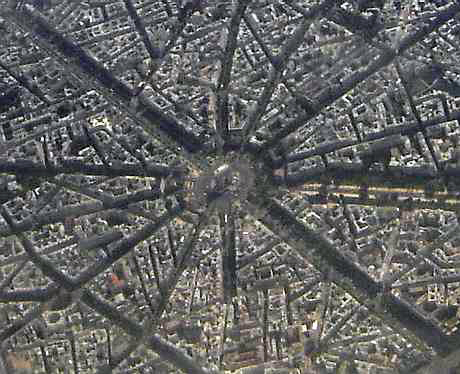
French insurance does not cover accidents inside the roundabout. That is a real rule. Any insurance claim for a bump on Place de l’Étoile is split 50-50 by default because it is impossible to apportion blame. Drivers who don’t know it tend to crash. Locals just merge and assume everybody else will yield, which everybody else doesn’t. From the rooftop you can watch this happen. Cars come into the circle from every angle, the people inside the circle have priority over those entering (which is the opposite of every other roundabout in France), and somehow it works.
You don’t cross at street level. The pedestrian access to the Arc is via a tunnel from the north side of the Champs-Élysées, opposite the avenue heading west. There is no crosswalk at street level and trying to cross will end you. The tunnel entrance is signposted but it’s small. Once you’re at the base of the Arc you’re on a stone island and you stay there. The ticket office and the staircase up are both on this island.
Tickets, hours, who gets in free
Ticket is €13 standard. Online it’s about $18 by the time exchange and platform fees settle. The on-site office sells the same ticket but the queue at the bottom of the staircase can run 30 to 45 minutes on a weekend afternoon, which makes the booked-online version a different experience. You scan your QR code, walk past the line, and start climbing. In summer the saving in queue time is the entire reason to pre-book.
Free entry applies to:
- Anyone under 18, regardless of nationality
- EU residents aged 18 to 25 (you need ID showing residence)
- Disabled visitors and a single companion
- Holders of the Paris Museum Pass
- Anyone visiting on the first Sunday of the month, November through March
- European Heritage Days, which is the third weekend of September
If you fall in the free category you still have to queue at the on-site office to be issued a ticket. There’s no online “free ticket” booking. So in practice, the booked-online ticket is for the rest of us.
Opening hours run roughly 10:00 to 22:30 in summer (1 April to 30 September), 10:00 to 22:00 in winter, with last admission 45 minutes before closing. Closed 1 January, 1 May, 8 May morning, 14 July morning, 11 November morning, and 25 December. The morning closures are because the Arc is the centre of the major public ceremonies on those dates: Bastille Day, Armistice Day, the V-E Day commemoration. If you book a morning slot for one of these, you’ve got an issue. Easy fix: book the afternoon, watch the public ceremony from the Champs-Élysées side first.
The 284 steps, the lift, and the accessibility issue
The official figure is 284 steps from the base to the rooftop. It’s a stone spiral that doesn’t get wider as you go up. There are three short rest landings and you’ll want them. I’ve climbed it three times now and it’s a serious staircase, narrower and steeper than the Florence Duomo dome and the Pisa Tower combined, though much shorter than either.
There is a small lift but it doesn’t go to the roof. It goes from the ground to the mezzanine museum level and stops there. The remaining 42 steps from the mezzanine to the open terrace are the same spiral, no lift, and the staff at the top are clear that the rooftop is not accessible if you can’t manage those 42 stairs. Visitors with mobility issues can do the museum level for free, accompanied by a carer. The rooftop, in plain language, no.
For travellers who can climb it, the staircase is part of the experience: you’re climbing inside the wall of the Arc, you can hear the traffic noise drop away as you go up, and the door at the top opens directly onto the open sky and the city. You don’t realise you’re at altitude until that door opens. After three climbs I’ve come to think of the staircase as the build-up that makes the view feel earned.
The view, sector by sector
The roof terrace is rectangular. You walk a loop around the parapet. Each side gives you a different sector of Paris, and the trick is to know what you’re looking at before you stand there.
East (Champs-Élysées side). The 1.9 km of the Champs-Élysées drops away to the obelisk of the Place de la Concorde, then the gates of the Tuileries, then the Louvre. The whole 8 km Voie Triomphale axis lines up here. This is the photograph everybody takes. Late afternoon, early evening light is best because the sun is behind you and the avenue lights up.
South (Eiffel Tower side). Avenue Marceau and Avenue d’Iéna run down towards the river. The Eiffel Tower stands clear at about 1.5 km, no buildings between you and it. On the Eiffel side you also pick out the dome of the Hôtel des Invalides where Napoleon is buried, the gold a giveaway in afternoon light. If you’re going to do the Seine River cruises later, you can pick out the river and the dock under the Eiffel from up here.
West (La Défense side). Avenue de la Grande Armée runs straight to the modern district of La Défense. On a clear day the Grande Arche is visible at the end of the line. This is the modern half of the Voie Triomphale and the side most visitors don’t realise is the more interesting one. Sunset light here is direct in your face, so morning or midday is the better time for this view. Bring a hat in summer.
North (Sacré-Cœur side). Avenue Hoche and Avenue de Wagram angle off towards the 17th arrondissement. The white dome of Sacré-Cœur sits up on the hill of Montmartre at about 3 km. The basilica is at 130 m elevation and you’re at 50 m, so you’re looking up slightly to see it.
When to go: hour by hour
Light matters more here than at any other Paris viewpoint. The Voie Triomphale axis only photographs cleanly when the sun is on the right side of it.
Morning, 10:00 to 11:30. The Arc opens at 10:00. Quietest time of day. Light is from the east, so the eastern view (down the Champs-Élysées) is into the sun and contrast-y, but the western view to La Défense is well-lit. Pick this slot if you want photos of the Grande Arche end of the axis.
Midday, 12:00 to 14:00. Hardest light, sun overhead. Skip this slot. Use it for lunch on the Champs-Élysées (avoid the chains, walk one block off the avenue and find a brasserie on Rue de Berri or Rue Washington), come back later.
Late afternoon, 16:00 to sunset. The signature slot. Light from the west means the eastern view down the Champs-Élysées to the Louvre is fully lit. Buildings glow gold. This is the hour that earns the ticket. Pre-book this if you can.
Sunset. The platform stays open through dusk. Sunset light hits the western face of the Arc itself and you get to watch the Grande Arche silhouette in front of an orange sky. Then the Eiffel Tower starts its hourly sparkle (every hour on the hour for 5 minutes from sunset until 23:00 in summer, 01:00 in summer Saturday) and you watch it from a kilometre away with the Champs-Élysées lit up below you.
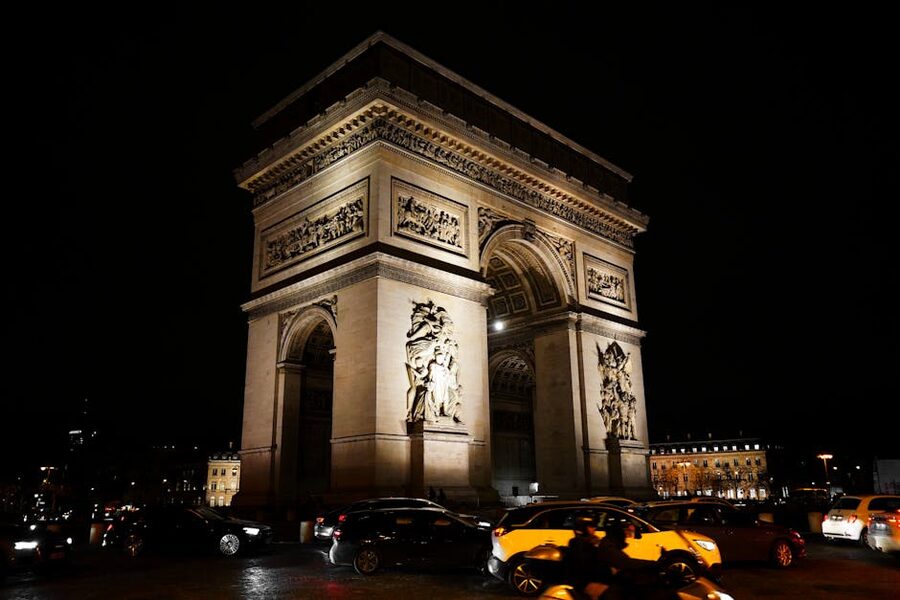
Night. The Arc stays open until 22:30 (summer) or 22:00 (winter), so a full hour after sunset. Night photography from the rooftop is its own thing: the Champs-Élysées is a continuous strip of red and white lights, the Eiffel sparkles every hour, La Défense lights up. The ticket office stops selling about an hour before closing, so book online if you’re aiming for the night slot.
Three picks: the rooftop ticket, the Seine combo, the full sightseeing day
1. Arc de Triomphe Rooftop Ticket: $18
This is the right pick for 90% of visitors. Skip-the-line entry, full rooftop access, the museum room at the mezzanine, and you set your own pace at the top. If you’re also doing the Eiffel, plan the Arc for late afternoon to get the Champs-Élysées axis in good light, then walk down to the Trocadéro and look back at the tower as the sky turns.
2. Arc de Triomphe + Seine River Cruise: $45
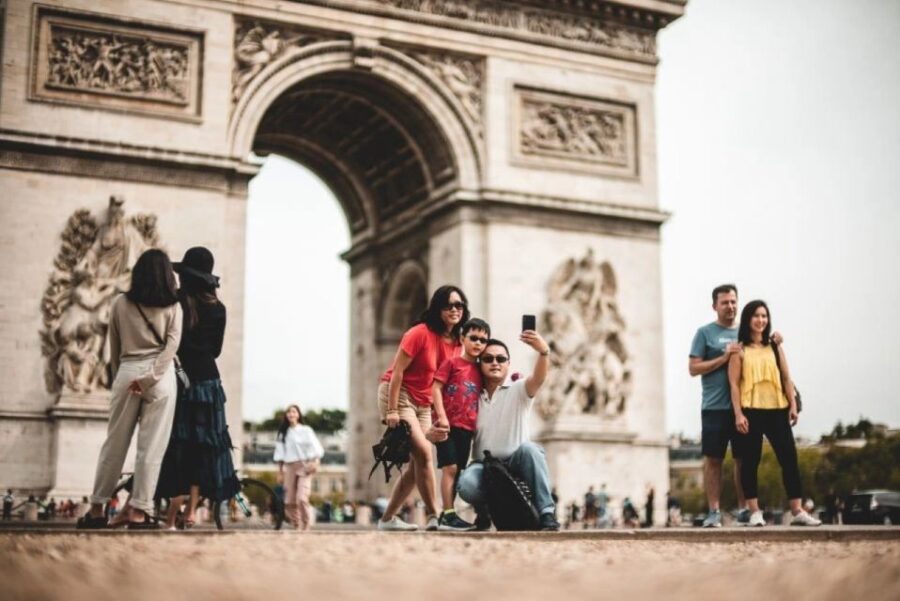
The combo if you want the rooftop view and an hour on the river the same afternoon. Our review of the combined ticket notes the cruise dock is a 10-minute walk from the Arc base, which is fine, but the schedule isn’t always clear in the app, so don’t rush down expecting an immediate boat. The river angle gives you the southern half of the axis (Eiffel, Invalides, Louvre) from water level, which complements the rooftop view nicely.
3. Arc + Big Bus Hop-On + Seine Cruise: $63
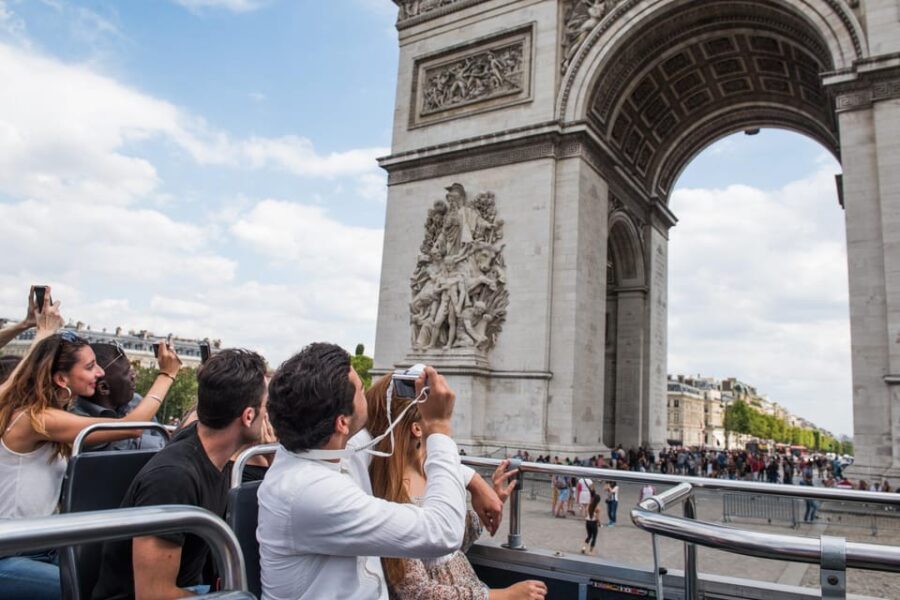
If you’ve got one full Paris day and want to stitch together the major sights without working out the metro, this is the one. The Paris Hop-On bus route covers Eiffel, Trocadéro, Concorde, Louvre, Notre-Dame, and ends here at the Arc, so the bus and the rooftop pair logically. Real catch in summer: the open-top deck is exposed and Paris traffic is slow, so plan a cooler day or use the bus mostly in the evening.
How the Arc compares to the other Paris viewpoints
Paris has four real city-view options. They’re not interchangeable. Each gives you a different angle of the same city.
The Eiffel Tower is the highest at 276 m to the summit observation deck. The view is panoramic and the Eiffel itself is, of course, not in the photo because you’re standing on it. This is the killer flaw of the Eiffel as a viewpoint: every other Paris viewpoint includes the Eiffel in the frame, the Eiffel doesn’t include itself.
The Montparnasse Tower is at 210 m, on the Left Bank, and the Eiffel is centre-frame from there. It’s the only viewpoint where you photograph the Eiffel with the Champ de Mars lawns spread out in front. It’s also a 1973 office tower that locals consider an architectural disaster, which is why most travellers don’t go up. They should. Of the three city-view options it’s arguably the best photograph.
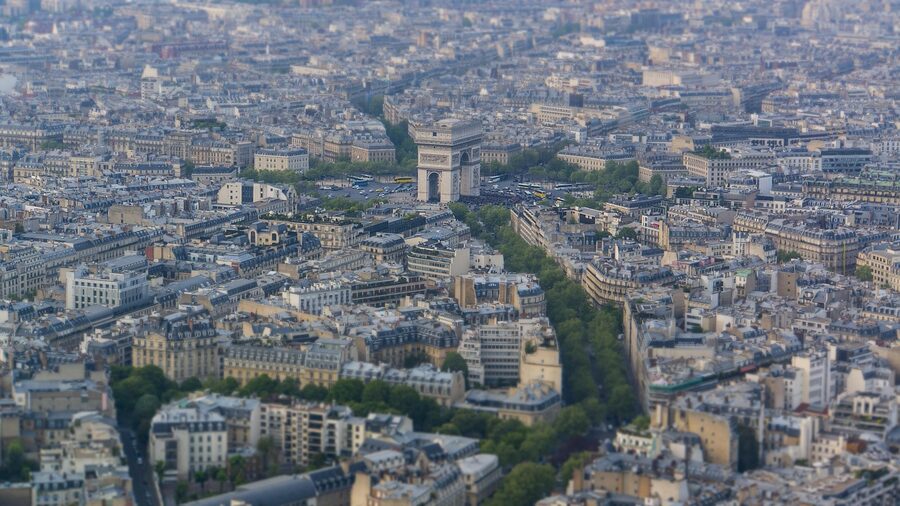
The Arc rooftop is at 50 m, well below the other two, and the photography compensation is the axis. You don’t get the Eiffel central in the frame, you get the city as a planned design. Eiffel to your south, Sacré-Cœur to your north-east, the Champs-Élysées and Louvre east, La Défense west. It’s the only place that shows you the Voie Triomphale as a line.
The fourth option, Sacré-Cœur basilica steps in Montmartre, is free, but you’re at street altitude on a hill, looking down at distant central Paris. It’s a different kind of view, more cityscape and less monument-axis. Worth doing on a separate day.
If you want a viewpoint comparison frame from another country I’ve climbed: the Leaning Tower of Pisa is fun for the lean and the climb, but the view from 56 m is into the back of the Pisa Cathedral, not really a city panorama. The Milan Duomo terraces is the closest cousin to the Arc roof: 70 m, in the historic centre, gives you a planned cathedral square layout from above. The Setas de Sevilla is even shorter, 26 m, but does the same thing for Seville’s old town. The Montjuïc cable car in Barcelona is a different mode entirely (you ride up rather than climb), but at the top you get the harbour and city laid out in the same axial way the Arc gives you Paris. Amsterdam’s NEMO Science Museum rooftop is the free version, a Renzo Piano hull rising out of the harbour with a sloping public terrace that locals treat as a low-altitude belvedere over the IJ.
The reliefs and the carved names: what to look at on the walls
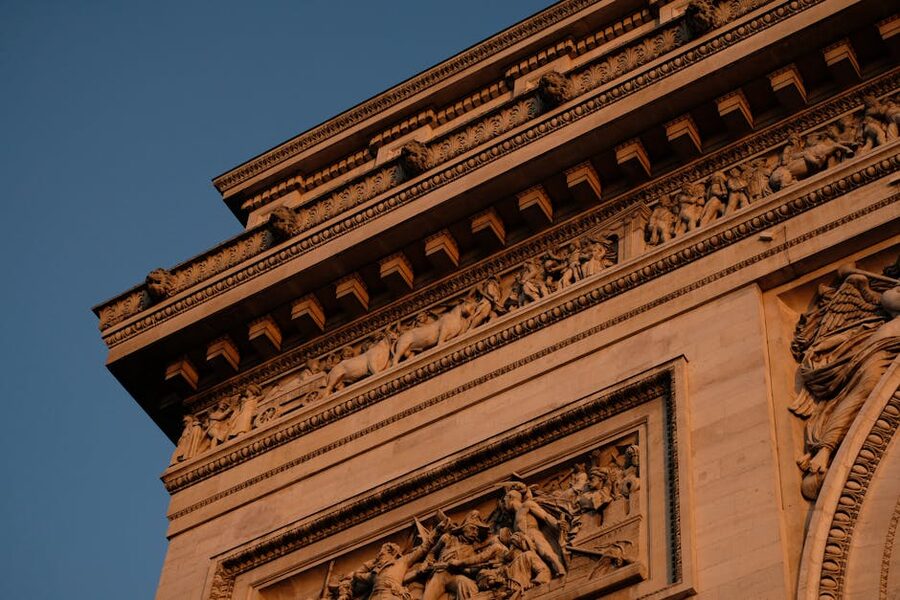
Before you climb, walk a slow loop of the four pillars at street level. Each pillar has a giant high relief, four in total. They were carved between 1833 and 1836 to a programme set by Adolphe Thiers, then Prime Minister.
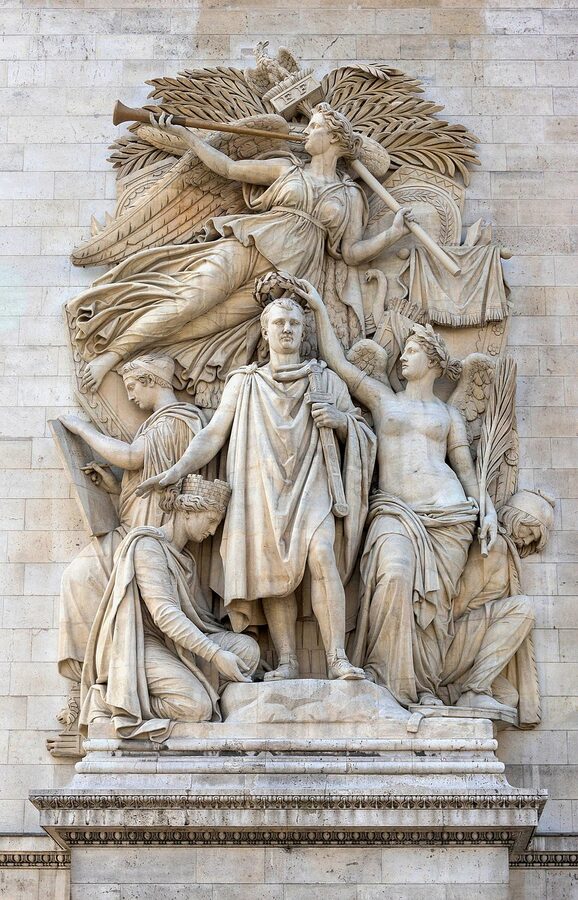
The famous one is on the right-hand pillar facing the Champs-Élysées: Le Départ des Volontaires de 1792 by François Rude, which everyone calls La Marseillaise after the national anthem. The figures in it are screaming. The female figure at the top is the Spirit of the Republic with wings, sword raised, and her face is the version of revolutionary France you see on every postcard. It’s the most reproduced relief on the building.
The other three are quieter. Le Triomphe de 1810 by Cortot (right-hand pillar facing west, the Napoleon coronation triumph), La Résistance de 1814 by Étex (left-hand pillar facing east, France defending against the invasion that ended the Empire), and La Paix de 1815 by Étex (left-hand pillar facing west, peace after Napoleon’s fall). Reading them in clockwise order around the Arc is reading the abridged history of France 1792 to 1815, which is the period the building is about.
Above the reliefs, the upper frieze runs the full perimeter of the Arc and shows two sets of scenes: the Departure of the Armies on the east side (1789 onwards), and the Return of the Armies on the west (after the campaigns ended). Between each pair of pillars on the inside walls, the names of 558 French generals and 128 battles of the Revolutionary and Napoleonic wars are carved in stone. Underlined names are generals who died in battle. The lists are in chronological order, top to bottom, left to right. Anyone with a French great-grandfather from the right century has a real chance of finding the family name up there.
Getting there and what’s nearby
The closest metro station is Charles de Gaulle – Étoile, which is the intersection of metro lines 1, 2, and 6, plus RER A. The exit you want is Champs-Élysées, which puts you on the southern edge of the roundabout. From there you find the pedestrian tunnel to the Arc base, signposted “Accès Arc de Triomphe.”
The line 1 metro is the most useful here because it runs directly along the Voie Triomphale axis: La Défense (Grande Arche) → Charles de Gaulle – Étoile (Arc) → Concorde (obelisk) → Tuileries (gardens) → Palais Royal-Musée du Louvre. You can ride the line and visit the whole axis as a single day. From a planning perspective that’s the smart way to do the day: Louvre in the morning (when light through the I.M. Pei pyramid is best), Tuileries lunch picnic, walk the Champs-Élysées up, Arc in the late afternoon, sunset on the rooftop. That’s the axis as an experience, not just a view.
By foot, the Arc is at the western end of the Champs-Élysées, and the Champs-Élysées walk from Concorde takes about 25 minutes if you’re not stopping. Most visitors stop. The cluster of luxury shops, the Louis Vuitton flagship, the Renault concept store, the Ladurée macaron shop, the Disney store, and a permanent rotation of demonstrations and tourist crowds means it’s not a fast 1.9 km. The avenue itself is wide (70 m) and has six lanes of traffic. Local Parisians don’t hang out here. They go to the side streets in the 8th arrondissement.
If you’ve got time to extend the day, the Trocadéro (across the river to the south, line 6 metro from Charles de Gaulle – Étoile, three stops) gives you the Eiffel Tower at its photogenic best. The route Arc → metro line 6 → Trocadéro → walk down to the river → cross Pont d’Iéna → Eiffel Tower is a logical late-afternoon-into-evening progression. A Seine river cruise from the Eiffel dock at sunset closes the day.
What to eat near the Arc, and what to avoid
Plain advice: don’t eat on the Champs-Élysées itself. The avenue is tourist-priced and most of the restaurants on it are chains. The good food in the 8th arrondissement is one or two streets back. Specifics:
Le Drugstore Publicis at 133 avenue des Champs-Élysées is the exception. It’s a Publicis-owned brasserie at the Arc end of the avenue, the one with the curved glass facade. Open late. Reasonable for what it is.
Rue de Berri (one block south of the avenue, between George V and Franklin Roosevelt metros) has neighbourhood brasseries used by office workers in the area. Not cheap, but locally-priced.
Rue du Faubourg Saint-Honoré (parallel to the avenue, two blocks north) has higher-end places including Ladurée’s main salon. Also Hermès and Lanvin if you’re shopping the way the 8th arrondissement intends you to.
If you’re crossing into the 16th arrondissement (south side of the Arc), Rue de Longchamp and Avenue Marceau have Lebanese and Italian places that the locals from the residential blocks actually go to. Skip the steakhouses on the avenue itself.
For a day-out comparison: this is the kind of “famous avenue, eat one block off it” rule that applies in Seville’s old town near the Setas and around Milan’s Duomo. The famous square is for the photograph and the building. The food is on the side street.
Common mistakes I see at the Arc
Three mistakes I watch happen on every visit, in roughly this order of frequency.
Mistake one. Trying to cross at street level. There is no crosswalk on Place de l’Étoile. Use the tunnel from the Champs-Élysées side. People who try to dash across get yelled at by drivers, and rarely get hit because the cars are still moving very slowly through the chaos, but it’s not a good way to start the visit. The tunnel entrance is right at the corner of avenue de la Grande Armée and the Champs-Élysées, look for the steps going down.
Mistake two. Booking the morning slot on a public holiday. The Arc closes the morning of Bastille Day, Armistice Day, V-E Day, and a few others for the official ceremony. Booking platforms don’t always make this clear. If you booked 14 July at 10:00, your ticket isn’t valid: re-book or come back in the afternoon.
Mistake three. Not allowing time at the Tomb level. People power up the spiral, stand on the rooftop for fifteen minutes, power back down, and walk out without registering they passed the Tomb of the Unknown Soldier on the way through. The whole point of the building is what’s at the bottom and what’s at the top. Plan for 90 minutes minimum: 15 minutes at the base reading the reliefs and seeing the Tomb, the climb itself, 30-40 minutes on the rooftop with the axis, the descent, another 5 minutes at the bottom.
The Arc in the Paris ceremonial calendar
Three big civic dates put the Arc on television every year, and if you’re in Paris on any of them the experience changes.
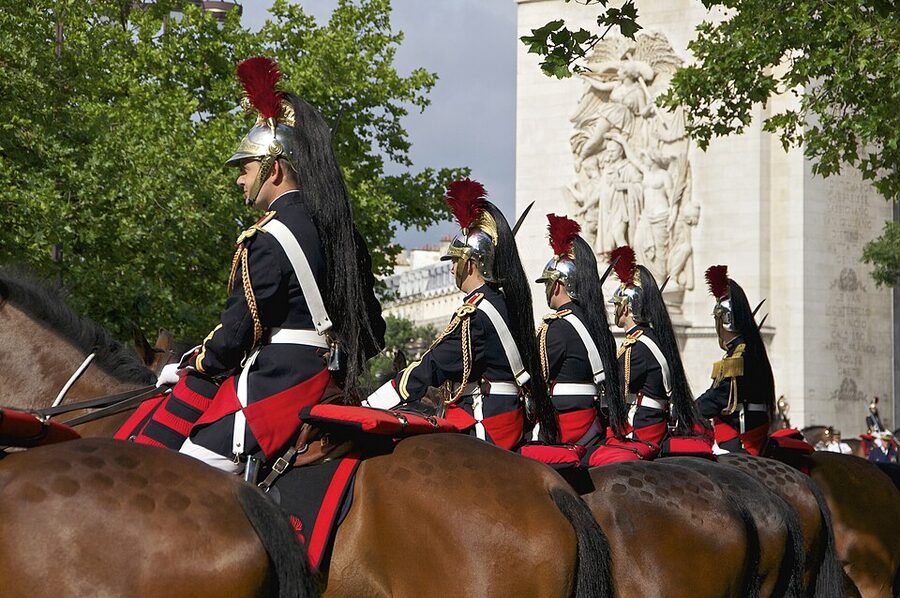
Bastille Day, 14 July. The Bastille Day military parade marches up the Champs-Élysées from Concorde to the Arc, ending with a flyover of jets trailing the tricolour smoke (blue, white, red) directly over the Arc. The avenue is closed to traffic from early morning. The Arc itself is closed in the morning. Best public viewing is from the Champs-Élysées sidewalk near Concorde, or one of the cafés on Avenue Friedland. The Garde Républicaine on horseback is at the Arc throughout. After 13:00 the public can usually access the rooftop.
Armistice Day, 11 November. The President of the Republic lays a wreath at the Tomb of the Unknown Soldier at 11:00. The whole stretch of the Champs-Élysées is closed in the morning. The eternal flame is rekindled in the major ceremony. Smaller public ceremony than Bastille Day, but the more solemn one and historically the one the Arc was always for.
Tour de France final stage, late July. The Tour finishes on the Champs-Élysées. The peloton does multiple laps of a circuit that goes from Concorde up the avenue to the Arc, around the roundabout (anti-clockwise), back down the avenue, repeat. The finish line is on the Champs-Élysées itself. Watching from the Arc rooftop in the afternoon is, if you can get a ticket for that day, one of the better Tour viewing spots: you can see the riders both coming up the avenue and returning.
New Year’s Eve. The biggest crowds. The avenue and Place de l’Étoile fill with hundreds of thousands of people. Light shows are projected on the Arc. The roof is closed for the evening for security reasons. Watch from the Champs-Élysées itself. Don’t try to drive anywhere within five blocks; you won’t move.
What you’ll spend, time and money
Realistic budget for the visit:
- Ticket: €13 list, $18 booked online once exchange and platform fees settle.
- Time on site: 90 minutes is the right minimum. 2 hours if you want time at the Tomb and a slow rooftop loop.
- Add-on: Champs-Élysées walk down to Concorde, 25-30 minutes if you stop. Seine cruise from Eiffel dock, another hour. Total day: 4-5 hours.
- Avoid: the on-site queue in summer. Booked online ticket is the entire reason this visit doesn’t burn a half-day.
If you have the Paris Museum Pass, the Arc is included. The pass is €70 for 4 days and covers about 60 sites, including the Louvre, the Orsay, the Invalides, and the Arc. If you’re doing three or more of those it pays for itself fast.
If you only have one day in Paris
The Arc rooftop is one of three things I’d put on a one-day Paris itinerary, and I’d put it last. Here’s why and how the day works.
Morning, 09:30: Louvre at opening. Two hours, hit the Mona Lisa, the Winged Victory, the Venus de Milo, the Salle des États for the Italian Renaissance, then leave. You will not “do” the Louvre in two hours. You will see the four things that need seeing.
Late morning, 12:00: walk out the east side of the Louvre, cross to Île de la Cité, see Notre-Dame from outside (the cathedral is reopening December 2024 after the 2019 fire, with restored access). Cross back, walk through Place du Châtelet, head west.
Lunch, 13:30: in the 1st arrondissement. Look for the small bistros around Rue Saint-Honoré. Skip Le Train Bleu unless you’ve booked weeks ahead.
Afternoon, 15:00: walk through the Tuileries gardens, exit at Concorde, look up at the obelisk, then start the Champs-Élysées walk west. Stop at the Orsay if Impressionism is your thing (it’s a 10-minute walk south from Concorde, on the Left Bank); skip if not.
16:30: at the bottom of the Champs-Élysées. Walk up.
17:30 to 19:00: at the Arc, slot booked for late afternoon. Climb. Sunset from the rooftop.
19:30: descend, walk south down Avenue Kléber to Trocadéro (10 minutes), then across the river to the Eiffel Tower for the night sparkle.
That’s the day. The Arc is the editorial peak of it because by the time you’re on the rooftop at sunset, you’ve walked the full eastern half of the Voie Triomphale yourself, and from up there you can see what you walked. The view earns more meaning if you’ve earned the route.
What it’s like in practice: a fourth visit
I’ll give you the fourth time I climbed it, last year, late September. I had a 17:00 slot. The on-site queue at the staircase was 35 minutes long; my pre-booked ticket put me past it in two minutes. The climb took me twelve minutes including a forty-second pause on each of the three rest landings to let groups going down pass me. The mezzanine museum room, I gave four minutes. The remaining 42 steps to the rooftop felt steeper than the lower section because you can see the open sky through the door above and you instinctively try to power up the last bit.
On the rooftop I spent about forty minutes. Started at the eastern parapet for the Champs-Élysées axis shot in golden hour. Walked anti-clockwise around the perimeter: south for the Eiffel and Invalides (both well-lit), west for La Défense (sun in my face, harder photo, came back to that side later), north for Sacré-Cœur. Came back to east for the long Champs-Élysées lighting up at twilight. The Eiffel did its 19:00 sparkle visible from a kilometre away. The Champs-Élysées headlights coming up the avenue made it look like a river of light flowing toward the Arc.
I came down at about 18:25 and stood at the edge of the eternal flame ceremony at 18:30. Twelve minutes. A delegation of French Foreign Legion veterans laid a wreath, the bugle played, a minute of silence, the flame rekindled. Maybe forty other tourists watched. After that I walked back down the Champs-Élysées as the streetlights came on. Total time door-to-door: just under three hours including the ceremony. It was the best three hours of central Paris I’ve spent.
Pair the Arc with
If the Arc earns its place in your day you’ll want to extend it. The natural pairings: the Eiffel Tower for the southern half of the axis, the Montparnasse Tower for the third Paris-from-above option (and arguably the best photograph because it includes the Eiffel), the Seine river cruise from the Eiffel dock for the river-level perspective, the Louvre at the eastern terminus of the Voie Triomphale, the Orsay for the chronological successor museum on the Left Bank, and the Invalides for the other half of the Napoleon legacy. If you’re driving the kids to Disneyland Paris the next day, the Arc is the right way to close the city day before the day at the parks.
For a longer trip, plan a Versailles day trip after the Arc to compare imperial-axis design (the Sun King’s at Versailles, Napoleon’s at the Arc), or Giverny if you’ve done the Orsay Impressionists and want the source. The Paris hop-on bus is the lazy option for stitching it all together; locals walk it and use the metro, which is the better way unless you’re carrying kids or the weather’s foul.
The Arc is one of those Paris monuments that everybody photographs from the outside and a fraction of visitors actually go inside. It’s small. It’s not glamorous on the climb. But the rooftop is where the whole city lays itself out as a deliberate piece of design, and once you’ve seen Paris that way you can’t quite see it any other way.