
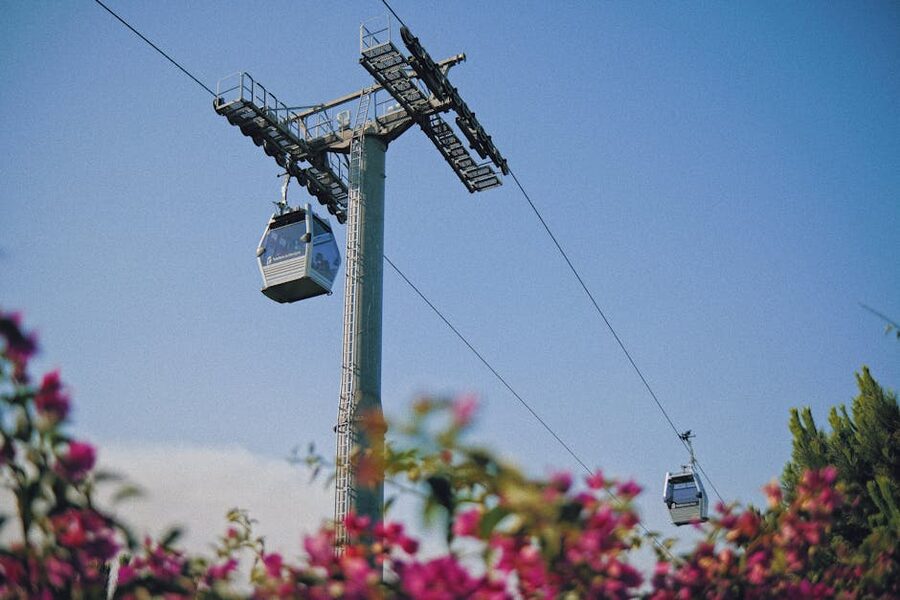
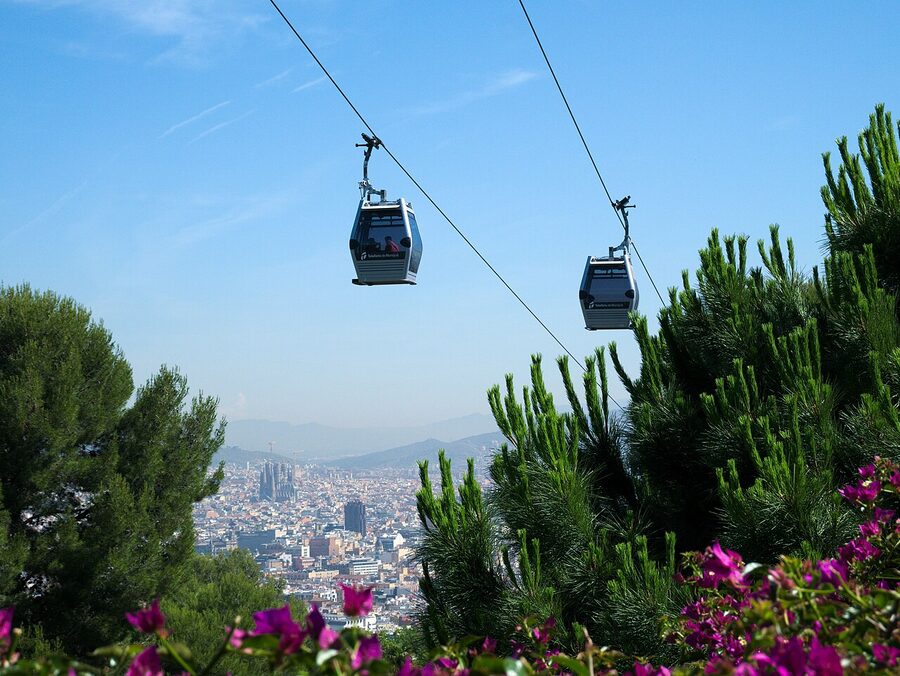
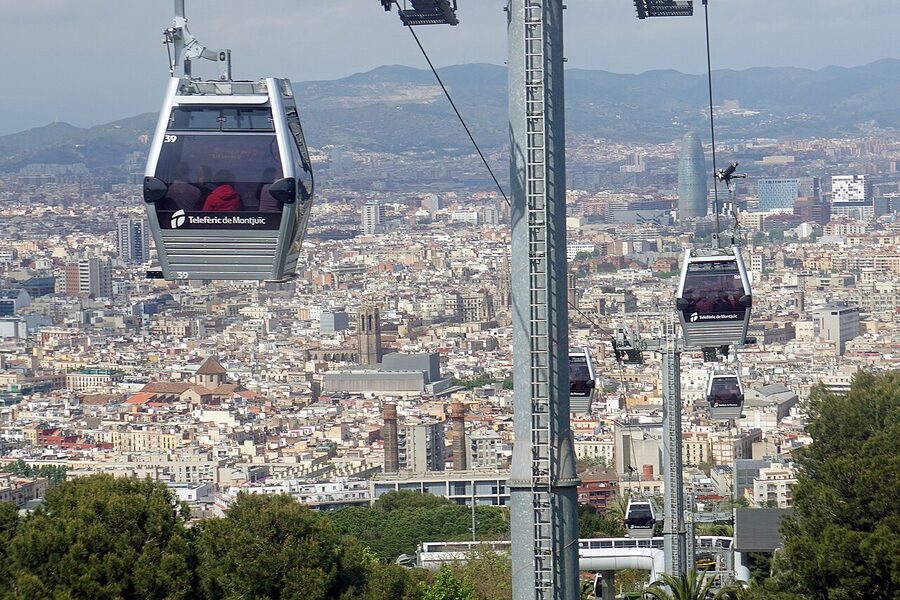
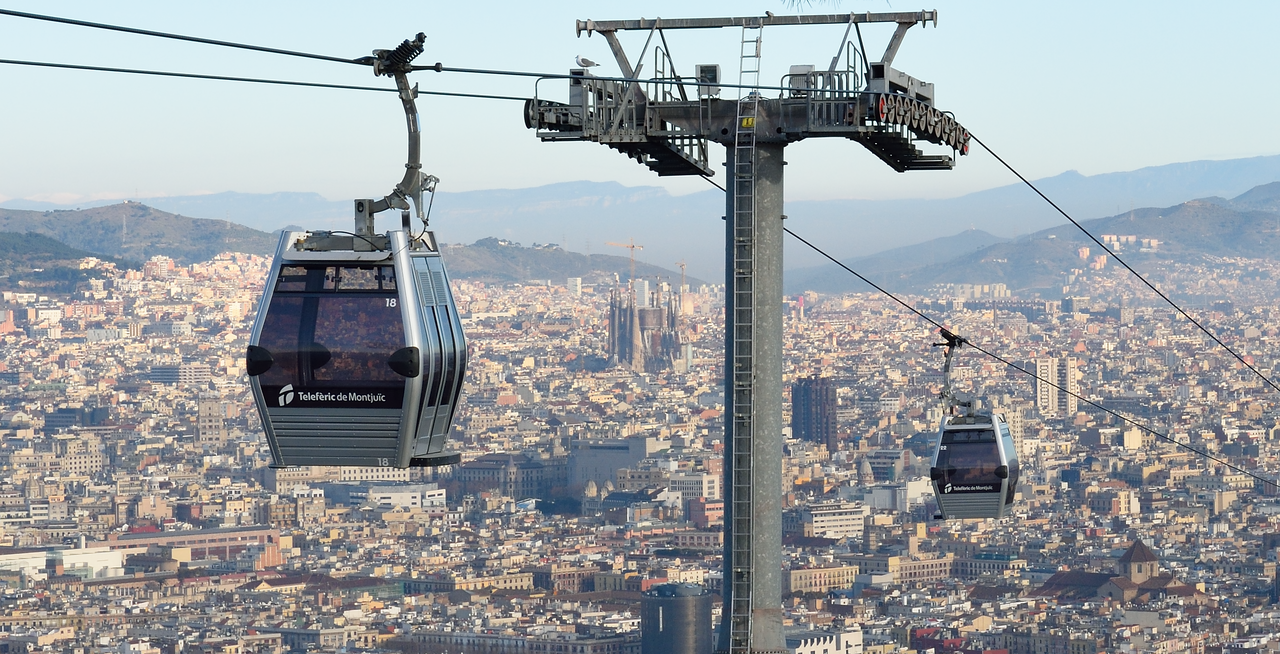
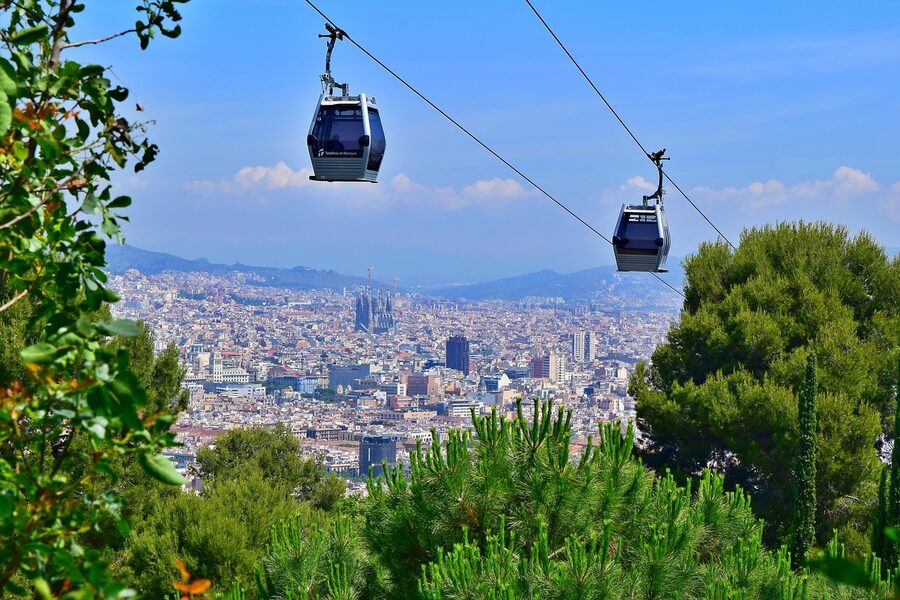
You crest the slope about three minutes in. The cabin has been climbing in a steady, almost silent line above the trees on the southwest face of Montjuïc, and you’ve been watching the floor of the harbour widen out under your feet, when the angle shifts and the whole city opens up. Sagrada Família’s spires to the northeast, lined up like a stone pipe organ. Tibidabo’s basilica on the far hill behind it. Plaça d’Espanya and the Venetian Towers below, on a clear day the Pyrenees in a thin grey line at the horizon.
You forget, briefly, that you paid €17 for it.
This is the moment the Telefèric de Montjuïc earns its ticket. The whole ride is eight minutes door to door and 84 metres of vertical, but the payoff is concentrated in about ninety seconds in the middle, when the angle hands you a panorama you can’t get from anywhere else in Barcelona that doesn’t cost five times as much. I’ll get to the booking mechanics, the funicular question, and what to actually do at the top. First, the easy answer for people who already know they want to ride it.
If you’re short on time
- Just want the ride? The Roundtrip Ticket at $22 is the cheapest way on. Go.
- Want the castle, the views and a guide? The Walking Tour with Castle & Cable Car ($64) packages it with La Rambla, the Boqueria and the dungeons.
- Want it as one chapter of a bigger Barcelona day? The E-Bike Tour with Cable Car & Boat Ride ($191) is the splurge.
What the Montjuïc Cable Car actually is
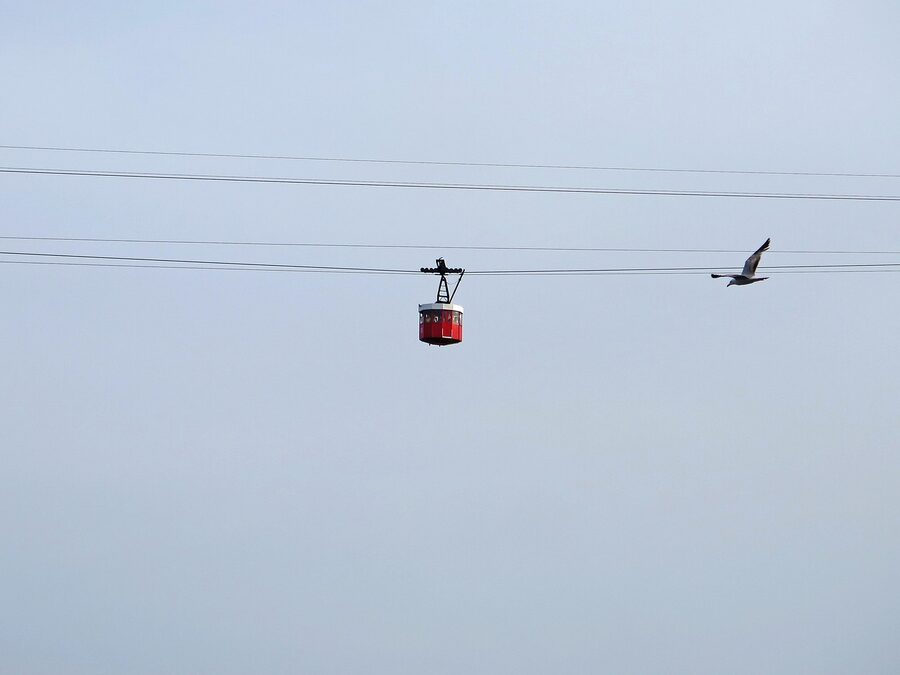
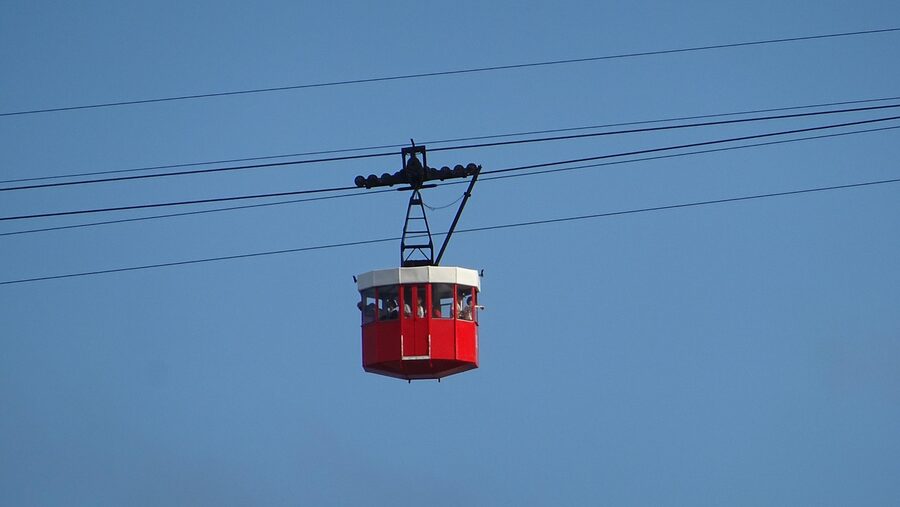
Two things confuse first-time visitors. The first is that there are two cable cars in Barcelona. The Telefèric de Montjuïc, which is the one we’re talking about, is the modern aerial gondola that runs along the upper half of Montjuïc hill. The other one is the Teleférico del Puerto (Port Cable Car), the older red-and-white system that runs from Barceloneta beach across the harbour to Miramar. They’re both worth doing, but they’re not the same ride and they don’t share tickets.
The second confusion is the funicular. The Funicular de Montjuïc is a small underground tram that runs from Paral·lel metro station up to the base of Montjuïc Park. It’s part of the city transit network and it’s free with any standard metro ticket. The cable car starts where the funicular ends. Most people who ride one ride both, but they’re separate operations with separate fare systems.
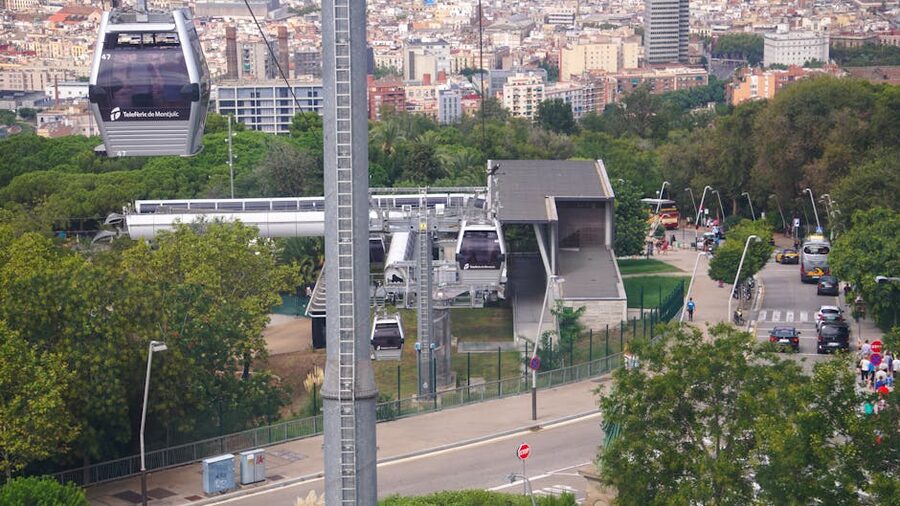
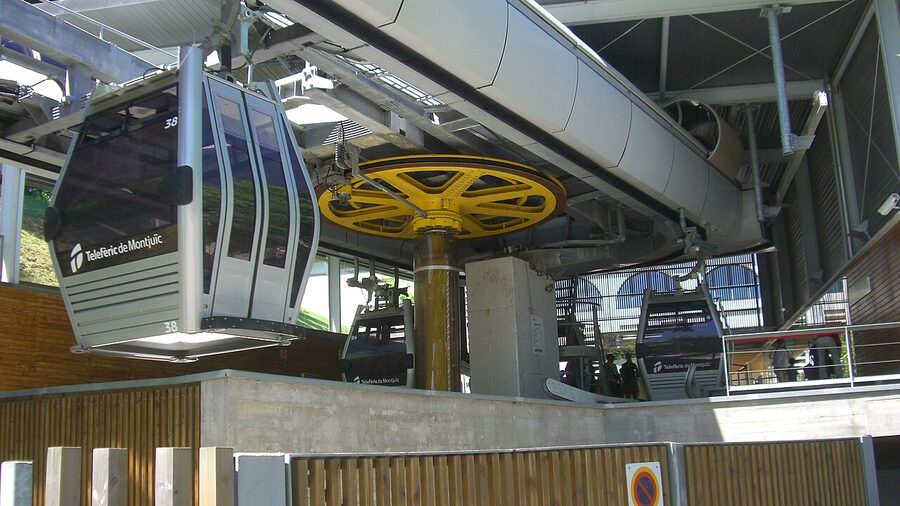
The cable car itself has three stops: Parc de Montjuïc (the lower station, near where the funicular drops you), Mirador (a midway terrace), and Castell de Montjuïc (the top, at the gates of the 17th-century fortress). A single roundtrip ticket lets you get off at all three on the way up and the way down. You don’t have to plan your stops in advance. Just hop off when something looks worth a look.
Tickets and prices in 2026
The cable car is run by Projectes i Serveis de Mobilitat, the same company that operates the Hola Barcelona transport pass. Fares are reset every January and stick for the year. As of 2026:
- Roundtrip adult: €19.00 at the booth, €17.10 online (10% discount)
- Roundtrip child (4–12): €13.00 booth, €11.70 online
- Roundtrip under 4: Free
- One-way adult: €12.00, booth only (no online sale)
- One-way child (4–12): €10.00, booth only
The roundtrip is what almost everyone wants. The one-way exists for people walking down from the castle who want to skip the descent, or for people taking the bus up and the cable car down (which I’d actually recommend if you’re doing it in the morning, since the light is better facing east on the way down, and you don’t bake in the queue at the lower station).
Buying online through Hola Barcelona’s official site saves you about €1.90 per adult and lets you skip the booth queue entirely. The voucher is valid for 90 days, so book ahead and use it whenever the weather looks right. Third-party resellers like the GetYourGuide ticket priced at $22 are worth it if you want one cancellable booking instead of a non-refundable Hola Barcelona ticket. Same product, slightly different terms.
The view, broken down
This is what you actually came for, so let me be specific about what you can see and where to look.
The cabin starts low at Avinguda Miramar and climbs at about a 28-degree angle along the southwest spine of the hill. For the first thirty seconds you’re below the tree line and the windows mostly fill with green. Don’t worry. The angle widens fast.
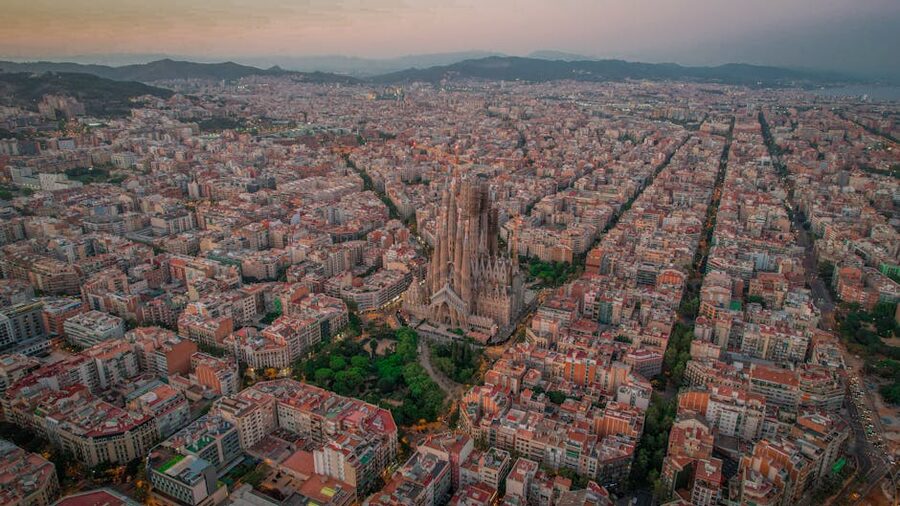
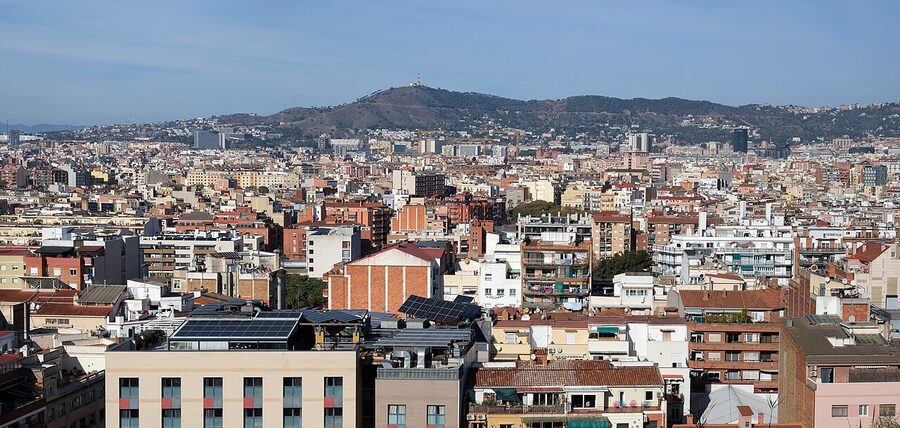
Looking northeast, which is to your left if you’re sitting facing the direction of travel: the dense grid of the Eixample district, with Sagrada Família’s spires standing clear above everything else. On a really clear day you can see Tibidabo, the wooded hill on the far side of the city, with its basilica and the old amusement park silhouetted on top. The Pyrenees show up about five days a year, usually right after a tramuntana wind blows the haze out, and when they do, they’re a thin grey-white line at the horizon, fifty kilometres away.
Looking south, which is to your right: the harbour. Cruise ships docked at Moll Adossat, container terminals beyond, the Mediterranean stretching out into the haze. The W Hotel’s sail-shaped tower at the tip of Barceloneta. The old Port Vell with its yacht basin closer in.
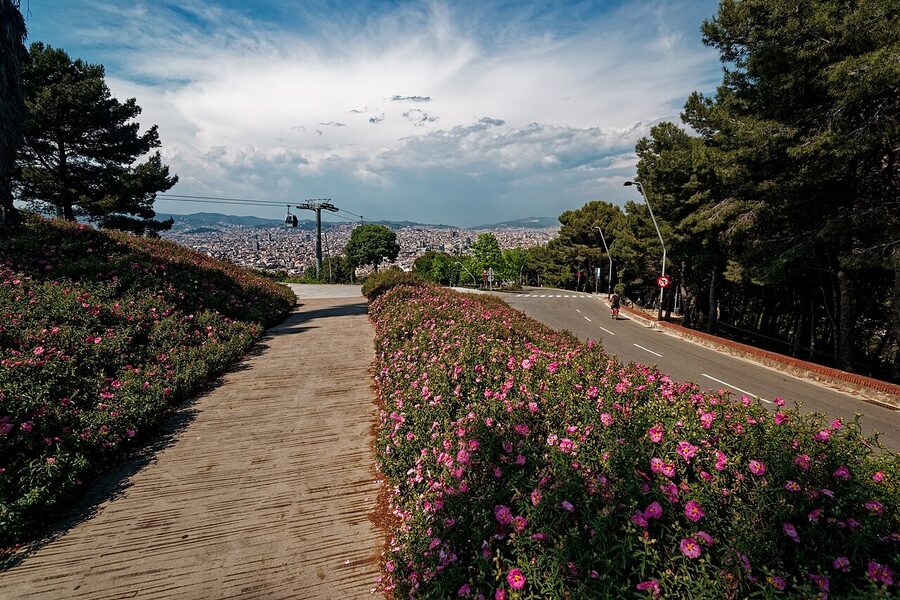
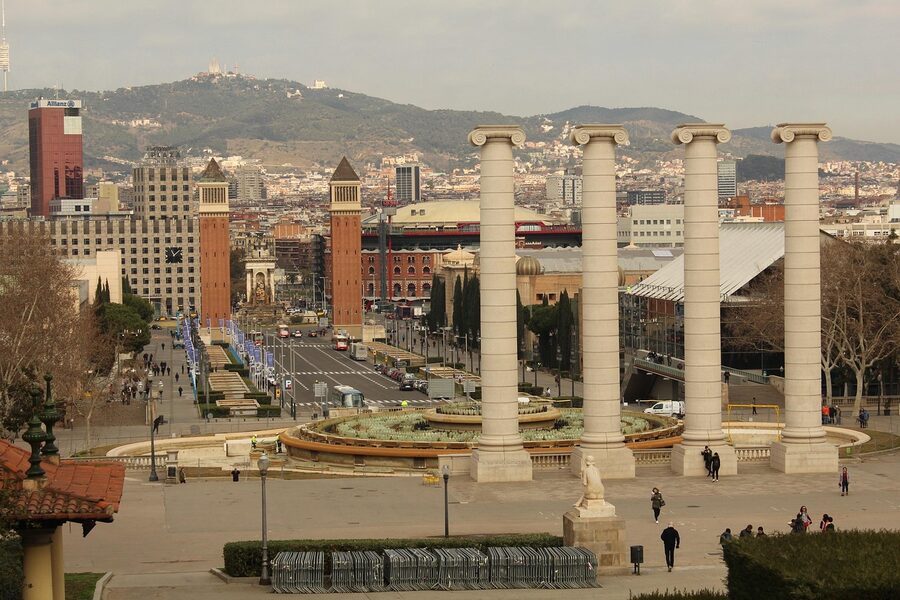
Looking northwest, behind you on the way up: Plaça d’Espanya, the Venetian Towers, the colossal stairs of the National Art Museum, the rooflines of the Eixample fading off into the distance. This is the side most people miss because they’re too focused on Sagrada Família. Turn around. The Magic Fountain forecourt looks like a tiny model from this angle.
The funicular question
This trips up about half the people who plan their first visit. There are three different ways to get up Montjuïc and they’re easy to confuse:
- Funicular de Montjuïc: An underground rail tram. Runs from the Paral·lel metro station up to Avinguda Miramar (the cable car’s lower station). Free with any metro ticket, including the Hola Barcelona Travel Card. Two minutes, no view, just a transit shortcut.
- Telefèric de Montjuïc: The aerial gondola. Runs from Avinguda Miramar to the castle. Eight minutes, panoramic, paid separately.
- Bus 150: A regular city bus that climbs the hill. Free with the Hola Barcelona Card or any metro ticket. Slow but scenic-ish through the gardens.
The textbook itinerary is: metro to Paral·lel, free funicular up to the cable car base, paid cable car up to the castle. Then on the way back down, either reverse it or take Bus 150 down through the gardens for a different angle.
One thing nobody tells you: the funicular runs on the metro’s maintenance schedule, not the cable car’s. It closes for weeks at a time, sometimes months. When the funicular is out, there’s no easy walk-up to the cable car base. You’ll need Bus 55 or Bus 150 from Plaça d’Espanya, or a taxi from Paral·lel. Always check the TMB website (or just ask at any metro station) the morning of your visit. The cable car operator’s website rarely advertises funicular closures, even though they affect every visitor.
When to ride
The cable car runs year-round but with seasonal hours:
- January–February: 10am–6pm
- March–May: 10am–7pm
- June–September: 10am–9pm
- October: 10am–7pm
- November–December: 10am–6pm
On Christmas Day, January 1, and Three Kings (January 6), it runs a short 10am–2:30pm shift. The whole system shuts down in high winds, which on Montjuïc is a real possibility. Check the forecast if you’re going on a tramuntana day.
The single best slot is the last hour before closing, especially in summer when the 9pm closure means you ride at golden hour and watch the sun set over the harbour from the castle terrace. The line is shortest then because most day-trippers have already been and gone. The single worst slot is mid-afternoon in July or August: queues at the booth can run to 45 minutes, the cabins get hot, and the haze hits its peak.
What to do at the top
You arrive at the castle gate. Now what?
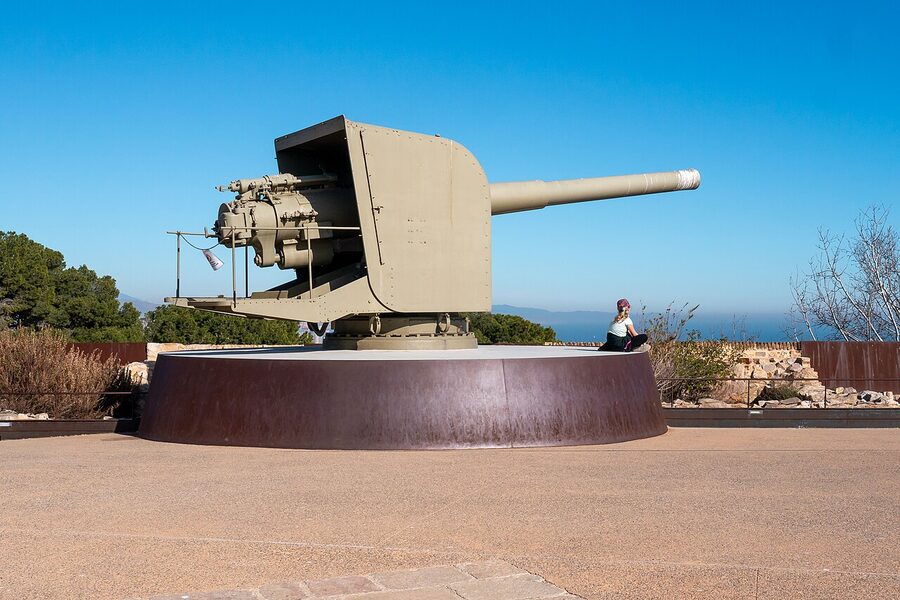
Castell de Montjuïc is the obvious answer. The fortress dates from 1640 in its earliest form, was rebuilt in 1779 by military engineer Juan Martín Cermeño into the star-shaped bastion you see today, and was used by the Spanish military right up until 2007 when it transferred to the city. Entry is €12 adults, €7 concessions, free for under-16s and on the first Sunday of every month. Allow at least 90 minutes inside if you want to walk the ramparts, see the cisterns, and read the (genuinely dark) interpretive panels about its use as a political prison under Franco.
The cable car ticket does not include castle entry. This is the most common mistake people make. You buy the castle separately at the gate, or pre-book online via the city’s culture portal. If you want both bundled, the Walking Tour with Castle & Cable Car is the simplest one-payment option (more on that below).
If the castle isn’t your thing, you can stay outside and walk the perimeter for free. The east-facing rampart has the best harbour view in Barcelona, full stop. There’s a small café terrace inside the moat that does decent coffee and sandwiches at non-extortionate prices for a fortress on a hill.
Three tours worth booking
You don’t need a guided tour to ride the cable car. The roundtrip ticket is straightforward, the queues are short outside peak summer, and the Castell de Montjuïc has decent self-guided panels. But three options solve specific problems worth flagging.
1. Montjuïc Cable Car Roundtrip Ticket: $22
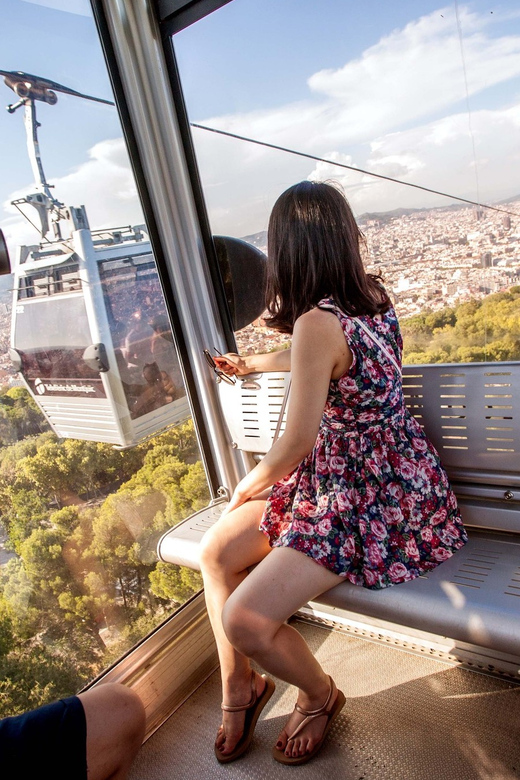
This is the default pick: a clean, cancellable roundtrip on the same cabins everyone else is riding, booked through GetYourGuide instead of the official Hola Barcelona portal. Our full review covers the small price gap (about $2 over the official online discount) versus the flexibility of cancellation. Pick this one if your itinerary might shift and you don’t want to be locked into a specific date.
2. Walking Tour with Montjuïc Castle & Cable Car: $64
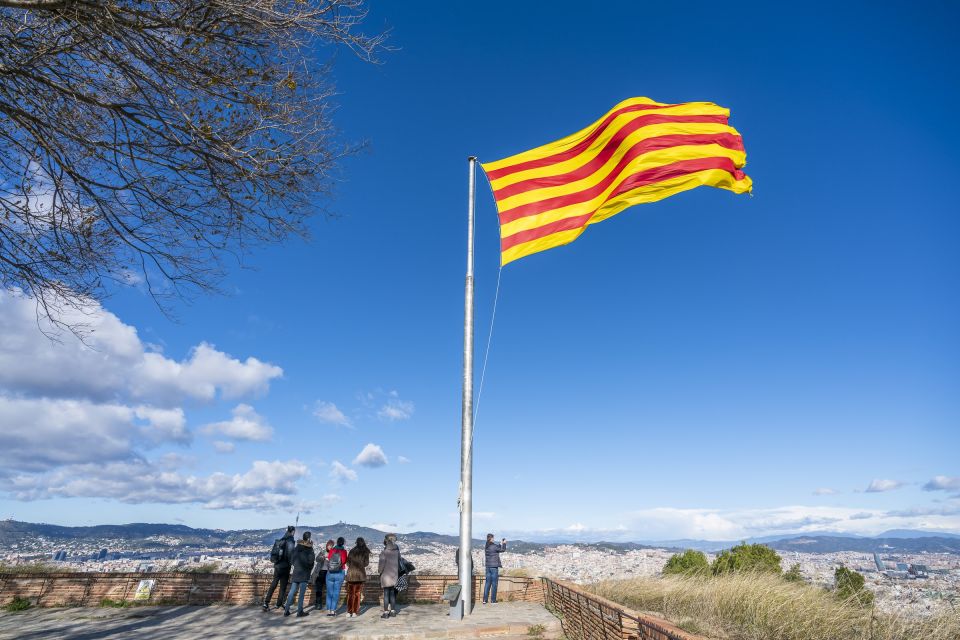
Group capped at twelve, three and a half hours, La Rambla and the Boqueria included before you climb the hill, and the package fixes the most common solo-traveller mistake by bundling the castle entry with the cable car. Our full review notes the dungeon access is the standout, since most self-guided visitors miss the lower cisterns entirely. Pick this if you want context, not just transit.
3. E-Bike Tour with Cable Car & Boat Ride: $191
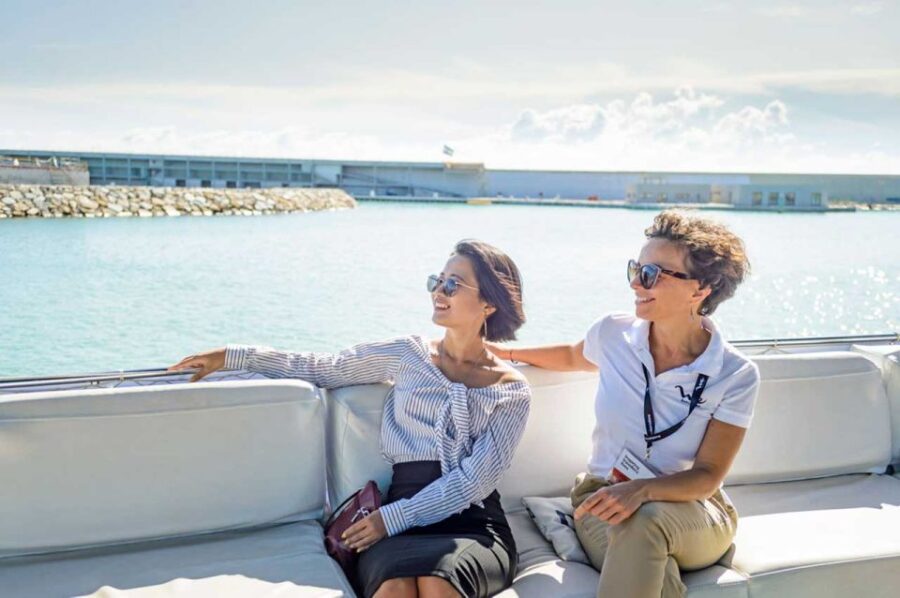
This is the splurge: three transport modes in four hours, with the cable car as the middle act between e-bike and harbour boat. Our full review flags it as the right pick for active travellers who want to see the Olympic Ring and the lighthouse without grinding up the hill on a regular bike. Skip it if you’re already planning a separate catamaran from Barcelona; the harbour leg overlaps.
The Mirador stop most people skip
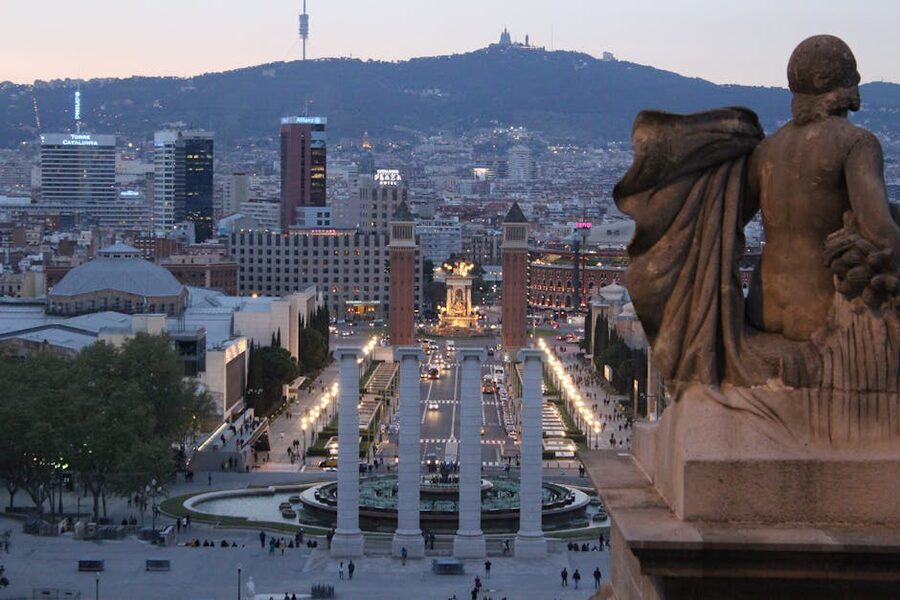
The middle stop, Mirador (officially Mirador de l’Alcalde), is the one most riders skip on the way up because they’re impatient to reach the castle, then forget about on the way down because they’re already mentally on to dinner. It’s the best photo terrace on the whole hill.
From the Mirador platform you get an uninterrupted view of the harbour, with no fortress wall in front of it the way you do at the top. There’s a small café (Mirador Café Terrace) with about ten outdoor tables that fill up at golden hour. Coffee is fine. The view is the point.
The hop-off is included in your roundtrip ticket. Just step off when the cabin opens at Mirador instead of staying in for the third stop. Walk to the railing, take ten minutes, then catch the next cabin up. They cycle every thirty seconds, so you don’t lose meaningful time.
What’s around the lower station
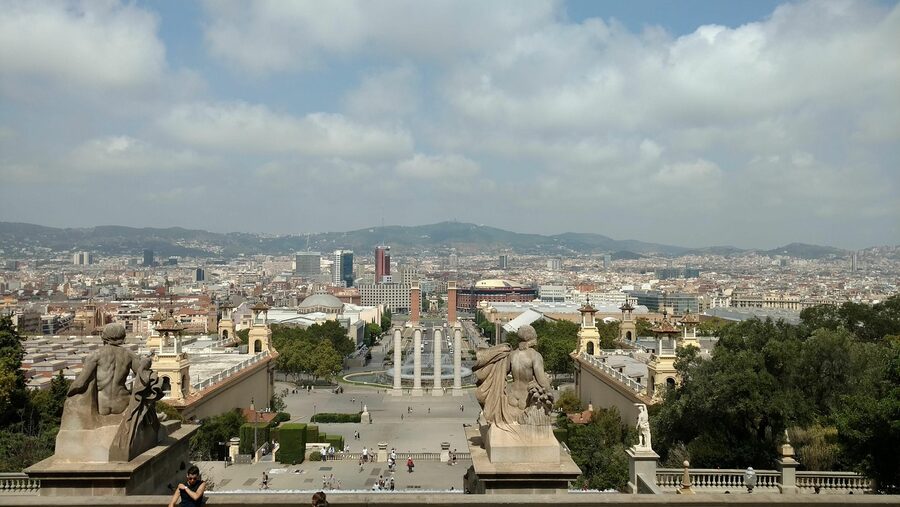
If you arrive at Avinguda Miramar by funicular and the cable car queue is long, there are two genuinely worthwhile detours within five minutes’ walk while you wait.
Fundació Joan Miró is the closest. It’s the artist’s own foundation, designed by his friend Josep Lluís Sert in 1975, and it holds the largest collection of Miró’s work anywhere. The terrace sculpture garden is free to enter even without a ticket. About 8 minutes on foot from the cable car base.
Poble Espanyol takes a bit longer (maybe 15 minutes by foot, or you can catch Bus 150) but it’s worth it if you’re staying multiple days in Barcelona. It’s an open-air architectural reproduction of regional Spanish villages built for the 1929 World’s Fair, with active artisan workshops in most of the buildings. Skip it if you only have one Barcelona day. Add it if you’re staying four-plus.
Both pair naturally with the cable car as a half-day Montjuïc plan. The hill rewards a slow visit, not a quick stop on a list.
How the cable car compares to other Barcelona viewpoints
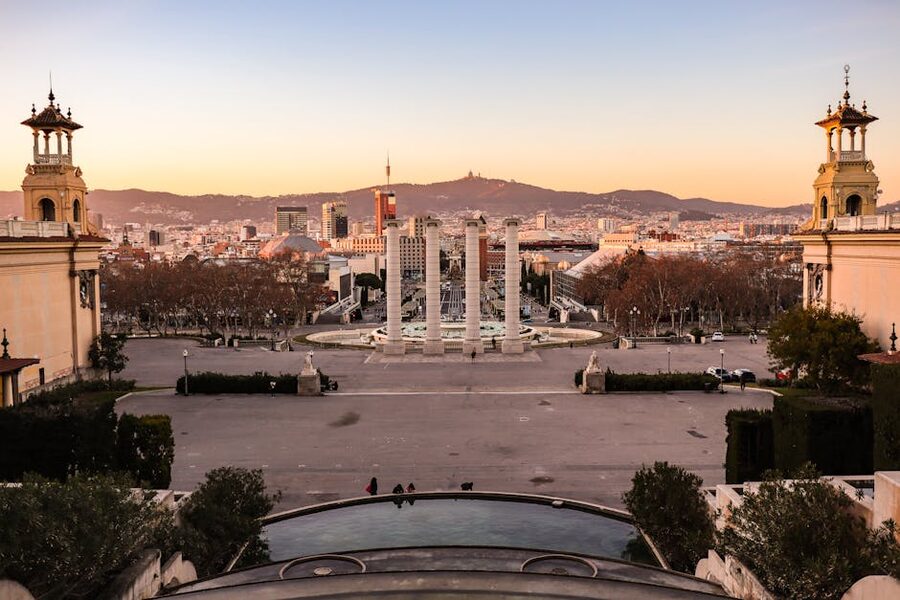
This part matters because Barcelona has a lot of “great views” and they’re not equivalent.
The Bunkers del Carmel (officially Turó de la Rovira) is free, higher than Montjuïc, and a 360-degree panorama. The catch is it’s a 25-minute uphill walk from the nearest metro and the rooftop is bare concrete with no shade. Go if you want the view at no cost and don’t mind the climb.
Park Güell’s terraces give you a tighter, lower-altitude view from the eastern hills. The framing is different: closer to the Eixample but further from the harbour. Our Park Güell guide covers the timed-entry mechanics for the Monumental Zone, where most of the photo-friendly viewpoints actually live.
Tibidabo is higher than both (512 metres versus Montjuïc’s 173) but it’s further from the centre and the journey involves a tram, a funicular, and a bus. The view is better in scale, worse in framing (Sagrada Família is far enough away to look small).
Casa Batlló’s roof, La Pedrera’s roof, Sagrada Família’s spires: all paid, all involve queues, all give you Barcelona-from-the-roofline rather than Barcelona-from-above. Different category. Worth doing in addition to Montjuïc, not instead of. Casa Batlló in particular has the best close-up roof view in the city.
The Telefèric de Montjuïc’s edge is that you get all of the above in a moving frame, with the harbour, the city grid, and the mountains in one composition. No queue at the railing. No “find a gap between strangers’ phones” problem. The window is yours for eight minutes. The Paris equivalents are platform-based rather than cable-based: the Montparnasse Tower for the cleanest panoramic frame and the Arc de Triomphe rooftop for the twelve-avenue radial. Amsterdam’s NEMO Science Museum stacks a free public roof terrace over a Renzo Piano hull, and the Rotterdam harbour cruise gives you the working-port version of the same wide composition from the water.
The other Barcelona cable car
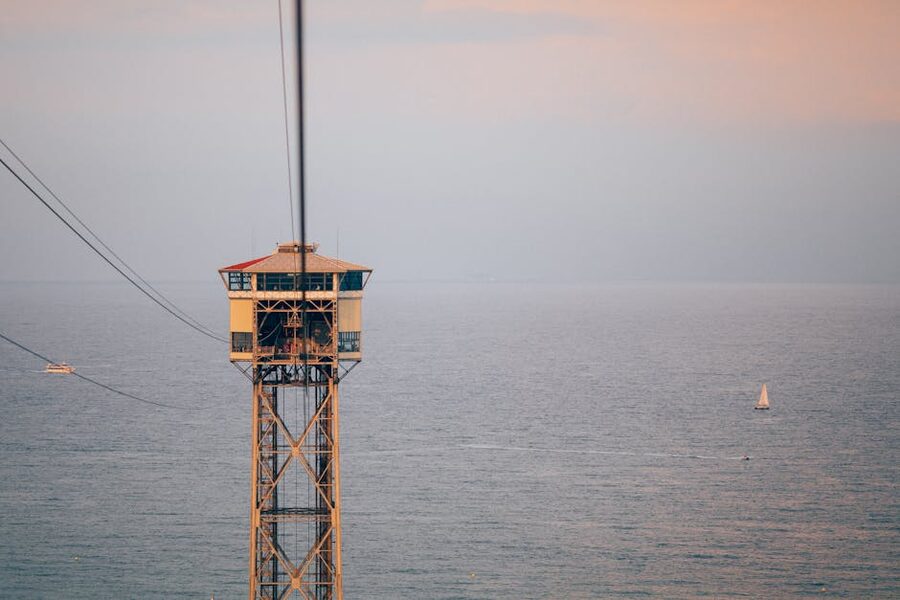
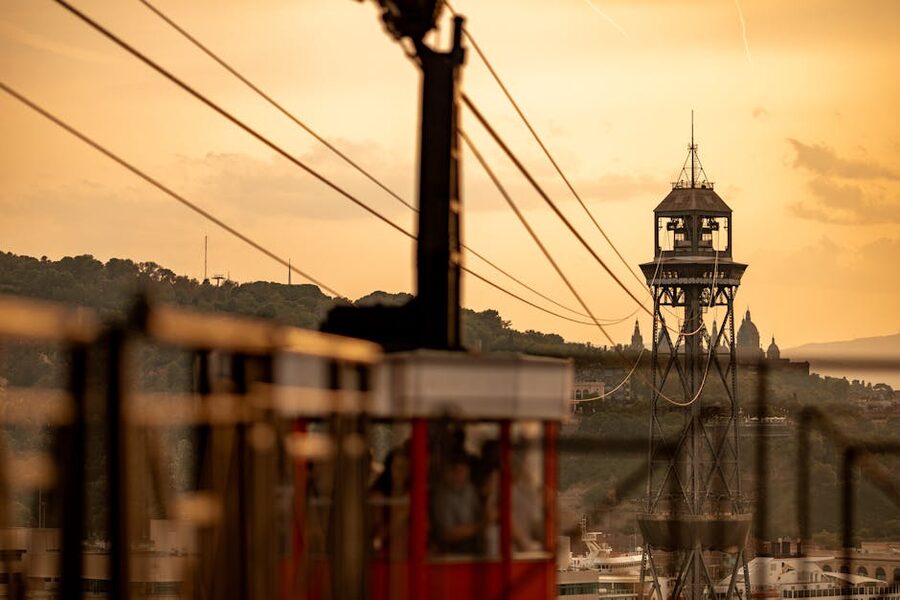
Worth a paragraph because it confuses people. The Teleférico del Puerto (Port Cable Car) is the older red-and-white cable car that runs from Sant Sebastià Tower in Barceloneta, across the harbour to Jaume I Tower, and on up to Miramar. It dates from 1931 and was originally built for the World’s Fair. The cabins are smaller (about 19 passengers), the towers are taller, and the route is much longer than the Telefèric de Montjuïc.
It’s run by a separate private operator, Teleférico de Barcelona S.A., and the ticket is more expensive: €11 one-way, €16.50 roundtrip as of 2026. The queues can be brutal: sometimes a 90-minute wait at peak summer because there’s no online booking system worth the name.
Many visitors do both. The Port Cable Car gives you the harbour-crossing experience, the Telefèric gives you the city panorama. They connect at Miramar (about a 10-minute walk between stations), so if you’re really committed you can ride one across, walk over, and ride the other up to the castle. It’s a full afternoon and your legs will know.
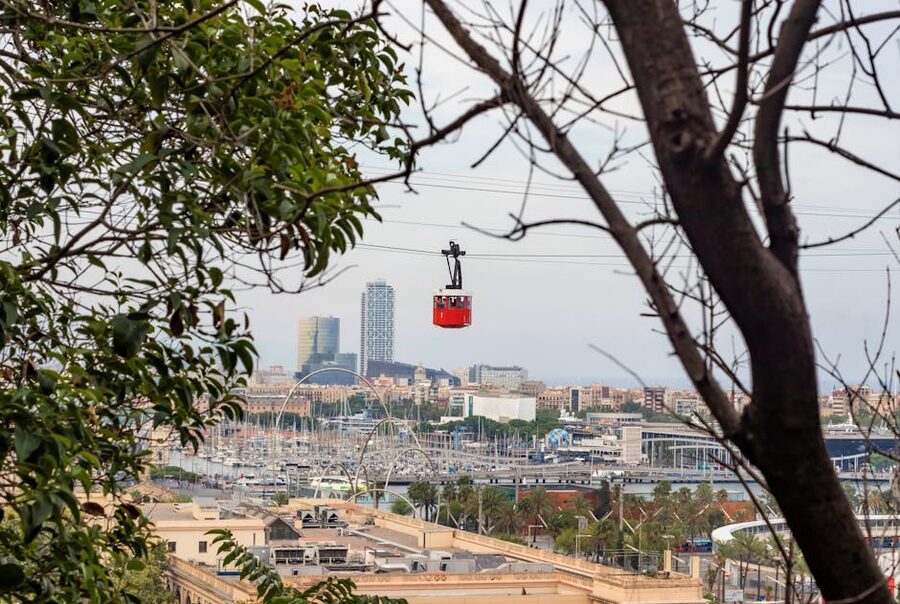
If you have to pick one and it’s your first Barcelona trip, pick the Telefèric de Montjuïc. It’s faster, cheaper, more reliable, and the view is genuinely better because you’re looking at the city from above rather than from the side.
What’s at the bottom of the hill
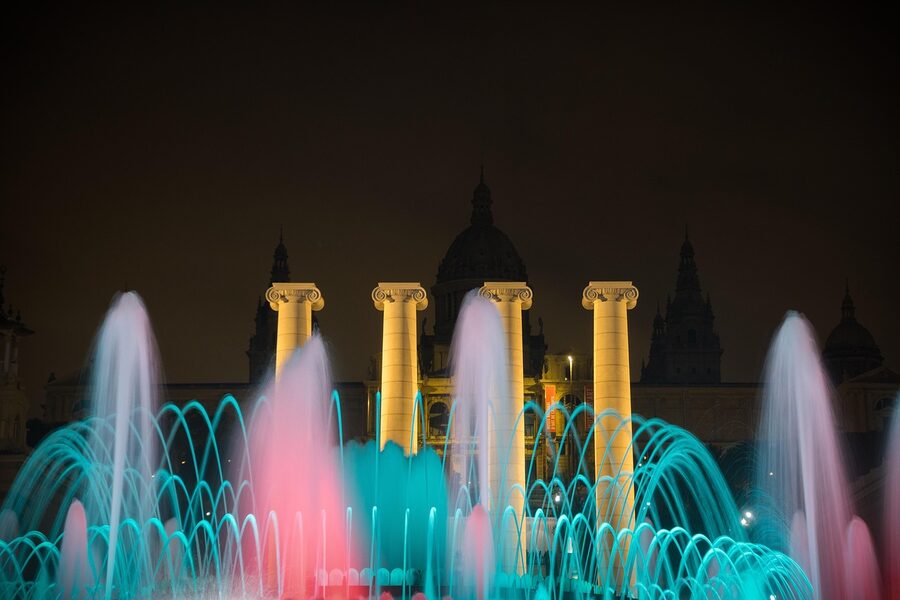
You don’t have to ride the cable car as a one-trick visit. The whole base of Montjuïc is essentially one of Barcelona’s biggest open-air cultural complexes, built up around the 1929 World’s Fair and the 1992 Olympics.
The Magic Fountain (Font Màgica de Montjuïc) sits at the foot of the steps below the National Art Museum. It runs a free music-and-light show four nights a week from spring through autumn, drawing crowds of several thousand. Show schedules vary by season: generally 9pm or 9:30pm starts in summer, 8pm in winter, dark on Mondays and Tuesdays.
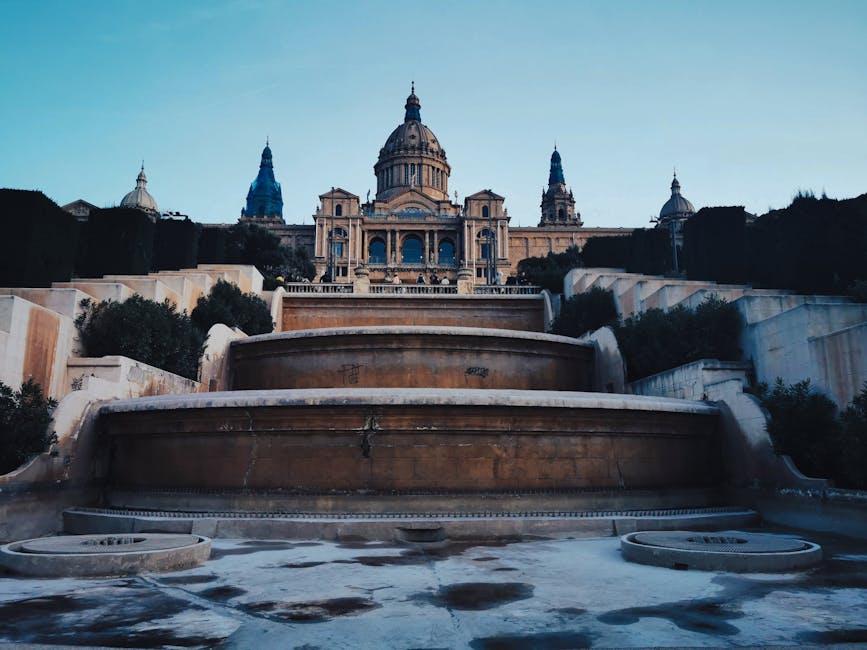
Palau Nacional houses the Museu Nacional d’Art de Catalunya (MNAC), home to the largest collection of Romanesque mural paintings in the world. The frescoes were carefully removed from the walls of Pyrenean churches in the 1920s and reassembled here. Not on the Telefèric route exactly, but a five-minute walk from Plaça d’Espanya, which is where most people end up after the Magic Fountain.
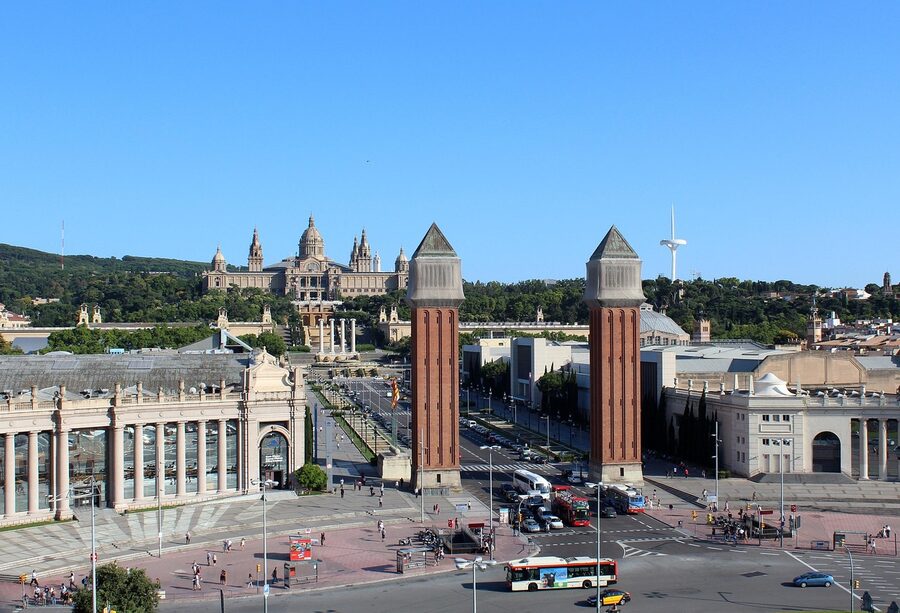
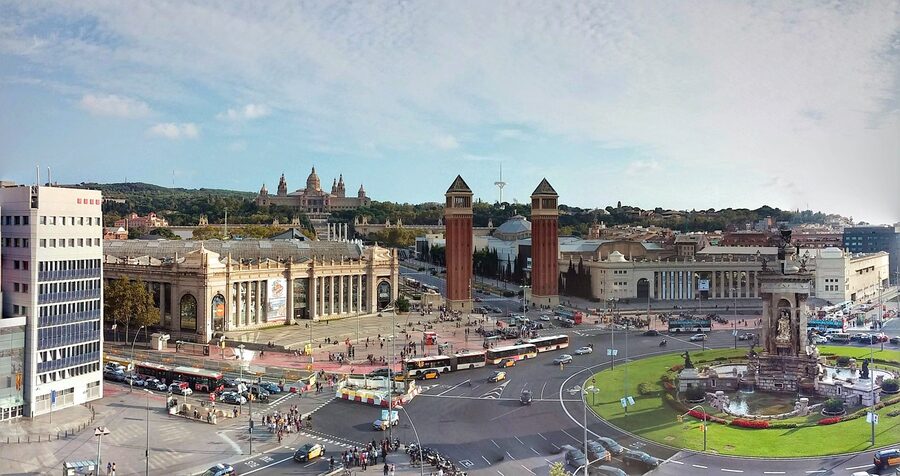
Plaça d’Espanya itself, with its Venetian Towers and the converted bullring shopping centre (Las Arenas) on one side, is the natural arrival or departure point for any Montjuïc plan. The Hola Barcelona Travel Card stop is right here. It’s also where the airport-bus and Bus 150 (the Montjuïc shuttle) pull in.
Practical tips that actually matter
Don’t wear the wrong layers. The cabins are unheated and the wind on the upper hill is sharp even in May. Bring a light jacket if you’re riding outside June–September, even on a warm day.
The cabins have limited cell signal at the apex. Download Google Maps and any audio guide before you board, especially if you’re using your phone for the route map.
Smoking, drinking, pets, and bicycles are not allowed inside the cabins. Folding strollers are fine. The cabins are wheelchair accessible: there’s a level boarding platform and a designated spot inside.
The cabin weight limit is 640 kg, about eight average adults. If you’re a group of six, you’ll usually get your own cabin. If you’re solo or a couple in summer, you’ll share.
The booth at the lower station accepts cash and card. The booth at the upper station (used for one-way returns) sometimes runs out of change in cash if you arrive late afternoon, so bring a card.
Skip the one-way if you can. It’s only available at the booth, not online, and it forces you to stand in the queue you’d otherwise skip. The roundtrip is €5 more and you can use both legs whenever the timing suits.
Combining the cable car with the rest of Barcelona
Most people fold Montjuïc into a half-day. Here’s how I’d actually sequence it depending on what else you’re doing.
If your big sight is Sagrada Família: do the cable car the day before or after, never the same day. Sagrada Família is a sit-down, look-up basilica visit that benefits from a slow morning. The cable car is a moving viewpoint that benefits from a low-haze afternoon. Stack them and you’ll burn out by 3pm.
If your day is Casa Batlló or La Pedrera: Passeig de Gràcia in the morning, then walk down to Plaça de Catalunya, take the metro to Paral·lel, funicular up, cable car. The Gaudí houses close around 8pm; the cable car runs until 9pm in summer. You can sequence both in one day if you’re moving fast.
If you’ve got the Barcelona Hop-on Hop-off bus: the Red Route stops at Plaça d’Espanya and the Magic Fountain, which puts you within walking distance of the funicular. The cable car ticket itself isn’t included on the HOHO, but the bus solves the “how do I get to the base” problem cleanly.
If you’re doing Park Güell the same day: do Park Güell at sunrise (it’s free before 9am with a separate timed pass for the Monumental Zone) and the cable car at sunset. The two viewpoints are the bookends of a single Barcelona day, and the lighting is different enough at each that they don’t repeat themselves.
If you only have an hour
This is the version for people on a tight Barcelona day or a cruise stop.
Metro to Paral·lel. Funicular up. Cable car roundtrip. Don’t get off at Mirador on the way up; get off at the castle. Walk to the east rampart. Look. Take three photos. Don’t pay to enter the castle. Walk back to the upper station. Cable car down, with a hop-off at Mirador this time for the harbour-side view. Funicular down. Metro out. Total time including the metro: about 75 minutes. Cost: €19 plus the metro fare.
That version misses the castle, the Magic Fountain, the museums, and the gardens. But it gets you the view, which is the actual product, in the time you have. If you’re in Barcelona for two days, give it a half-day instead and do it properly.
How it compares to other European cable car rides
For context, since people often ask: the Telefèric de Montjuïc is a city cable car, not a mountain one. If you’ve ridden the Bernina Express route through the Swiss Alps, you’ll find Montjuïc tame by comparison: a city panorama, not a glacier crossing. If you’ve ridden the cable car up Mt Vesuvius near Naples or the Funivia dell’Etna on Sicily, those are volcano-summit experiences with a totally different scale. The serious mountain-cable-car cousin is the Aiguille du Midi cable car at Chamonix, which lifts you to 3,842 metres and a glacier balcony in twenty minutes.
What Montjuïc gives you is what most mountain cable cars don’t: a viewpoint of the city you’re already in, in eight minutes, for €17. That’s a different product. Better in some ways (no full-day commitment, no transit logistics out to a mountain) and worse in others. Don’t compare them. Use Montjuïc for what it does well.
A short history of the route
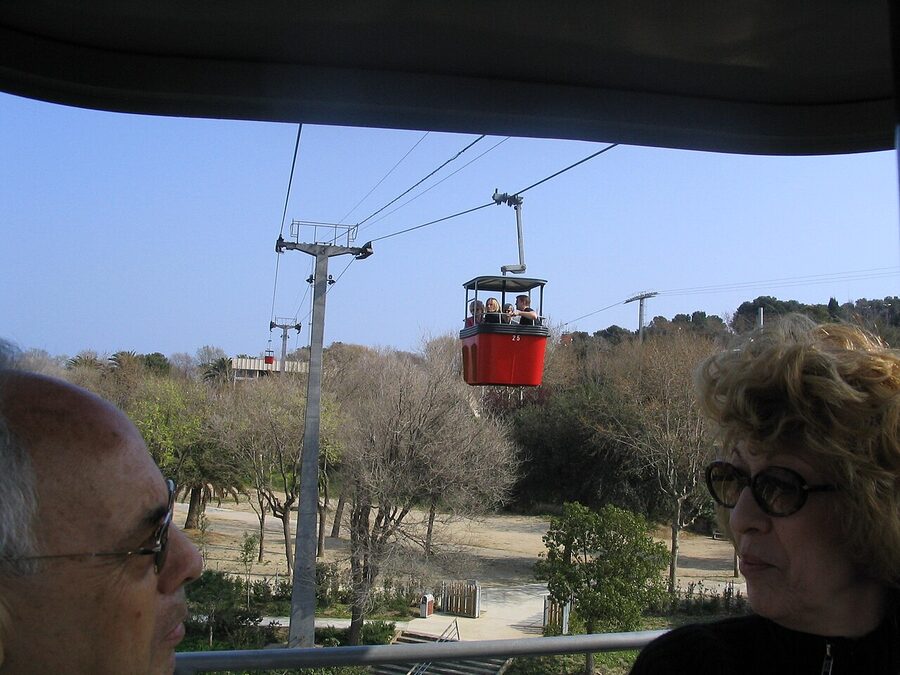
The current Telefèric de Montjuïc opened in 1970, as part of a cluster of mountain-tourism projects the Franco-era city planners commissioned for the working-class districts of southern Barcelona. The original cabins were small: six passengers each, painted blue. They ran for thirty-seven years.
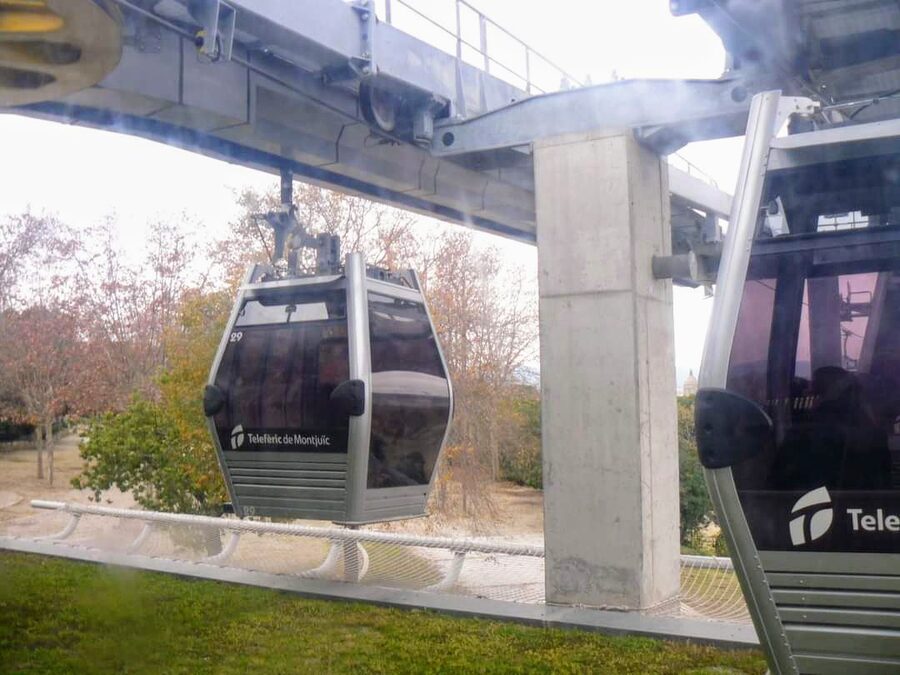
In 2007 the whole system was rebuilt. The towers were strengthened, the cable replaced, the stations redesigned, and the modern eight-passenger yellow cabins came in. The whole project cost about €11 million and was completed for the Olympic Games anniversary that year. The route, the angles, and the framing are essentially the same as 1970, but the experience inside the cabin is unrecognisable.
The original 1929 World’s Fair cable car (a different system entirely) actually ran from a different starting point and was decommissioned decades earlier. Photos of it survive in the city archives if you go looking. It’s not the same as the modern Telefèric, but it’s part of why Montjuïc has been associated with cable-car rides in the city’s imagination for nearly a century.
Common mistakes
Buying castle entry on the cable car ticket. They’re sold separately. The cable car runs to the castle gate, but you pay €12 more to actually go in.
Showing up at the wrong cable car station. The Telefèric de Montjuïc starts at Avinguda Miramar, on the inland side of the hill. The Port Cable Car (the older one) starts at Sant Sebastià Tower in Barceloneta. Easy to confuse on a map.
Not checking funicular status. When the funicular is closed for maintenance (which happens for weeks at a time) there’s no easy walking route to the cable car base. You’ll need a bus or taxi. The cable car operator’s website doesn’t always flag this.
Riding mid-afternoon in summer. The booth queue is at its worst between 1pm and 4pm in July and August. Either go early (10–11am) or late (last hour before close).
Not booking online. The 10% online discount is small but real, and the bigger win is skipping the booth queue. If your dates are firm, book ahead.
Treating it as transit instead of a viewpoint. Some visitors use the cable car as a way to “get up” to the castle, which works, but they miss the point. The ride is the experience. Don’t text on it. Don’t stand against the back wall. Stand at the window. Look.
What to do after
If the cable car’s been your morning, the rest of the hill is right there. Walk down through the gardens (the Jardins de Mossèn Cinto Verdaguer and the Jardí Botànic both flank the route) and you’ll end up at Plaça d’Espanya in about forty minutes on foot, with the Magic Fountain steps and MNAC’s Romanesque collection along the way. It’s a slow walk, mostly downhill, mostly through trees, and it’s the version of Montjuïc most rushed visitors miss entirely.
From Plaça d’Espanya, the metro gets you back into the centre fast. If you’ve still got energy, it’s a fifteen-minute metro ride to Passeig de Gràcia for a Gaudí evening. Start with Casa Batlló if you’ve prebooked, or just walk the Quadrat d’Or and have a drink. If your legs are done, the Barcelona Aquarium at Port Vell does evening sessions and is twenty minutes by metro.
Or, if you’ve got time and the wind is right, go back. The cable car looks completely different at sunset. The haze burns off, the harbour catches the gold light, and the cabin’s south-facing window becomes the best seat in Barcelona. Same €17 ticket. Different city.
Pair the Montjuïc cable car with Sagrada Família the day before for the city’s most-recognised landmark seen from above and inside. Park Güell works the day after: Gaudí’s other terraced viewpoint, lower and looking the other way. If you’re piecing together a longer Spain trip, Montserrat is the day-trip cousin (different mountain, different cable car, a full hour out of town). And if you wind up in Italy, Vesuvius from Pompeii is the volcano-summit equivalent: the cable-car-as-viewpoint logic is the same, the scale is wildly different.