
Park Güell was supposed to be a 60-house gated community for Barcelona’s wealthy. Two of those houses got built. One was Antoni Gaudí’s. The other was Eusebi Güell’s. The other 58 plots never sold, the project went bankrupt, and the Güell family handed the whole failed real-estate development over to the city in 1922.
The mosaic salamander, the wave bench, the Hypostyle Hall: every iconic photo you’ve seen of Park Güell is the marketing showroom for a luxury subdivision that nobody bought into. The “park” was never meant to be a park.
In a hurry: my three picks for Park Güell
- Cheapest entry: Park Güell Admission Ticket ($25). The basic timed entry, same price as the official site, no faffing with the Spanish-language portal.
- Best with a guide: Skip-the-Line Guided Tour ($31). Seventy-five minutes with a Barcelona-born guide who tells you which bits Gaudí actually designed and which were finished after he died.
- Adds the Gaudí House Museum: Park Güell + Gaudí House Museum ($33). For the eight extra euros you get inside the only one of the 60 houses Gaudí actually lived in.
Why Park Güell exists at all
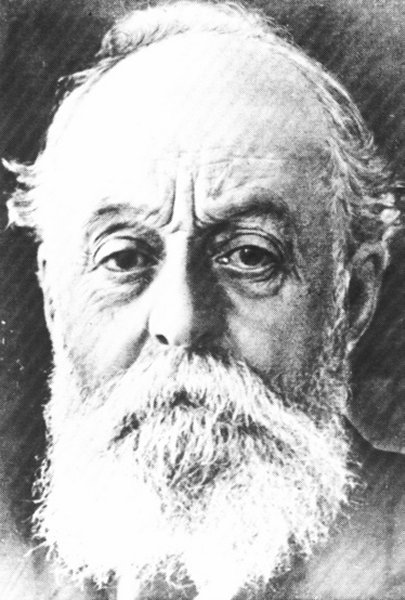
Eusebi Güell was Gaudí’s patron. A textile-industry millionaire, deeply religious, obsessed with English garden cities. In 1900 he bought a chunk of bare hillside on the slope of what was then called Muntanya Pelada (Bald Mountain) and hired Gaudí to lay out a private community of 60 houses for Barcelona’s wealthy industrial class.
The plan was specific. Tram-served. Walled and gated. English-style detached houses on terraced plots, with private parks, a chapel, a market square, and a triangular plaza where residents could gather for festivals. Each plot had a 60-year deed restriction on what you could build.
The project was a complete commercial failure. By 1914 only two plots had sold, and only one of those two buyers was even a stranger. Gaudí himself bought one and moved his family in. Güell built the other. The remaining 58 plots sat empty for the next two decades while Barcelona’s industrial elite quietly looked the other way.
Why didn’t it sell? Three reasons people argue about. The location was too far from the city. The tram line that was supposed to serve it never came. The deed restrictions were too tight. And the design was too eccentric for the conservative bourgeoisie Güell was pitching to. Gaudí was building biological cathedrals on the hillside and Barcelona’s wealthy families wanted Parisian apartment blocks.
From private estate to city park
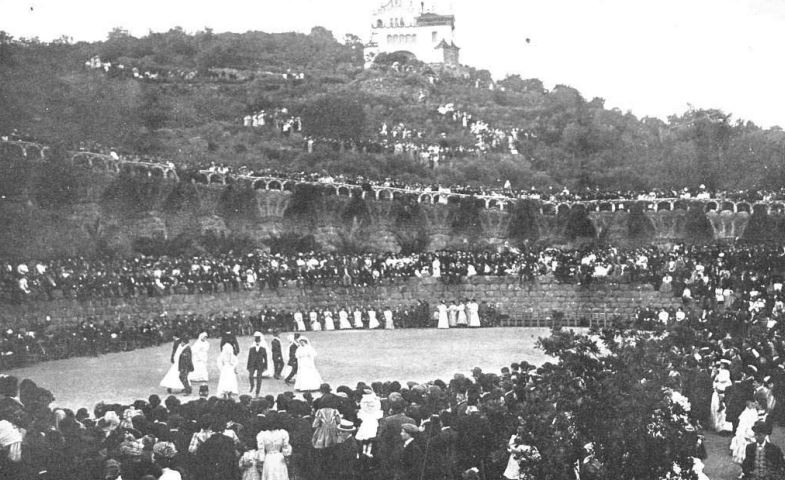
Eusebi Güell died in 1918. His heirs had no interest in restarting the doomed real-estate venture, so in 1922 they sold the property to the Barcelona city council, which turned the failed subdivision into a public park the next year. That’s the moment Park Güell went from private fiasco to civic landmark.
It opened as a free public park and stayed free for ninety years. Barcelona only started charging for entry in 2013, and only for the central monumental zone: the staircase, the Hypostyle Hall, the wave-bench plaza, and the entrance pavilions. The rest of the 17-hectare park is still free.
UNESCO listed Park Güell as a World Heritage site in 1984, bundled with six other Gaudí works under the title “Works of Antoni Gaudí”. The listing recognised it for what it actually was: an experiment in modernist architecture that had been preserved by accident, kept intact by the very commercial failure that doomed it.
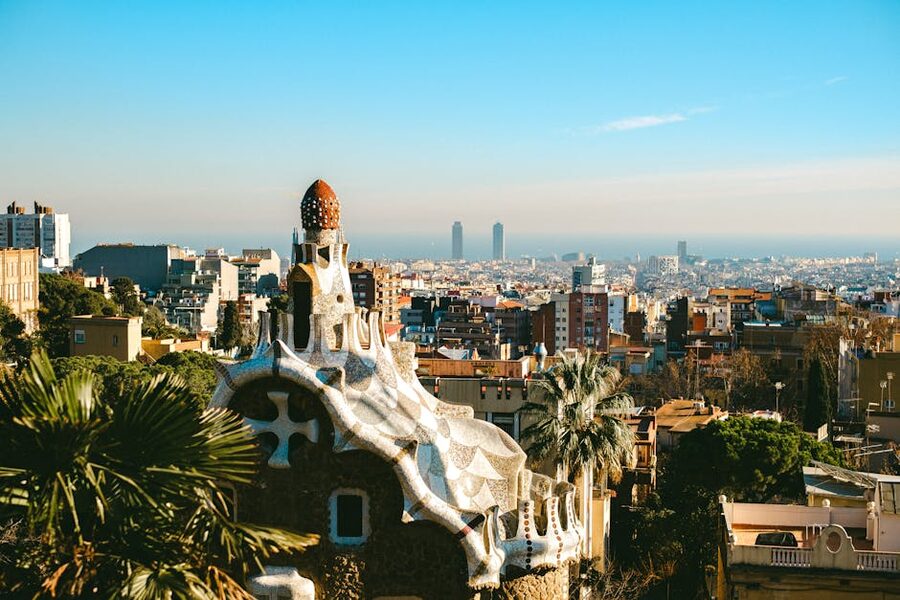
What you actually see inside (the monumental zone)
The ticketed area is a roughly hourglass-shaped circuit. You enter at one of three gates, walk down the same monumental staircase that was meant to lead residents to a covered market, and exit by the opposite pavilion. It’s about a 90-minute visit at a relaxed pace. Less if you don’t queue for the salamander photo.
The entrance pavilions:
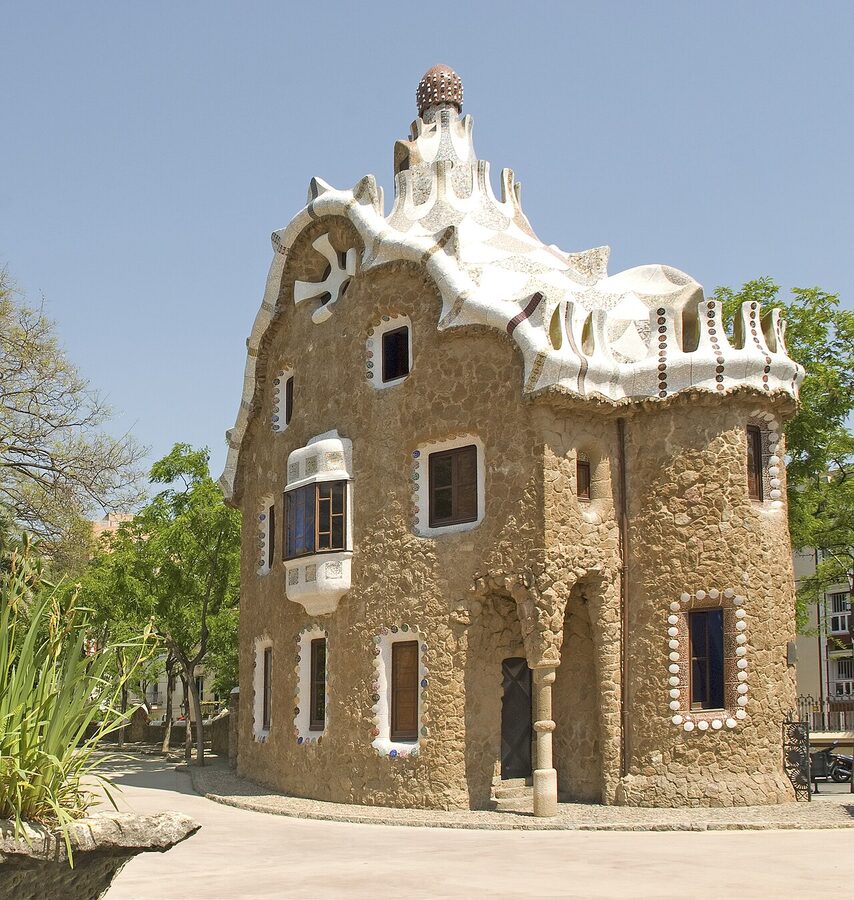
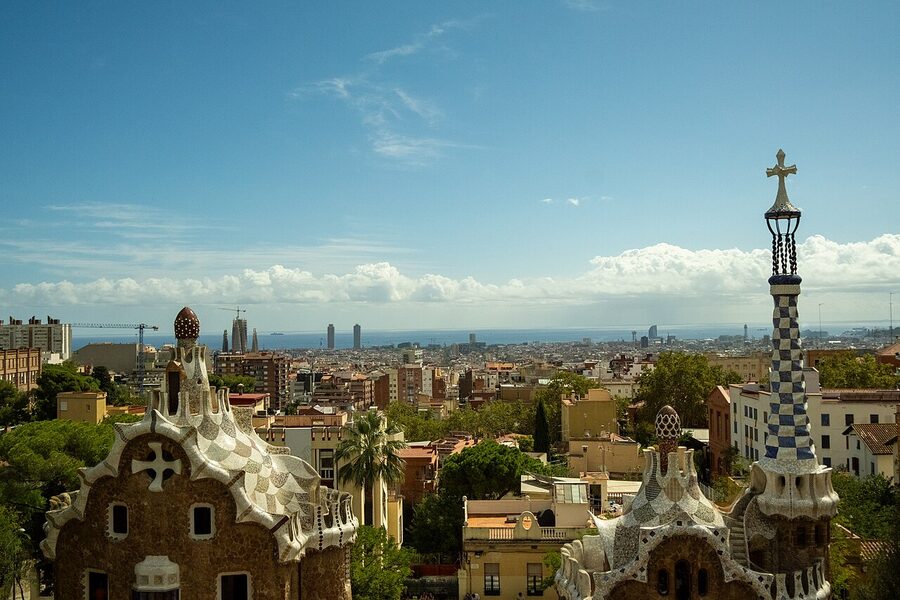
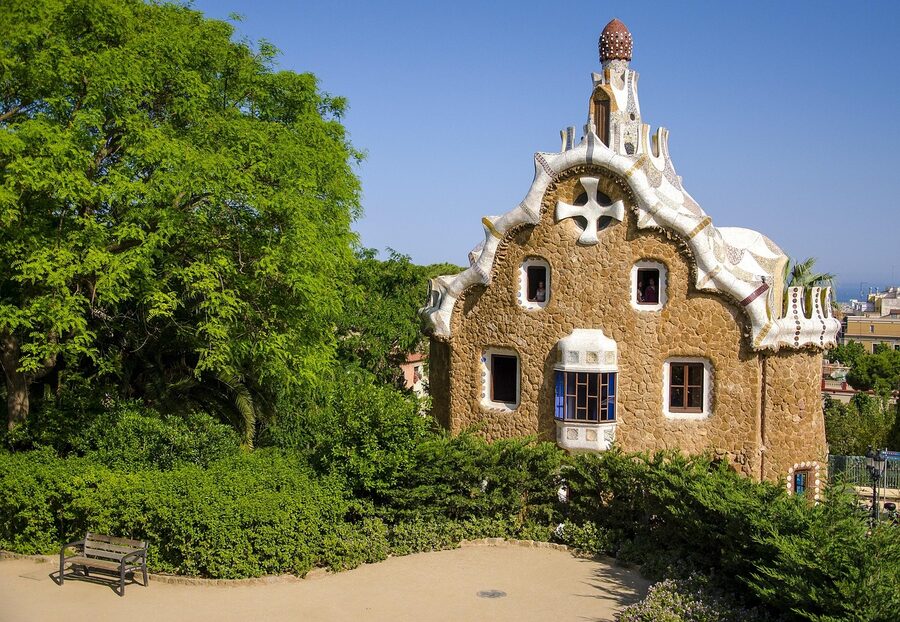
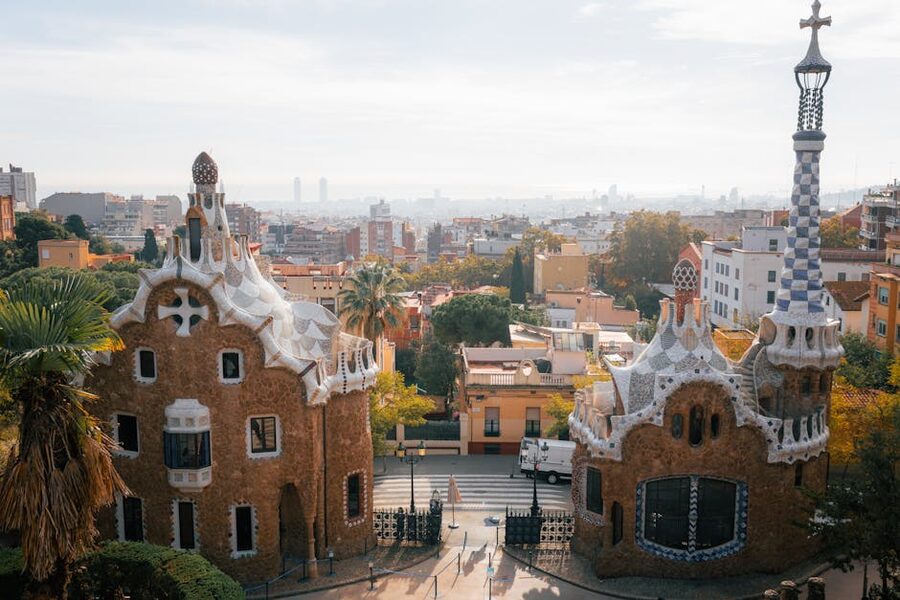
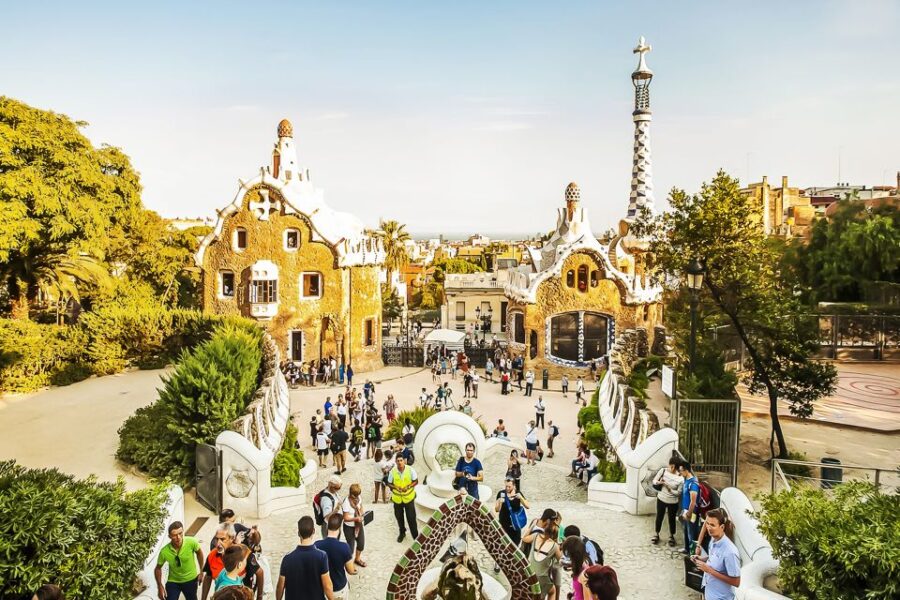
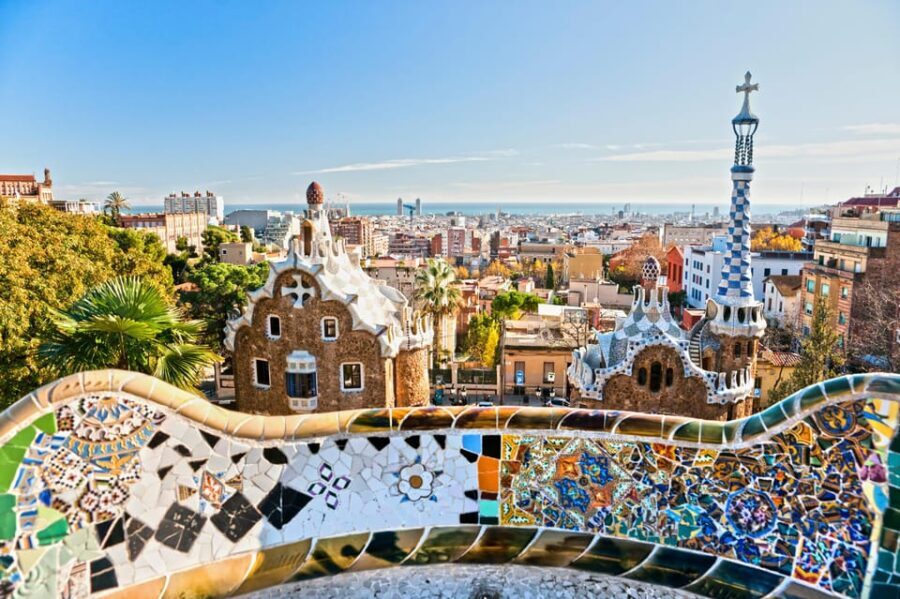
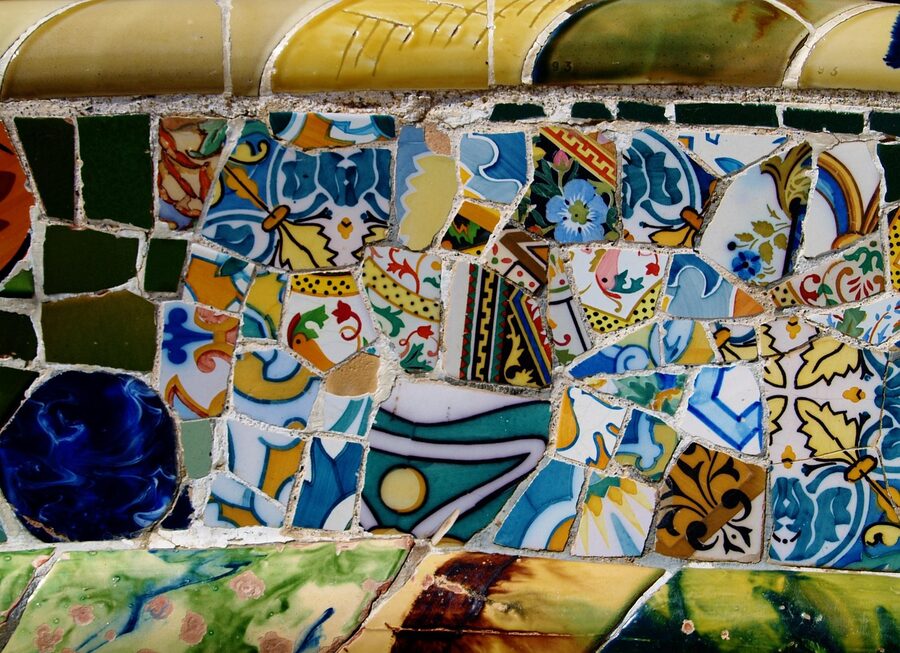
The two pavilions at the bottom gate were practical buildings for a private community. Porter’s lodge on the right, administrative office on the left. The roofs are dressed in trencadís (Gaudí’s signature broken-tile mosaic) and the towers are topped with gingerbread-house finials that look like they were squeezed from a piping bag. They’re also the only two buildings on the estate that Gaudí finished completely.
The dragon staircase and salamander:
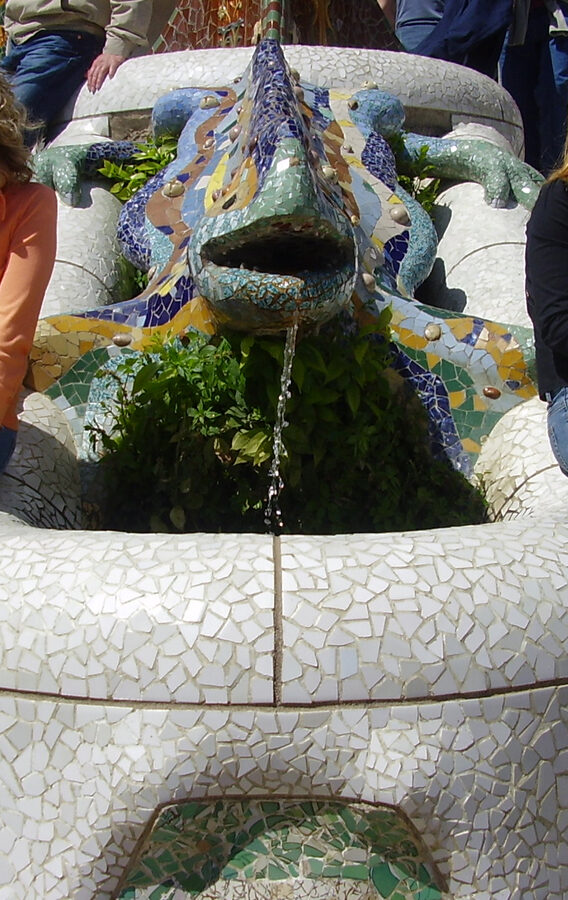
The mosaic salamander on the staircase is Park Güell’s logo, the souvenir-shop image, the photo everybody takes. Locals call it “el drac” (the dragon), which is technically wrong (it’s a salamander or a chameleon depending on which Gaudí scholar you ask) but the name has stuck.
It’s also smaller than you’d expect. About 2.4 metres long. Almost everyone who reaches it stops, takes the photo, takes the queueing-up photo, and creates the queue behind them. There’s no way around this. Buy your ticket for the first entry slot of the day if the salamander matters to you.
The Hypostyle Hall:
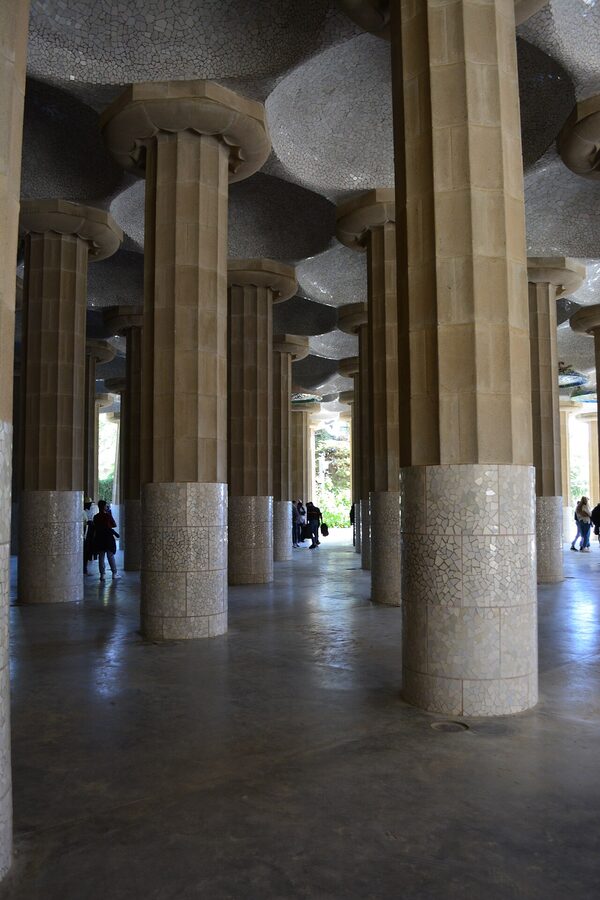
This is the part most casual visitors blow past, and it’s the most architecturally interesting space in the whole park. Eighty-six Doric columns, all subtly tilted inward to bear the load of the plaza above. Fourteen of them are missing on purpose. Gaudí pulled them out to leave room for civic gatherings. The ceiling between the columns is a quilt of mosaicked rosettes, four of them designed by Gaudí’s collaborator Josep Maria Jujol with broken plates and bottle bottoms embedded in plaster.
The hall was meant to be the covered market for the gated community. It now functions as a corridor, a busker stage, and an acoustic chamber. Stand in the middle and clap once. The echo bounces around the columns for several seconds.
The Nature Square and serpentine bench:
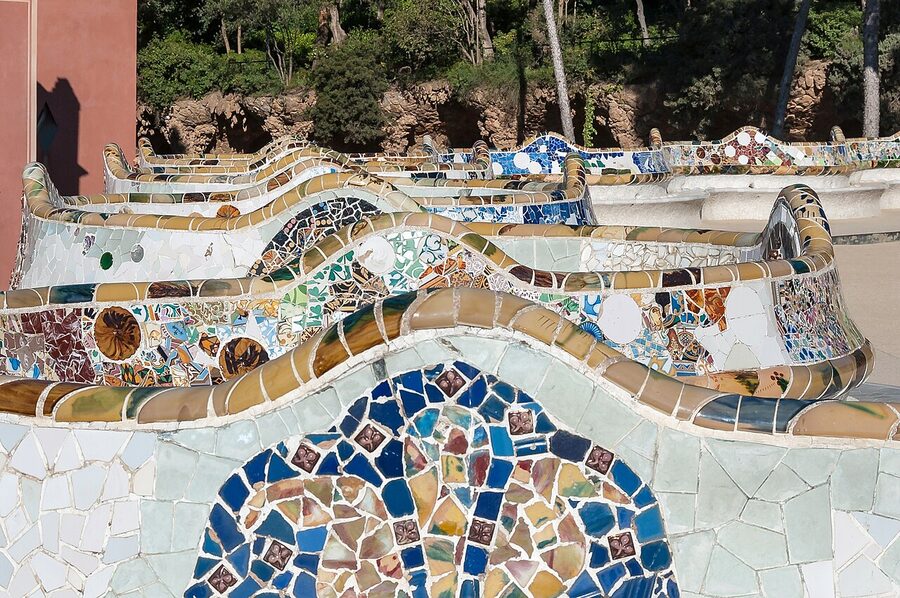
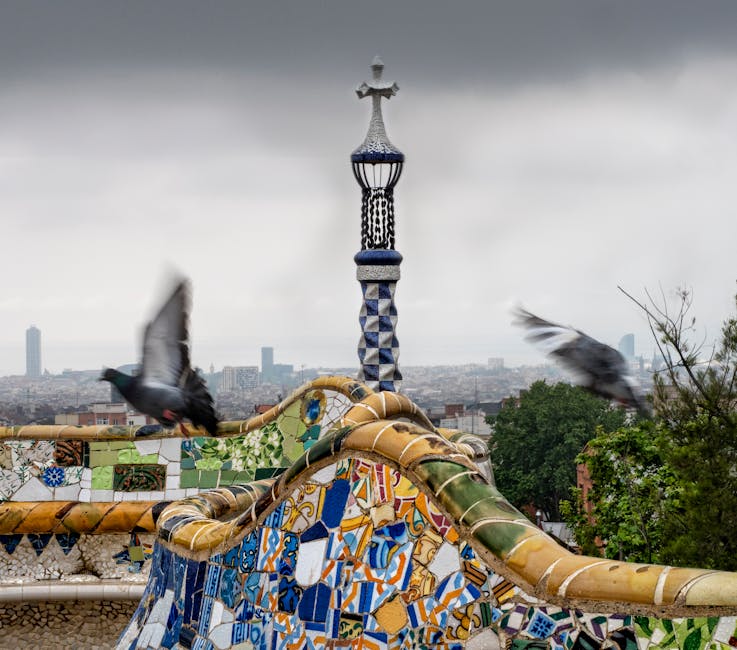
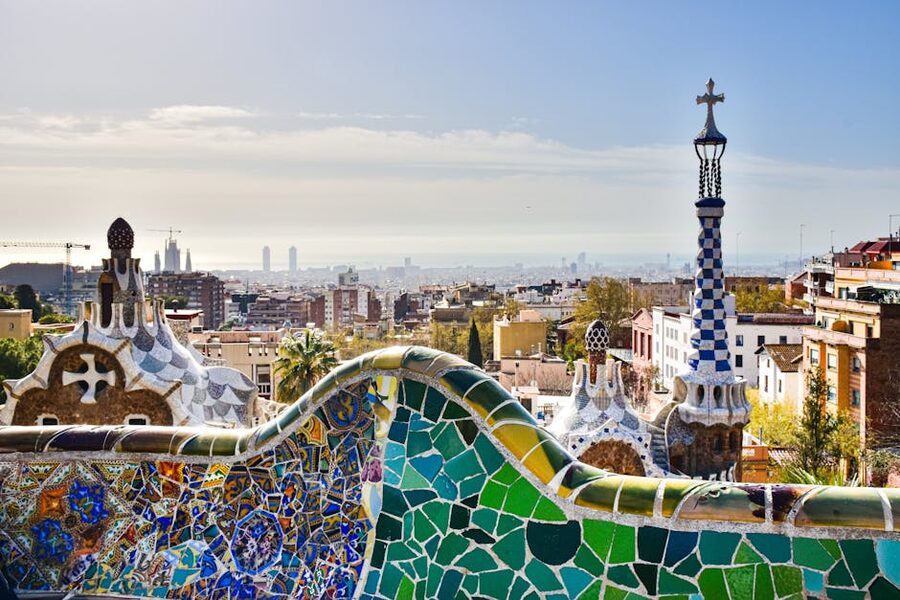
Climb the steps from the Hypostyle Hall and you arrive at what was supposed to be the central public square of the gated community: Plaça de la Natura, or the Greek Theatre as some maps still call it. It’s the postcard view. A wide terrace ringed by an undulating mosaic bench, with the city of Barcelona and the Mediterranean behind it.
The bench follows the perimeter for about 110 metres. Sit down on it for a minute. The shape of the seat-back is curved to fit the human spine. Gaudí used a workman as a body-mould to design it. You don’t notice until you’ve been sitting for thirty seconds and your back stops hurting.
The viaducts and pathways:
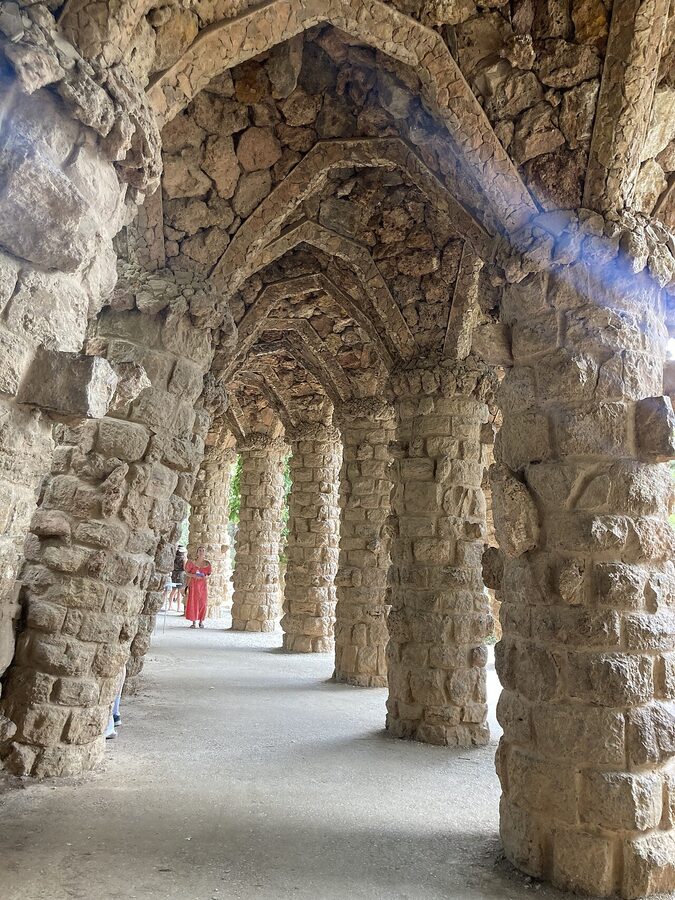
Three viaducts thread between the terraced plots, designed so residents and their carriages could move between properties without disturbing the gardens. The columns are deliberately rough, made from unfaced local stone Gaudí had quarried on-site. They lean inwards in a way that looks unstable until you realise they’re following the line of the actual force vectors.
This is where Gaudí was thinking out loud. The hyperboloid columns inside the Sagrada Familia nave are direct descendants of these viaduct supports. He built Park Güell as the workshop where he tested the engineering ideas he’d later use in his cathedral.
The Gaudí House Museum:
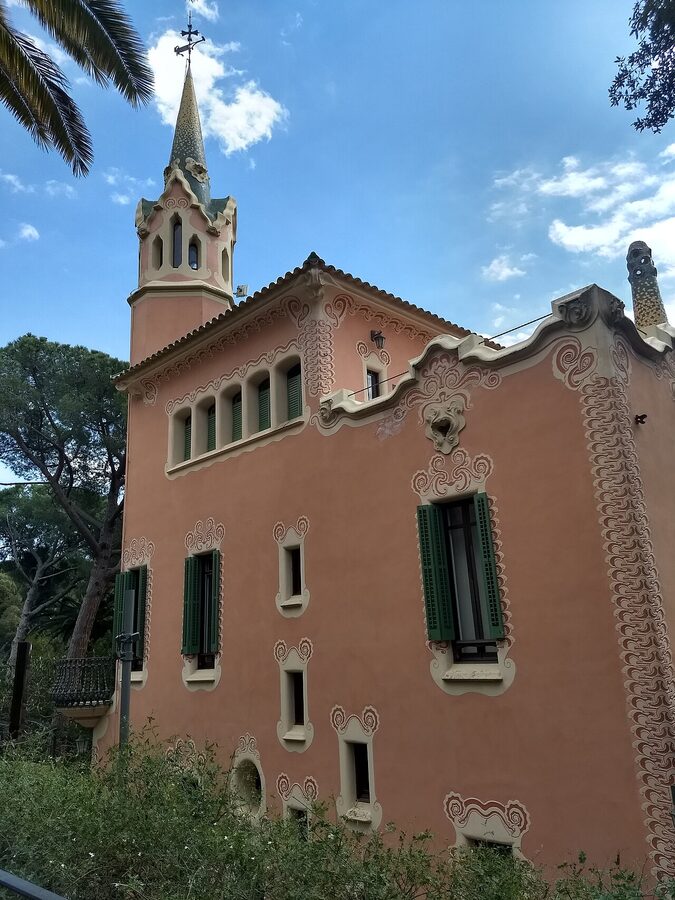
The pink house with the spire is where Gaudí lived from 1906 until 1925, when he moved into the workshop on the Sagrada Familia site to oversee construction. He didn’t design it himself (his collaborator Francesc Berenguer drew the plans) but Gaudí lived there with his father and his niece for nineteen years, and most of his furniture is still inside.
The museum entrance is separate from the main park ticket. If you’ve travelled this far up Carmel Hill, the eight euros to walk through Gaudí’s actual bedroom and see the rocking chair he designed for himself is hard to skip. Get the combined ticket if you know in advance.
Tickets, prices, and the timed-entry system
The monumental zone runs on timed entry. You buy a 30-minute slot, and you have to scan in within that window. Show up at 11:45 for an 11:30 slot and you’re in trouble. Once you’re in, you can stay as long as you want, but you can’t re-enter once you leave.
The basic ticket from the official site is €18. The $25 GetYourGuide version is the same price (currency-converted) and arrives by email instantly, which makes the morning-of routine easier. There’s no skip-the-line privilege on the basic ticket. There isn’t really a queue if you turn up with a valid timed entry.
If you’re staying in central Barcelona and treating Park Güell as one of three or four big-ticket Gaudí stops, look at how the city pass options stack up against single-attraction tickets. The pass calculus here works the same way as it does in Italy, where the Rome city pass only beats individual entries if you’re hitting four or more headline sites in 48 hours. Park Güell on its own is cheaper as a single ticket. Bundle it with Sagrada Familia, Casa Batlló, and Casa Vicens and the maths starts to flip.
How to actually get there
Park Güell is on Carmel Hill, well north of the Eixample. Three sensible ways to get there from central Barcelona:
- Metro + walk: Green Line (L3) to Lesseps or Vallcarca. From Lesseps it’s a 15 to 20-minute uphill walk. From Vallcarca there are escalators on Avinguda de l’Hospital Militar that cut the climb dramatically. This is the better option if you’ve got knees that complain.
- Bus 24 from Plaça Catalunya: Drops you about 200 metres from the side entrance. Easy and slow, especially in the morning when the road clogs up with tour buses.
- Bus Güell shuttle from Alfons X metro: An official shuttle that runs on the busiest entry slots. €1.50 with the city travel card. Worth knowing about if you’re rolling a stroller.
The Barcelona hop-on hop-off bus stops at Park Güell on the Blue Line, which is genuinely useful for this attraction specifically. The bus saves the uphill walk and drops you at the top entrance. Whether the bus is worth it for the rest of Barcelona is another argument; for Park Güell alone it’s a fair tool.
Don’t bother with the official Park Güell car park. Carmel Hill’s roads are residential, the spaces are reserved for residents, and the public garages charge tourist rates. Take public transport.
When to go (and when not to)
The park opens at 9:30am and the first entry slot is the only one I’d consider booking from May to September. By 11am the place is shoulder-to-shoulder, and the salamander photo becomes a 20-minute exercise in waiting your turn. The light is also better at 9:30 than at noon. The trencadís mosaics catch the low sun beautifully and the colours read warmer.
The other useful slot is the last one of the day, which shifts seasonally between 5:30pm and 7:30pm. The evening light is golden, the day-trippers have left, and the Mediterranean view from the Nature Square goes from sharp to hazy as the sun drops.
Avoid Sundays if you can. Sunday morning is when Barcelona locals come up with kids and the entry slots sell out a week in advance. Tuesday or Wednesday morning is the cleanest combination of low crowds and full opening hours.
The park stays open on most public holidays, but Christmas Day and New Year’s Day shut it down. January and February are by far the quietest months. You can usually walk up and buy a same-day ticket at the gate, which isn’t an option at any other time of year.
How long to spend, and what’s around it
Two hours covers the monumental zone at a relaxed pace. Three hours if you add the Gaudí House Museum and walk up to the three crosses (the Turó de les Tres Creus) at the top of the hill, which is free and outside the ticketed area but gives you the best 360° view in Barcelona. The crosses themselves are nothing special. The view is the point. Park Güell sits in the same ledger as Monet’s gardens at Giverny: a place an artist designed for a private vision, opened to the public after the original purpose collapsed.
Pair Park Güell with another Gaudí stop on the same day if you’ve got the energy. The natural pairing is Sagrada Familia in the morning and Park Güell in the late afternoon, or the other way round. Both have timed entry, both are at opposite ends of the metro Green Line, and the light is better at Park Güell after 5pm anyway.
If you’re chasing the full Gaudí trio, Casa Batlló on Passeig de Gràcia can fit between the two as a midday stop. That’s a brutal day. Three Gaudí sites is a lot of architecture for one human. But it’s doable and a lot of visitors do it. Park Güell rewards the same half-day-out-of-the-city instinct that pulls Amsterdam visitors to Zaanse Schans: a curated landscape that started as a working place and became a postcard.
Three Park Güell tickets worth booking
I’ve been through dozens of Park Güell options on the booking platforms. Most are the same basic timed entry resold by different middlemen. Three are genuinely worth your money for different reasons.
1. Park Güell Admission Ticket: $25
This is the right pick if you’re confident navigating the park yourself and just want to get in without faffing with the official Spanish-language portal. Our full review covers the cancellation terms and the wallet-pass workflow. The flagship cheapest option, and the one most visitors actually need.
2. Skip-the-Line Guided Tour: $31

Worth the small upgrade if you’ve got a real interest in modernist architecture or you’ve already seen our full review of this guided option. A native Barcelonan guide separates Gaudí’s actual work from the parts his collaborator Jujol designed, and explains the failed-subdivision history in a way the audio guide doesn’t. Best value of the three for first-time visitors.
3. Park Güell + Gaudí House Museum: $33
Pick this one if you care about Gaudí the man as much as Gaudí the architect, and read our review of the combined ticket for what’s actually on display inside the house. The eight-euro premium over the basic is hard to beat if you’re walking past the front door anyway. Skip if you’re tight on time and just want the salamander photo.
What to know before you go
A few things that aren’t obvious from the booking page:
- Your ticket is for a 30-minute window, not a 30-minute visit. You enter inside the window and stay as long as you want. Most visitors don’t realise this and rush through.
- Re-entry isn’t allowed. Once you leave the monumental zone you can’t come back. Eat before you go in, or save lunch for when you’re done.
- The free zone is bigger than the paid zone. The 17-hectare park around the central monument area is free and worth wandering. The viewpoint at the three crosses is the best in Barcelona.
- Cash isn’t a thing here. The on-site ticket office has been closed for years. Buy online or use the kiosks at the gate, which only take cards.
- Wear shoes that can grip stone. Carmel Hill’s pathways are steep and the stone gets slippery after rain. The viaducts especially.
- Bring water in summer. There are vending machines but no fountains. Barcelona’s heat in July and August is no joke and the park has limited shade outside the Hypostyle Hall.
- The toilets are at the start. Use them on the way in. There’s nothing in the upper part of the park.
Where Park Güell sits in the bigger Barcelona picture
Of all Gaudí’s projects in Barcelona, Park Güell is the one where his thinking is most visible, and the most accidentally preserved. The Sagrada Familia is still being finished, so what you see is partly Gaudí and partly the engineers who came after him. Casa Batlló is one polished townhouse on a chic shopping street, beautifully restored but heavily polished. La Pedrera is similar. Park Güell is the one site where you walk through Gaudí’s failed dream as he left it in 1914: a half-finished gated community that Barcelona accidentally inherited and turned into a public park because it had nothing better to do with the land. The closest cross-border parallels are the formal gardens of Versailles (royal vision opened up after the monarchy fell) and the Keukenhof gardens outside Amsterdam, where a working flower estate was reframed as a public spectacle.
If you’re spending three or four days in Barcelona and you only see one Gaudí site, see Sagrada Familia. If you’ve got time for two, add Park Güell. The contrast between the cathedral he died working on and the failed-development hilltop where he tested every engineering idea is the whole story of his career in two stops. The Barcelona hop-on bus stitches them together usefully if you don’t want to mess with the metro twice.
And if you’ve only got an afternoon? Skip the salamander selfie, walk straight up to the Nature Square, sit on the wave bench, and watch the Mediterranean for half an hour. That’s the best version of this site. The mosaics will still be here in fifty years. The view of Barcelona from a hilltop where 58 millionaires were supposed to live, and never did, is the rarer thing.