
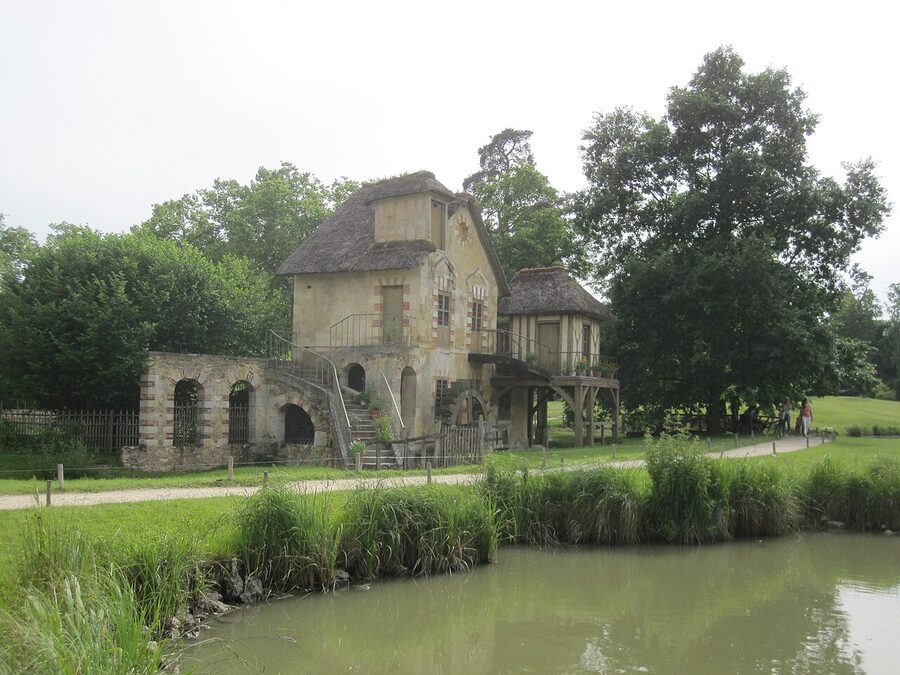
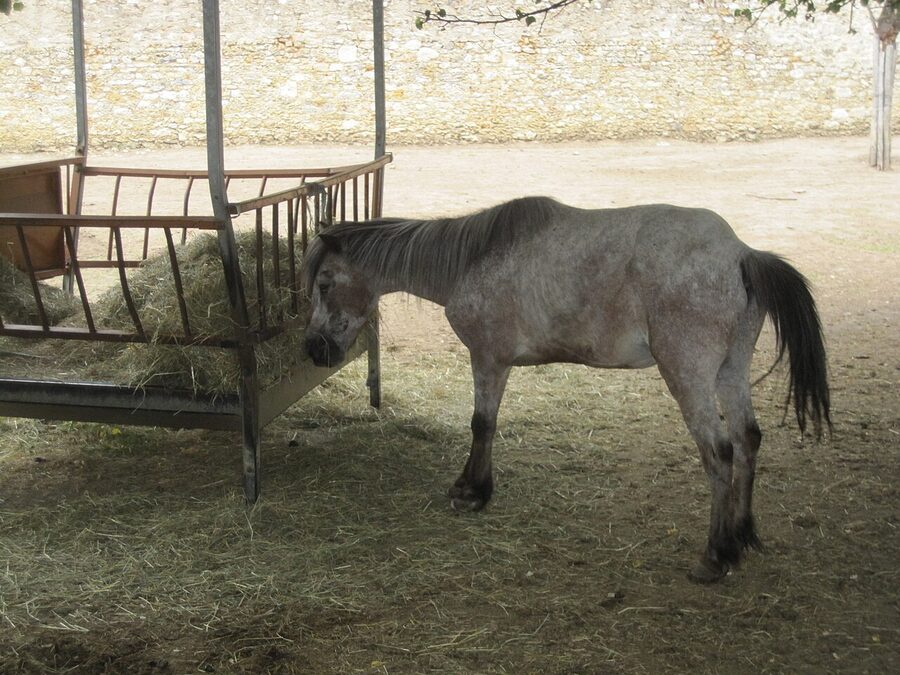
The chicken did not move when I walked past. She was sitting on a low stone wall outside a thatched cottage, in a working farmyard, in the middle of one of the most expensive royal estates in Europe. Two ponies grazed thirty metres away. A dovecote leaned slightly to one side. This is the Hameau de la Reine, the queen’s village, and almost everyone who comes to Versailles never sees it.
That’s the real mistake at Versailles. The estate is 800 hectares, the palace alone has 2,300 rooms, and the standard day trip from Paris gives you four hours to see roughly five percent of it. If you do what the tour buses do, you queue ninety minutes for the Hall of Mirrors, you do the State Apartments in a herd of eight hundred people, and you eat lunch in a coach park beside Trianon. You will have travelled from Paris and back to see the same set piece every other tourist saw. This article is about the other day. The one that starts at Trianon, ends in the King’s Apartments, and treats the Palace as something you walk through after lunch instead of the thing you fight to get into at ten in the morning.
In a Hurry: The Three Tickets That Actually Matter
- Passport ticket, around $17 (Palace + Trianon + Gardens, audio guide). The cheapest and most flexible. Book the Passport ticket on GetYourGuide.
- From Paris with transport, around $53. Bus or train both ways plus admission, for travellers who don’t want to navigate the RER. Book the transport-included tour.
- Skip-the-line guided tour, around $74. A live guide takes you through the State Apartments and out into the Trianon estate. Book the guided tour.
Why the Standard Day Trip Doesn’t Work
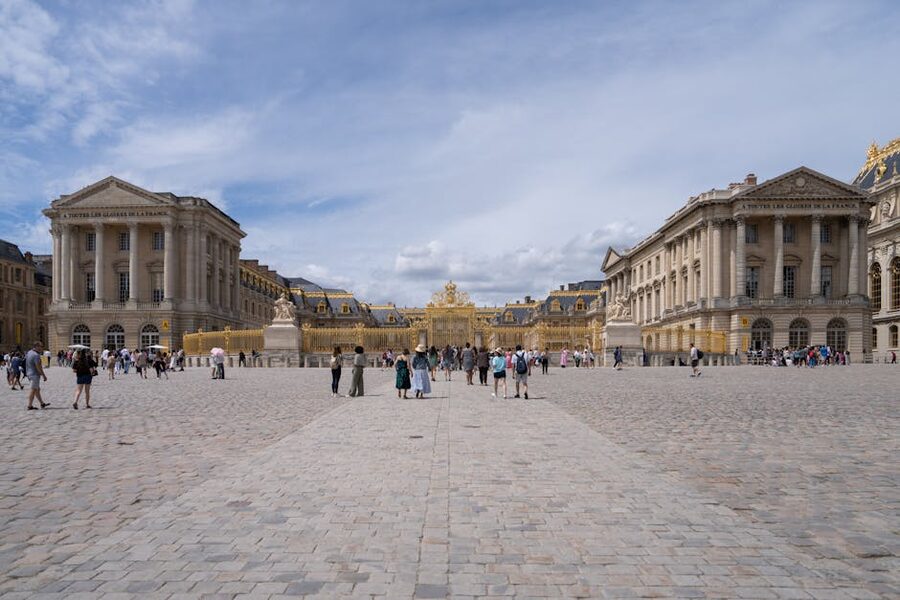
The way most people do Versailles goes like this. You leave Paris around nine. You arrive at the Palace gates around ten. You queue for security, then again for the Palace entrance, then funnel through the State Apartments behind a guide holding up a numbered paddle. By the time you reach the Hall of Mirrors it is past noon and you are standing shoulder to shoulder with eight hundred other people doing the same thing. You walk out the south wing onto the terrace, take a photograph of the gardens, and start thinking about lunch. Your bus leaves at half past four.
That entire structure exists for one reason. The Palace ticket is the bottleneck. Every tour group, every coach trip, every package out of Paris is designed around the Palace’s morning entry slot. Nobody schedules around the Trianon. Nobody schedules around the Gardens. So the morning crush is not a fact of nature; it’s a logistical default that you can opt out of if you arrive with your own ticket and a different plan.
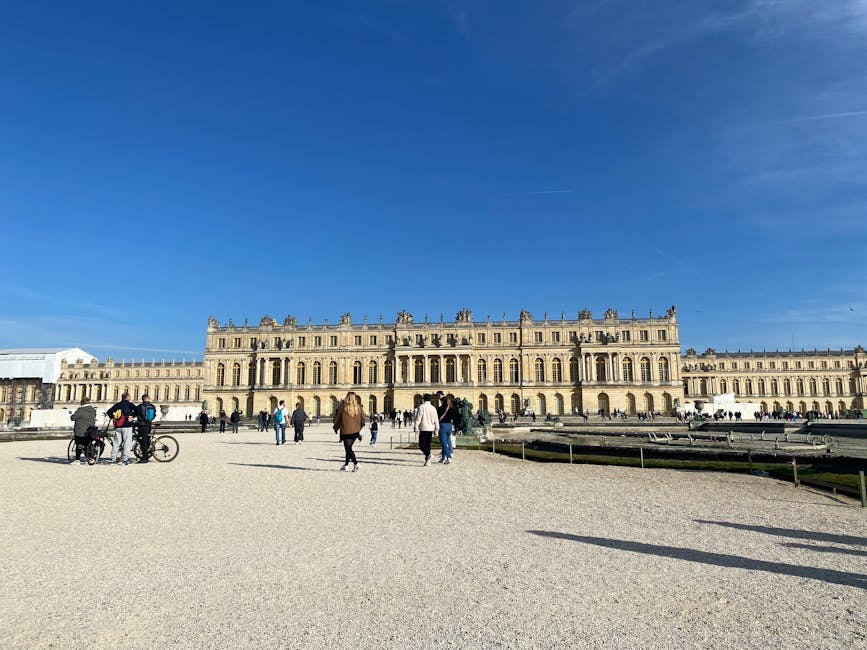
The reframe is simple. Show up at nine, walk past the Palace, and head directly to the Trianon estate at the far end of the gardens. Spend the morning at Petit Trianon and the Hameau de la Reine while the Palace queue is at its worst. Have lunch beside the Grand Canal. Go to the Palace after two, when the morning groups have left for Paris and the State Apartments thin out. You will see the same Hall of Mirrors. You will also see the parts of Versailles that the tour buses skip.
I’d rather walk the Hall of Mirrors at three with two hundred people than at eleven with eight hundred. If you’ve ever stood inside the Louvre in front of the Mona Lisa at midday, you already know the difference an hour either side of peak makes. Versailles is the same problem at twice the scale.
What Versailles Actually Is
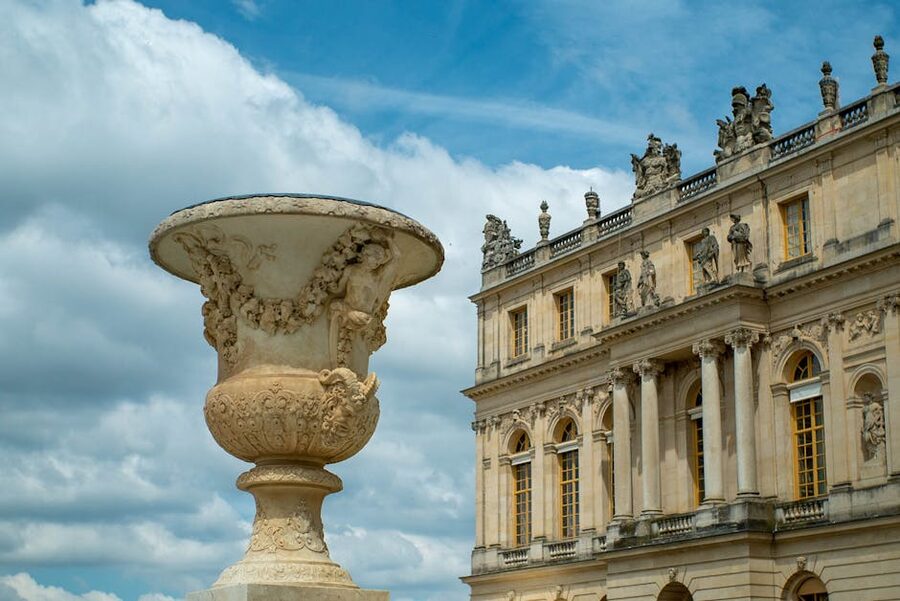
People talk about Versailles the way they talk about a single building. It isn’t. The estate is 800 hectares, roughly the size of central Paris inside the Périphérique, and it has three quite separate parts that you can walk between in about forty-five minutes end to end.
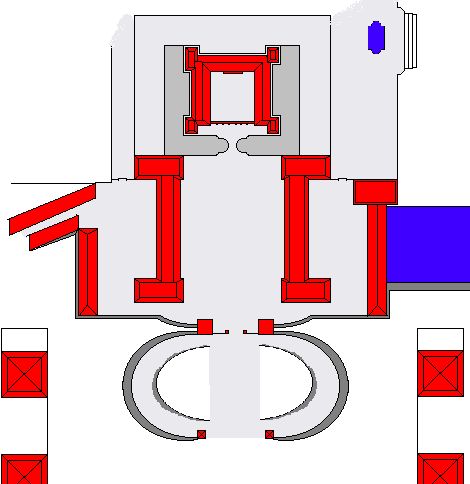
The first part is the Palace itself. Two thousand three hundred rooms, sixty-seven staircases, around 67,000 square metres of floor area. The bit you’re allowed to walk through is small relative to that, mostly the State Apartments of the King and Queen, the Royal Chapel, and the Hall of Mirrors. You don’t see the kitchens, the ministry wings, the servants’ quarters or anywhere the actual machinery of the court ran. It’s about a 90-minute self-guided walk if you don’t stop, about two hours if you read the audio-guide stops.
The second part is the Gardens, designed by André Le Nôtre between 1661 and 1687. They are formal-French baroque, which means everything is in straight lines and geometric parterres, with fountains marking the major intersections. The Grand Canal runs east to west for 1.7km and is the single longest piece of water in any French royal garden. On a non-fountain day the gardens are free to walk; during the summer Musical Fountain shows they cost about €10. Most people see the parterre directly behind the Palace and turn around. The whole point of the design is that you walk down the perspective, not just look at it.

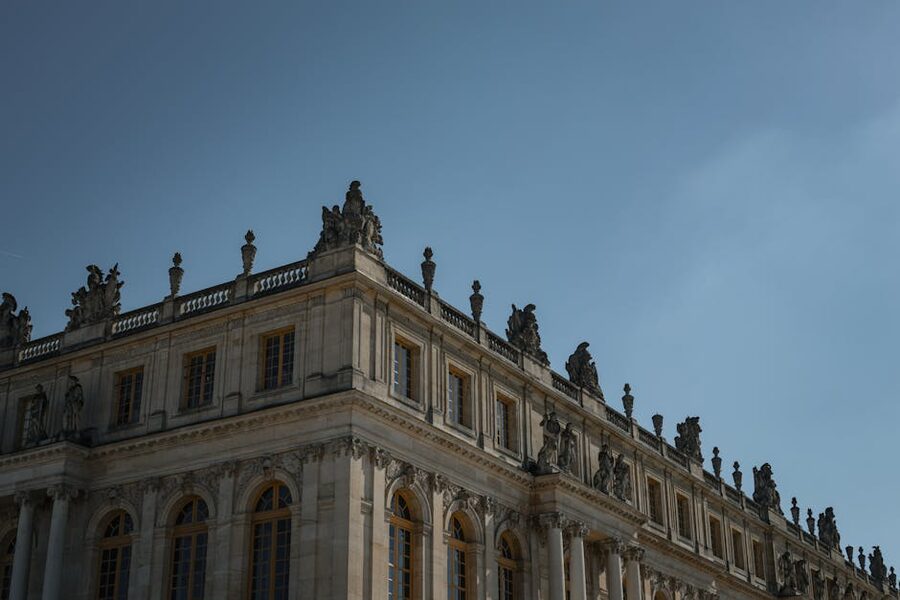
The third part is the Trianon estate. Two miniature palaces and a fake village, all of them tucked behind a tall hedge at the far north end of the gardens. The Grand Trianon is from 1687 and was Louis XIV’s escape from the protocol of the main palace. The Petit Trianon is from 1768 and Louis XVI gave it to Marie Antoinette in 1774 as her private retreat. The Hameau de la Reine, finished in 1786, is the queen’s pretend-rural village built around a working farm. This is the part of Versailles most travellers never even step inside, and it’s the part that will stay with you longest.
The mental shift is to stop thinking of Versailles as one thing and start thinking of it as three separate visits, each with their own door and their own opening hours. Once you do that, the day plans itself.
The Hameau de la Reine, In One Hour
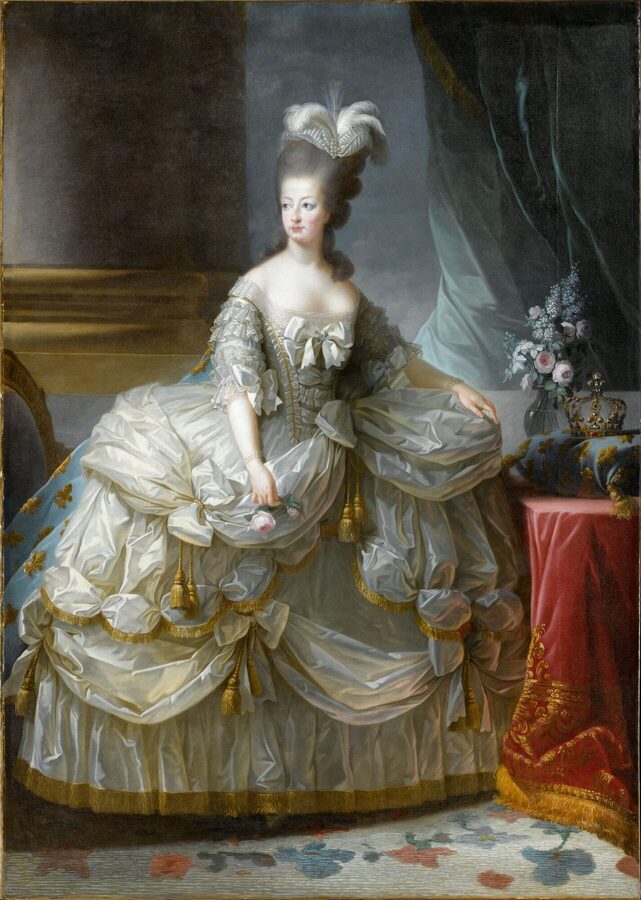
Marie Antoinette commissioned the Hameau in 1783, when she was twenty-eight and had been queen of France for nine years. Her architect, Richard Mique, gave her twelve thatched cottages arranged around an artificial lake. There’s a working dairy. There’s a real mill with a working wheel. A dovecote called the Marlborough Tower. A boudoir, a billiards house, a barn, a guard’s cottage. There were chickens, cows and goats kept by paid farmhands, who also produced butter and cheese for the queen’s small dinners. She came here to walk, to fish in the lake, to read on the grass with her ladies-in-waiting, and to play at being someone other than the queen of France.
The cottages are deliberately rustic on the outside, with timber framing, sagging rooflines and weathered shutters. Inside, the Queen’s House is decorated to the standards of the rest of Versailles: silk wallpaper, fine furniture, painted ceilings. That tension is the whole experience. You’re inside what looks like a peasant farmer’s cottage from the front, except the dining room would not have been out of place in the State Apartments.
The story everyone has heard is the wrong one. Marie Antoinette did not actually milk cows in pearl earrings, and no contemporary source has her saying anything about cake. What she did do, repeatedly and with witnesses, was come here to escape the absurdity of court life. There were 3,000 to 10,000 courtiers attached to Versailles depending on the year. Every meal was public. The act of waking up in the morning was a ceremony with assigned roles. The Hameau was the only place at Versailles where she could sit on the grass and read a book.
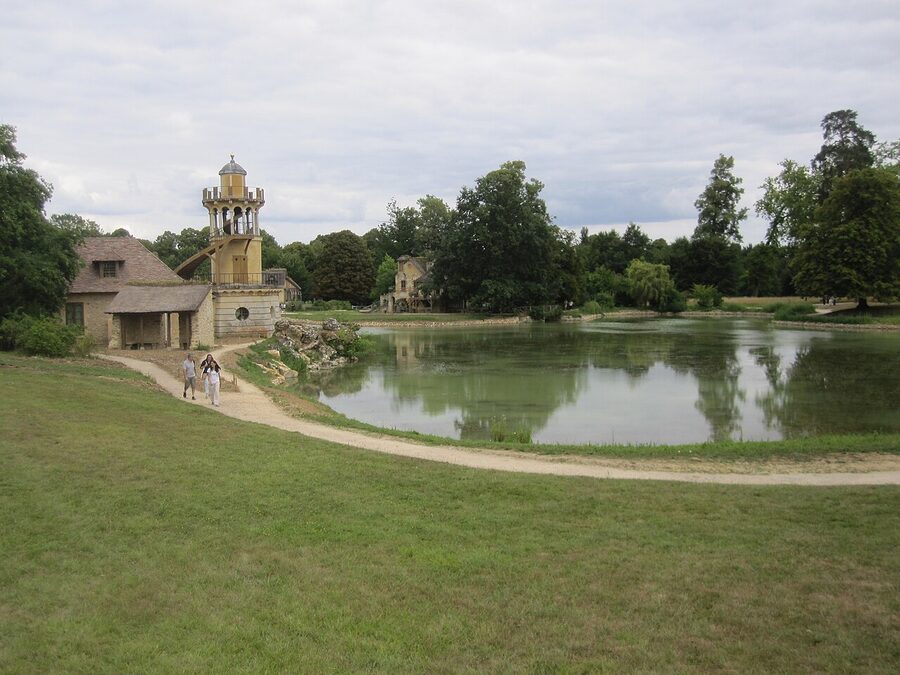
Practically, the Hameau is open the same hours as the Trianon estate, roughly noon to half past six in summer, with morning closures for the Petit Trianon itself. Get to the Trianon entrance at midday opening, walk the Petit Trianon and its formal garden first, then loop out to the Hameau and budget at least an hour. The cottages were extensively restored between 2014 and 2019 and several of the interiors are open to walk through, including the Queen’s House, the Boudoir and the Mill. The Marlborough Tower, the four-storey hexagonal dovecote on the lake, is the building you’ll keep wanting to photograph.
If the comparison helps, this is the closest thing in any French royal site to the Boboli Gardens behind Pitti Palace in Florence, in the sense of a private retreat designed for one person to escape the formal palace next door. Boboli is older and the planting is Italian rather than French, but the function of the space is similar. Versailles has the surreal extra layer of being a literal pretend village.
The Petit Trianon
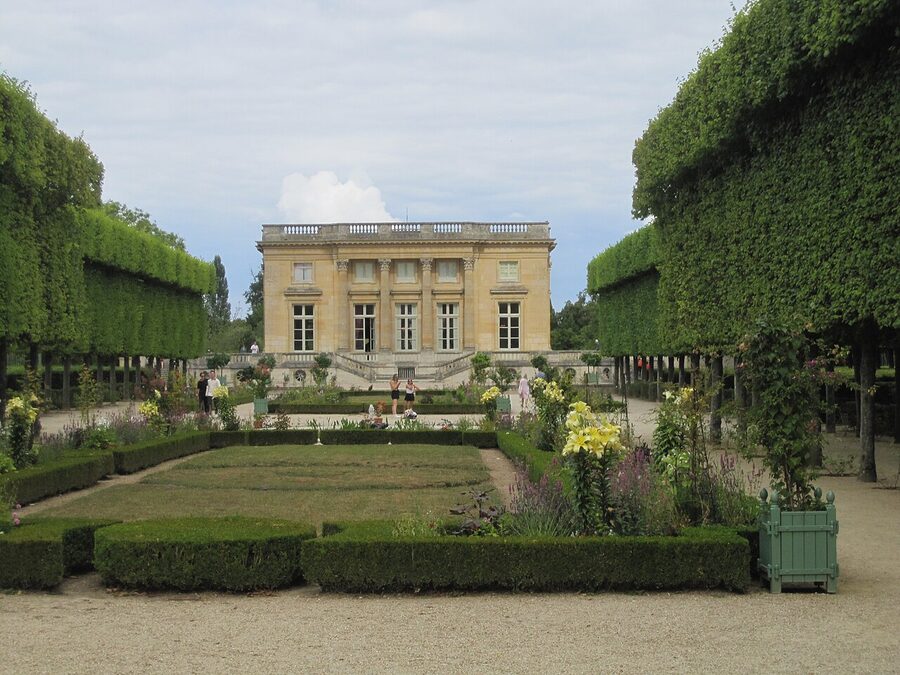
If the Hameau is Marie Antoinette’s escape from the queen role, the Petit Trianon is her house. Louis XV had it built between 1762 and 1768 for his official mistress, Madame de Pompadour, who died before it was finished. His next mistress, Madame du Barry, used it briefly. When Louis XVI gave the keys to his nineteen-year-old wife in 1774 he was effectively giving her the only piece of Versailles where her husband, the king, would not enter without her permission. That’s the part most visitors miss when they look at the modest scale of the building. It looks small because it was supposed to feel small. Versailles is the public stage. The Petit Trianon is the private flat.
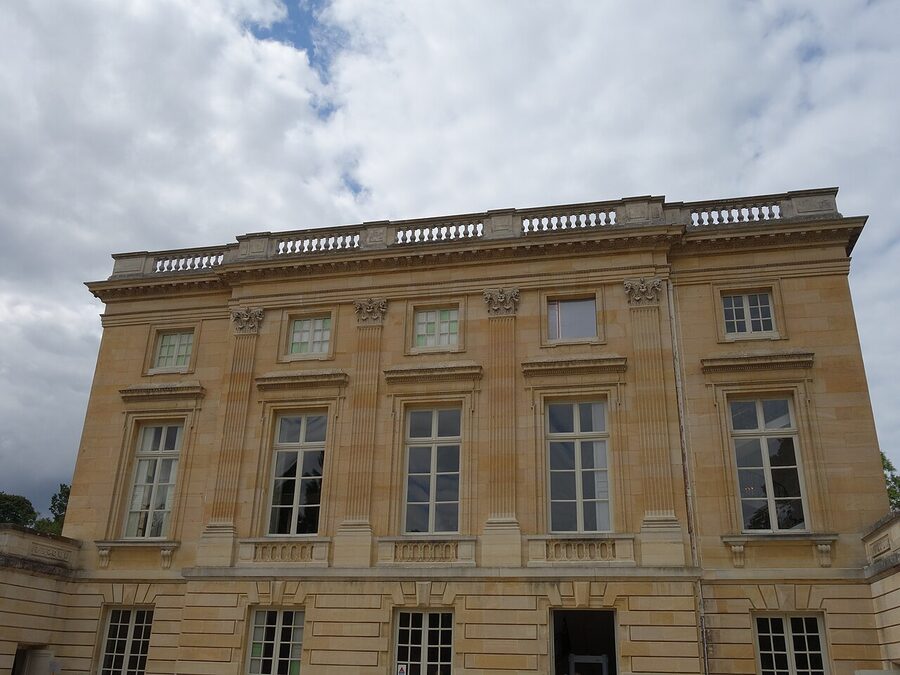
Inside, you walk through about ten rooms over two floors. The dining room has a famous mechanical table, the “table volante”, which could be lowered through the floor for the kitchen below to reset and raised back up; it doesn’t function any more, but you can see the trapdoor mechanism. The boudoir has mirrored shutters Marie Antoinette could close from inside to make the room private from passing servants. The grand staircase has a wrought-iron balustrade with her monogram. None of it is on the scale of the State Apartments, and that’s the point. This is the room where the most powerful queen in Europe could have a private conversation.
The English garden behind the Petit Trianon was added by Marie Antoinette herself between 1774 and 1781. She rejected the formal French style of the main gardens and commissioned an “anglo-chinois” garden with curving paths, an artificial cave, a Belvedere pavilion and a small theatre. Walk it. The whole point is that it doesn’t feel like Versailles. It feels like an English country park dropped into the middle of Le Nôtre’s geometry, which is exactly what it was supposed to do.
If you only have time for one of the Trianon buildings, pick the Petit Trianon over the Grand Trianon. The Grand is a lovely pink-marble pavilion built by Louis XIV in 1687, and worth walking past, but the rooms inside are sparser and the historical thread is thinner. The Petit gives you Marie Antoinette’s actual life. The Grand gives you another set of state apartments at half scale.
Lunch at La Flotille
You will be hungry by one. Most day trippers eat in the village of Versailles outside the gates, which is fine but means twenty minutes of walking out of the estate and back in again. The smarter move is to eat inside the gardens.
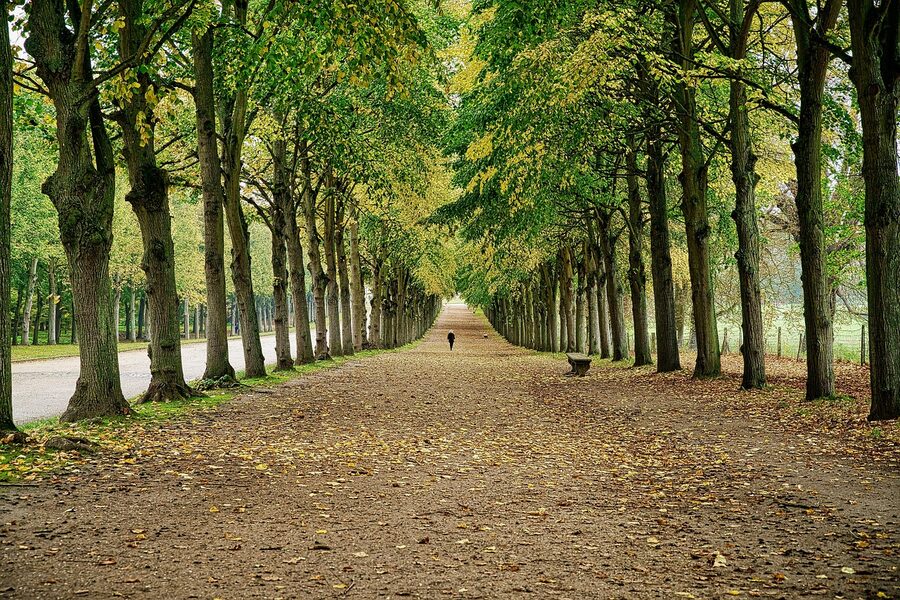
La Flotille sits at the eastern end of the Grand Canal, a ten-minute walk from the Petit Trianon and a fifteen-minute walk from the Palace. It’s been there since 1896, and it has both a sit-down restaurant and a self-service brasserie attached. A main course at the brasserie is around €18 to €22, a sandwich and a coffee under €15, and you can take it outside to a terrace overlooking the canal. The food is unfussy French brasserie cooking; this is not a destination meal, it’s a sensible refuel. You will see the rowing boats people rent on the canal from the table. About thirty euros for an hour. Worth it on a hot day, completely skippable on a cold one.
If La Flotille is full, there’s also a smaller café at the Petit Trianon, called the Salon du Frais, with simpler salads and pastries. Either is better than walking back out into the town.
The Gardens and the Grand Canal
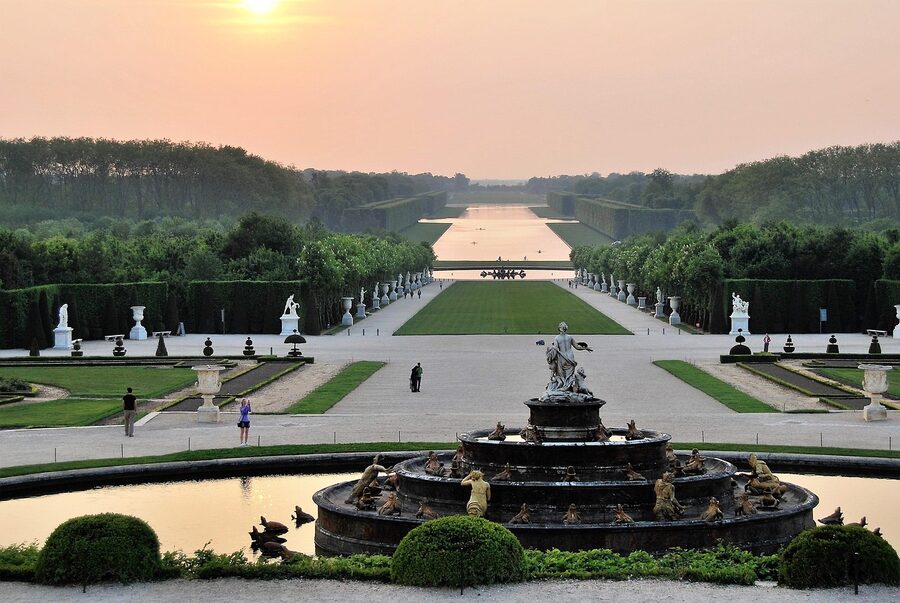
Le Nôtre’s gardens reward walking, not viewing. The classic mistake is to walk out the south door of the Palace, look at the parterre directly below, take a photograph and turn around. That’s the postcard view, but it’s also about three percent of the gardens. The whole geometry was designed to be experienced as a sequence: parterre, Latona Fountain, Tapis Vert, Apollo Fountain, Grand Canal. Each one resolves into the next as you walk.
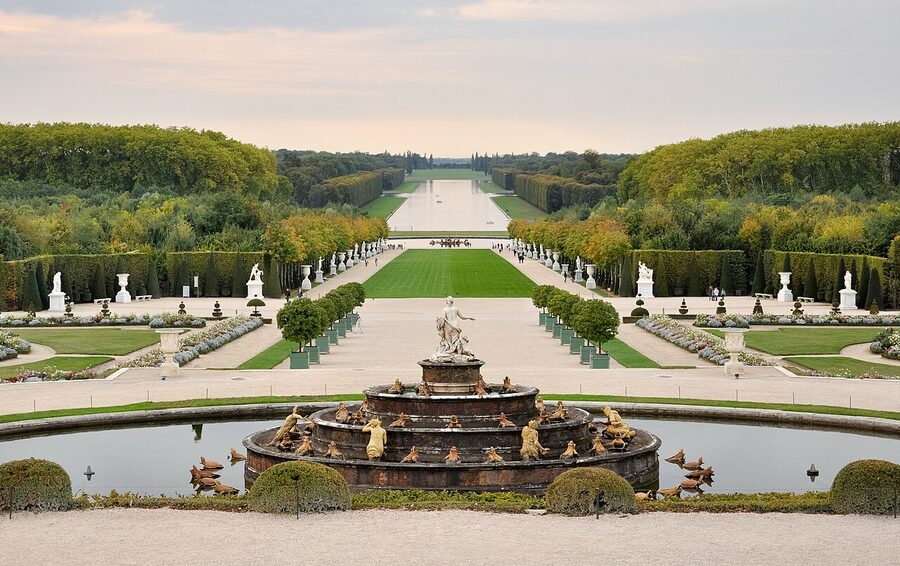
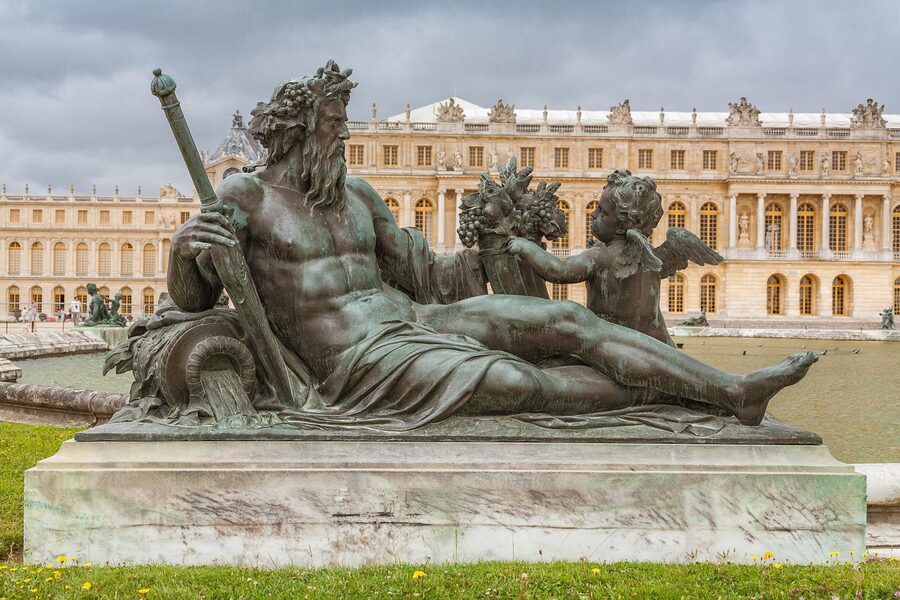
Latona is the first fountain you reach below the Palace, and one of Le Nôtre’s best pieces. Six tiered basins descend in a stepped pyramid, with statues of frogs and people in mid-transformation around the rim. The myth being illustrated is the goddess Latona turning Lycian peasants into amphibians for refusing her water. Restored fully in 2015, it’s the cleanest fountain in the gardens and the one you should make a point of looking at properly rather than walking past.
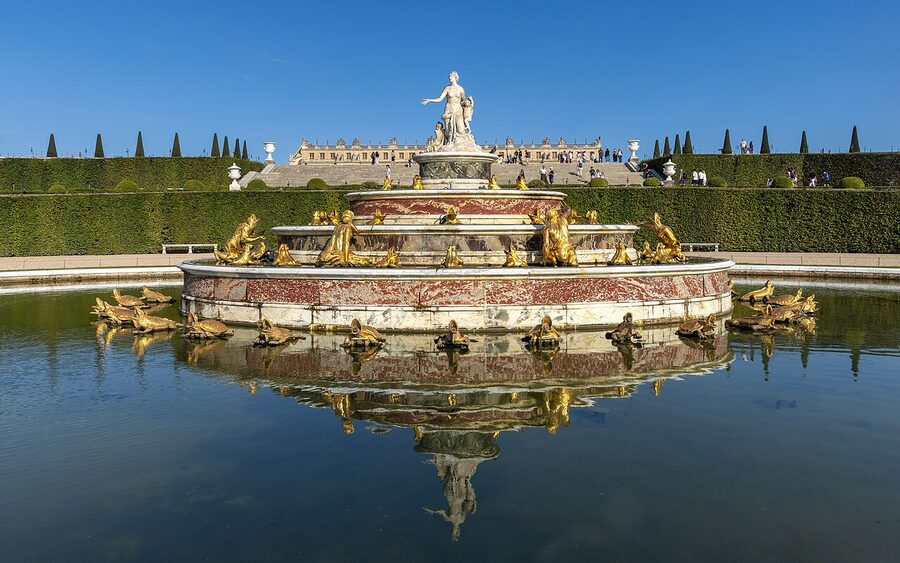
Apollo, at the far end of the Tapis Vert, is the centrepiece. Tuby’s gilded sun-god in his chariot rises out of the basin facing east, towards the rising sun, and the gardens were laid out so that the king’s bedroom and the sun’s daily path aligned with the same axis. Louis XIV called himself the Sun King and meant it literally. Stand at Apollo facing east and you can see the whole spine of the estate, with the Palace at the top and the Grand Canal stretching behind you.
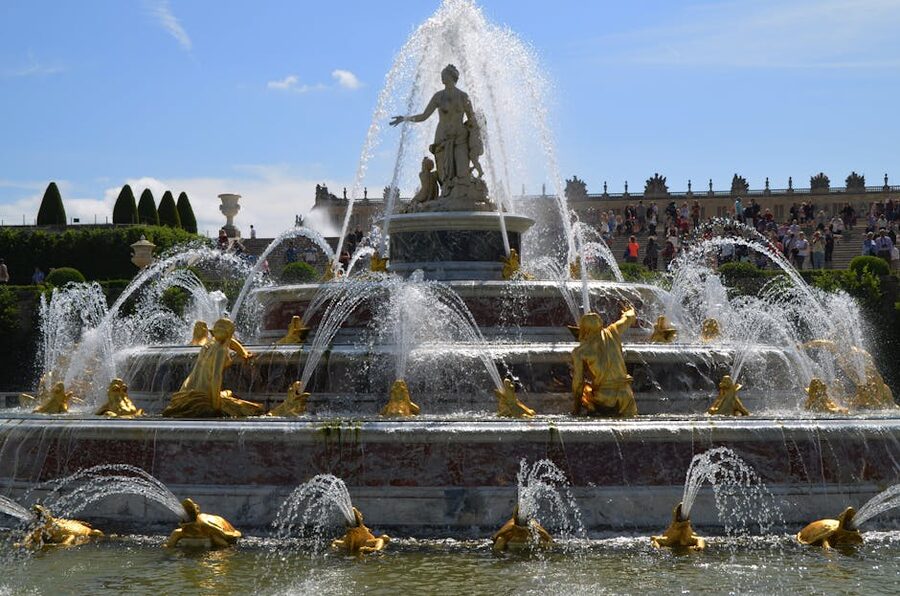
The Grand Canal itself is 1.7km long on its main arm, with a perpendicular arm running 1km north-south. It’s not deep enough to swim in, but you can rent rowing boats at the eastern end for around €17 to €30 per hour depending on size. On a hot day this is the smartest thirty minutes you’ll spend at Versailles. You also get a perspective on the gardens that you cannot get from the bank: the Palace recedes at the end of the axis exactly as Le Nôtre intended.
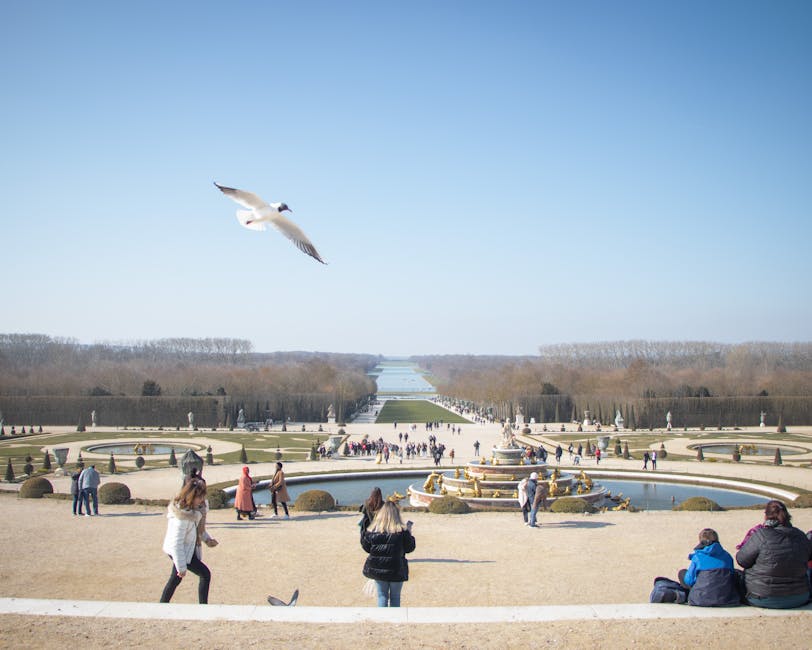
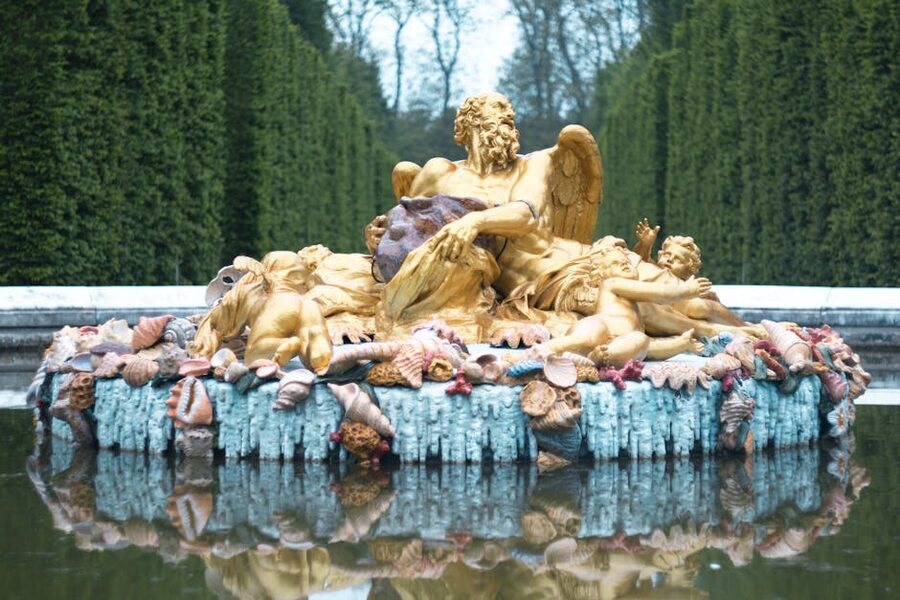
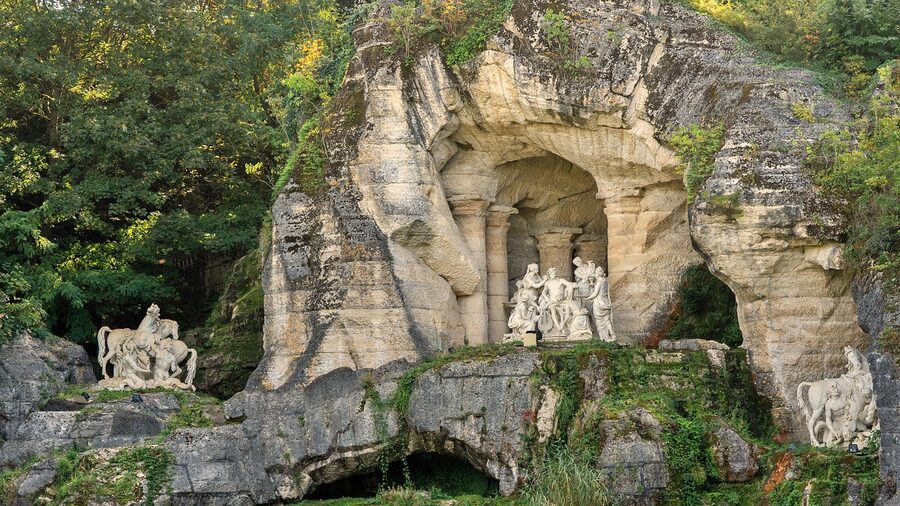
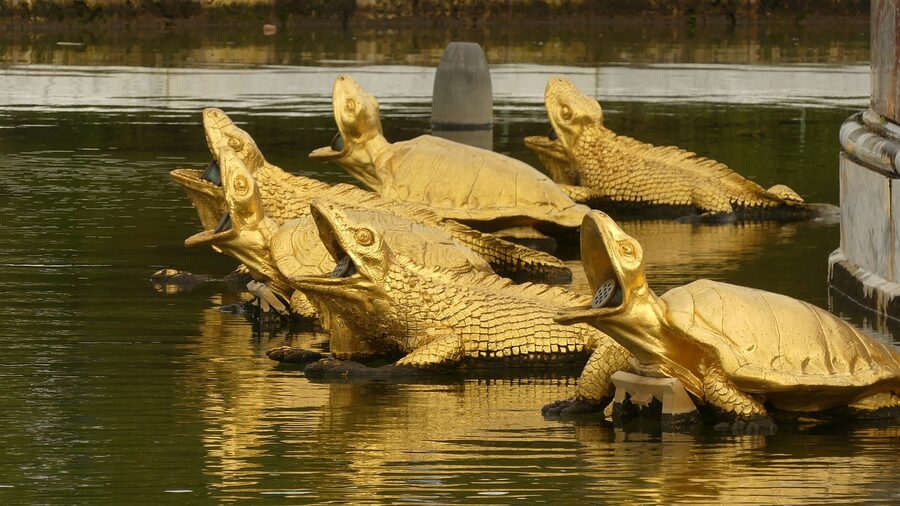
If you want gilded fountain photographs, Apollo and Saturn are the best two. Saturn is at the southern end of the lower parterre, partly overlooked because it sits off the main axis. The bath of Apollo, in the Bosquet de l’Encelade area, is a sculptural group hidden in a grotto and takes a deliberate detour to find. None of these are signposted in a way that competes with the main walk, which is why they’re often empty even when the central fountains have crowds.
The Palace, After Lunch
By two o’clock the morning crush is gone. The first wave of tour buses has loaded back up and left for Paris, the cruise-passenger groups are heading for their meeting points, and the State Apartments empty out by perhaps half. This is when you walk the Palace.
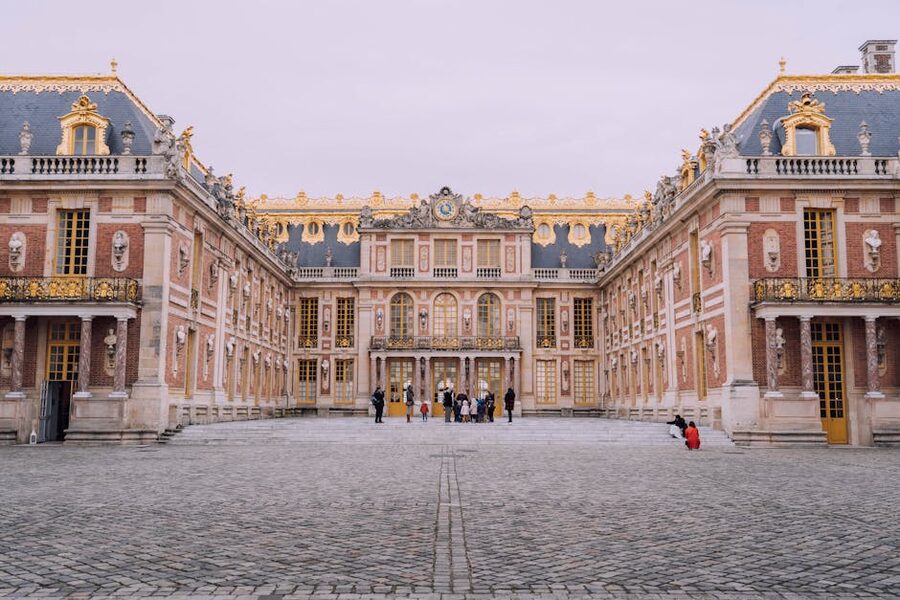
The route is fixed. You enter through the Royal Chapel ground floor, work up through the Hercules Salon, through the King’s State Apartments (Mars, Venus, Diana, Apollo, Mercury rooms), past the Hall of Mirrors, then through the Queen’s State Apartments and back down. The audio guide included with most tickets is decent and follows the same direction as the foot traffic. There’s no reason to fight the route or try to do it backwards.
The Royal Chapel is the first big room and one of the most underrated. White stone, gilded organ, a fresco ceiling by Antoine Coypel from 1709, a marble floor patterned in geometric inlay. From the upper level, where you walk in, you look down on the nave the way the king did. He had Mass said here every morning during the years he was in residence. There are services here only twice a year now, both occasions tied to a specific historical anniversary.
The Hall of Mirrors comes about two-thirds of the way through. It’s 73 metres long, 10.5 metres wide and 12.3 metres high. The ceiling is a Le Brun cycle of frescoes celebrating Louis XIV’s military victories. The 357 mirrors in the seventeen arches were a deliberate display of French industrial supremacy: in 1684, when the hall was completed, mirrors at this scale could only be made in Venice, and Louis XIV’s industrial policy had set up a French rival glassworks at Saint-Gobain. Each mirror was the most expensive object in the room when it was first installed. The hall doubled as the corridor between the King’s and Queen’s apartments and as a state ballroom.
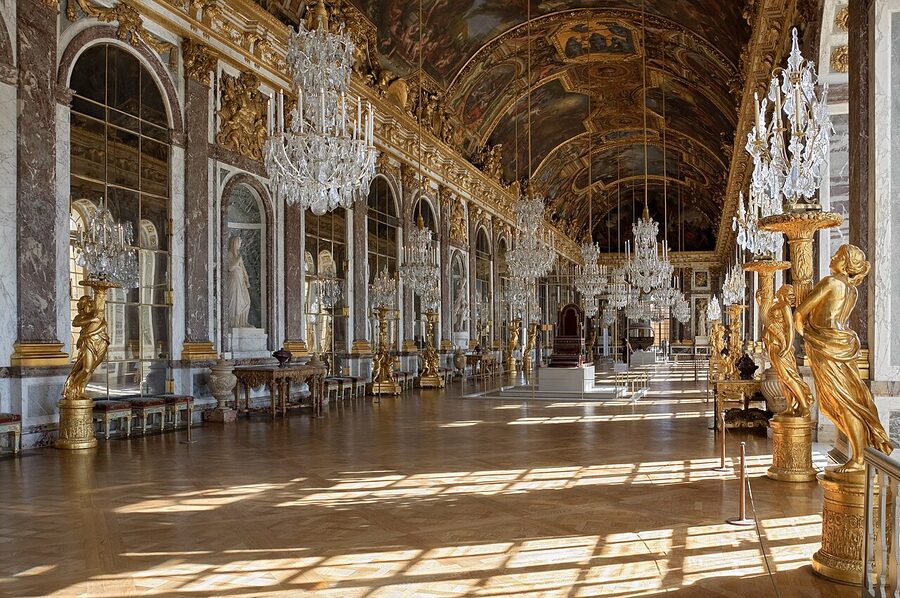
The hall is also where the Treaty of Versailles was signed on 28 June 1919, ending the First World War. There’s a small plaque on the floor where the signatories’ table stood, in front of the central window facing the gardens. Most visitors walk past it without noticing. If you stop and read it, you’re standing in the spot where the political shape of the twentieth century was decided. That’s worth a minute.
From here you walk into the Queen’s Apartments. The Queen’s Bedroom is the room nineteen royal children were born in (Marie Antoinette’s first, Madame Royale, was born here in 1778) and where Marie Antoinette fled on the morning of 6 October 1789, when a Paris mob got into the palace and tried to kill her. There’s a hidden door in the panelling she used to escape into the King’s apartments. It’s a small detail and the audio guide will point it out. Stand there for a second. This is the room where the Bourbon monarchy effectively ended.
The exit is through the Coronation Room, which holds David’s enormous canvas of Napoleon’s 1804 coronation, and out into the gift shop. Allow ninety minutes inside the Palace, two hours if you stop for the audio guide.
The structural lesson, if you want to compare, is the same one that applies at the Doge’s Palace in Venice. State palaces are designed to be walked through in a fixed sequence. Trying to break the sequence to skip crowds doesn’t work. What works is showing up at a different time. Mid-afternoon is to a state palace what early morning is to a museum: the only window where you actually get to see the room rather than the back of someone else’s head.
Getting There: RER C vs Organised Tour
The simplest way out of Paris is the RER C train from any of its central stations. Boards say “Versailles Château Rive Gauche”, and the journey is about 35 to 45 minutes depending on where you board. A round trip costs around €8.50 if you buy a Navigo Easy ticket and tap on. The station sits a 10-minute walk from the Palace gates, signposted. Trains run every 15 minutes most of the day.
If you take the RER, three things are worth knowing in advance. One, buy your Versailles ticket online before you go: the on-the-day queue at the Palace ticket office can run thirty minutes even before you start the security queue. Two, the RER C has multiple branches, so check the destination board at your platform; a “VICK” or “VICE” code on the indicator means it goes to Versailles. Three, the return train can be packed at five o’clock if you’ve stayed late. If you finish around three you’ll have a seat both ways.
The organised day tour, around $53 with the transport-included ticket, replaces the RER and the ticket queue with a coach pickup in central Paris and a walk-through entry. The trade-off is that you’re locked to the group’s schedule, which usually means leaving Versailles at three or four in the afternoon. If your priority is to control your day and stay until the gardens close at six or seven, do it independently. If you’d rather not navigate and you’re willing to skip the late-afternoon empty Palace, take the bus.
This is the same trade-off you face for almost every Loire Valley chateau day trip from Paris. The independent option is cheaper and gives you more hours on site; the organised tour buys you a guide and removes the navigation. There is no universally right answer; just be clear with yourself about which one you want, and don’t pay for transport you’d happily do yourself for €8.
If you’ve done Segovia and Ávila as a day trip from Madrid or Toledo from Madrid, you’ll know the same logic applies in Spain: the cheap regional train usually beats the day tour on flexibility, and the day tour wins on logistics if you’re tired. Versailles is a particularly easy independent because the train deposits you a five-minute walk from the gates.
The Three Tours Worth Booking
This site recommends about three tours per topic: one cheapest, one with transport for travellers who’d rather not deal with the RER, and one premium guided. All three feature the Trianon estate in their access, which is the part you don’t want to miss.
1. Versailles Palace and Gardens Full Access Passport: $17
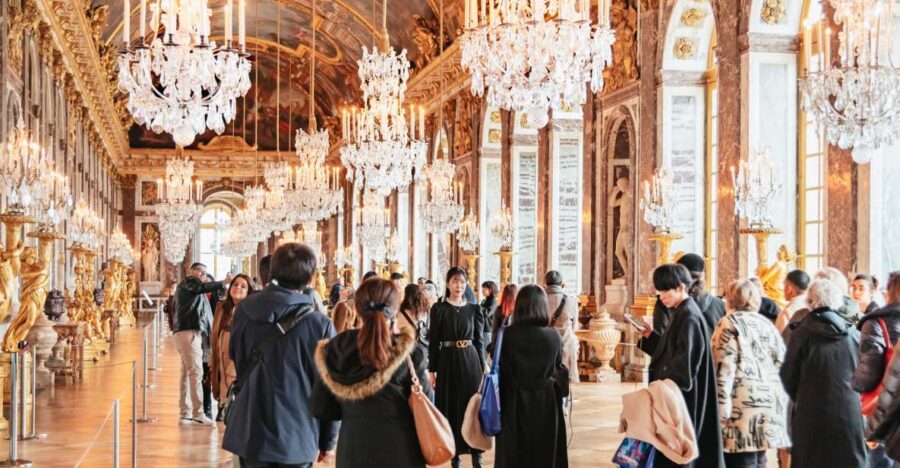
This is the right pick if you want to control your own day. The Passport gets you into the Palace, the Trianon estate, the Hameau and the Gardens on one timed-entry slot, and our full review walks through how the entry windows actually work and why booking two weeks ahead matters in summer. The trade-off is you handle the RER yourself, which saves you about $36 and twenty minutes of organisation.
2. Versailles Palace and Gardens with Paris Transport: $53
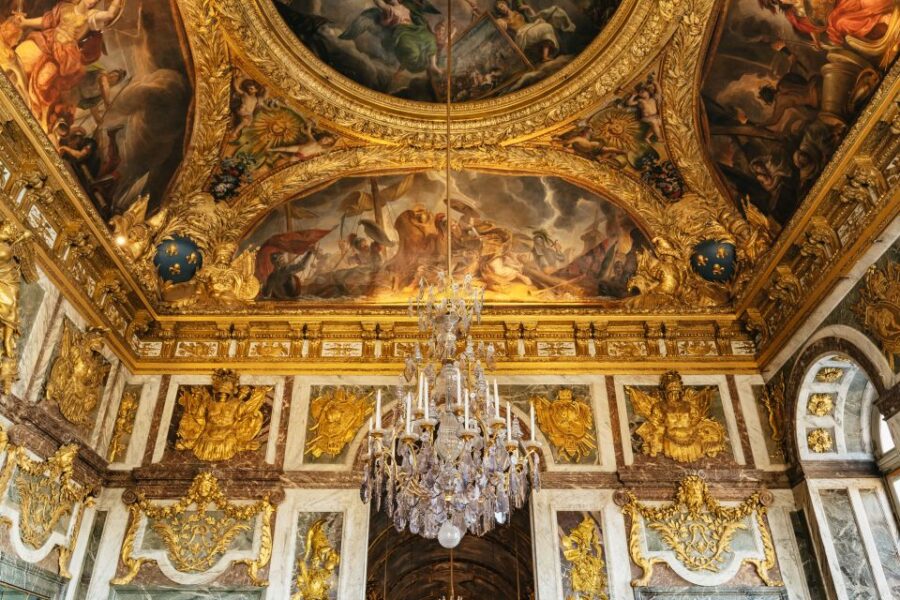
This is the right pick if you’ve had a long week of city navigation and you’d rather not work out the RER. The price over the Passport buys you the return transport plus a small package premium, and our review covers which Paris pickup is the most central and how the return scheduling works. The catch is the bus leaves on a fixed schedule, which usually means you’re back in Paris before five and you’ve missed the late-afternoon empty Palace window.
3. Skip-the-Line Guided Tour with Gardens Access: $74
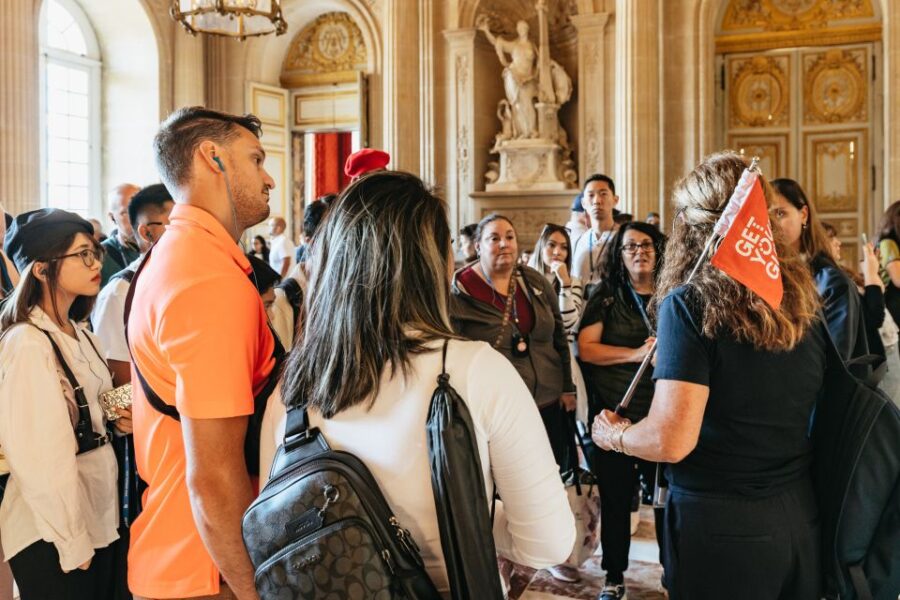
This is the right pick if you actually want a person explaining the rooms, not an audio guide in your ear. Our guided-tour review covers how the small-group format plays in the Hall of Mirrors and why the morning slot is worth booking over the afternoon. The cost premium over the Passport is about $57; whether it’s worth that depends entirely on whether you’d rather hear the stories from a guide or read them at your own pace.
What to Eat, What to Skip, What to Bring
Wear shoes that work on uneven gravel; the gardens are mostly raked path, not paved, and you will walk between four and seven kilometres in a normal day. Bring a refillable water bottle. There are drinking-water fountains marked on the map at the Petit Trianon, near the Apollo Fountain and outside the Palace. The cafés inside the gardens charge €4 for a small bottle and €7 for a coffee.
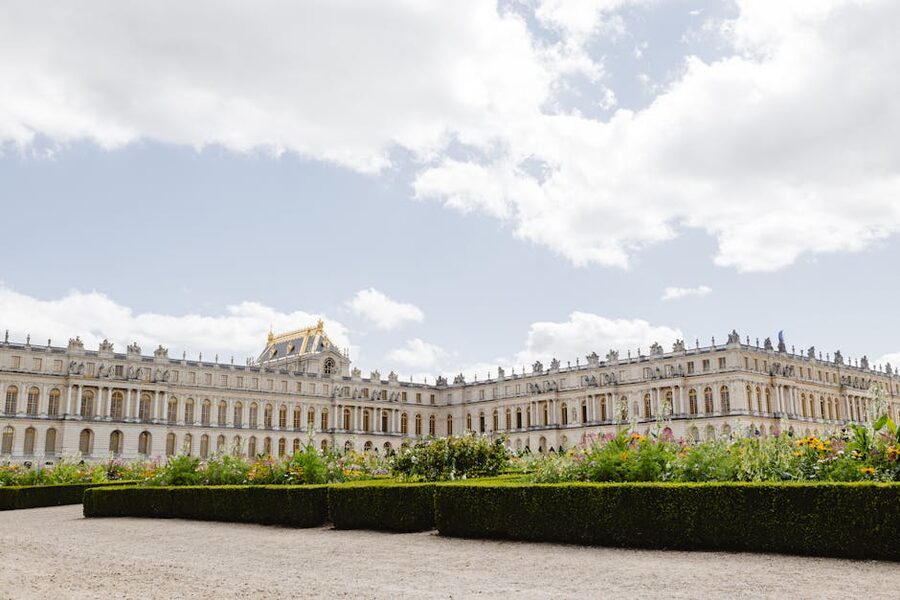
Skip the Petit Train if you can walk. It costs €8 a head and runs a tight circuit between the Palace, the Trianon and the Grand Canal that is faster on foot if you’re at all able-bodied. It exists mostly for visitors with mobility issues and for families with very small children. If that’s not you, the walk between Palace and Trianon is about twenty-five minutes through the gardens, and it’s pleasant. The train will stop in places you don’t want to stop and skip places you do.
Skip the gift shop’s “Marie Antoinette” perfume and macarons. There is a Ladurée concession in the Palace and another in the village, and they’re identical to every other Ladurée in Paris at a 30% premium for being inside Versailles.
The bookshop in the Palace exit is actually good. The Royal Academy editions are well-printed, and the Versailles-specific monographs (Hameau, Trianon, Gardens) are all written by current curators. If you have any interest in the place at all, walk through it.
The Grand Trianon and the Other Half-Day
If you have done the basic visit and you’re back in Paris thinking about a return trip, the upgrade is the Grand Trianon and the parts of the Palace you skipped. The Grand Trianon is the pink-marble pavilion Louis XIV built in 1687 for his secret second wife, Madame de Maintenon, and a long line of subsequent royals used it as a private residence. The interiors are sparser than the State Apartments but more intimate, and the gardens behind it are unlike anywhere else at Versailles.
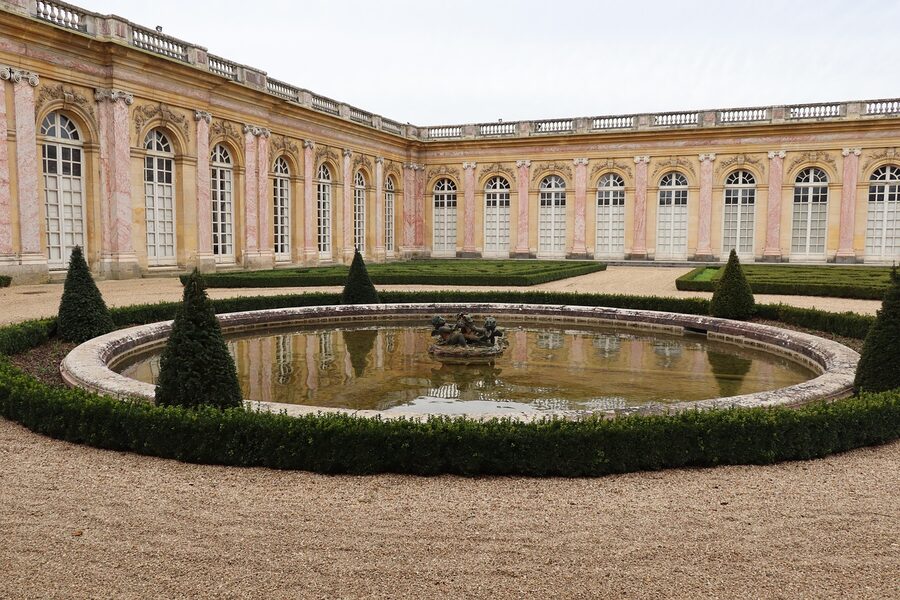
The other half-day worth doing inside the Palace is the Mesdames Apartments and the Dauphin’s Apartments, on the ground floor below the State Apartments. These were the rooms occupied by Louis XV’s daughters and the various Dauphins, and they are quieter, smaller and more domestic than the State rooms upstairs. They’re included on the Passport ticket but most visitors run out of time before they reach them.
For comparison, the equivalent at the Royal Palace of Madrid is the Royal Pharmacy, and at the Royal Alcázar of Seville it’s the upper royal apartments still used by the Spanish royal family. State palaces all have these quieter sub-apartments; almost all of them are skipped on the standard tour. They are usually the best part.
Summer vs Winter
The fountains run on Tuesdays, weekends and selected holidays from April to October. These are the Musical Fountain show days, and the gardens cost about €10 to enter on those days; on all other days the gardens are free. If you specifically want to see the fountains running, plan around the schedule on chateauversailles.fr. If you don’t, go midweek in shoulder season and the gardens are quieter and free.
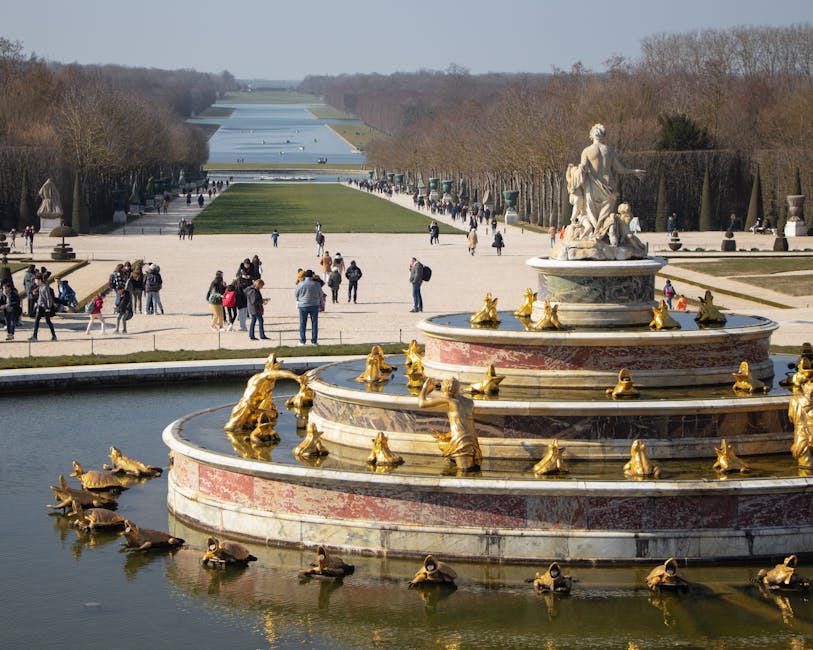
Winter Versailles is a different building. November to March, the visitor numbers drop by maybe two-thirds, and the Hall of Mirrors empties out enough that you can stand in it without bumping into anyone. The fountains are off, and most of the statues in the gardens are wrapped in protective wooden boxes. The light is grey, the trees are bare, and the whole estate has the slightly desolate feeling of a country house out of season. If you’ve already seen the gardens in colour, the winter visit is the better one for the rooms.
If your trip is in summer, plan for heat. The State Apartments are not air-conditioned and on a 30°C August afternoon the Hall of Mirrors becomes uncomfortable, with seven hundred bodies in a narrow space. The gardens have shade in the lateral allées but the main axis is fully exposed. Hat, water, sunscreen, the usual. Avoid the noon to 2pm slot in the Palace if you can.
What I Would Skip on a First Visit
Short list. The Coach Gallery (Galerie des Carrosses), an outbuilding showing the old royal carriages, is interesting but feels disconnected from the rest of the visit and adds twenty-five minutes if you go. Skip on a first day. The Royal Stables and the Dauphine’s Library are similar: niche, charming, not worth the time on a single-day visit.
The audio guide app is fine but the in-Palace signage is also fine. If you’ve read up before you went, you can do the Palace without the audio guide and save the battery for the gardens. The gardens are where the audio actually adds context that isn’t on a sign.
The Petit Train de Versailles, mentioned earlier, is a skip unless mobility makes it the right call. The Galerie des Glaces guided tour add-on (which some operators upsell) repeats what’s on the standard audio guide; pass. The “Marie Antoinette experience” upgrade tickets (a private tour of the Petit Trianon at extra cost) can be worth it if you have a serious interest, but on a first visit the included Petit Trianon access on a normal Passport ticket gives you 90% of the experience for none of the upcharge.
The Reframe, in One Sentence
The day you want at Versailles starts at noon at the Trianon entrance, has lunch on the Grand Canal, walks the Palace at three, and leaves at six with the gardens still open and gold-light on the parterre. The day everyone gets is the opposite of that, and the only difference is which entrance you walk through at nine in the morning.
If Versailles is your only day trip out of Paris, it’s also worth thinking about what comes after. The natural next two day trips are the Loire Valley castles for a longer chateau-and-vineyards day, and Mont Saint-Michel for the rock-and-tide-and-medieval-monastery experience. Versailles is the urban-sister day; the Loire is the rural one; Mont Saint-Michel is the coastal pilgrimage. Each is its own shape. None of them duplicate what you’ve already done. The closest equivalent if you cross to the Netherlands later is Zaanse Schans from Amsterdam, which is the Hameau de la Reine logic at full national scale: a working windmill village preserved as a curated rural escape from the capital.
Pairing Versailles with the Rest of Paris
Most people do Versailles on day three or day four of a Paris trip. That’s the right call. If you front-load Versailles you arrive jet-lagged at the Palace gates and remember nothing; if you back-load it you’re tired and you skim. The middle of the trip is the sweet spot.
What you’ve already seen in central Paris will shape how Versailles reads. If you’ve done the Eiffel Tower and walked along the Seine, you’ll appreciate Le Nôtre’s gardens differently: there’s a 200-year arc from the formal Tuileries to the romantic Champ de Mars, and Versailles sits at one extreme of that. If you’ve taken a Seine cruise, you’ve seen the Louvre from the water; the Hall of Mirrors at Versailles makes more sense once you’ve seen Louis XIV’s earlier residence in central Paris. And if you’ve done the Louvre itself, you’ve already absorbed the visual culture that Versailles represents at full volume.
The other useful preview is Les Invalides, where Napoleon is buried under the gilded dome. Napoleon’s coronation is the big David canvas in Versailles’s Coronation Room, and standing in front of it after seeing his tomb at Invalides gives you the missing chapter: the Bourbons collapsed in 1789, the Revolution couldn’t hold, Napoleon stepped into the void and crowned himself emperor in 1804, and the painting at Versailles is his version of the story.
If you’ve been to Italy on the same trip, you’ll see another rhyme. Versailles and the Doge’s Palace in Venice are both state palaces designed to overwhelm the visitor by sheer scale of decoration. Versailles is bigger and gildedier; the Doge’s Palace is older and the political story is republican rather than monarchical. The two of them together teach you something about how seventeenth-century Europe used architecture as propaganda. Pitti and Boboli in Florence are the Italian dynastic equivalent: a Medici palace with a private retreat garden, on a smaller scale than Versailles but the same idea.
In Amsterdam, the equivalent civic-monarchy building is the Royal Palace on Dam Square, which started as the 17th-century Stadhuis (city hall) of a republic and only became a royal residence under Louis Bonaparte. The Dutch building is a fraction of the scale of Versailles but the political story is the more interesting one: a merchant republic’s town hall promoted to monarchy by a Bonaparte. And if you’re a Spain person, the closest match for Versailles is probably the Royal Palace of Madrid, which is bigger by room count than Versailles but feels emptier because nobody lives there and the historical narrative is fragmented. The Alhambra in Granada is the more interesting comparison: built three centuries earlier, by a culture Versailles’s builders considered inferior, and yet the spatial intelligence in the Nasrid palaces is, room for room, more sophisticated than anything at Versailles. If you do both you’ll understand French royal taste better by contrast.
The Last Photograph
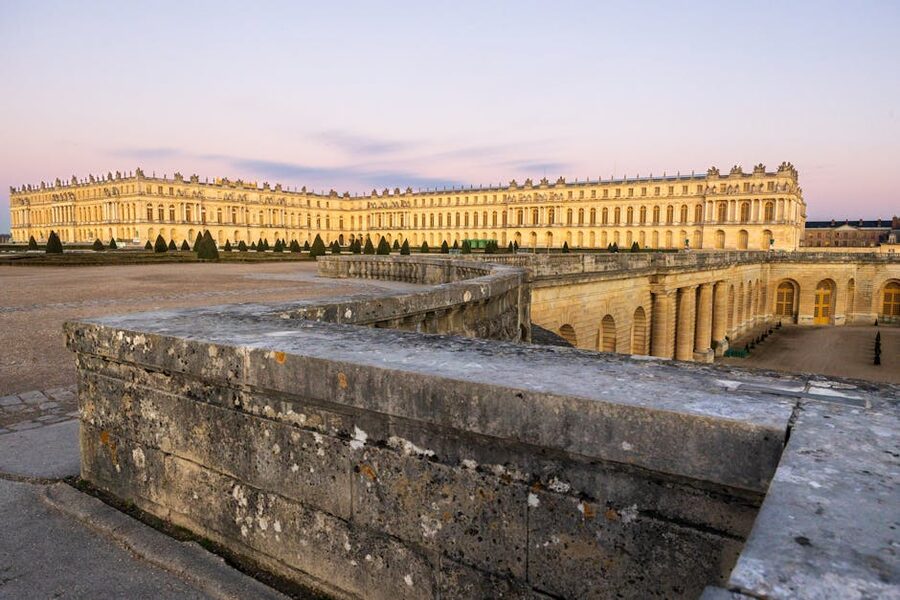
If you walk out of the Palace at six, the gates of the gardens close around half past six in summer (earlier off-season), but you can stand on the upper parterre as the light goes flat across the Grand Canal. There’s a fifteen-minute window when the gold leaf on the gates of the Palace catches the last sun. You’ll be the only person doing this. Most visitors are already on their RER train back to Paris; the tour buses left at four. This is the photograph everyone tries to take in the morning and gets wrong because the sun is in the wrong half of the sky.
Then you walk back through the parterre, out the main gate, and down the cobbled rue de la Paroisse to the RER station. The five-twelve train back to Paris is half empty. Forty minutes later you’re at Saint-Michel-Notre-Dame and the city is waking up for dinner. You’ve done in one day what eighty percent of the people you saw at Versailles failed to do, which is to actually look at it.
That’s all there is to it. A different start time and a different door. Five euros and an extra hour of walking. The most original royal site in France is sitting unattended at the back of the gardens, behind a hedge. Go find it.