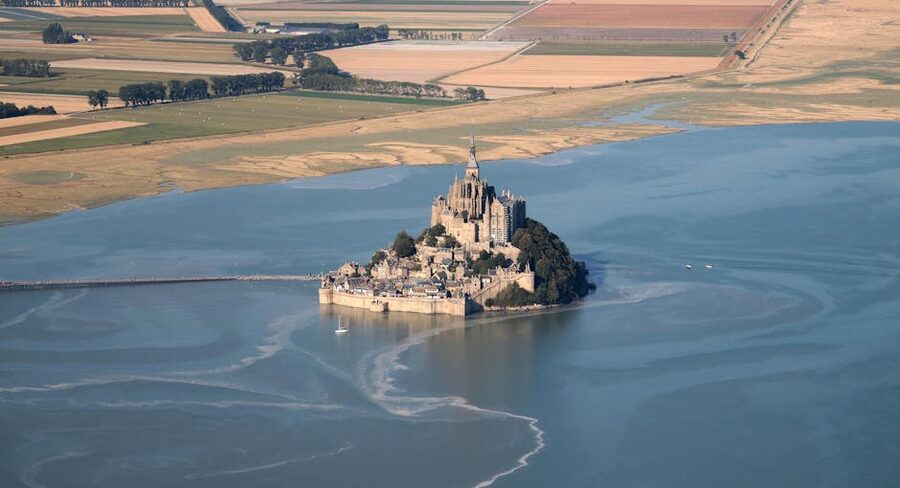
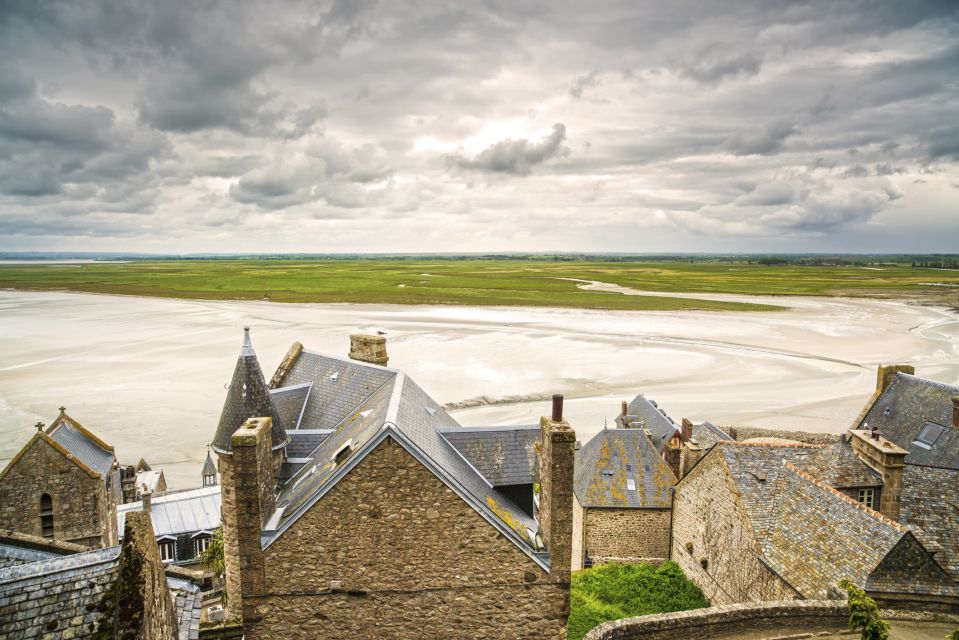
The footbridge is empty at 11am on a weekday in May, which is the small miracle nobody told me about. It’s a kilometre across the wooden walkway from the shuttle drop to the gates, and as you walk, the abbey grows. Eighty metres of granite and lead spire against a pale sky, with the bay still draining around it from the morning tide. By the time you reach the village ramparts the wind off the Channel is loud enough that you can hear the gulls but not the day-trippers behind you.
That’s the Mont-Saint-Michel that’s worth the hours from Paris. Not the one most people get, which is 1pm on the rampart staircase shoulder-to-shoulder with three tour groups. Get there early or get there late. The middle three hours are the worst, and the day trip from Paris is the longest day trip you can do in France that’s still actually a day trip. Five hours each way by car, four by train-and-bus, and the people who tell you it’s “easy” have either never done it or did it by helicopter.
So here’s the article I wish someone had handed me before I booked. What it actually takes to do Mont-Saint-Michel as a day trip from Paris, when the abbey is worth the climb and when it isn’t, what to skip in the village, and which of the three booking options below makes sense for the kind of traveller you are.
If you only have 30 seconds to book
Driving yourself or staying overnight nearby? Buy the abbey ticket in advance and skip the queue. Mont-Saint-Michel Abbey Entry Ticket ($15)
Want the easiest door-to-door from Paris? The flagship coach day trip handles the 11-hour logistics and gives you free time at the rock. Day Trip From Paris by Coach ($153)
Prefer history walked through with you? The guided version costs less and adds a real abbey tour. Day Trip From Paris with Guide ($128)
The day-trip math, plainly
Most articles about Mont-Saint-Michel from Paris bury the time cost. Here it is up front. You’re looking at 11 to 13 hours door-to-door, depending on traffic and how the train schedules line up.
By coach you leave central Paris around 7am and get back around 9pm. You’ll have roughly four hours on the rock and the rest is the seat. By the train route, the TGV from Paris Montparnasse to Rennes takes 1h27, then the official Keolis Mont Saint-Michel bus does the Rennes-to-Mont leg in 1h15. Add the time to get to Montparnasse, the wait between train and bus, and the same in reverse, and you’re at 11 hours minimum. By car, plan on 4h45 each way via the A11 plus the kilometre walk from the shuttle terminal to the ramparts.
If your itinerary already has Mont-Saint-Michel as a non-negotiable, do it. Just understand that the day trip is the day. You’re not also going to add Giverny in the morning and the Mont in the afternoon. You can do one or the other from Paris in a day.
The smart play, if your trip allows it, is to spend the night in the village or in the nearby town of Pontorson. Then you wake up on the rock, walk the abbey at 9am when it opens with maybe twenty other people, and take the coach back to Paris in the afternoon. That turns a brutal day into a beautiful overnight. But if you only have one day, the all-in coach tour is what most readers will land on, and it’s not a bad pick.
What is Mont-Saint-Michel, exactly?
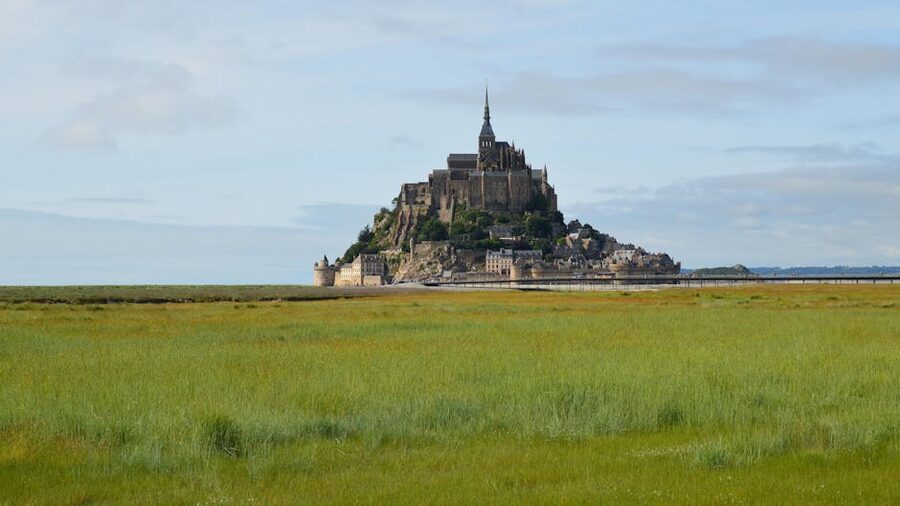
A tidal island commune. Seven hectares of granite rock 1km off the Normandy coast, with a Romanesque-Gothic abbey rising 80 metres above a fortified medieval village. Permanent population: about thirty. Annual visitors: roughly three million. UNESCO World Heritage since 1979.
The legend story: in 708 AD, the Archangel Michael appeared to Bishop Aubert of Avranches in a dream and demanded a church built on the rock then known as Mont Tombe. Aubert ignored him twice. The third time, according to the legend kept in the bishop’s relic at Avranches Cathedral today, Michael burned a hole in the bishop’s skull with his finger to make the point. Construction began that year. The abbey kept building, expanding, and rebuilding for the next thousand years. What you climb today is layered Romanesque (1023), early Gothic (the cloister, 1225), late Gothic (the choir, rebuilt after the 1421 collapse), with prison-era walls from when Napoleon’s regime turned the abbey into a state prison from 1793 to 1863.
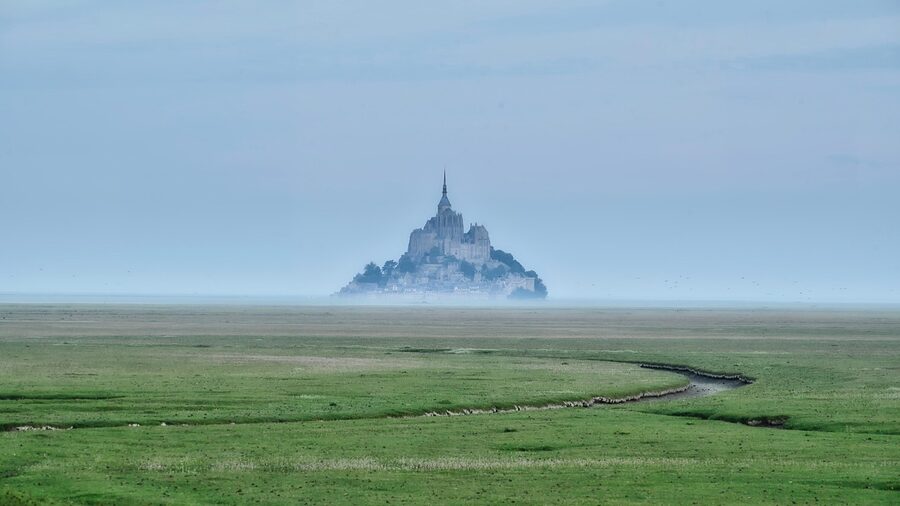
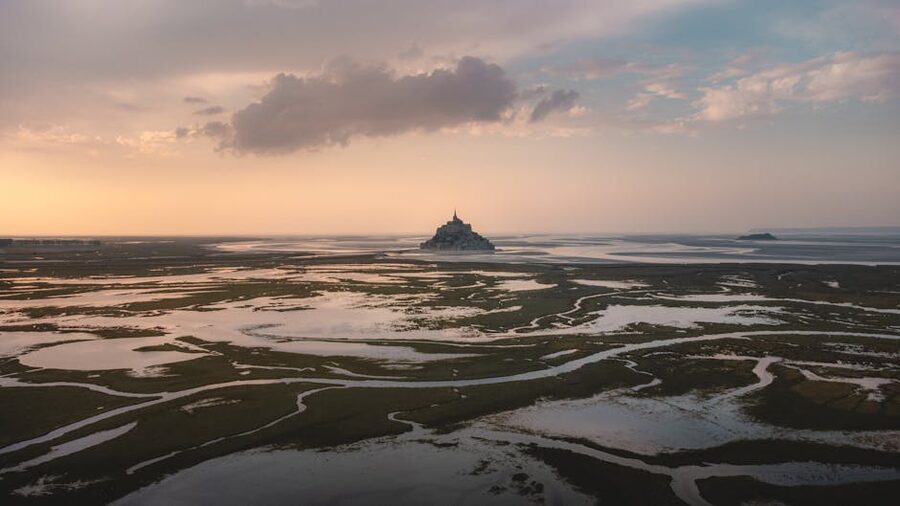
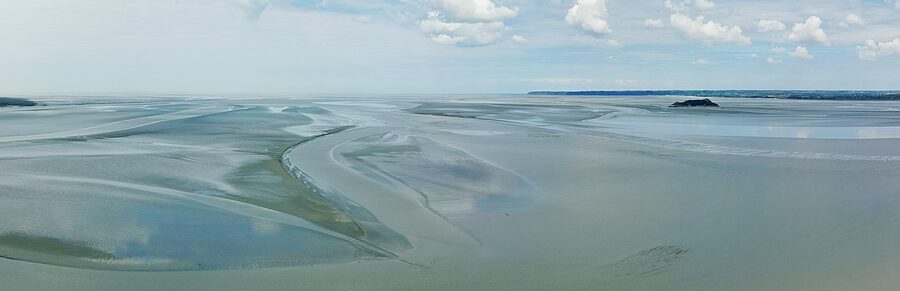
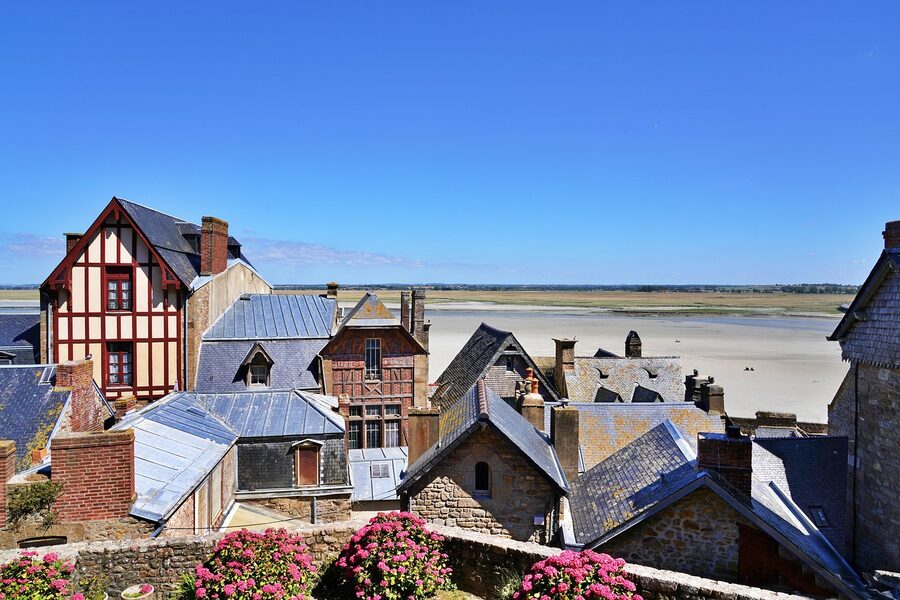
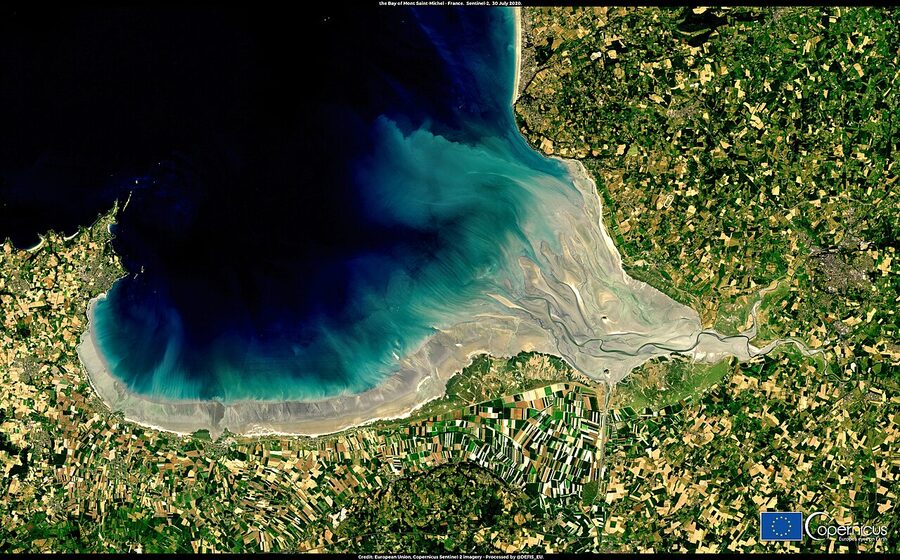
The other thing nobody tells you in advance: the bay around the Mont has the highest tides in continental Europe. The range is 12 to 14 metres. At dead low tide, the sea is 15km out and the rock looks like a hill in the middle of a wet field. At high tide six hours later, the Mont is the island it was built to be. Get a tide chart for your visit day. The abbey is open through both states; the village walk is much better at high tide because the silver water actually touches the walls.
The three ways to get there
By guided coach tour from Paris (the simplest)
This is what 80% of readers will book and it’s the right answer for most. The pickup is somewhere central in Paris between 6:45 and 7:30am. A 50-seat coach (these are real coaches with WiFi and a toilet, not minibuses) drives the A11 to Normandy, with one comfort stop. You arrive at the shuttle terminal around noon. From there it’s the kilometre walkway to the rock. You’ll have roughly four hours of free time, then back on the coach around 5pm and into Paris around 9-9:30pm.
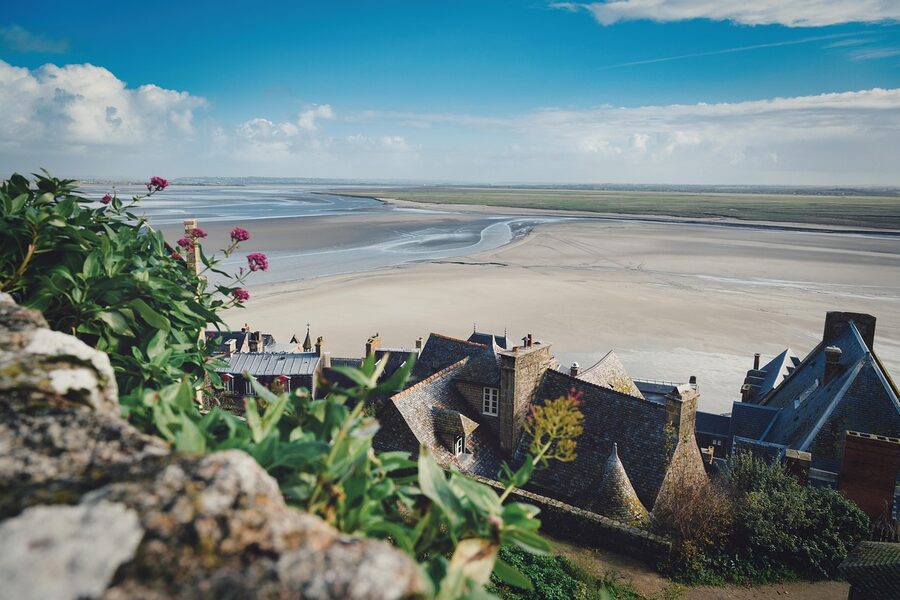
The coach tour is genuinely the easiest option. You don’t manage anything. Whether it’s “worth $153” depends on whether you’d otherwise be navigating the Paris Montparnasse train station at 7am with luggage, then connecting to a regional bus. If yes, the coach is worth it. The free-time format is what we recommend, because the abbey is the kind of place you want to wander, not be marched through.
By TGV + Keolis bus (the budget option)
TGV Paris Montparnasse to Rennes runs hourly from 6:15am. Tickets are $50-90 booked in advance via SNCF Connect, much cheaper than buying same-day. From Rennes station, the official Keolis Mont Saint-Michel bus runs five times a day; the morning departure is timed to the early TGVs and gets you to the Mont around 11am. Round-trip bus is about $30. Total transit cost: $130-220 depending on TGV class and season.
The catch: the day requires you to make connections. Miss the TGV connection and you’ve broken the day. The all-in coach removes that risk for $153 flat. If the price difference matters, the train route works fine, but build in 30 minutes of buffer for the Montparnasse change in the morning.
By rental car (only if you’re already road-tripping Normandy)
4h45 each way via the A11 in normal traffic. Toll roads add about $50 round-trip. Parking is at the shuttle terminal car park (Place des Navettes), $15 for the day. Then the same kilometre walkway as everyone else. The only reason to drive is if Mont-Saint-Michel is one stop on a longer Normandy itinerary. Adding the D-Day beaches the next day, or pairing with Honfleur and Bayeux, makes the car make sense. Driving from Paris just for Mont-Saint-Michel and back is exhausting and the train is faster.
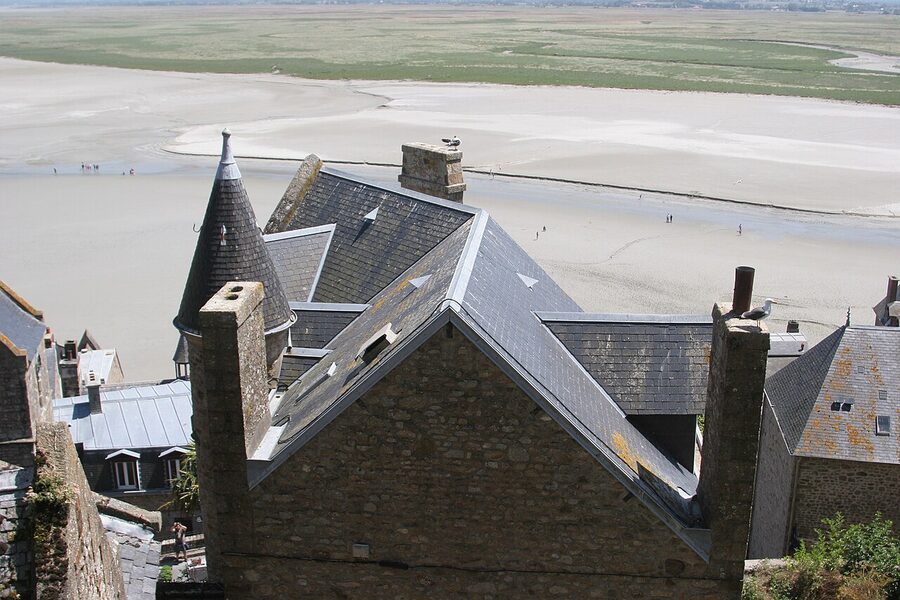
The right structure for the day on the rock
Once you’re at the parking shuttle terminal, here’s the rhythm I’d run. Times assume an 11am arrival.
11:00-11:30: Walk in across the bridge. Don’t take the shuttle. The shuttle saves you ten minutes and costs you the best photographs of your trip. The 1km walkway gives you the abbey approach in slow motion, with the bay opening on both sides. Most coach tours give you the option of bridge-walking; take it.
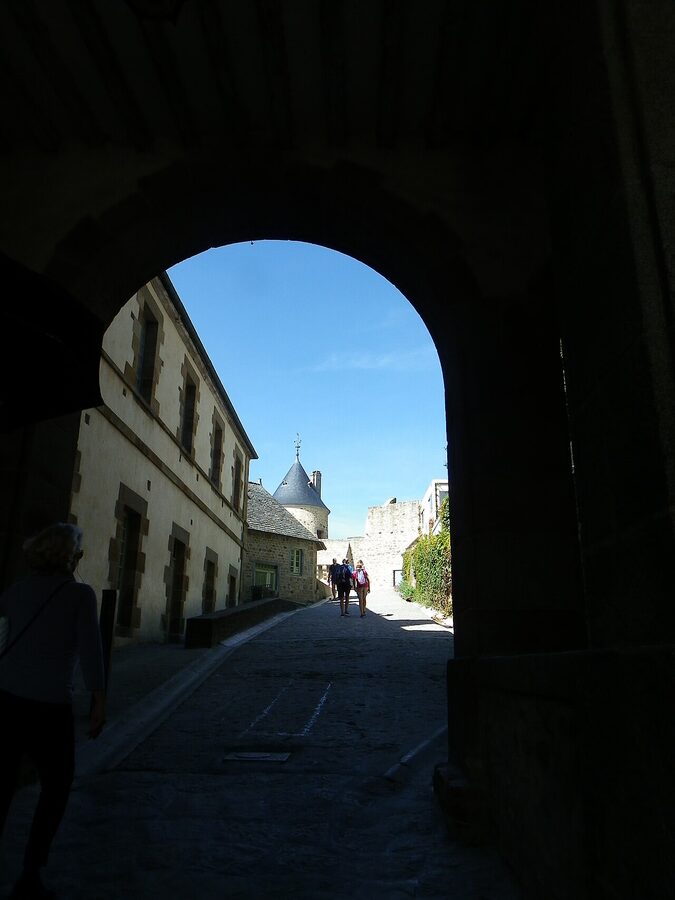
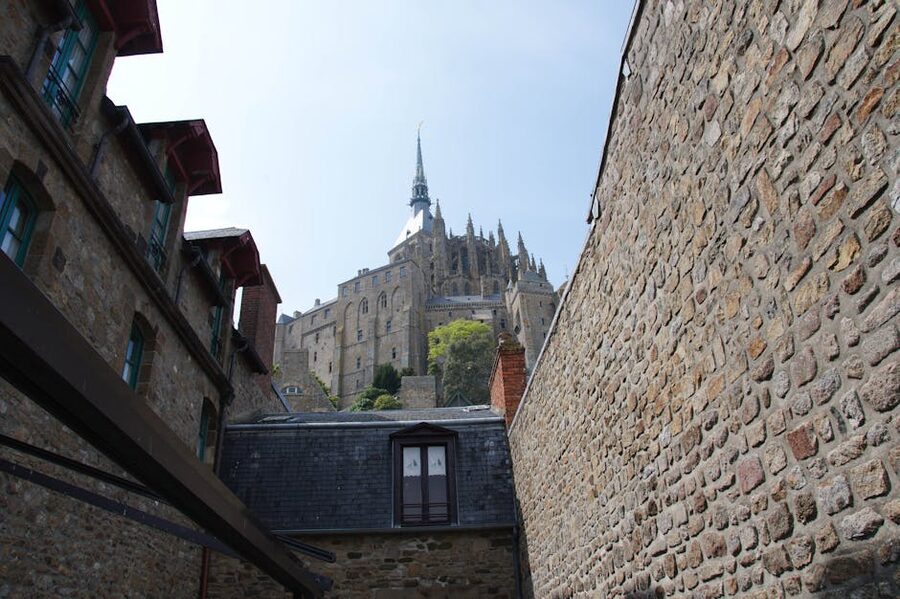
11:30-12:00: Walk the ramparts before going up. The fortified walls run around the village base. Twenty minutes circles you back to the main gate. This is the lap to do before the noon tour-group surge. The view from the ramparts up at the abbey is the angle you’ll be inside in an hour, and seeing it from below first makes the climb feel earned.
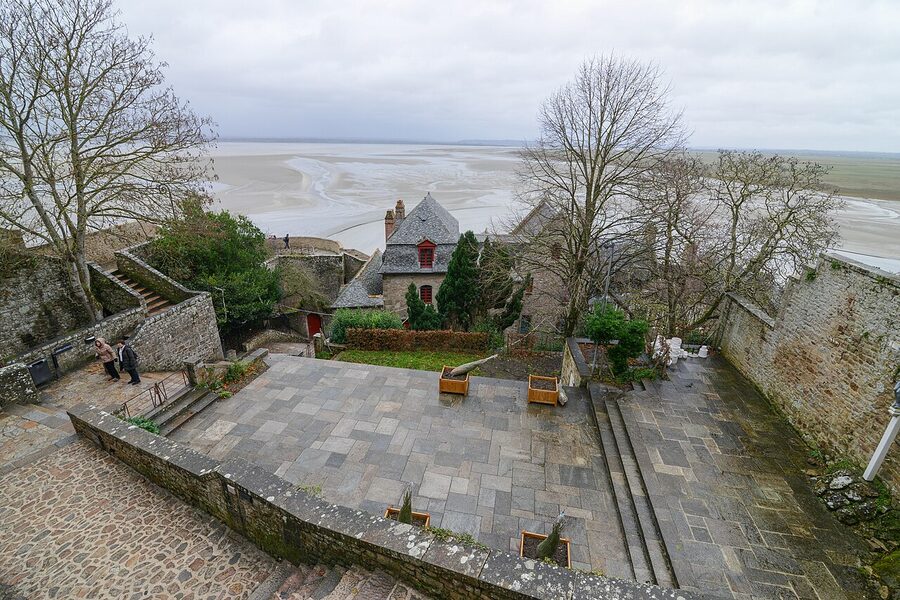
12:00-12:30: Up the Grande Rue, fast. The single village street is 200 metres of cobblestones with about 30 souvenir shops and 20 restaurants packed in. It’s the most touristy stretch of any UNESCO site I can think of. Walk it once for the medieval scale of the alley, but don’t stop to shop and definitely don’t eat here. Every menu is a captive-audience tourist menu and the prices are 1.5-2x what you’ll pay on the mainland.
12:30-15:00: The abbey. Buy the entry ticket online before you arrive (the tour-card section below has the link). Walk-up ticketing in summer is a 30-40 minute queue and there’s no need to spend that time in line. The abbey climb is 350 stairs from the entry. You go up through the Almonry, the Salle des Hôtes (the guests’ refectory), the abbey church at the top with its astonishing west platform open to the sea, then back down through the cloister, the refectory, the crypt of the Big Pillars, and out through the Tour de la Liberté. Allow 90 minutes minimum. Two hours is better.
15:00-15:30: Lunch on the mainland or at the cheap end of the village. If you must eat in the village, La Mère Poulard (the famous omelette place by the gate) is the historic name but charges €40 for an omelette. La Sirène at 6 Grande Rue is the local pick. Better: take the shuttle back to the mainland and eat at one of the brasseries near the parking terminal at half the price.
15:30-16:00: Bay walk if the tide’s right. A guided bay walk takes 2-3 hours and isn’t compatible with the day trip. If you’re staying overnight, this is the thing to add the next morning.
The abbey, what’s actually inside
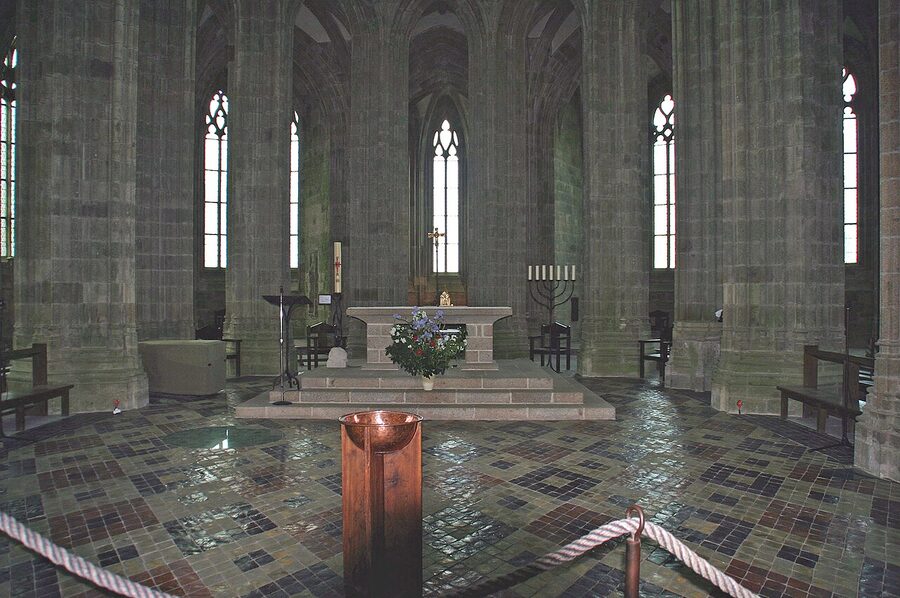
The abbey climb takes you through about a thousand years of construction history in vertical order. The lower halls are the oldest. The Crypt of the Big Pillars (1446) holds up the choir of the church above it; the columns are five metres around because they’re carrying the weight of the entire upper chancel. From there you climb through three storeys of Romanesque guest rooms and refectories, each rebuilt in turn after fires and collapses.
The abbey church is at the top. The nave is Romanesque (early 11th century), the choir is late Gothic (rebuilt after a 1421 collapse). What’s startling is the west terrace you walk out onto in front of the church. The original nave extended further west; three bays collapsed in the 18th century and were never rebuilt, leaving an open platform with the bay 80 metres straight down. On a clear day you can see Tombelaine, the smaller rocky island a kilometre offshore that was once a hermit’s chapel and is now a bird sanctuary.
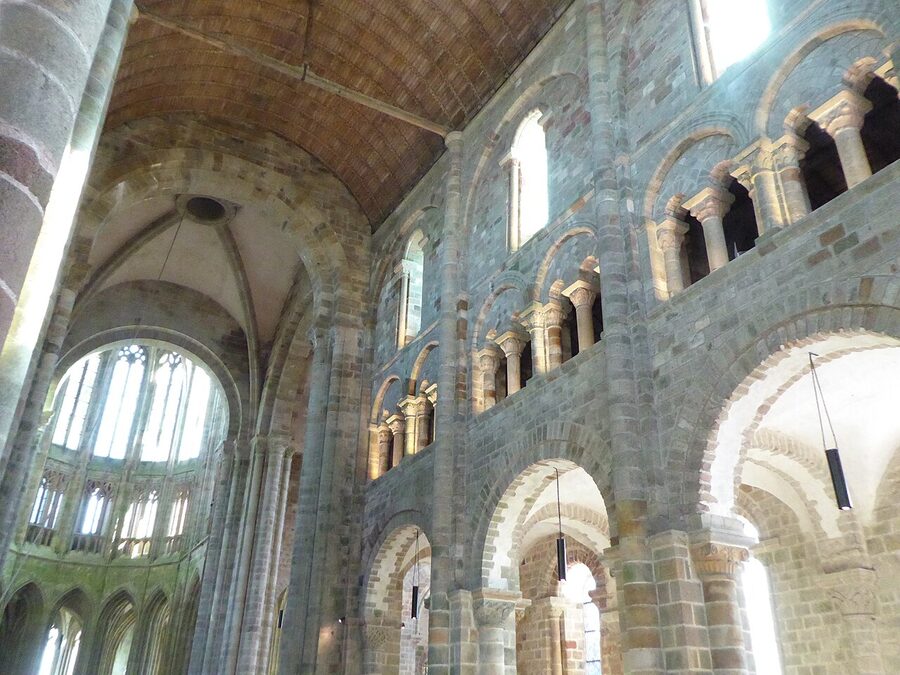
The cloister at the top
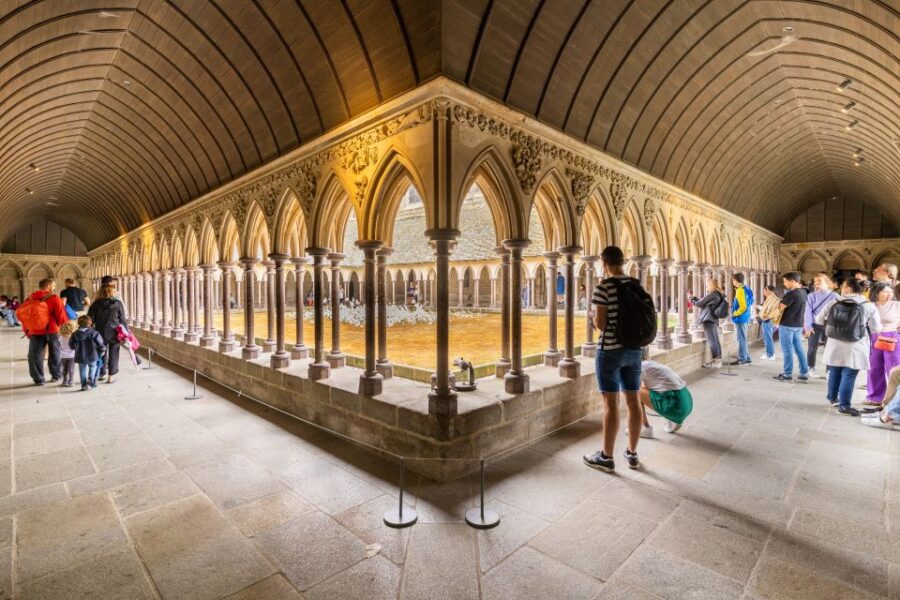
The cloister is the second moment of the climb. After the church, you cross into a square garden surrounded by 227 small slender pillars in two staggered rows. The pillars carry no real structural load; they’re decoration on top of a vaulted hall below them. The genius is the staggering. Standing inside, the pillars never line up, which makes the perspective shimmer slightly as you walk. The garden in the middle is a herb plot, replanted in the 1960s based on medieval Benedictine plans.
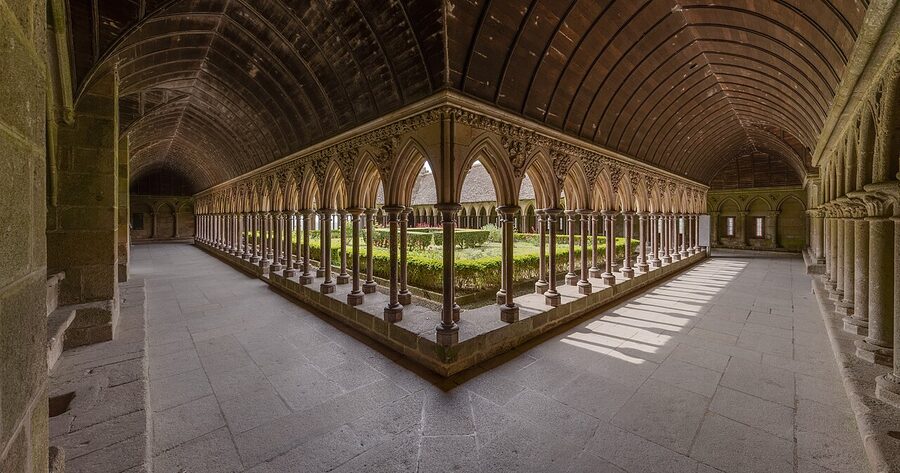
The west wall of the cloister is unfinished and open. The original plan was for a chapter house to be built there. Funds ran out around 1228 and the wall stayed open. The result is a 13th-century accident that frames the bay perfectly through three Gothic arches. This is the angle you’ll see in every photograph of Mont-Saint-Michel that isn’t the rock from outside. Stand at the third arch from the left and the abbey’s drop to the sea is right there.
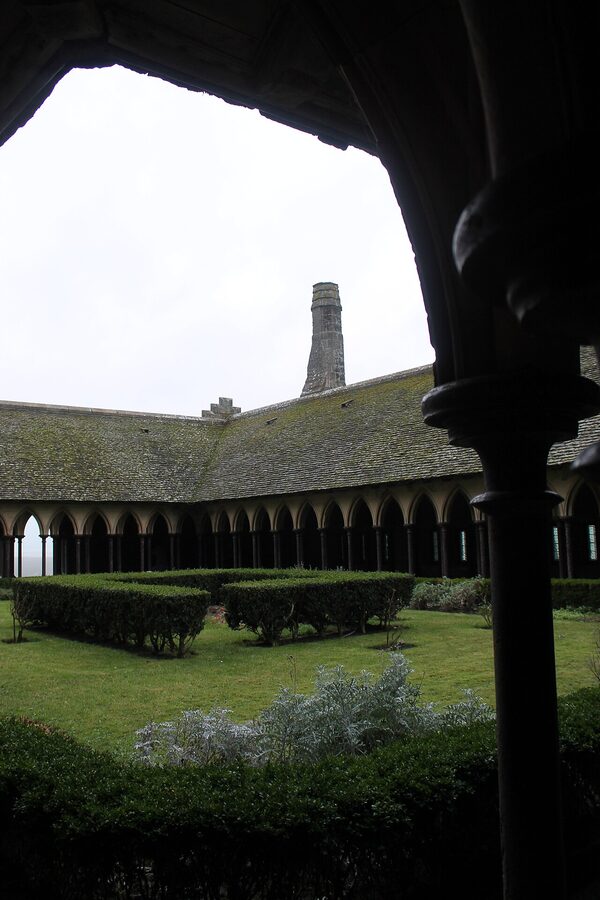
Recommended tours
Three ways to actually book. The first is the abbey ticket on its own, which works if you’re getting yourself to the rock. The other two are the round-trip from Paris in two formats: free-roam coach versus walked-through guide. We’ve used both and they suit different travellers.
1. Mont-Saint-Michel Abbey Entry Ticket: $15
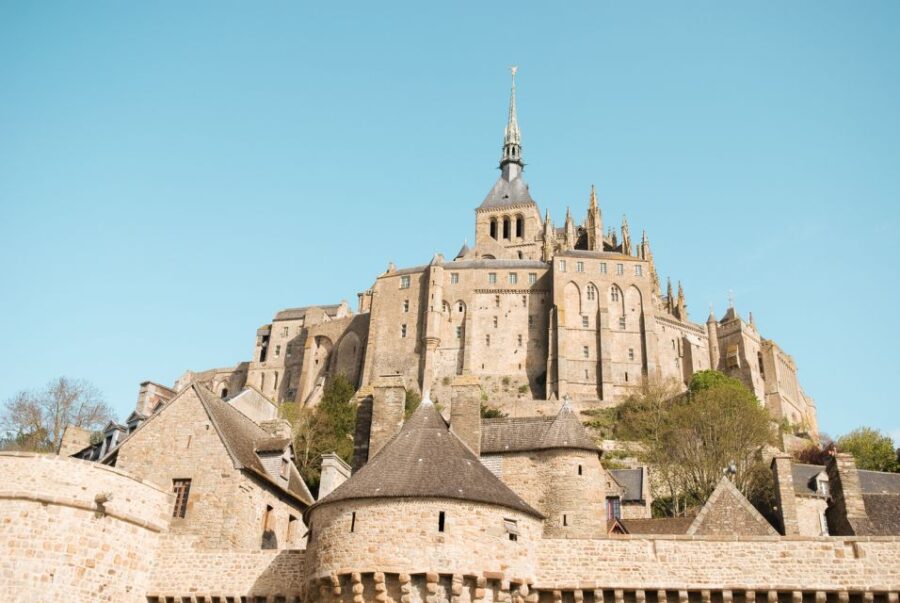
Skip-the-line entry is the entire point at $15, since summer walk-up queues at the ticket office hit 30-40 minutes by 11am. Our full review of the abbey ticket covers the smartphone audio guide and what’s included (almost everything; the only paid extras are the optional guided upgrades). Buy this one if your transport is already sorted.
2. Day Trip From Paris by Coach: $153
This is the right answer if you want one ticket that handles the whole day, including the abbey entry that kills the queue on arrival. You get four hours of free time to walk in across the bridge, do the abbey at your own pace, and eat where you want. Our review of this coach tour covers the comfort-stop schedule, the rebooking flexibility, and which Paris pickup point is least painful.
3. Day Trip From Paris with Guide: $128
Pick this if you’d rather have someone walk you through the architecture than wander the abbey alone. The guides for this run hold accreditation from the French ministry of culture and the abbey access stops are spaced so you still get free time at the village level. Our take on this guided version notes the smaller-group format and the bilingual English-French structure that some guests find slows pace.
The tide situation, in plain language
The tides at Mont-Saint-Michel are 12-14 metres at the highest. In Europe only the Bay of Fundy in Canada is bigger globally. At the highest spring tides (called grandes marées, with tide coefficients above 110), the rock is fully surrounded by water and the new pedestrian bridge stays passable but is splashed at the edges.
What this means for your day:
- The shuttle bridge is always passable. The 2014 footbridge was engineered specifically so the highest tide can flow through and around it without flooding the walkway.
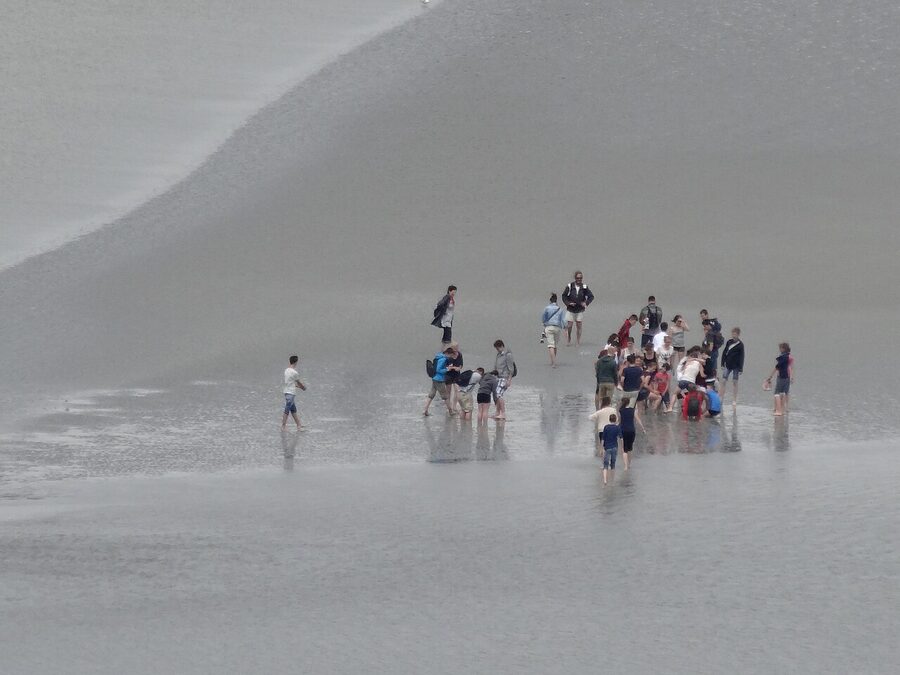
- The 15km mudflat receding tide is not safe to walk solo. Quicksand patches and the speed at which the tide returns kill people every few years. Only walk the bay with a licensed guide.
- The “rock as island” photo only works at high tide. If the famous photograph is the reason you came, check the tide chart before booking and aim for a high-tide hour during your visit. The website horaire-marees.fr has a free tide table for the bay.
The 1879 causeway, which connected the rock to the mainland for 135 years, was the reason the bay slowly silted up. The Mont was losing its tidal character, becoming part of the mainland by sediment build-up. The 2014 footbridge replaced it precisely so the tides could resume their work; the causeway was demolished in 2015 and the rock has been returning to its original island state ever since.
The history, briefly
The dates that matter to a visitor:
708 AD: Bishop Aubert of Avranches builds the first oratory after the Archangel Michael’s three-visit demand. The tradition holds that Aubert’s skull, with its small hole still visible, is preserved in the basilica at Saint-Gervais d’Avranches today. Whatever you make of the legend, archaeology has confirmed an 8th-century pre-Romanesque structure under the current abbey.
966 AD: Duke Richard I of Normandy hands the rock to Benedictine monks from Mont Cassino. The Benedictines run the abbey for 800 years until the French Revolution. Their library at the Mont was one of the most important scriptoria in medieval Europe; the manuscripts now sit in Avranches’ municipal library and are still studied today.
1023-1080: The Romanesque abbey church is built on the rock’s summit. The trick was that the summit wasn’t flat; the engineers built four crypts on the slope to create a level platform. The crypts you walk through on the climb are those load-bearing supports.
1421: The Romanesque choir collapses. The Hundred Years’ War is on, the English are besieging the rock, and the rebuild has to happen under wartime conditions. The Flamboyant Gothic choir you see today was finished in 1521.
1791: Revolutionary France suppresses the Benedictine community. The abbey becomes empty for the first time in 800 years.
1793-1863: The abbey is converted into a state prison. Up to 14,000 prisoners passed through. The Salle des Hôtes that you walk through now was the prison dormitory; the heavy bars on certain windows date from this era. Victor Hugo led a public campaign to close the prison and restore the building, and in 1863 Napoleon III shut it down.
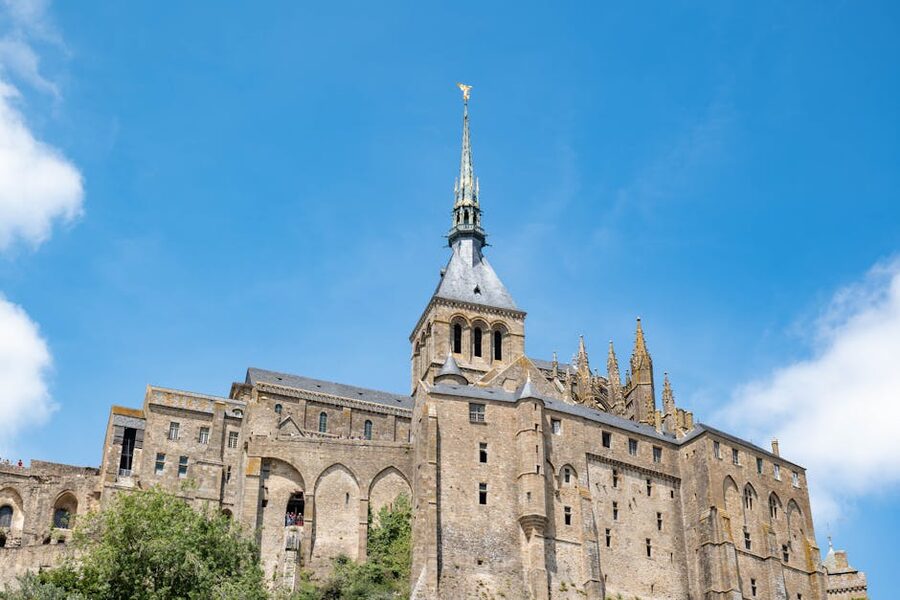
1874: Restoration begins under architect Édouard Corroyer. He’s the one who put back the spire and the gilded statue of the Archangel Michael at the very top, finished in 1897. Most of what you photograph from below is medieval; the silhouette at the very tip is late 19th-century reconstruction.
1979: UNESCO World Heritage designation.
2014: The footbridge replaces the 135-year-old causeway, restoring the tidal flow around the rock.
2017: The Benedictine community returns. Today, twelve monks of the Fraternités Monastiques de Jérusalem live and work in the abbey. They sing the offices in the church (open to visitors at certain hours; check the abbey website for that day’s schedule). It is one of the few places where a working monastery is also a paid-entry tourist site.
What about staying overnight?
If your trip can absorb a night, this is the upgrade. The village inside the walls has about a dozen small hotels and B&Bs; together they hold maybe 100 beds. Auberge Saint-Pierre and Hôtel du Mont Saint-Michel are the two best in the village; both run €200-350 a night in season and book six to nine months ahead.
The cheaper option is to stay on the mainland in Pontorson (8km away, hotel rooms €70-110) or in the visitor centre area at La Caserne (right next to the parking shuttle terminal, €100-150). Either lets you do the same morning-on-the-rock trick without the village-bed price.
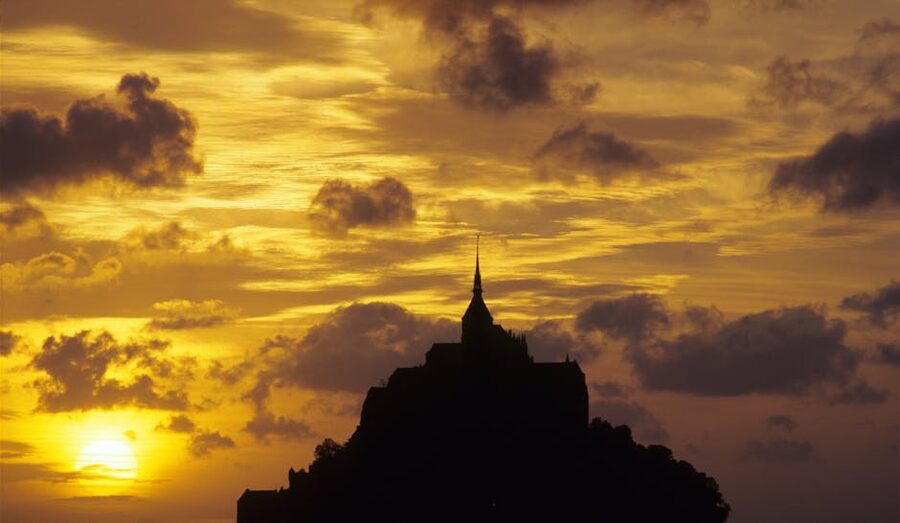
The reason to do this: at sunset the rock empties. The abbey closes at 7pm in summer, the last shuttle for day-trippers leaves around 8pm, and from that point the village ramparts are essentially yours. You eat in the village, walk the walls in the dark, and watch the rising tide come in around the base of the rock. Then you wake up at 8:30am, walk to the abbey for the 9am opening with maybe twenty other people, and have the cloister for ten quiet minutes that no day-tripper ever gets.
What to skip
Some real cuts based on a day at the rock.
La Mère Poulard. The famous 1888 omelette restaurant at the village gate. €40 for an omelette is a tourist-trap price, and the omelettes themselves are not worth the writeup. The history is real (Annette Poulard fed pilgrims here from 1888 onward and the recipe is famous), but the modern restaurant is a high-volume tourist operation.
The Maritime Museum, the Archeoscope, and the Tiphaine House. These are three small ticketed museums halfway up the Grande Rue. They’re tourist-trap fillers. Skip all three. The abbey ticket is the only one worth its money on the Mont.
The “best photo” tripod-spots from the road. The most famous Mont-Saint-Michel photographs were taken from the airport in Pontorson with a long lens or from a helicopter. You can’t replicate them with a phone from the parking lot. Don’t spend an hour trying. The walk-in across the bridge gives you a better photograph than any roadside angle.
Driving from Paris just for the day. If you don’t have other Normandy stops, the drive is a brutal use of a French day. Take the coach, take the train, take an overnight. Don’t rent a car for this single attraction.
Practical micro-details
- Abbey ticket: $15 self-guided, $25 abbey + paid guided tour upgrade. Free for EU residents under 26 with ID and for everyone on the first Sunday of the month from November to March.
- Abbey hours: 9:30am-6pm October-April; 9am-7pm May-September. Last entry one hour before close.
- Abbey closed: 1 January, 1 May, 25 December.
- Best months: April-June and September-October. July and August are punishing in the village street; February-March are quiet but the abbey’s shorter hours compress the day.
- Tide chart: Free at horaire-marees.fr. Pick a day with high tide between 11am and 4pm if the photograph matters.
- Parking: Place des Navettes, €15 for the day. Walking from the parking to the rock is 2.5km; the free shuttle covers it in 12 minutes.
- Shuttle hours: Roughly 7:30am to midnight, every 8-12 minutes in season.
- Wheelchair access: The lower abbey halls are accessible. The upper abbey (church, cloister, refectory) is not. The village street is steep cobblestone and tough on mobility devices.
- Cash: Not needed. Cards work in every shop and restaurant.
- Toilets: Free public toilets at the parking shuttle terminal and at the village base near the gate. The village interior is short on free toilets.
- Phone signal: Decent throughout the village; weak inside the abbey’s lower halls.
Where Mont-Saint-Michel fits in a longer trip
If your trip is Paris-only and one Normandy day, this is the day. If you have two Normandy days, pair Mont-Saint-Michel with the D-Day beaches and Bayeux. The two stops sit naturally either side of a single Normandy itinerary, and a guided two-day combo from Paris lets you drop the Paris-Mont commute on day two. We’ve covered both as separate one-day trips because most readers do one or the other; the two-day combo is the upgrade for Normandy-curious travellers who don’t have a week.
If your trip is built around Paris, this slot competes with two other genuinely worthwhile day trips. Versailles is the standard pick because it’s only 30 minutes from Paris on the RER C, which means you have most of the day at the chateau and most of the evening back in the city. Giverny, Monet’s garden in Vernon, is a softer half-day that pairs well with a morning at the Musée d’Orsay or l’Orangerie. Mont-Saint-Michel costs you the whole day. It’s the only Paris day trip that does. If you’re cross-shopping European capital day trips, the same all-day commitment applies to Keukenhof from Amsterdam in tulip season: the train-plus-shuttle to the gardens swallows the day the same way the Mont swallows yours, with the difference that Keukenhof only opens for eight weeks a year.
Quick comparison: Mont-Saint-Michel vs the other long Paris day trips
The closest comparison case to Mont-Saint-Michel from Paris is the Loire Valley castle day trip. Both are 2-2.5 hours each way by TGV, both involve a coach or rental car for the local connections, and both reward an overnight far more than a day trip. The Loire’s advantage is that you can pack three or four sites into one day (Chambord + Chenonceau + a bonus chateau and a wine tasting); Mont-Saint-Michel is a single site and the bridge walk. If your taste runs to architecture and Renaissance interiors, Loire wins. If your taste is for raw geography and a single overwhelming object on a horizon, Mont-Saint-Michel.
The other UNESCO sites that get compared to it tend to share the “ancient construction on improbable terrain” thing. Italy’s Matera sassi cave-houses are the closest sister site in Europe (both UNESCO, both ancient layered architecture, both reframed by 20th-century preservation campaigns). Spain’s Alhambra is the next-closest European hilltop fortress experience, with the same approach-from-below-and-climb-up structure. And the Florence Duomo, where you also climb 463 steps to reach a similar bay-or-city horizon, is the closest single-spire-architecture comparison; if you’ve already climbed Brunelleschi’s dome, the abbey climb at Mont-Saint-Michel feels like the gothic Romanesque cousin of the same instinct: build something improbably high on something improbably tall. The Dutch parallel for the day-trip-from-the-capital part of the formula is Zaanse Schans from Amsterdam: a short train, a quick coach, a single iconic vista (windmills on a polder canal instead of an abbey on a rock), and the same logic of compressing a country’s identity into one out-of-town day.
The view from the top, finally
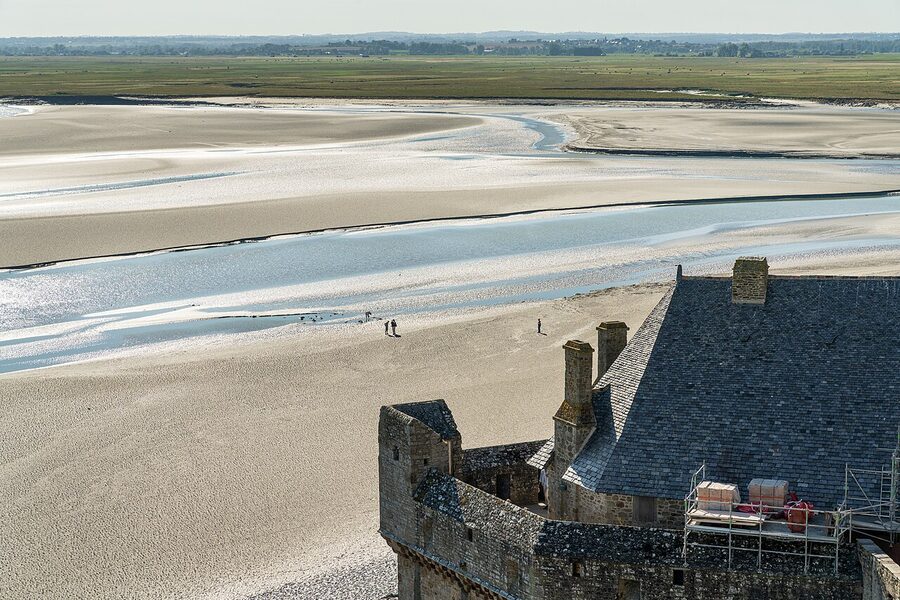
By the time you reach the west platform of the abbey, you’ve climbed 80 metres of stone stair through 1,000 years of construction. The view opens west across the bay to Tombelaine and the Brittany coastline beyond it. On a clear day in spring you can see Cancale, the oyster town, on the horizon to the southwest. The wind here is unfiltered. There’s nothing between you and the open Atlantic except a thousand years of vertical building and 15km of tidal flat.
This is the moment that makes the day trip worth it. Whatever the train timetable cost or the coach seating felt like, you climb out onto the platform and the geography does its work. You’re standing on the highest point of an island that’s an island only sometimes, looking at a bay the size of a small country, with the rock you’re standing on slowly emptying of day-trippers behind you as the afternoon shuttle leaves. Stay until the abbey closes if you can. Walk down through the cloister one more time. Take the last shuttle out.
Pairing this with the rest of France
Most readers pulling Mont-Saint-Michel into their itinerary are also booking the Eiffel Tower, doing a Seine cruise on a Paris evening, and either Versailles or the Loire as a second day trip. The Mont fits best on a day where you’re willing to commit to nothing else. If you’re already planning a day at Sainte-Chapelle and the Conciergerie, that pairs with a morning on Île de la Cité, not a day in Normandy.
If your trip is going further south, Lyon and Carcassonne are the two stops worth knowing about as alternatives. Lyon is the food city and the Rhone confluence; Carcassonne is France’s other UNESCO walled-medieval-town, and the closest thing in spirit to Mont-Saint-Michel that France has. Carcassonne is built on a hill not on a rock in the sea, but the sense of climbing through layered medieval defensive walls into a religious-civic core at the top is very similar. If you’ve done Mont-Saint-Michel and want the same architectural feeling somewhere quieter, Carcassonne is the southern equivalent.
One more thing about the silhouette
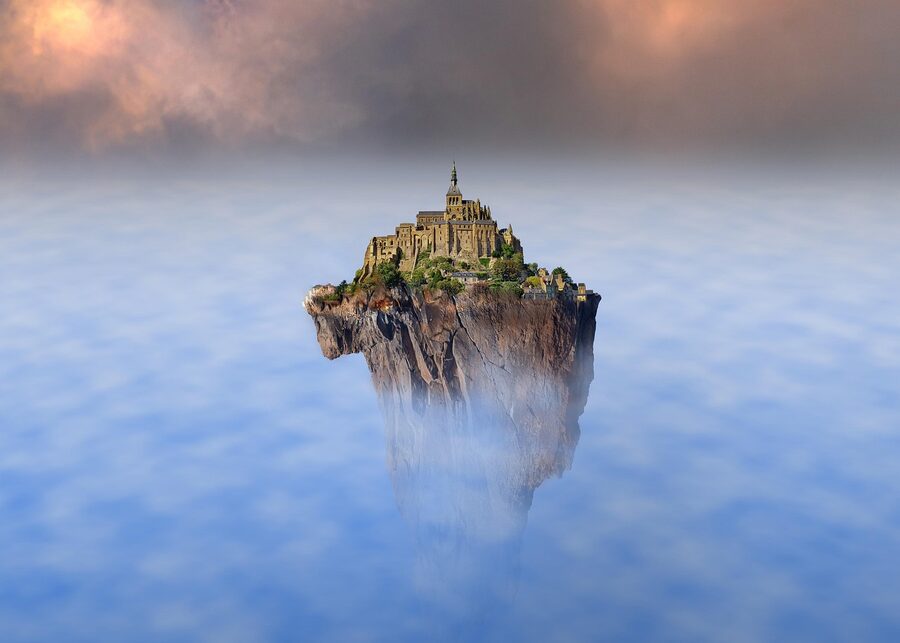
You may notice Mont-Saint-Michel feels familiar even if you’ve never been. Walt Disney’s animators in the 1950s based Cinderella’s castle silhouette partly on Mont-Saint-Michel and partly on the Bavarian castle of Neuschwanstein. The pyramidal tapered ascent up to a single tall spire on a fortified island base is what made the rock so visually appealing to the animators. So when you step out of the shuttle and look up at the rock for the first time, the reason it looks like a fairy tale is that it has been the source of one. The fairy tale started here, in 708 AD, with a bishop and a stubborn archangel and a hole in the side of a head.
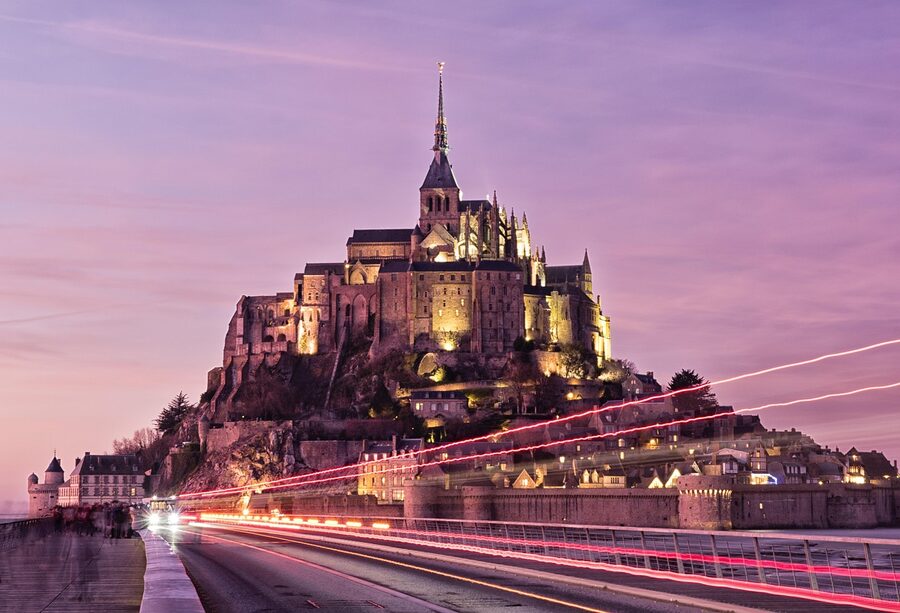
The rock is worth the day. Plan it carefully, get the right ticket, and time the climb so you reach the abbey’s west platform before the sun moves behind it. If you can stay overnight, do that instead of the day trip. Either way, this is the one site in France where the cliché lives up to itself.