
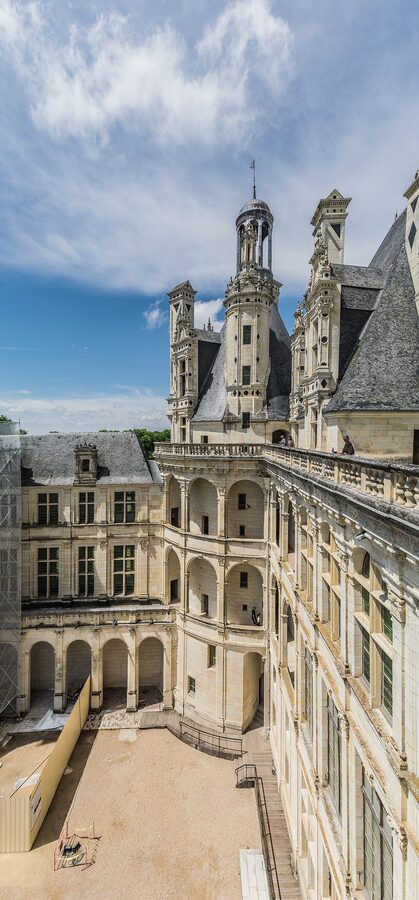
Halfway up the central staircase at Chambord, you stop and lean over the stone balustrade. Someone is climbing the other spiral about three metres across the open well from you. They lift their hand. So do you. You are walking up the same staircase, on the same level, in the same direction, at the same speed. You will not meet. There are two of you, climbing two intertwined spirals around one shared central column, and at no point in the next three storeys will the two of you actually share a step.
That moment is the editorial spine of a visit to Chambord. The double-helix staircase at the centre of the keep is one of the most quietly radical pieces of Renaissance engineering anywhere in Europe. Most modern guides will tell you Leonardo da Vinci designed it. The truth is messier and the timing alone is reason enough to give the attribution at least a hard look. Leonardo died at the manor of Cloux in Amboise on 2 May 1519, about 40km west of the Chambord building site. Construction at Chambord broke ground that September. The staircase has technical cousins in his sketchbooks. He had spent the previous three years at Amboise on François I’s payroll, doing exactly the kind of speculative engineering that a 24-year-old king would have asked him to draw up.
That’s the romance. The reality is that Chambord is a 17-year-old king’s hunting lodge that grew, over 28 years and four wings, into a 440-room fantasy palace that he barely lived in. François I slept here for about 50 nights in his entire reign. The building was never quite finished. The man who commissioned it died in 1547 while it still had open walls. Henry James, walking the rooflines in 1884, called the place “an architect’s nightmare” and meant it as something between an insult and a compliment. He was right both ways. Chambord is the most-visited château in the Loire and the strangest building in France. Here’s how to actually get inside it.
In a Hurry
Chambord skip-the-line entry ticket: $24. The cheapest way through the door, valid for the keep, the rooftop terrace, and the gardens. Book direct.
Loire castles day trip from Paris with wine tasting: $104. The full set, Chambord plus Chenonceau plus a vineyard stop and a Blois lunch. Picks you up in central Paris, gets you back by dinner. Book direct.
Full-day Loire châteaux tour from Paris: $127. Coach from central Paris, longer time inside Chambord, smaller-group feel. The pick if you want a guide doing the heavy lifting. Book direct.
The double-helix staircase, and why everyone keeps mentioning Leonardo
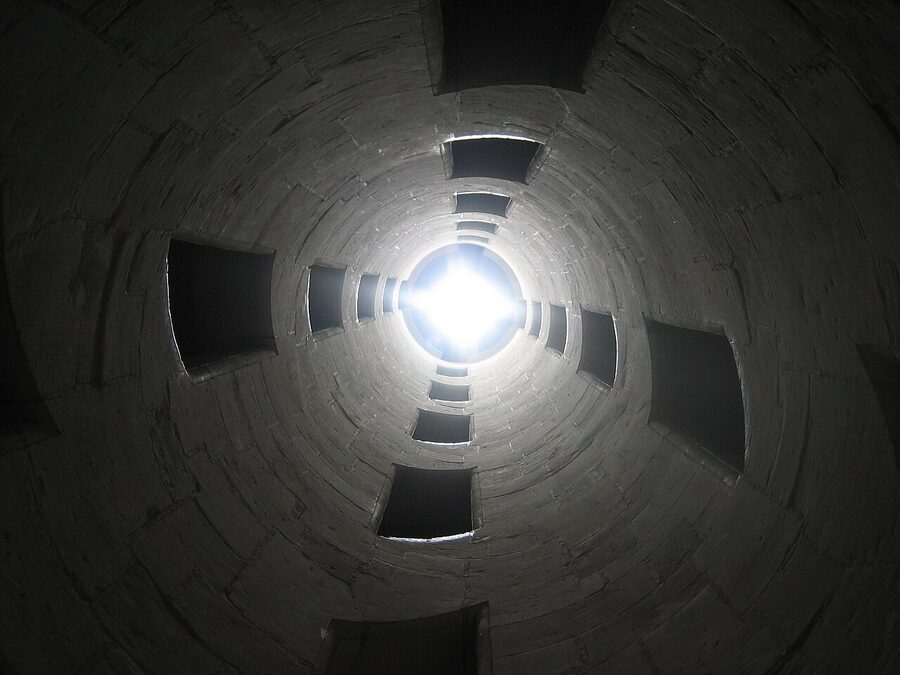
The staircase sits at the dead centre of the keep. Two intertwined spirals, four open landings on each level, four storeys high. The landings line up so that someone on the opposite spiral is always visible across the central well. The geometry is doing two jobs. It separates traffic, so the king’s hunting party going up doesn’t crash into the servants going down with the linen. And it produces a kind of social theatre, where you can see and be seen across the well without ever having to actually meet the other person at a doorway.
Leonardo’s notebooks contain a sketch in the Codex Atlanticus that shows two interlaced spiral staircases around a central core. There’s also a separate drawing in his manuscript notebooks of a single spiral with a hollow open well, which is the engineering trick that makes the Chambord stair work at all. The dates are tight. The geographic proximity is tight. Leonardo’s known work for François I in those last years included consulting on royal building projects. None of that is proof. There’s no signed drawing for Chambord, no contract that names him as architect. The official record names Domenico da Cortona for the original wooden model and Pierre Nepveu for the on-site supervision, with an “architect unknown” hedge for the master plan.
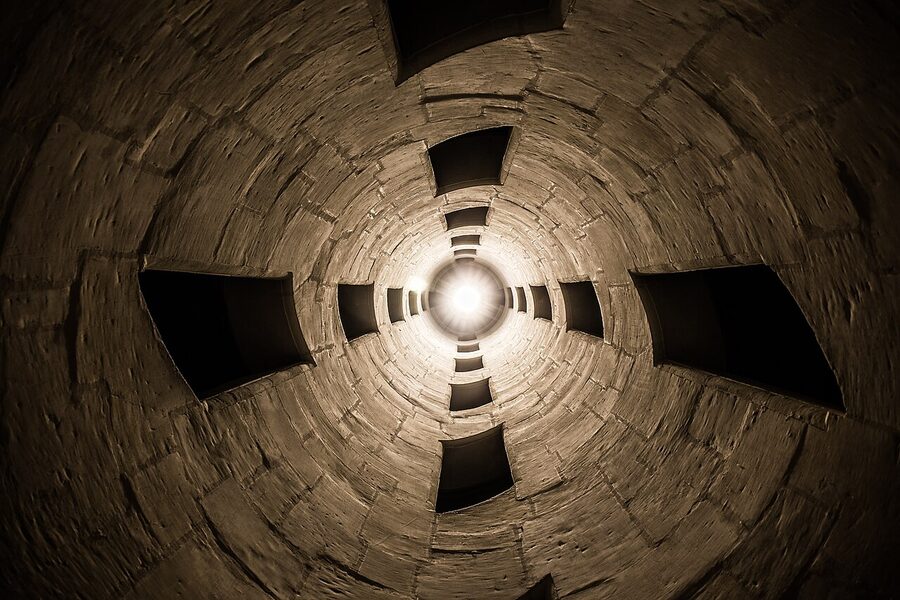
So here’s how I’d put it. The staircase is plausibly Leonardo’s idea, executed by someone else, modified during construction, and then redesigned again in the 1530s when the upper section was finished. The Leonardo attribution is what gets repeated because it’s a better story, because the geometry feels like him, and because every visitor remembers it. If you’ve made the Da Vinci pilgrimage in Italy already, this stair belongs on that list with the Last Supper in Milan, the Mona Lisa at the Louvre, and his machine reconstructions at the Museo Nazionale della Scienza and the Leonardo Interactive Museum in Florence.
One practical tip. Climb it once at the start of the visit when the keep is still mostly empty. Then come down it about an hour later, after you’ve done the upper rooms and the roof. The view changes. You see what you missed.
What you’re actually looking at: the building in two minutes
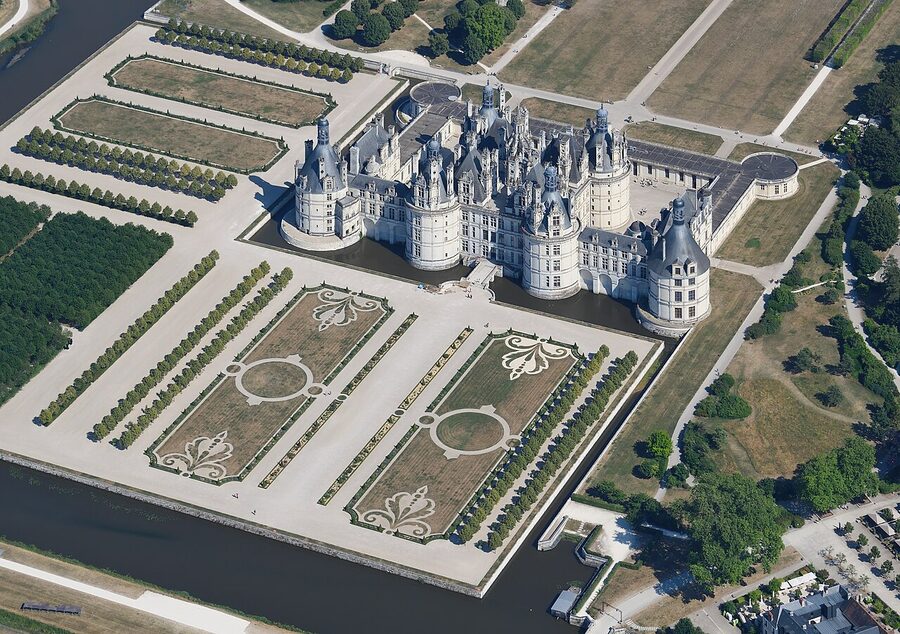
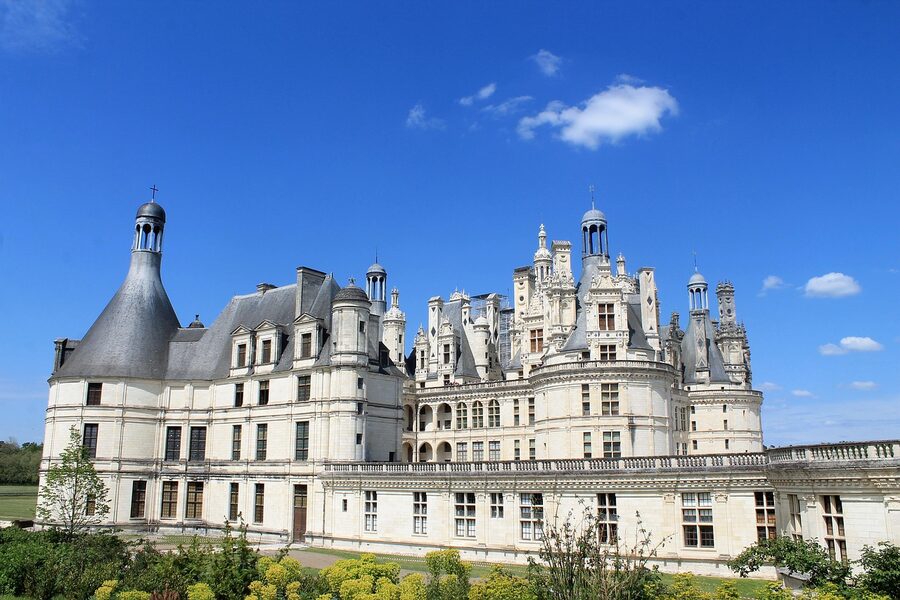
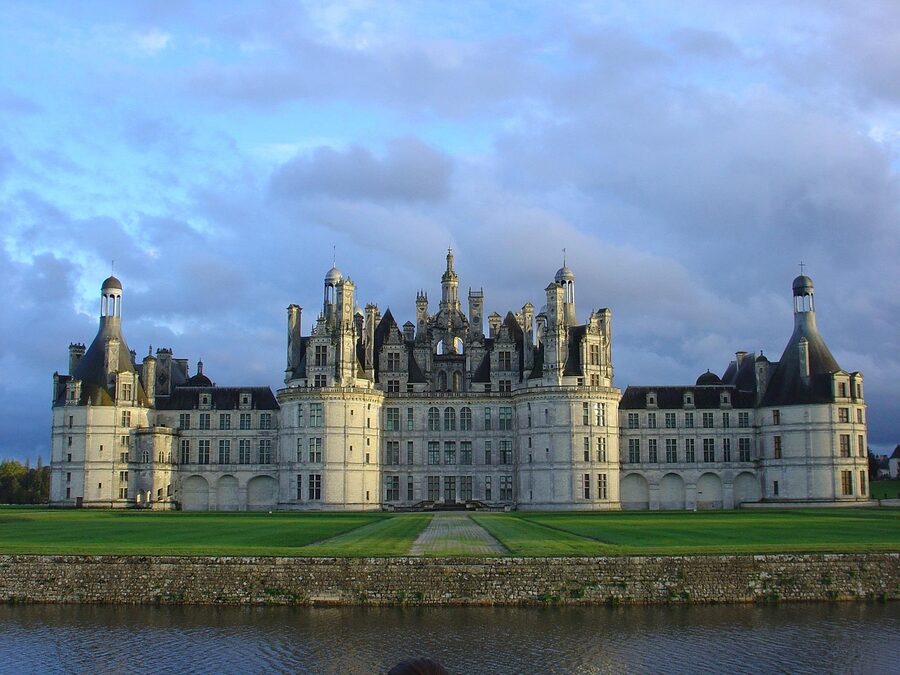
The footprint is simple once you see it from the air. There’s a square central block with four round towers at the corners. That central block, called the donjon or keep, holds the famous staircase, the four cross-shaped halls on each floor, and the original 1519 royal apartments. Then a low wall runs around the keep on three sides, with two longer wings projecting to the east and west and another tower at each outer corner. That whole outer ring was an afterthought. François I added it from 1539 onwards because the keep alone was too small for a court of 2,000 people.
The numbers people quote at you are real. 440 rooms or so, depending on how you count partitions. 282 fireplaces. 84 staircases. 365 chimneys, which is the number that gets the legend treatment. 32,500 square metres of interior floor space. A 5,440-hectare park surrounded by a 31km perimeter wall, the largest enclosed forested park in Europe, with red deer and wild boar living wild inside it.
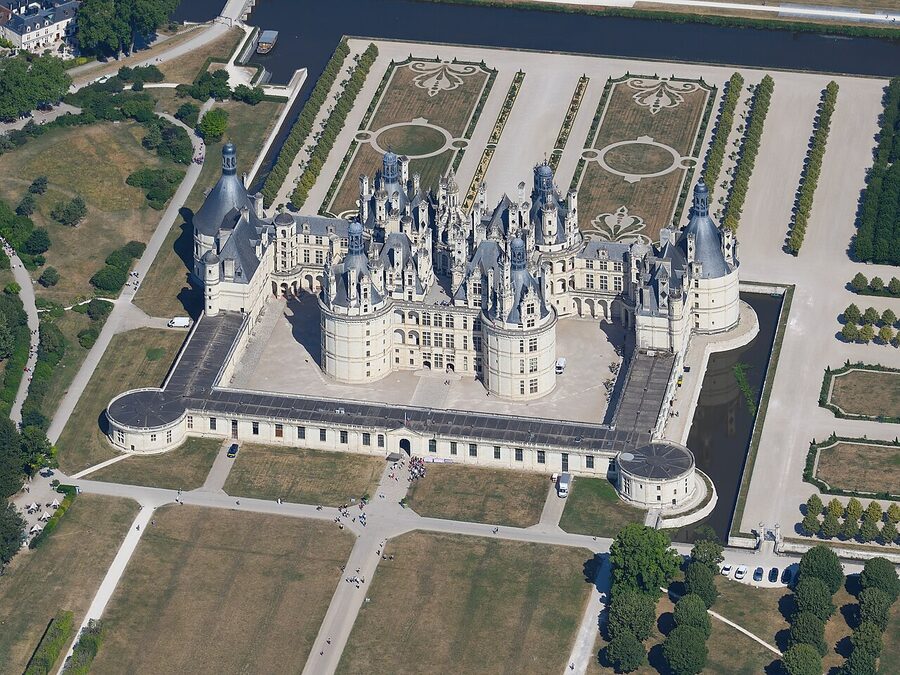
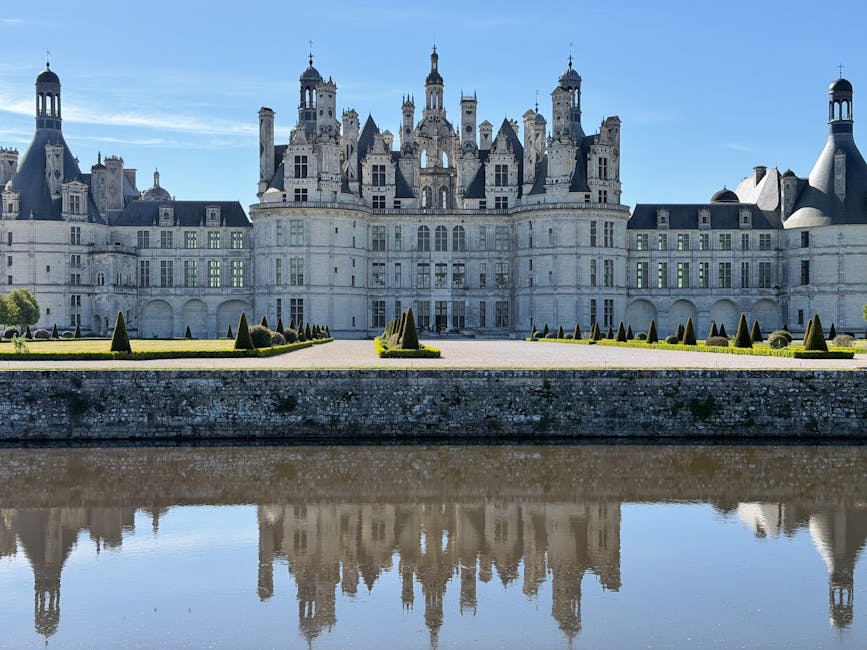
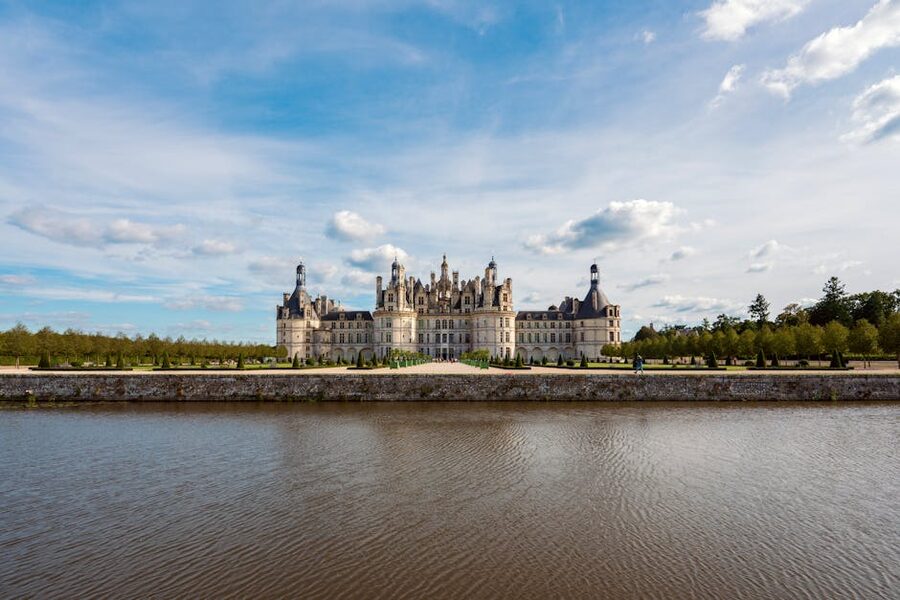
The orientation is worth knowing before you go in. The northwest facade is the photogenic one, the one that ends up on every postcard, with the Cosson canal in front of it producing the famous reflection. The southeast facade is the back. It’s much plainer because the corner of the original keep that should have been mirrored on the south side was never built out to the same level of decoration. If your guide brings you up the entrance road from the south, the building doesn’t fully reveal itself until you walk around to the front. Don’t form your opinion from the first angle.
Booking and tickets, the practical version
The standard adult ticket is around $24 at the official site. Children 6 to 17 pay about $9. Under-6s are free. EU residents under 26 are free with ID. Paris Museum Pass holders get free entry, which becomes relevant if you’re combining Chambord with a long Paris run. The grounds, the canal, the perimeter walls, and most of the park are free to walk in and around. You only need a ticket for the building itself.
You’ll see two pricing approaches online. The official château website sells direct tickets at the gate price plus a small booking fee. Third-party resellers like GetYourGuide and Viator sell at the same price band but with the convenience of a mobile-readable QR code and a clean cancellation policy. The skip-the-line difference, in practice, is small. Chambord doesn’t have the kind of two-hour security queue you get at the Eiffel Tower or the Louvre. On a midweek morning in March you might walk straight in. On a peak-summer Sunday afternoon the queue can be 30 to 45 minutes. Pre-booked tickets save you that.
Opening hours are 09:00 to 17:00 in winter (October to March) and 09:00 to 18:00 in summer (April to September). Last entry is 30 minutes before close. The building is closed 1 January, the last Monday of November, and 25 December. Outside those three days it’s open every day of the year. Don’t fall for the “closed Mondays” assumption that applies to most French museums. Chambord is open every Monday.
If you’re booking from outside France, the GetYourGuide skip-the-line ticket is the clean default. The price matches the official gate price. Cancellation is free up to 24 hours out. The QR code works at the entrance gate without you needing to pick up a paper ticket. If you’d rather pay the official site direct, that’s chambord.org and the booking system there is in English. Skip the resellers that quote prices in dollars without saying “Chambord direct” anywhere on the page; some of those repackage the same ticket with a 30% markup.
Getting there, by car, by train, or by tour from Paris
Chambord sits 175km south of Paris in the Loir-et-Cher department. By car from central Paris you take the A10 motorway south, exit at Mer or Blois, and follow signs through the forest of Chambord. Total drive time is about 2h 15 minutes outside rush hour. Tolls are around €25 each way. There’s a vast paid car park at Chambord itself, €6 for the day, about a 10-minute walk from the front facade. Don’t park outside the boundary trying to save the fee. The walk in is much longer than it looks on the map.
By train it’s complicated. The nearest railway station is Blois-Chambord, on the Paris-Saint-Pierre-des-Corps line. From Paris Austerlitz the journey to Blois takes 1h 30 to 1h 45 minutes on the standard Intercités train, or about 1h 5 minutes if you connect via TGV through Saint-Pierre-des-Corps and back-track. From Blois station to Chambord itself is another 17km, and there’s no train. The shuttle bus, the Rémi Chambord-Cheverny line, runs roughly six times a day in summer and four in winter, takes 40 minutes, and costs about €3 each way. Outside summer the bus schedule is genuinely thin, so check before you commit.
If your French is up to it, the simplest train option is Paris Austerlitz to Blois, then a taxi from the station rank, about €25 to €30. The taxi splits cleanly across two or three travellers. From Blois it’s a 25-minute drive through the forest. Coming back, ask the cashier at Chambord to phone a taxi for you about 30 minutes before you want to leave; the cab pool gets thin late afternoon.
The third option is a guided day tour from Paris by coach, which is what most first-time Loire visitors actually book. A coach picks you up near the Louvre or Châtelet around 7:30am, hits Chambord first while the keep is empty, breaks for a Loire lunch in Blois, then continues to Chenonceau in the afternoon, sometimes with a wine tasting bolted on. You’re back in Paris by 8 or 9pm. It’s a long day. It also solves the train-bus-taxi puzzle in one click. We’ve done both, and on a single-day Paris-to-Loire trip the coach is the better trade. On a two- or three-day Loire trip with a rental car based in Tours or Amboise, the rental wins.
For comparison, a similar Paris day trip pattern works for Versailles, Giverny and Monet’s house, Mont Saint-Michel, and the Champagne region. The same pattern shows up in Amsterdam, where the rural-day-out-by-coach is built around Zaanse Schans and the windmill villages. Chambord and Loire are the longest day of the four. Mont Saint-Michel is the only one that competes for hours-on-the-coach.
The hunting lodge that grew: a quick history
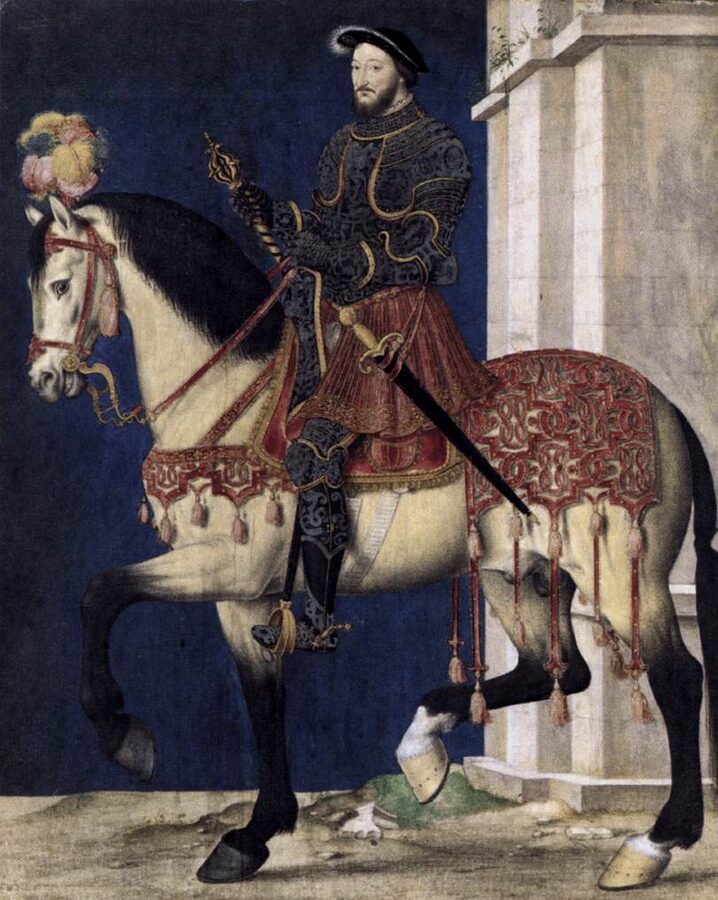
François I came to the throne in 1515 at twenty years old, beat the Swiss at Marignano four months later, and rode home to a country that suddenly had Italy’s attention. He’d already met Leonardo. Within two years Leonardo had moved from Italy to Amboise on a royal pension. The young king was building a personal myth around himself and had decided he was going to be the French Renaissance. Chambord was part of that.
The original brief was a hunting lodge in the forest of Boulogne, the medieval royal preserve. François I owned it through inheritance. He was 24, he loved hunting, and he wanted somewhere to entertain visiting nobles after a day of chasing red deer through the woods. The first plans, drawn up around 1518, were essentially a square keep with four corner towers, the standard medieval form for a noble residence. What happened next is that the design got bigger every year. By 1530 the keep alone was the size of a small palace. By 1540 the surrounding ring of walls and the two long wings had been added. By 1547 the place could house 2,000 people and a stable for hundreds of horses, and the king was dead before he could see it finished.
What’s strange is that François I almost never lived here. The royal court moved constantly. The king spent most nights at Blois, Amboise, or Fontainebleau, all closer to administrative business. Chambord was for short hunting weeks, two or three at a time, maybe three or four times a year at peak. Best modern estimate is around 50 to 60 nights total in 32 years. He brought his court, the courtiers slept on straw mattresses in the long wings, and on the morning of departure the entire household, furniture and tapestries and beds and kitchens, packed up onto wagons and moved on.
That’s the second strange thing about Chambord. The interior was bare. There was no permanent furniture for most of the early life of the building. Kings who stayed here brought their tapestries and their beds with them. When the king left, the rooms went back to empty stone. What you see today inside is partly modern reconstruction with period furniture, partly genuinely surviving 17th-century pieces from when Louis XIV used the place. The building tells you almost nothing about François I’s daily routines because he didn’t have one here.
The post-François history is a bit of a comedown. Henry II didn’t care for the place. Louis XIII gave it to his brother Gaston of Orléans, who lived here in semi-exile from court. Louis XIV did some restoration in the 1680s, dug the canal across the front, and used Chambord for a series of theatrical performances of Molière plays. The state confiscated it during the Revolution. Napoleon gave it to one of his marshals, Berthier, as a hunting estate. The Polish-French Bourbon claimant Henri d’Artois inherited it in the 19th century. The state finally took it permanently in 1930 and it’s been a public monument ever since.
Inside the keep, room by room
The keep interior is laid out as a Greek cross on every floor. Four arms radiate from the central staircase. Each arm holds two or three rooms. At each corner where the arms meet the perimeter wall, there’s a circular tower with one more room. That gives you about ten rooms per floor in the keep, four floors high.
The ground floor is mostly entrance halls and what was called the salle des gardes, the guard rooms. The walls are bare. The ceilings are low for Chambord standards, around five metres. This was the working level, where carriages came up to the door and visiting parties were greeted. There’s a small chapel off the western arm. It’s a chapel in the formal sense rather than the practical one, never lavishly decorated, used briefly for court masses when the king was in residence.
The first floor holds the royal apartments. François I’s rooms occupy the eastern arm. Louis XIV later took the western arm. Henry II’s wife Catherine de’ Medici has a smaller suite at the south. The rooms are recognisable from each other once you know what to look for. François I’s ceiling F monogram is everywhere on his floor. Louis XIV brought in heavier 17th-century woodwork. Catherine’s apartment has the more delicate Italian-influenced grotesque painting. The same kind of layered royal residence reading works at the Royal Palace on Dam Square in Amsterdam, which started as a 17th-century town hall and was later occupied by successive Dutch monarchs adding their own taste on top of the original civic-classical bones.
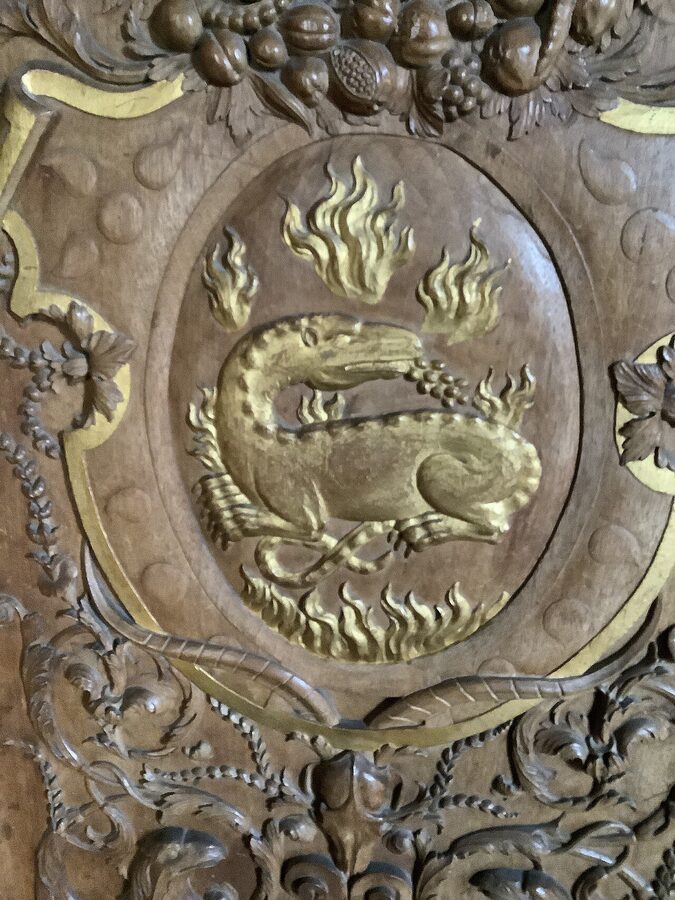
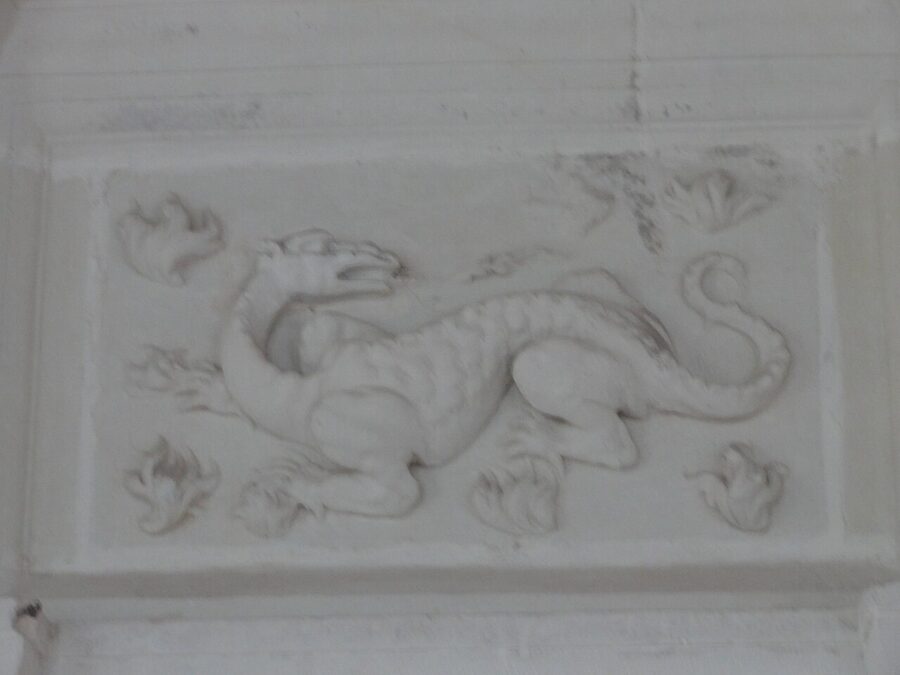
The second floor was for visiting courtiers and the king’s hunting party. It’s less restored than the first, which means the bones of the building are more visible. Look up at the vaulted ceilings. Each corner of each cross-shaped hall has the salamander carved into the keystone, sometimes overlaid with the king’s F monogram, sometimes paired with the cordeliere knot of François’s mother Louise of Savoy.
The third floor, just below the roof, was traditionally the level for the household staff. It’s now the level you walk through to reach the rooftop terrace, which is the part most visitors actually came for.
The roof: an architect’s nightmare
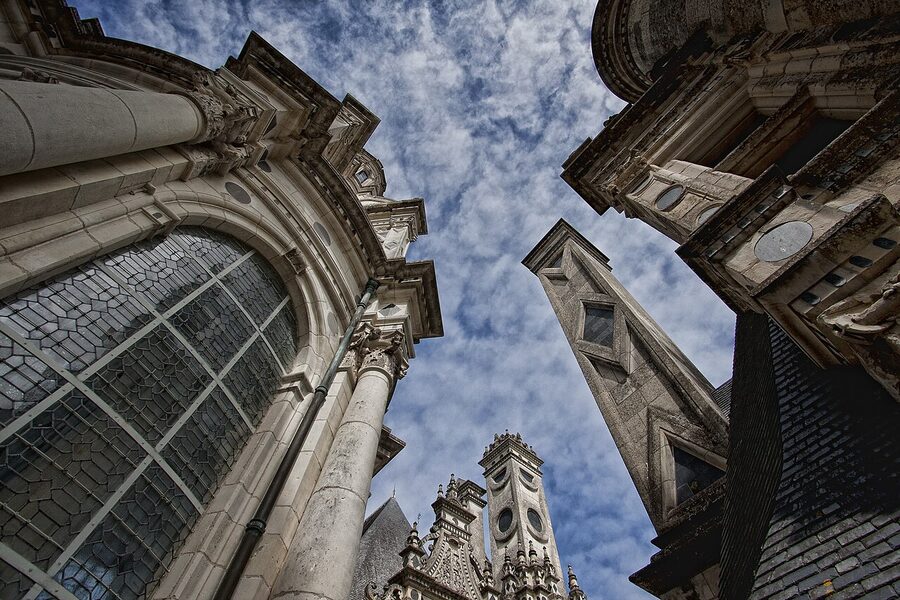
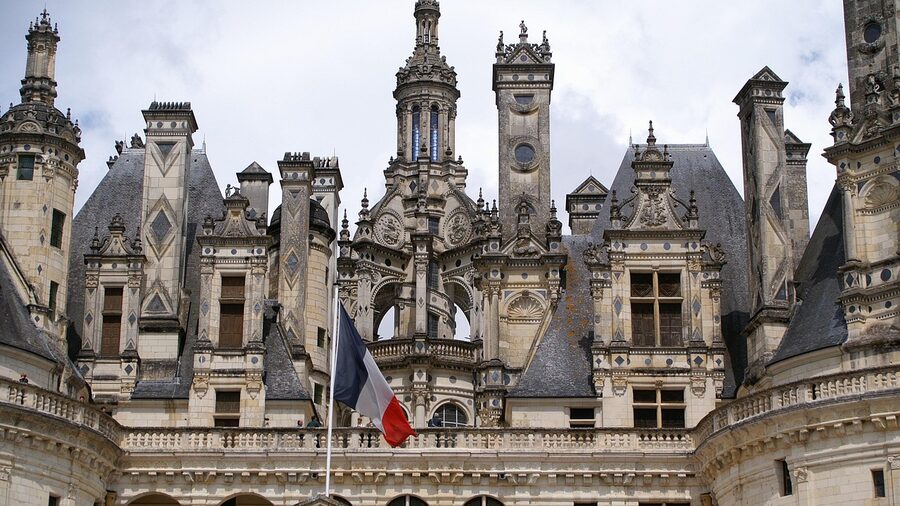
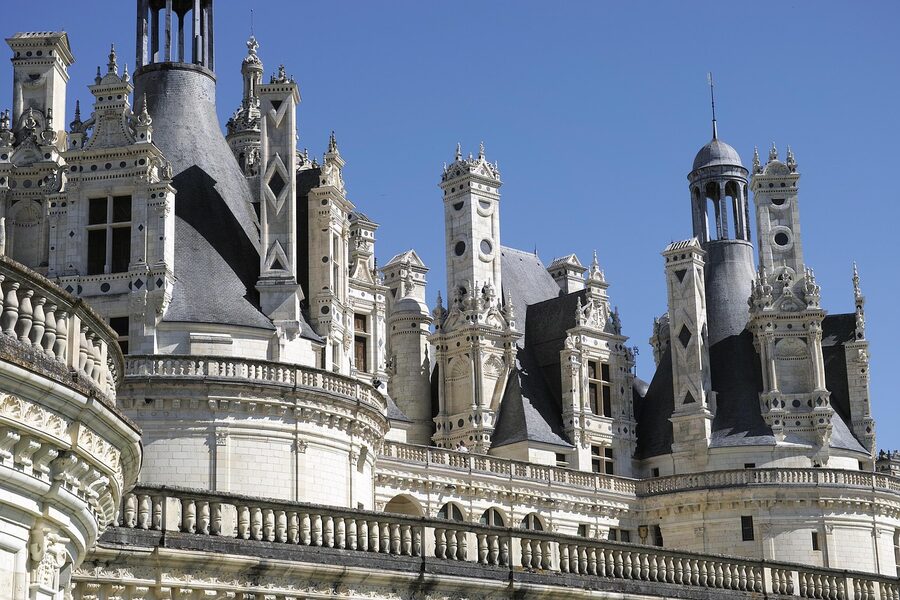
The roofline is the visual signature of Chambord. After climbing one of the four spiral wings of the staircase to the third floor, you exit onto an open terrace that runs all the way around the central lantern. From here the design idea finally makes sense. The architect, whoever that was, has built a town on top of the building. Hundreds of chimneys and turrets cluster around the central lantern, sculpted to look like the silhouette of a small medieval city seen from a distance. They aren’t all functional. Many of them are pure ornament. Some genuinely vent fireplaces, some mask staircase exits, some are decorative shells with no internal flue at all.
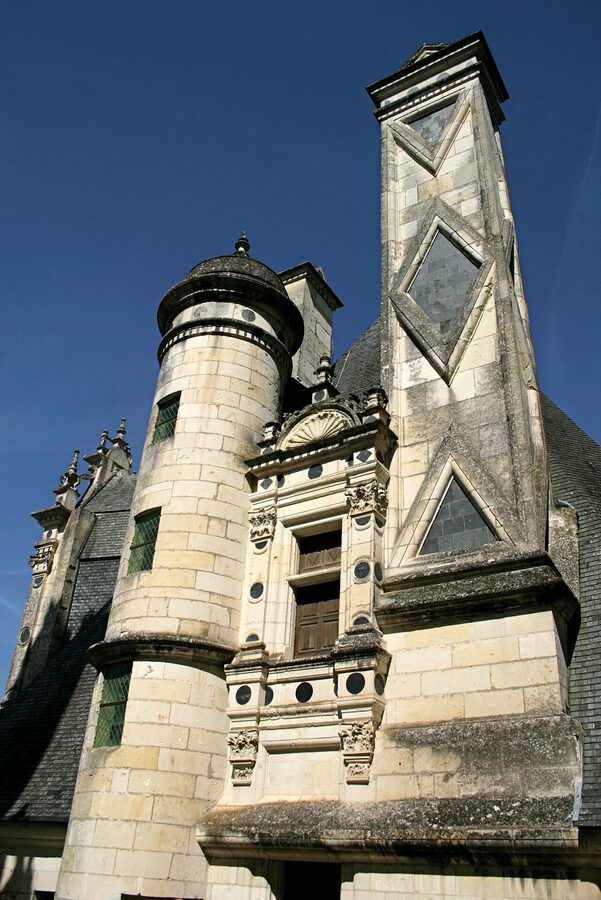
The “365 chimneys for every day of the year” line is a tour-guide invention. The actual count varies depending on what you count as a chimney versus a decorative pinnacle. The number is somewhere between 280 and 365. It doesn’t matter. What matters is the visual impression, which is overwhelming. From the centre of the roof terrace you have a 360-degree skyline of competing pinnacles. The slate-on-stone inlay is the design move that holds it all together: dark slate diamonds and discs set into pale Loire limestone, repeated across every chimney. It produces a rhythm that ties the whole roof into one composition.
The central lantern, the tower at the top of the staircase, is the highest point. It’s about 56 metres above the ground. The roof terrace runs around it at the equivalent height of the third floor. From the terrace, on a clear day, you can see the forest of Boulogne stretching to the horizon in every direction. The hunting park is genuinely vast. You’re looking at 5,440 hectares of state-owned wilderness, with red deer, wild boar, and roe deer living inside the perimeter wall. In autumn you sometimes hear the bellowing of rutting stags from the terrace.
Henry James walked this roof in 1882, which is why his “architect’s nightmare” line has stuck. He also wrote that the roof “resembles, in miniature, a fragment of an Indian or Chinese palace.” That’s the right feeling. Most of the rest of the building is recognisable French Renaissance. The roof is something else, more theatrical, less rule-following. If you have time for one slow loop on the visit, do this one.
The grounds, the canal, and the park
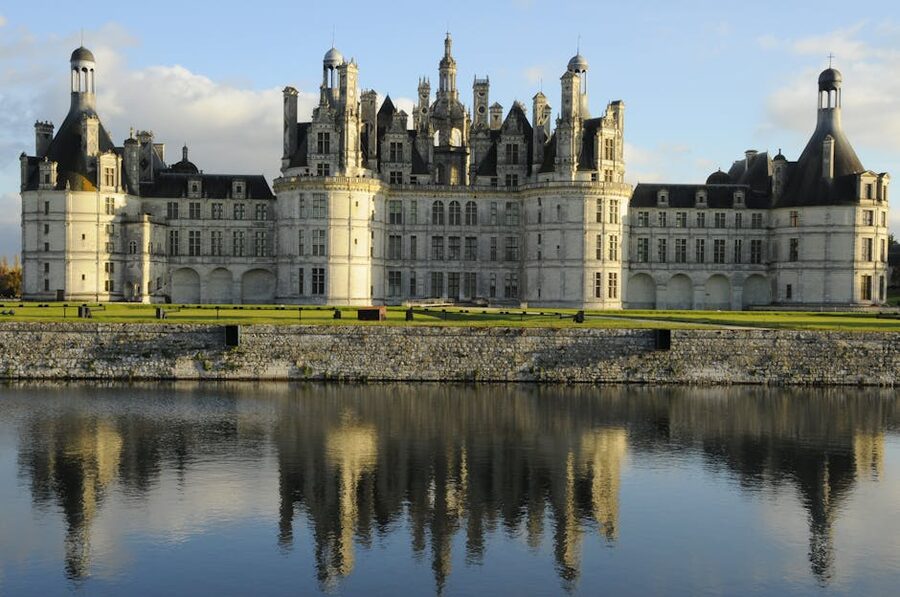
The canal in front of the keep is the diverted Cosson river. Louis XIV’s hydraulic engineers cut it across the front in the 1680s, partly to drain the marshy ground around the building, partly because a moat-with-bridges flatters a Renaissance castle. The bridge is the right vantage point for the postcard shot.
The formal gardens to the north of the keep were restored in 2017 after a decade of work and a private donation. Before that, they’d been turned to grass for two centuries. The reconstruction is based on the 1734 plans of Pierre Desgots, Le Nôtre’s nephew. The result is a French formal garden with low box hedges, gravel walks, citrus trees in pots, and a long view back towards the keep’s north facade. They’re worth a slow 30-minute walk on a sunny day. They’re not Versailles-scale, but they’re properly maintained and nicely free to walk through with your château ticket.
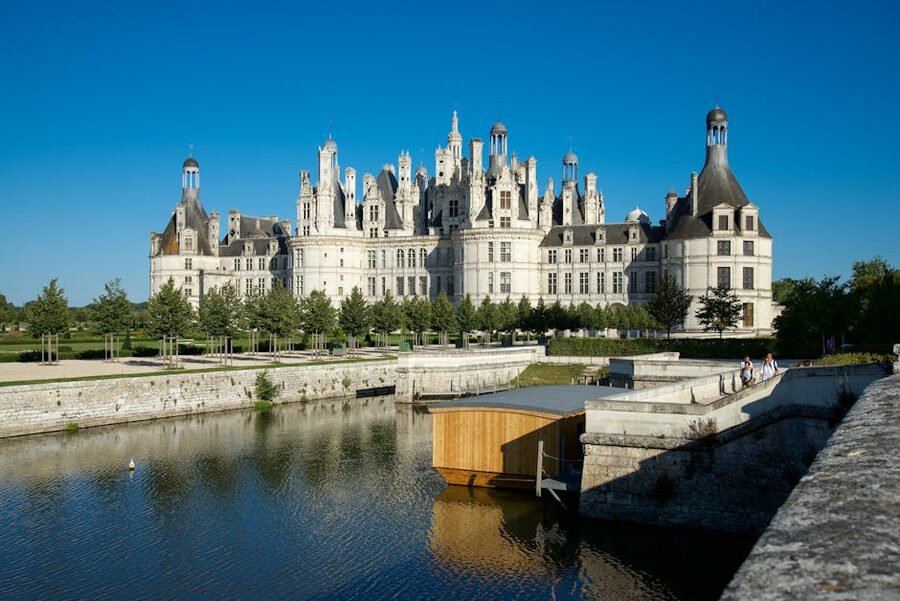
The wider park is the real surprise. 5,440 hectares of mostly closed-to-the-public forest, all owned by the state, all surrounded by a 31-kilometre stone wall built between 1542 and 1645. The wall is breached in only a few places where roads pass through, and most of the park is genuinely closed to walkers. About a quarter of the perimeter has been opened for visitors over the past decade. You can walk to two woodland viewing platforms where deer come to feed in late afternoon. You can also rent a bike at the visitor centre, around €17 for a half day, or one of the small electric boats on the Cosson, around €18 for an hour, which lets you look at the keep from water level.
The park is the part of Chambord that competes with anywhere else in the Loire. If you want a similar approach with smaller scale, Chenonceau has its own riverbank. The other Loire châteaux mostly do not have this kind of land around them. Chambord’s combination of building and park is genuinely unmatched.
Pairing it with Chenonceau, and why most people do
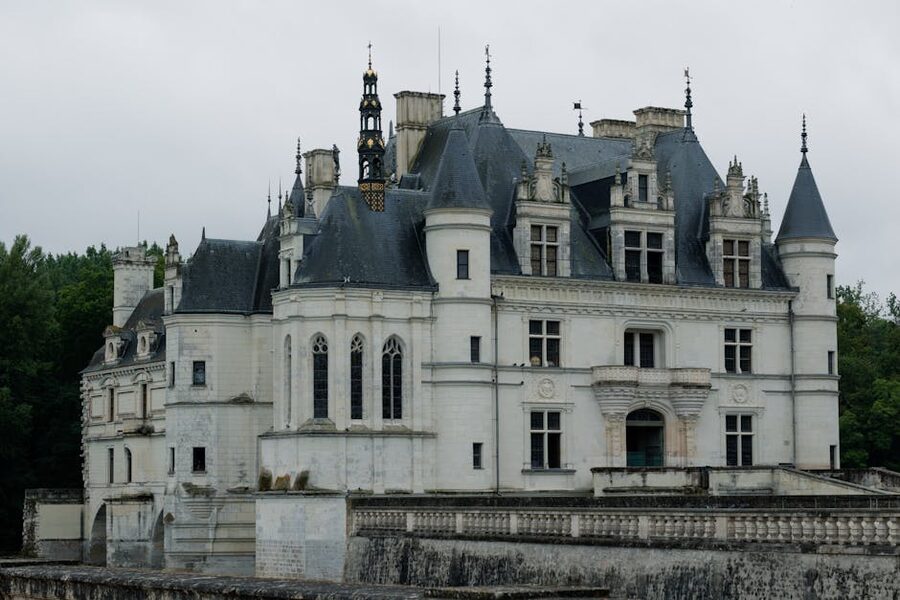
If you only have one day in the Loire from Paris, do not just do Chambord. The standard pairing is Chambord plus Chenonceau, and there’s a reason every coach tour follows that pattern. The two châteaux are 60km apart, about an hour’s drive between them, and they’re the two visual icons of the region. They’re also opposites in character. Chambord is the famous one, the architectural fantasy, the masculine François I monument. Chenonceau is the beautiful one, the gallery built across the river Cher, mostly designed and lived in by women, intimate and proportioned in a way Chambord refuses to be.
If you’re picking one, pick Chenonceau for the building itself and Chambord for the spectacle. If you’re driving and have a full day, go Chambord first thing in the morning, lunch in Blois, then Chenonceau in the afternoon. The light is better that way. Chambord’s north facade catches the early sun and Chenonceau’s gallery photographs best from the south bank in afternoon light. If you have two days, add Cheverny for a third château with a different period (mostly 17th century, much smaller, owned by the same family for 600 years).
The five-château run that some tours sell, Chambord plus Chenonceau plus Amboise plus Cheverny plus Blois in a single day, is theoretically possible but you’ll do half-hour stops at each. Skip those. Two châteaux done well beats five rushed.
WWII and the Mona Lisa

One footnote that comes up at almost every tour. In late summer 1939 the French government evacuated the Louvre’s most important collection ahead of the German invasion. Chambord was the first stop. Around 3,690 paintings from the Louvre were trucked here in August 1939, and the Mona Lisa spent a few weeks here before being moved on to safer storage further south, eventually ending up in a series of private château safe-rooms in the southwest of France. The painting was hidden in the cellars of an abbey at Loc-Dieu and later at the Musée Ingres in Montauban.
The Chambord stop was brief, but the building did serve as a long-term holding facility for less famous works through the war. The story is told in the small history exhibit on the third floor, which is worth a five-minute look on the way to the roof. The “Mona Lisa was at Chambord” line is one of those facts that’s just true enough to be worth repeating.
The sound and light show
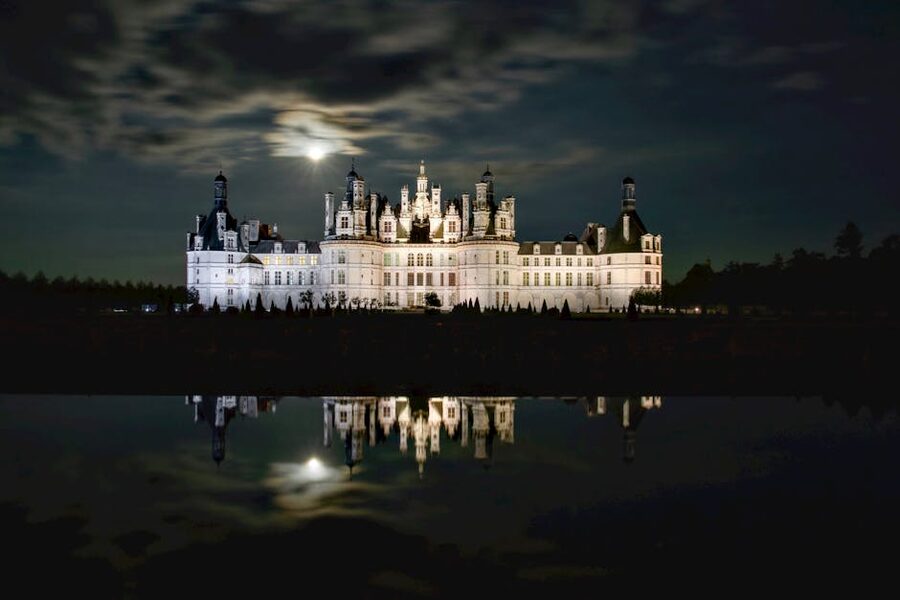
From the second half of June through to mid-September, Chambord runs a 30-minute projection mapping show called “Chambord, le Songe des Lumières” most evenings after dark. The show projects animated sequences onto the front facade, set to music. It’s a paid additional ticket, around €15, separate from the daytime château entry. Showtimes are usually around 22:30 in mid-summer when it’s dark enough, earlier in late August.
It’s a polished production, not a flashy one. The projections trace the building’s history, the salamander emblem, the staircase mathematics. It works best if you’ve already done the daytime visit, because half the imagery references things you’ve seen inside. If you can swing an evening from a base in Blois, Tours, or Amboise, this is the second-best Chambord experience after the roof terrace at noon. Skip it if you’re squeezing it into a Paris-back-the-same-day trip; the late finish makes a long day genuinely punishing.
The three tickets we’d actually book
Three different ways to do this, depending on whether you have a car, a base in the Loire, or just a single day out of Paris.
1. Chambord Skip-the-Line Entry Ticket: $24
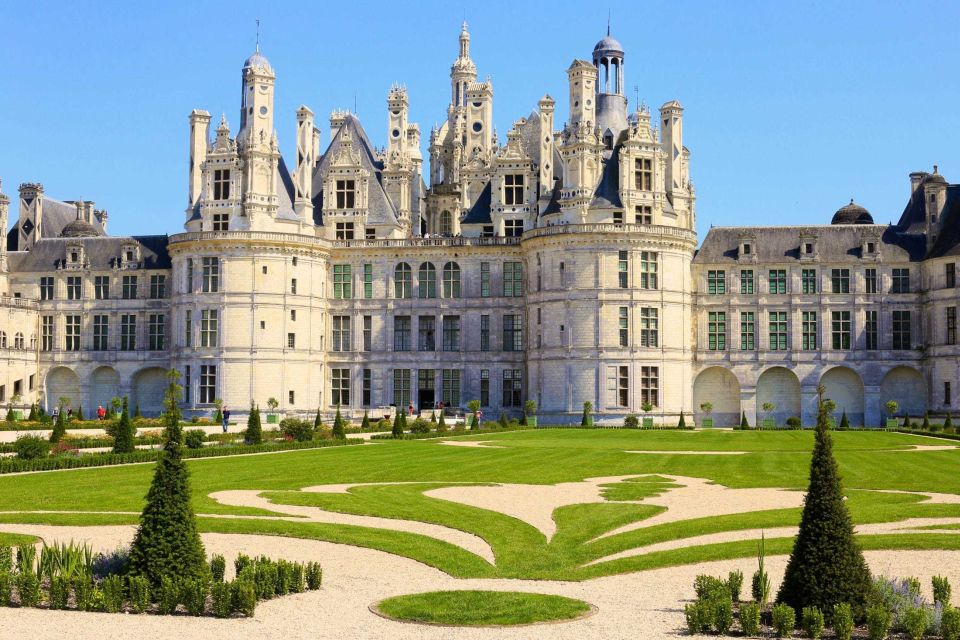
This is the right pick if you’re driving in or coming with a Loire-based plan. Our full review covers the gate-side experience, what’s included, and how to time the visit. The price matches the official château direct, the cancellation policy is gentler, and the QR works first time at the gate.
2. From Paris: Loire Castles Day Trip with Wine Tasting: $104
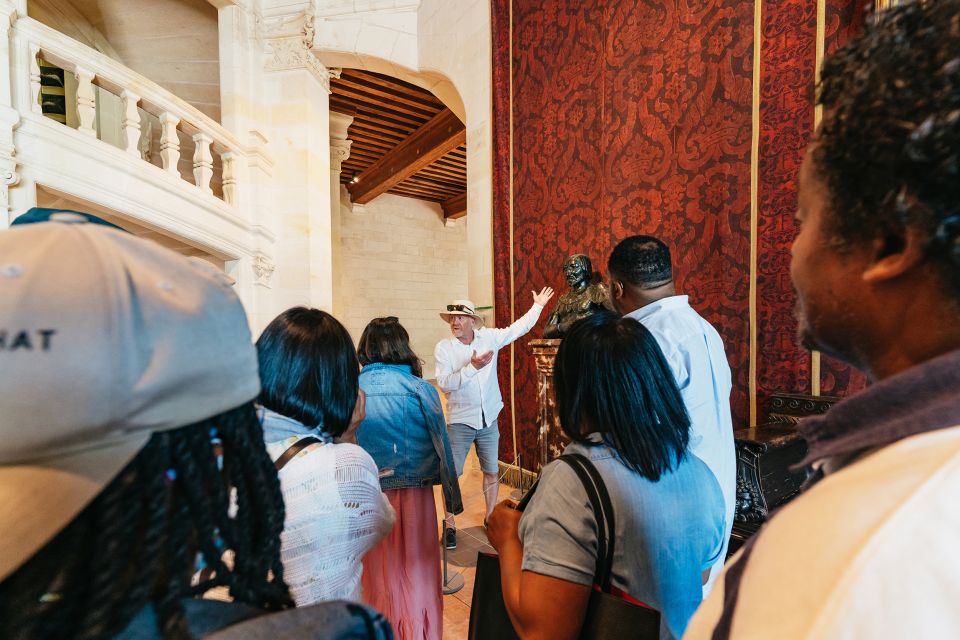
This is the right pick if you have one day in Paris and want the headline pair done properly. The full tour review covers what’s actually included and the trade-offs of the long coach day. The wine tasting is a real Loire winery stop, not a token sip in a tourist gift shop.
3. From Paris: Full-Day Loire Valley Châteaux Tour: $127
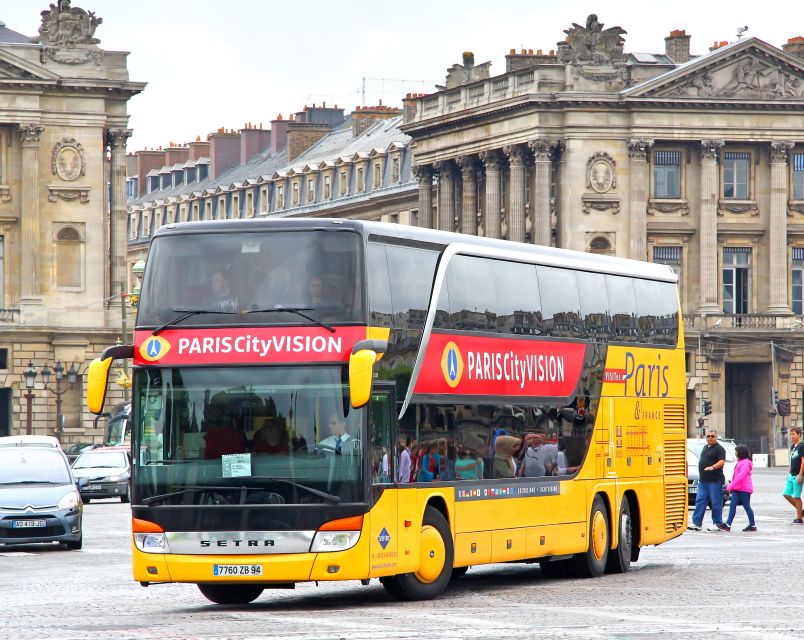
This is the right pick if you’d rather not rush the inside of the buildings. The full review compares it directly with the cheaper coach option above. The premium pays for less herding, a guide who actually answers questions on the bus, and a slightly later 9pm Paris finish.
Where Chambord fits among the day trips from Paris
Chambord is one of the longer day trips from Paris by total hours invested, comparable to Mont Saint-Michel, longer than Versailles, longer than Giverny. The trade is that you get the most-visited Loire château done in a day from a Paris base, which the rail map otherwise makes painful. Most travellers who try the Loire properly end up basing themselves in Tours or Amboise for two or three nights and treating Chambord as one of three or four châteaux.
For the Da Vinci-curious, the Chambord staircase joins the Last Supper in Milan, the Mona Lisa at the Louvre, the machine reconstructions at the Leonardo Museum in Milan, and the hands-on workshop at the Leonardo Interactive Museum in Florence as the five places you go if you’re following the man around Europe. The Amboise tomb at the Chapel of Saint-Hubert is the sixth, 40km west of Chambord. If you’re doing a Loire trip with the Da Vinci angle, build in a stop at Amboise on the same day as Chambord; the chapel is small and free to enter.
For the royal-palace comparison, Chambord and Versailles are the two Île-de-France-adjacent French royal palaces that everyone visits. They’re 130 years apart. Chambord is the early-Renaissance prototype where the king who commissioned it never really lived. Versailles is the late-classical answer where the king who commissioned it lived obsessively. Both are bigger than they need to be. Both were built in part to outshine someone. Chambord wanted to outshine the Italians, Versailles wanted to outshine Louis XIV’s predecessors. A Renaissance fortress-palace parallel that travels well is the Alhambra in Granada, where Charles V’s Renaissance palace was bolted onto a Nasrid fortress and the result is also two buildings refusing to make sense as one.
The other building-as-fantasy pairing worth knowing is the Borromean Islands in Lake Maggiore, where the Borromeo family spent 350 years competing with their own rival branch by overbuilding palaces on tiny constructed islands. Chambord and Isola Bella have similar editorial DNA: aristocratic patrons treating a building as a personal myth. They both work better if you understand the patron’s story before walking in.
Practical bits and timing
Best time of day to arrive is 9:00am sharp. The keep’s first floor is empty for the first hour. Tour groups typically reach Chambord between 10:30 and 11:30, and the building goes from quiet to busy in about 30 minutes when the buses pull in. If you can be on the staircase by 9:15, you’ll have it largely to yourself for the photos that everyone tries to take.
Best season is late April to mid-June, or mid-September to early October. Summer heat in the keep is real because the building has no air conditioning and the central staircase channels air upward. Winter is fine inside but the gardens are bare. February through early March can be beautifully empty if you can stand the cold.
Allow about 2 hours for the keep alone, doing it slowly. Add 30 minutes for the formal gardens and another 30 minutes for the canal-and-grounds walk. If you want to walk the wider park or rent a bike, add another 90 minutes. A complete Chambord visit, building plus full grounds plus a moderate park walk, is closer to 4 to 5 hours. The standard coach tour from Paris allocates about 90 minutes, which is enough for the keep and the front gardens but not for the rest.
Food on site is basic. The on-property café does sandwiches and coffee. There’s a more substantial restaurant called Le Grand Saint-Michel just outside the gate, around €25 to €35 for a sit-down lunch. Better food is in Blois or Bracieux, both about 15 minutes’ drive away, where you can find proper Loire fish, rillettes, and goat-cheese-with-Sancerre menus at country prices.
Accessibility is a mixed bag. The ground floor and the formal gardens are wheelchair-accessible. The keep itself has a lift that reaches the first floor and the third floor (rooftop terrace level), which means most of the building is reachable. The actual double-helix staircase is not wheelchair-accessible because of its tight stone treads. For the seriously mobility-restricted, the Chambord visitor centre has electric mobility scooters available to rent for the grounds.
Toilets are at the visitor centre, the gardens entrance, and on the ground floor of the keep. The latter has the shortest queue. There are no toilets on the upper floors or the roof terrace, so plan accordingly before you start the staircase climb.
The detail most visitors miss
Three small things that the audio guide skips and the rushed visitor never sees.
The corner of every cross-vaulted ceiling in the keep has a carved keystone. Some have salamanders, some have F monograms, some have the cordeliere knot of Louise of Savoy, the king’s mother. About forty of them, scattered through about a hundred ceilings, have an additional carved letter or symbol that doesn’t fit the official iconography. Some scholars think these are mason’s marks, the signatures of the individual stoneworkers. Look up at the ceilings as you walk; you’ll start spotting them once you know to look.
On the second floor of the keep, in the south-east corner room, there’s a small graffiti scratched into one of the window stones. “Toutes femmes sont volaiges,” it reads. “All women are fickle.” Tradition says it was scratched there by François I himself. There’s no contemporary evidence for that, but the inscription has been in place since at least the 17th century. It’s a small tourist-spotter detail worth asking the room steward to point out.
The roof has, just south of the central lantern, a stone block carved with the date 1547. That’s the year François I died. Construction effectively stopped that year, with most of the south wing roofline still unfinished. A plain Italian-Renaissance castle would have been completed by his successor. The reason Chambord still feels architecturally weird is that, after 1547, nobody finished it the way the original architect intended. The building is essentially frozen at the moment of the patron’s death. That date stone is the marker.
If you’re already planning Paris days
Chambord pairs naturally with the Da Vinci-and-French-Renaissance Paris run. The Louvre for the Mona Lisa, the Orsay for the late-19th-century French story, Sainte-Chapelle for medieval glass, the Eiffel Tower for the obvious, and a Seine cruise for the river-view perspective. Chambord adds the Renaissance royal-palace beat that Paris alone doesn’t quite cover.
If you’ve come this far down the page, you’re probably committed. Book the skip-the-line ticket if you’re driving in. Book the Paris coach day if you’re not. Show up at 9am sharp. Climb the staircase first while the keep is empty. Then go to the roof. Then come back down through the rooms. That’s the visit, and it’s worth two and a quarter hours on the autoroute each way.