
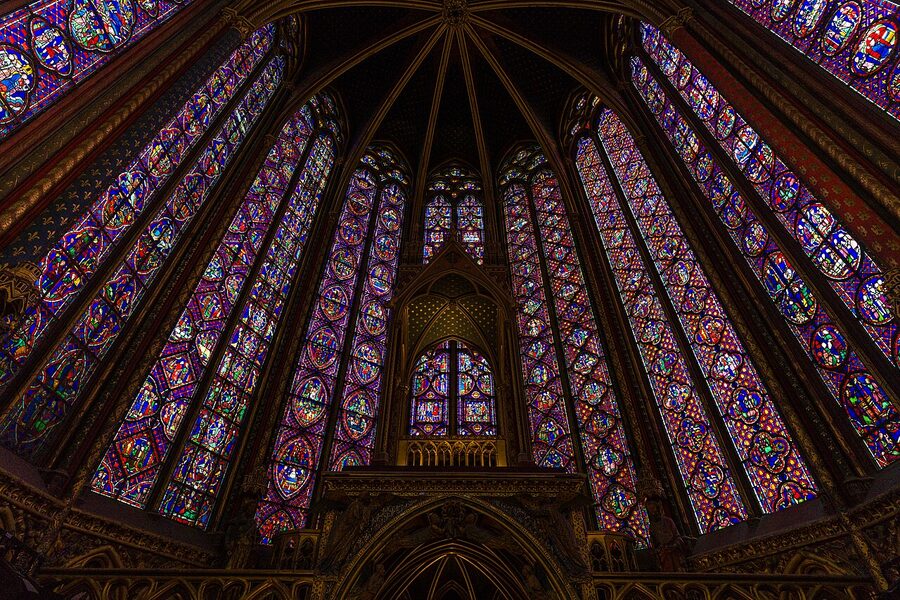
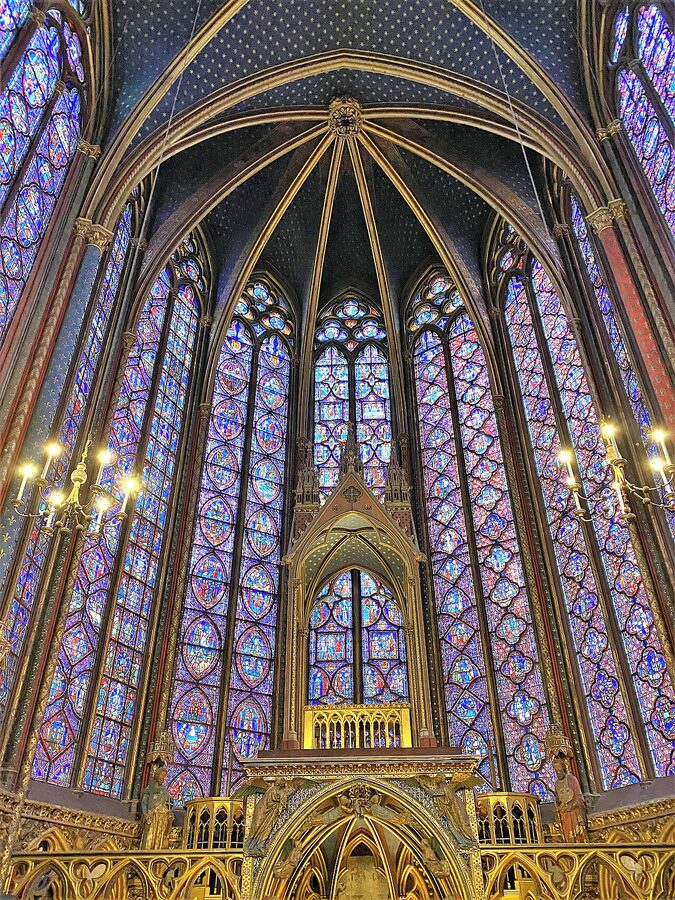
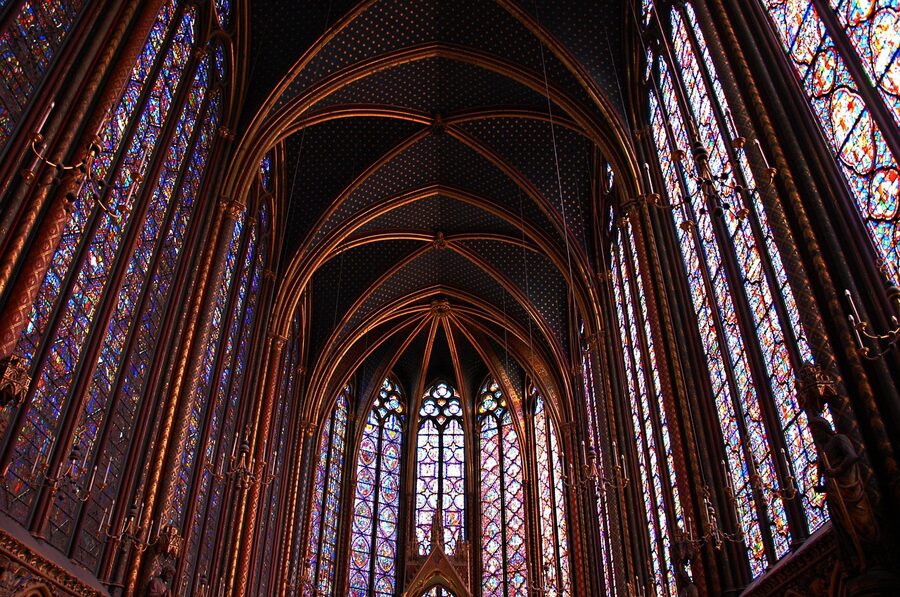
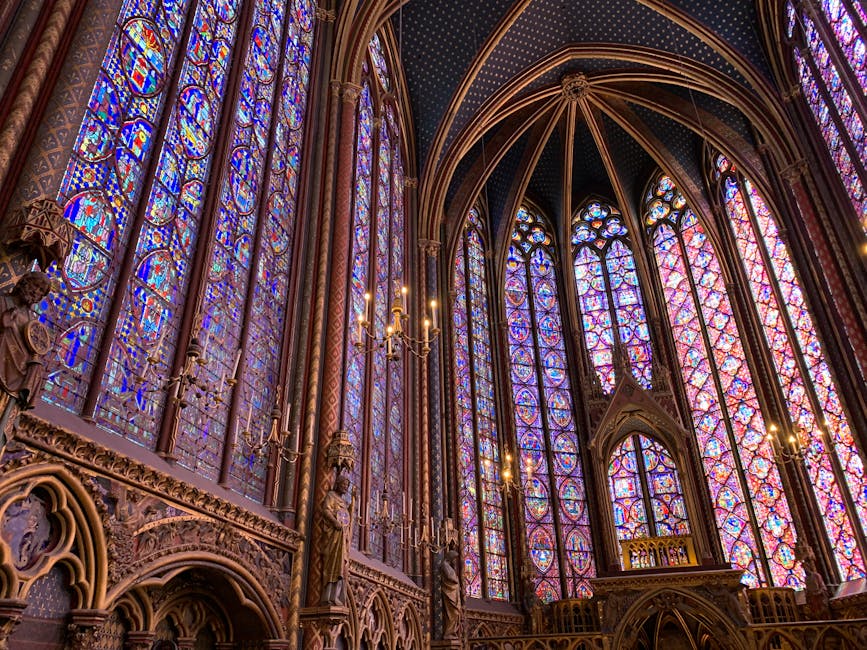
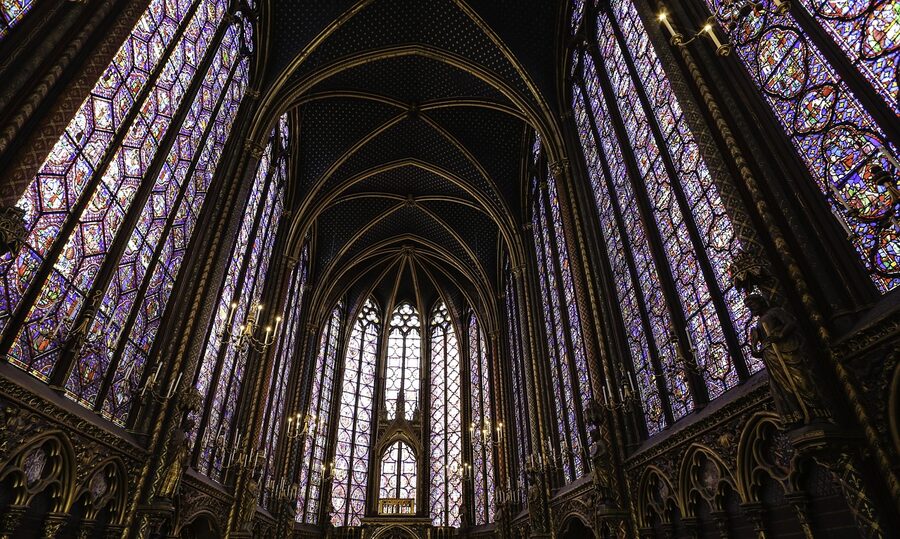
It is 14:30 on a clear afternoon in late September. The western windows of the upper chapel have just caught the sun, and the scene at the bottom-left of the second window from the door, scene one of the Genesis cycle, is glowing as if lit from inside the glass: God dividing the light from the dark, in cobalt and a red the colour of poured wine. Above it, twenty-six metres of vertical glass climb to a vault painted with gold stars on a midnight blue. Around you, fourteen more lancet windows do the same thing on the same scale, all the way to the apse and the rose. There is no wall behind the glass. There is no wall at all.
That is the move that makes the Sainte-Chapelle a building unlike any in Europe. The walls have effectively been deleted. The load is carried by external buttresses; everything between them is glass. Fifteen lancet windows, plus a 13-metre rose, 1,113 individual scenes, and roughly 70% of it is the original 1248 glass still in place. Seven hundred and seventy-seven years old, and the colour still works.
In a hurry? Three picks
- Sainte-Chapelle Entry Ticket: $16. The cheapest legitimate way in, just the chapel, fastest queue.
- Sainte-Chapelle + Conciergerie Combined: $27. The right pick for most people; you get the chapel and the prison next door.
- Sainte-Chapelle + Conciergerie + Notre-Dame Guided Tour: $88. Small group, two hours, an actual guide who can read the windows for you.
Why the chapel exists at all
This is the part most people miss inside the upper chapel. They walk in, they crane their necks, they take 40 photos, and they leave without ever asking the obvious question: why is this here?
It exists because of one specific object. In 1238 a young French king, Louis IX (later Saint Louis), bought the Crown of Thorns from Baldwin II, the Latin Emperor of Constantinople. Baldwin had pawned it to the Venetians as collateral on a loan. Louis paid the loan, took possession of the relic, and shipped it from Venice to Paris in a sealed silver chest. The price was 135,000 livres. The chapel that would eventually house it cost about 40,000. Louis paid more than three times the building cost for the contents.
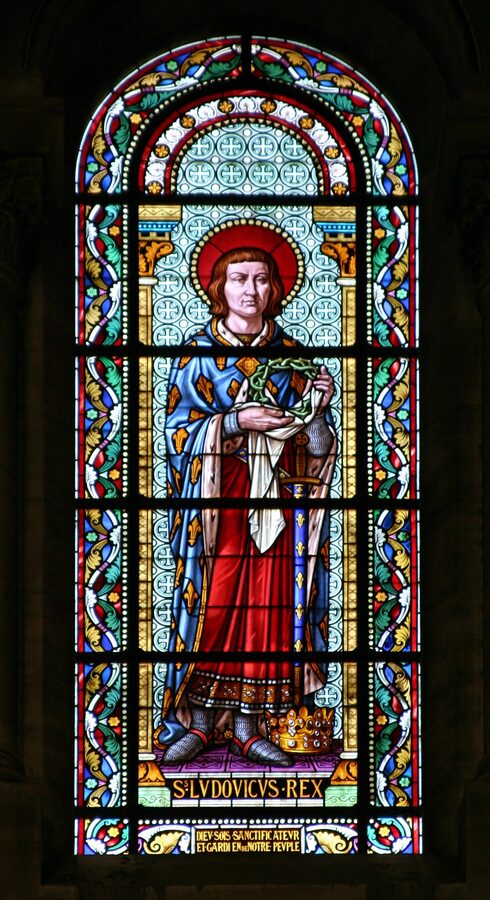
Read that again. The reliquary cost more than the building. The Sainte-Chapelle is not a chapel that happens to contain a relic. It is a giant reliquary that you can stand inside. Once you understand that, the whole thing reframes. The 33-metre vertical lift, the wall of glass, the gold stars on blue paint, the apse where the relic was kept on a silver platform behind a grille: this is a jewellery box for a single object, and Louis built it on the scale of a cathedral because the thing inside it was, to him, the most important physical artefact in Christendom.
Construction took just seven years, 1241 to 1248. For comparison: the dome of Florence’s Duomo took sixteen years to build, the cathedral underneath it took 140. The Sainte-Chapelle went up in less than a decade because Louis was paying for it personally and because the design was radical: skip the heavy walls, throw the load onto external buttresses, and fill the rest with glass.
What you actually see when you walk in
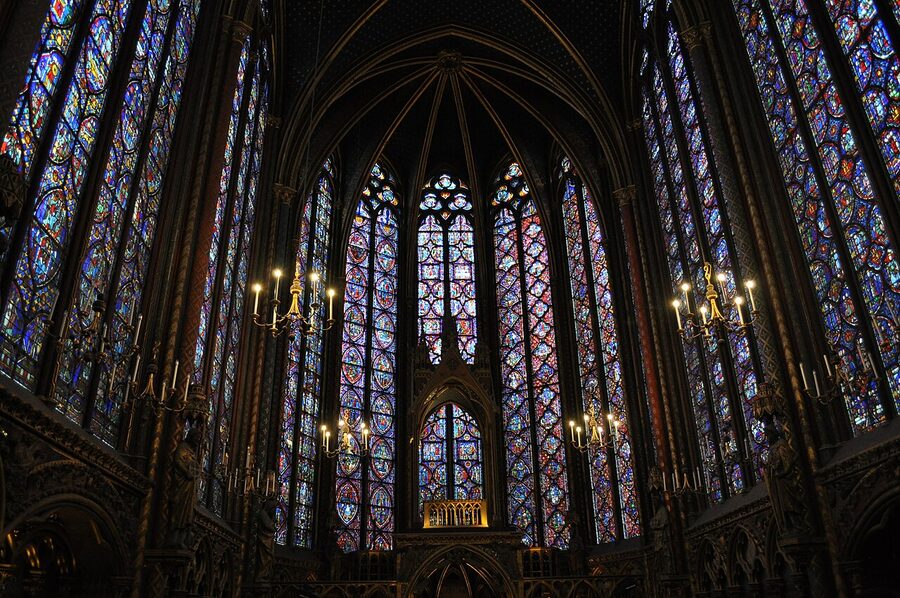
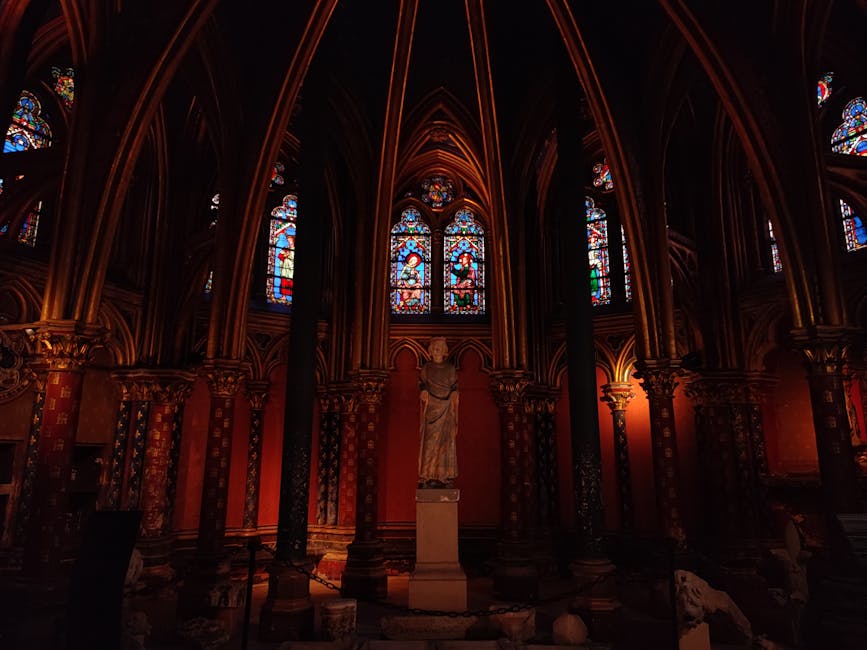
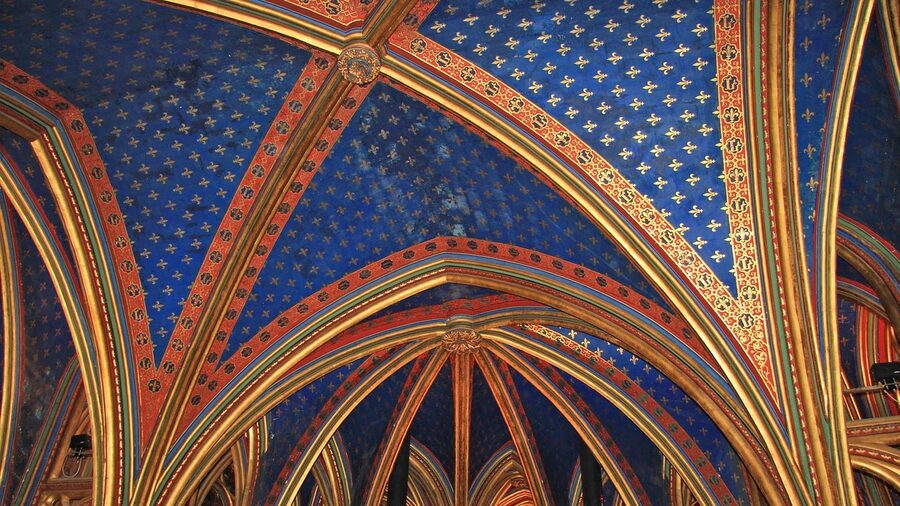
You enter through the lower chapel, which is a different building emotionally. The lower chapel was for staff and palace servants, low ceiling, painted blue and red, fleur-de-lys everywhere. It is dim. It is meant to be. The point of the lower chapel is to be a tonal shock absorber so that when you climb the spiral stair to the upper chapel, the colour and the light and the height hit you all at once. It is a piece of theatrical architecture, and it works on people who have known it was coming for years.
The upper chapel is 33m tall, 17m long, 10.7m wide. There are fifteen lancet windows running the length and the apse, plus a 13-metre rose window above the western door (which is the door you originally came through, when you were a king). The rose window is 15th-century, added during the reign of Charles VIII; everything else is mostly mid-13th-century, with restoration work by Eugène Viollet-le-Duc between 1841 and 1855.
The 1,113 scenes, in order
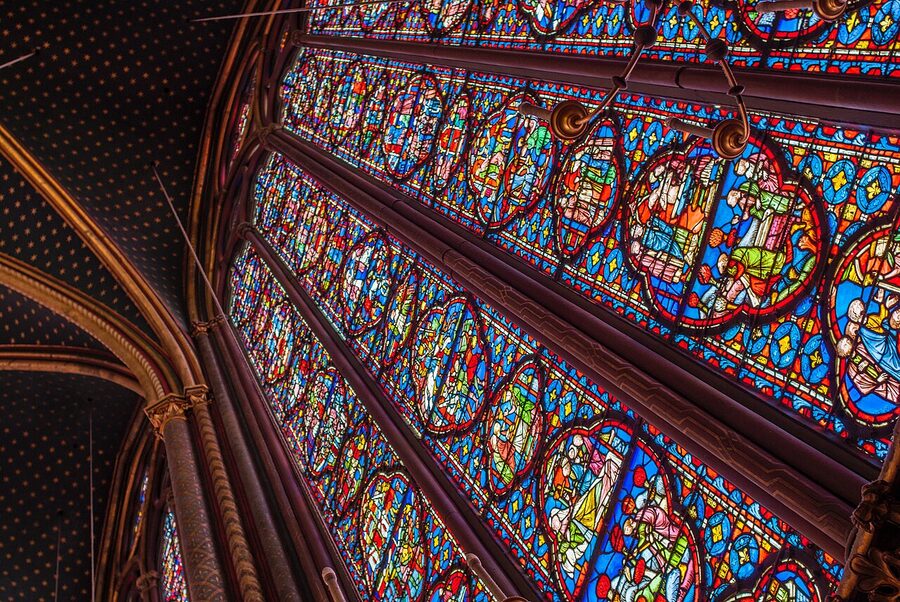
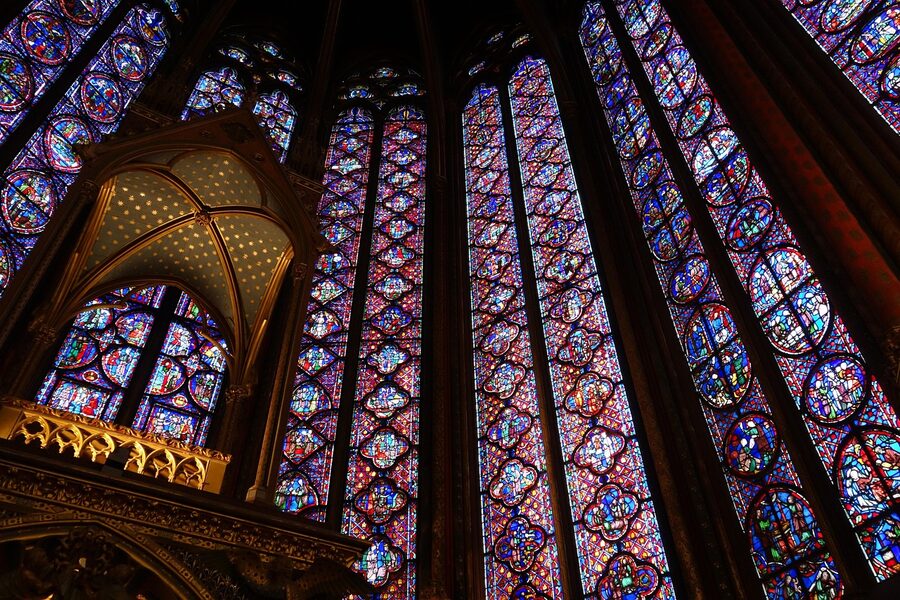
This is the part the audio guide will not give you fast enough. The fifteen windows tell the entire Bible story, Genesis to Apocalypse, in 1,113 individual stained-glass panels. They are meant to be read clockwise from the western wall, with scene one in the bottom-left of each window. Once you know that, the whole chapel becomes legible.
Starting from the western wall and moving clockwise around the chapel, here is what you are looking at:
- Window 1 (Genesis): creation, Adam and Eve, Cain and Abel, Noah, the Tower of Babel.
- Window 2 (Exodus): Moses, the burning bush, the parting of the Red Sea.
- Windows 3 and 4: the rest of the Pentateuch, plus Joshua, Judges, and Ruth.
- Window 5: Isaiah and Jesse’s tree.
- Window 6: the books of Saint John the Evangelist and the Childhood of Christ.
- Window 7 (apse left): the Passion of Christ.
- Window 8 (apse centre): the life of John the Baptist and Daniel.
- Window 9 (apse right): Ezekiel.
- Window 10: Jeremiah and Tobit.
- Window 11: Judith and Job.
- Window 12: Esther.
- Window 13: the Books of Kings.
- Window 14: the relics window. This is the one to find. It tells the story of how Louis brought the Crown of Thorns and the True Cross from Constantinople to Paris. It is, in effect, the building’s signature on itself.
- Window 15 (eastern wall): back to the start, with Jesse and the Tree.
- The 13m rose window: the Apocalypse, scenes from the Book of Revelation, Christ in the centre.
Window 14 is the one most visitors walk past. It is on your right as you face the apse, near the back. It shows the relic’s journey: Louis on horseback receiving it, the silver chest, Paris welcoming the king. It is the closest a 13th-century building gets to a self-portrait, and it is exactly what makes the Sainte-Chapelle different from St Mark’s in Venice or any other relic-heavy church. St Mark’s hides its relics under altars and behind grilles. Sainte-Chapelle puts the story of how it got them in the windows themselves.
The 13m rose
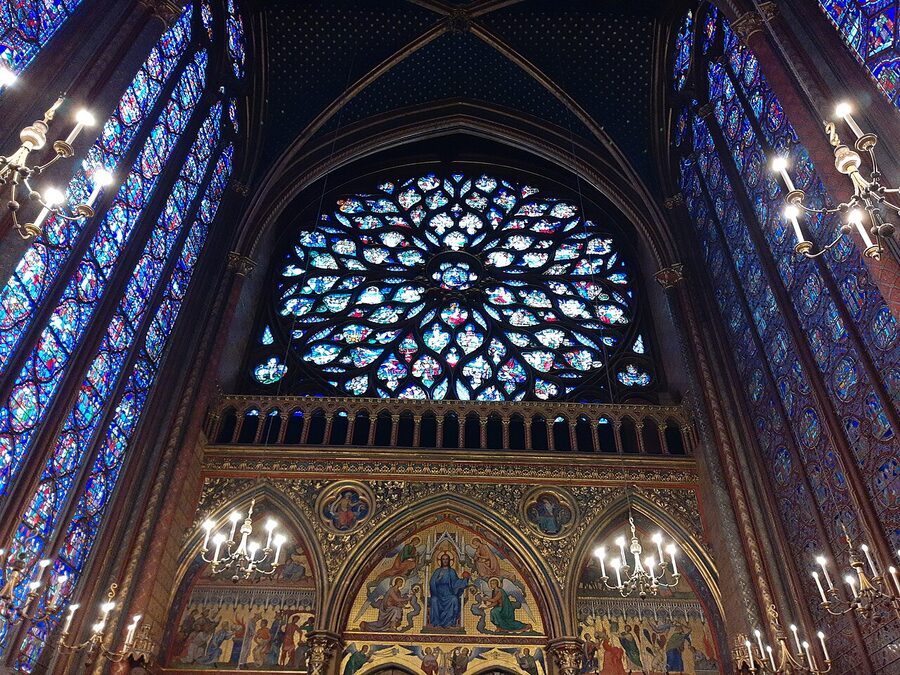
The rose window faces west. That matters. It catches the strongest direct sun in the late afternoon, and the entire scheme of the chapel is built around the assumption that you will eventually turn around. The lancet windows are about close reading; the rose is about being hit.
It is the second rose. The first one, contemporary with the chapel, was lost. The current one dates from around 1485 and was commissioned by Charles VIII as part of a partial reset of the western wall. The subject is the Book of Revelation. Christ sits in the centre. Around him, in 86 panels, the angels open the seals, the four horsemen ride, the locusts emerge from the bottomless pit, and the New Jerusalem descends. It is medieval Christianity’s most dramatic story, given the most dramatic glass surface in the building.
Here is the practical move: spend the first 10 minutes of your visit looking at the lancet windows from up close. Walk the perimeter, read window 1 left to right, work your way clockwise. Then go to the back of the chapel by the apse and turn around. The rose is the encore.
How they did the engineering
Strip the glass off and the structural diagram of the Sainte-Chapelle is almost embarrassing in its simplicity. The walls between the windows are basically just stone fingers. Each one is a buttress doing very little visible work; the actual lateral force is being transferred outward through the buttresses you see from the courtyard, and downward through the floor to a vaulted lower chapel that itself functions as part of the structural diaphragm.
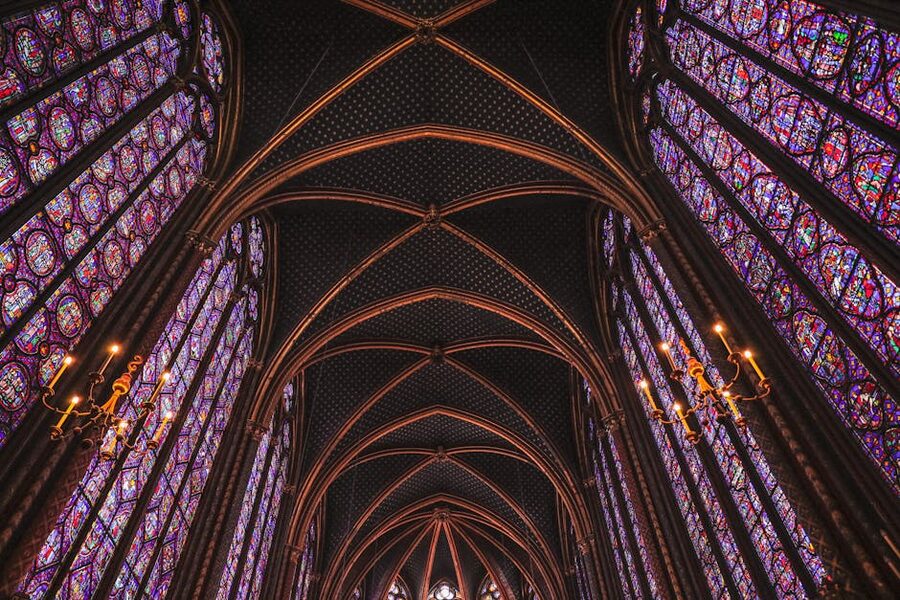
This was the cutting edge of Gothic design in the 1240s. Pierre de Montreuil, the master mason often credited with the chapel, was working at the same moment as the masters of the cathedrals at Reims and Amiens, and the technique that gets called rayonnant Gothic peaks here. After Sainte-Chapelle, the next 200 years of European church-building would chase this same effect: more glass, less wall, more vertical lift. Most never matched it.
One reason the survival rate of the original glass is so high (about 70%) is the chapel’s small footprint. Big cathedrals lost windows to wind, settling, and fire over the centuries. The Sainte-Chapelle is small enough, and was protected enough, that it kept most of its 1248 glass through eight centuries.
Surviving 1789
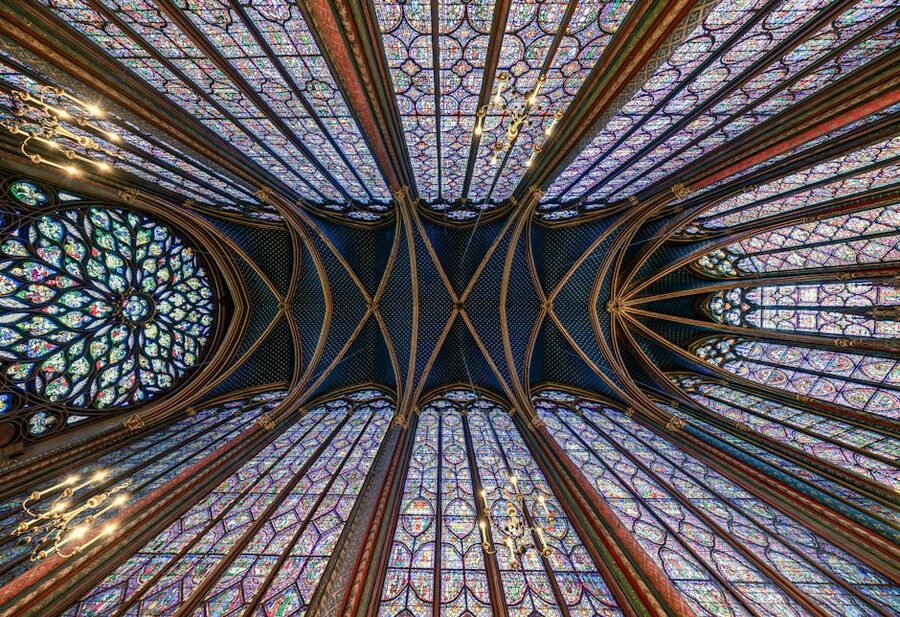
By 1789 the Sainte-Chapelle had been a royal chapel for five centuries. The Revolution had no patience for that kind of building. Most of its furnishings, the spire, the rood screen, and a chunk of the relic collection were destroyed or sold. The Crown of Thorns itself was rescued by sympathetic clergy and eventually transferred to Notre-Dame, just across the Seine on the same Île de la Cité.
The chapel building itself was used as a flour storage warehouse and an archive. That is what saved it. While other Paris churches were being torn down for stone or burned, the Sainte-Chapelle was useful enough as a dry, vaulted box that the new authorities left the structure standing. The windows were boarded up. The interior was painted over. By 1840 the chapel was an embarrassment to the new bourgeois Paris, the kind of forgotten medieval building you walked past without noticing.
Eugène Viollet-le-Duc and Félix Duban took on the restoration in 1841 and finished in 1855. Viollet-le-Duc gets a mixed reception in modern restoration circles, but at Sainte-Chapelle he was working with most of the original glass still intact and a structure that had survived because of indifference. The result is what you see now: about 70% original 13th-century glass, with the rest being 15th-century, 19th-century Viollet-le-Duc replacements, or 20th-century repairs done after Second World War damage.
The Crown of Thorns: the relic that started it all
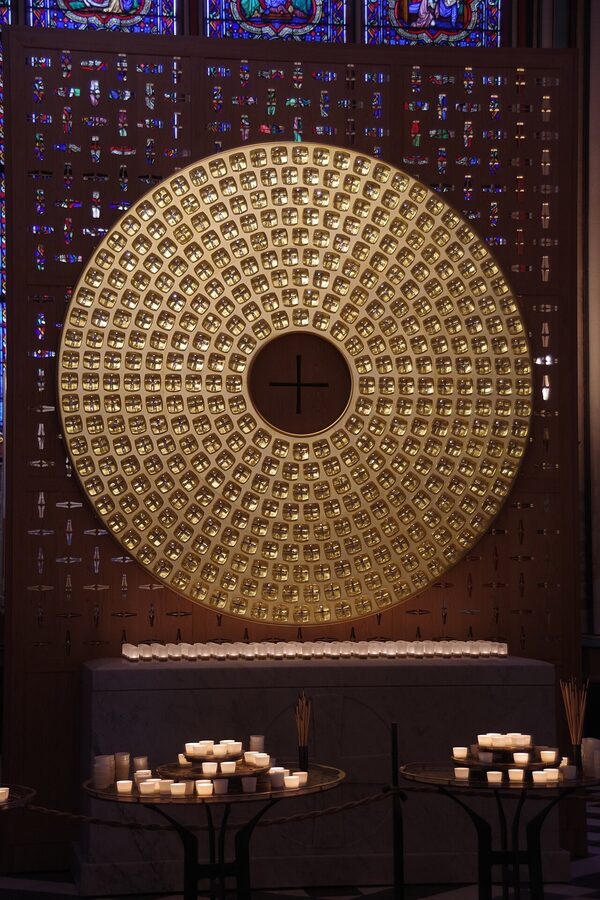
The Crown of Thorns has the longest unbroken provenance of any relic in Christendom. The historical record runs from the 4th century in Jerusalem, through the Byzantine emperors in Constantinople, through Baldwin II’s pawn-shop crisis in Venice, into Louis’s hands in 1238, into the Sainte-Chapelle apse from 1248 to 1789, into private safekeeping during the Revolution, and finally into Notre-Dame, where it has stayed since 1804.
It survived the night of 15 April 2019, when Notre-Dame caught fire during restoration work. The chaplain, Father Jean-Marc Fournier, and the head of the Paris fire brigade went into the burning cathedral together. They retrieved the Crown and several other objects from the treasury before the spire fell. There is a grainy photo of Fournier walking out of the cathedral with the relic in a black case. Whatever you think about authenticity, the survival rate of this object is extraordinary.
Today the Crown is shown at Notre-Dame on the first Friday of every month and during Lent. The chapel where it was kept for 540 years no longer holds it. But the story is still there, on Window 14, in glass.
Practical: how to actually book
You buy your ticket online, you pick a time slot, you show up at 4 Boulevard du Palais inside the modern Palais de Justice complex. You go through airport-style security (this is an active courthouse, not a museum, so the security is real). You enter the lower chapel, climb the stairs to the upper chapel, and you have your slot.
The capacity inside the upper chapel is about 80 people at a time. That is deliberate. The chapel administrators cap entries to preserve both the experience and the conditions for the glass. If you arrive without a pre-booked ticket in summer, you may queue 60 to 90 minutes outside the security perimeter, and that is in addition to the security queue itself.
The three legitimate ticket options:
- Sainte-Chapelle alone, $16. The cheapest, just the upper and lower chapels.
- Combined Sainte-Chapelle + Conciergerie, $27. Adds the prison next door, valid same day. This is what most travellers should buy. The Conciergerie alone is not worth a separate trip; bundled with the chapel, it is excellent value.
- Guided trio of Sainte-Chapelle + Conciergerie + Notre-Dame exterior, around $88. Small group, two hours, with a real guide. Worth it if you want someone reading the relics window for you in real time.
If you have a Paris Museum Pass, the chapel is included, but you still need to pre-book a time slot. The pass does not skip the time-slot booking step.
Best time to visit
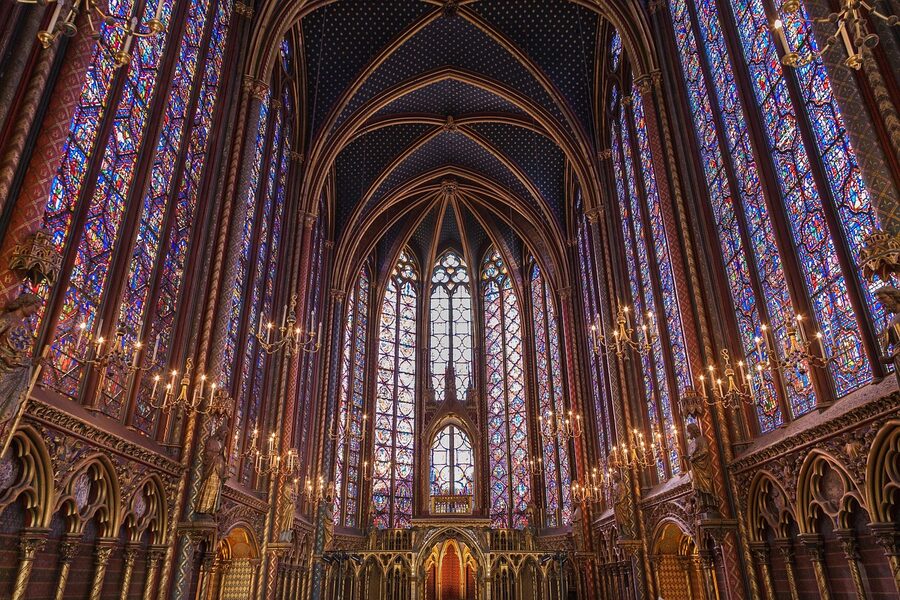
The windows face roughly south and west, with the western rose facing the setting sun. The colour effect is best on a clear or partially clear day, between 14:00 and 16:00 in spring and autumn (a little later in summer, earlier in winter). On overcast days the chapel still works but the colour is muted; on overcast winter mornings it can feel almost grey, which is not what you came for.
If you can only go in summer, aim for 15:00 to 17:00 and accept the queue. If you can go in October, you can get a 14:30 slot on a Tuesday, walk in, and have the chapel feel almost private for the first ten minutes of your slot. October midweek is the sleeper season for Paris; the Louvre and Orsay are also lighter then, which makes a multi-stop day cleaner.
If your trip overlaps with one of the chapel’s late-evening classical concerts, take it. Vivaldi’s Four Seasons, Pachelbel, Bach, played by chamber ensembles in the upper chapel after hours, with the windows lit from outside and the audience in folding chairs. It is touristy and it is also one of the better evenings you can have in Paris if your alternative was a generic Seine river cruise. Tickets typically run €25 to €50 and you can book them at the chapel website or via the same booking platforms that handle daytime entry.
The Conciergerie: why you should bother
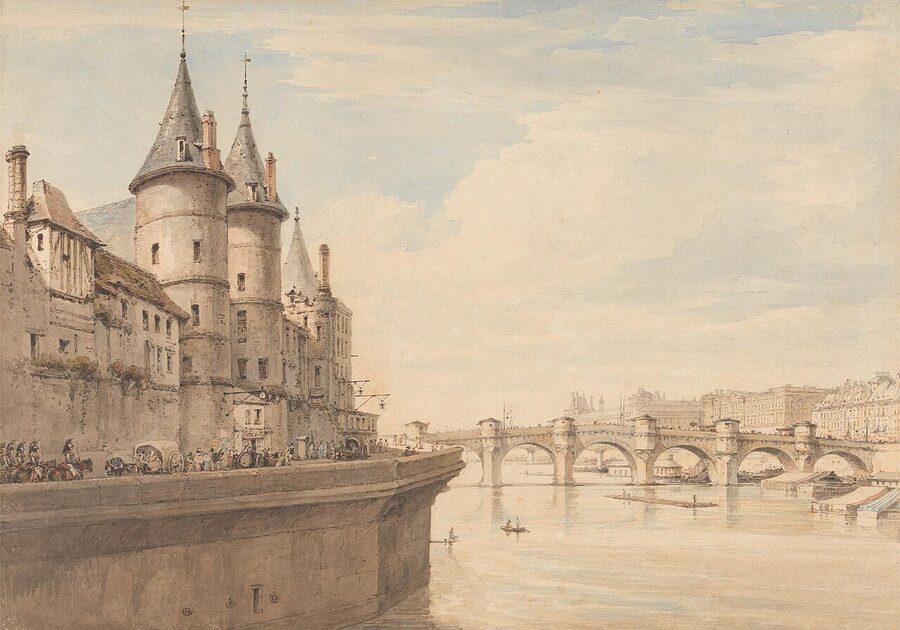
This is why I keep telling people to buy the combined ticket. The Conciergerie shares a wall with the Sainte-Chapelle. They were both part of the same complex, the medieval Palais de la Cité, the seat of French royal power from the 10th century until Charles V moved the court to the Louvre in 1364. The chapel was Louis IX’s private prayer room. The Conciergerie was the great hall, the kitchens, the servants’ wing, the courtroom.
Then in 1392 the king’s tasks shifted and the Palais de la Cité became a court of justice. By 1391 the Conciergerie was being used as a prison annex. The two functions, courthouse and prison, would dominate the building for the next four centuries. The current Palais de Justice next door is the modern continuation; the Conciergerie wing is the museum.
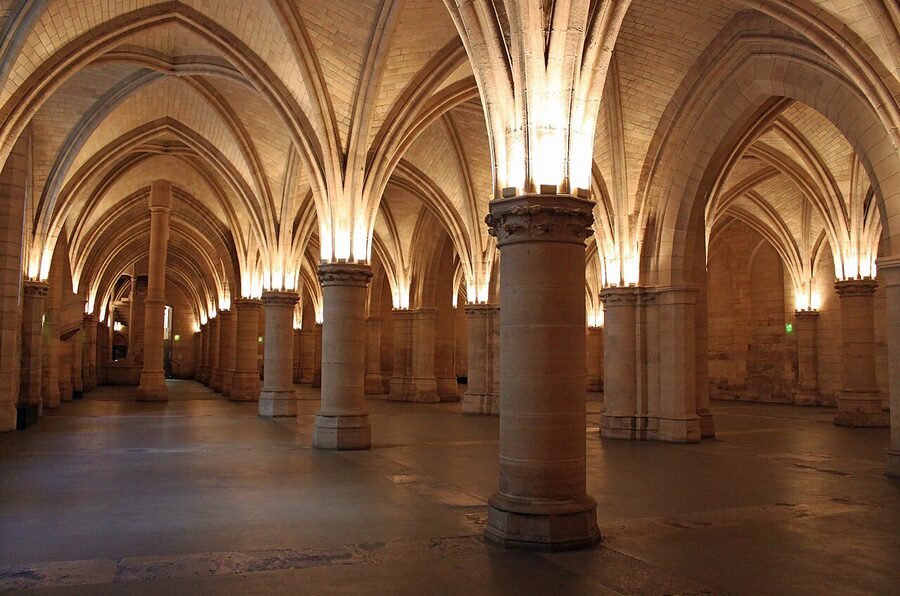
The Salle des Gens d’Armes is the part you should not miss. It is a vaulted Gothic hall built around 1302 to 1313 under Philip the Fair. Sixty-four metres long, twenty-seven wide, with the original ribbed vaulting still visible. It was built to feed two thousand people in one sitting, which was the size of the royal household at the time. Today it is empty and echoing and you can stand in the middle of it and get a real sense of medieval scale, the kind that the chapel, with its small intimate footprint, deliberately does not give you.
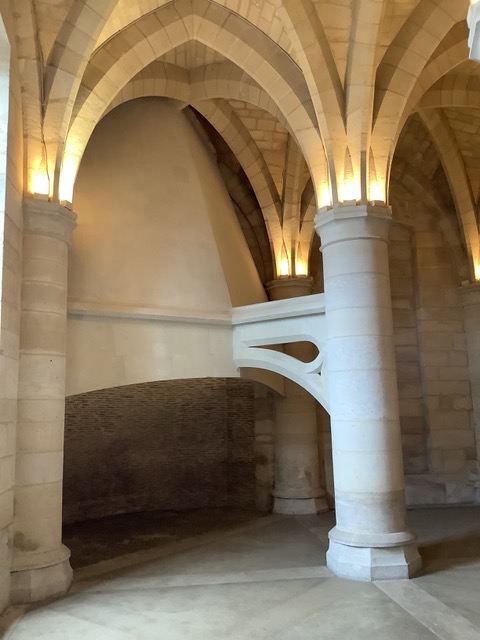
The Conciergerie’s revolutionary chapter
The Conciergerie’s other role, the one that draws most visitors, is its function as the principal Paris prison during the Reign of Terror, 1793 to 1794. About 2,780 people passed through the Conciergerie on their way to the guillotine during this period. Almost no one walked back out. The Revolutionary Tribunal sat in what is now called the Salle des Gardes, just upstairs from the medieval kitchens.
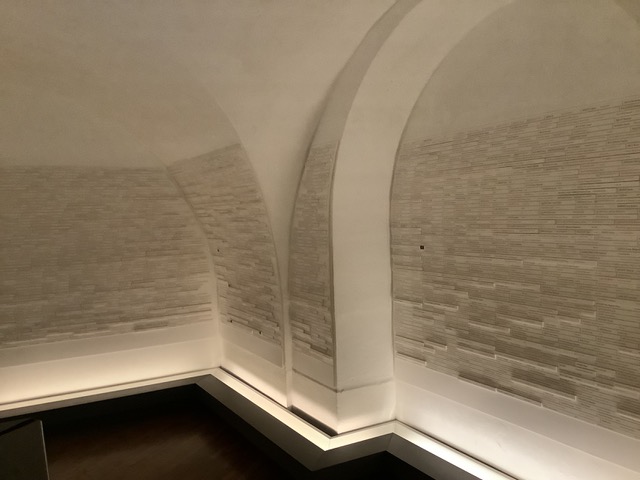
Marie Antoinette was the most famous prisoner. She was held here from 1 August to 16 October 1793, when she was guillotined at the Place de la Révolution (now Place de la Concorde). Her cell, cell 17, was on the ground floor. It has been reconstructed as part of the Conciergerie museum. There is a chapel built on the spot in 1816 by Louis XVIII, her brother-in-law, after the Restoration.
If you have read Hilary Mantel or seen any of the dozen films about the Revolution, the Conciergerie is the building those stories happen inside. You can stand in roughly the same square metre of stone that Antoinette stood in for the last sixteen days of her life. Most travellers walk through this section in fifteen minutes; a slower visit, half an hour, with the augmented-reality tablet they hand you at the entrance, repays itself.
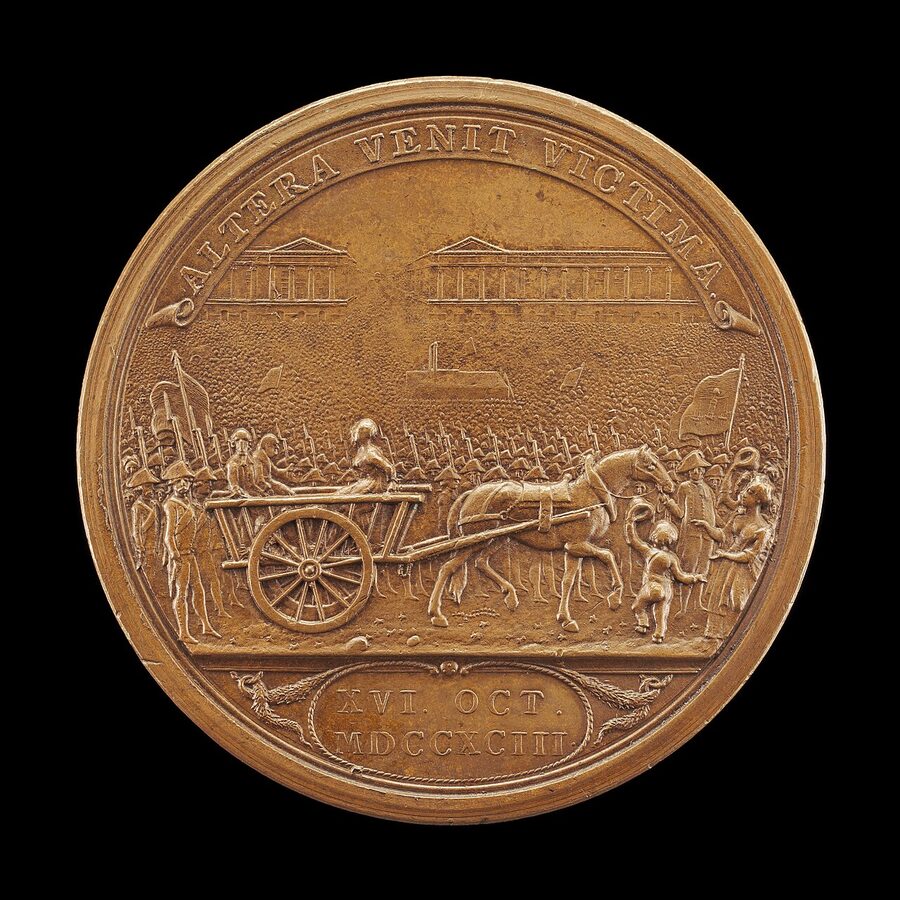
This is also why pairing the chapel with the Conciergerie matters as a single visit. You move from the building Saint Louis built in 1248 to enshrine the Crown of Thorns, to the building where, 545 years later, Marie Antoinette was kept before her execution. The two buildings, sharing a wall, hold the highest and lowest moments of the French monarchy. That is a compression of history you do not get anywhere else in Paris. The Amsterdam parallel is the Anne Frank walking tour, a smaller-scale single-stop pilgrimage where the building (the canal-house annex) carries 20th-century weight the way the chapel-Conciergerie pair carries the 13th-to-18th-century one.
How long to spend
For Sainte-Chapelle alone: 45 minutes inside is the realistic floor; an hour is comfortable. Five minutes for the lower chapel, 30 to 45 for the upper, with five to ten more spent at the apse end looking back at the rose.
For the combined Sainte-Chapelle + Conciergerie ticket: budget two and a half hours for both, including the walk between them. The Conciergerie itself is about an hour to ninety minutes if you read the wall texts.
For the guided trio (chapel + prison + Notre-Dame exterior): the tour is two hours, plus your travel time to and from. Add a meal break afterwards, because the trio finishes at the western tip of Île de la Cité and there are good cafés on Quai des Orfèvres.
The tours worth booking
1. Sainte-Chapelle Entry Ticket: $16
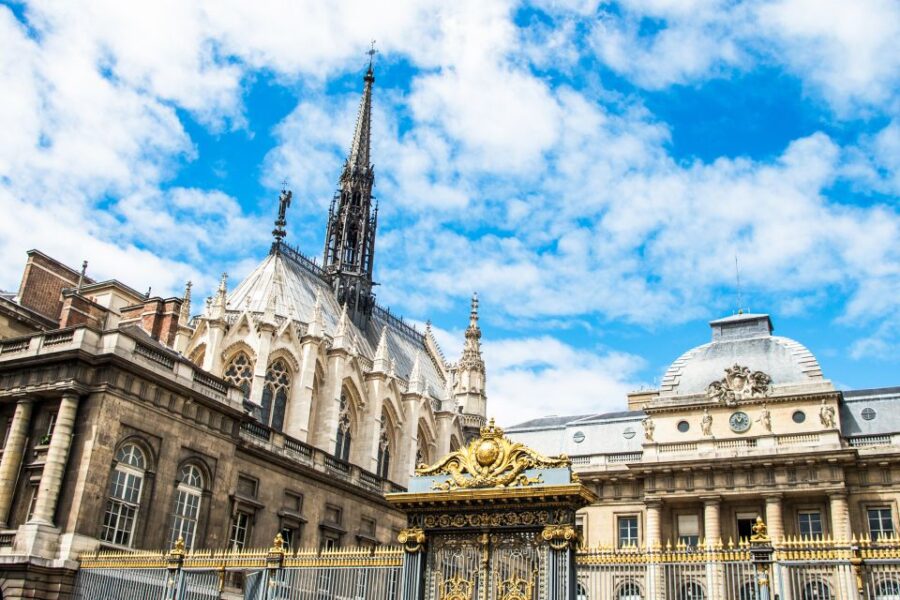
The value depends on how you frame it: if your Paris trip is short and dense, $16 for 45 minutes inside one of Europe’s three or four most affecting Gothic interiors is the deal. If you have a half-day, the combined ticket is the better buy by a long way, and our full breakdown of the chapel and prison together covers what you give up by skipping the Conciergerie. Pick this one only if you genuinely cannot spare another ninety minutes for the prison next door.
2. Sainte-Chapelle and Conciergerie Combined Tickets: $27
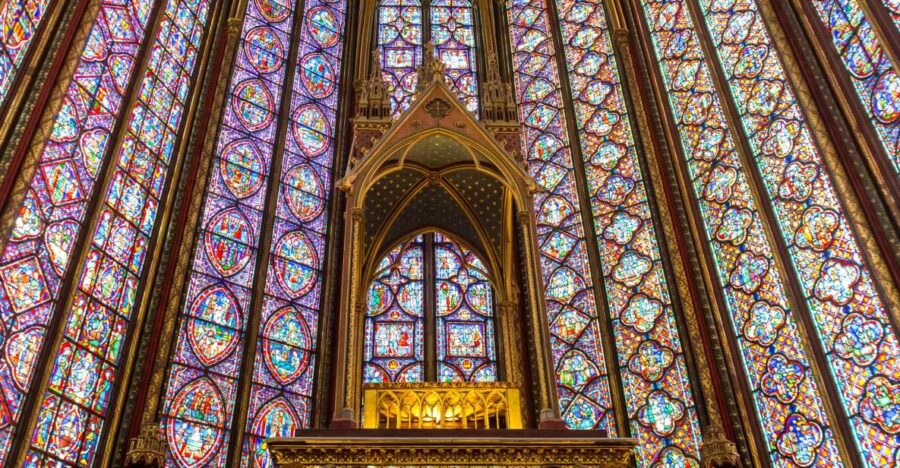
This is the right pick if you have a half-day for Île de la Cité and you want both halves of the story. The chapel is the high point of medieval French monarchy, the Conciergerie is its violent endpoint, and the $11 premium over the chapel-only ticket buys you the second building plus the augmented-reality tablet that flags the Marie Antoinette cell and the Tribunal courtroom. Our review gets into how the two buildings physically connect and what to look for in each.
3. Sainte-Chapelle, Conciergerie, Notre-Dame Guided Tour: $88
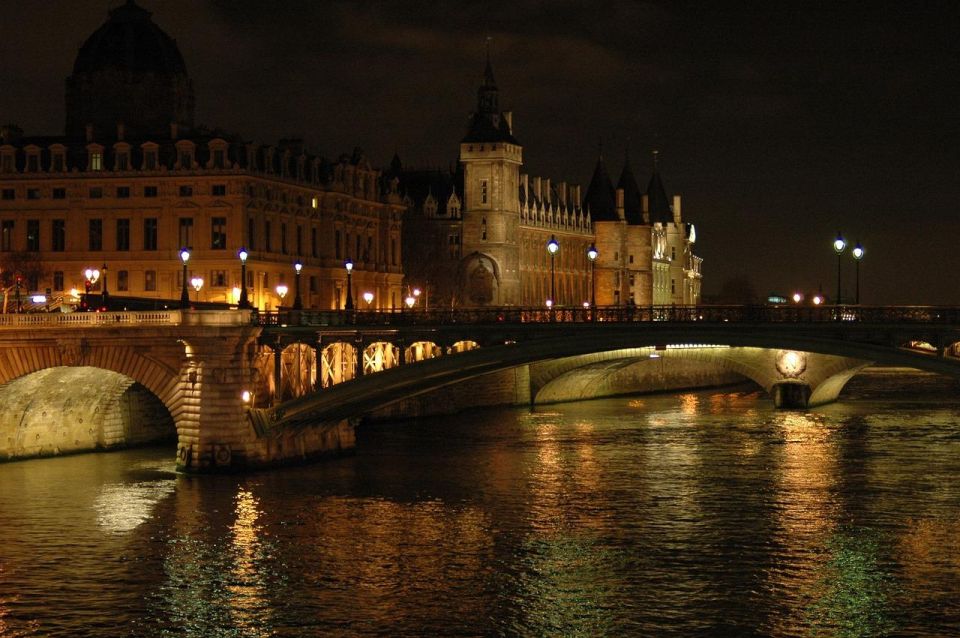
Pick this if you would otherwise be reading wall texts and tilting your phone for the audio guide; the live guide is faster and better at the Conciergerie’s prison logic. The Notre-Dame portion is exterior only, which is the right move while interior renovation continues. Our review notes that the small-group cap (around fifteen people) is the difference between this and a typical group tour.
What to pair it with
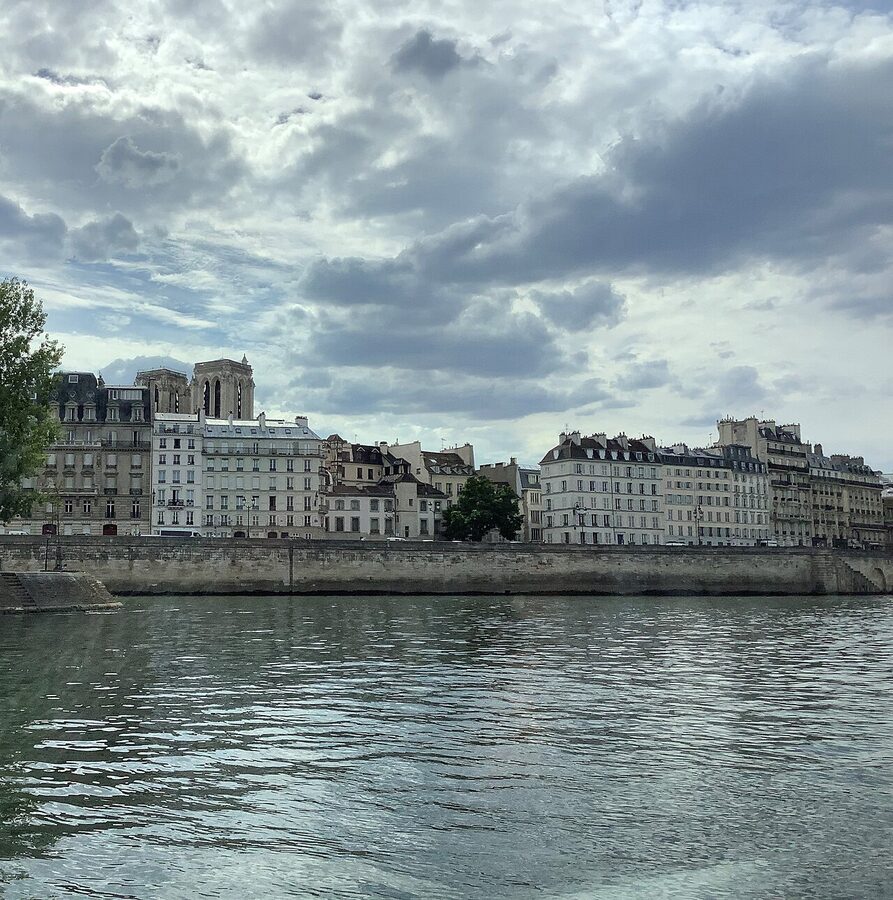
The Sainte-Chapelle and Conciergerie sit on Île de la Cité, the small central island in the Seine that is the historical heart of Paris. The whole island is a 30-minute walk corner to corner. Within those 30 minutes you have the Sainte-Chapelle, the Conciergerie, the Palais de Justice, the Préfecture de Police, Notre-Dame (still in restoration through this decade), the Crypte Archéologique under the parvis, and the western pocket-park, the Square du Vert-Galant, with the best riverside seat in the city.
For a full half-day, the cleanest sequence is: Sainte-Chapelle 14:00, Conciergerie 15:30, walk east past Notre-Dame’s exterior, sit at Square du Vert-Galant for the late-afternoon light. If you have energy, cross to the Right Bank for an early-evening visit to the Louvre (open until 21:00 on Wednesdays and Fridays), which is a fifteen-minute walk away.
If you are doing the chapel as part of a wider Paris stained-glass and royal-architecture itinerary, the natural pairings are the Panthéon (originally a chapel to Saint Geneviève, secularised in 1791 as a mausoleum, the post-revolutionary inverse of the Sainte-Chapelle’s royal-religious function), Les Invalides for Napoleon’s tomb (the king-relic-pilgrimage tradition continued by other means), and a day at Versailles if you have the day. The Sainte-Chapelle is the smallest and oldest of these, and starting the week with it gives you the right scale-anchor for everything that follows.
How the chapel reads against other great-glass interiors
If you are coming to Sainte-Chapelle with other major medieval churches in mind, here is the rough comparison.
Versus St Mark’s in Venice: St Mark’s is older, Byzantine, and dominated by gold mosaic, not glass. The two interiors are doing the same job (overwhelm with decorative mass) but with completely different materials. Sainte-Chapelle is what Gothic Paris produced when Byzantine Constantinople had been St Mark’s reference point. Both are coloured-light interiors. Different palettes, different theology, similar effect on a visitor’s nervous system.
Versus Gaudí’s Sagrada Família in Barcelona: the Sagrada Família is the modern equivalent in scale and colour intensity, but it is a 140-year project that started in 1882 and is still under construction. The light effect at Sagrada Família is much closer to Sainte-Chapelle’s than to any other historic European church. If you have already done Barcelona, you will recognise the way colour and verticality combine the moment you walk in.
Versus the cathedrals in Seville and Córdoba: Seville is bigger, darker, and built around a converted minaret; Córdoba is a Moorish horseshoe-arch interior with a Christian cathedral inserted into it. Both are larger than Sainte-Chapelle, both are doing different things. The Sainte-Chapelle is small, focused, vertical, and coloured. The Spanish cathedrals are the opposite end of the spectrum.
Versus Palma Cathedral: a closer cousin. Palma’s nave was renovated by Gaudí in the early 20th century, and the rose window throws colour patterns onto the floor in a way that echoes Sainte-Chapelle without quite matching its density. Palma is bigger; Sainte-Chapelle is more intense.
Versus Leonardo’s Last Supper in Milan: not architecturally comparable, but tonally yes. Both are 15-minute visits that sit at the centre of a longer Italian or French art-history conversation. Last Supper is one wall, Sainte-Chapelle is fifteen. The chapel rewards a longer dwell.
Versus Amsterdam’s Royal Palace on Dam Square: the polar-opposite use of monumental space. Where Louis IX built a coloured-glass jewel box to enshrine a relic, the Dutch republic built a marble-floored civic hall (the 17th-century Stadhuis) to enshrine a city’s mercantile power. Both are 13th-and-17th-century power statements; one looks up to heaven, the other looks across the harbour.
Reading the windows: a 30-minute method
This is the method I use for a focused 30-minute visit, since most of the time you are working with a 60-minute slot and you want to spend the second half just looking.
Minute 0 to 5: stand at the western entrance of the upper chapel and look east, all the way down the nave to the apse. Take in the whole. Don’t read anything yet. Just notice the colour-temperature gradient: the apse end is the most concentrated, the nave around you is the lightest.
Minute 5 to 10: walk to Window 1, on the south wall by the western door. Read the bottom-left scene, then the next, then the next, working left to right and bottom to top. Move on after you have read three or four scenes. You don’t need to read all 86 scenes in the window. You need to know how the reading direction works, and you need to feel the rhythm.
Minute 10 to 20: walk clockwise around the chapel, pausing at every fourth or fifth window. Identify Window 14 (the relics window, on the north side as you face the apse). Spend three or four minutes on it. This is the chapel’s signature.
Minute 20 to 25: walk to the apse end, stand under the small canopy where the silver platform once held the relic, and turn around. The view back towards the rose is the chapel’s strongest single composition.
Minute 25 to 30: stop reading. Sit on one of the benches if there are any free, or stand to one side. Look up. Just look.
What to skip
Skip the audio guide for Sainte-Chapelle if you have already read this article or the wall placards inside. The audio is competent but it is slower than reading the windows yourself with the order I have given you. Save the audio budget for the Conciergerie, where the AR tablet is genuinely useful for visualising the Tribunal’s layout and the prisoners’ route.
Skip the gift shop. Every Gothic-cathedral gift shop in Europe sells the same imported postcards and the same plastic rose-window magnets, and Sainte-Chapelle’s is no exception.
Skip going on a Friday afternoon in summer if you can. Friday afternoons are when the cruise-ship coach groups arrive, the queue stretches halfway along Boulevard du Palais, and the chapel feels crowded. Tuesday or Wednesday morning is faster.
If you are coming back
For a return visit, the move is to time it to one of the evening classical concerts. The chapel programmes about 100 concerts a year, mostly Vivaldi, Bach, Pachelbel, and Mozart, with the upper chapel cleared of daytime visitors and reset with chairs facing the apse. The acoustic is harder than you would expect (vaulted Gothic interior, lots of glass) but the visual is unmatched: the windows lit from outside, the dark of the chapel, an ensemble in front of the apse where the relic used to sit.
Tickets are typically €25 to €50, depending on programme and seating. Book direct on the Sainte-Chapelle concert website rather than via a tour platform; the platform mark-up on these is meaningful and the direct route puts you in the same seats.
Reframing the visit
The reason most travellers come away from Sainte-Chapelle a little dazed is that they were sold it as “stunning stained glass” and they walk in expecting a Gothic interior with some windows. What they get is a building that is essentially nothing but windows, designed by a king to enshrine an object he believed was the literal Crown of Thorns, and built in seven years on a budget that exceeded most cathedrals because Louis was a king with a relic obsession and unlimited funds.
Once you understand that, the chapel reads differently. The 1,113 scenes are not decoration. They are a defence of the relic’s authenticity, an argument in glass that the object Louis bought from Baldwin II of Constantinople was real, was significant, and was worth more than the building itself. The chapel and the relic were a single proposition, and Window 14 says so on the wall.
And then, when you walk the 90 metres next door to the Conciergerie, you are walking from the highest moment of French royal-religious confidence to the moment 545 years later when that whole edifice came apart. The same complex held both. That’s the visit. Not “stunning stained glass.” A two-building compression of the entire arc from Saint Louis to Marie Antoinette, and one shared security entrance.
If you have time for one Paris monument and you want it to do real work on you, this is a strong contender. The Eiffel Tower gives you the view; the Orsay gives you Impressionism; the Louvre gives you sheer collection scale. Sainte-Chapelle gives you a single mood, very strong, in 45 minutes.
Île de la Cité as a half-day, written out
For anyone planning the practical day, here is how I would actually structure it.
13:30: arrive at Cité métro station (line 4), the only station physically on the island. Walk two minutes east on Boulevard du Palais.
13:45: security queue at 4 Boulevard du Palais. Have your phone ticket ready and your bag emptied.
14:00: Sainte-Chapelle slot. Lower chapel, then upper. 45 minutes inside, with the western windows just starting to catch the autumn-spring afternoon angle.
14:50: leave the chapel. Walk 90 metres west to the Conciergerie entrance on Quai de l’Horloge.
15:00: Conciergerie. The tablet, the Salle des Gens d’Armes, the kitchens, Marie Antoinette’s cell. About 75 minutes.
16:15: out. Walk east along Quai de l’Horloge, past the Préfecture de Police, into the parvis of Notre-Dame. Five minutes for the exterior, even with the renovation hoarding still up.
16:45: walk west again, along the southern bank of the island, to Square du Vert-Galant at the very tip. This is the best riverside seat in central Paris. Take 20 minutes here. Watch the boats pass.
17:30: cross Pont Neuf to the Right Bank. Either head into the Louvre if it is a Wednesday or Friday (open until 21:00) or sit at a café on Rue de Rivoli for an early dinner.
Final practical points
- Address: 4 Boulevard du Palais, 75001 Paris, inside the modern Palais de Justice complex.
- Métro: Cité (line 4), Saint-Michel (lines 4 and RER B/C), Châtelet (multiple lines).
- Opening hours: 09:00 to 19:00 in summer, 09:00 to 17:00 winter; last entry 30 minutes before closing.
- Closed: 1 January, 1 May, 25 December.
- Security: bag check, no large bags or sharp objects; this is an active courthouse so the security is real.
- Photography: allowed, no flash. Tripods need a permit.
- Accessibility: the lower chapel is accessible; the upper chapel is reached by a narrow spiral stair with no lift. Check ahead if mobility is a concern.
- Best time of year: April to October for the strongest western-window light; June and July are crowded but the late northern sunset gives you light until almost 22:00.
- Worst time: midwinter overcast mornings; the colour effect is muted and the chapel feels grey.
What it leaves you with
Most travellers come out of Sainte-Chapelle quieter than they went in. That is the chapel doing its job. It was designed by a king and a master mason in the 1240s to overwhelm a small royal household with the proximity of a single object. Eight centuries later, with the object moved to Notre-Dame and the king’s bones long gone, the building still does what it was built to do. The story of the relic is told in the glass; the glass is held up by buttresses you mostly can’t see; the chapel itself is a piece of physical theology that worked then and works now, in 2026, on people who arrive without much theology of their own.
If your Paris trip is built around the Eiffel Tower, the Louvre, and a Seine cruise, give Sainte-Chapelle one of your remaining half-days. Pair it with the Conciergerie. Go in the afternoon if the weather is clear. Read Window 14 for the relics story. Turn around at the apse to see the rose. Walk next door to stand where Marie Antoinette stood. Eat afterwards at a Right Bank café, with the colours from the chapel still doing their work in the back of your head.
That is the visit. $27, two and a half hours, the smallest and most concentrated piece of medieval France you can stand inside.
If you are booking other Paris experiences while you are at it, the Orsay‘s Impressionist holdings work well as a Sainte-Chapelle counterpoint (one is medieval colour, the other is 19th-century colour); a Seine cruise the same evening lets you see both Île de la Cité buildings from the water; and a day trip to Versailles the next day gives you the absolutist endpoint of the royal architecture story that started, eight centuries earlier, in the upper chapel of the Sainte-Chapelle.