
The two facts about La Seu that I never see in guidebooks: Antoni Gaudí worked here for eleven years, and twice a year the cathedral does something with light that nobody planned for and almost nobody outside Mallorca knows about. The Gaudí you came to Spain for, the one who built the Sagrada Família and Park Güell, was hired by the Bishop of Mallorca in 1903 to redesign the inside of an existing Gothic cathedral. He stayed until 1914, then walked away after a fight with the chapter. The other thing happens on 2 February and 11 November at sunrise, when light from the east rose window passes through the cathedral and projects directly underneath the smaller west rose window, making a perfect figure-eight of overlapping rose windows on the wall. Locals call it the Festa de la Llum, the Festival of Light. It lasts about ten minutes.
That’s the cathedral you’re booking a ticket for. It also happens to sit on the foundation of a 13th-century mosque demolished after the Christian reconquest of Mallorca, which puts it in a small architectural club with Seville’s cathedral and the Mosque-Cathedral of Córdoba. The difference: Palma kept zero of the mosque. Sevilla kept the minaret as the Giralda. Córdoba kept the entire mosque and built the cathedral inside it. Palma flattened the lot and started fresh in 1300.
In a Hurry? Three Picks
Cheapest, fastest: Skip-the-Line Entry Ticket ($12). Phone ticket, walk in, that’s it.
With context: City Walking Tour with the Cathedral ($34). Two and a bit hours of Old Town plus the cathedral entry bundled in.
Old Town focus: Old Town and Cathedral Tour ($32). Smaller groups, 90 minutes, priority entry to the cathedral.
What La Seu Actually Is
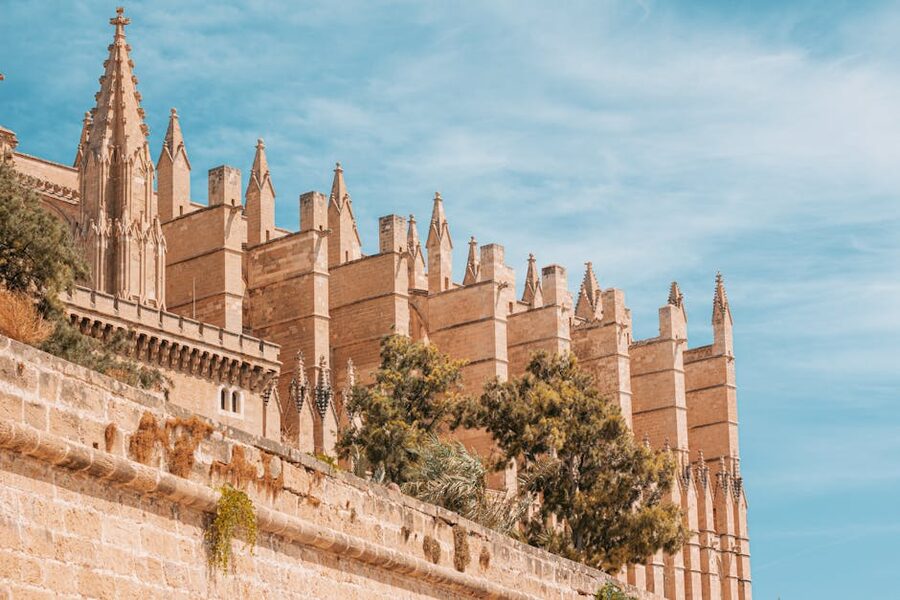
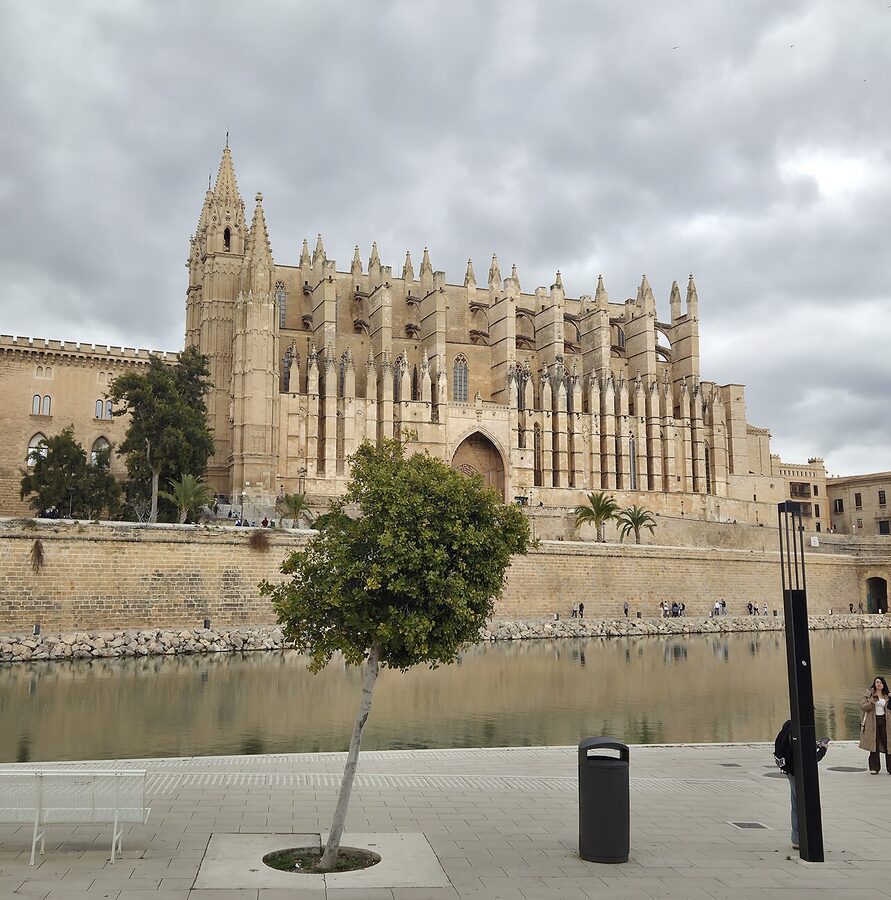
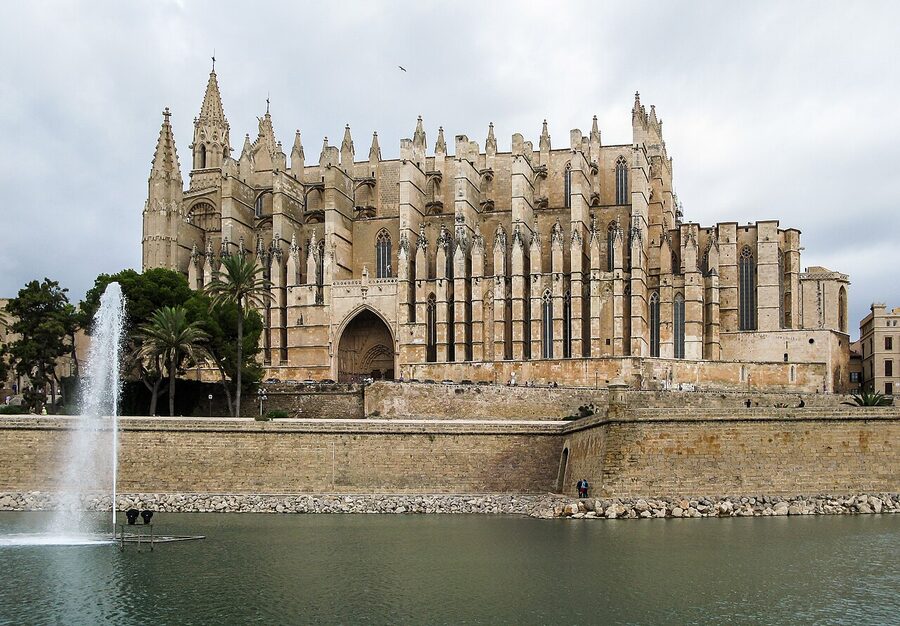
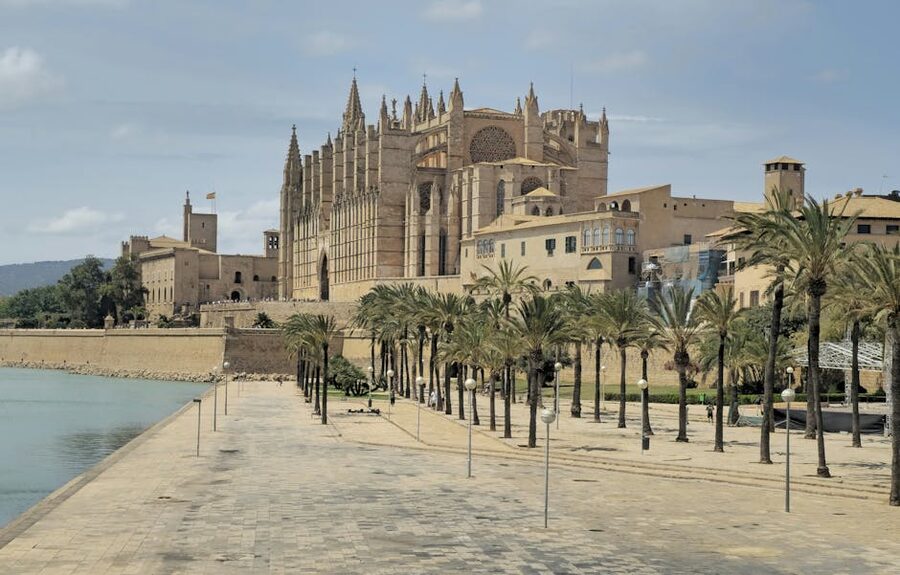
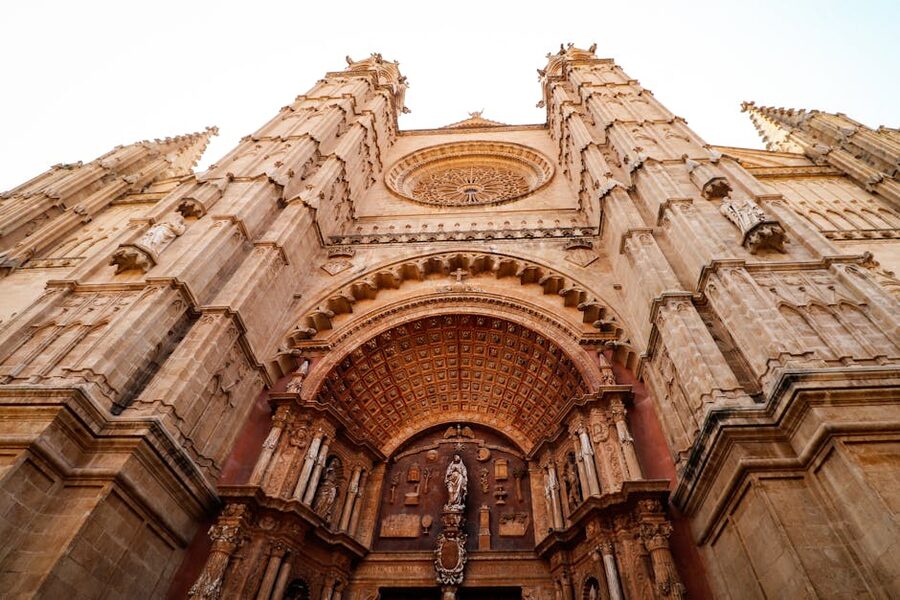
La Seu is short for la Seu de Mallorca, Catalan for “the See of Mallorca”, as in the bishop’s seat. The full Spanish name is Catedral-Basílica de Santa María de Palma. Locals just say La Seu and you should too. The numbers are absurd. 121 metres long. 55 metres wide. 44 metres high inside. The east rose window is 13.4 metres in diameter and holds 1,236 panels of stained glass, which makes it one of the largest Gothic rose windows in Europe.
Construction started in 1300 under Jaume II of Mallorca and finished in 1601 under the Spanish Habsburgs. That’s 301 years. Three centuries to build one building. For comparison, the Florence Duomo took about 140 years from foundation to dome. St Peter’s in Rome went up in roughly 120. La Seu took twice as long because Mallorca kept losing its kings, kept running out of stone, and kept pausing whenever the politics of who controlled the island shifted.
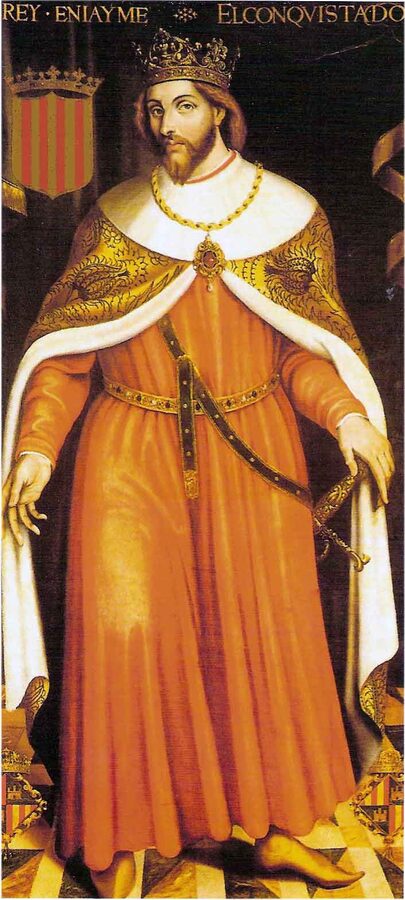
The mosque-foundation point matters. When Jaume I of Aragón landed at Santa Ponça in September 1229 with a fleet of about 150 ships, the city he was attacking, Madina Mayurqa, had been Muslim for three centuries. By the end of December the city had fallen and the Almohad mosque, built where the cathedral now stands, became Christian for one mass, then was demolished. The cathedral you’re standing in now is the third building on the same plot. Roman temple, then mosque, then this.
The Gaudí Years
This is the part most people miss. In 1903, Bishop Pere Campins, who had become friends with Gaudí during a visit to Barcelona, hired him to redesign the inside of La Seu. Gaudí was 51, already famous for the Casa Calvet, halfway through Park Güell, and slowly drawing the new Sagrada Família. The Palma commission was strange in his career: it was his only major restoration of a Gothic cathedral. Everything else he built was new.
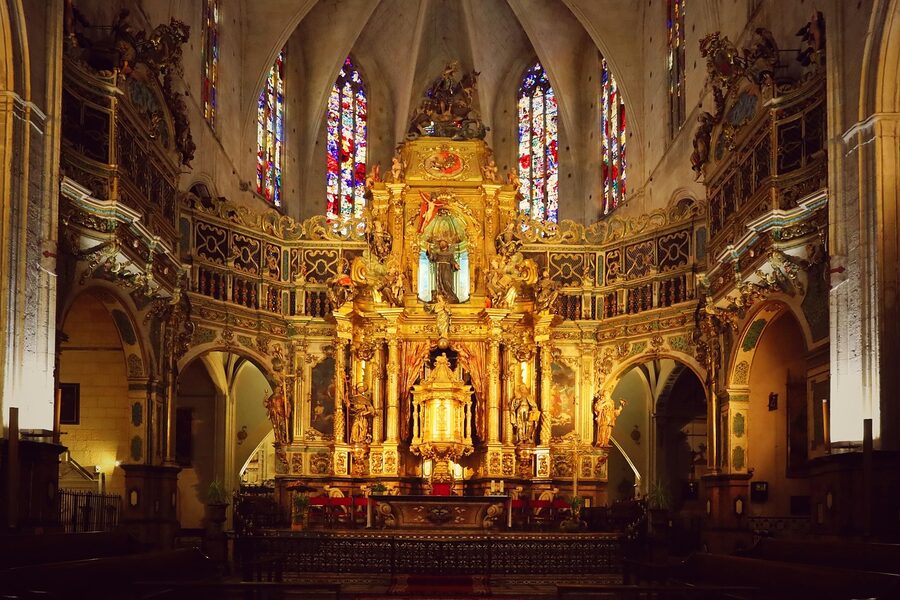
What did he actually do? Three things, really. First, he moved the choir stalls. They had sat in the middle of the nave for centuries, blocking the view of the altar from the back of the church, which was the standard medieval arrangement. Gaudí pulled them out and installed them along the side walls of the apse, opening up the entire nave so you could see all the way through the building from the west door to the high altar. This was radical at the time and the chapter never fully accepted it.
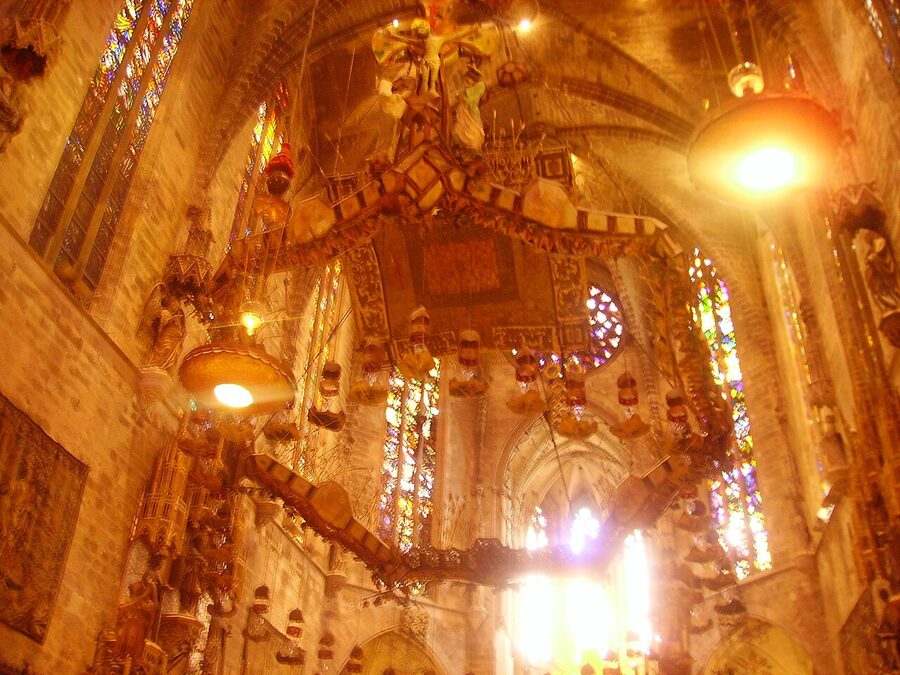
Second, the wrought-iron canopy over the altar, the baldaquí. This is the polygonal hanging structure with lamps at each corner. Gaudí designed it on the symbolic form of Christ’s crown of thorns. Everyone who’s walked into a major cathedral has seen baldachins, the stone or marble canopies over altars. Gaudí’s is suspended on cables. It hovers. It looks like nothing else in any cathedral I’ve ever been in.
Third, he electrified the lighting and reworked the colour palette of the choir, ceramics included. The ceramic mural designs and the painted choir stalls were hand-decorated under his direction. If you’ve been to Casa Vicens, his very first house in Barcelona, the ceramic instinct is the same one you see at La Seu. The trim and the warmth on tile rather than on stone. The 21st-century equivalent of an architect leaving a single signature gesture inside an existing building is something like Frank Gehry’s Fondation Louis Vuitton in Paris, where the architect and the gesture are inseparable from the institution; what Gaudí did at La Seu is the Edwardian-era version of that same idea.
He worked on La Seu for eleven years. In 1914 he had a falling-out with the cathedral chapter over a relatively small matter (accounts vary, the most-cited reason is a dispute over the painting of one of the bishop’s chairs) and walked. He never returned to the project. He spent the last twelve years of his life on the Sagrada Família and on nothing else.
So if you’re doing the Gaudí pilgrimage in Spain, La Seu fits in the timeline like this: Casa Vicens 1883–1885, Park Güell 1900–1914, Casa Batlló 1904–1906, La Pedrera (Casa Milà) 1906–1912, La Seu 1903–1914, then nothing but the Sagrada Família until his death in 1926. La Seu is parallel-stream Gaudí, the late period, the same years he was figuring out the Casa Milà loft. You can see the through-line if you look.
Tickets and How They Work
Standard adult entry is around €10–12 depending on whether you book direct or through a marketplace. The flagship skip-the-line ticket on GetYourGuide hovers at $12. The official ticket from the cathedral itself is similar. Both work. The marketplace version is sometimes a euro or two more, but the queue you skip is the queue at the ticket office, not the queue to enter the building, so the skip-the-line phrasing is doing a little more work than it should be. In peak summer the queue at the ticket office can be 20–30 minutes. In April or October, sometimes none.
Hours, roughly:
- Monday to Friday: 10:00–17:15
- Saturday: 10:00–14:15
- Sunday: closed to visitors (mass only)
- Last entry: 30 minutes before close
- Free for residents on Sundays for mass, but not for tourist visiting
There’s also a separate tower climb ticket (the bell tower, currently around €20 and only available in limited timed slots, often booked weeks ahead in summer). It’s not always running. If it’s a hard yes for you, check the cathedral’s own website at the start of your trip. The skip-the-line marketplace tickets do not include the tower.
The Three Tickets I’d Actually Book
1. Cathedral of Mallorca Skip-the-Line Entry Ticket: $12
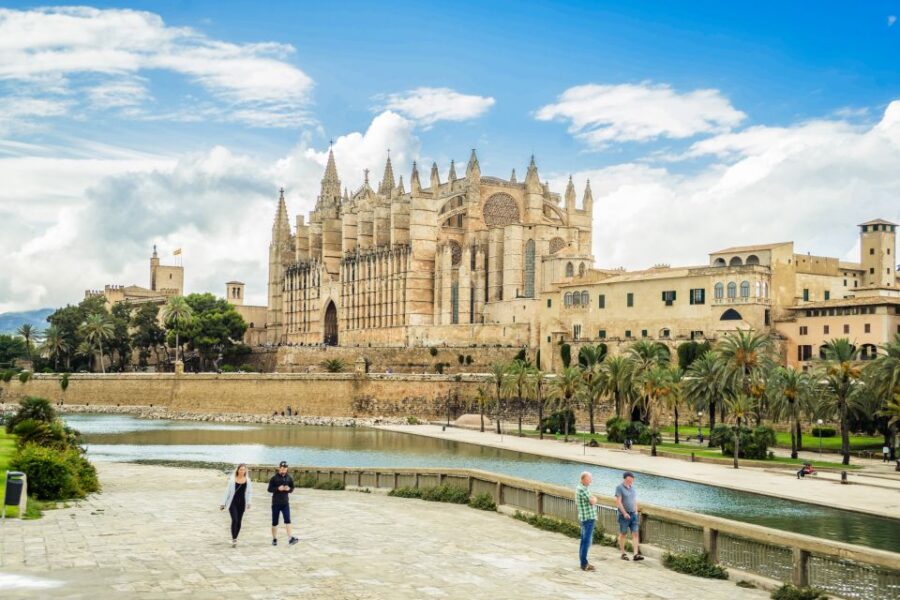
This is the right pick if you want self-paced solo time inside La Seu and you don’t need a guide. It’s the cheapest legitimate ticket on the market and our full review walks through what’s actually inside the entry price (museum included, tower not). The trade-off: no audio guide is bundled, so if you want context, bring your phone or read the Wikipedia article on the bus over.
2. City Walking Tour With the Cathedral: $34
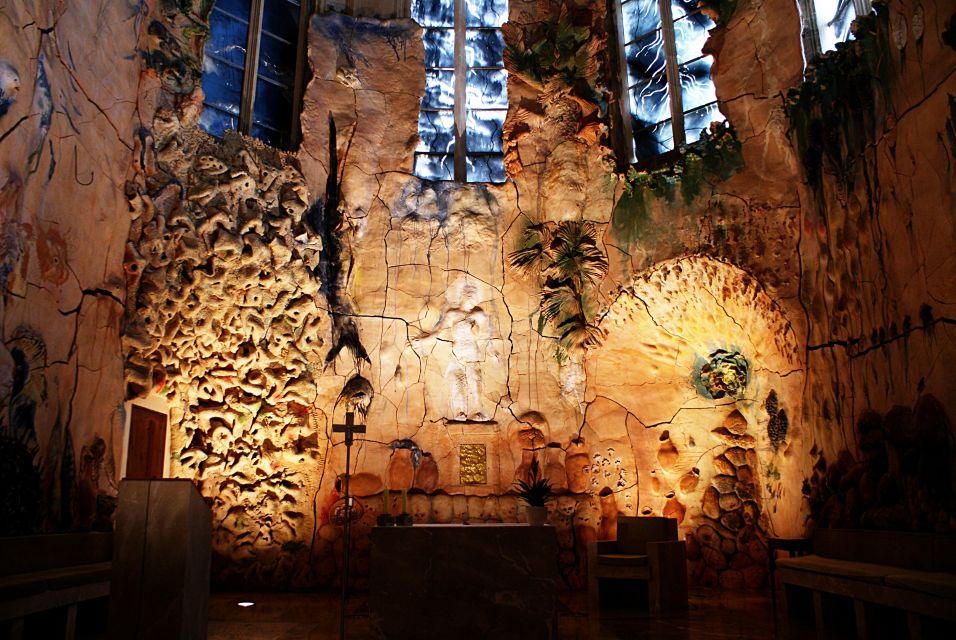
This is the right pick if Palma’s Old Town is your first stop on Mallorca and you want a guide to anchor the day. The tour walks Plaça Major, Plaça del Rei Joan Carles I, the Almudaina exterior, then enters the cathedral with priority access. Our review notes the trade-off: it’s a big-group format, so if you want intimate, the next card down is better.
3. Old Town and Cathedral Tour: $32
This is the right pick if you want a smaller group and you care more about Old Town context than cathedral context. It’s 90 minutes, capped at around 10–12 people, and the guide quality reads better in our review for the alley-and-courtyard side of Palma. Trade-off: less time inside the cathedral itself than the longer walking tour above.
The Festa de la Llum (the Figure-Eight)
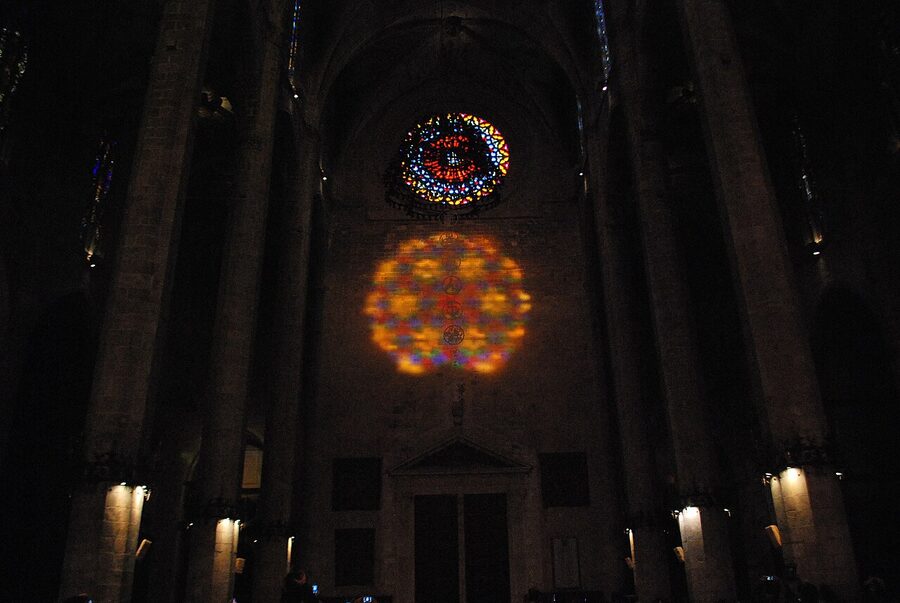
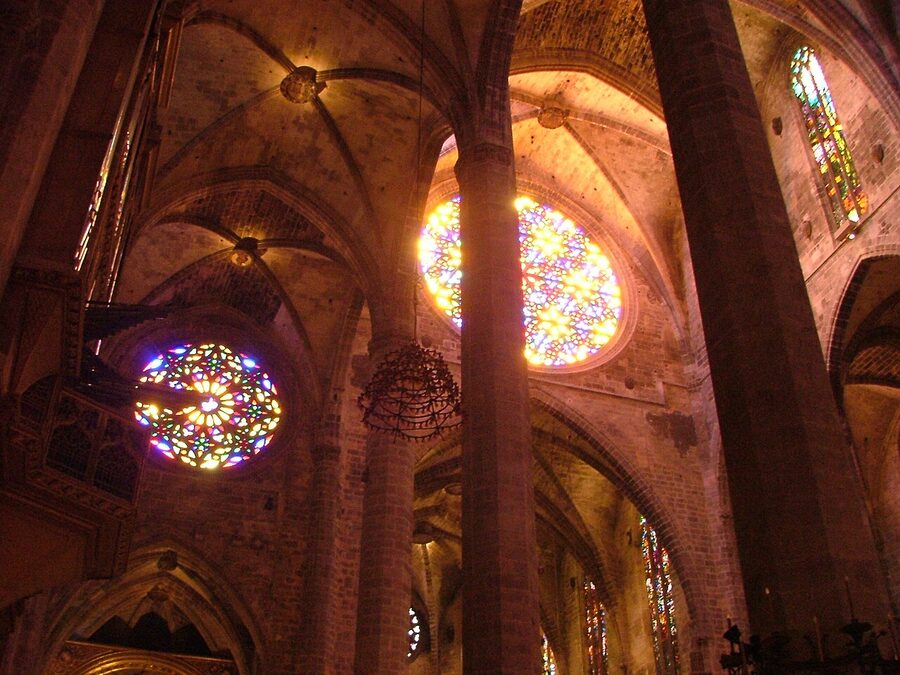
Twice a year. 2 February and 11 November. At sunrise, somewhere around 8:15–8:35am depending on the date and the weather. The light from the east rose window passes through the entire 121-metre length of the cathedral and projects onto the west wall, directly underneath the smaller west rose window. For about ten minutes, you can see two rose windows on the west wall. The actual stained glass at the top, and a perfect projection of the east rose window directly below it. Locally it’s called the Festa de la Llum, the Festival of Light. Catalan-speakers also call 2 February la Candelera (Candlemas), which is why a lot of the photographs you’ll find on Wikimedia are filed under that name.
The cathedral is open early on those two mornings (it opens around 8:00am for the spectacle, even though normal hours start at 10:00am), and entry is included with your standard ticket. You don’t need a special booking. You do need to plan for 2 February or 11 November specifically. If your dates don’t line up, you don’t get to see it. There is no reproduction.
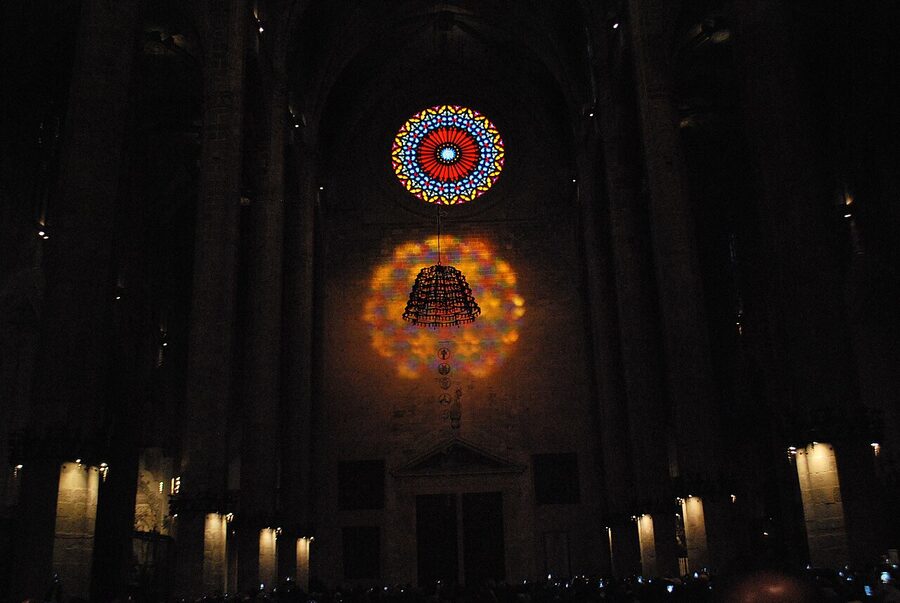
Two practical things, because they catch people out. The phenomenon depends on clear weather. If it’s overcast on 2 February, you don’t get the projection, you get a damp grey light. The cathedral opens regardless and a lot of people come anyway, but the figure-eight needs sun. The other thing: photographers fill the cathedral early, so if you want to be inside, get there by 7:45am. By 8:30am the central nave is full of tripods and you’re shooting between heads.
The Rose Window Itself
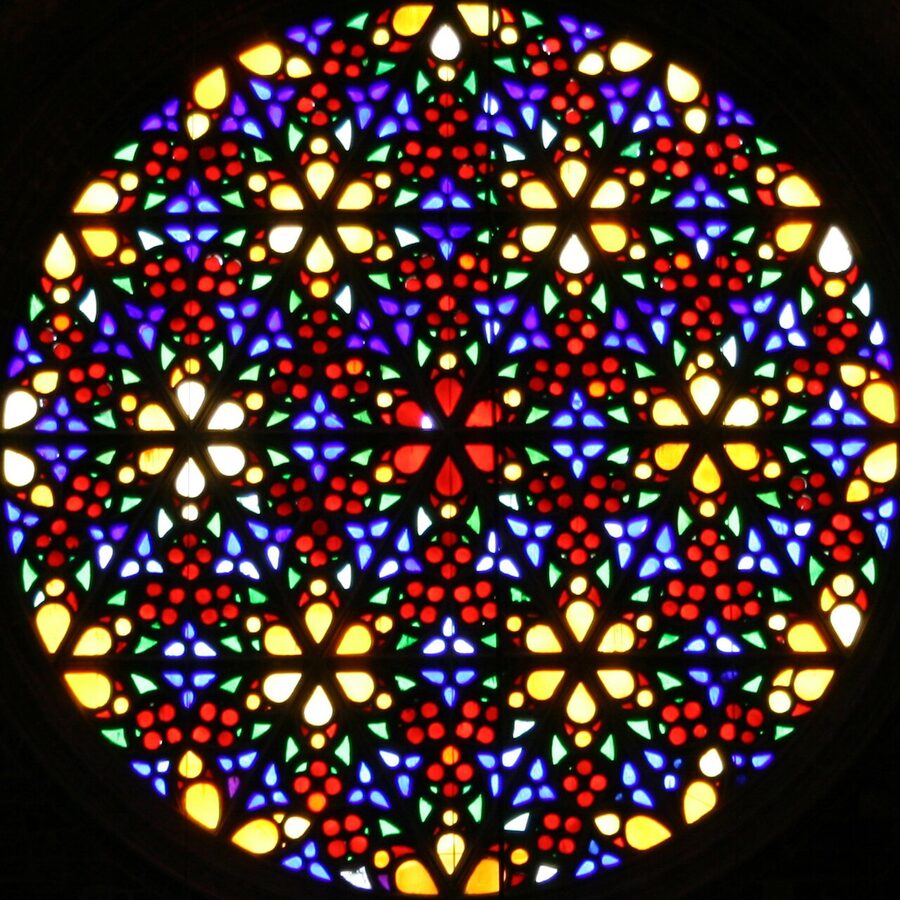
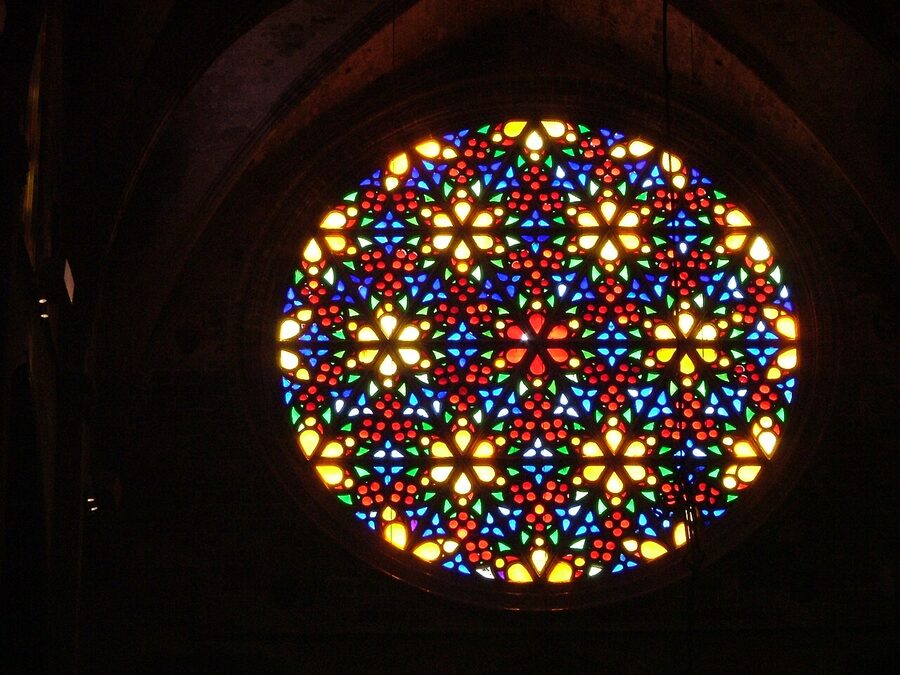
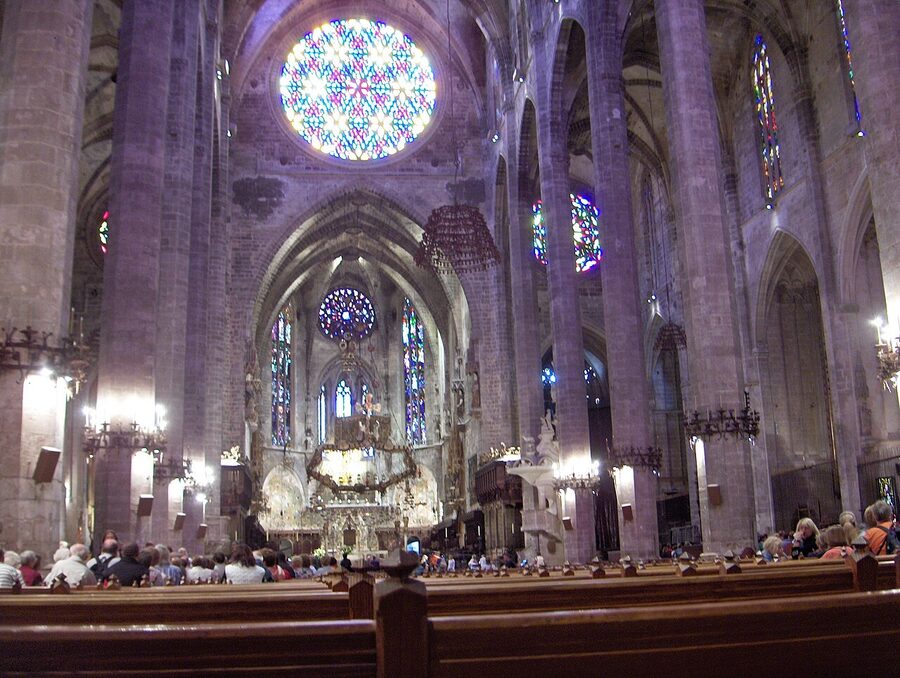
Even on a non-Festa day, the east rose is the centrepiece. 13.4 metres in diameter is hard to grasp until you stand under it. Picture a window twice the height of a London bus, set into the apse wall at about 25m off the ground. The 1,236 stained-glass panels were made over centuries. The original 14th-century glass is mostly gone, replaced after a 1851 earthquake collapsed parts of the rose. The glass you see now is largely a 19th- and 20th-century reconstruction, which annoys some restoration purists and which I think is fine because the geometry is what gives the window its character, and the geometry is original.
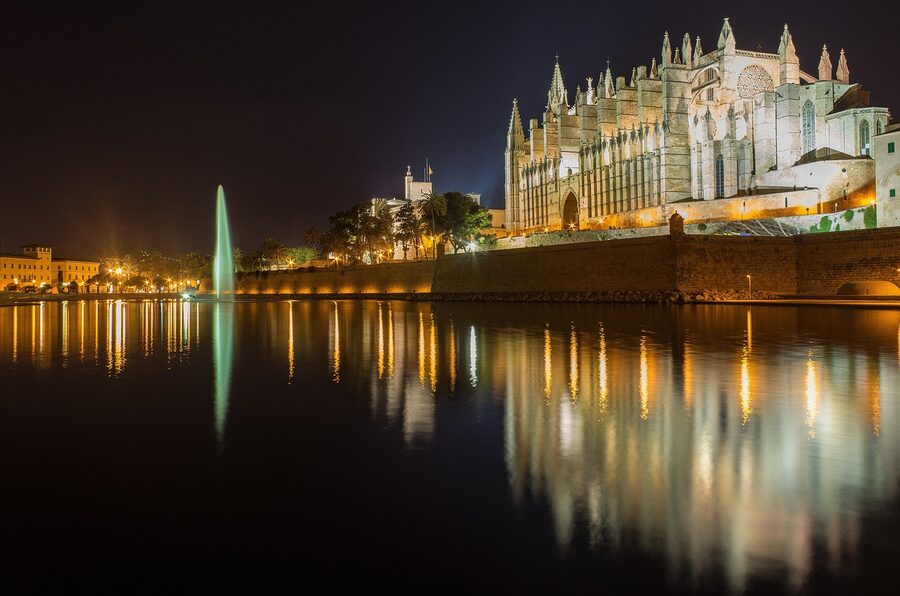
The west rose, the one that gets projected onto, is smaller, around 11 metres across. It sits over the west door and, on Festa mornings, it’s the canvas, not the source. The two windows together are why La Seu is sometimes called La Catedral de la Luz, the Cathedral of Light, in tourism copy. The Catalan-language tourism office calls it la catedral de la llum. Same idea. The marketing follows the architecture.
The Miquel Barceló Chapel (the Controversial Part)
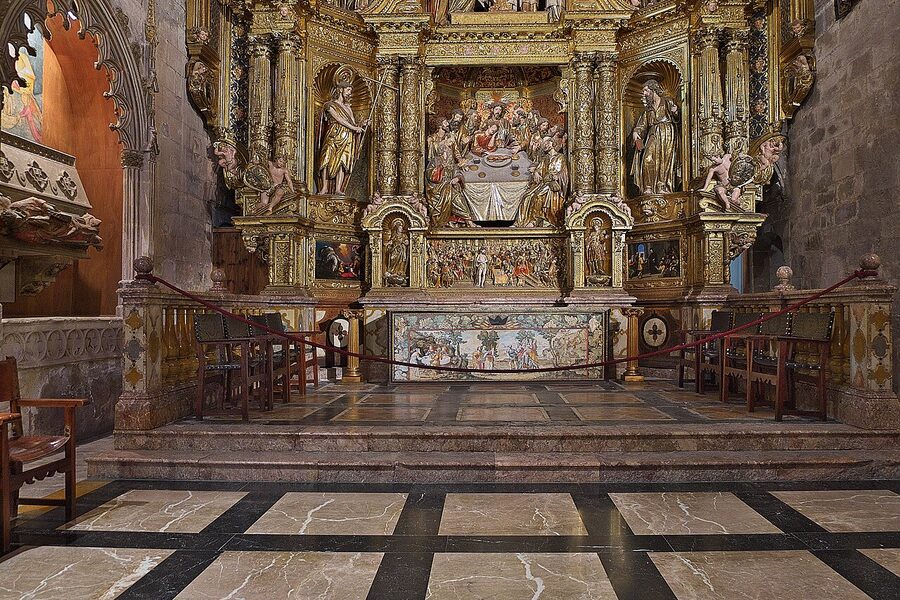
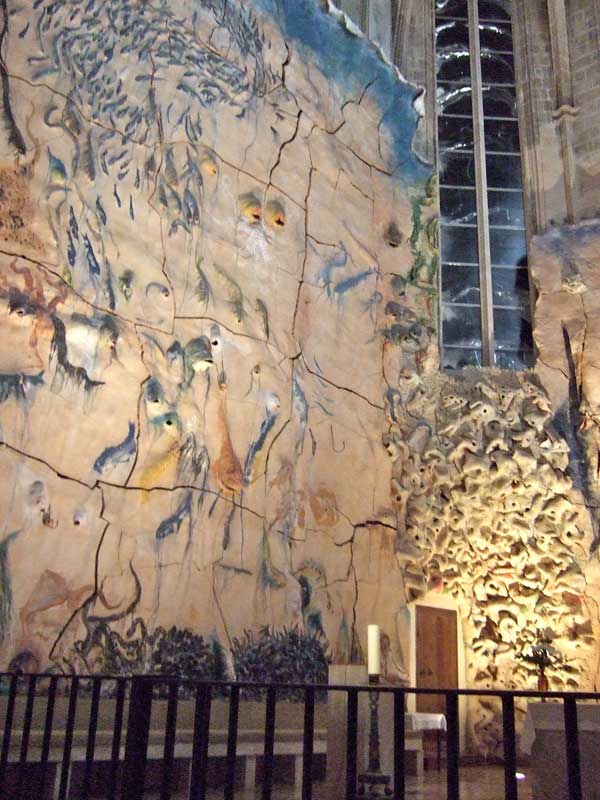
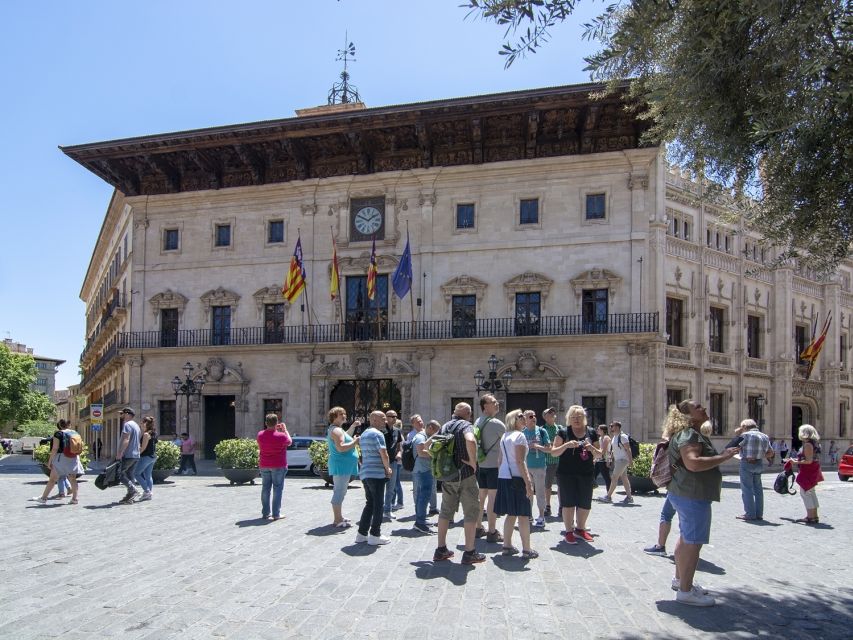
In 2007, a Mallorca-born contemporary artist named Miquel Barceló finished an installation in the cathedral’s Capilla del Santísimo (the Chapel of the Holy Sacrament). It is a 300m² ceramic-and-bronze wall covering that depicts the multiplication of loaves and fishes from the Gospel of John. The kind of single-architect contemporary statement landing inside a much older civic shell is something the Dutch civic scene also pulled off with Renzo Piano’s NEMO Science Museum on the Amsterdam waterfront, which is a different programme but the same instinct: a famous contemporary hand on a very public building, controversy at the time, accepted twenty years on. Fish in relief. Bread broken open. Skulls. Waves. It looks nothing like the surrounding 14th-century Gothic. It looks like Barceló pushed his hands into wet clay at industrial scale. Which is more or less what he did.
People hated it when it opened. The Mallorca conservative press accused the cathedral of letting a “secularising” artist deface a sacred space. The Vatican had to weigh in. Twenty years later, opinion has shifted: the chapel is now one of the things people specifically come to see, and Barceló’s later commissions (the UN Geneva ceiling, big pieces in Madrid) all trace back to this one. I think it’s the most interesting piece of contemporary religious art made in Spain since the war. Whether you like it or not, it’s worth ten minutes of standing very close to one of the side walls.
The chapel is included in the standard ticket. You don’t need a separate booking. It’s signposted inside the cathedral as Capilla del Santísimo or Capilla del Santíssim in Catalan.
The Other Things You Can Actually See Inside
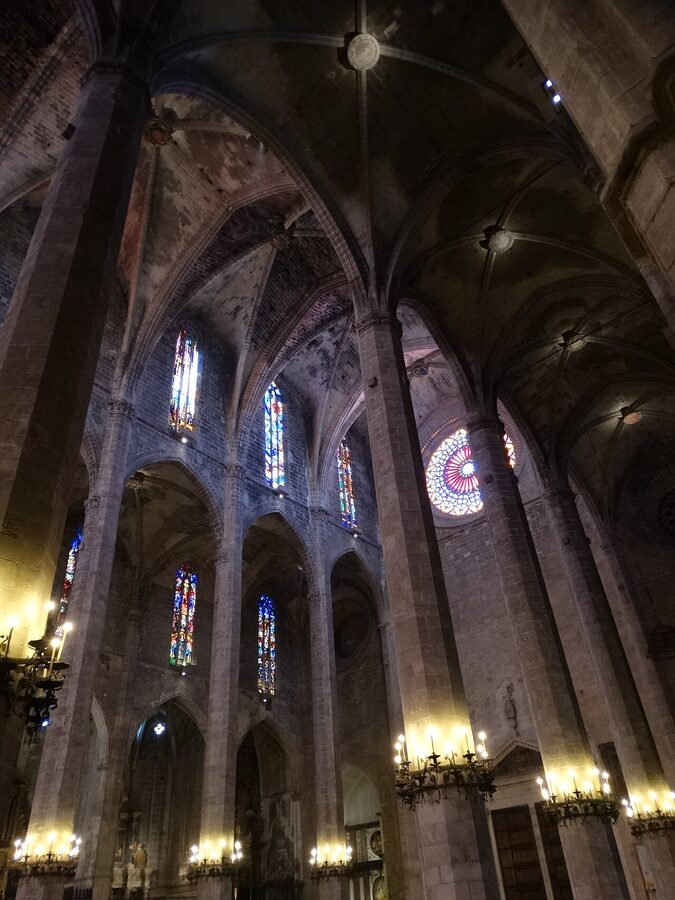
The cathedral’s pillars are doing something architecturally interesting that’s worth noticing. They’re octagonal in cross-section and they rise to about 21 metres before the vault springs. There are seven pairs along the nave, and the vault between them sits at 44 metres. To put that in context, the vaults at St Mark’s Basilica in Venice sit at about 28m. La Seu’s vault is taller than most Italian Gothic cathedrals. The reason it feels even taller than it is: the pillars are unusually thin for the load they carry. They look fragile. They’re not. They’ve held that vault up for 700 years.
The Cathedral Museum is included in the entry. It’s housed in the cathedral chapter house and contains the usual stuff: chalices, monstrances, vestments, paintings of various Mallorcan bishops. The standout objects are two enormous reliquaries (the True Cross fragment cases) and a 14th-century painted retable of St. Eulalia. If museum-of-objects isn’t your thing, blow through it in 15 minutes. If it is, give it 40.
One last thing inside. The tomb of Jaume II of Mallorca is in the chapel of the Trinity, behind the high altar. He’s the king who started the cathedral in 1300. He died in 1311 and never saw any of it built above floor level. He’s buried in his own unfinished cathedral, which is fitting. There’s also the tomb of Jaume III in the same chapel, the last independent king of Mallorca, killed in 1349 trying to take his own kingdom back from his cousin Pedro IV of Aragón.
When to Go (and When Not To)
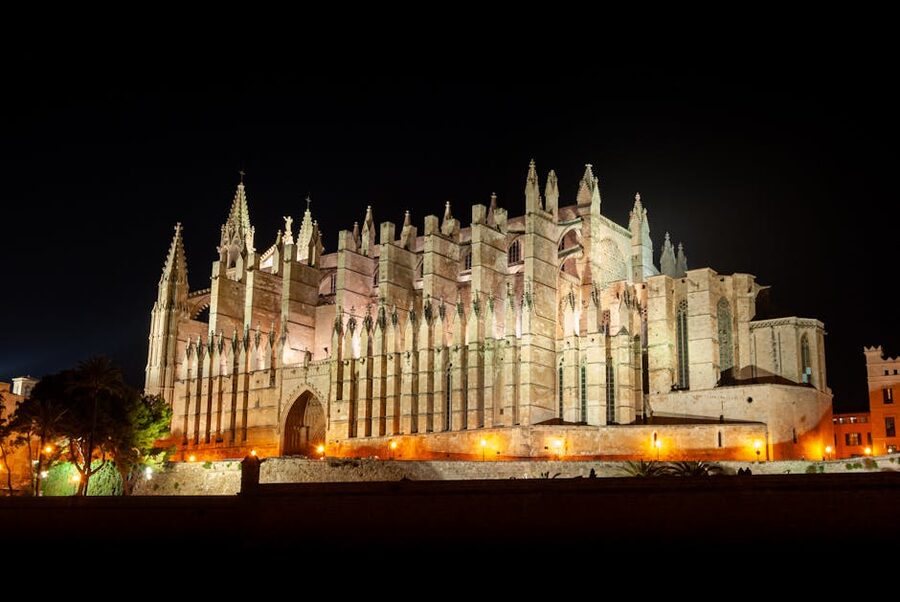
The morning is better. The cathedral opens at 10am most days and the first hour is the quietest. By midday in summer it’s busy, and from 2pm to 4pm it’s heaving with cruise day-trippers from the Palma port. If you can be inside between 10:00 and 11:30, you’ll get a different experience from the post-lunch crowd. Saturday closes at 14:15 (last entry 13:45), so Saturday afternoons in summer are not happening.
Avoid Sunday entirely unless you’re attending mass. The cathedral is closed to tourist visiting all day. The locals get their cathedral back. If you only have Sunday in Palma, sit on the Parc de la Mar steps with a coffee and look at the building from outside. Or take a catamaran day trip from the port and come back to Palma with the cathedral profile rising out of the water. It’s a different way of seeing the building and arguably the way it was meant to be seen, from a ship arriving.
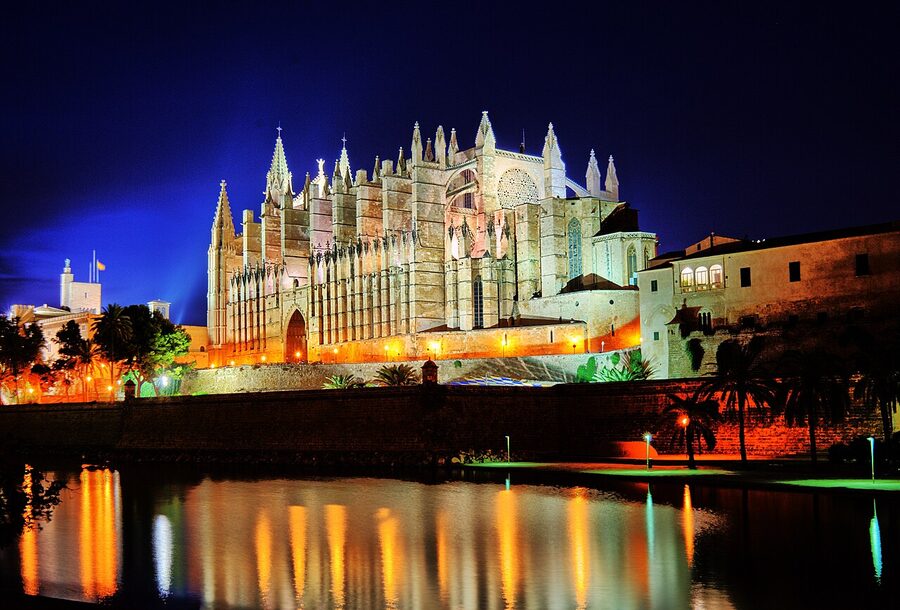
Off-season is the better window for the cathedral itself. October, November, January, February, March. Cooler weather, no cruise crowds, the same 121 metres of building. If your trip lands in February, you might catch the Festa de la Llum on the 2nd. November, you might catch it on the 11th. Both are off-season, both are when Palma feels most like Palma instead of like a tourism stage.
Getting There and What’s Around
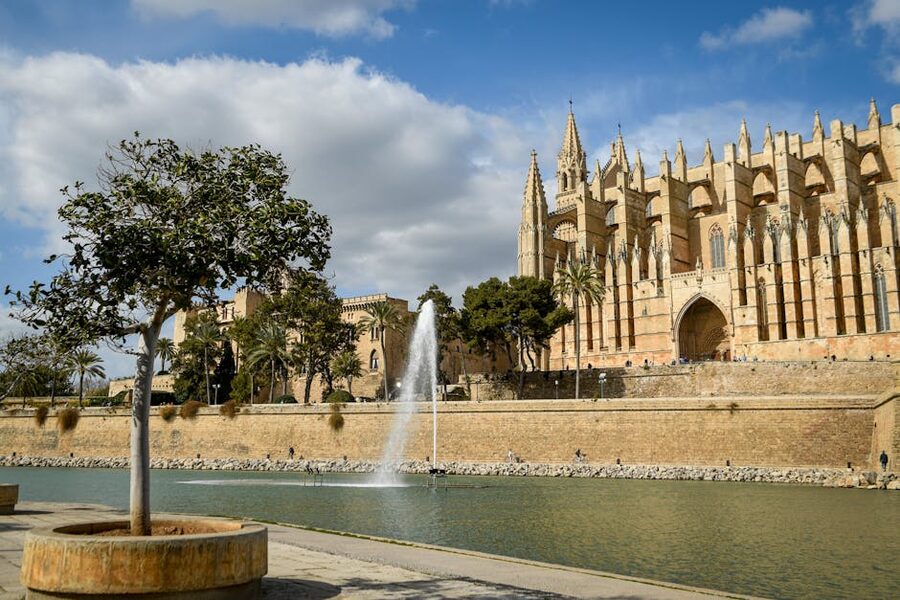
The cathedral sits on the south edge of Palma’s Old Town, directly above the Parc de la Mar lake. From the cruise port, it’s about a 25-minute walk along the Paseo Marítimo, or a 10-minute taxi (around €10–12). From Plaça d’Espanya (the central transport hub), about 15 minutes on foot through the Old Town. The Palma hop-on hop-off bus stops at the cathedral plaza, but the city is small enough that the bus mostly only pays off if you’re heading out to Bellver Castle or the Pueblo Español on the western edge.
Right next door is the Royal Palace of La Almudaina, the Spanish royal family’s official Palma residence (in practice they stay at Marivent in summer; the Almudaina is open to visitors most of the year). Same plot, same Almohad foundations, separate ticket around €7. If you’ve already paid €12 for the cathedral, the Almudaina is the obvious add-on. The Dutch parallel for the cathedral-and-palace pairing on a tight Old Town footprint is the way the Royal Palace on Amsterdam’s Dam Square sits opposite the Nieuwe Kerk, two civic buildings on one square that you do back-to-back. Half an hour, then back outside.
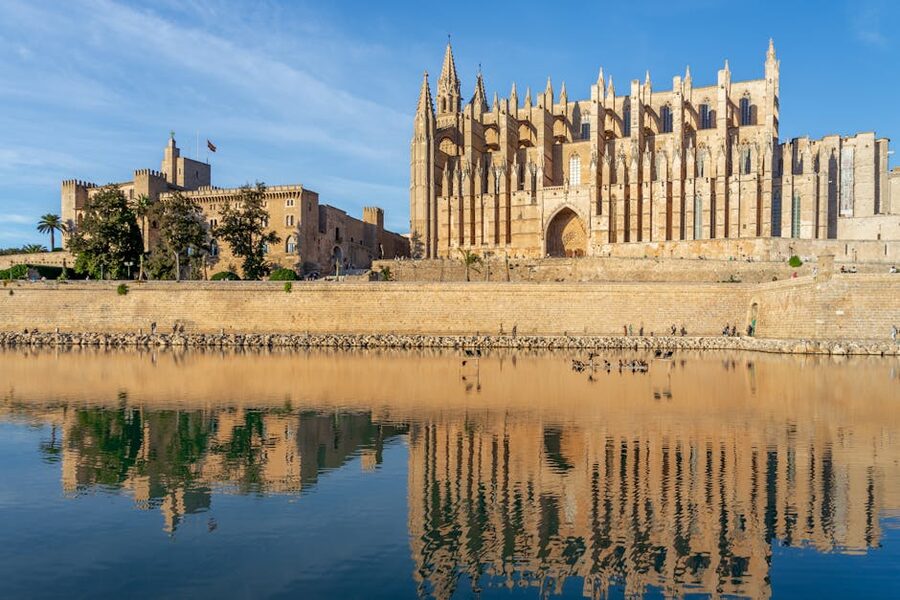
For the rest of the day, you have options. Old Town in the morning, lunch at the Mercat de l’Olivar (10 minutes north of the cathedral, full of locals at 1pm), then a beach in the afternoon. Or, if you have a second day on the island, head to the Caves of Hams on the east coast for the underground concert in the cave lake. They’re 70km away, 90 minutes by car.
How La Seu Compares to Spain’s Other Mosque-Cathedrals
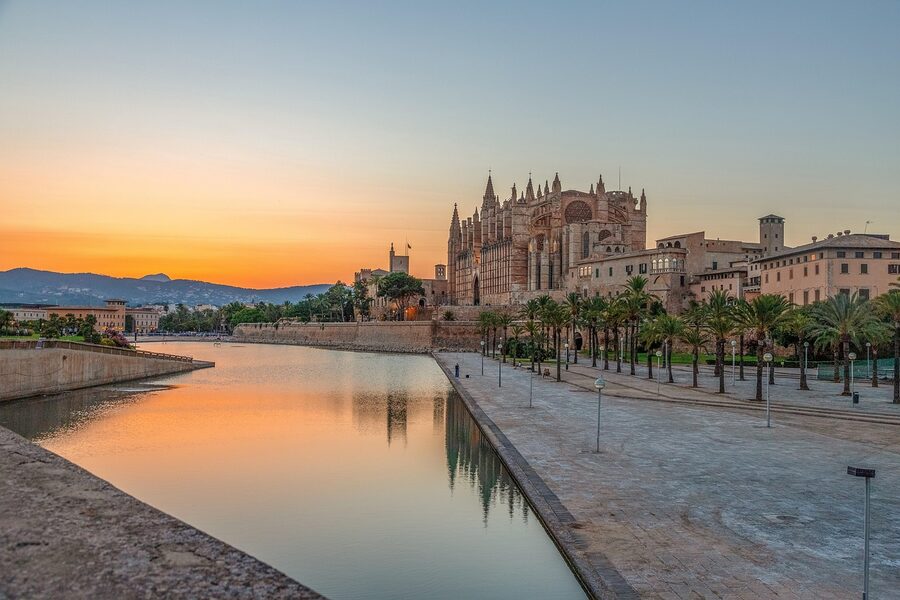
If you’ve been to Seville Cathedral or the Mosque-Cathedral of Córdoba, La Seu is the third leg of the same Spanish reconquest pattern, and the comparison is genuinely interesting. All three Christian cathedrals are on the foundations of demolished or repurposed mosques. The differences are how each city handled the inheritance.
Córdoba kept the entire mosque, the Mezquita, and inserted a Renaissance cathedral inside it. Charles V famously visited in 1526 after the cathedral was started inside the mosque and said something like “you have built here what could have been built anywhere, and you have destroyed something unique to the world.” The Mezquita is still mostly the mosque you remember. The cathedral feels like a tumour growing in it.
Seville kept the minaret as the bell tower, La Giralda, and built a new Gothic cathedral on the rest of the plot. The Giralda is still the most identifiable bit of the Almohad city. The cathedral wraps around it.
Palma kept nothing of the mosque. Demolished it entirely in 1229, started a fresh Christian cathedral 70 years later, and that’s what you visit today. There’s no Almohad architecture to compare to. The reason it matters: Palma had the smallest pre-Christian Muslim population of the three cities (Madina Mayurqa was a regional capital, but smaller than Sevilla or Córdoba), so the political incentive to preserve anything was minimal. Sevilla and Córdoba had Mudéjar (Christianised-Moorish) populations to integrate. Palma did not.
The Italian comparison is also worth a moment. St Mark’s in Venice is the Byzantine answer to what La Seu is doing with light, except St Mark’s uses gold mosaics on every interior surface to bounce daylight, while La Seu uses 1,236 panels of stained glass. The closest French parallel for the stained-glass-as-architecture move is the Sainte-Chapelle on the Île de la Cité, where the entire upper chapel is fifteen 15-metre Gothic windows and the structural stone is just the frame around the glass. Milan’s Duomo took six centuries to build, like La Seu, and is also a long-haul Gothic project that ate every regime that started it. Different scale, similar timeline.
Things People Get Wrong
A few things visitors get wrong, in my experience.
“It’s a quick stop”. People give the cathedral 20 minutes. It deserves 90. The interior is enormous, the rose window pulls you in for 10 minutes alone, the Barceló chapel needs 10–15, the museum 20. If you’re rushing it, you’re spending €12 to look up briefly.
“The skip-the-line ticket skips the cathedral entry queue”. It skips the ticket-office queue. The doors at the entry, you pass through with everyone else. In summer with cruise crowds, the doors themselves can take 5–10 minutes. It’s still worth it because you don’t have to queue twice, but the phrase oversells.
“The Festa de la Llum is at sunset”. It’s at sunrise. The east rose window is on the apse end of the cathedral, which faces sunrise. The projection goes east-to-west through the building. If you turn up at sunset on 2 February you’ll get the cathedral closing for the day.
“You can climb the bell tower with the standard ticket”. You can’t. Tower climb is a separate timed-slot ticket (around €20) when it’s available, which isn’t always.
“It’s a Gaudí cathedral”. It isn’t. Gaudí restored the interior. The exterior, the structural Gothic, the pillars, the rose window, all of that pre-dates Gaudí by 600 years. Calling La Seu a Gaudí cathedral is like calling the Sagrada Família a Subirachs cathedral because Subirachs sculpted the Passion façade. Wrong scale of contribution.
What to Pair It With on the Same Day
Half a day in, half a day out, is the right Palma rhythm. Cathedral in the morning, then either the Almudaina next door, or a walk through the Old Town to Plaça Major and Plaça Cort. Lunch at one of the Mercat de l’Olivar’s stand-up bars (Bar Joan is my favourite, around €15 for a full plate). Then in the afternoon, options.
If the weather is good, head south. Catamaran day trips from Palma leave from Moll Vell and the Club de Mar marina, both 15 minutes’ walk from the cathedral. A 5-hour cruise plus lunch runs about $69 and gets you out to the south-west coves. The contrast is the whole point. You spend the morning inside one of the largest Gothic cathedrals in the Mediterranean, then you’re swimming over a seagrass bed by 2pm.
If you’d rather stay on land, the Palma hop-on hop-off covers Bellver Castle (the round 14th-century castle on the hill west of the city, also Jaume II commission) and Pueblo Español. Bellver in particular is worth the trip up. It’s the only round castle of its kind in Spain, and the views over the Bay of Palma from the upper terrace are the postcard view of the island.
Final Practical Notes
A short list of things I wish I’d known before my first visit.
- Dress code applies. No sleeveless tops or above-the-knee shorts, the same as in Italian cathedrals like St Peter’s. They will turn you away. Bring a scarf if you’re in a tank top.
- No flash photography. Phones on silent. Some sections have stricter rules during mass.
- Bag check at the entry. Big backpacks need to go in the cloakroom. Day bags are fine.
- Audio guide isn’t included with the cheap ticket. There are a few good free apps that cover La Seu. Or read up before you go.
- Toilets are at the museum end, on the way out. There’s nothing inside the cathedral itself.
- Mass is at 9am on weekdays in the Capilla Real, not the main nave. You can attend without a ticket if you’re going as a worshipper. You can’t tour during the mass.
If You’re Doing the Gaudí Trail
One more thing for the architecture-pilgrims. If you’re working through Gaudí systematically, La Seu is the only site outside Barcelona on the canonical list, and the only place in Spain where you can see Gaudí’s hand on a Gothic building rather than on his own nineteenth- and twentieth-century inventions. The order I’d recommend: Casa Vicens first because it shows you Gaudí before he was Gaudí, then Casa Batlló and La Pedrera for the mature urban work, then Park Güell for the failed-utopia chapter. La Seu fits between Park Güell and the Sagrada Família in the chronology, the parallel commission while Park Güell stalled. Then Sagrada Família last, because nothing else compares and you’ll measure everything against it on the way out.
If you’re doing it the cheap way and you only get one trip, see the Sagrada Família and read about La Seu later. If you’re doing it properly, fly Barcelona to Palma (40 minutes, often €30 each way), spend a long morning at La Seu, lunch in the Old Town, and fly back the same evening. It’s the kind of day-trip pilgrimage that costs less than most museum memberships and changes how you read everything else in his catalogue.