
The lights drop. Not slowly. All at once. One second you’re sitting on a wooden bench in a vaulted cave 30 metres under the east coast of Mallorca, looking at a black underground lake the colour of ink, and the next second the cave is dark except for a row of candles set along a stone shelf above the water. Then a violin starts. Just one note, held. The note hangs in the air for a long time before the rest of the strings come in.
That’s the moment you’ve paid to see at Coves dels Hams, the Fishhook Caves, in Porto Cristo. Not the stalactites. Not the limestone. The moment the lights drop and Albinoni’s Adagio starts in the dark.
Most people who go to Mallorca and want to see a cave don’t go to Hams. They go to the bigger, louder, more famous Caves of Drach, ten minutes down the road. Drach has the larger lake, the longer concert, the bigger barge. Drach is the headline. Hams is the smaller, quieter one your taxi driver mentions on the way back, after you’ve been to the other.
I’d pick Hams. Or rather: I’d pick both, in one half-day, with Hams second so the smaller cave isn’t dwarfed by the memory of the larger. But if you only have time for one, the call isn’t obvious. This guide is about how to actually decide.
In a hurry? Three quick picks
- Cheapest entry, just the cave: $21 for the Caves of Hams entry ticket. Drive yourself, walk in, do the hour, leave. Best value.
- Family combo with dinosaurs: $29 for the Caves of Hams + Dinosaurland combined ticket. The two attractions sit on the same Porto Cristo road. Good if you have kids.
- Drach plus optional Hams add-on: $62 for the Caves of Drach day trip with optional Hams. Hotel pickup, guide, and you can bolt Hams onto the same morning.
What Coves dels Hams actually is
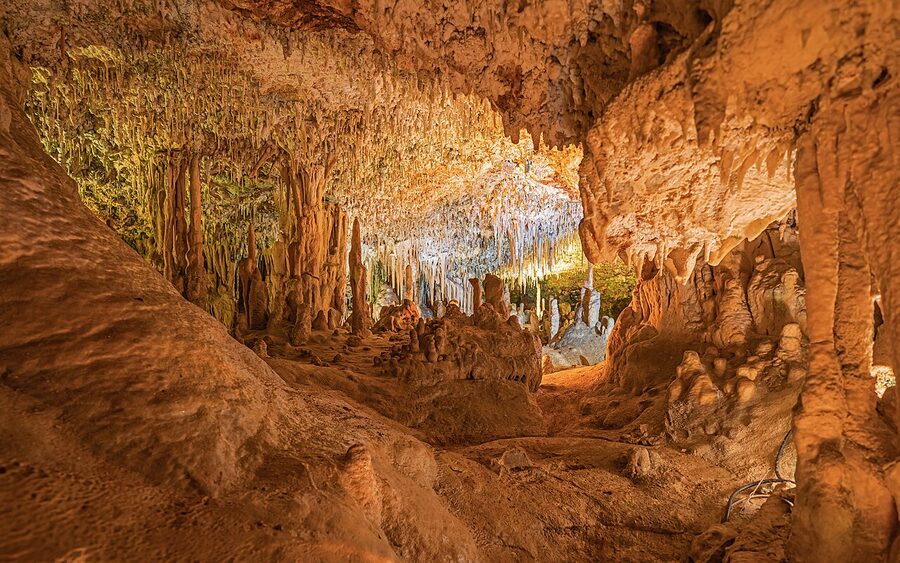
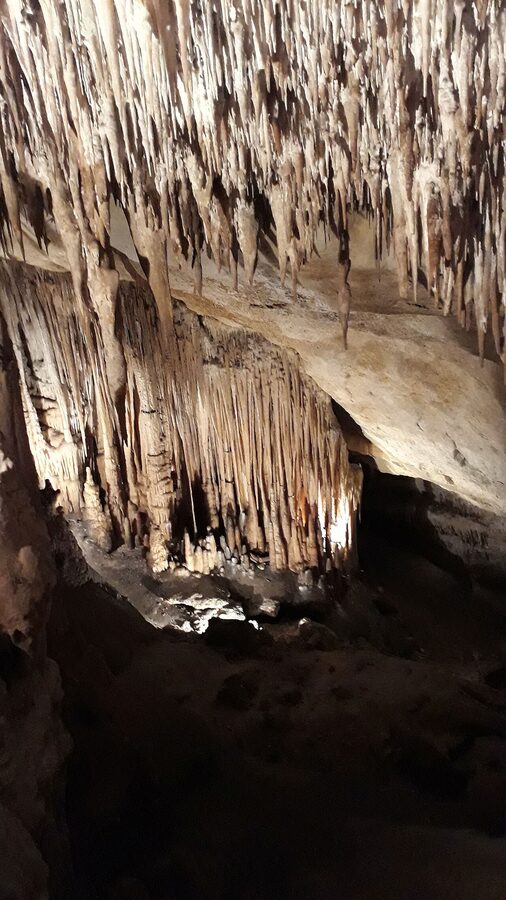
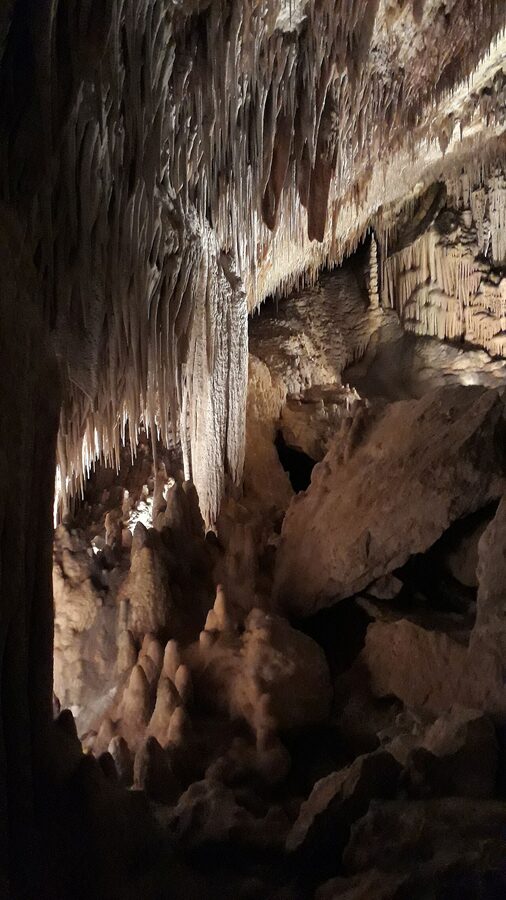
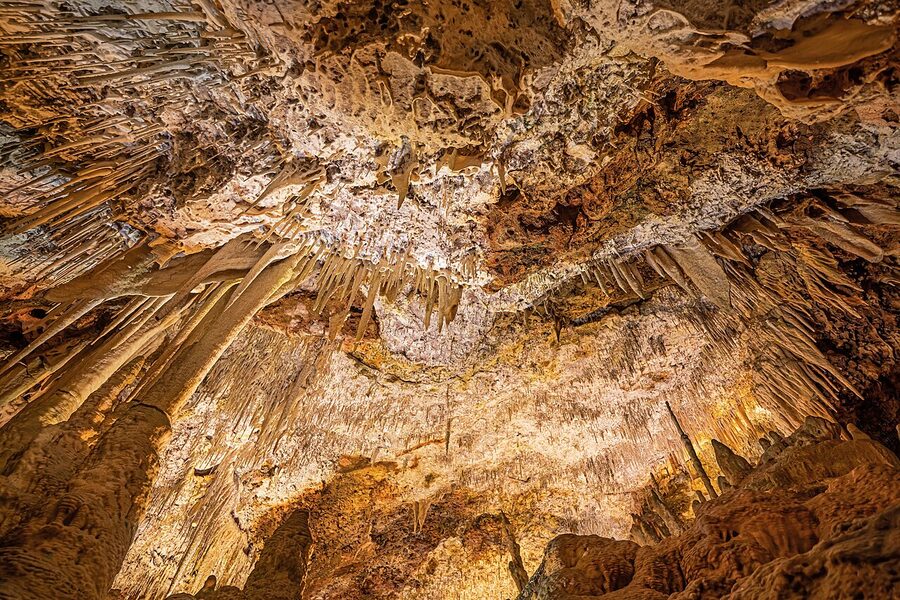
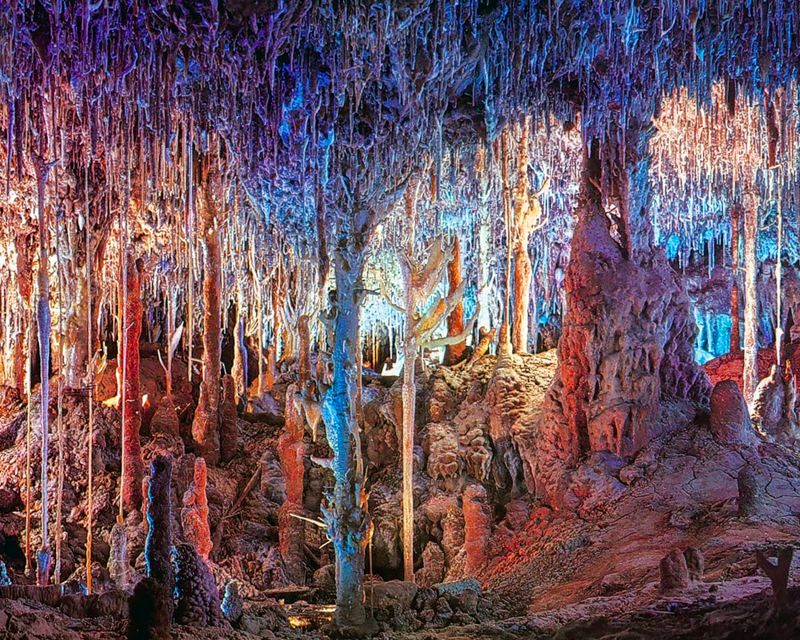
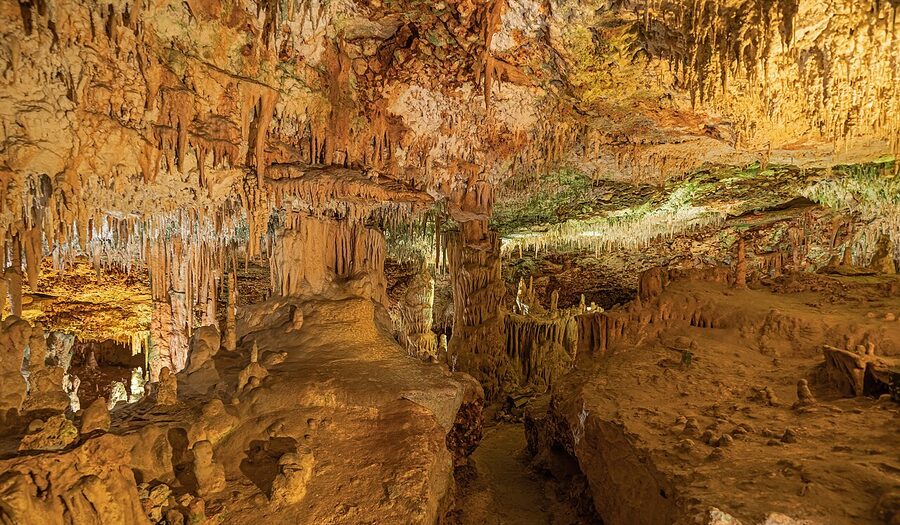
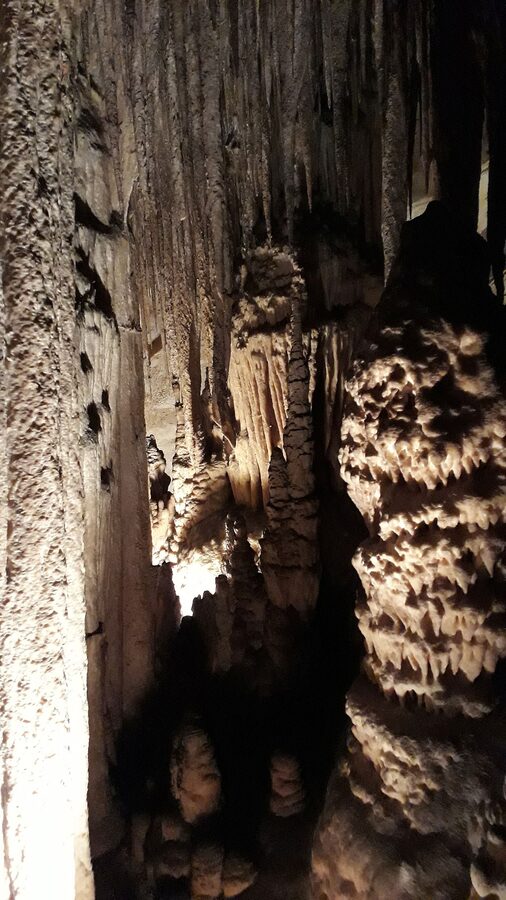
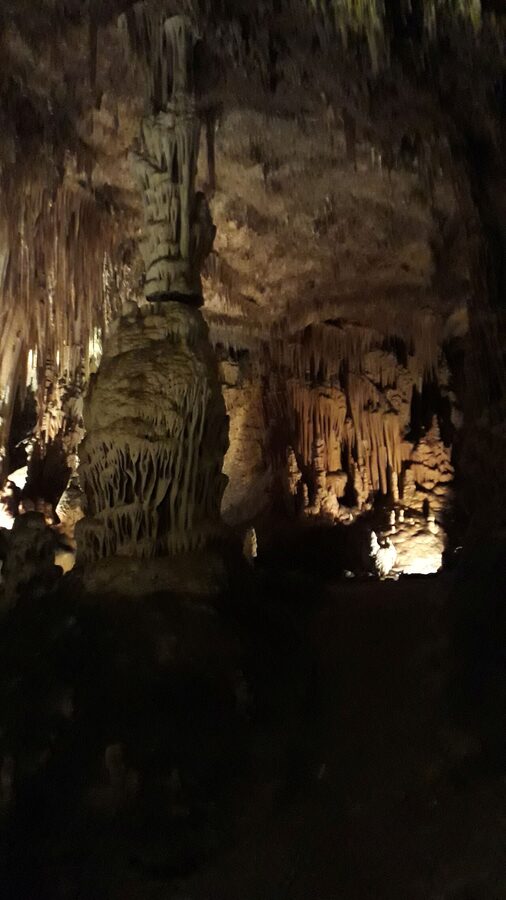
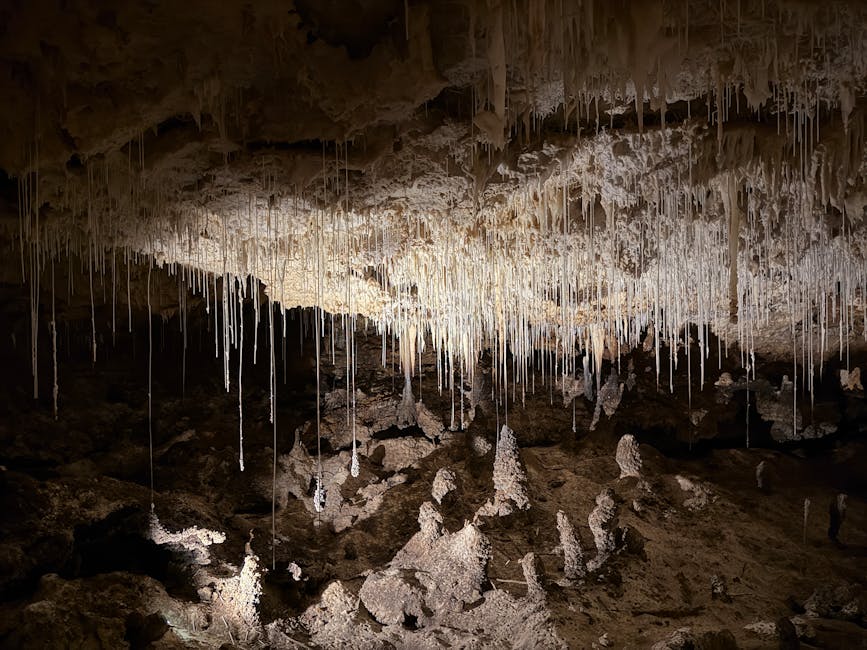
The Catalan word “hams” means fishhooks. The cave is named for a particular kind of stalactite that grows here in unusual abundance: long, thin spikes coming down from the ceiling that curl back on themselves at the tip, like a fishhook. They form when dripping water hits a draft of air and the calcium-rich water gets pushed sideways before it falls. Over thousands of years the drips deposit calcium in the slightly wrong direction, and the stalactite grows with a curl.
The caves are about a kilometre west of the centre of Porto Cristo, on the east coast of Mallorca, in the municipality of Manacor. They run for around 850 metres total, with 15 named galleries open to the public. The walking route through them takes about 30 minutes. Then the concert. Then a short boat appearance on the lake. The whole visit is about an hour. If your Mallorca itinerary already has the standard set of central-Palma cultural stops, with Palma Cathedral as the anchor, this east-coast half-day is the natural complement.
The caves were found by accident in 1905 by a speleologist named Pedro Caldentey Santandreu, who was actually digging for onyx in the area. He cut into a wall and the rock gave way into open space. The gallery he opened that day is now called the Sala 2 de Marzo, the 2nd of March gallery, after the date of the discovery.
By 1910 the caves were open to paying visitors, the first show cave in Spain to offer regular guided tours. Two years later they were the first cave in Mallorca to install electric lighting, powered by a small water-driven generator built into the system itself. Most caves you visit elsewhere in Europe got electric light decades later. The Hams family, who still own and run the site, were doing it before most cities in Spain had reliable street lighting.
That early-electric-light history matters for the experience even now: the lighting has been part of the design for over a century, not bolted on. Compare to the engineered subterranean atmosphere at Setas de Sevilla, which is a 21st-century structural overlay above an underground Roman archaeological site. Different scale, different era, same instinct to make a downstairs feel like its own room rather than a tunnel.
The concert in the dark
This is the part that decides whether you book or not. So let me describe it properly.
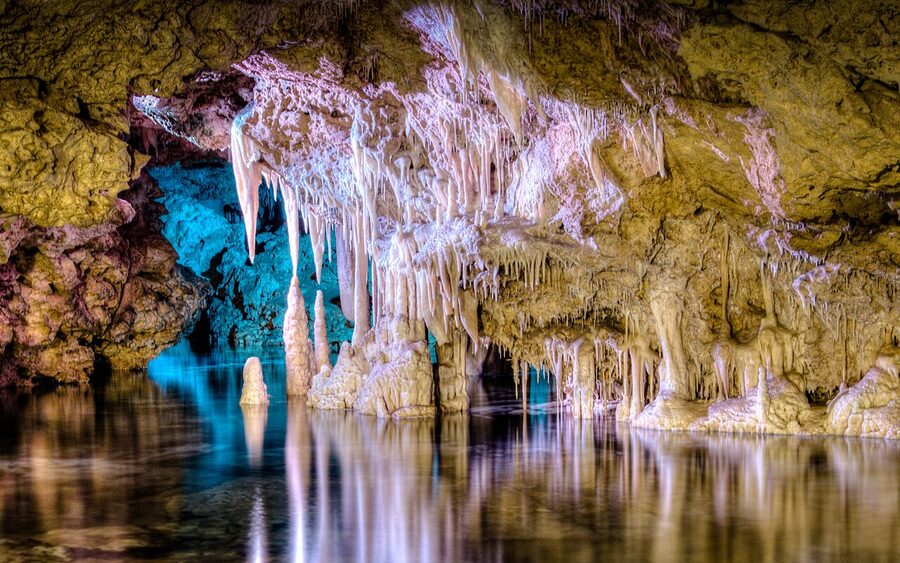
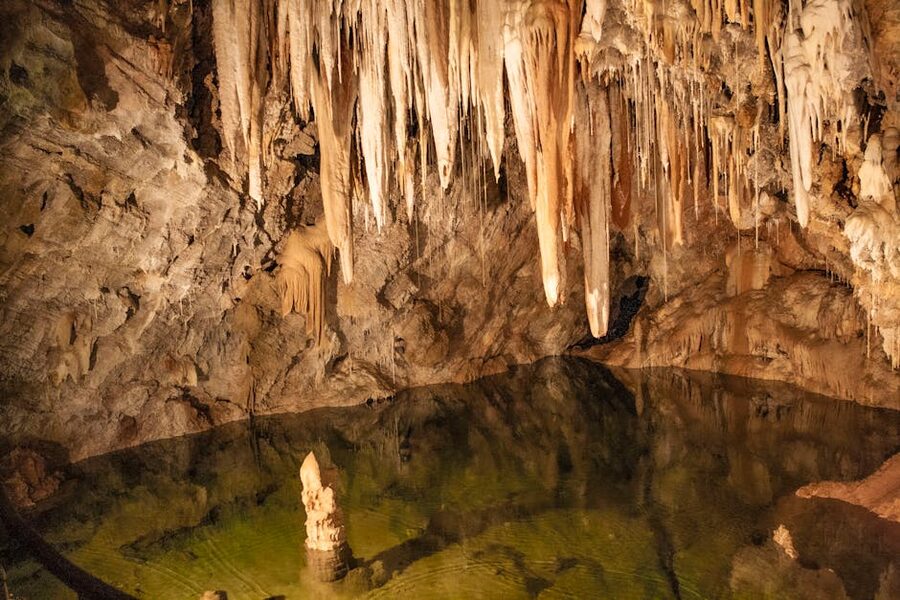
The concert is held in a single chamber called the Mar de Venècia, the Sea of Venice. The chamber is a roughly oval cavern, with the underground lake taking up most of the floor space and a tiered seating area for visitors built into one wall above the water. The lake is about thirty metres long and twelve metres across at its widest, and the water is between five and nine metres deep, depending where you are above it. The ceiling is hung with stalactites, some of them a metre or more long.
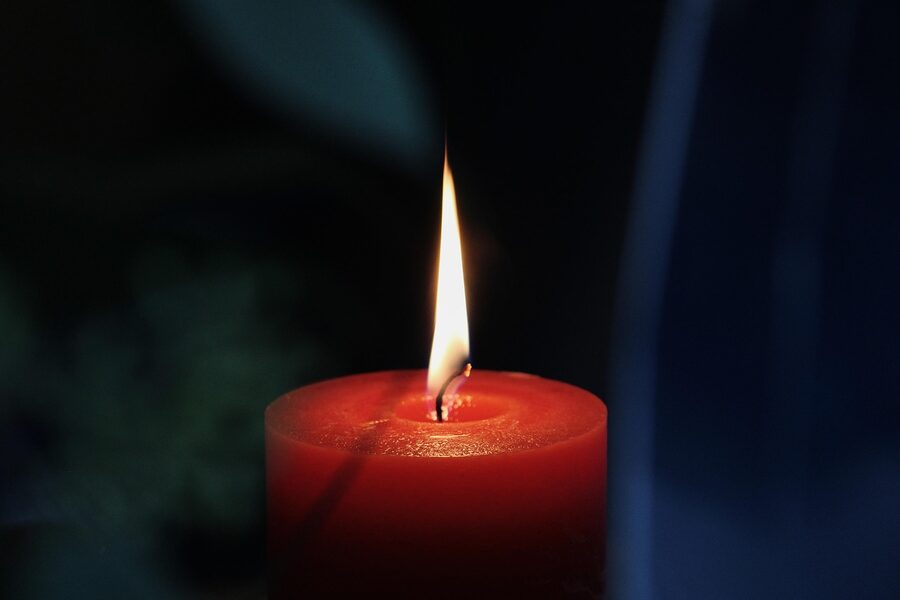
You walk in from the side, take a seat, and the staff give a brief introduction. Then the lights go off. Not dimmed. Off. There’s no electric light at all during the performance, and after a few seconds your eyes adjust enough to see the row of candles set along the far wall above the water, the stalactites silhouetted against the glow.
A small classical ensemble plays from a hidden alcove off the lake. The pieces vary by performance but typically include short selections from Albinoni’s Adagio in G minor, a Chopin nocturne, and one or two other slow string-and-piano works. The whole programme is around ten to fifteen minutes long. Halfway through, a small wooden boat appears on the lake. A boatman in a hooded costume rows it from one end of the chamber to the other, carrying a single oil lamp. The musicians keep playing. The boat passes, the music ends, and the lights come back up gradually.
The closest Italian cousin to this format is a small concert at Venice’s La Fenice opera house, where the room is the show as much as the music is. Hams flips the venue from gilded theatre to natural cave, but keeps the same compact intimacy. The northern-European parallel for a boat that crosses water as part of the performance is the candlelit evening version of an Amsterdam canal cruise, where the city is the stage set and the slow-moving boat is the audience point of view; same trick of letting water carry you through a held room.
Two things to flag. First: the music is recorded for some performances and live for others. The schedule isn’t always published in advance. If live performance matters to you, check at the ticket booth before you commit. Second: the boat is theatrical, not a ride. You don’t get on. You sit in your seat and watch it pass.
The whole thing is what I’d call denser than the equivalent at Drach. There are fewer people in the chamber, the lake is smaller, the candles are closer, and the music is performed at a fixed location rather than from a moving barge. It feels more like a chapel. Drach feels more like a theatre. The comparison maps roughly to the difference between a grand opera house and the side chapel where someone is rehearsing: Drach is the gilt and the chandeliers and the velvet, Hams is the smaller, denser room.
Hams vs Drach: pick the right one for your trip
Both caves are in Porto Cristo. Both have classical music in a candlelit underground chamber. Both have stalactites you’d happily look at for an hour even without the music. So why do most travellers pick Drach, and is that the right call?
Drach is bigger in every measurable way. The cave system is larger, with four named caves connected to each other, descending to about 25 metres below sea level. The underground lake at Drach is Lake Martel, named after the French speleologist Édouard-Alfred Martel who explored and mapped the system in the 1890s. Lake Martel is 177 metres long, around 30 metres wide, and 12 metres at its deepest point. It’s one of the largest underground lakes in Europe, and depending which list you read, in the world.
The Drach concert is staged on Lake Martel itself. The musicians sit on a long wooden barge, and the barge moves along the lake during the performance, drifting from one end of the seating area to the other while a string quartet plays. Visitors sit on tiered benches built into both sides of the chamber, with the lake between them. After the music finishes, you can take a short boat ride yourself across the lake to the exit. The Drach concert takes between 15 and 20 minutes, the cave walk before it about 45 minutes, and total visit time is closer to 75 minutes.
And here’s the catch. Drach can hold over a thousand visitors per concert, and on summer days they often run multiple concerts back to back at peak capacity. You can find yourself in a chamber with 1,000 strangers, which changes the room considerably. The stalactites are still beautiful. The music still echoes. But the silence between movements is broken by coughing and shuffling and the occasional camera flash, no matter how many times the staff ask politely. On a quiet weekday in shoulder season the Drach concert is sublime. On a crowded August Saturday it’s a tour-bus checkpoint with a soundtrack. The same problem hits the queue at Leonardo’s Last Supper in Milan in reverse: the room only takes 35 people at once, by design, which is why the experience holds. Drach is the version that hasn’t capped numbers; Hams is closer to the held-room model.
Hams takes around 200 to 300 visitors per concert at peak times. The seating wraps around one side of a smaller chamber. The candles are visibly closer to you. The musicians are not on a moving barge but in a fixed alcove, which means the music doesn’t get further from you and quieter near the end. The boat appearance on the lake is shorter and more theatrical. The whole experience is denser, in the sense that more of the cave is concentrated in your direct sightline. If you’ve stood inside St Mark’s Basilica in Venice with the gold mosaic ceiling lit only by spotlights, the visual register at Hams is the natural-cave equivalent: dim ambient light against a richly textured surface, the room itself doing a job a concert hall would have to engineer.
So which one to pick? It depends what you want.
- Pick Drach if: you want the spectacle. The biggest underground lake. The barge with musicians moving on water. The boat ride afterwards. The “I went to one of Europe’s largest caves” story. Drach is the more photographable, the more gasp-inducing, the more dinner-party narrate-able.
- Pick Hams if: you want the more concentrated atmosphere. Fewer people. The candles closer. The music played at a fixed point so the dynamics work the way the composer intended. A shorter, denser visit. Better if you’re the kind of person who finds large tour groups slightly draining.
- Do both if: you have a half-day. They’re ten minutes apart by car. The combined day-trip ticket from Palma covers Drach plus an optional Hams add-on, and that’s the most complete way to experience the caves of east Mallorca in one go.
If you’re already booking the bigger Mallorca highlights, the comparison rhymes with the choice between Palma Cathedral and the smaller chapels in the old town: Drach is the headline, Hams is the place that rewards you for slowing down. Both deserve the time.
What you actually walk through inside Hams
The visit is split into three named sections. You move through them in order, with a guide either physically leading you or speaking over a sound system as you go.
The Round Cave
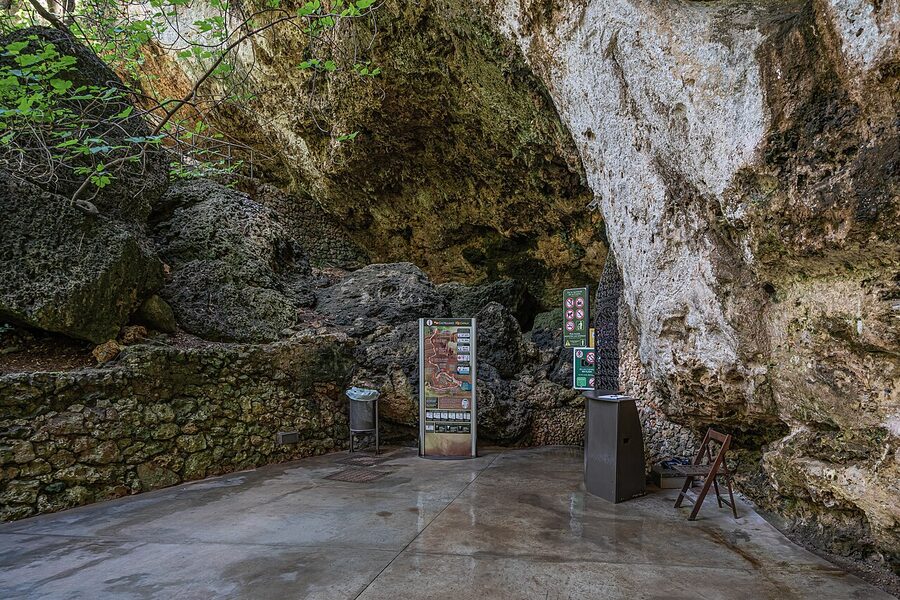
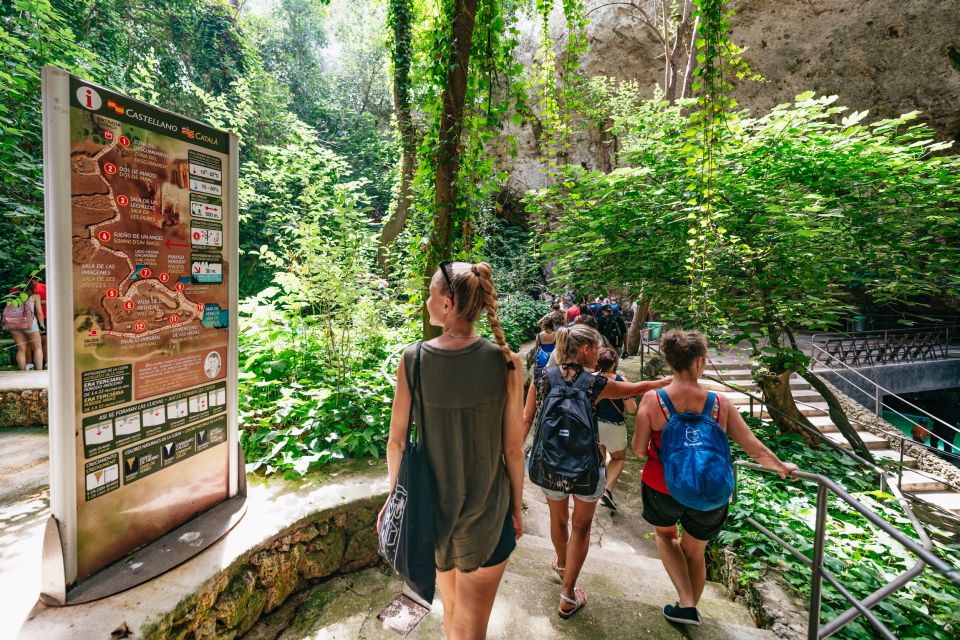
You enter through a courtyard called the Sala Redona, the Round Cave. It’s actually open-air now, but it used to be underground. Millions of years ago the chamber had a stone dome over it, and the dome collapsed, leaving an open bowl with cave walls on all sides and the sky above. Plants and small trees have grown into the bowl, and during summer it’s full of swallows. The temperature in the bowl is a few degrees cooler than the air outside, which makes it a useful place to acclimatise before you go into the deeper, cooler sections.
This is also where the ticket booth and the gift shop live. The opening times shift slightly by season, but in practice the caves run from around 10:00 to 17:30 in summer with concerts roughly every 30 minutes during peak hours. In winter the hours are shorter and the concerts further apart. Check the official site before you go for the current schedule.
The Blue Cave
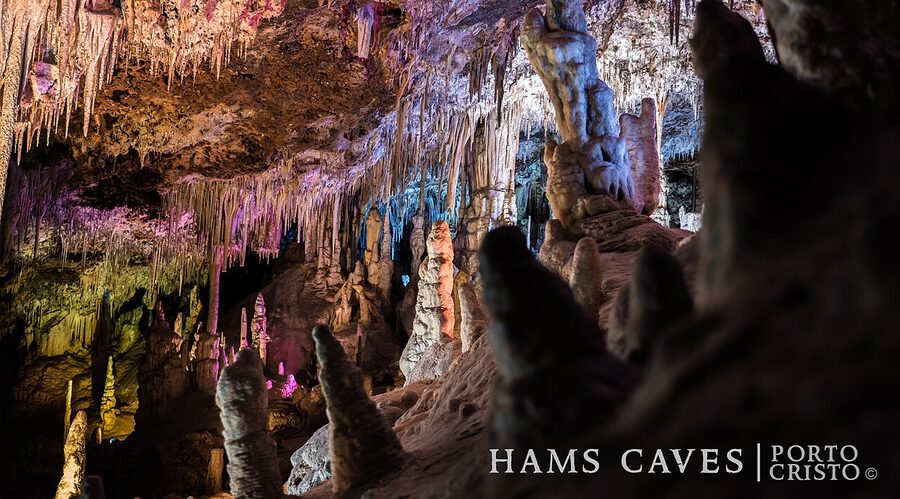
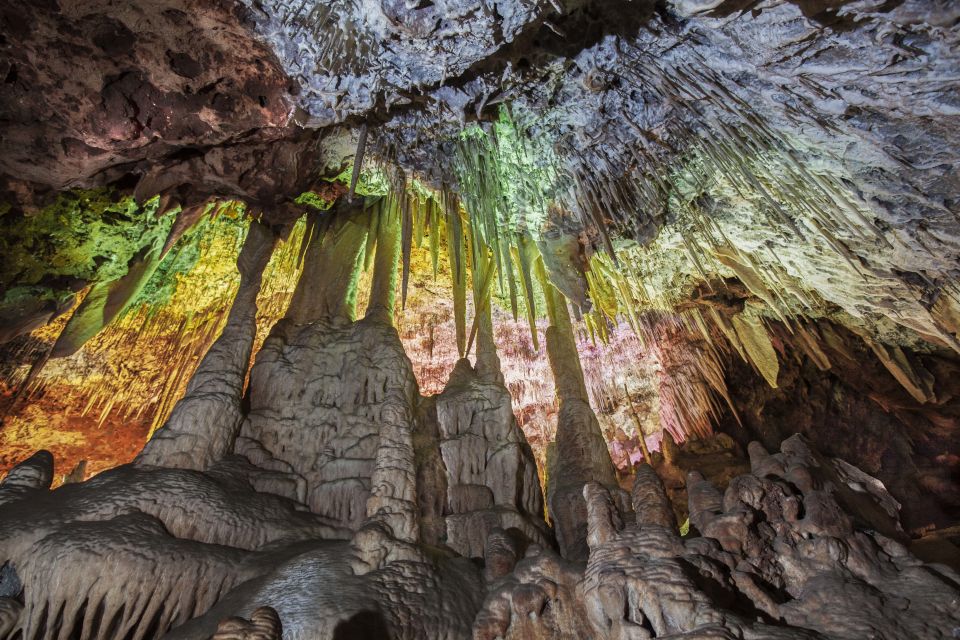
The first proper underground section is the Cova Blava, the Blue Cave. The name comes from a 2015 lighting installation that washes the chamber in slowly shifting LED blues and whites. Two short documentaries play here, one on the geology and one on the discovery of the caves, projected directly onto the limestone. The natural rock takes the projection cleanly: it’s dark enough to read the image but the texture of the cave is still visible behind it.
The Blue Cave includes two named formations worth slowing down for. Samson’s Pillars are a pair of vast parallel stalagmites, perhaps four metres tall, lit blue against a darker background. The Pit of Hell is a deep alcove below the walkway with steep sides and projection mapping that runs Genesis, a short film tracking from the Big Bang to the present day, onto its rock face. It’s the sort of attraction that sounds gimmicky in a guide and works better than expected when you’re standing in front of it. The closest comparison is the projection-mapped underground rooms of Naples Underground, where modern lighting design is used to make a 2,000-year-old cistern legible to visitors who don’t already know what they’re looking at. The Dutch equivalent in scale and intent is the Fabrique des Lumières in Amsterdam, where projected painting fills the walls of a former gasworks; same instinct of using a dark interior plus moving light to do the explanatory work, just at room scale rather than landscape scale.
The Classic Cave
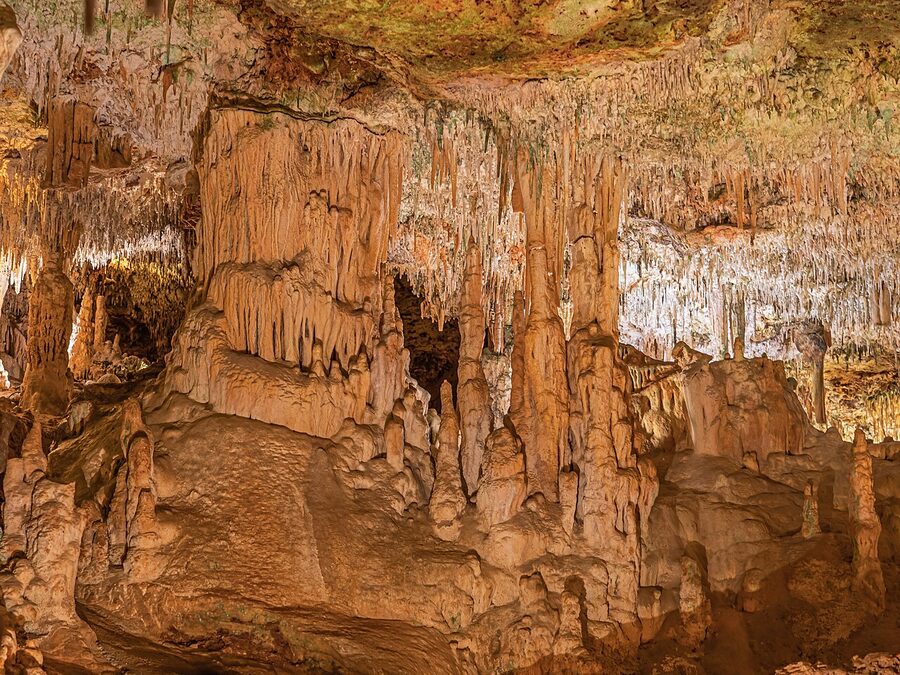
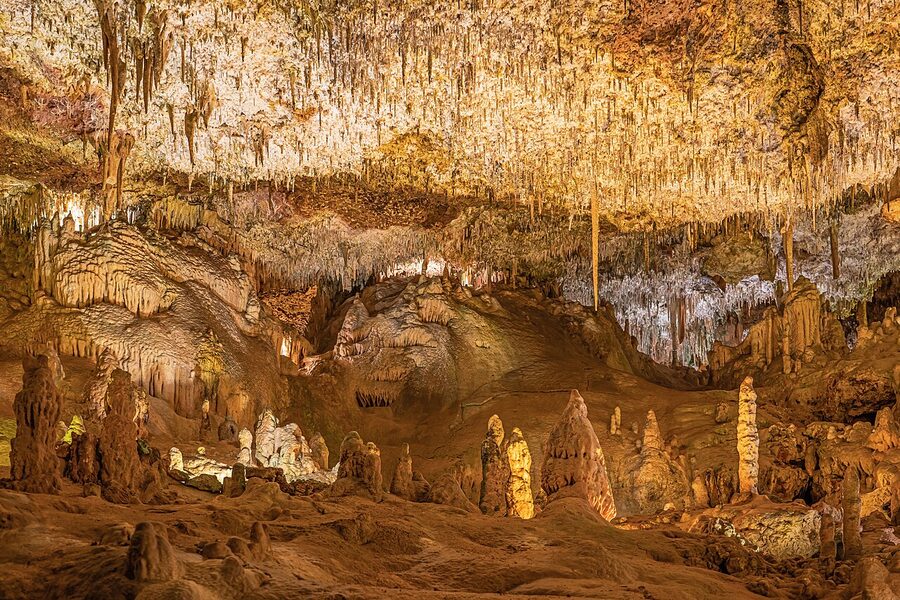
Next you step into the Cova Clàssica, the Classic Cave, which is what the original 1905 system looked like before the new sections were opened up. There are 12 galleries here, all of them densely hung with stalactites, including the fishhook formations the cave is named for.
Two galleries get singled out by the guides. El Paraíso Perdido, Lost Paradise, is a long oval chamber where the formations are particularly dense and the lighting is set low to favour the white stalactites against the brown rock. El Sala 2 de Marzo, the 2nd of March gallery, named after the 1905 discovery date, is the original room Caldentey first broke into. There’s a small marker indicating where his pickaxe came through the wall.
The Classic Cave ends at the entrance to the Sea of Venice. You don’t backtrack: you walk through, settle into the seating, and the concert is the closing act of the visit. If you’ve done the Catacombs of San Gennaro in Naples, the rhythm here is similar: a long underground walk that builds anticipation, then a single chamber that lands the experience.
The three tickets I’d actually consider
The short version: the cheapest entry ticket is fine for most people. The combined ticket adds value if you have kids. The day trip is the right answer if you don’t have a car or you want both caves in the same morning.
1. Caves of Hams Entry Ticket: $21
The basic entry ticket: drive yourself or taxi over, walk in, do the hour, leave. Our full review notes that this is the most-booked Hams ticket on the market by a wide margin, which makes sense: it’s the lowest-friction way in. The marina-side parking lot in Porto Cristo is the easiest place to leave a car.
2. Caves of Hams + Dinosaurland Combined Ticket: $29
Eight extra dollars buys you Dinosaurland too, a low-key dinosaur park on the same Porto Cristo road with around 100 life-size dinosaur models and a small museum. Our full review rates this above the standalone ticket if you have children under 12 in the group. Useful add-on if the cave is going to bore them after twenty minutes.
3. Caves of Drach Day Trip + Optional Caves of Hams: $62
This is the right ticket if you don’t have a car: hotel pickup from Palma, transfers, the Drach concert and lake boat ride, and an optional Hams add-on for a small surcharge. Our full review flags that the route also stops at a pearl factory, which is genuinely commercial; skip the pearl shop and do both caves instead. Eat in Porto Cristo on the way back.
How to actually get there
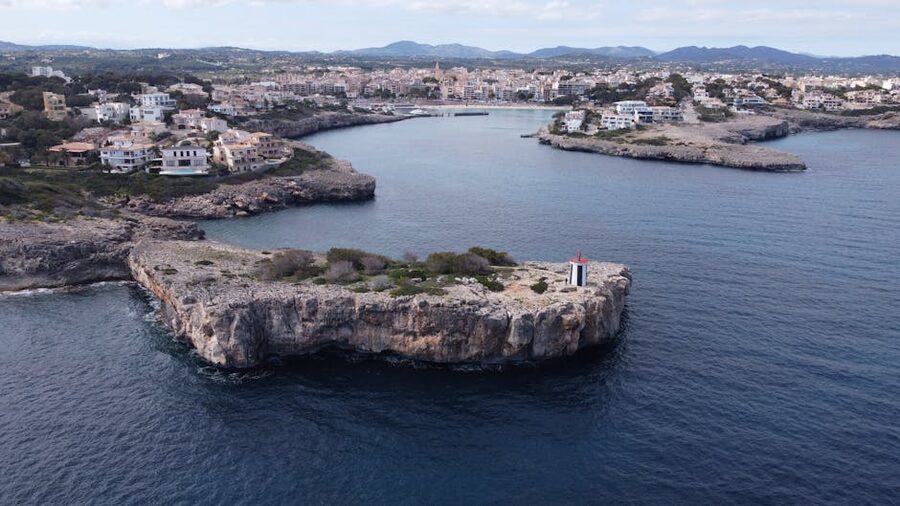
Porto Cristo is on the east coast of Mallorca, about 65 kilometres from Palma. There are three reasonable ways to arrive at the cave entrance, and they sort cleanly by how much hassle you want.
Self-drive. The fastest and the most flexible. From Palma the drive is roughly an hour on the Ma-15 and the Ma-4023, mostly motorway-grade road. Free parking on site at the cave car park, which is large and signposted from the main road into Porto Cristo. If you’re staying in the south-east of the island in resort towns like Cala d’Or or Cala Millor, you’re 20 to 30 minutes away. The drive itself is unremarkable, mostly almond groves and low scrub, but it’s painless. Get there by 10:30 to land an early concert slot before the bus tours arrive.
Public bus. Possible but not what I’d recommend unless you’re already used to Mallorca’s bus network. The 411 from Palma’s intermodal station runs to Porto Cristo a few times a day, and the journey is around 90 minutes. You then need a 25-minute walk from the bus stop to the cave entrance, which is uphill in places and not particularly scenic. Total time to get there from Palma is more than two hours each way, and the bus schedule is not generous, so you’d be planning your day around two specific departures.
Day-trip tour. Hotel pickup, coach transfer, both caves done by lunchtime, drop-off back at the hotel. The path of least resistance, particularly if you’re staying in the south of the island and don’t want to drive the unfamiliar roads. The trade-off is the pearl factory stop on the way back, which is essentially a jewellery store with a small workshop visible behind glass. You’re not obliged to buy anything, but the bus does sit in the parking lot for about half an hour while you wander. Read this trade-off as part of the cost.
If you’ve already used the Palma hop-on hop-off bus or a Mallorca catamaran trip to get around the rest of the island, the day-trip pickup format will feel familiar. If you’re car-free, similar to how getting to Montserrat from Barcelona usually means either a slow public train or a coach pickup, this is the same calculus on a smaller scale.
What to do with the rest of your day in Porto Cristo
The cave visit eats about an hour. If you’ve driven from Palma you’ve spent another two hours on the road. So your half-day already has a couple of usable hours on the back end, and Porto Cristo is a nice town to be released into.
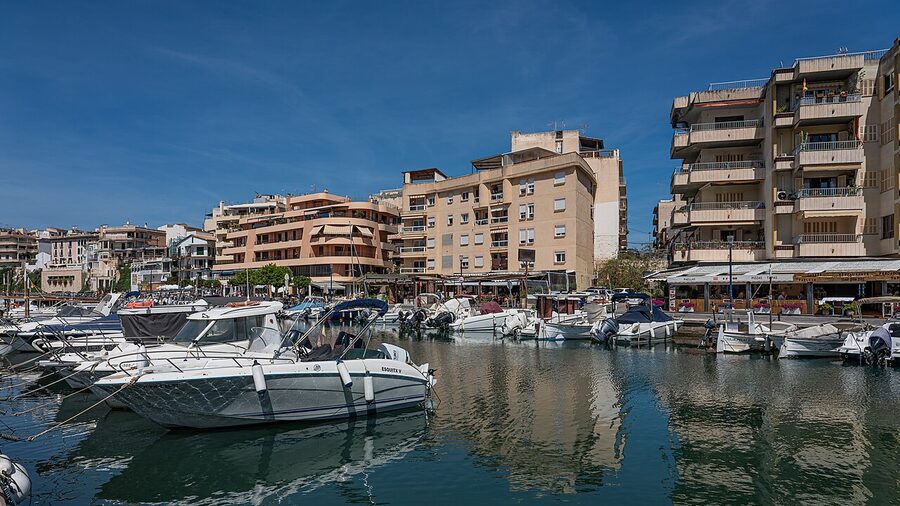
The harbour is the centrepiece. It’s a working marina, not a tourist toy harbour, with a mix of small fishing boats and yachts. The waterfront has half a dozen seafood restaurants where the daily catch is genuinely the daily catch and the prices reflect that this is still a Spanish town more than a holiday strip. Sa Llonja and Restaurante Siroco both do good arroz negro and a paella that comes out properly burnt-bottomed.
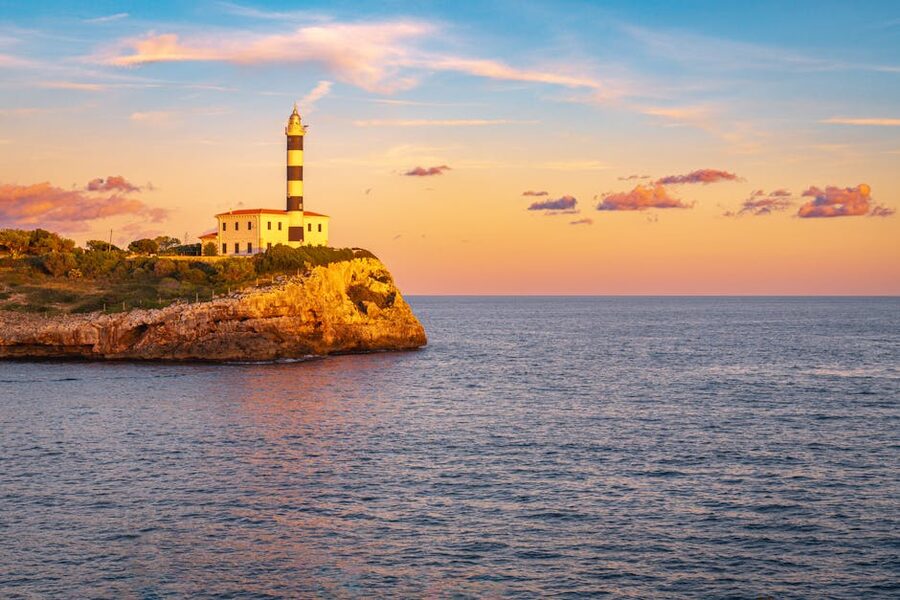
The town’s other landmark is the Torre dels Falcons, the Falcons Tower, a 16th-century coastal watchtower built to spot pirate ships. It sits on the headland north of the marina, a 10-minute walk from the harbour. The tower itself is closed to the public, but the path around it gives the best view of the inlet and the open Mediterranean beyond.
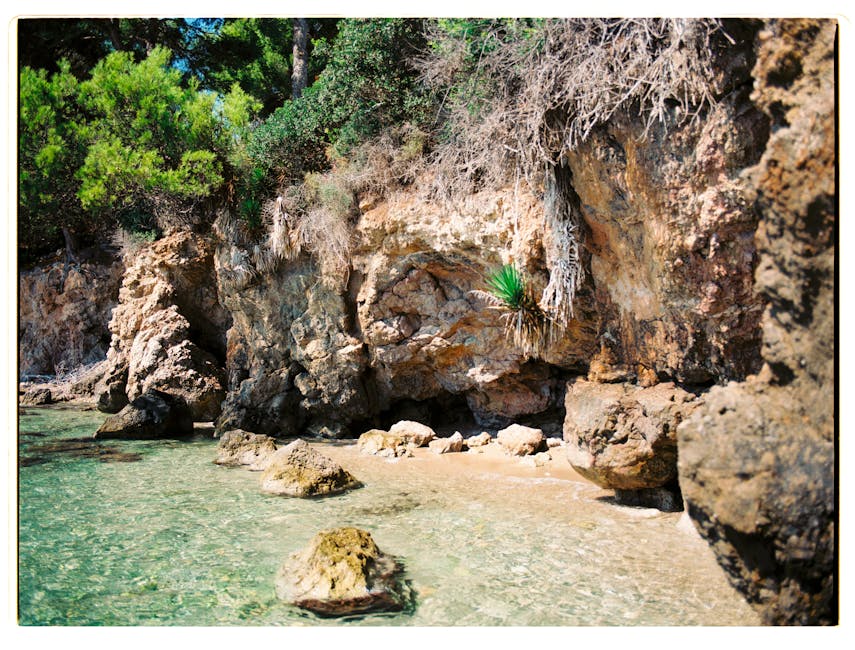
If you want a beach in the same trip, Cala Petita is a small unspoiled cove a kilometre and a half south of the harbour, accessible only by foot via a coastal path. No facilities, no parking. Just a strip of pale sand between two low cliffs, and water that’s clearer in October than it has any right to be.
For a longer beach stop, Cala Mendia is a few minutes north and has the basics: a bar, sun loungers, a snorkelling-friendly bay. If you came in on a tour, this stop is sometimes already on the route. If you drove yourself, you have to choose.
What it’s like in different seasons
The caves are open year-round, but the experience is meaningfully different across seasons. Worth knowing if you’re choosing when to come.
Summer (June–August). Hot outside, packed inside. Concerts run more or less continuously through the day, and the queues for tickets start to back up by 11am. Book online for a specific slot. The cave temperature is a steady 18 degrees, which when you’ve come in from a 35-degree afternoon outside hits like air conditioning. Wear something with sleeves: the change is significant. The Drach overflow days get over a thousand visitors, and Hams gets up to its 200-300 ceiling. Mornings are quieter than afternoons.
Shoulder (April–May, September–October). The sweet spot. Concerts still run regularly, but rarely sold out. You can walk in 30 minutes before a slot and find a seat. The light outside is softer and the drive over is more pleasant. October concerts often have richer acoustics, which I assume is humidity-related but I haven’t found a definitive source on. Mallorca generally is in its best mood in late September.
Winter (November–March). Reduced hours and fewer concerts, but the quietest version of the experience. Sometimes you’ll be in a chamber with only twenty other people. The cave is the same temperature year-round, so the contrast with the outside world is gentler. The Christmas-week openings include some seasonal music programming and tend to draw a Spanish-family audience rather than international tour groups. The downside: some of the day-trip tours don’t run in low season, so the self-drive ticket becomes the default.
Why the caves of Mallorca are a thing in the first place
If you only ever go to Hams, the geology is a backdrop. If you start visiting other caves, you notice the same pattern: the limestone of the eastern Mediterranean coastline, the karst landscape, the slow work of acid in water. Spain alone has hundreds of show caves and tens of thousands of unmapped ones. Mallorca is concentrated, with at least a dozen open to visitors and probably ten times that number known to local cavers.
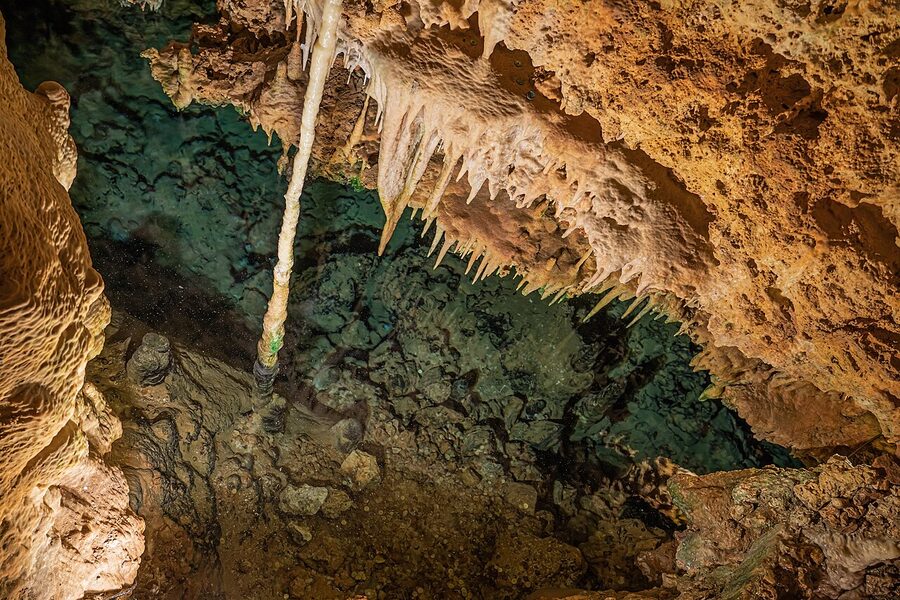
The east coast of Mallorca is karst country, meaning the bedrock is soluble limestone. Rain falls, picks up dissolved CO2 from soil and air, becomes mildly acidic, and over millions of years dissolves channels through the rock. Where those channels stay above the water table you get show caves with dry walkways and dripping ceilings. Where the channels dip below the water table you get underground lakes like Hams’s Mar de Venècia and Drach’s Lake Martel. The same process makes the spectacular hill formations of Setas de Sevilla look like a modern echo of the natural pillar-and-canopy structure of a deep cave.
Underground, the speed is geological. A stalactite grows roughly one centimetre per hundred years in good conditions and far slower in poor ones. The metre-long fishhooks above the Mar de Venècia have been forming since before recorded human history. The columns where stalactites and stalagmites have met and fused, you’re looking at 50,000 to 100,000 years of work. It’s a useful frame of reference for what the music is being played in front of: the cave doesn’t notice the concert. It noticed the dome falling in on the Round Cave a few million years before that, and it’ll keep doing what it does long after the last performance.
If the underground theatre side of this appeals, Italy’s parallel is the layered subterranean world beneath Naples and Rome: cisterns repurposed across millennia, early Christian burial chambers carved into volcanic rock, the Roman catacombs running the same idea on a larger scale. The French equivalent is the crypt under the Dome at Les Invalides in Paris, where Napoleon is buried: a deliberate going-below into a cool, vaulted, acoustically dead room where the ceiling is the thing you came for. Hams is closer to the natural side of the spectrum: nature did the carving, humans added the lights and the music. But the same instinct draws you down. Going below changes the kind of attention you pay.
Some practical things people get wrong
A few small details I’d have wanted to know before I went.
The cave isn’t dark while you’re walking through it. The lighting in the corridors is theatrical but adequate. You can see your feet, you can see the formations, you can take photos without flash. It’s the concert chamber that goes properly dark, and only during the music. Don’t bring a torch.
You can’t bring large bags into the concert chamber. There are small lockers near the entrance, free to use. A daypack is fine but a full-size suitcase or a beach bag won’t fit comfortably between you and the next person on the bench.
Phones are technically forbidden during the concert and aggressively unforbidden in practice. The staff ask you not to use your phone during the music. They don’t enforce this with vigour. People take photos. The flash and the screens visibly degrade the atmosphere for everyone behind them. Consider being the person who doesn’t.
The temperature drops noticeably halfway through. The Mar de Venècia chamber is the deepest and coolest in the cave. If you wore a t-shirt in to the cave, by the concert you’ll wish you’d brought a long sleeve. A light layer in your daypack is enough.
Children under five are usually free. Kids over five pay a child ticket, around half the adult price. The concert is short enough that it usually holds the attention of even small kids, and the boat appearance specifically tends to land well with anyone under ten.
The recorded versus live music question. The concert programme is a mix of recorded music and live performance depending on the slot, the season, and the day. If live performance is non-negotiable for you, ask at the ticket booth before you book. Most slots have at least one or two live musicians; some have a full small ensemble; the early-morning and last-of-the-day slots are more likely to be recorded with a single live violinist.
The cave is wheelchair-difficult. The route includes flights of stairs and uneven paving, and the seating at the Mar de Venècia is on tiered stone benches with no level access. If mobility is a concern, Drach is the better choice: it has more accommodating step-free routes and accessible seating.
If you’re here for a wider Mallorca trip
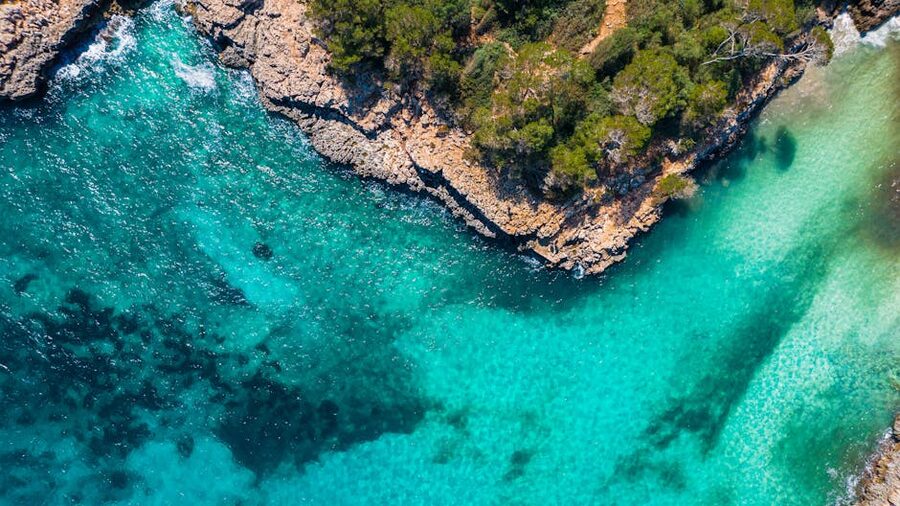
The caves are a half-day. So how does the rest fit?
The two natural pairings on the same east-coast trip are a beach stop and a seafood lunch in Porto Cristo. You can do both easily on the way back. If you’ve come from Palma and want a longer afternoon, swing west on the return for a sunset stop somewhere on the south coast.
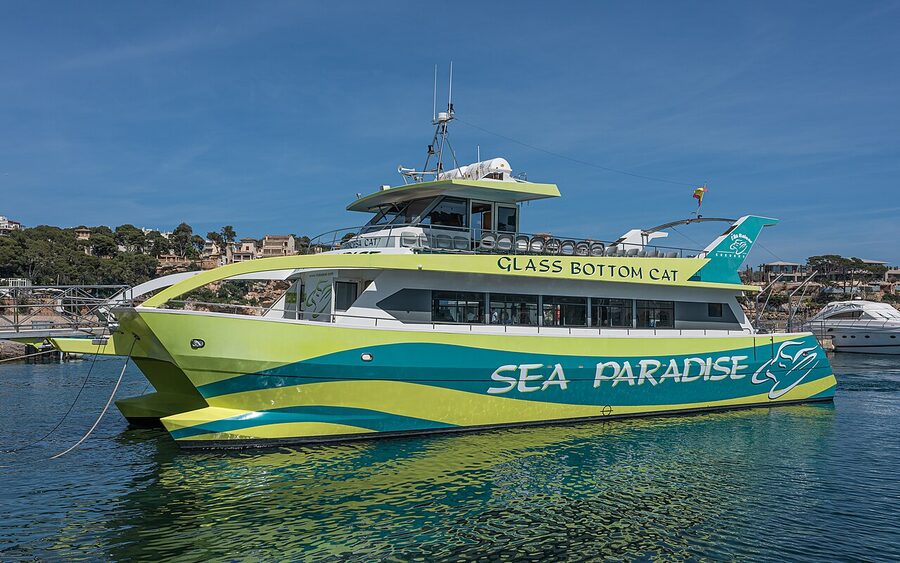
For broader Mallorca itineraries, the obvious water-and-coast anchor is a day out with a Mallorca catamaran cruise from one of the south-coast marinas. A full day out to one of the offshore beaches with lunch on board. Three days in Palma plus a fourth out to Hams and Drach plus a fifth on the catamaran is a full Mallorca short-break itinerary.
If you’re using a tour pass to get around, the Palma hop-on hop-off bus is the right answer for the city itself but not for the east-coast caves. The HOHO bus doesn’t go that far. For the east coast, the day-trip tour or self-drive remains the only practical way.
And if you’re island-hopping the Balearics, the next stop is usually Ibiza. The cave-and-classical-music experience doesn’t repeat there: Ibiza is more about the water and the sunset bars. But for travellers doing the Balearics in sequence, an Ibiza beach cruise is the natural follow-up half-day after a couple of days on Mallorca.
How Hams compares to similar experiences elsewhere
The “classical music in a candlelit underground space” niche is small but not unique. The instinct that draws you down into a held room and asks you to listen has a handful of close cousins.
For the curated-darkness side of art experience, the Vatican’s Sistine Chapel is a useful counterpoint. The Sistine is the famous one, the larger one, the thousand-people-at-a-time one. Smaller chapels in Rome have smaller masterpieces and you can be the only person in the room. Drach is the Sistine of caves on Mallorca’s east coast. Hams is the smaller chapel. The closest French cousin for an underground room with serious acoustics and a held atmosphere is the Conciergerie’s vaulted Salle des Gens d’Armes on the Île de la Cité, paired with the Sainte-Chapelle ticket that gets you into both; the cells beneath are the closest urban analogue to standing in a stalactite chamber.
The closest cousin in tone is the cold-stone sound at the start of an early-morning Mass at any of the Romanesque chapels of Mallorca itself: small space, careful acoustics, the wait between phrases of music longer than feels comfortable. Hams adds a lake and turns the lights down, but the rhythm of attention is the same. Music being made for the room rather than a recording being played at it.
A short note on the family who run it
The Caves of Hams have been operated by the same family since their discovery. The Caldentey family opened the caves to the public in 1910 and have run them as a private business ever since. The Drach Caves are also family-owned, by the Servera family, who have operated them since the early 20th century. Both families are members of a small group of Mallorcan dynasties whose 19th and 20th century fortunes were tied to the islands’ growing tourist economy.
This matters more than it sounds. The caves are not a state attraction. They’re a private business. The schedule, the pricing, the music selection, the lighting design, the theatrical staging, all of it is decided by family members rather than by a tourism board. Which is why both caves feel slightly idiosyncratic compared to most show caves elsewhere in Europe: someone made an aesthetic decision rather than running a focus group. The ratio of theatre to nature feels chosen rather than averaged.
It’s also why you should book through their official channels or via the standard third-party booking sites: there are reseller scams that will quote inflated prices for tickets you could buy at the door. The day-trip combos via the major operators are real and properly priced.
Where to eat near the caves
Two notes here, because it’s the question I always end up wishing I’d asked.
If you want a sit-down lunch by the water, the best in Porto Cristo are Sa Llonja on the harbour for a long fish-focused lunch with views over the marina, and Restaurante Siroco for a more casual tapas-and-rice lunch at a third the price. Both honour the Spanish lunch tradition: full service starts around 13:00, peak service around 14:00, kitchens close around 16:00. If you’ve come out of an 11:00 cave concert and want lunch at noon, the kitchens may not be ready for you.
If you want a quick bite, the bar at the cave car park does coffee and small sandwiches. Better: drive five minutes into the centre of Porto Cristo and find a counter spot at one of the cafés on Carrer del Port. A bocadillo with serrano and a coffee is around six euros. That’s the version locals do between errands.
For something more elaborate, the back end of Cala Bona and Cala Millor (north of Porto Cristo, 20 minutes by car) has the classic Mallorcan resort-strip restaurants. Avoid the tourist menus. Find the places where the lunch crowd is older and Spanish.
A small reframe
The instinct to default to the bigger, more famous attraction is a real instinct and it’s frequently right. Drach is the bigger cave and there’s a version of this trip where Drach is the only one you do, and that version is good. You don’t need both.
But the case for Hams sits in what gets lost when the venue is bigger. Hams is the version where the seat next to you is empty. Where the candles are five metres away rather than fifteen. Where the acoustics carry every breath of the violin’s bow. Where the cave doesn’t feel like a venue, it feels like a room you weren’t supposed to find.
Ten minutes apart. About thirty euros for both. A quiet half-day. If you have any flexibility at all, do the two of them.
One more thing before you book
Concert times. You will see the published timetable. You should also know that the schedule shifts with demand and weather, and the cave staff will sometimes condense or skip the concert during periods of low visitor numbers in the off-season. The chance of this happening on a peak summer day is essentially zero. The chance on a wet Tuesday in February is non-trivial. Confirm the day’s schedule when you arrive at the ticket booth, before you’ve gone through. If they tell you the next concert is in 70 minutes, that’s worth knowing before you buy in.
Also: the official site sometimes announces special concerts around Christmas, Easter, and major Spanish holidays. These are full-length classical performances rather than the standard short showcase, and they sell out fast. If you happen to be on Mallorca during Holy Week or in late December, check whether the special programme overlaps with your dates. It’s a different version of the experience.
The caves don’t change. The music does, slightly, by season and by the musicians on duty. The first time you go is the version you’ll remember, so it’s worth picking the slot when the cave is at its best. For Hams, that’s a weekday morning in May or October, the 11am or noon concert, after the bus tours have moved on to Drach. For Drach, that’s the same logic, an hour earlier so you beat the Hams overflow.
And then you sit in the dark and listen to a violin in a room where water has been deciding the architecture for ten million years. The whole reason you came.