
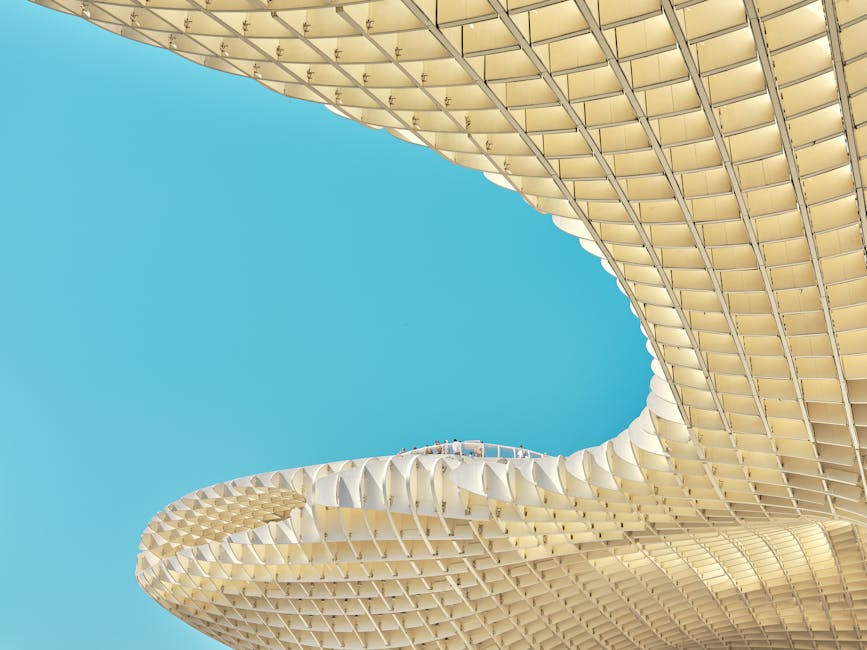
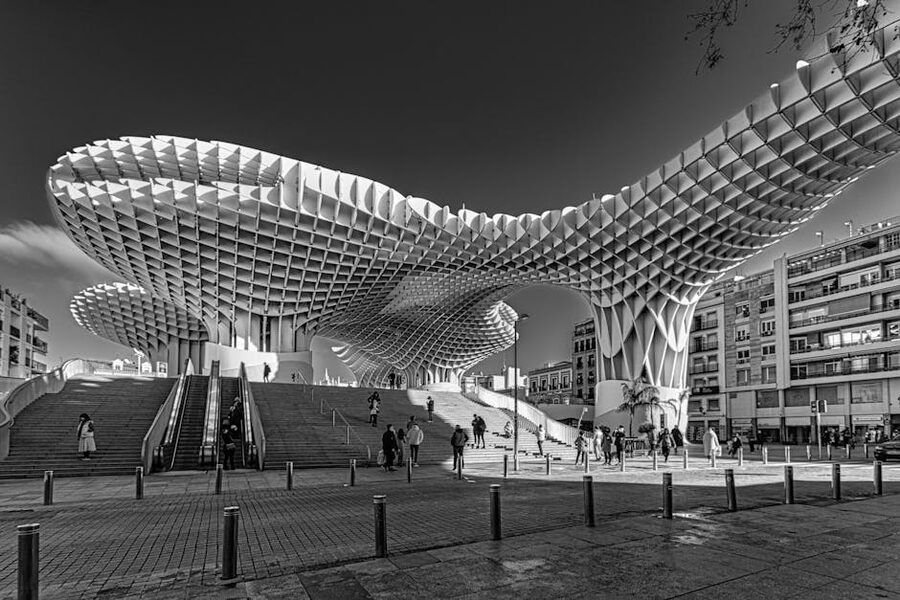
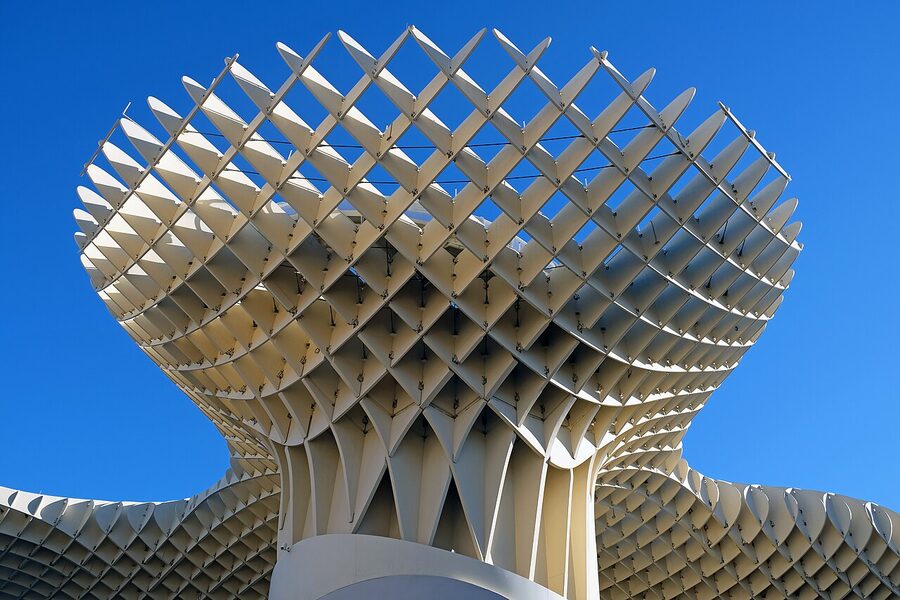
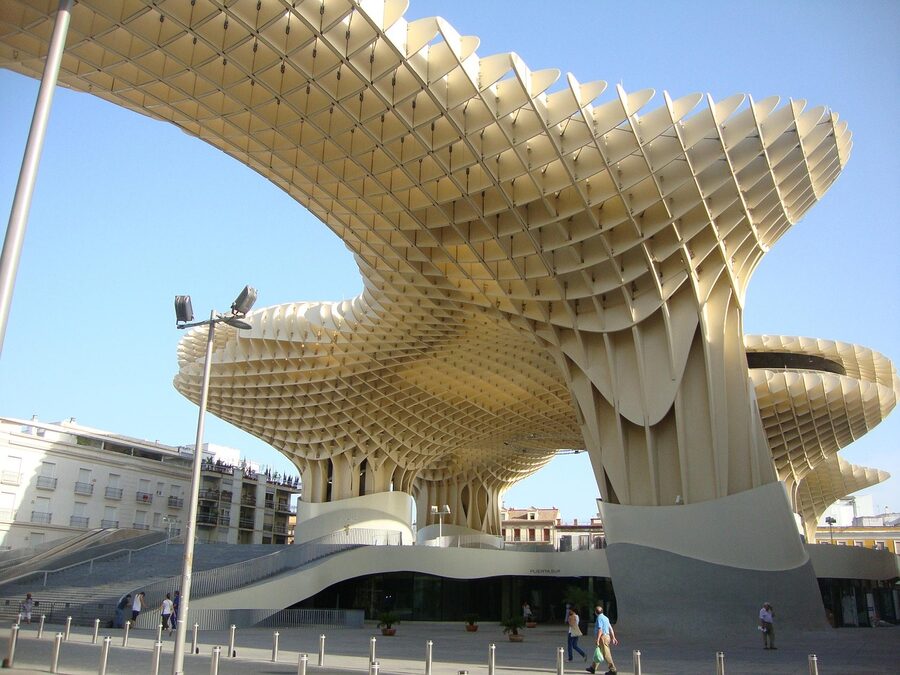
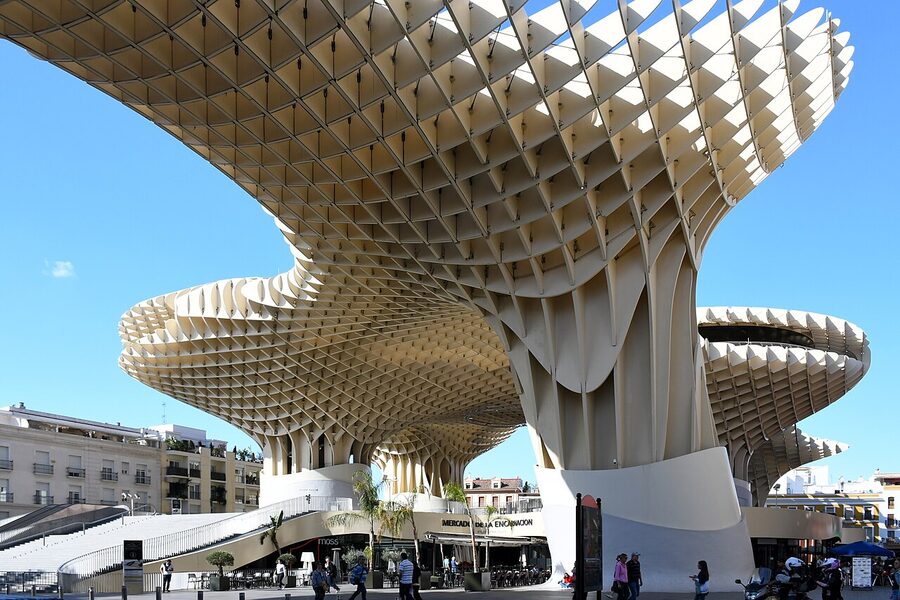
Setas de Sevilla is the largest wooden structure in the world. Six interlocking parasols, 150 metres long, 70 wide, 26 high, sitting in the middle of one of the most historic city centres in Europe. The locals call it Las Setas (the mushrooms) because that’s exactly what they look like. For most of its existence Sevillanos hated it, and you can still find people in Triana who’ll tell you it’s a modernist eyesore that should never have been built on top of a Roman archaeological site.
Then something quiet happened over the last few years. Locals started using it daily. Sunset rooftop walks, the basement Antiquarium museum with the Roman ruins it nearly destroyed, the food market underneath. The thing they hated for a decade became part of their evening routine. The reframe is the whole article.
In a Hurry? My Top Picks
- Setas Entry Ticket ($18): The flagship. Rooftop walk, immersive room, Aurora light show. Book the night slot. Check availability on GetYourGuide.
- Mushrooms Guided Tour with VR ($34): Skip the line, plus a virtual-reality walk through Roman Híspalis on the same ticket. Book the guided VR tour.
- Tablao Flamenco Las Setas ($33): The flamenco tablao directly beneath the structure. Pair it with a sunset visit upstairs. Book the flamenco show.
What you’re actually looking at
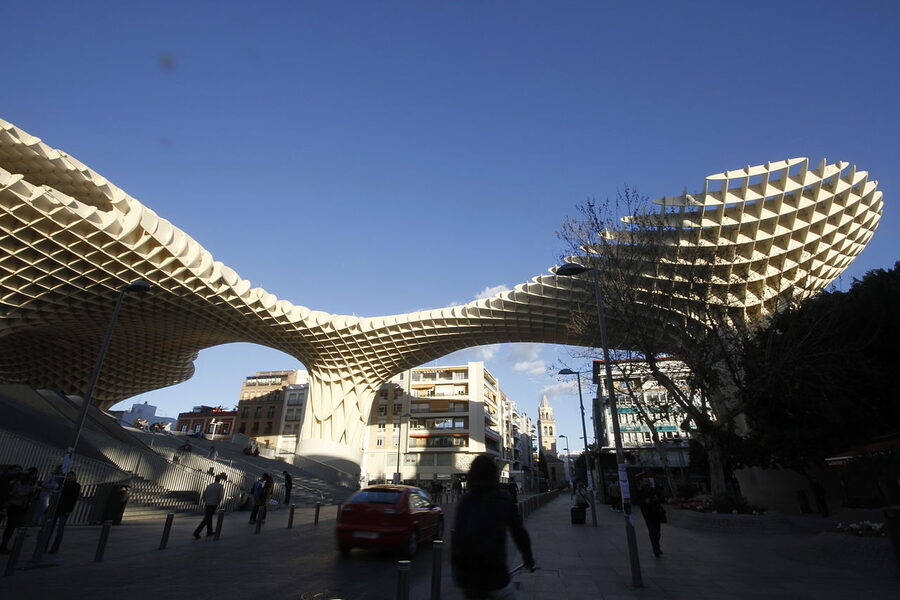
The official name is Metropol Parasol. Nobody in Seville calls it that. To the locals it’s Las Setas, the mushrooms, and the affectionate nickname has now overtaken the architectural one so completely that the city replaced the official signage in 2020. Even the website is setasdesevilla.com.
It opened in April 2011, designed by the German architect Jürgen Mayer after he won an international competition in 2004 to redesign Plaza de la Encarnación. The square had been a parking lot since the 1970s. Before that it was a market that burned down in 1973. And before that, when crews started digging foundations for a new underground car park in 1990, they found the Roman ruins that would delay the whole project by more than a decade.
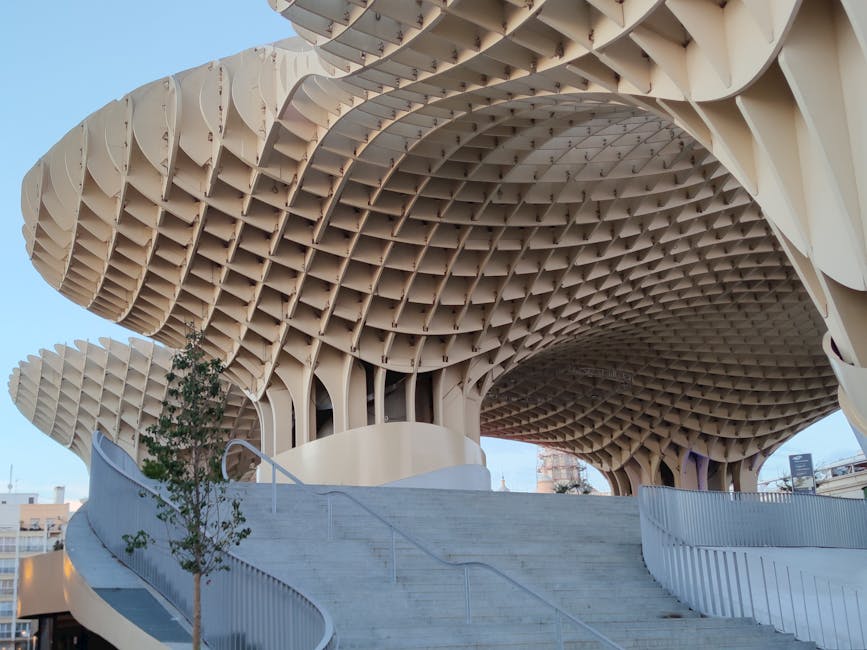
Mayer’s bid won partly because his design integrated those ruins. The parasols sit on five concrete columns that thread between Roman walls and mosaics. The basement was redesigned as the Antiquarium, an archaeological museum sitting five metres below street level, in the same museum-as-architecture mode as Renzo Piano’s NEMO Science Museum in Amsterdam. That decision is why the build went 90% over budget and finished four years late. It’s also why the structure exists at all.
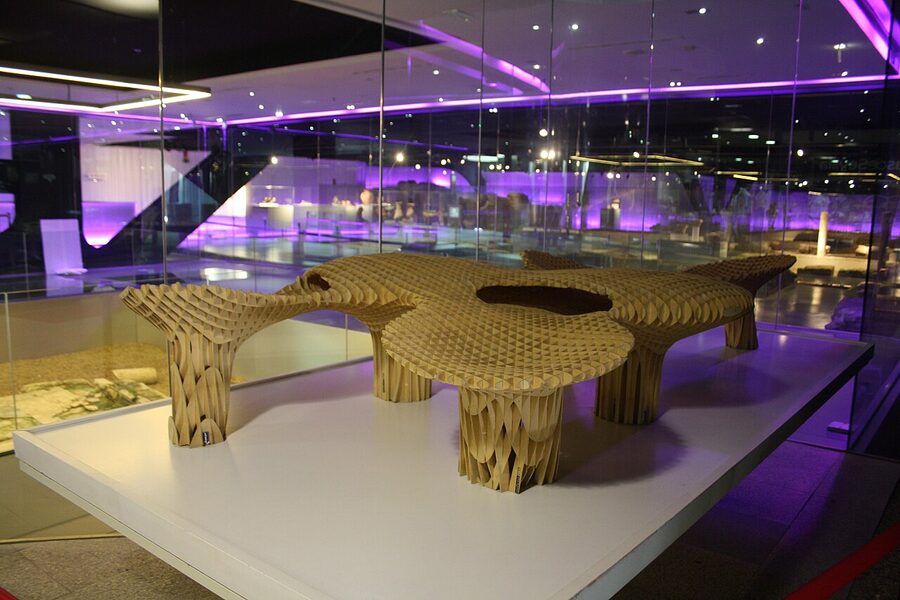
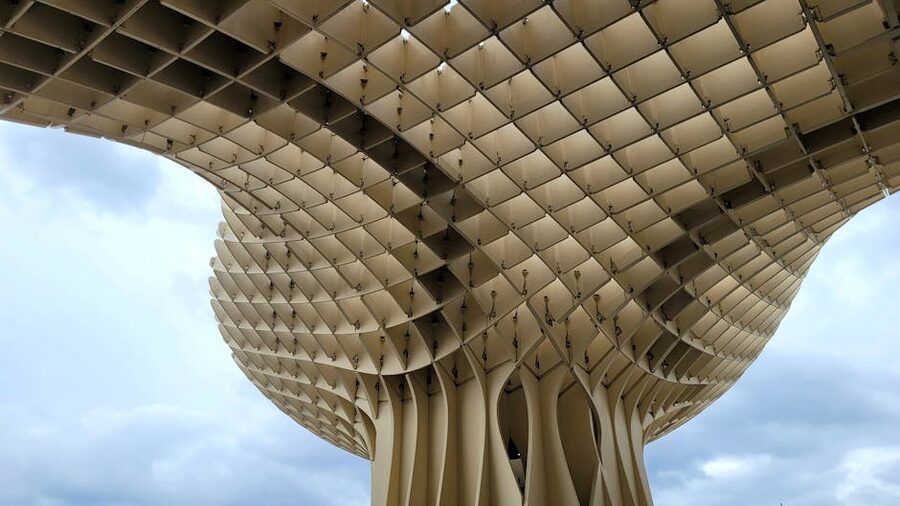
The build is mostly Finnish birch laminate, glued and bolted into a 3,400-piece grid. Polyurethane on top to keep the Andalusian sun from cooking the wood. There is some steel, some concrete, but the headline is the wood. That is what makes it the largest wooden structure in the world. The numbers don’t read like a building, they read like an aircraft hangar.
Booking the entry ticket
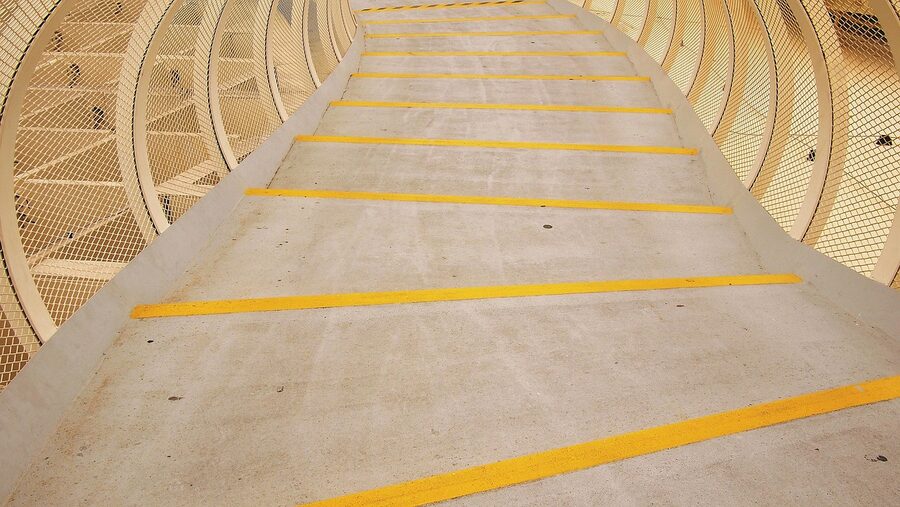
The basic entry is €16 for adults, €13 for kids 6 to 14, free under 6. That gets you the lift up, the rooftop walkway, the immersive room with the historical projection, and access to the Aurora night light show. Book it online at setasdesevilla.com or through GetYourGuide. The walkup queue at midday in summer is the only real catch. Book the timed slot and walk straight in. The Royal Alcázar, by contrast, is the one place in Seville where booking online is non-negotiable; for Setas the walkup is fine in winter mornings.
The website lists separate tickets for the Antiquarium downstairs (€2, free under 16). They are not packaged together. You can do both in the same visit, but you buy separately, and the Antiquarium has its own entry around the corner from the lifts. Tuesday to Saturday only for the museum, 10am to 8pm. Closed Mondays.
Day vs. night entry: a real choice
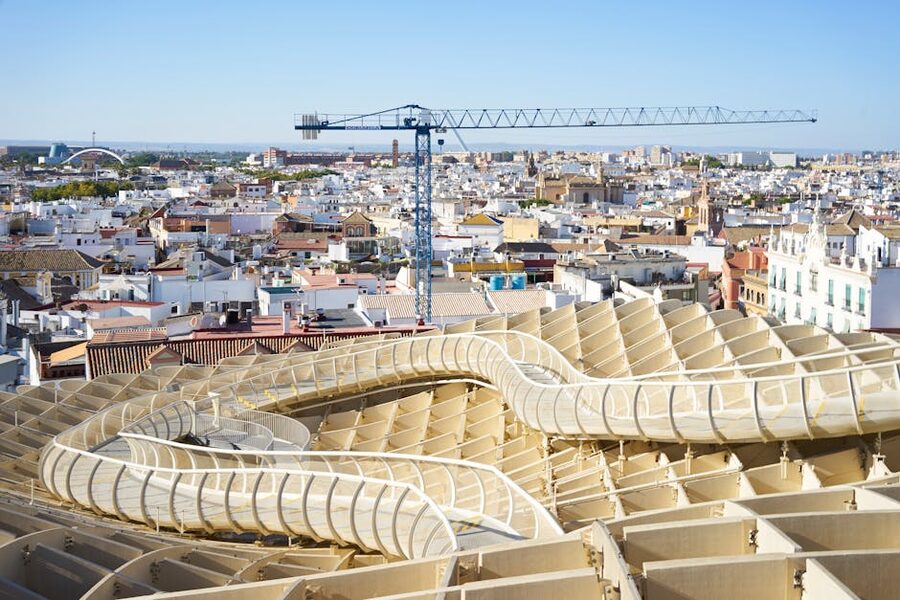
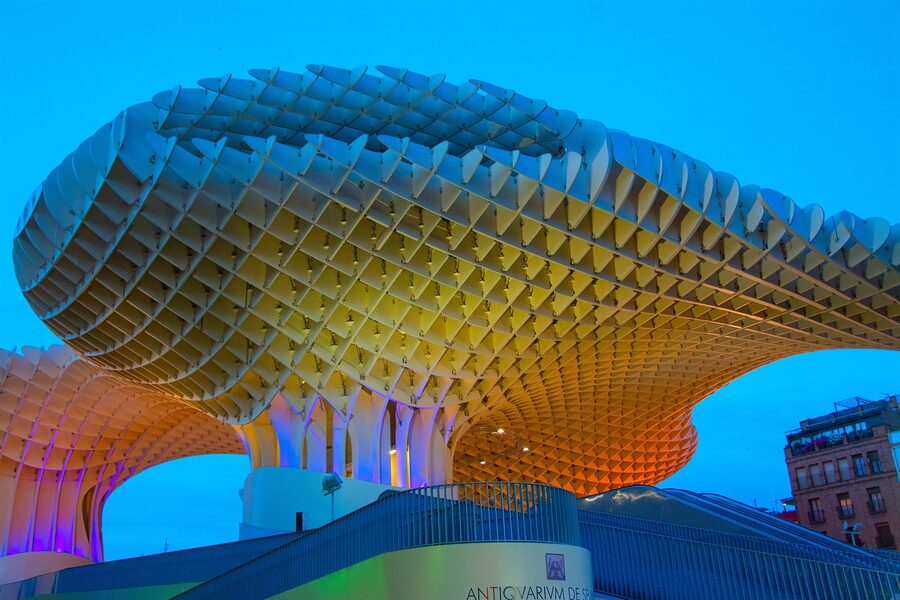
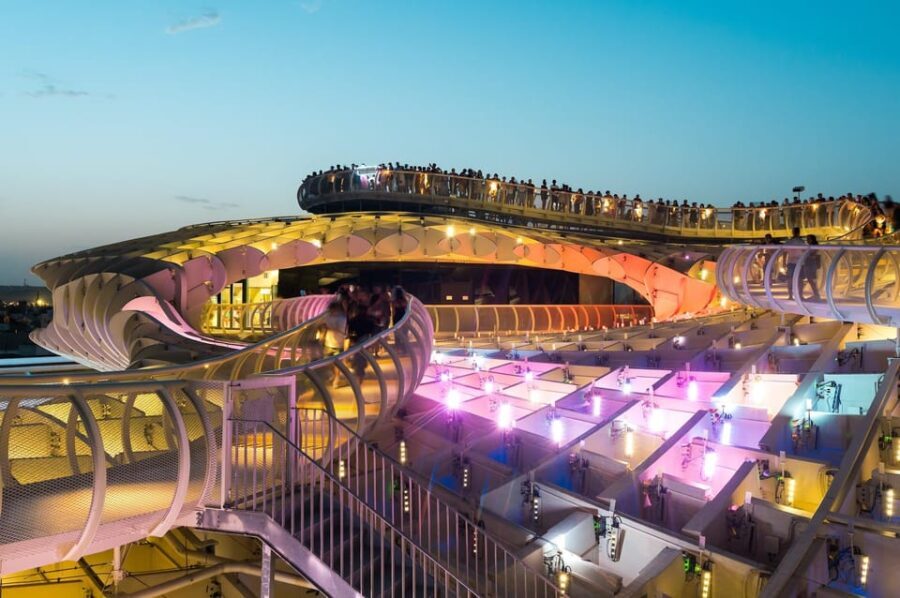
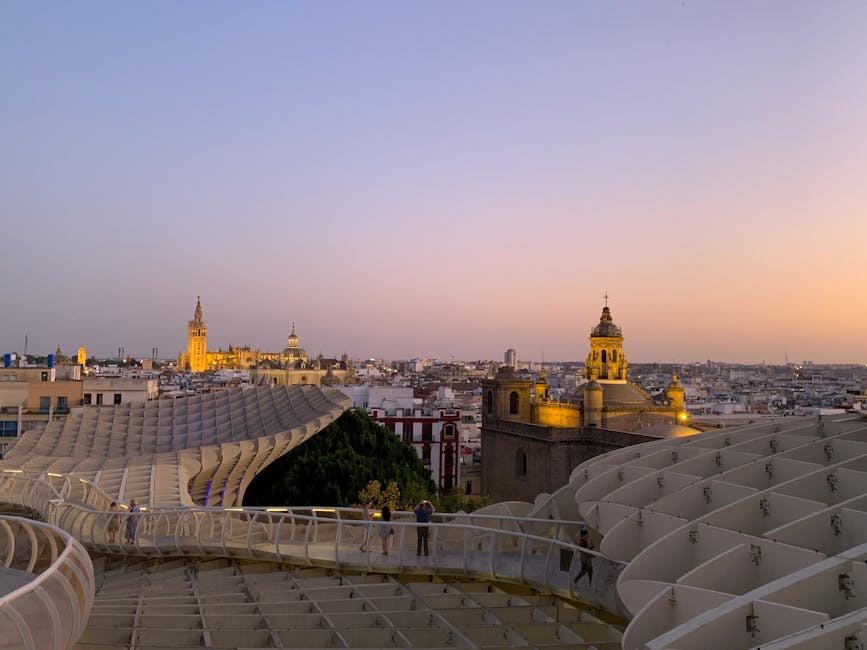
There are two genuinely different visits. Day visit gets you the views, the heat, the Cathedral and Giralda framed against the rooftops, and a sense of the geography of central Seville from above. Night visit gets you the Aurora light show, an LED installation across the underside of the parasols that pulses in slow gradients of colour. The light show runs about 25 minutes and triggers automatically in the evening; check the season’s exact start time on the official site, because it shifts with sunset.
If you have only one slot, take the night one. The day view is good. The night view is the one people remember. The Aurora wash across the wood looks almost biological, which is appropriate given the nickname, and it sits in the same architectural-projection family as Fabrique des Lumières in Amsterdam. The Giralda lit up in the distance is the picture you came to Seville for.
What’s included that nobody mentions
Three things the booking page bundles in but doesn’t sell hard:
- Immersive room. A short multi-screen film about Seville’s history, narrated, projected on three walls. About six minutes. Cooler than it sounds, especially the section on the Roman foundations under your feet.
- Re-entry on the same ticket. If you go up at sunset and want to come back later for the full Aurora cycle, you can. Bring the QR code.
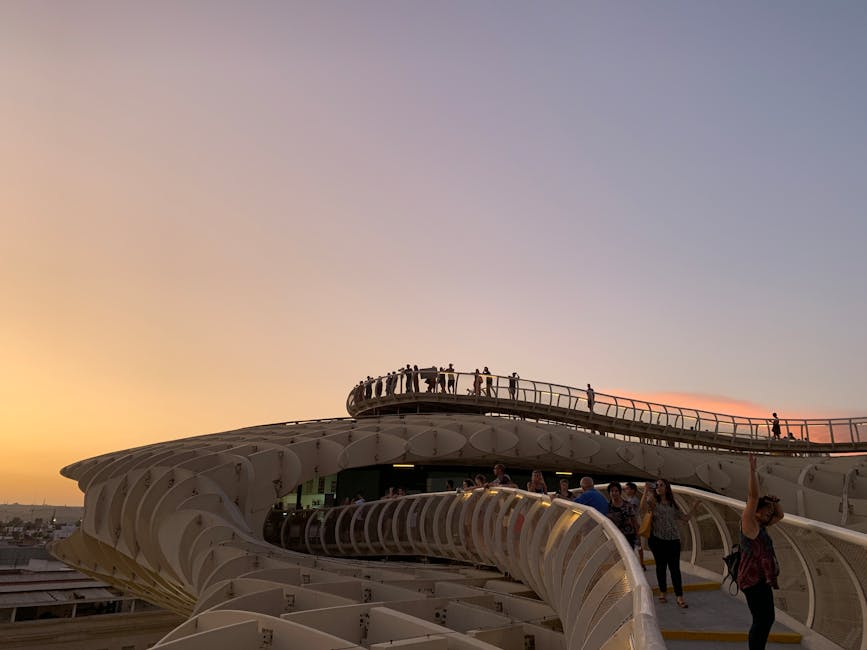
- The viewpoint terrace at the highest point. Not just the walkway. There’s an upper deck with benches around the curve where most visitors stop, take three photos, then leave. Sit there for 15 minutes instead. The light changes faster than you’d expect.
The history nobody tells you
For most of its existence the people of Seville wanted Las Setas torn down. The build went four years past schedule and 90 million euros over budget. The original 50-million-euro budget swelled to roughly 100 million by completion. Local papers ran weekly stories about the cost overruns. The mayor who’d championed the project, Alfredo Sánchez Monteseirín, lost the 2011 election partly because of the controversy.
The arguments were genuinely difficult. Was a contemporary structure appropriate in a city centre that’s a UNESCO World Heritage Site? Were the Roman ruins better preserved or ruined by a building sitting over them? Was 100 million euros the right way to spend public money in a city with one of Spain’s highest unemployment rates? The answers depend on who you ask, and in 2011 most of the answers were no.
What changed is just time. The structure is 14 years old now. People grew up with it. Couples meet under the parasols. Families queue at the food market underneath. The Aurora show became a date-night standard. Walk through Plaza de la Encarnación on a weekend evening and you’ll see a hundred Sevillanos who don’t think about whether the building should exist any more than they think about whether the Cathedral should exist. It just does.
There’s a useful parallel here with Florence. The Leonardo Interactive Museum is a contemporary intervention inside a Renaissance city, and the locals have a similar relationship with it: hostile at first, gradually domesticated, eventually loved. The same arc ran in Paris when Frank Gehry’s Fondation Louis Vuitton opened in the Bois de Boulogne. Cities absorb new buildings the way bodies absorb new tissue. Slowly, with rejection and infection, then suddenly fine.
The Antiquarium below
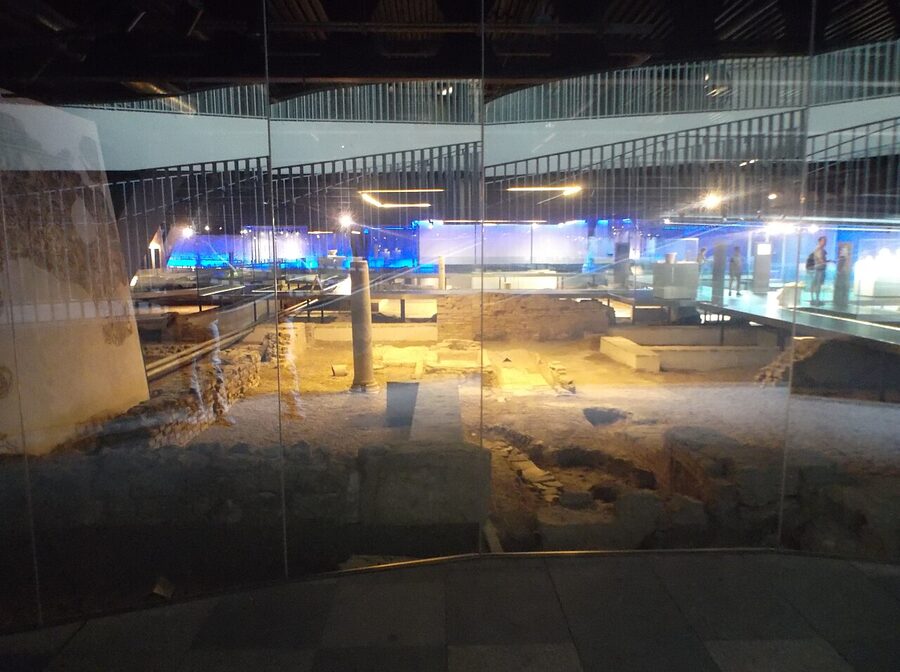
This is the part most visitors skip. Don’t. The Antiquarium is a 4,800-square-metre archaeological site preserved in situ five metres below street level. It covers Roman houses from the 1st century AD, a salting factory, mosaics, the foundations of a Moorish house from the 12th century built on top of the Roman remains. The whole thing reads like a vertical timeline of Seville from Híspalis through al-Ándalus.
The crucial detail: when the city excavated the plaza in 1990 to build a parking lot, they found this. Spain has very strict heritage laws. The dig had to stop. The site sat exposed, unprotected, deteriorating, for nearly 15 years while the city argued about what to do. Mayer’s design integrated the ruins as a permanent climate-controlled museum. That is genuinely the only reason this archaeology is still legible today.
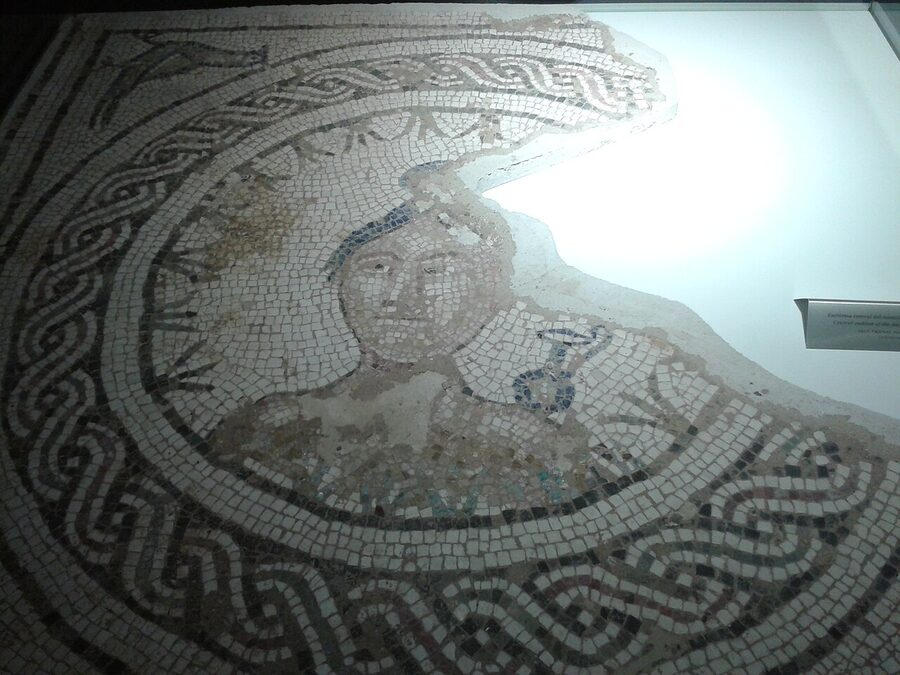
If you’ve already done Pompeii or Matera, the scale here is much smaller. This is a museum visit, not a half-day. Expect 30 to 45 minutes, more if you read all the panels. The signage is bilingual Spanish-English, which is more than you get at most Spanish state museums.
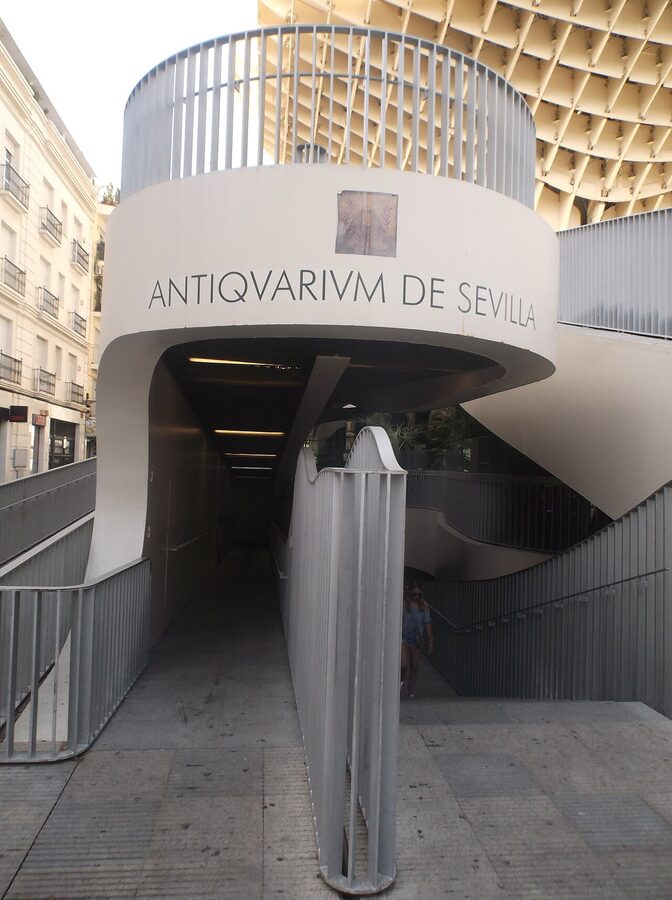
The Antiquarium is part of the city’s archaeological network and the entry ticket is separate from the rooftop. €2. The two visits don’t connect through the building, you have to exit and walk around. This is a small annoyance the booking page glosses over, and the entry to the Antiquarium is on the south side of the structure, at street level on the corner of Calle Imagen.
Three Setas tours worth booking
1. Setas de Sevilla Entry Ticket: $18
This is the cheapest legitimate way in and the one I’d default to. Our full review walks through the timed-slot flow, when to book versus walk up, and which time of day actually maximises the experience. Book the evening slot for Aurora unless you specifically want the day view of the Cathedral.
2. Mushrooms Guided Tour with VR: $34
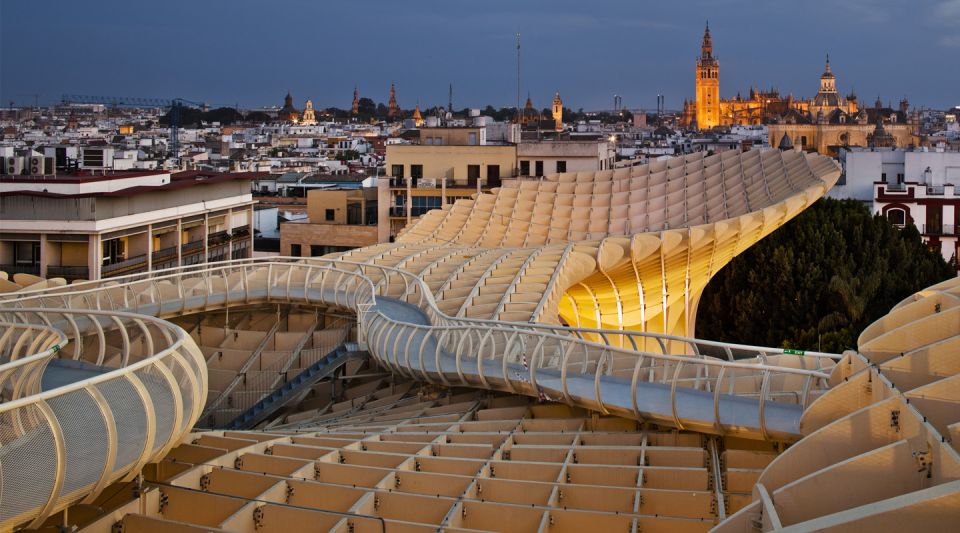
Pick this if you want the history rather than just the views. Our review covers the VR sequence in detail and what the optional walking-tour add-on actually includes. The VR glasses are simple Cardboard-style units, not a deep-immersion rig, but the content is genuinely informative for the price.
3. Tablao Flamenco Las Setas: $33

If you’re already up top for sunset, the obvious next move is dinner and a flamenco show without changing neighbourhoods. Our review compares Las Setas to Casa de la Memoria and Tablao El Arenal: this is the more intimate room of the three. The schedule also lines up cleanly with the 8pm Aurora cycle upstairs, so you can pair them on the same ticket.
Practical info: what to know before you go
The structure sits in Plaza de la Encarnación. From the Cathedral it’s a 10-minute walk north. From the Alcázar 12 minutes. From the Triana side of the river, about 18 minutes plus the crossing. There’s a metro stop (“Plaza Nueva,” Line 1) about 800 metres south, and a bus stop on the square itself served by the 27 and 32 routes.
Opening hours run roughly 9.30am to midnight. April through October the closing pushes to half past midnight. The Antiquarium has its own shorter schedule: Tuesday to Saturday 10am to 8pm, Sundays and holidays 10am to 2pm, closed Mondays. Don’t waste a Monday morning trying to do both.
Lifts are inclusive: there’s full step-free access to the rooftop, including the upper deck. The walkway itself has a handrail along the inner edge but the outer edge is open in places, which is fine for adults but worth flagging if you’re with small kids.
What to do with the rest of your half-day
Setas itself is short: figure 90 minutes for a thorough rooftop visit, plus 30 to 45 in the Antiquarium if you do that, plus dinner. So the question is what surrounds it. The good news is that almost all of central Seville is a 15-minute walk away.
For the historic side: the Alcázar is the obvious pair, but the contrast is more pointed if you do Casa de Pilatos instead. Casa de Pilatos is the quieter cousin of the Alcázar, a 16th-century aristocratic house with the same Mudéjar-Italianate vocabulary, sitting eight minutes’ walk south of Las Setas. Doing Casa de Pilatos and Setas back-to-back gives you 500 years of Seville architecture across a 600-metre walk.
For the food side: the food market underneath the parasols is reasonable but local-er options sit two streets over. Mercado de Feria, Cervecería La Bodeguita on Calle Rivero, Bar Eslava on Calle Eslava (about ten minutes northwest of Las Setas). All cheaper, more local, fewer English menus.
How long to budget
For most travellers a single visit is enough. Plan for 90 minutes if you’re doing rooftop + immersive room + Aurora, plus another 30 to 45 in the Antiquarium if you decide to add it. Rough budget: half a morning or half an evening, not a full day.
If you want to maximise the experience, do this: late afternoon visit, climb up around 90 minutes before sunset, watch the city light up from the deck, stay for the first Aurora cycle. Then walk down for dinner and a flamenco show at the tablao directly underneath. That’s about four hours of programming starting at golden hour, all within a 100-metre radius of one another.
Common mistakes I see visitors make
The biggest one: doing Las Setas at midday in summer because that’s when the Cathedral queue is longest and people fill the gap. Bad idea. The walkway is all painted concrete with the Andalusian sun directly overhead. There’s almost no shade at the upper level. Do Cathedral late afternoon, Setas at sunset.
The second biggest: skipping the Antiquarium because the entry is awkward. €2. Twenty minutes. It’s the reason the building exists and it makes the rooftop visit make more sense afterward.
Third: assuming the rooftop walkway is a quick photo stop. The whole point is the slow walk. The structure is designed so the view changes as you move. Take 40 minutes minimum and walk both directions. The light reads differently each pass.
Fourth: not bringing water. There’s a small kiosk on top in season but it runs out by mid-afternoon on weekends. Bring a bottle.
Fifth: comparing the views unfavourably to the Giralda climb. They’re different products. The Giralda gives you a 70-metre vertical view of the Cathedral roof and the old town. Setas gives you a 26-metre horizontal view of the city skyline, with the Cathedral in the foreground rather than under your feet. The Paris equivalent of that low-modern observation deck is Montparnasse Tower, which sells you a horizontal city view with the Eiffel in the frame instead of underfoot. Both are worth it. They’re not interchangeable.
Las Setas after dark
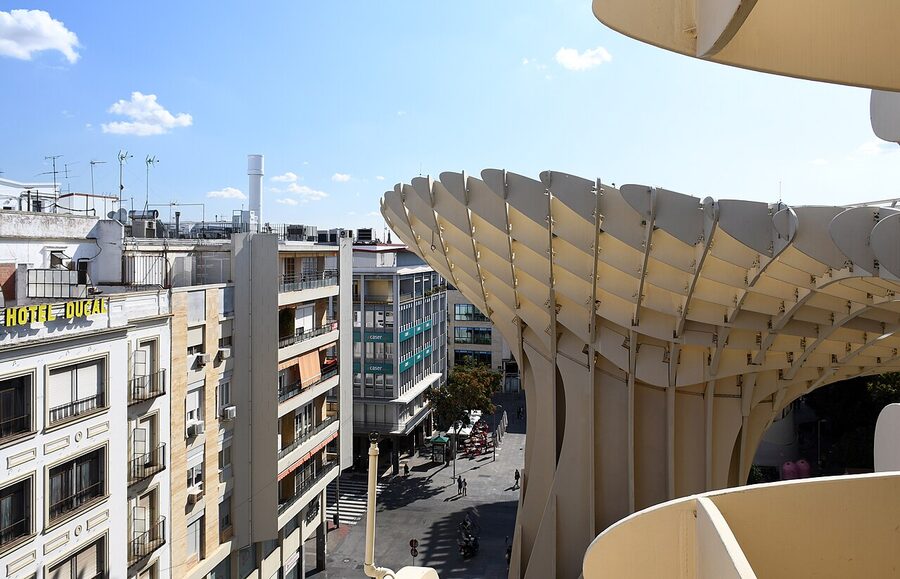
The Aurora show is what most travellers come for and it’s the part that’s hardest to describe in print. A continuous LED installation runs along the underside of the parasols, programmed by Filipe Pais and the Diller Scofidio + Renfro studio. It cycles through about 25 minutes of slow gradient sequences. Think of it as ambient lighting more than a “show.” There’s no countdown, no peak moment, no soundtrack beyond the city’s own background hum. The colours wash, the wood absorbs them, the geometry shifts slightly as you walk.
Two practical things. First, the show triggers automatically about an hour after sunset, so the start time shifts through the year. In June it begins around 10.30pm. In December closer to 7pm. Check the official site the day of. Second, there are several “wash” cycles per night, so don’t panic if you arrive mid-cycle. Wait 25 minutes and the next pass starts.
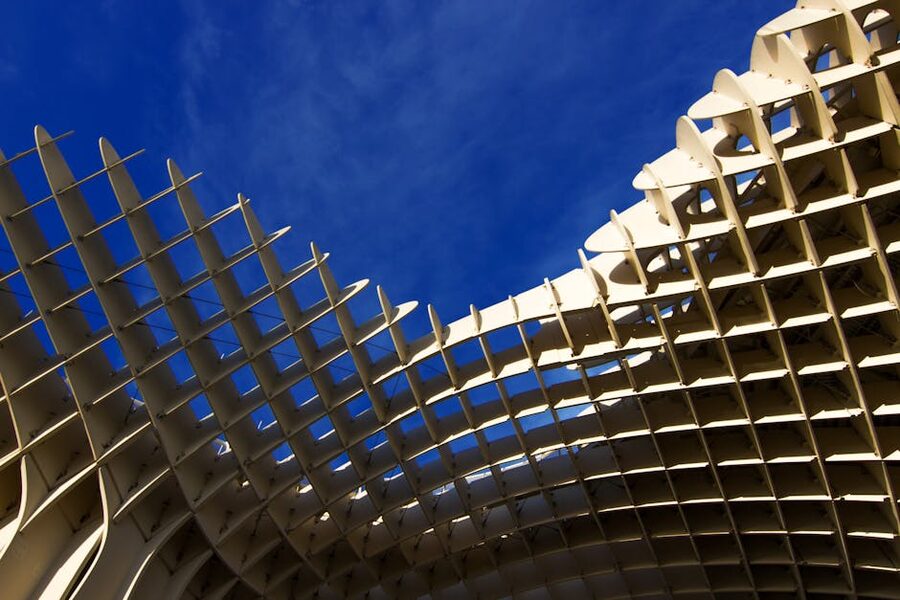
People who’ve seen La Fenice in Venice or other son-et-lumière installations will recognise the genre. This is the budget version, but the building it’s projected onto is so unusual that it works better than the genre usually does. The wood absorbs the light unevenly. Each parasol glows at a slightly different brightness because of the subtle thickness differences in the laminate.
Photo guide: the angles that actually work
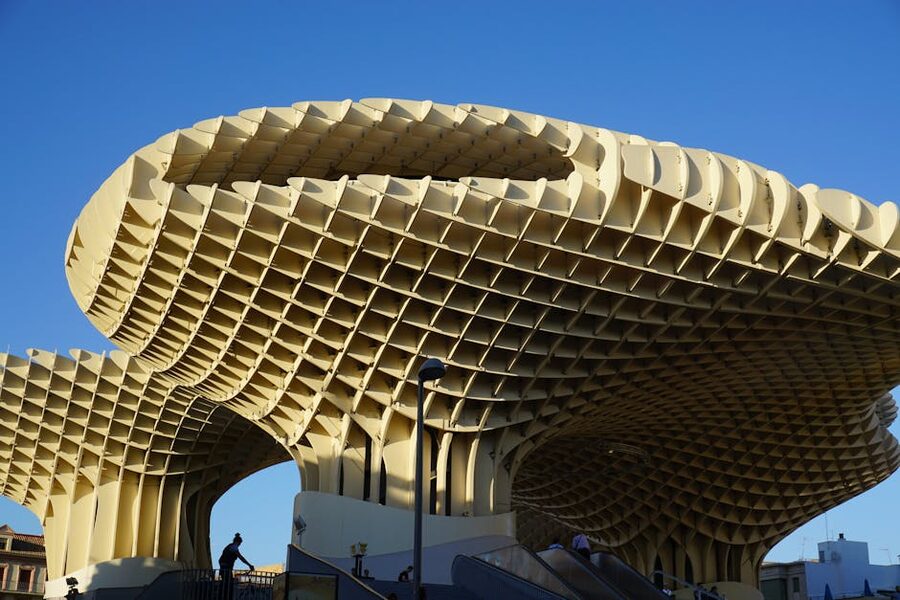
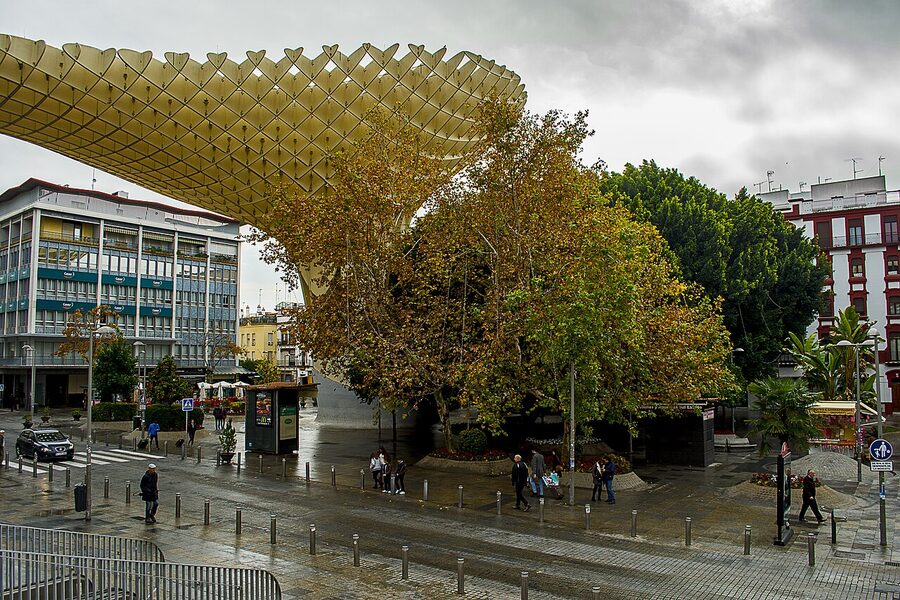
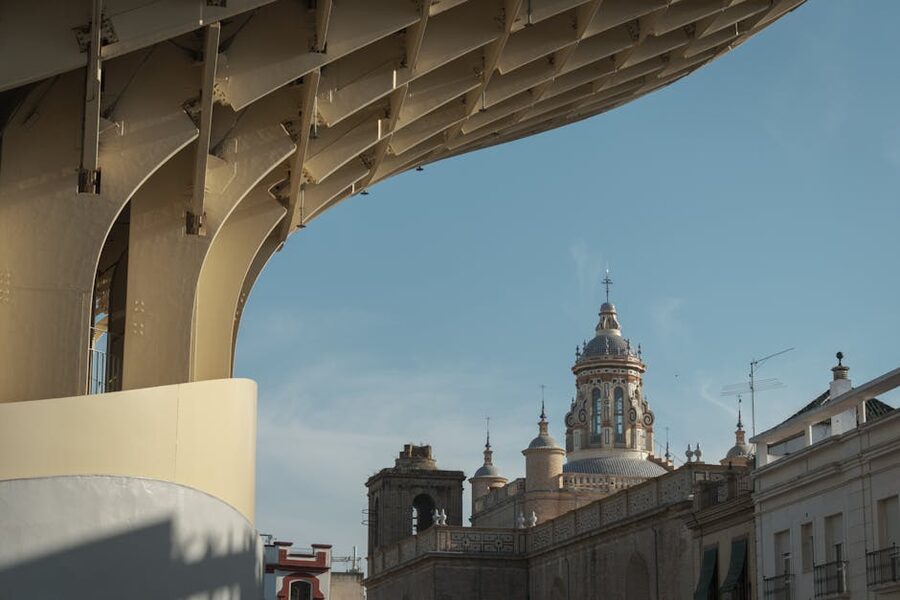
From the ground, the best angle is the southwest corner of the plaza near the Iglesia de la Anunciación. You get the parasols, a bit of plaza, and the historic church at the edge of frame. Wide lens. Sunset hits the wood at about 30 degrees, gold light.
From the rooftop, the obvious shot is the Cathedral and Giralda in the south. The less obvious one is straight down through the openings in the walkway, looking at the plaza below. The composition is geometry against people, and it changes every minute.
The Aurora shot is harder than it looks. Phones flatten the gradient. If you have a real camera, slow shutter (1/8 to 1/30, hand-held against the railing) gives the colour bleed; faster shutter freezes the wood detail but loses the wash. Pick one. Don’t try both.
How Setas fits the rest of Seville
Most travellers spend two or three days in Seville. The big four are the Cathedral and Giralda, the Royal Alcázar, a flamenco show, and a Triana neighbourhood walk. Setas slots in either as the contemporary counterpoint to the historic core (do it on the same day as the Alcázar, the contrast lands hard) or as a sunset closer for the second day.
If you’ve got a third day and want to dig deeper into the Mudéjar architecture you’ll have seen in the Alcázar, Casa de Pilatos is the unlocked level: same architectural language, fewer crowds, eight minutes’ walk from Las Setas. If you want a moving panorama instead of a fixed one, the Guadalquivir cruise is a one-hour float along the river that gives you Triana, the Torre del Oro, and the Plaza de España from the water.
Day-trippers from Córdoba often try to do Setas in a four-hour slot before the train back. It’s possible if you skip the Antiquarium, but you’ll feel rushed. Better to budget Setas as part of an overnight, even a budget hotel night, rather than a half-day add-on to a longer Andalucía circuit.
Skip the bus, walk it instead
The Seville hop-on hop-off bus stops near Plaza de la Encarnación but the centro histórico is genuinely walkable end to end and the bus loop is long. If your visit to Setas is part of a Seville centre tour, walk. Save the bus for the Plaza de España / Parque de María Luisa loop where the distances are real.
The same logic that holds for the Florence HOHO applies here: the historic core is too dense for a bus to add value, the periphery is where buses earn their fare. Barcelona’s HOHO works because the city is bigger; Seville’s doesn’t, for the same reason.
A word on the architectural fight
The Setas controversy is sometimes framed as locals versus the architect, or tradition versus modernism. It was actually messier. The most vocal critics in Seville were academics and historians who’d argued for years that the Roman ruins below should determine what gets built above. The most vocal supporters included the Roman archaeologists who’d worked on the Antiquarium, who genuinely wanted a permanent building on top to preserve the site. Mayer’s design lost in the European architecture press but won, eventually, in the city.
The reframe is uncomfortable. Most contemporary architecture inserted into historic centres ages badly. Sevillanos still hate the 1960s ICOM tower a few blocks south. They’ve stopped hating Las Setas. The difference might be the timber. Wood ages into a city the way concrete and steel never quite do. The parasols are darkening, weathering, taking on patina, doing what wooden boats do at the dock. Twenty years from now they’ll look more, not less, like they belong.
What to do next
Setas is a strong second-day Seville move. After the headline sights (Cathedral, Alcázar, Santa Cruz), Las Setas is the structure that pulls the city forward in time. Pair it with Casa de Pilatos for the architectural conversation across centuries, or with a flamenco show at the tablao directly underneath. If you’ve got the appetite for a day trip, Córdoba’s Mosque-Cathedral is 45 minutes by AVE; Granada’s Alhambra works as a 2-hour drive or a slower train. And if Mayer’s contemporary intervention left you wanting more 21st-century art, the Reina Sofía in Madrid is the country’s cleanest counterpoint to all the medieval cathedrals you’ll see in Andalucía.