
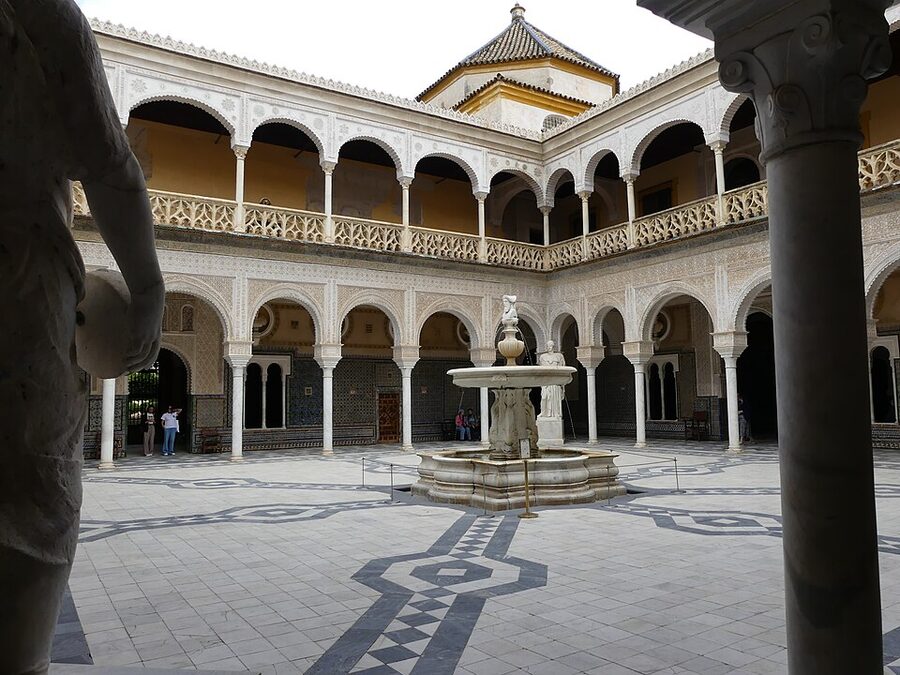
The first thing I noticed when I stepped into the central courtyard at Casa de Pilatos was how quiet it was. Twenty-four Roman emperors stared down from their wall niches without an audio guide blaring underneath them, no group of forty waiting for a turn at the fountain, no shuffle of feet on a single forced route. The fountain itself was already four hundred and ninety years old when I leaned against the railing, and I could hear it from across the patio.
This is the catch nobody tells you about Seville. Most visitors do the Royal Alcázar in two hours, queue for the Cathedral and the Giralda, and leave. Casa de Pilatos is fifteen minutes away on foot, costs less than half what the Alcázar does, and gets you the same architectural conversation in a smaller key. I think of it as the quieter Alcázar. That’s the whole pitch.
In a Hurry: 3 Picks
- Ground Floor Entry Ticket ($14): the cheapest, easiest way in. Audio guide via QR code, ninety minutes is plenty. Book on GetYourGuide.
- Salvador Church + Casa Pilatos + Setas Walking Tour ($46): three Seville sights, one guide, two and a half hours. Book on GetYourGuide.
- Casa de Pilatos + Condesa de Lebrija Private Palace Tour ($258 per group): both noble palaces with a guide who can read the iconography. Book on GetYourGuide.
Why This Palace Slips Past Most Visitors
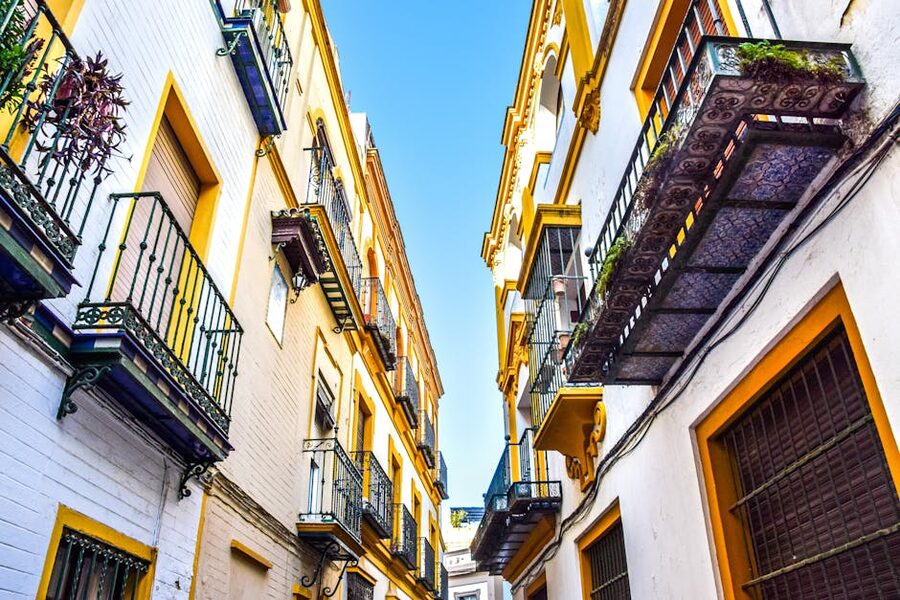
Seville’s tourist itinerary is genuinely tight. You get the Cathedral and the Alcázar across the Plaza del Triunfo from each other, the Plaza de España fifteen minutes south, and Las Setas ten minutes north. Most people fill a long weekend with those four and call it Seville. Casa de Pilatos sits a five-minute walk east of the Cathedral, in the Barrio San Bartolomé, and almost no first-time visitor puts it on the list.
That’s the reframe of this entire article. If you’ve already done the Alcázar and you walked away thinking “I’d happily look at that again, slower, with fewer people,” Casa de Pilatos is the answer. The architecture is in the same family. The crowds aren’t.
The official name is the Palacio de los Adelantados Mayores de Andalucía, which is a mouthful even for Sevillanos. Locals have called it Casa de Pilatos since the 1520s, when the second owner came back from a pilgrimage to Jerusalem convinced that the distance from his front door to a chapel called Cruz del Campo matched the distance Christ walked from Pilate’s house to Golgotha. He turned the route into the city’s first Via Crucis. By 1529 the procession was so popular it had to move out into the streets to handle the crowds. The name stuck.
None of this is in the audio guide. You learn it from the ducal foundation’s own pamphlets if you bother to pick one up, and it changes how you read the building.
The 500-Year Family
Construction started in 1483 when Don Pedro Enríquez, the Adelantado of Andalucía (a kind of governor-general for the king), bought up a block of properties that had been confiscated during the Spanish Inquisition. The plot mattered because it had access to the Caños de Carmona aqueduct, the Roman-era water supply that ran into the city from the east. Only a handful of Sevillian houses had running water in the fifteenth century. One of them was the Alcázar. The other was about to become Casa de Pilatos.
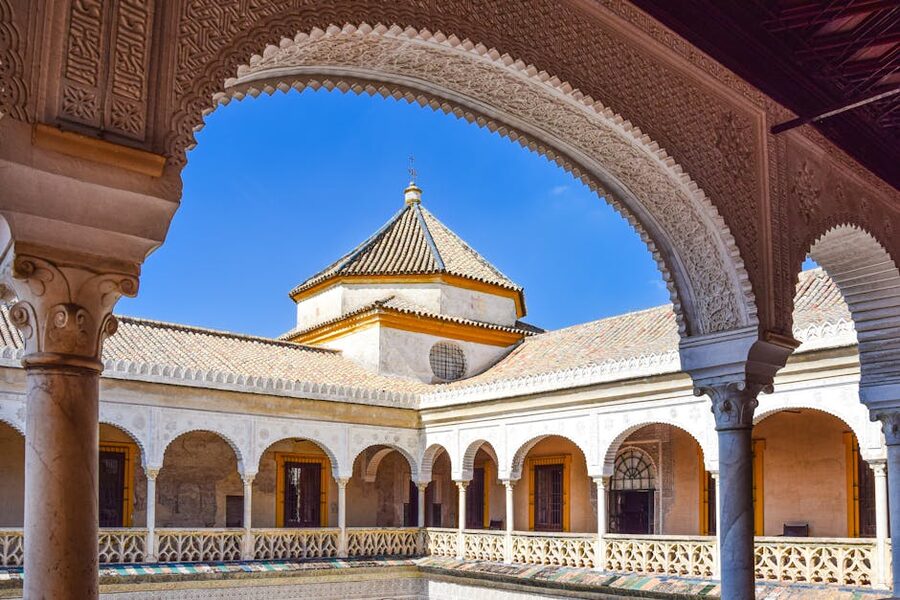
The son who finished the palace, Don Fadrique, made the trip to Jerusalem in 1519 and came home full of ideas. He’s the one who imported the Italian Renaissance arches, the marble columns from Genoa, the Roman emperor busts, and the layout of the central patio. He grafted Italian Renaissance form onto the Andalusian Mudéjar tradition his father had built in. The result is a hybrid you basically can’t find anywhere else in Spain. Five hundred years later the Dukes of Medinaceli still own the place. The 19th Duchess and her family still live in part of the upper floor. It is one of the longest-running owner-occupied private homes in Europe.
Hold that detail in your head when you walk in. You’re not in a museum that used to be a palace. You’re in a palace that lets the public into the rooms the family doesn’t currently use.
Inside the Patio Principal
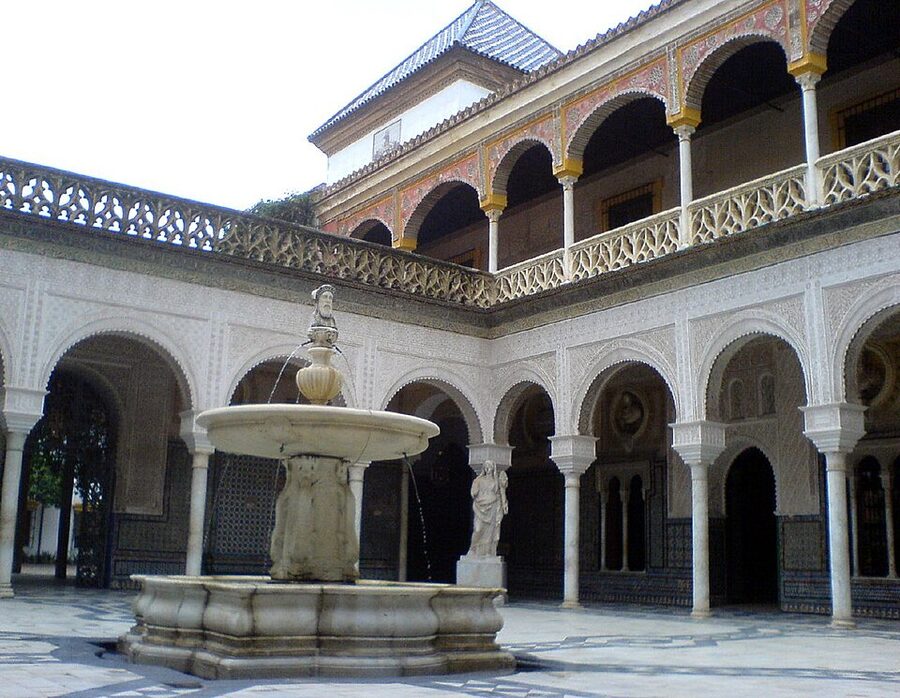
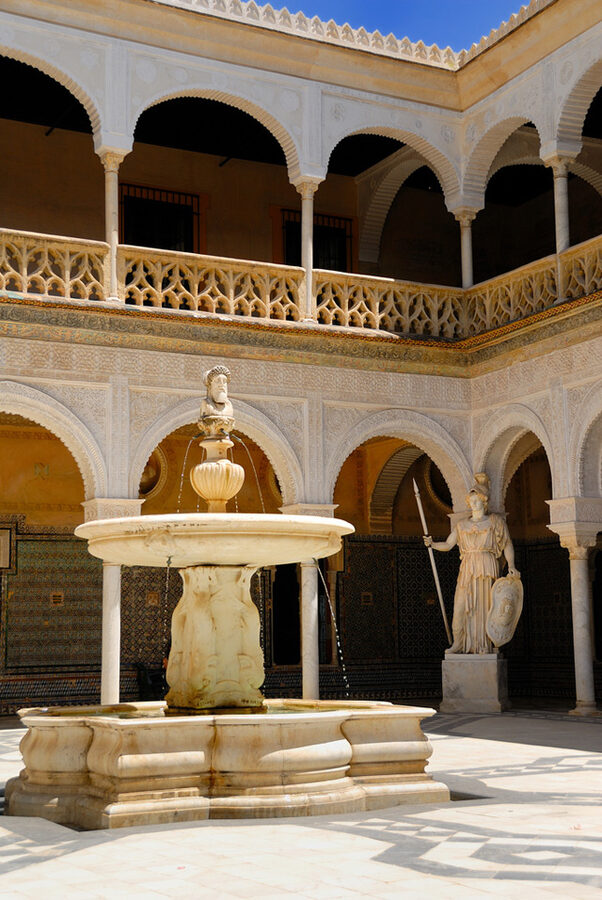
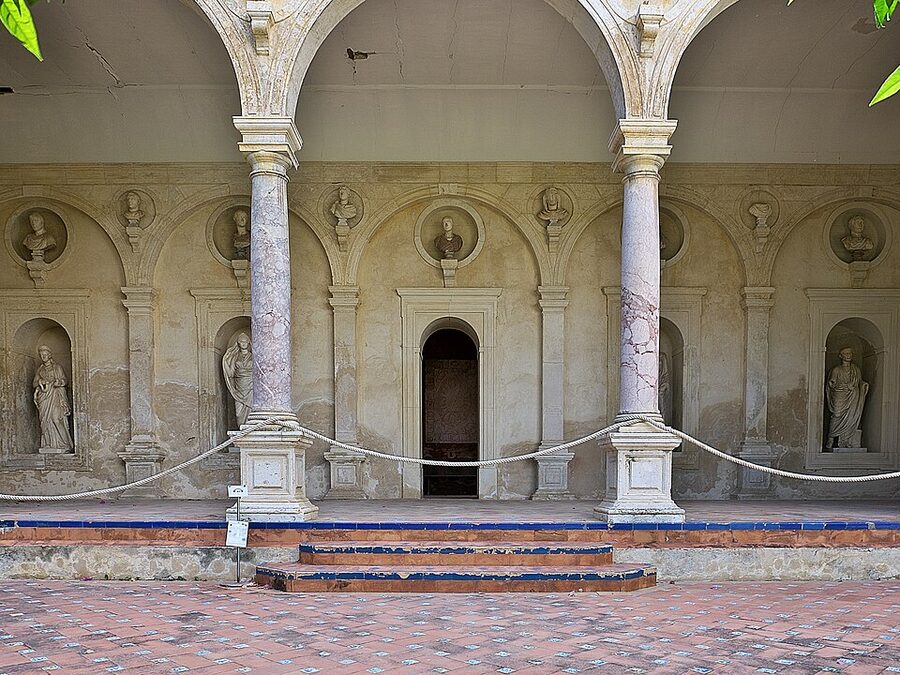
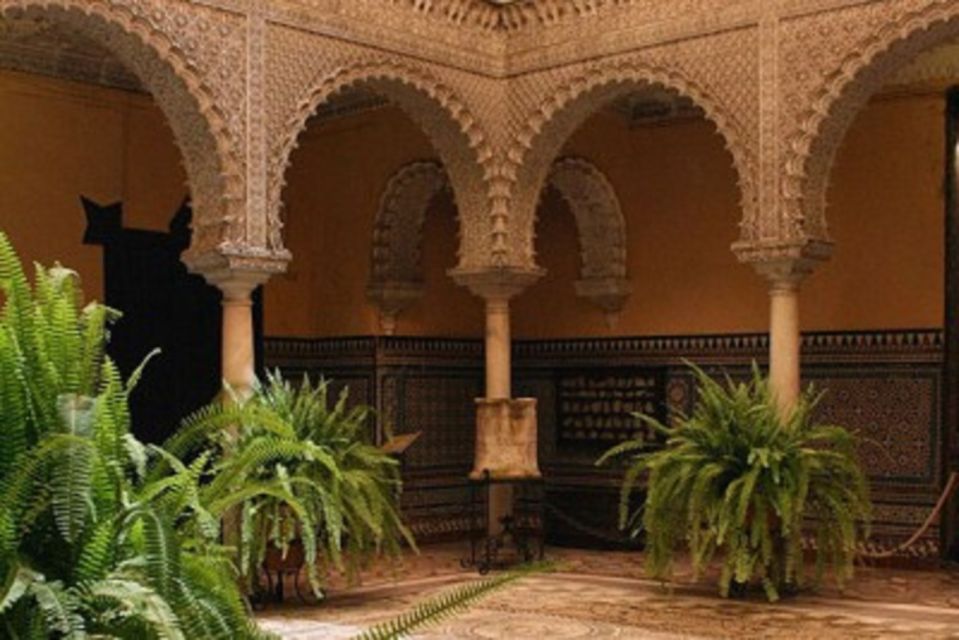
The central courtyard is the moment everyone comes for. Square plan, two-storey arcade running around all four sides, a fountain dead-centre, twenty-four Roman emperor busts in niches at gallery height, four full-size statues at the corners. The proportions feel right the moment you stand in it. That isn’t an accident. The patio is, by some art-historical accounts, the most coherent fusion of Italian Renaissance and Spanish Mudéjar architecture in existence.
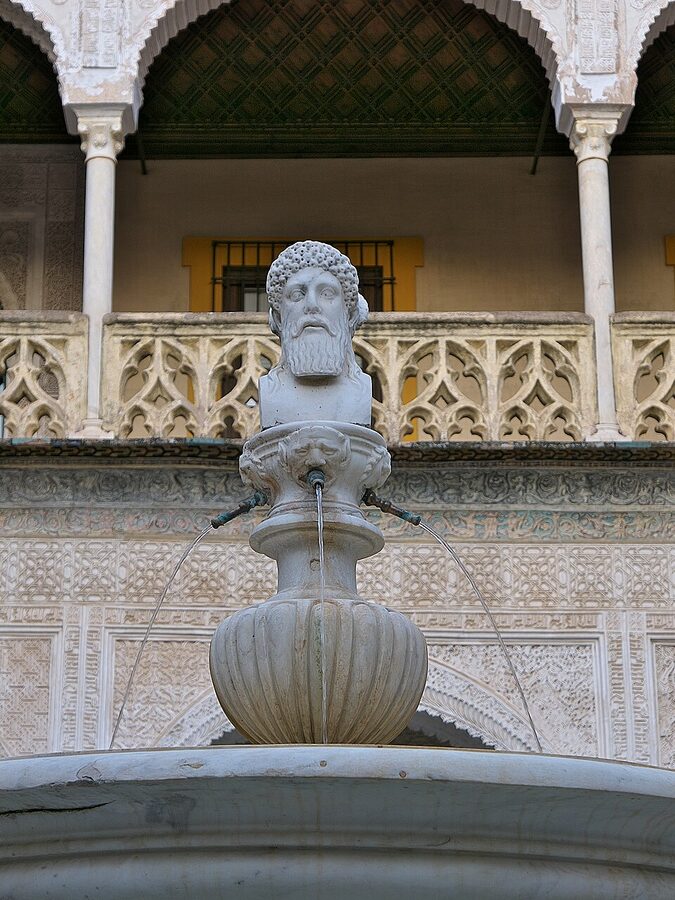
The fountain in the centre is original, made in 1529 in Genoa to Don Fadrique’s commission, and shipped over assembled. On top of it is a four-faced Janus, the Roman god of beginnings. He looks east, west, north, and south at once. The dolphins around the basin are Italian Renaissance carving; the octagonal tile-clad base under them is local Andalusian work. You’re looking at the design philosophy of the whole house in a single object.
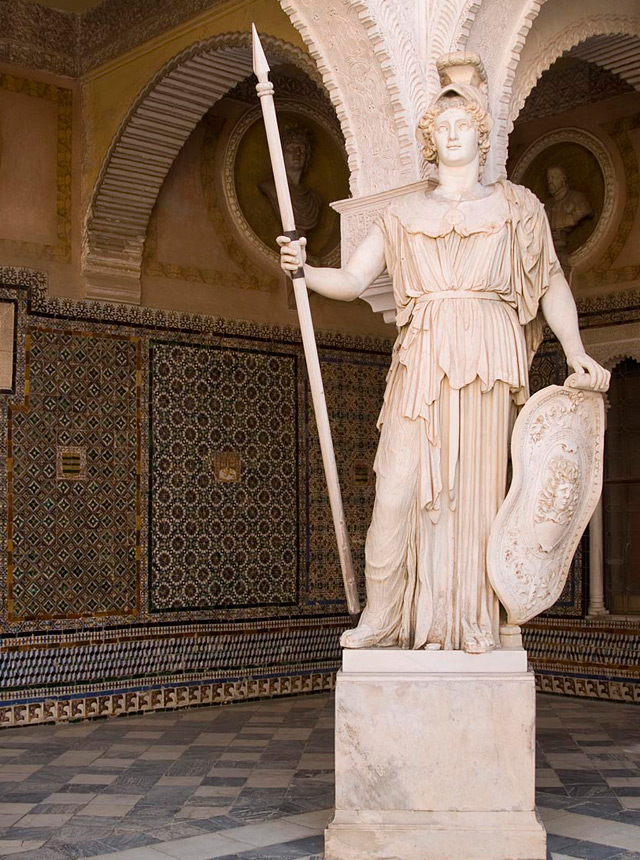
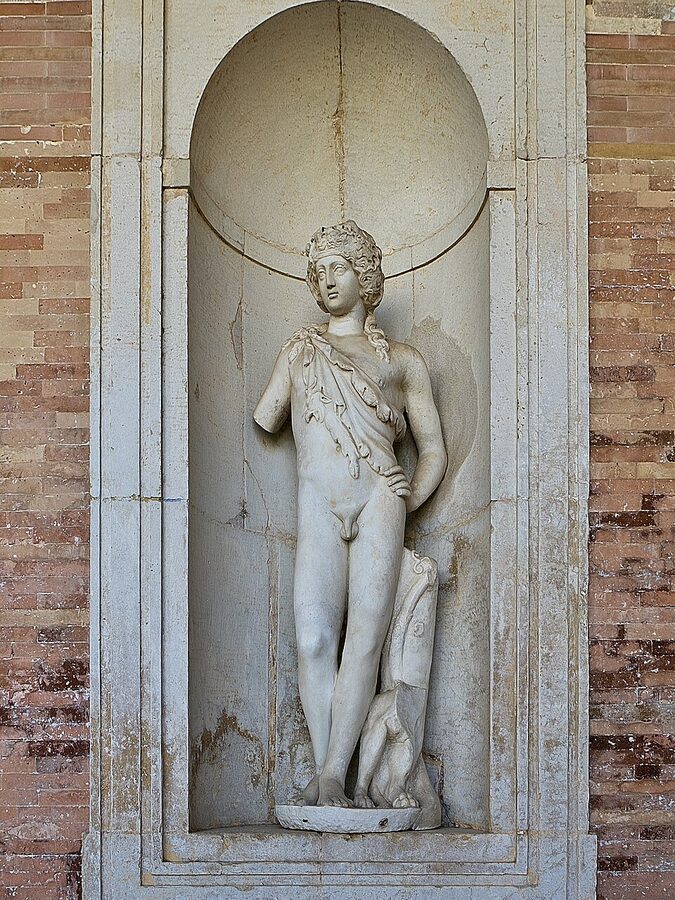
The four corner statues are where the courtyard turns into a riddle. Three of them are sixteenth-century Italian work in the style of the Roman antiquities of the period: Ceres, a Roman matron called Pallas Pacífera, and a young Athena. The fourth Athena is something else entirely. Her body is a Renaissance-era Italian copy of a famous Athena Medici figure, but her head is genuinely Roman, second-century, and original. It’s the only complete Athena Medici in the world that still has its original head. The other Renaissance copies of this figure ended up with replacement heads when the originals were lost. This one didn’t.
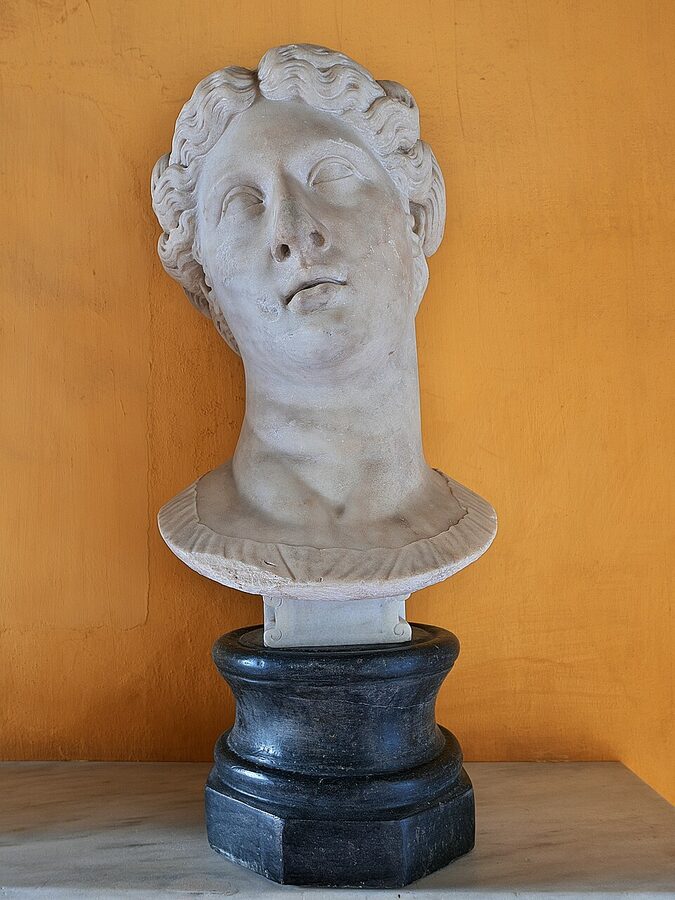
Stand under the gallery and look up. The twenty-four busts circling the patio are the Twelve Caesars on the lower run plus twelve later emperors above. Don Fadrique was building a private gallery of Roman authority and parking it in his own house, the same kind of private antiquities collection that became national institutions like the Rijksmuseum in Amsterdam. It was a very expensive way to say “we are the natural heirs of empire here.” Five hundred years later it’s still working as a piece of architecture; the political pitch has aged into history.
The Tile Work, Up Close
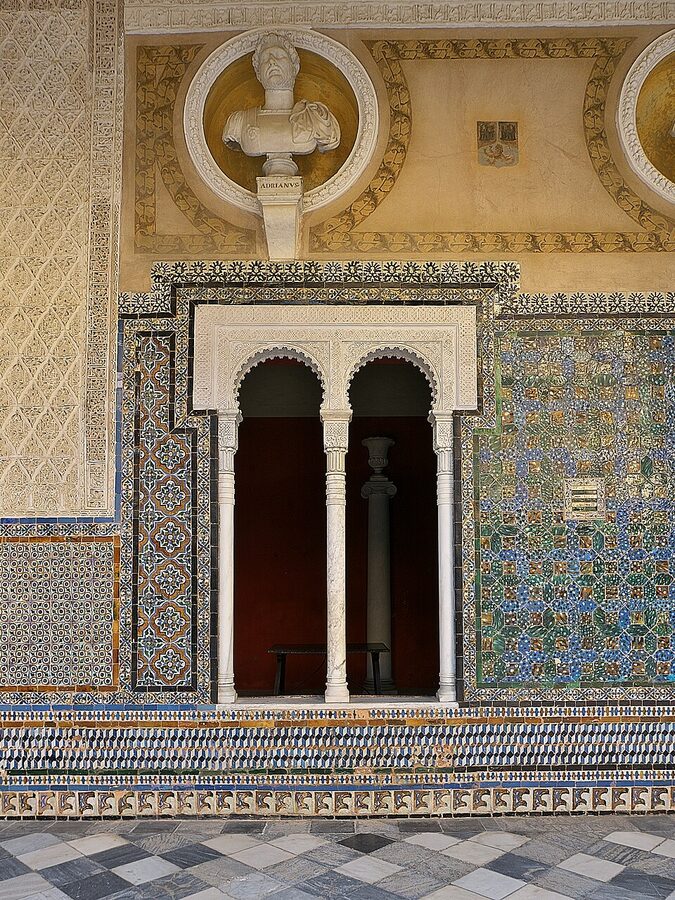
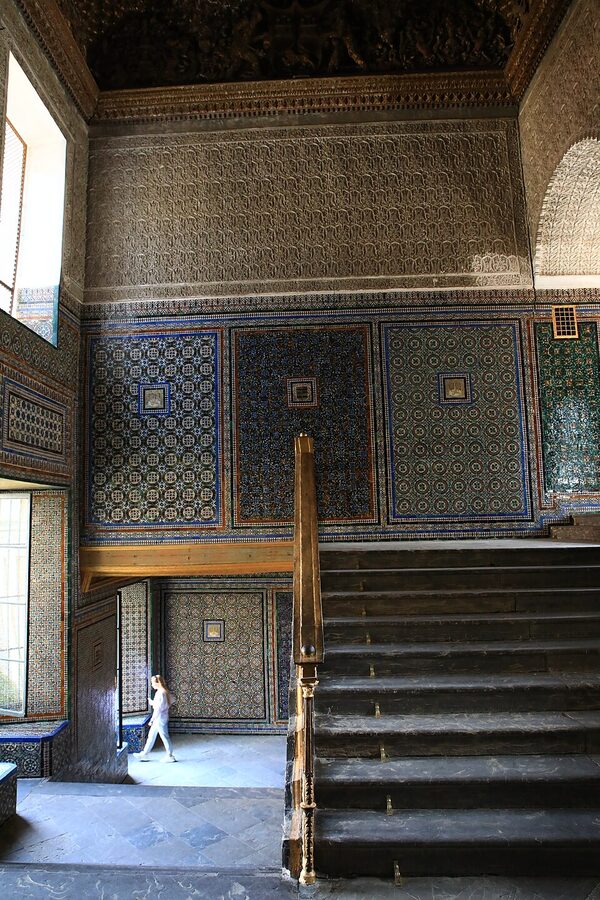
Casa de Pilatos has the largest collection of sixteenth-century azulejos in Spain. Roughly 150 different geometric and figurative tile designs cover the lower walls of the patio, the corridors, the staircase, and the chapel. The tile-makers were the same Triana workshops that did the Alcázar. The patterns repeat across both buildings; if you’ve already done the Alcázar you’ll spot the same star polygons and the same blue-green-yellow palette here.
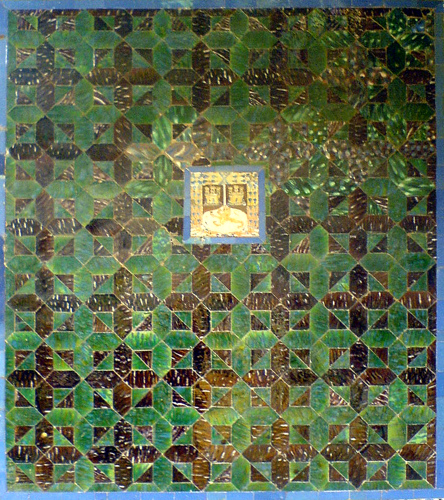
The patterns aren’t decorative for the sake of being decorative. Mudéjar tilework is a translation of Islamic geometric language into a Christian house. Star polygons, interlace strapwork, calligraphy in Arabic-style script (some of it real Arabic praise of God, retained from earlier walls; some of it nonsense ornament copied for visual effect): the entire visual code of a mosque, sitting inside the home of a Catholic governor. The Spanish Inquisition was active in Seville the whole time this was being built and nobody seems to have raised an eyebrow.
The Salón del Pretorio and the Coffered Ceiling
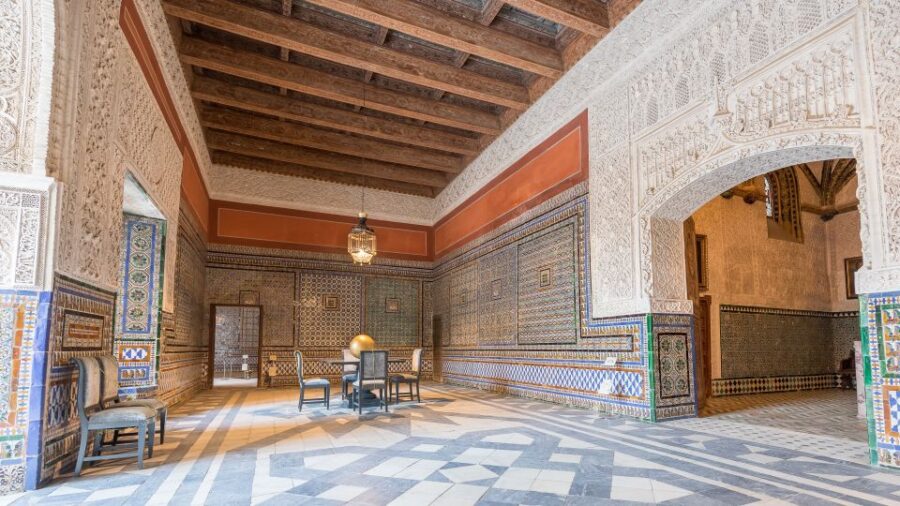
Off the south side of the patio is the Salón del Pretorio, a 132-square-metre reception room that served as the family’s hall of state. The walls below the ceiling line are continuous azulejo. The walls above the tile dado are bare plaster. The ceiling is a wooden artesonado, the carved geometric coffered work that the Mudéjar craftsmen had been refining since the twelfth century in Andalusia.
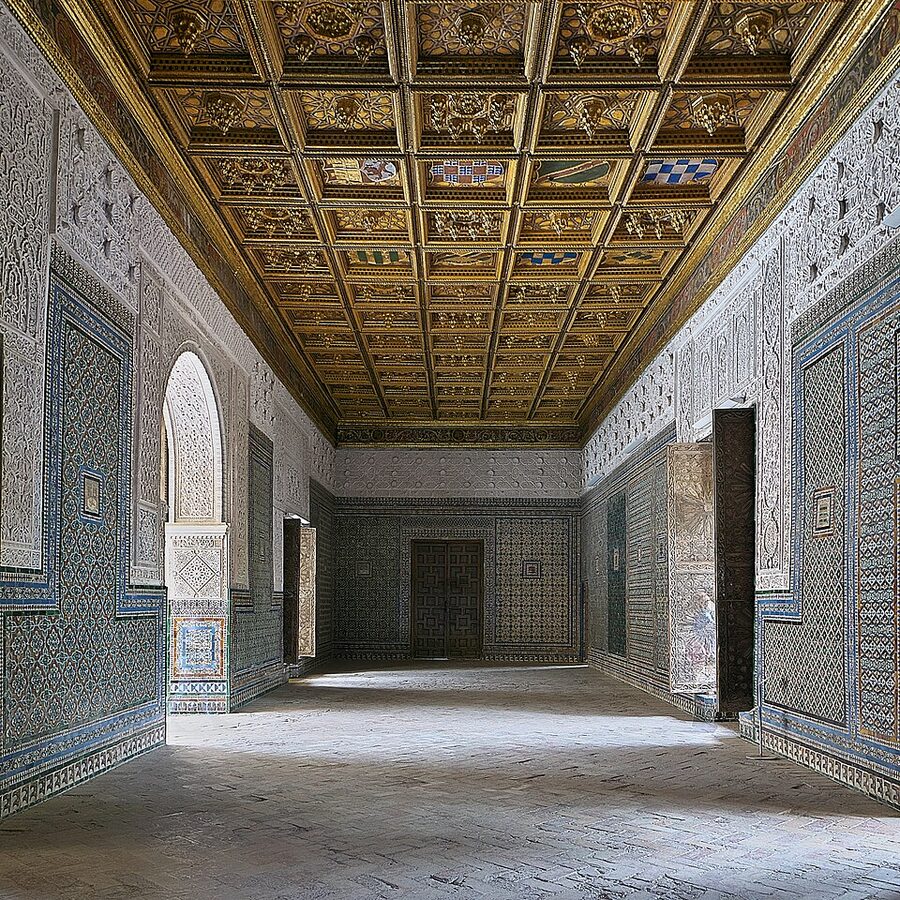
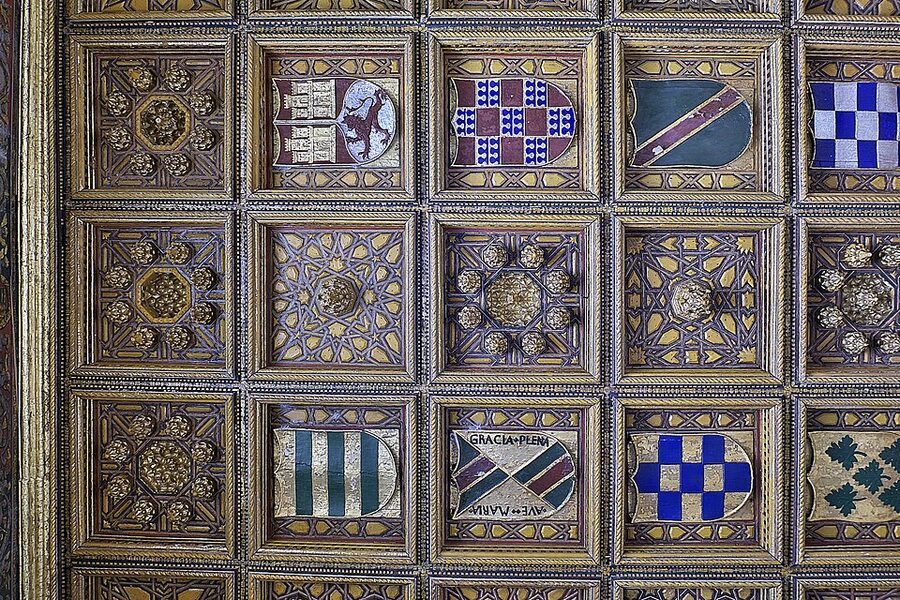
The Pretorio is also where the building’s modern double-life as set location becomes obvious. Lawrence of Arabia filmed scenes here in 1962. The Kingdom of Heaven, Knight and Day, and at least two seasons of Game of Thrones have shot in this hall and the courtyard outside it. The film crews come in overnight and the building opens to visitors the next morning. If a room looks vaguely familiar from a Crusader film, that’s why.
The Pink Salon and the Chapel
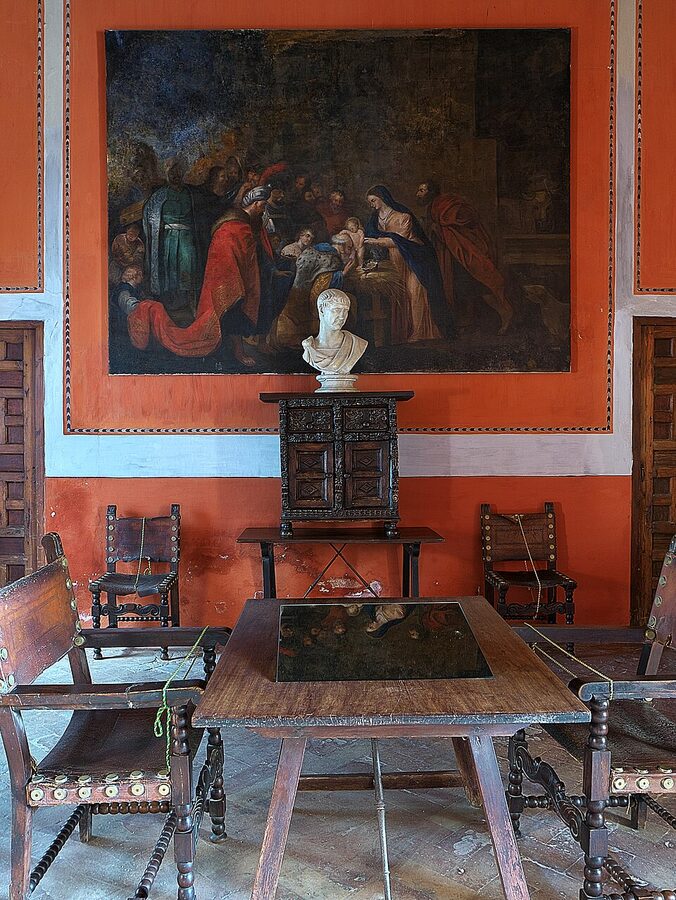
Walking clockwise around the ground floor you reach a smaller hall sometimes called the Salón Rosa. It’s named for the pink-painted walls that were applied in the nineteenth century, a Victorian-era softening of what would otherwise be more white plaster. There’s a row of Roman statues along one wall and a few large tapestries facing them. The mix of pink walls plus first-century portraiture is unsubtle, and somehow it works.
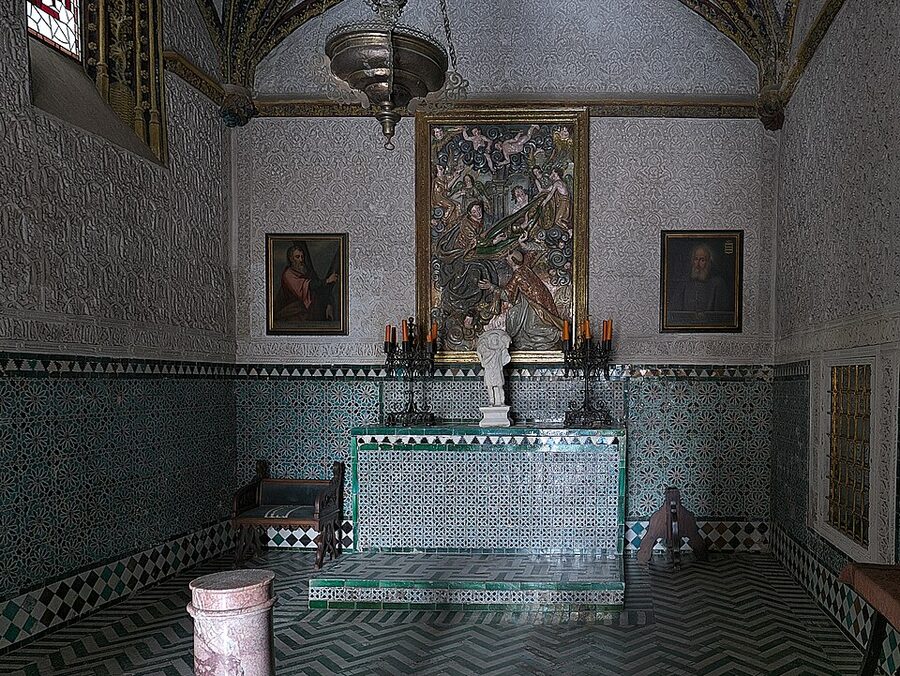
The Capilla de la Flagelación, the Flagellation Chapel, is the oldest room in the palace. It was already built when Don Pedro Enríquez bought the property in 1483, which makes it pre-Pilatos in the literal sense. The vault is Gothic ribbing covered with thick Mudéjar plasterwork. The walls are blanketed in azulejos that look more like the inside of a mosque than a Christian chapel. In the centre of the room is a polished pink-jasper column meant to symbolise the column where Christ was scourged before his crucifixion. The pilgrimage detail again. The whole house keeps coming back to that 1519 trip to Jerusalem.
The Two Gardens: Small and Grande
One of the things Casa de Pilatos quietly does better than the Alcázar is gardens for their own sake. The Alcázar’s gardens are vast (and stunning), but they get crushed in summer because every Alcázar ticket-holder ends up there at the same time. Casa de Pilatos has two enclosed gardens, both small enough to feel personal, both reliably empty.
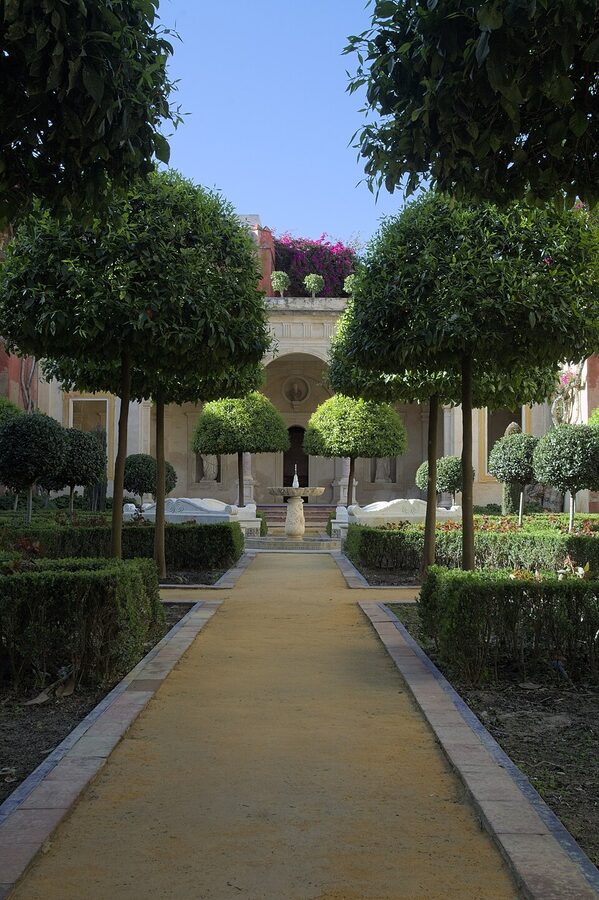
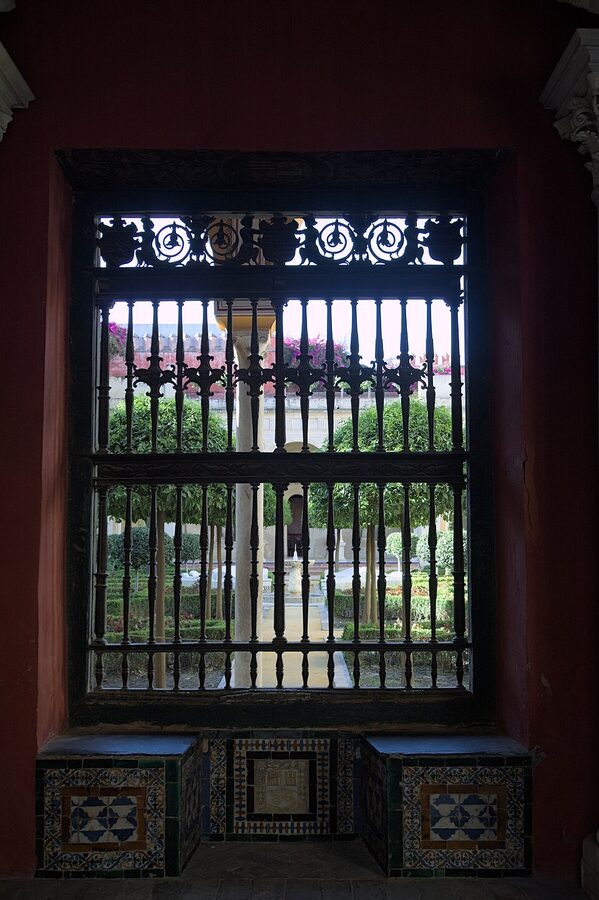
The Jardín Chico (the Small Garden) is the one most people stumble into first. You reach it through a narrow corridor called the Zaquizamí, a name that comes from the Arabic sáqf samá’i, meaning “fragile roof” or “roof of the sky.” Walk through it slowly. The light filters through the wooden screen overhead and fragments across the floor.
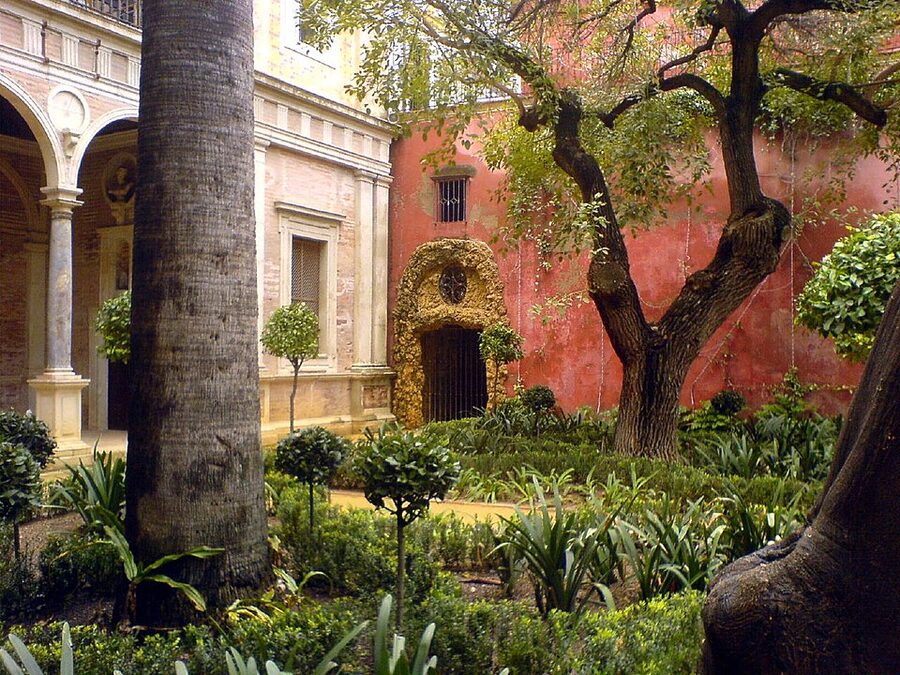
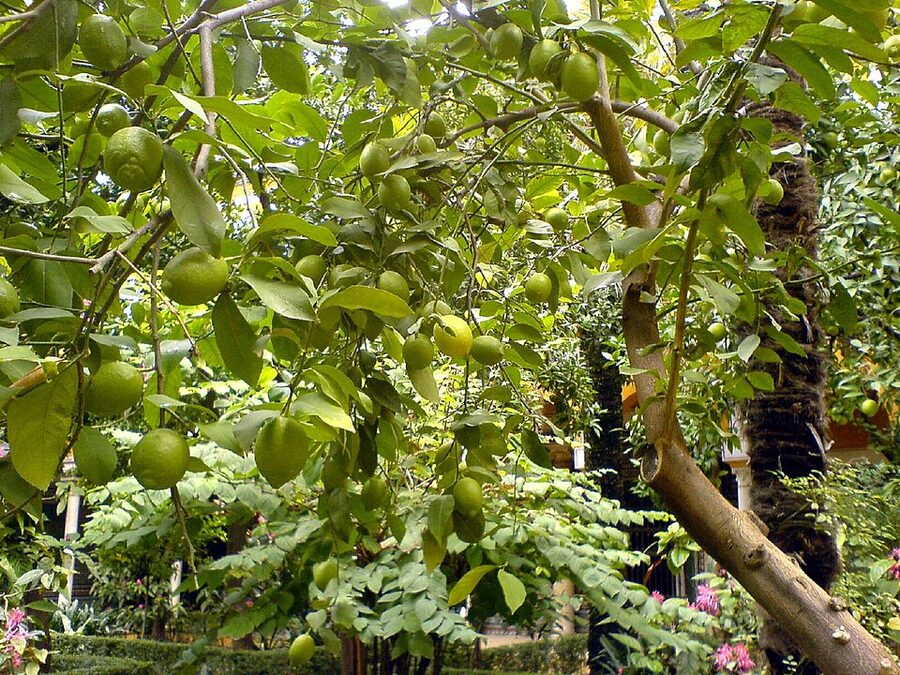
The Jardín Grande (the Large Garden) is what was once the orchard for the household. By the seventeenth century it had been formalised into the layout you see now: stone paths, a central allée, statues at the cross-points, citrus trees in pots along the walls. There’s a loggia on the northern side and a vaulted pavilion called the Cenador on the eastern side, both built so the family could sit in the shade and look across the garden during the late-afternoon heat. The lemon trees are still bearing fruit in May.
The Upstairs: Should You Pay for It?
There are two ticket types. The cheaper one ($14) gets you the ground floor and both gardens. The more expensive option ($18 or so) adds a guided thirty-minute visit to the upper floor. The upstairs visit is in a group, on a fixed schedule, and they don’t let you stop for photos.
I’d skip it on a first visit. The reasons: the upper floor is where the Medinaceli family actually live in part of the building, so the rooms shown to the public are a small selection of furniture-and-paintings rooms that aren’t original to the period the rest of the palace reads as. The English commentary is uneven. And the ground floor and gardens are genuinely the best part of the building. Casa de Pilatos is a courtyard-and-tile-work palace; the upstairs is a museum-of-the-family-history added on top.
If you really want a guided experience, the better choice is the small-group walking tour that combines Casa de Pilatos with one or two other attractions and gives you a guide who can read the iconography for you. The next section has the picks.
The Three Tours Worth Booking
The pool of guided tours for Casa de Pilatos is small. There’s one cheap entry ticket that everyone defaults to, a couple of small-group walking tours that thread the palace into a wider Seville itinerary, and a handful of private tours that combine it with the Lebrija Palace next door. Three options cover almost every traveller.
1. Casa de Pilatos Ground Floor Entry Ticket: $14
This is the default pick: skip-the-line entry to the ground floor and both gardens, with a multilingual audio guide via QR codes you scan as you walk. Our full review covers the audio-guide quality and the QR-code system in detail. Ninety minutes in the building is enough; come at 9am open or after 4pm in summer.
2. Salvador Church, Casa Pilatos & Setas Walking Tour: $46
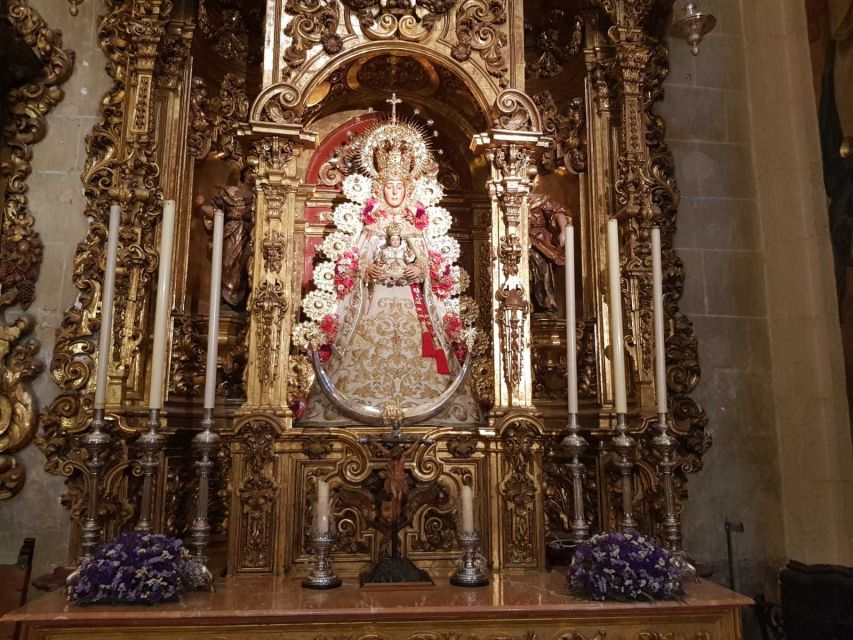
Two-and-a-half hours, expert guide, all entrance tickets included. Our review notes that the guide is what makes it work; the iconography in the Salvador altarpiece and the patio at Casa Pilatos both genuinely benefit from a proper explanation. Pair it with Setas at sunset if you can.
3. Casa de Pilatos & Condesa de Lebrija Private Palace Tour: $258 per group
This is the splurge pick if you’re a small group: a private guide takes you through Casa de Pilatos plus the Palacio de la Condesa de Lebrija a five-minute walk away, which has Roman mosaics from the nearby ruins of Italica laid into its own floors. Our review calls it the best private tour in Seville for anyone interested in Andalusian aristocratic homes; the iconography in both buildings is denser than any guide can cover for free.
Booking and Practical Info
The basics, and a few details that actually matter:
- Address: Plaza de Pilatos 1, in the Barrio San Bartolomé. Five minutes’ walk east of the Cathedral.
- Hours: Daily, 9am to 6pm (last entry 5:30pm). Hours extend in summer; the foundation’s website is the source of truth.
- Tickets: €12 ground floor + gardens. €15 (or so) for ground floor + guided upstairs. EU citizens free Monday afternoons (you’ll queue, but it works).
- Audio guide: included with ground-floor ticket. QR codes on the wall in each room. The English narration is decent if a touch theatrical.
- Time needed: 90 minutes is plenty for the ground floor and gardens. Add 30 if you book the upstairs.
- Photography: allowed (no flash) on the ground floor and in the gardens. Not allowed upstairs.
The ticket office takes cash and card. There’s no cloakroom, so don’t show up with a backpack the size of a small car.
When to Visit
Mornings are coolest and the patio gets the best light between 9am and 11am, when the eastern arcade is fully lit. By noon the courtyard is in shadow and the contrast goes flat. The garden photographs better in late afternoon, around 5pm, when the western light hits the lemon trees and the cenador.
If you’re in Seville in July or August, plan around the heat. Nine in the morning the whole thing is bearable. Two in the afternoon you’ll be miserable in the patio because there’s no air-conditioning and the building is genuinely a stone box. Locals do siesta for a reason.
Mondays after 3pm the place fills with EU residents using the free entry, so if you’re not eligible for that perk, skip Monday afternoon entirely. Sundays are the second-busiest day. Tuesday through Friday mornings are the quietest you’ll find it.
Casa de Pilatos vs the Royal Alcázar
This is the question every visitor with a half-day to spare ends up asking. Here’s the answer.
Do the Royal Alcázar first if it’s your first time in Seville. It’s the bigger, more famous, more spectacular building. The Salón de Embajadores ceiling, the Patio de las Doncellas, the Almohad gardens, the Game-of-Thrones-Dorne footprint: nothing in Casa de Pilatos competes at that scale.
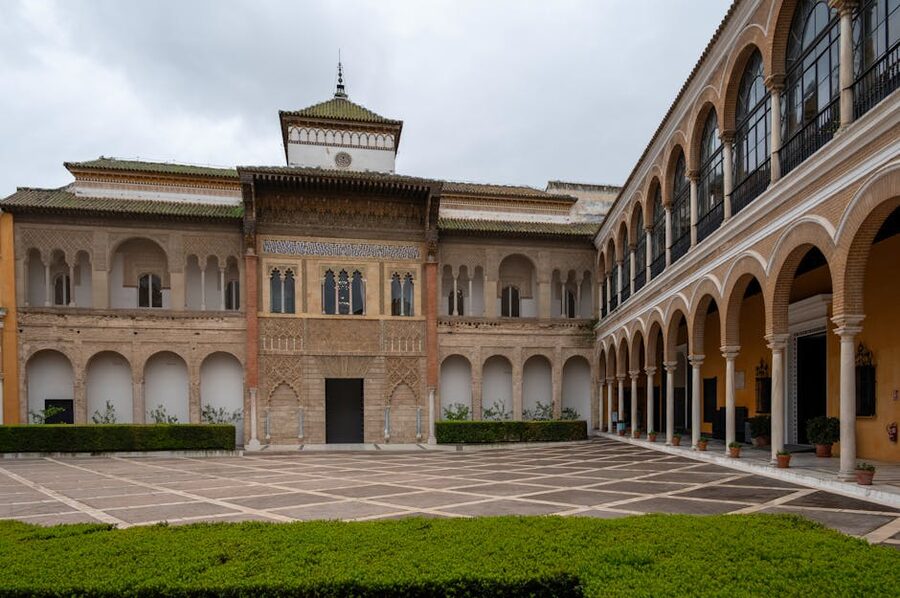
But: do Casa de Pilatos second, the same trip, ideally the day after the Alcázar. The two buildings are in conversation. The Alcázar is the king’s house; Casa de Pilatos is the king’s most powerful Andalusian governor’s house, built thirty years later by craftsmen who’d worked on the royal site. You can read the family resemblance in the tile patterns, the patio proportions, the artesonado ceilings, the way the gardens close around small fountains. Casa de Pilatos is what the Alcázar’s design language looks like at private scale, with the volume turned down.
If you only have a day and you’re choosing between them, do the Alcázar. If you have two days and you’ve already done the Alcázar and want more of that, Casa de Pilatos is the right second move. Don’t pick this over the Alcázar. Pick it instead of skipping it.
What to See Nearby
The Plaza de Pilatos sits in the eastern half of the historic centre, away from the Cathedral cluster but close to the Casa de los Pinelo and the Iglesia de San Esteban. Within a fifteen-minute walk you can chain Casa de Pilatos to two of the better Seville attractions for a half-day:
Walk south through Calle Águilas and you’ll reach the Alcázar in twelve minutes, hitting the Iglesia de San Esteban and the Casa de los Pinelo on the way. Walk north along Calle Imagen and you’ll reach Las Setas in eight minutes, passing Salvador Church and the Plaza del Salvador (the most underrated square in the city for a beer at 6pm).
The Cathedral and the Giralda are about ten minutes south of the palace. If you’re combining everything in a single day, the natural order is Casa de Pilatos at 9am, walk to the Cathedral and Giralda by 11, lunch in the Santa Cruz quarter, Alcázar in the afternoon. The Casa de Pilatos pacing matters: the patio looks best in morning light, and starting your day in a quiet courtyard before joining the bigger Alcázar crowds keeps the temperature of your day calmer.
Where Casa de Pilatos Sits in the Spanish Aristocratic Palace Tradition
If you’ve been collecting noble palaces around Spain (and you should; they’re some of the country’s most overlooked travel highlights), Casa de Pilatos sits in a specific lineage. It’s the southern Andalusian counterpart to the late-medieval and early-modern aristocratic homes you’ll find in Madrid and Toledo. The Royal Palace in Madrid is a different beast: bigger, Bourbon-era, formal in a French way (think Versailles) that has nothing to do with the Andalusian tradition. The closer cousin is the Toledo aristocratic homes, where Christian, Jewish, and Islamic visual languages share the same walls.
The Italian comparison is even closer. Italian noble families in the same period built urban palaces with central courtyards, family chapels, formal gardens, and the same kind of antiquities-collecting habit Don Fadrique displayed. Pitti Palace and Boboli Gardens in Florence is the closest direct parallel: a Medici-era family residence, taken over later by other dynasties, opened to the public as a museum, with a substantial garden adjoining. Venice’s Doge’s Palace is a different model (state residence rather than family home) but sits in the same family of “powerful-house-as-museum” buildings. The French Loire châteaux fit the same lineage even more snugly: Chenonceau is a sixteenth-century private aristocratic residence with formal gardens added by successive duchesses, and Dam Square’s Royal Palace of Amsterdam is the Dutch civic-grandee version of the same impulse.
What makes Casa de Pilatos worth its own trip is the hybrid. It’s neither purely Italian nor purely Andalusian, neither royal nor minor-noble, neither Christian-formal nor Islamic-decorative. It’s a single family’s attempt, over two generations, to weave Italian Renaissance ideas onto an Andalusian Mudéjar substrate without losing either. They mostly succeeded. Five centuries later, the same family is still living upstairs.
If You Have More Time in Seville
Casa de Pilatos pairs well with the more atmospheric, less obvious Seville experiences. Once you’ve done it, the obvious next moves are Las Setas at sunset for the rooftop walk, a small-room flamenco show in Triana for the evening, and a Guadalquivir river cruise at golden hour if you want a moving overview of the city. If you’re road-tripping out of Seville the next day, Ronda and the white villages is the standard onward move.
And if you’re doing wider Andalusia, Casa de Pilatos is one of three tile-and-Mudéjar palaces in southern Spain that pair beautifully across a week-long trip. The Alhambra’s Nasrid Palaces in Granada is the masterwork of the Islamic-Spanish tradition. The Mezquita-Catedral in Córdoba is the Christian-Islamic hybrid taken to its most dramatic conclusion. Casa de Pilatos sits between them in the timeline, a private family’s version of the same conversation. Do all three, in chronological order if you can, and Andalusia starts making sense as a coherent place rather than a string of postcards.