
You’ve already done the Rome catacombs. Or you’re planning to. So why give up half a morning in Naples to do another set?
I want to sit with that question before I answer it. The honest version of it goes: catacombs are catacombs, you do one, you’ve done the genre. Stone tunnels, niches in the wall, a guide explaining what loculus means. You’ve already paid the entry fee in Rome. The Naples version is going to be the same thing but smaller and less famous, right?
I’ll tell you what changed my answer about an hour into my own visit. I’ll get to it. First, the practical side, because you came here to book a ticket.
In a hurry: my picks
- Catacombs of San Gennaro guided tour ($15): the flagship. 45 minutes, English and Italian, the one I’d book for almost everyone. Book on GetYourGuide
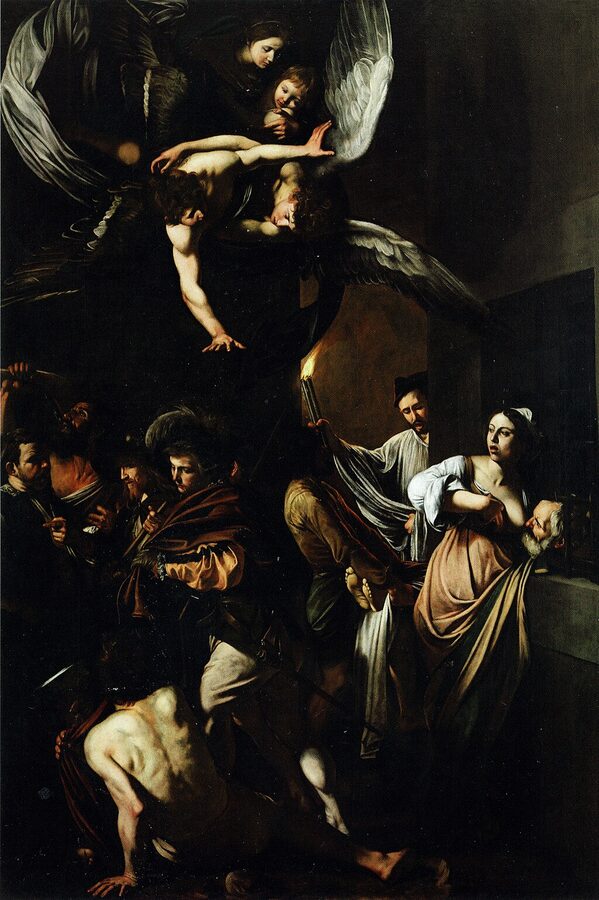
- San Gennaro & Caravaggio combined ticket ($20): if you want the saint’s full Naples story (catacombs visit plus cathedral Treasure plus the Caravaggio at Pio Monte). Book on GetYourGuide
- San Gennaro Experience with Filangieri Museum ($20): for art-museum people who’d rather pair the saint with a 19th-century private-collection palace than with a church. Book on GetYourGuide
The basic booking facts
Tickets for the Catacombs of San Gennaro start around €13 for adults. Under-18s are €6, under-6s and disabled visitors are free. Your ticket is valid for twelve months and gets you into the second Naples catacomb at San Gaudioso as well, which most people don’t realise. If you’ve got the time, do both. The Gaudioso site is smaller but has bizarre painted-skull portraits of Sanità nobles fixed into the wall, which sounds like I’m exaggerating but I’m not.
Hours are 10am to 5pm Monday to Saturday and 10am to 2pm on Sundays. Closed Wednesdays and on December 25th. That Wednesday closure catches people out. Don’t plan around it; it’s not negotiable.
Booking is in theory advisable but in practice the catacombs almost never sell out. They’re not a Colosseum. The biggest reason to book ahead is to lock in your guide-language slot, since each tour leaves with whichever guide is on duty in whichever language, and you don’t want to do an Italian-only tour if your Italian is restaurant-menu level.
How to get there from anywhere central
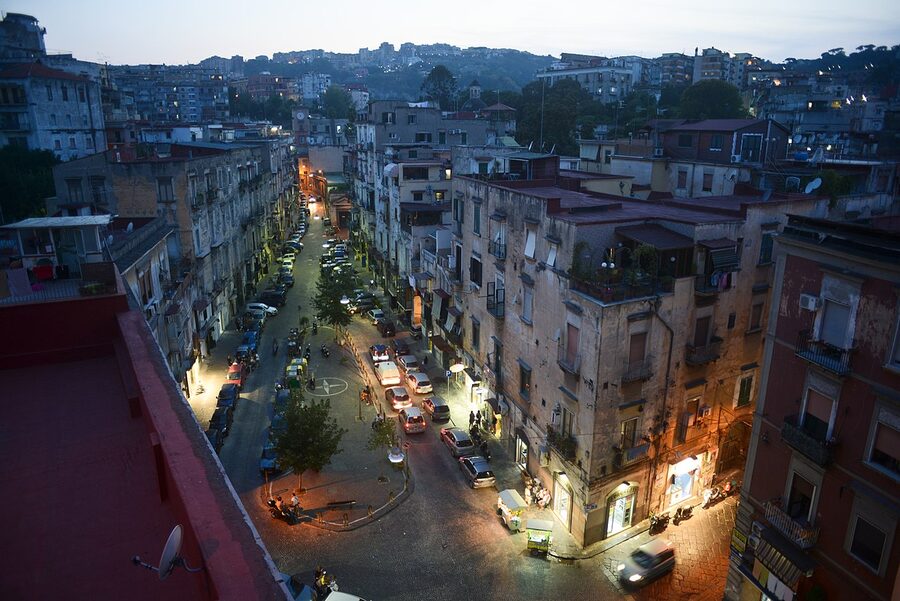
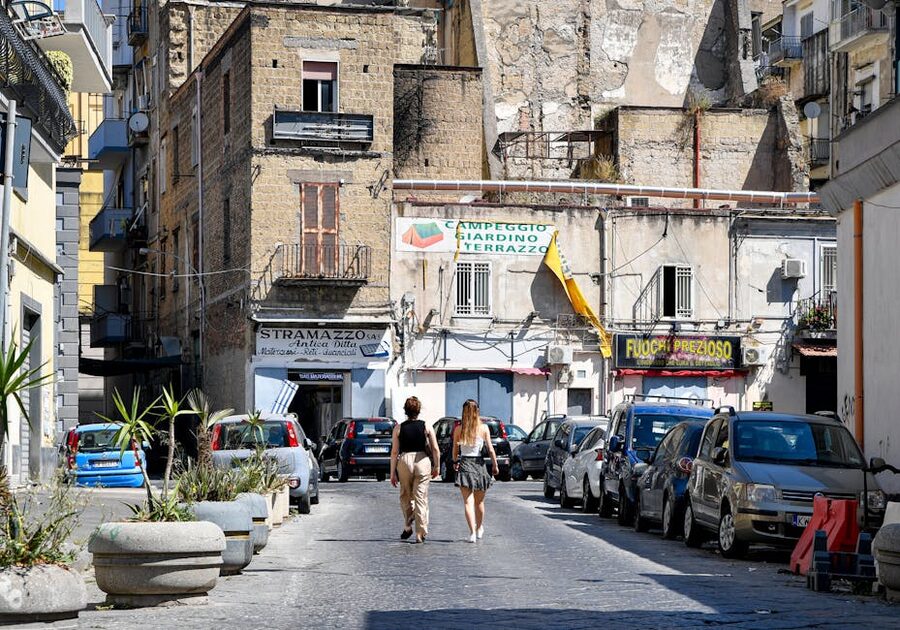
The catacombs are in the Rione Sanità, the working-class neighbourhood just north of the historic centre. Bus lines 168, 178, C63, and R4 all stop at “Basilica Incoronata – Catacombe San Gennaro”. From Piazza Dante or Piazza del Plebiscito you’re looking at about 15 minutes on the bus. A metered taxi is around €10 from most central points and skips the bus-route guesswork entirely.
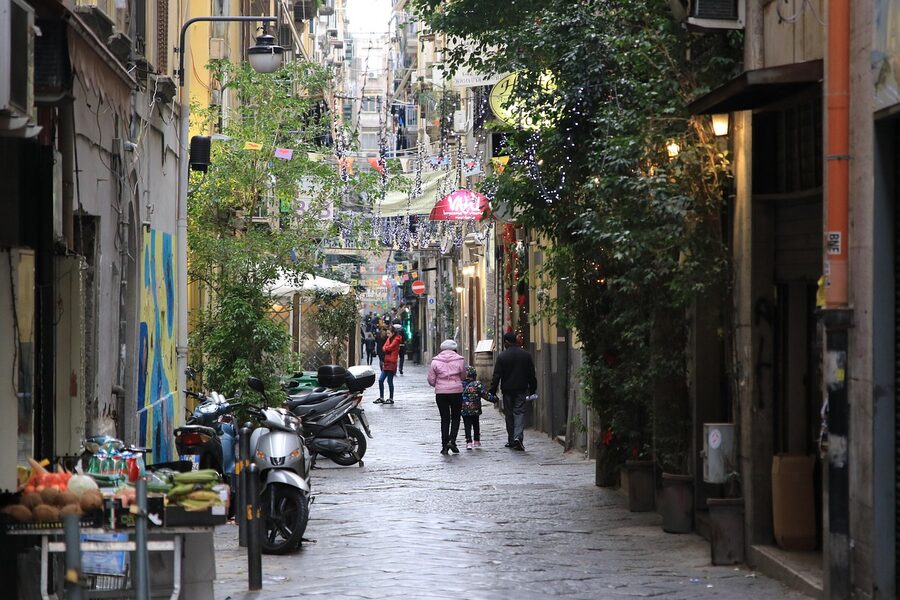
Walking is possible if you want to see the Sanità on foot, which I’d actually recommend on the way back rather than the way there. About 25 minutes downhill from the catacombs into the centre, through some of the best street-life in Naples. If you’re already arriving from the cathedral and you’ve done Naples Underground the day before, you could walk up the Sanità from below; it’s a beautiful uphill walk if your knees agree.
The official entrance is at Via Capodimonte 13. There’s free parking on site, which is unusual for Naples. If you’re driving in from Pompeii or the airport, take the Tangenziale to exit 5 (Capodimonte).
The first thing that hit me, and probably will hit you
The catacombs are huge. Not “long tunnel” huge, basilica huge.
You walk in through a vestibule from the late 2nd or 3rd century, and your guide says something casual like “OK, this room is the entrance hall,” and you realise the room is bigger than most parish churches. The ceiling is a single carved arch in the tuff, maybe seven metres up. Then you turn a corner and the space gets wider, not narrower. By the time you reach the lower basilica you’re standing in something that could seat 300 people for a service.
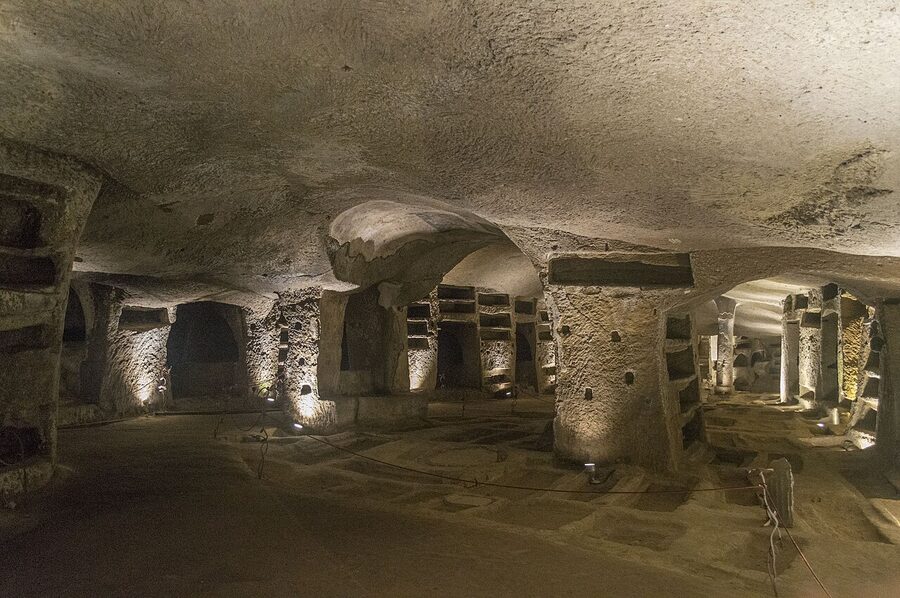
This is the thing the Rome catacombs can’t do. The Roman ones are tunnels: long, low, rough, with shelves cut into the side for bodies. Important historically and worth doing once, but the experience is fundamentally a corridor experience. You shuffle. San Gennaro lets you stand. There are real spaces, with real air, with light coming in from openings overhead because parts of the ceiling collapsed centuries ago and now sunlight cuts down into the lower level on bright afternoons.
It’s the difference between visiting a tomb and visiting a city of the dead that thought of itself as a city.
The frescoes are the actual reason to come
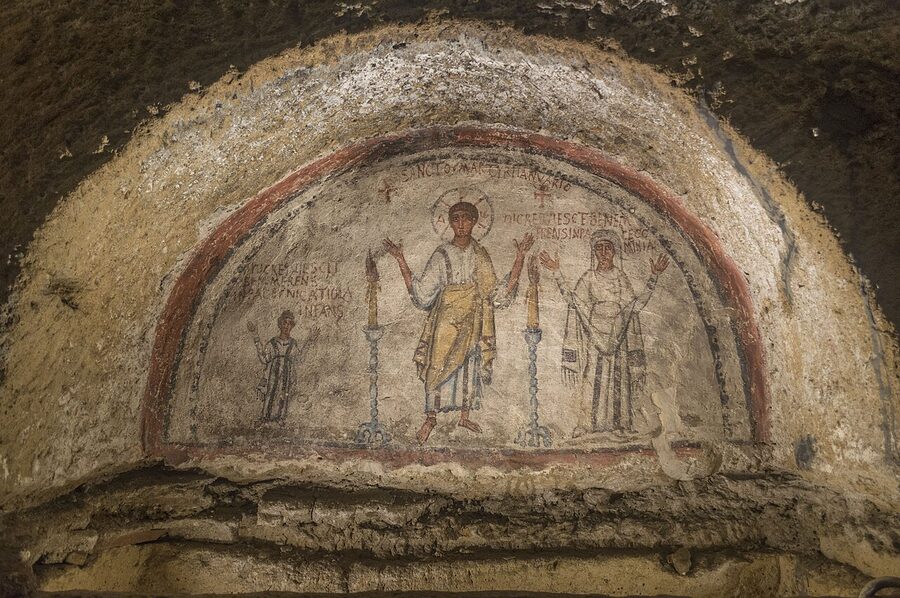
Some of these paintings are from the 4th and 5th centuries. That’s almost as old as Christian art gets.
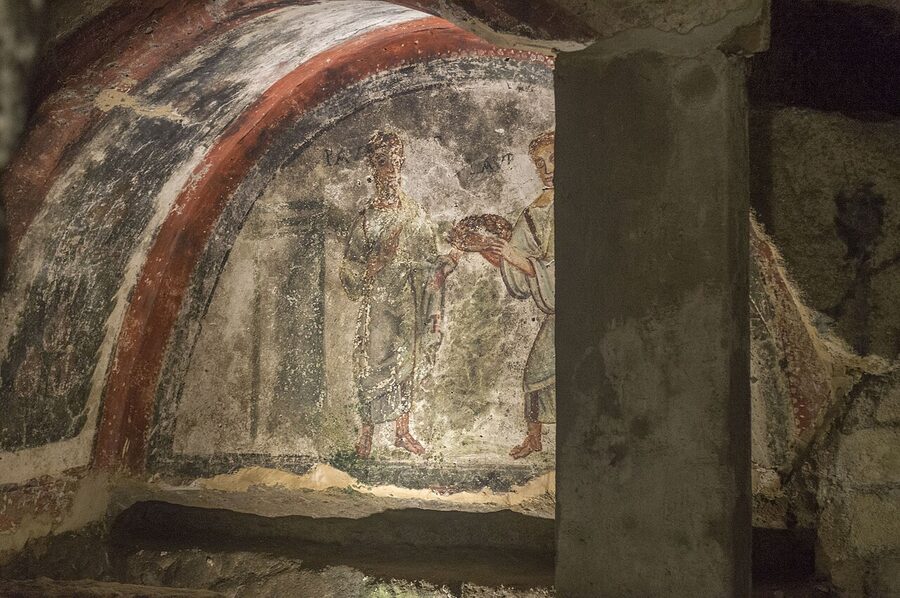
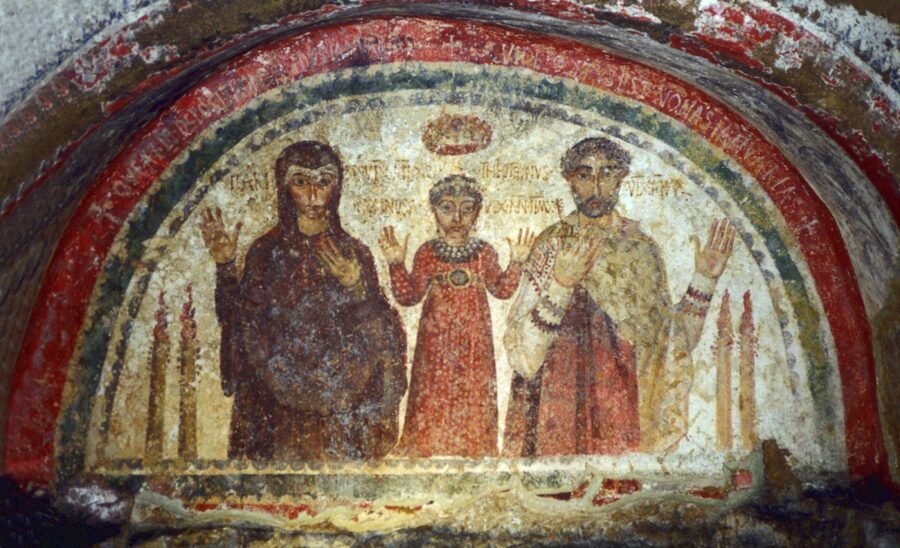
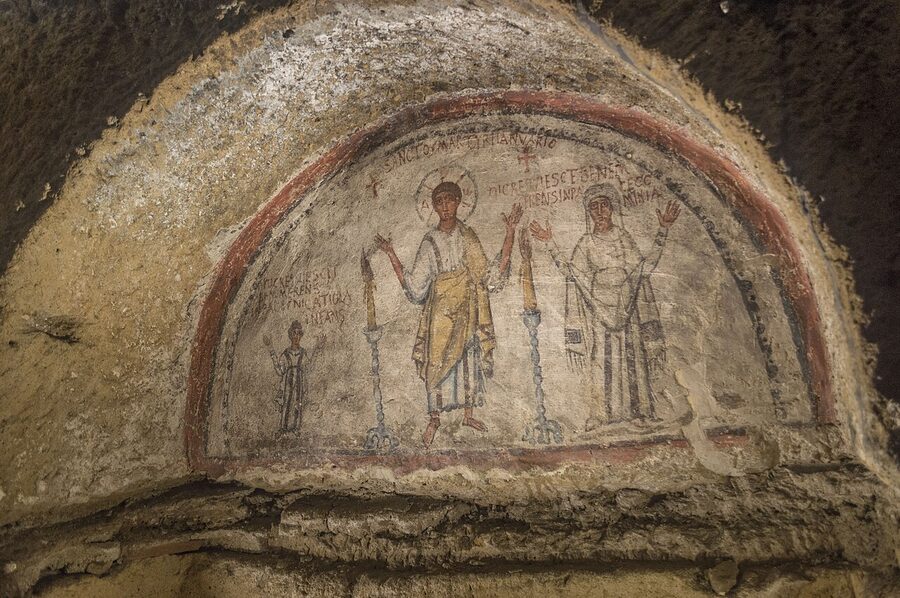
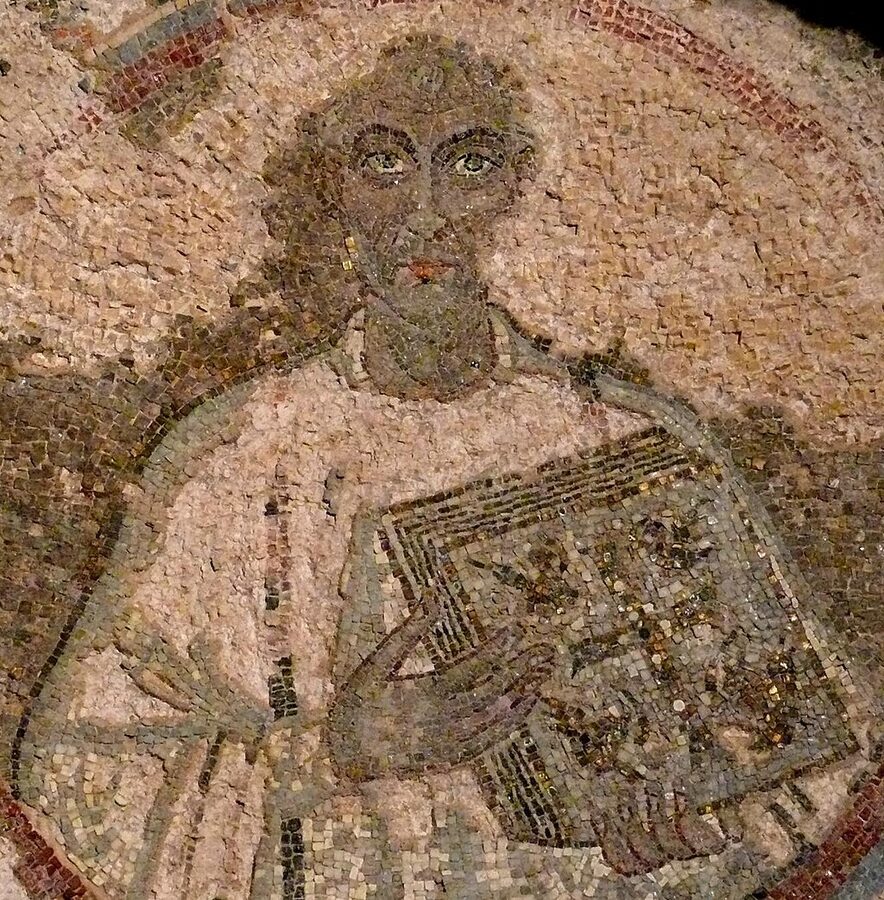
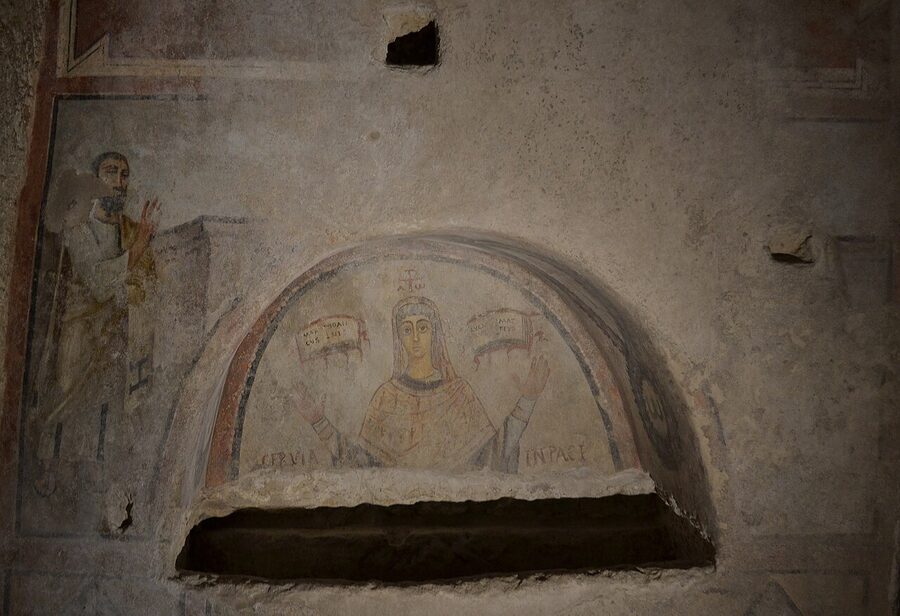
You’ll see family portraits in arcosolium tombs. A father, mother, and child painted into the curved arch of a wall niche, dressed in Byzantine cloth, the woman’s chlamys still bright red. There’s an Adam and Eve on a curve of wall in the upper catacomb, painted before the Council of Nicaea finished arguing about what divinity even meant (the same iconographic frontier you can read off the dissolved-rock interior of the Caves of Hams in Mallorca, where the paintings were added much later but the wall surface is just as old). There’s a portrait of the bishop Quodvultdeus, mosaic, 5th century, looking straight out at you with the same composed expression he wore when he wrote sermons against Pelagians.
If you’ve stood in front of the early-Christian frescoes inside St. Peter’s Vatican grottoes, the much later Byzantine work in St. Mark’s in Venice, or the Mozarabic interiors of the Mezquita in Córdoba, you’ll feel the family resemblance. But you also notice that this stuff is older than St. Mark’s and rawer than the Vatican grottoes. It’s pre-iconographic. The painters were still working out what a Christian visual vocabulary even looked like. You can see them trying things.
This is the part of the visit where I stopped looking at my phone for the time.
Who is actually running this place
Here’s the part of the story that the guidebooks tend to underplay.
The Catacombs of San Gennaro are managed by a social cooperative called La Paranza. La Paranza was founded in 2006 by a group of young people from the Sanità neighbourhood, with the help of the local parish priest, Father Antonio Loffredo. The cooperative trains kids who grew up in the Sanità as cultural guides. Your guide today, in jeans and a fleece, is most likely from this neighbourhood. They learned the catacombs the way most people learn the streets they grew up on.
This is unusual. Most of Italy’s archaeological sites are run by the state or by private concessionaires. The Vatican Museums, the Uffizi, the Borghese, even Pompeii are all state-run heritage sites with state-paid staff and contracted ticket vendors. The Catacombs of San Gennaro are different. The ticket price funds the cooperative directly, which has now created over forty jobs for young people in one of the poorest postcodes in Italy. The Sanità used to be the kind of place tourist guidebooks warned you about. La Paranza is one of the reasons the guidebooks have stopped warning you about it.
Visitor numbers went up roughly fivefold over the cooperative’s first decade. By 2019 they were doing 160,000 visitors a year across both catacombs. The recovered space underground is around 13,000 square metres.
I’m telling you this because it actually changes what the visit feels like. Your guide isn’t reading a script written in Rome. They have an opinion about which fresco is the best one. They get genuinely cross about the centuries of looting between the 1200s and the 1700s that stripped most of the marble. They make jokes about the bishop Agrippinus, who got buried here in the 3rd century and accidentally turned the place into a destination by being important. The whole visit has a tone that almost no other major Italian site has: it sounds like a person talking, not a curator narrating.
What you’ll actually walk through
The tour runs roughly 45 minutes to an hour and covers two levels.
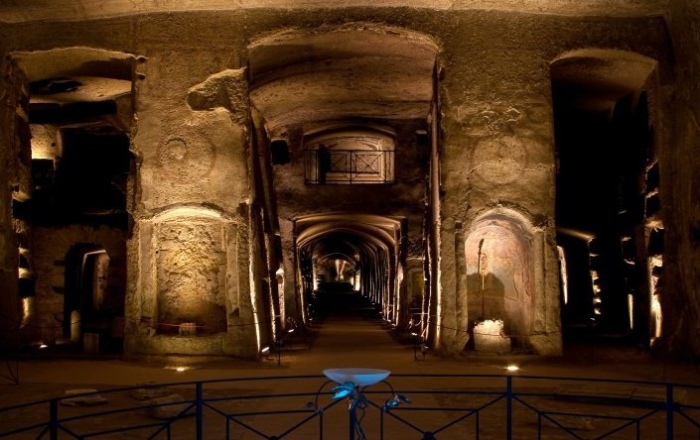
You start at the entrance just below the Basilica del Buon Consiglio, descend into the lower vestibule, and pick up the older 2nd-3rd-century burial spaces first. This is the deepest layer. Then you climb up to the upper level, which is where the basilica spaces and most of the high-quality frescoes live.
Stops your guide will probably make:
- The Crypt of the Bishops: a low chamber where most of Naples’ early bishops were buried. Mosaic portraits on the back walls. Quodvultdeus is here.
- The Basilica of Agrippinus: the chamber that grew around the tomb of the 3rd-century bishop whose burial first turned this place from a private cemetery into a pilgrimage site.
- The Adam and Eve fresco: small, faded, on a wall curve that’s easy to miss. Some of the earliest Christian narrative painting that survives anywhere.
- The Basilica Adjecta: the upper basilica with three naves, a carved tuff altar, and a baptismal font, all dug out of the rock as a single space.
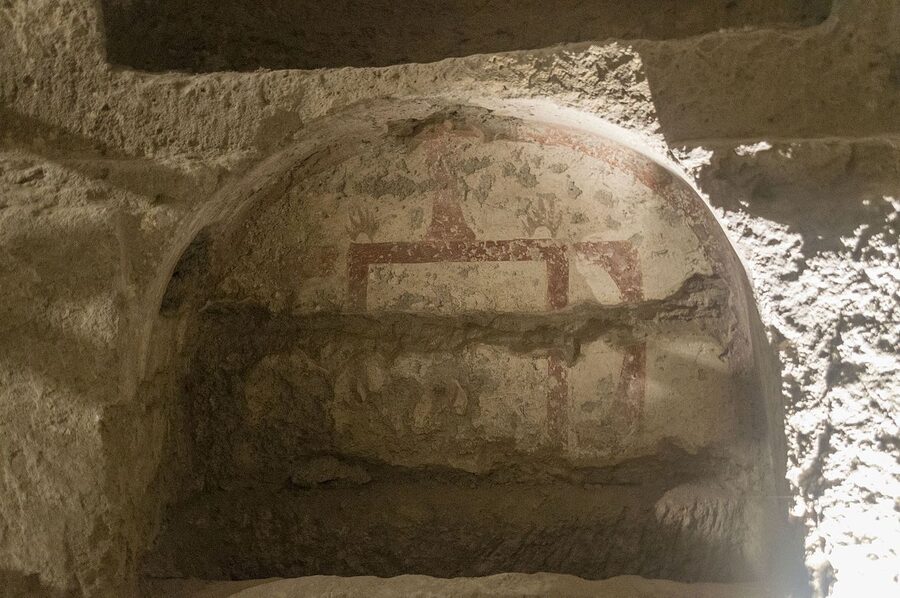
- The arcosolium tombs: the wall niches with painted family portraits of the people buried in them.
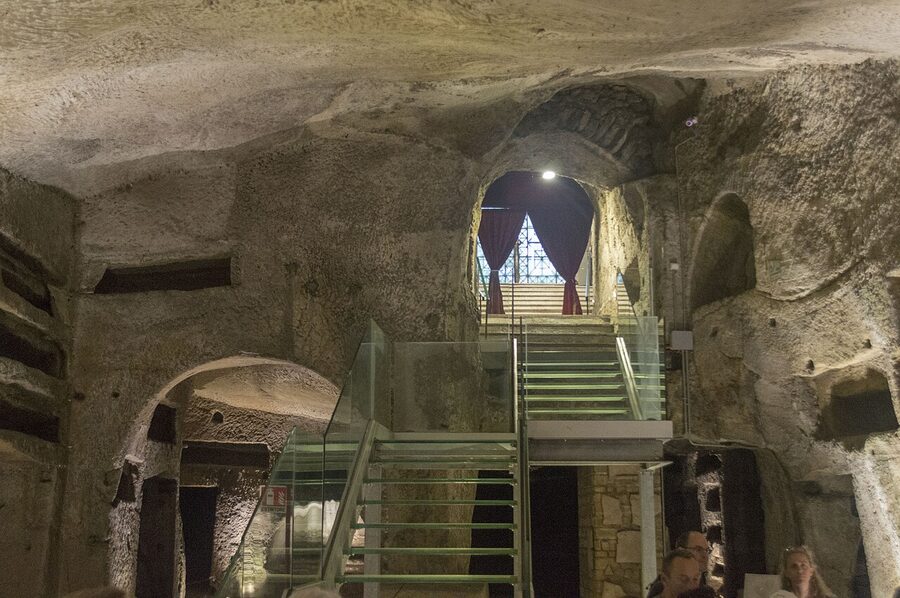
The catacombs were used during the Second World War as an air-raid shelter. People from the Sanità slept down here through the 1943 bombings, the same wartime memory layer that anchors the Anne Frank walking tour in Amsterdam. There’s no plaque about it, but ask your guide. The local memory is still active.
The fair comparison with the Rome catacombs
I’d say go to both if you’ve got the time. They’re different things.
The Rome catacombs are bigger by raw mileage. San Callisto, San Sebastiano, and Domitilla together amount to many kilometres of tunnel. They’re more famous, they’re easier to slot into a Rome itinerary, and the early Christian iconography there has more variety (the only catacomb-genre rival in Western Europe is probably Père Lachaise in Paris, which is above ground but operates on the same pilgrimage logic). Some of the very earliest Christian symbols survive on those walls.
San Gennaro wins on three things. It wins on architecture: the basilica spaces feel like rooms, not tunnels (closer in scale to the Renaissance crypt below the dome at Les Invalides in Paris than to a typical tunneled catacomb). It wins on visible painting: the lit, intact frescoes are bigger and easier to see than what survives in most of the Roman complexes. And it wins on the human side: a guide trained by a neighbourhood cooperative is a different kind of tour from a guide reading from a Vatican-approved script.
What Rome wins on: scale, name recognition, and the genuine experience of walking through a long Christian-era burial network. If you’ve only got a half-day in either city for an underground site, do whichever fits the trip you’re already on. If you’ve got the time to do both, the back-to-back comparison is one of the best ways to feel how Christianity actually arrived in Italy. Dispersed, regional, painted by local hands, before there was a Vatican telling everyone what it should look like.
The three ways to actually book
1. Catacombs of San Gennaro Entry Ticket & Guided Tour: $15
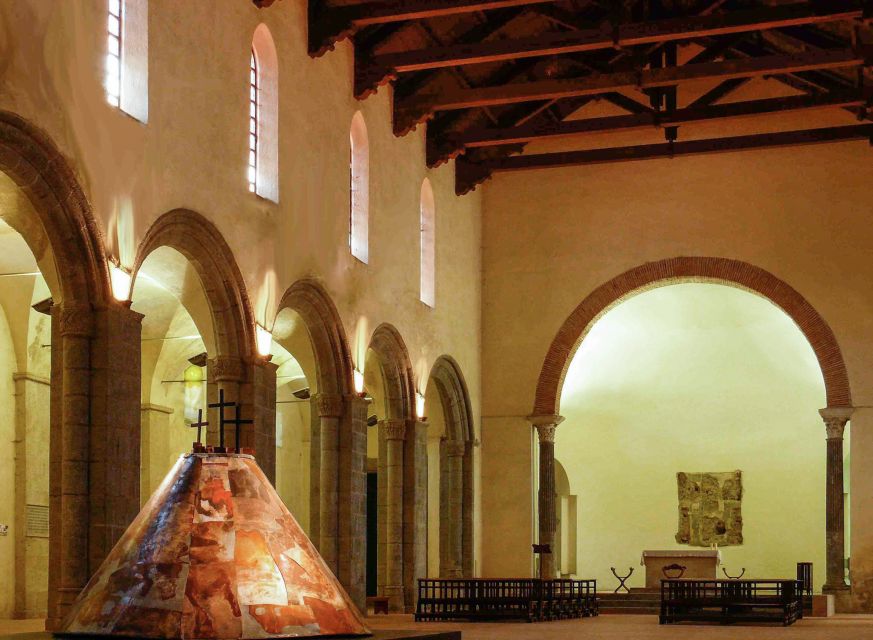
This is the flagship ticket and the one your money is best spent on. The English-and-Italian guided walk covers the Crypt of the Bishops, the basilica spaces, and the best of the frescoes; our full review goes deeper on what the guide actually shows you. Pay-later is available.
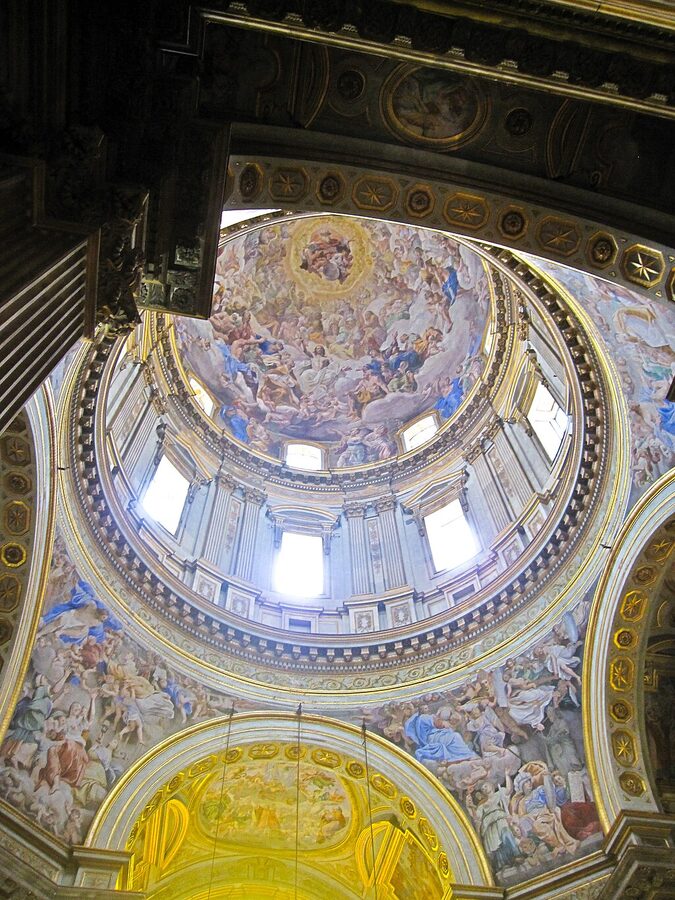
2. San Gennaro & Caravaggio Combined Ticket: $20
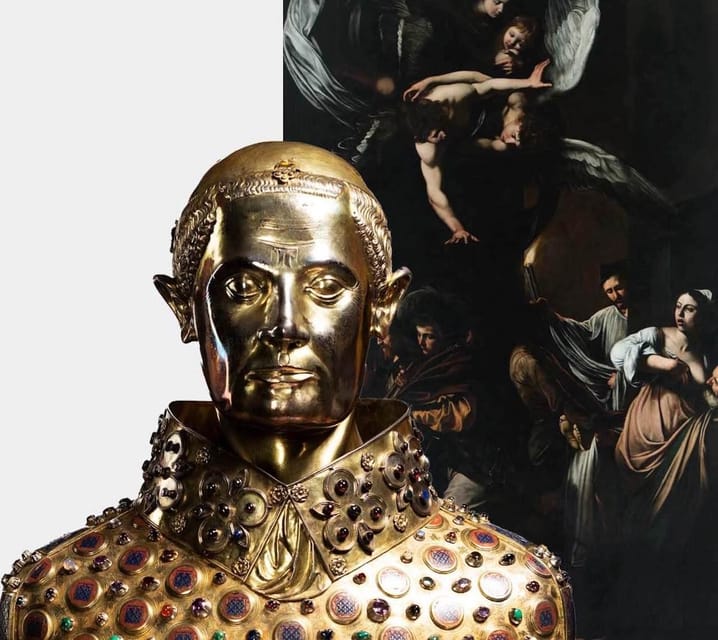
This pairs the catacombs side of the saint’s story with the cathedral chapel of San Gennaro and the Pio Monte della Misericordia, where Caravaggio’s “Seven Works of Mercy” altarpiece hangs. It’s the right pick if you’re a saint-history completist and want to see how the cult of San Gennaro lives above ground too; our review notes that the Caravaggio alone is worth the price difference.
3. San Gennaro Experience with Filangieri Museum: $20
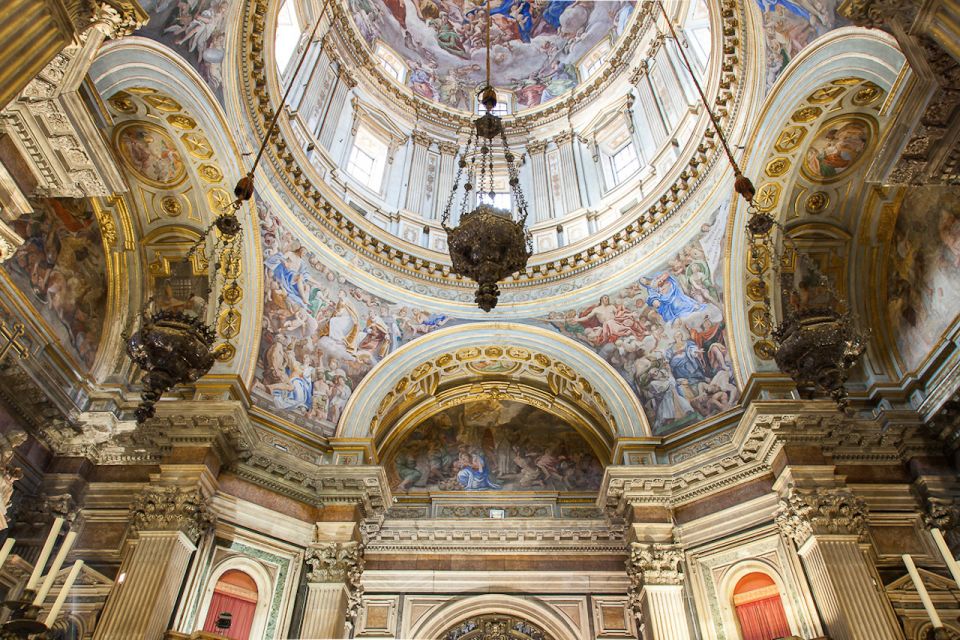
Same length as the Caravaggio combo but swaps the church for the Filangieri palace, a 19th-century aristocratic collection of arms, ceramics, and paintings; our review flags that the Filangieri occasionally closes for private events, which has burned a few bookers. The catacombs portion is the same as the flagship.
Practical notes you’ll thank me for
Wear a layer. Underground temperature sits around 15-22°C year-round, which feels cold in July and fine in March. A sweater or light jacket is enough.
Wear shoes that grip. The floors are uneven cut tuff and damp in places. Trainers or walking shoes are correct. Do not wear leather-soled dress shoes; you’ll skid.
Photography is allowed without flash. The lighting is enough for phone cameras most of the time. The frescoes do not love flash and your photos won’t look better with it.
Accessibility: San Gennaro is mostly barrier-free, with a step-free route into the upper level. There are tactile aids for visually impaired visitors and sign-language guides on request. There’s currently a hydrogeological-instability issue affecting the motor-disability access route; check the official site (catacombedinapoli.it) for the latest if you need step-free into the lower level.
How long to budget: the tour runs 45 minutes to an hour. Add 20-30 minutes if you want to walk around the Sanità afterwards, which you should.
Where to put this in your Naples trip
San Gennaro pairs naturally with whatever else you’re doing underground in Naples. The city has three different underground experiences, and they’re not interchangeable.
If your itinerary already includes Naples Underground (Napoli Sotterranea), you’ve seen the Greek-Roman aqueduct system and the WWII shelters that ran in the cisterns under the historic centre. That’s a different scale and a different story; you’re walking through what used to be the city’s water supply, not through tombs. The two complement each other rather than overlapping. I’d do San Gennaro on a different morning.
If you’re considering the Spanish Quarters underground, that’s the third of the three, and again different. The Spanish Quarters tour deals with WWII shelters and modern underground neighbourhood life rather than ancient burial. Three undergrounds, three different things; do as many as you have time for and don’t worry about repetition.
If you’re spending a day on Pompeii and you want a full Bay-of-Naples archaeological week, the catacombs slot easily into a half-day before or after. You can do morning catacombs, lunch in the Sanità, and afternoon Pompeii by Circumvesuviana train without rushing.
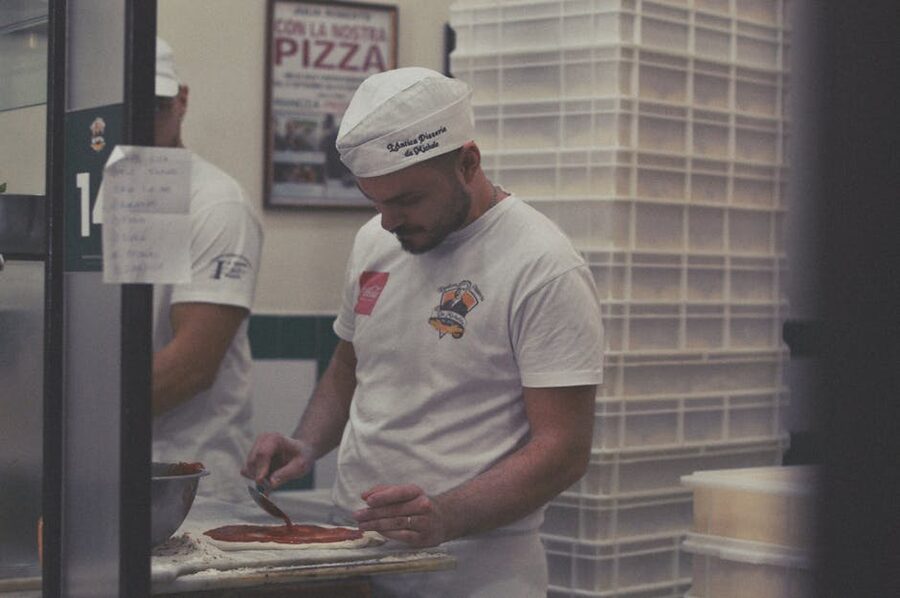
And if you’re working your way through pizza on this trip, the Sanità is one of the best neighbourhoods to eat in. Pizzeria Concettina ai Tre Santi is a fifteen-minute walk from the catacombs entrance and is one of the best pizzas in Naples. That’s a useful pairing.
So why bother, finally
Because the visit is small enough to do in an hour and big enough to actually change what you think Italian Christianity looked like before it became Roman Catholic. Because the frescoes are old enough that they were painted before the religion had decided what it looked like. Because the people running it grew up two streets over and have a stake in the answer.
That’s the actual reason San Gennaro beats the better-known option. Not bigger, not flashier, not older necessarily. Just specific, and honest, and run by people who care.
If you want to widen the trip out, the obvious next stops are Napoli Sotterranea for a totally different underground story and Pompeii for the open-air version of “Italian people frozen in their own century.” If you want the cathedral counterpart to the catacombs, the San Gennaro & Caravaggio combo above will get you there. And if you’ve still got an evening free, walk back through the Sanità at golden hour, find a pizzeria, sit outside.