
The most-visited grave in the most-visited cemetery in the world has nothing carved on it that anyone bothers to read. Jim Morrison’s plot in division 6 is a low rectangle of stone, no bust, no flourish, and on most mornings it sits behind a discreet metal barrier that the cemetery added years ago to slow the foot traffic. People still come anyway. They write notes on chewing-gum wrappers and stick them to the nearest tree. They leave little bottles, dried roses, the occasional joint. The bust that used to be on the headstone was stolen in 1988 and never replaced. None of that has dimmed the pilgrimage by even a little.
Pere Lachaise sees about 3.5 million visitors a year across 110 acres and roughly a million burials since it opened in 1804. That makes it the most-visited cemetery on earth, ahead of Arlington and ahead of any of the great Catholic graveyards of southern Europe. And yet most of those visitors come for maybe ten famous tombs out of seventy thousand. The rest of the cemetery is quieter than you’d expect, which is part of why it’s worth a morning of your time on a Paris trip that can otherwise become a queue between attractions.
In a Hurry
Best small-group tour ($23): A focused three-hour walk that hits the headline names without rushing. Check availability
Best for atmosphere ($25): The haunted-themed two-hour tour. Same ground, more legends, slightly later starts. Check availability
Cheapest famous-graves walk ($15): Two hours, no frills, hits the icons. Check availability
Why this cemetery exists at all
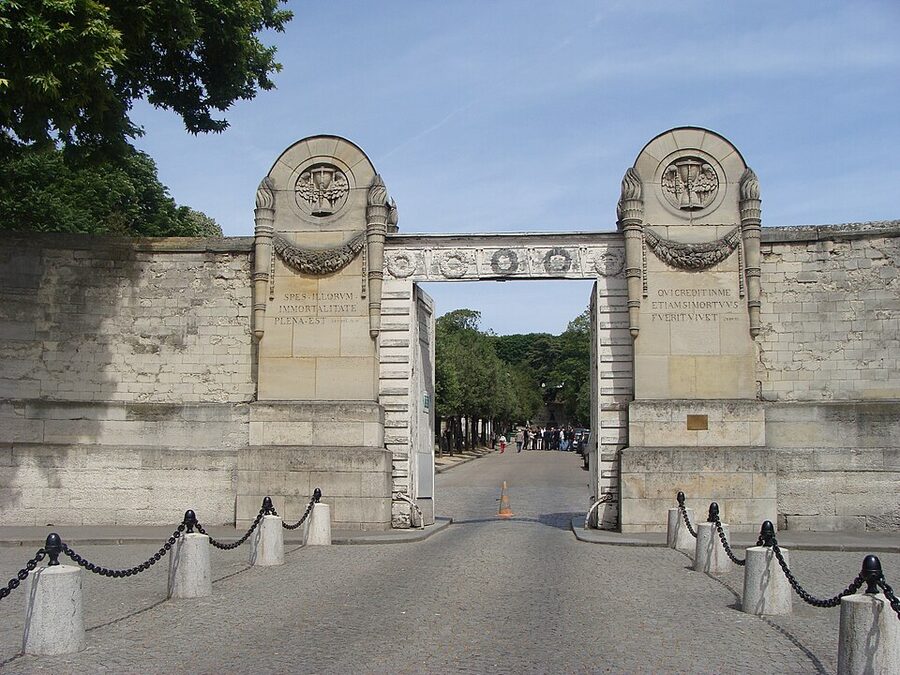
Before 1804 the dead of Paris were buried inside the city, in churchyards that had been filling up for eight or nine centuries. By the late 1700s the situation was a public-health emergency. Wells turned brown. Walls of mass graves collapsed into wine cellars on rue de la Lingerie. The smell carried. Napoleon, never one to leave a problem to a committee, signed a decree on 12 June 1804 that pushed all new burials outside the city limits and authorised four new cemeteries on the outskirts. Pere Lachaise was the easternmost of them, on a hill above what was then the village of Charonne.
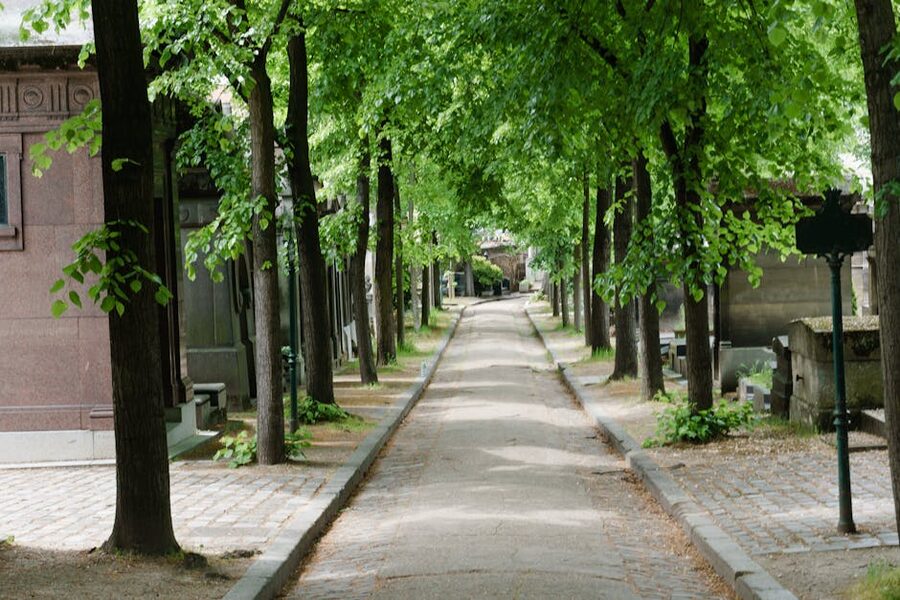
The decree did one other thing that turned out to matter much more than the public-health argument. It made these new cemeteries strictly secular. No religious tests, no separate sections for non-Catholics, no priest’s permission required to be buried here. That was new in France. The big Catholic cemeteries that Pere Lachaise was meant to replace had been refusing burial to Protestants, Jews, actors, suicides, and people who had died excommunicated, for centuries. The new system simply set those rules aside. If you have ever wondered why the city’s intellectual and cultural elite of the 19th century are all in one place, that’s why. They could be.
If you want the religious-and-state-sanctioned version of the same idea, that’s the Pantheon over on the Left Bank, where the great men of the Republic get a national mausoleum. Pere Lachaise is the secular bourgeois cousin. The Pantheon has Voltaire and Rousseau on a grand colonnaded floor under a dome. Pere Lachaise has Wilde and Morrison up a muddy lane in division 6 and 89. Both feel essentially Parisian. Neither would feel right in the other’s role.
The Molière effect, 1817
For its first thirteen years Pere Lachaise was a flop. The site was on a hill out beyond the city walls, the new cemetery felt suburban and irrelevant, and bourgeois families weren’t keen to bury their dead so far from town. Of the first 110 acres, fewer than a hundred plots had sold by 1815. The city was about to declare the experiment a failure.
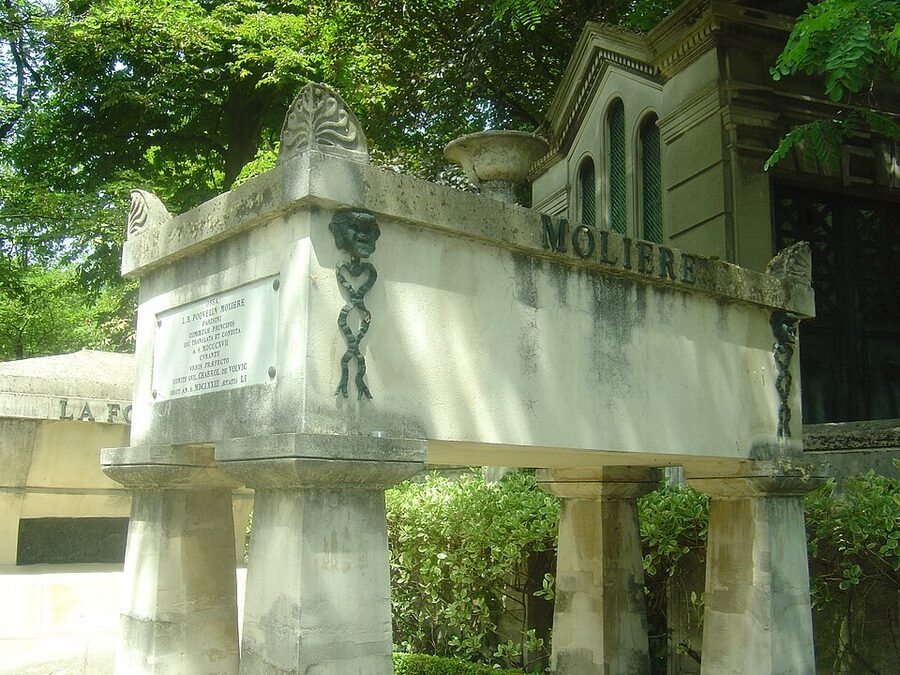
So the prefect did something clever. In 1817 the bones of Molière and Jean de La Fontaine were transferred from their original burial sites to Pere Lachaise, with great public ceremony. Molière had died in 1673, La Fontaine in 1695. Their actual remains were of dubious provenance by then. It didn’t matter. The transfer signalled that Pere Lachaise was where prestigious people went, and within a decade the bourgeois families of Paris were paying premium rates to buy plots on the same hill. By 1830 the cemetery was the place to be buried. By 1850 it was full.
That sequence, an unglamorous suburban cemetery rebranded by a celebrity transfer, is unique to Pere Lachaise. It’s why almost every important cultural figure of 19th-century France ended up here while their political and military counterparts went to Les Invalides or the Pantheon. Different cemeteries, different sorting logic. Napoleon’s body is at Les Invalides. The composers, novelists, and actresses Napoleon’s reforms made room for ended up at Pere Lachaise.
Where Jim Morrison actually is
Division 6, north-east of the chapel, about a ten-minute walk from the main entrance. The grave is signposted in a way most others aren’t, and on the cemetery map you’ll see a small icon for it. There’s almost always someone standing in front of it. On a typical morning you’ll see two or three people in their fifties and sixties, often visiting alone, and a steady trickle of younger fans on the Doors pilgrimage circuit.
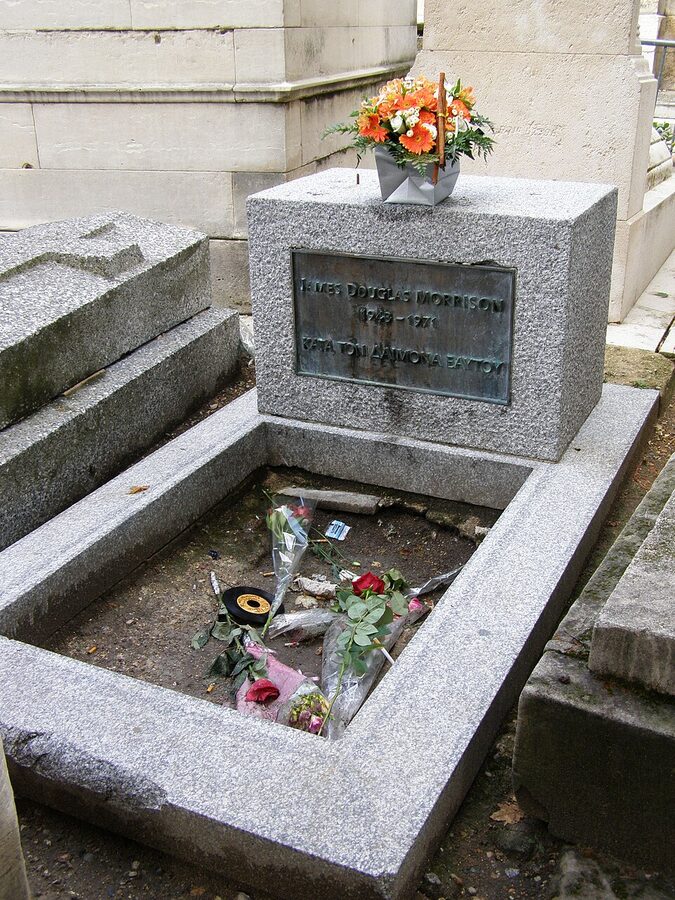
The history is grim and worth knowing. Morrison died on 3 July 1971 in the bathtub of his apartment at 17 rue Beautreillis in the Marais, age 27. The official cause was heart failure. He was buried four days later in the cheapest plot the family could arrange, division 6, with a simple wooden marker. The headstone you see today was placed by his father in 1990, after years of complaints about the state of the original. The Greek inscription is a careful sentence: “true to his own spirit”, which is more or less how Morrison’s family preferred to remember him.
Pamela Courson, his girlfriend, isn’t buried with him. She died in 1974 of a heroin overdose in California, where she successfully claimed common-law-wife status and was buried under the surname Morrison in Fairhaven Cemetery. The Doors mythology often confuses this. The grave at Pere Lachaise is Jim’s alone.
If you have done the Moulin Rouge cabaret circuit on this trip and have a fondness for the rock-as-pilgrimage tradition, this is the Paris version. Toulouse-Lautrec, who painted the original Moulin Rouge dancers, is buried at Verdelais near Bordeaux, not here. But the cancan dancers themselves often ended up in Pere Lachaise’s lower divisions, in unmarked group graves paid for by their families.
Oscar Wilde’s tomb and the lipstick problem
Division 89, on the eastern edge of the cemetery. About a fifteen-minute walk from the main gate, uphill. Worth pacing yourself for, this is genuinely the great piece of cemetery art on the site.
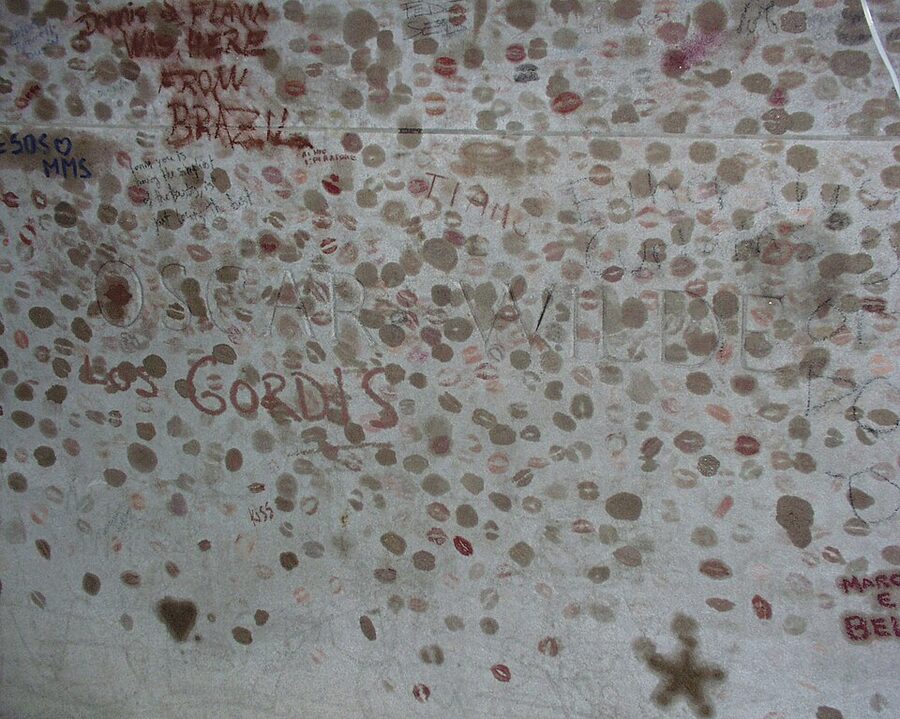
Wilde died on 30 November 1900 in a cheap hotel on rue des Beaux-Arts on the Left Bank, three years after his release from Reading Gaol, and was originally buried in a much smaller plot in Bagneux Cemetery on the city outskirts. In 1909 his estate raised the money to move him to Pere Lachaise. They commissioned a young British sculptor, Jacob Epstein, to design a monument. Epstein delivered a winged sphinx, modernist for its time, with a complicated set of references to Wilde’s ballad about Reading Gaol. The French government refused to allow it on display until Epstein removed the sphinx’s modesty, which had been carved at scale. He refused. The argument went on for two years until a compromise was reached: a bronze butterfly fixed to the sphinx’s groin. The original sphinx is intact, the butterfly was stolen in the 1960s, and the sphinx has been castrated at some point since by an unknown vandal.
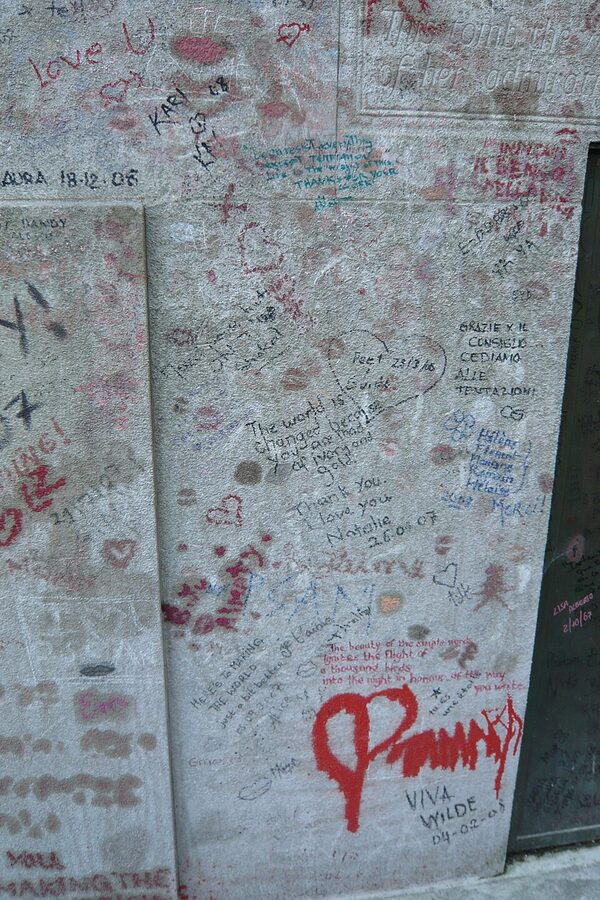
The lipstick tradition is more recent. From about the 1990s, fans, mostly women, mostly young, started kissing the tomb after applying fresh lipstick. By the 2000s the entire base was layered with overlapping lipstick prints. Conservators figured out around 2008 that the chemicals in modern lipstick were eating into the soft limestone faster than centuries of weathering, and in 2011 the cemetery installed a glass panel around the lower half of the tomb. People kiss the glass now. The cleaners come once a week with isopropyl alcohol and a roller.
You’ll often see fresh lipstick on the glass and a few notes pushed underneath. The glass solved the conservation problem, it didn’t change the ritual. Wilde would probably have appreciated that.
Chopin, in division 11
About six minutes’ walk uphill from the main gate. Division 11 is one of the older sections, with the densest cluster of significant graves anywhere in the cemetery, and Chopin’s is right at the upper edge.
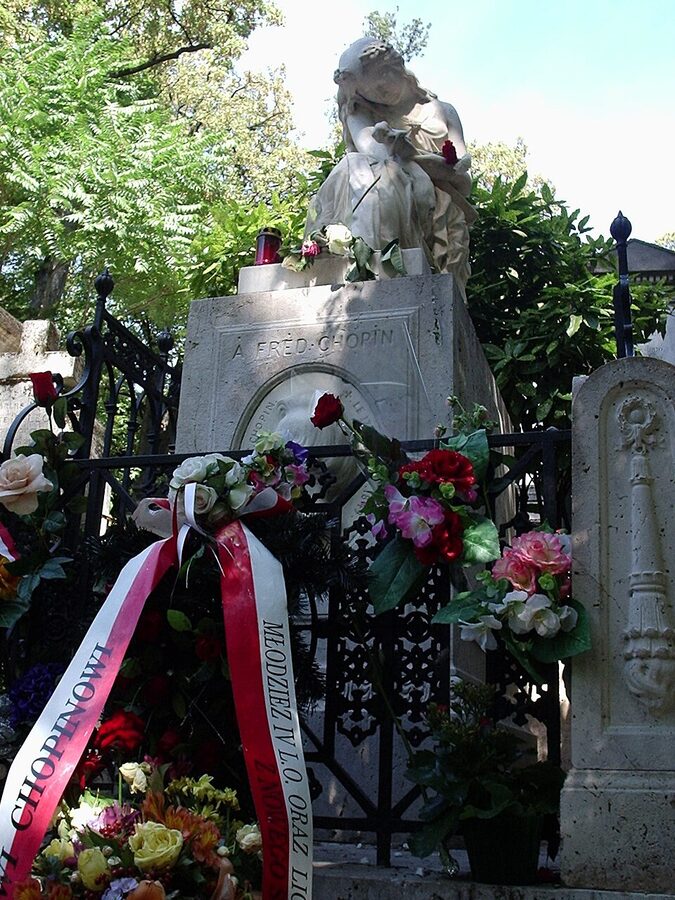
Chopin died on 17 October 1849 of tuberculosis at his apartment on Place Vendome, age 39. He had asked, on his deathbed, for his heart to be removed and returned to his native Warsaw. His sister Ludwika smuggled it back through Russian-controlled Poland in a jar of cognac, sealed in alcohol, and the heart now rests in a pillar of the Holy Cross Church in Warsaw. Just the heart. The rest of him is here in division 11.
The weeping muse on the headstone is the muse of music, Euterpe, holding a broken lyre. The sculptor was Auguste Clesinger, Chopin’s brother-in-law, and the same man who carved the slightly scandalous reclining nude that caused a small fuss at the 1847 Paris Salon. The grave is usually decorated with fresh flowers from Polish visitors, often arranged in white-and-red ribbon to match the Polish flag, and on 1 November (All Saints, the French day for visiting graves) the area in front of it fills up with candles. If you’re in Paris on that date and you’ve already done the Orsay’s 19th-century rooms, the cemetery’s All Saints’ Day visit is a clean continuation of the same period.
One footnote you may not see in the standard tour. George Sand, Chopin’s lover for nine years and the most famous woman novelist in 19th-century France, isn’t buried with him. She’s at her family estate at Nohant in central France. They had broken up two years before he died, and her family arranged a burial closer to home. The relationship had been complicated even by 19th-century standards.
Edith Piaf and the funeral that paralysed Paris
Division 97, on the south-east edge of the cemetery. About fifteen minutes’ walk from the main entrance, downhill toward the Gambetta gate.
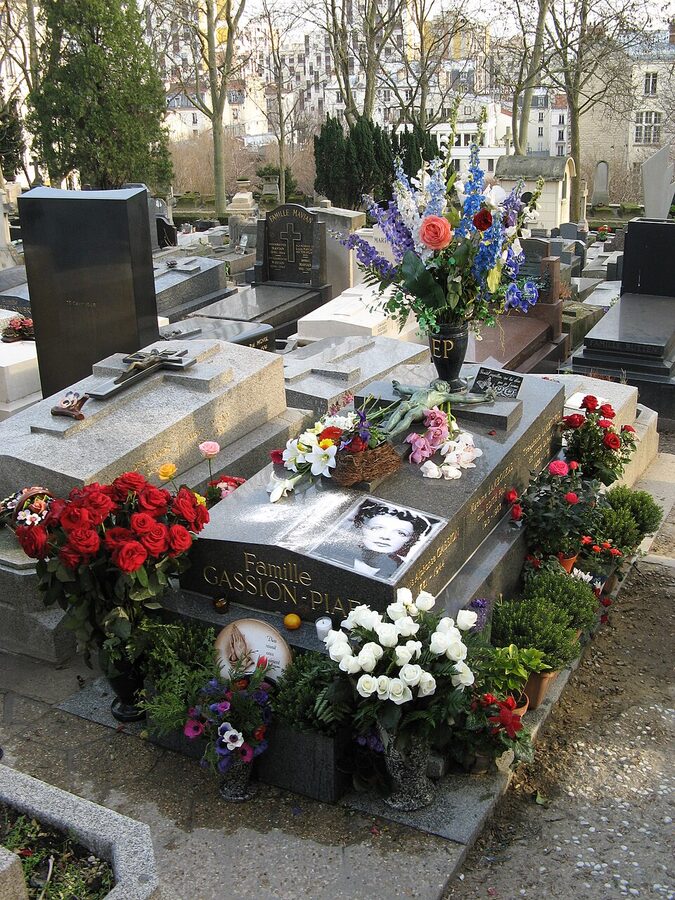
Piaf died on 10 October 1963 in Plascassier on the Riviera, age 47, but her body was secretly driven back to Paris overnight so that the press could be told she had died at her apartment in the city. The Catholic church refused her a religious funeral, citing her chaotic personal life. About 100,000 people came to Pere Lachaise on the day of the burial anyway. The streets around the cemetery were closed. Traffic across the eastern arrondissements was at a standstill for most of the afternoon. It remains the largest public funeral in Paris of the 20th century outside formal state events.
The grave you see is shared with three other Gassions, Piaf’s father Louis-Alphonse, her daughter Marcelle who died of meningitis at age two, and her second husband Theo Sarapo. The simple black stone with gilt letters is what she had asked for. There’s almost always at least one fresh bouquet, and visitors leave handwritten notes weighted down with small stones, often quoting lyrics. The most popular note text is “non, je ne regrette rien”, which everyone knows. The second most common is “la vie en rose”.
If you have spent any time on the great spectacle traditions of Italy, the Piaf grave reads as a French equivalent. Same idea, different aesthetic. Both speak to the way 20th-century European public life mythologised its great female performers.
Marcel Proust, division 85
Maybe a fourteen-minute walk from the main gate, in a less-visited corner of the cemetery. Worth the walk. The grave itself is a plain black-marble slab with no decoration, which is unexpectedly perfect.
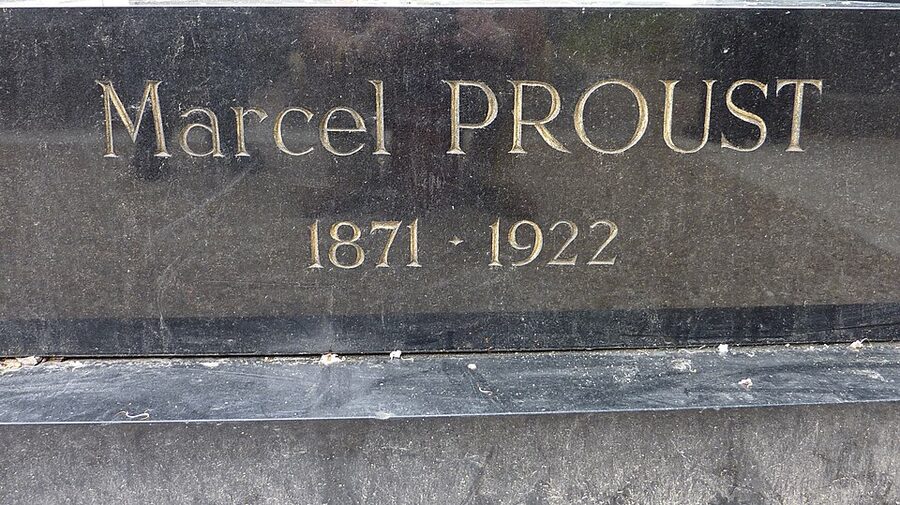
Proust died on 18 November 1922 of pneumonia at his apartment on rue Hamelin, age 51. He had finished the seven-volume In Search of Lost Time only the year before, the last three volumes published posthumously. The grave was paid for by his brother Robert, a successful surgeon, and the modest design was Proust’s own request. Visitors usually leave a single madeleine on the slab. Sometimes a coffee cup. Sometimes a handwritten line from the novel, often the famous madeleine passage. The cemetery staff clear the food once a week. The notes are left to weather.
Honore de Balzac, division 48
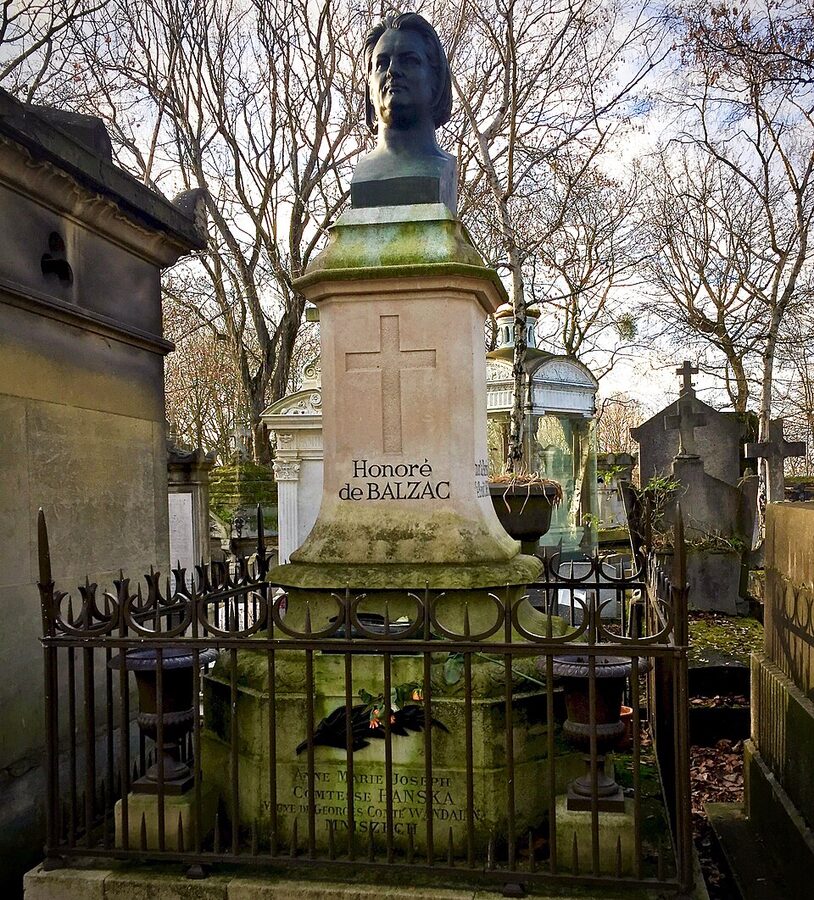
Balzac died in August 1850, five months after finally marrying the Polish countess he had been chasing for sixteen years. He wrote 91 novels in twenty years, mostly fuelled by sustained black coffee at a rate that would alarm any modern doctor. The story most often told is that he died of caffeine poisoning, which is medically vague but more or less correct, his digestive system was wrecked.
His funeral oration was given by Victor Hugo, who walked behind the coffin from the city centre to the cemetery in pouring rain and delivered a eulogy that’s still one of the great pieces of 19th-century French oratory. “The author of this immense and strange work was, without knowing it, of the strong race of revolutionary writers,” Hugo said. The grave itself is unremarkable. The bronze bust on top is by David d’Angers, a contemporary and friend. If you’ve spent the morning at the Louvre’s 19th-century French paintings rooms, you’ll have seen David d’Angers’ work in passing without really registering it.
Sarah Bernhardt and the actresses’ corner
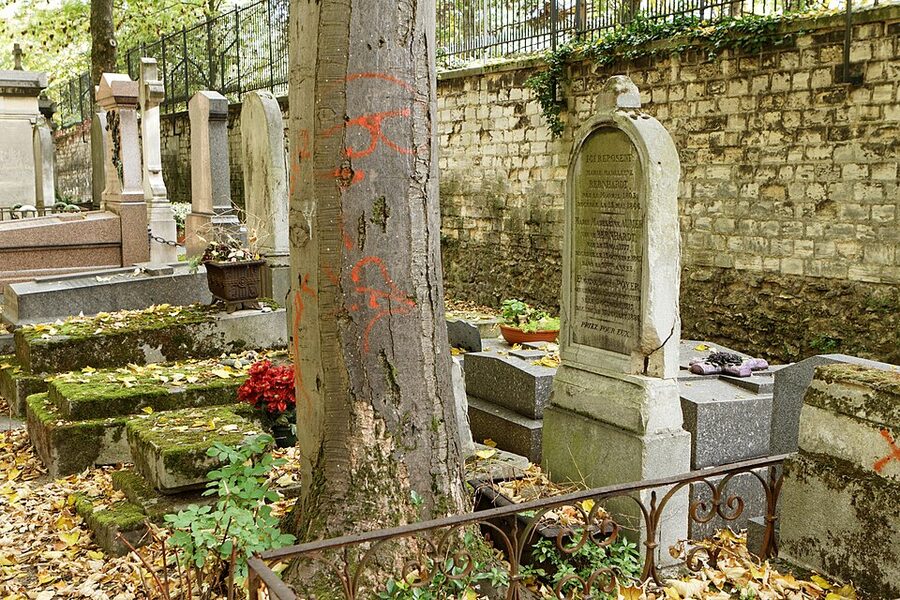
Bernhardt died on 26 March 1923 at age 78, having performed continuously into her seventies despite an amputated leg, the most internationally famous actress of the 19th century. The funeral procession from her apartment to Pere Lachaise drew the largest crowd in the cemetery’s history, even bigger than Piaf’s forty years later. The grave is in division 44 and is plain to the point of austerity, just her stage name and her dates, no inscription, no statue. She had insisted on simplicity. The flamboyance she gave to her performances she didn’t want on her grave.
Yves Montand and Simone Signoret share the same division. Montand died in 1991, Signoret in 1985, and they’re buried together with Catherine Allegret, Signoret’s daughter, in a quiet family plot. If you remember the great French cinema of the 1950s and 60s at all, this is where its leading couple ended up.
The Communards Wall
Division 76, far south-east corner. About eighteen minutes from the main gate, downhill, then sharp uphill at the end. The wall itself is an outer cemetery wall, perfectly ordinary stone, with a plaque about a metre and a half high.
This is the political pilgrimage on the site, separate from the celebrity-grave circuit. On 28 May 1871, after a week of street fighting that ended the Paris Commune, government troops cornered the last 147 Communard fighters here in the cemetery. They were lined up against this wall and shot. The bodies were dumped in a trench in front of it. The Commune had lasted 72 days.
The plaque was added in 1908 after years of campaigning by the French left, and the wall has been the focus of an annual march on the last Sunday in May ever since. The march brings between 10,000 and 30,000 people in normal years. The bullet marks in the wall, if you look closely, are still visible at adult-shoulder height. Most tour guides skip this if their group is on a tight schedule. It’s the part of the cemetery that asks you to think hardest about what the secular-republican Pere Lachaise actually means, more than the Wilde sphinx or the Piaf grave do. The Amsterdam parallel for this kind of working-out-loud history is the Anne Frank walking tour: a different war, a different century, the same insistence that a city’s tourist circuit run through the wall against which something terrible happened.
Modigliani and the suicide that wasn’t allowed
Division 97, near Piaf’s plot. Amedeo Modigliani, the Italian-Jewish painter who lived and worked in Paris from 1906, died on 24 January 1920 at age 35 of tubercular meningitis. His common-law wife, Jeanne Hebuterne, was eight months pregnant with their second child. She killed herself the next day by jumping from her parents’ fifth-floor apartment window. She was 21.
The Hebuterne family, observant Catholics, refused to allow her to be buried with Modigliani. They held her body for ten years. In 1930, after sustained pressure from Modigliani’s brother and most of Montparnasse’s surviving artists, they finally relented and Jeanne was moved to division 97 to lie next to him. The plaque reads “Devoted companion to the very edge of sacrifice”, which is what Modigliani’s brother had insisted on. It’s one of the more tragic stories in the cemetery, and worth knowing if you’ve already done the Orangerie’s small Modigliani holdings or seen the much larger collection at the Pompidou.
Funerary art you’ll see along the way
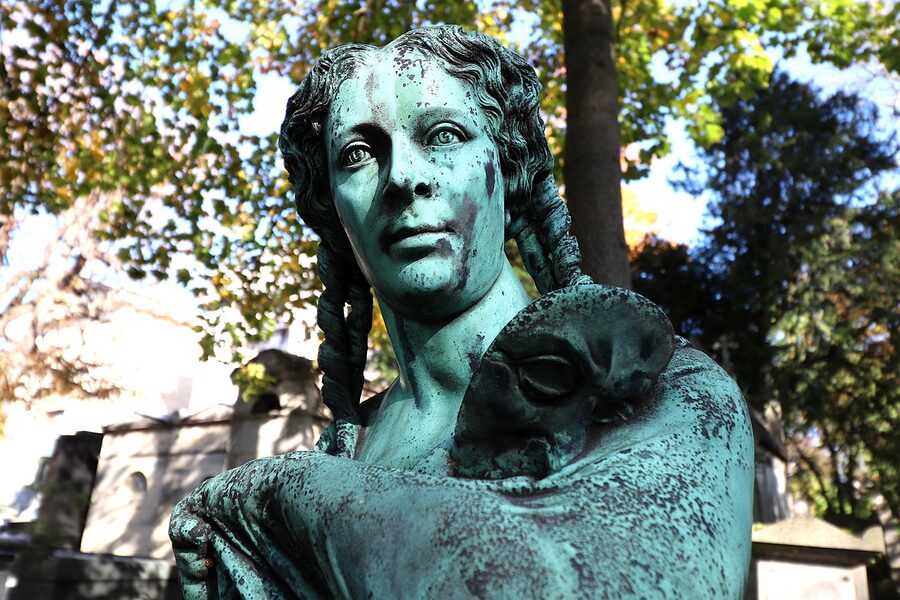
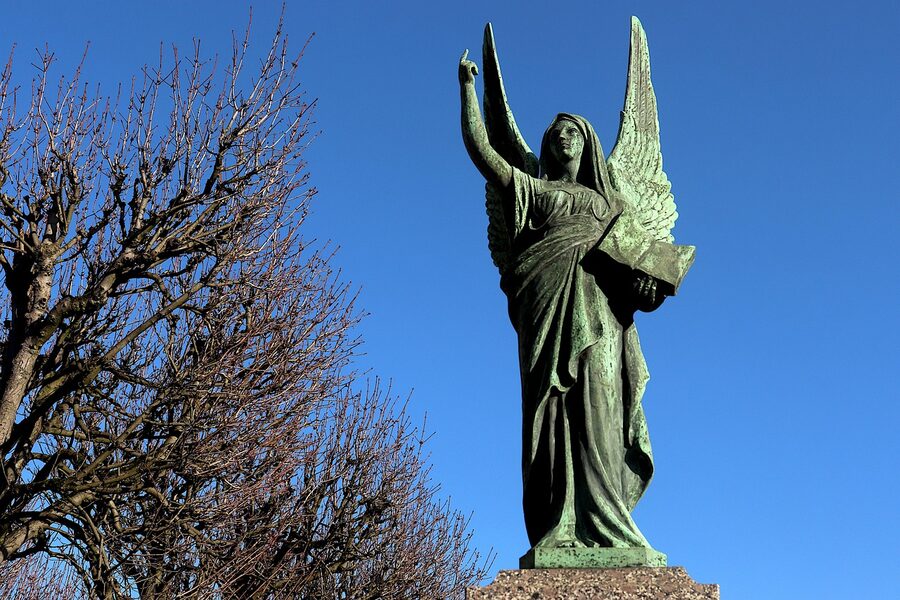
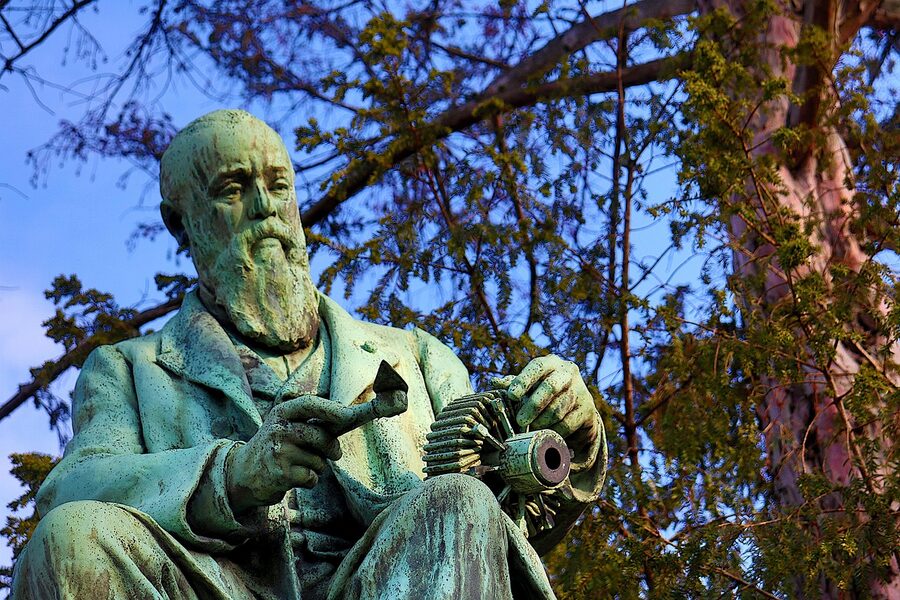
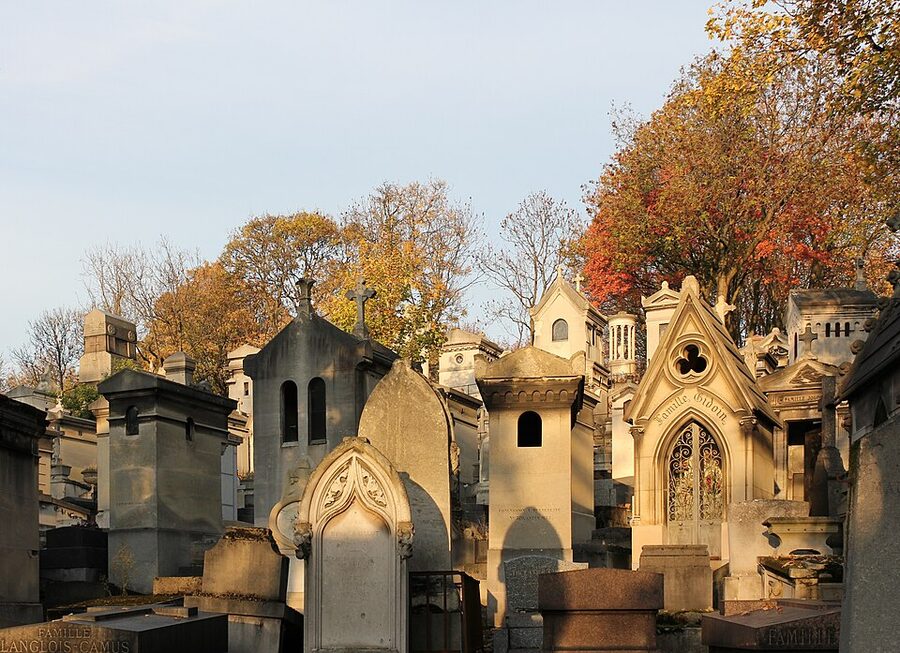
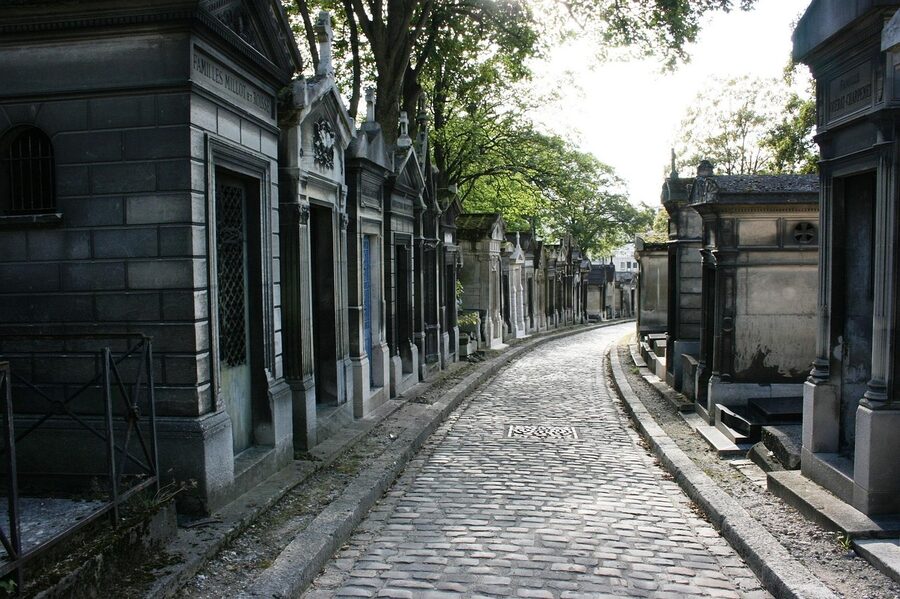
Walking between the headline graves you’ll cross several thousand other monuments, most of them 19th and early-20th century, in styles ranging from Gothic Revival mausoleums to Art Nouveau bronzes to severe 1930s modernism. This is genuinely one of the best places in Europe to look at funerary sculpture, and it’s free. You don’t pay to enter, so the open-air sculpture museum aspect of Pere Lachaise costs nothing.
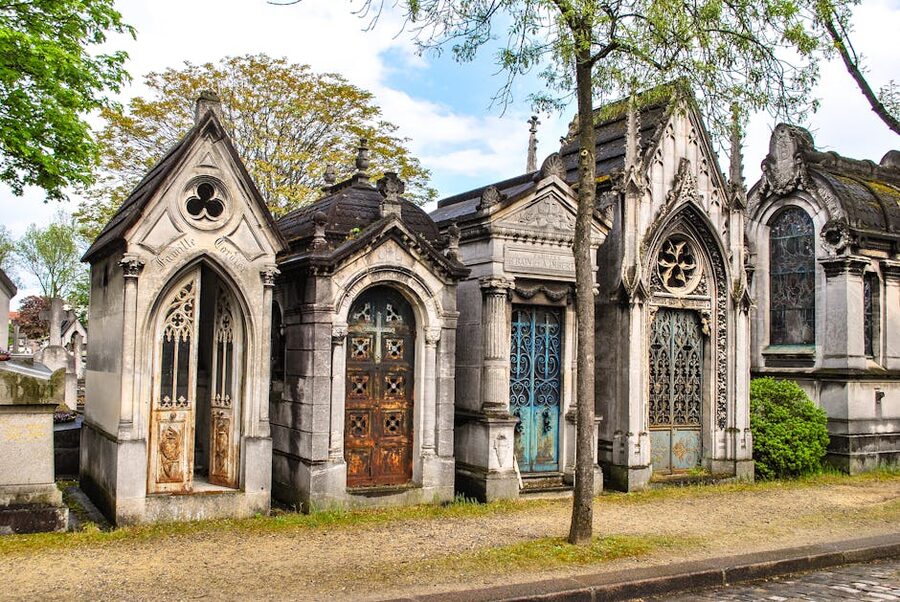
The general shape of the styles works like this. The oldest divisions, 1 through 11 close to the main entrance, have the heaviest concentration of Empire-style and Gothic Revival mausoleums, lots of marble and weeping muses. The middle divisions, 30 through 60, lean Second Empire and early Third Republic, more Beaux-Arts, more allegorical female figures with broken columns and snuffed torches. The eastern divisions, 80 through 97, drift into Art Nouveau by 1900 and then through Art Deco into modernism. Walking from the main gate to the back of the cemetery is roughly a walking tour of European funerary art from 1820 to 1960.
The other thing you’ll notice is the cats. Pere Lachaise has a colony of stray cats, fed and informally cared for by the cemetery staff and a handful of volunteers, that probably runs to about a hundred animals. They’re scattered across all divisions, but you’ll see the most concentration around the chapel and division 11. They’re not strays in the bad sense, they look healthy, they’re not afraid of visitors, they just live here.
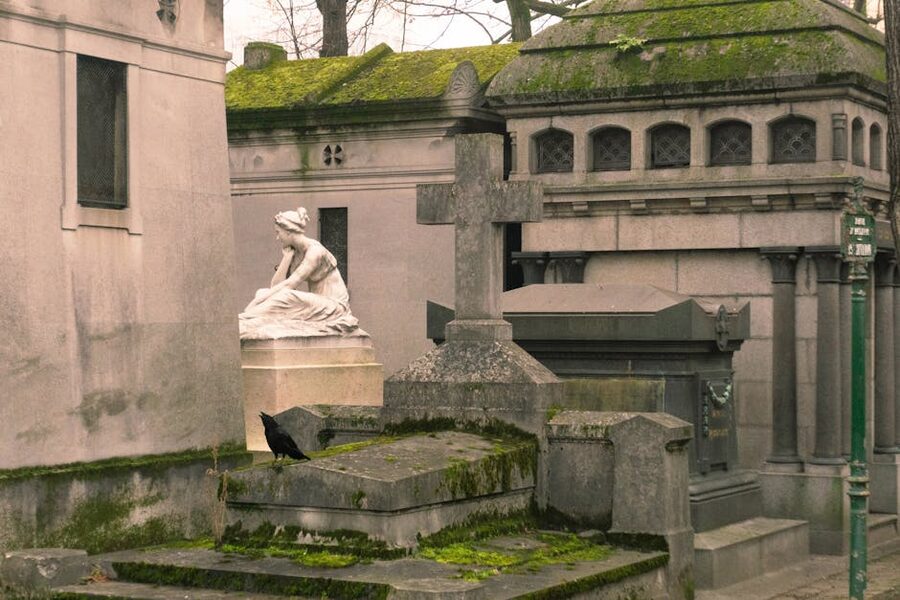
Three guided tours and what each is for
Pere Lachaise is genuinely confusing without a guide. The map is rough, the divisions don’t follow an obvious numbering pattern, and many of the signposted graves require turning down lanes that look identical to four other lanes. If you have done Sainte-Chapelle and the Conciergerie in the morning and have a half-day for Pere Lachaise in the afternoon, a tour is worth the time.
1. Pere Lachaise Cemetery Guided Tour: $23
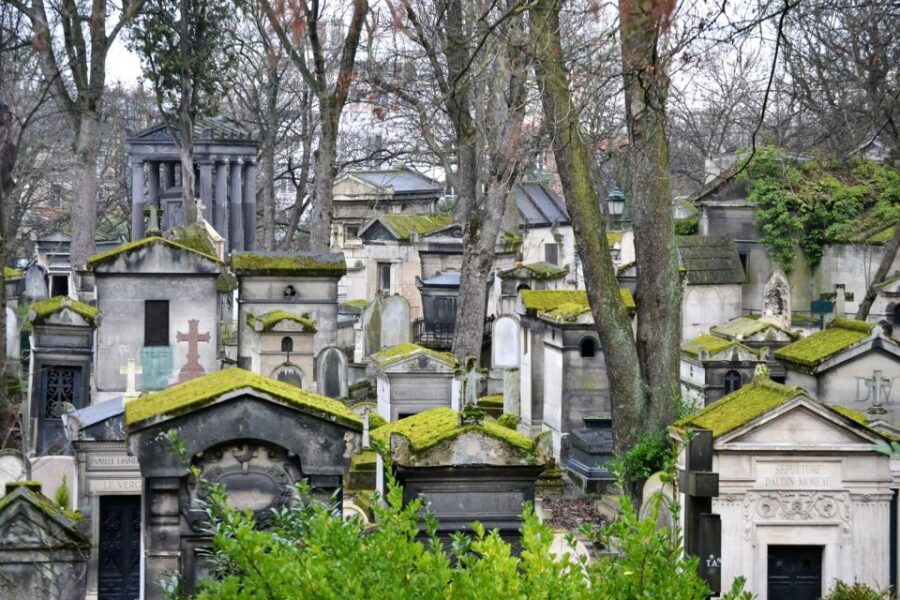
This is the best three-hour walk on the site, and our standard pick if you only do one Pere Lachaise tour. Three hours sounds long until you realise the cemetery is 110 acres and a two-hour tour spends most of its time walking. Our review covers the small-group format and what makes the longer slot worth the extra dollars.
2. Haunted Pere Lachaise Cemetery Guided Tour: $25
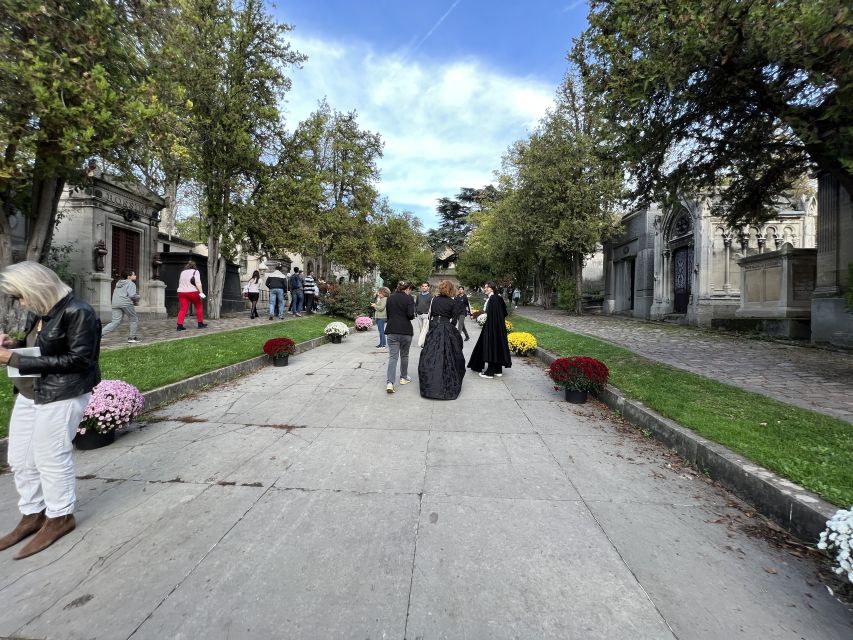
Pick this one if you’re travelling with someone who finds straight history dry. The guides are good and don’t oversell the supernatural angle, the framing is more about the cemetery’s role in the Romantic imagination, with a few good ghost stories worked in. Our review goes into which slots get the best light and which guides are the strongest storytellers.
3. Famous Graves of Pere Lachaise Cemetery Guided Tour: $15
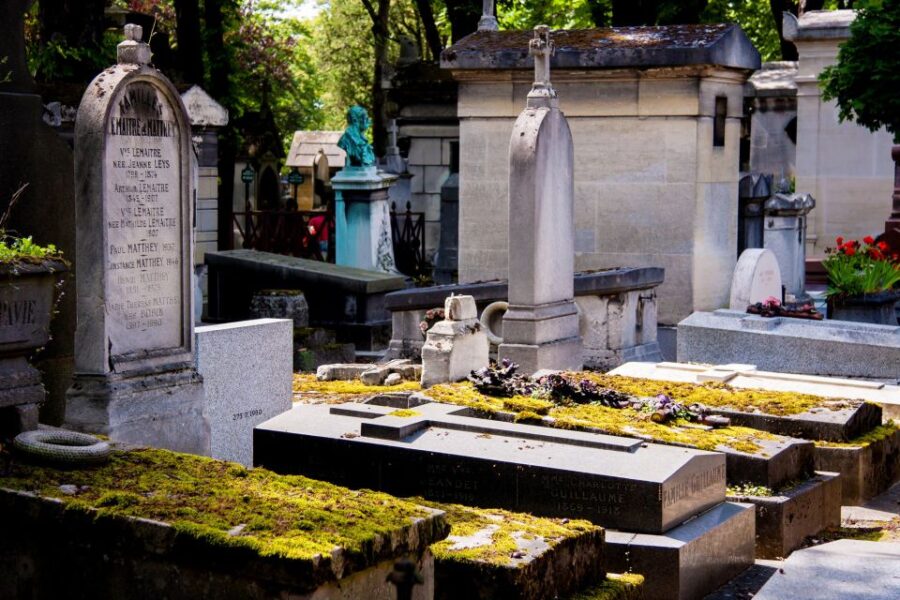
The price is the appeal here, two hours of competent commentary on the icons and not much beyond that. Skip it if you want the Communards Wall or the funerary-art context, take it if you only want the names you came for. Our review compares this with the longer options on what you actually get for the price.
Practical: getting in, getting around
The cemetery is at 16 rue du Repos in the 20th arrondissement. The closest metro is Pere Lachaise station on line 2 or line 3, which puts you about three minutes’ walk from the main entrance. Line 2 is the better choice if you’re coming from central Paris. From the Marais it’s about twelve minutes by metro, from the Latin Quarter about twenty.
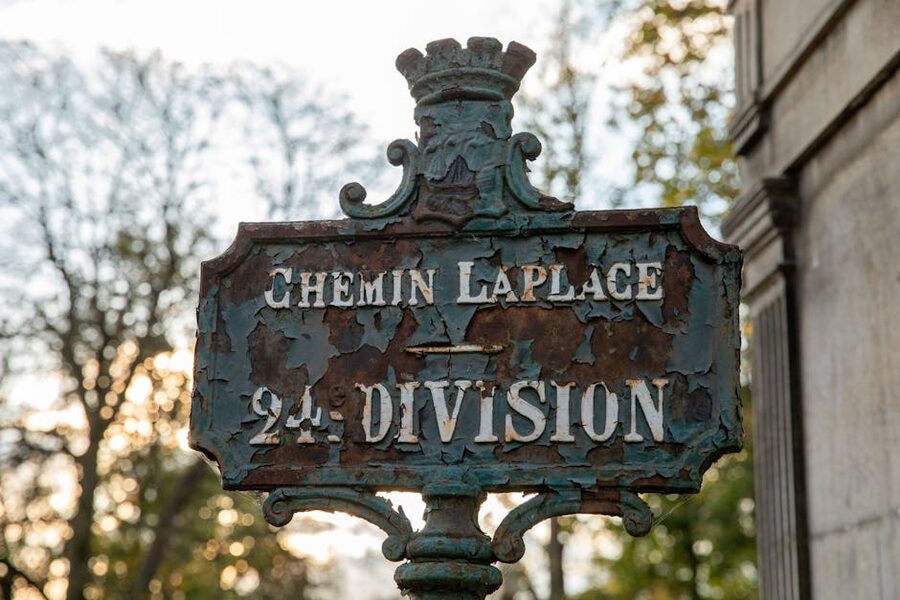
If you’re approaching from the back, Gambetta station on line 3 is closer to division 97 and the Communards Wall, and the back gate is a quieter entrance. The Philippe Auguste station on line 2 is also close, though slightly less convenient. For most visitors the Pere Lachaise station main entrance is the right starting point.
Hours are 8:00 to 18:00 from November through mid-March, and 8:00 to 18:30 from mid-March through October. Sundays open at 9:00. Closing time means closing time, the gates are locked on the dot, and if you’re not at an exit by then you’re sleeping with the dead. Cemetery staff start herding people toward the gates about 30 minutes before closing.
Entry is free. The maps at the kiosk just inside the main gate cost about three euros. Get one, this is non-negotiable, the cemetery is not navigable from memory or from a phone alone. The mobile signal is patchy in places. The maps mark the famous graves with small icons.
Best time to visit, in my experience, is between 10:00 and noon on a weekday in spring or autumn. October is the most photogenic, the chestnut leaves on Wilde’s grave is the cliche shot for good reason. Avoid Sunday afternoons, that’s when local Parisians visit family graves and the cemetery feels less like a tourist site and more like the working cemetery it actually still is. Out of respect, keep your voice down on Sundays especially.
What to wear, what to bring
Flat shoes you can walk in for three hours. The lanes are uneven cobblestone, in some places almost broken up, and the cemetery sits on a hill so you’ll be walking uphill and down constantly. Heels are a bad idea. Sneakers or sturdy loafers are the standard kit.
A light rain jacket if there’s any chance of weather, the canopy of plane and chestnut trees blocks sunshine but doesn’t keep rain off, and the cobbles get slick fast. There are three small kiosks inside the cemetery selling water and basic snacks at slightly inflated prices, so a bottle of water from the supermarket on rue de la Roquette is a few euros saved.
Don’t bring food to eat at the graves. This isn’t a strict rule but cemetery staff will ask you to move along, and respect for the working cemetery aspect matters. The little bistros along rue de la Roquette and rue de Bagnolet are the right post-cemetery lunch options. Au Petit Cahoua and Le Mistral are both fine if you want a sit-down meal within five minutes’ walk of the main gate.
The chapel and the central crematorium
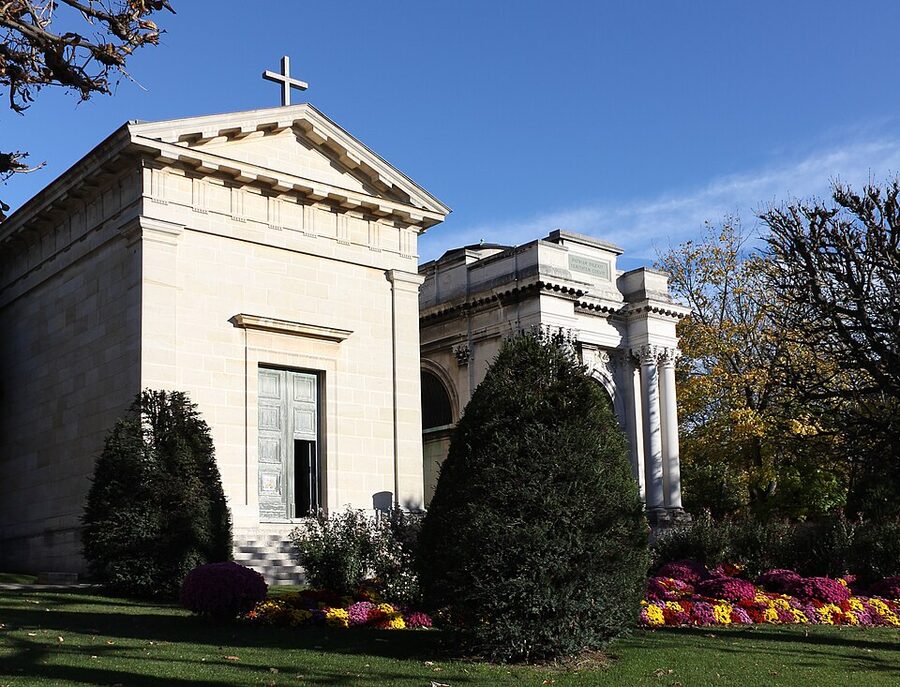
The chapel sits roughly in the middle of the cemetery, built between 1820 and 1823 in a small neoclassical style. It’s not usually open to visitors. Funeral services are still held there, several a week, and on those days you’ll see small groups of mourners walking the lanes. The chapel was designed by Etienne-Hippolyte Godde, the city architect at the time, who also did the Saint-Pierre-du-Gros-Caillou church near Les Invalides. Same hand, similar restraint.
Behind the chapel, in division 87, is the columbarium and crematorium. Pere Lachaise was the first cemetery in France to have a crematorium, opened in 1894 against significant Catholic-establishment opposition. The columbarium walls hold the ashes of about 30,000 people. Maria Callas’s ashes were stored here for years before being scattered in the Aegean, despite the popular belief that she’s buried at Pere Lachaise. Isadora Duncan, the American dancer who died in Nice in 1927 when her long scarf caught in the wheel of an open car, is in the columbarium for real.
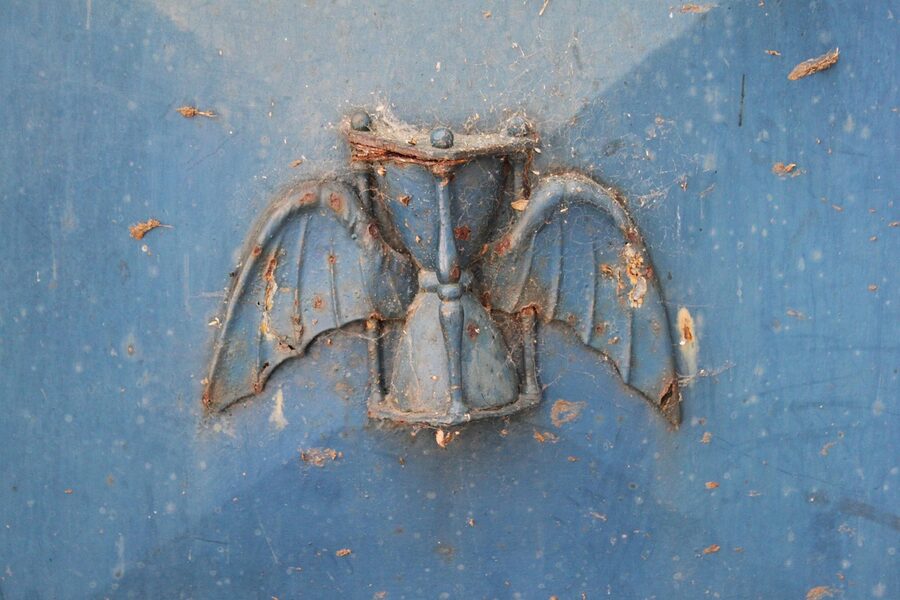
The hourglass and winged-detail funerary symbols you see on most older monuments are 19th-century shorthand. The hourglass is time running out. The winged hourglass, often shown overturned, is time having stopped. The torch pointing down is life extinguished. The broken column is a life cut short. The lyre with broken strings is a musician. Once you start reading the symbols the older divisions become much more legible, the families weren’t just decorating, they were communicating.
Compared to other Paris-as-history sites
Pere Lachaise is different from the other big Paris attractions in one important way. The graves you came to see are still owned by the families. There are no display cases, no glass barriers (with the one exception of Wilde’s tomb), no audio guides built into the site, no controlled flow of visitors. You wander.
The closest comparison in Paris is the Pantheon, which is the official, formal, state-managed version of the same idea. Both house the great names of French history, both are pilgrimage sites in their own way, and both speak to French ideas about secular nationhood and cultural memory. But the Pantheon is a museum, run on museum logic. Pere Lachaise is a working cemetery that happens to be a tourist destination.
The Italian comparison most travellers reach for is the Naples catacombs, which gets at the Catholic-versus-secular split well. Naples San Gennaro is medieval Christian burial space, decorated with frescoes that read as theology, designed to teach you about the resurrection. Pere Lachaise is post-revolutionary secular space, decorated with allegorical sculpture that reads as cultural memory, designed to honour individual achievement. Two different visions of what a cemetery is for. Both are ours, in the European tradition.
If you want the closest thing to the Pere Lachaise experience but underground, the Rome catacombs do it in a Catholic register. Same sense of personal pilgrimage, same density of history per square metre, very different aesthetic. The Dutch cousin is the Anne Frank walking tour through the Jordaan and the wider Jewish-Quarter route: not a cemetery but the same memorial-walking logic, where the buildings on the street are the headstones and you read a city’s 20th-century losses by walking past doors instead of plots.
The grave that isn’t here
Claude Monet is buried at Giverny, in the village churchyard about two minutes’ walk from his garden, not in Paris. If you’ve made the day trip out to Giverny for the water lilies and the studio, you’ll have walked past his grave already, even if you didn’t realise. He chose to be buried with his family in the village he had lived in for forty-three years rather than join the institutional pantheon at Pere Lachaise. That decision is more interesting than it sounds. By 1926 when Monet died, the cultural pull of Pere Lachaise was still very strong, and burying him in the village graveyard was a small, deliberate refusal of the Paris-centric story. Monet thought of himself as a Norman painter who happened to live near Paris, not a Parisian. Visiting Giverny gives you part of that story. Pere Lachaise gives you the version Monet didn’t choose.
Combining Pere Lachaise with the rest of your day
Pere Lachaise eats two and a half to three hours minimum if you do it properly, and four hours if you take a guided tour and then spend a little extra time wandering on your own afterwards. That’s enough time that you don’t want to schedule something demanding before or after. The right pairings are easy half-days. A Seine cruise in the late afternoon works because it’s all sitting and looking. An Eiffel Tower visit in the early evening, if you’ve timed your tickets, also works because the queue management does the work for you.
What doesn’t work is pairing Pere Lachaise with another walking-heavy site like the Montparnasse Tower climb-up or a long Louvre afternoon. You’ll be exhausted by 4pm and the second site will get short shrift. Pere Lachaise is a half-day commitment, treat it as such.
If you’ve got an evening free after, the bistros around Place Gambetta (one stop along line 3 from the back of the cemetery) are good and locals-only enough that you won’t see another tourist. The 20th arrondissement has had a long quiet renaissance over the last decade, and the area immediately north and east of the cemetery is one of the better neighbourhoods in Paris for an unforced dinner.
One last thing about respect
People are still being buried at Pere Lachaise. Roughly thirty new burials a week, in family plots that have been held for generations. The cemetery is not just a tourist attraction. It’s a working space, in the most literal sense. The most-visited graves, Morrison and Wilde and Piaf and Chopin, sit a few rows from much more recent graves where the flowers are still fresh and the family is still grieving.
This means a few things. Keep your voice low. Don’t sit on monuments, even ones that look like benches, they’re family property. Don’t lean on or touch the headstones, even the famous ones, the cemetery has spent considerable money repairing damage from exactly that. Don’t bring food into the cemetery to eat. And if you see a small group dressed in black gathered around a grave with a freshly-laid bouquet, give them a wide berth, that’s a funeral happening, and they have absolute priority over any tourist itinerary.
The single best thing about Pere Lachaise is that the dead are still being buried alongside the famous ones. It keeps the place real. Most of the great cemeteries of Europe have been frozen as museums. Pere Lachaise is still doing the job it was built for in 1804, just with three and a half million annual sightseers wandering past on their way to see Jim Morrison. That’s a particular kind of Parisian compromise, and it works.