
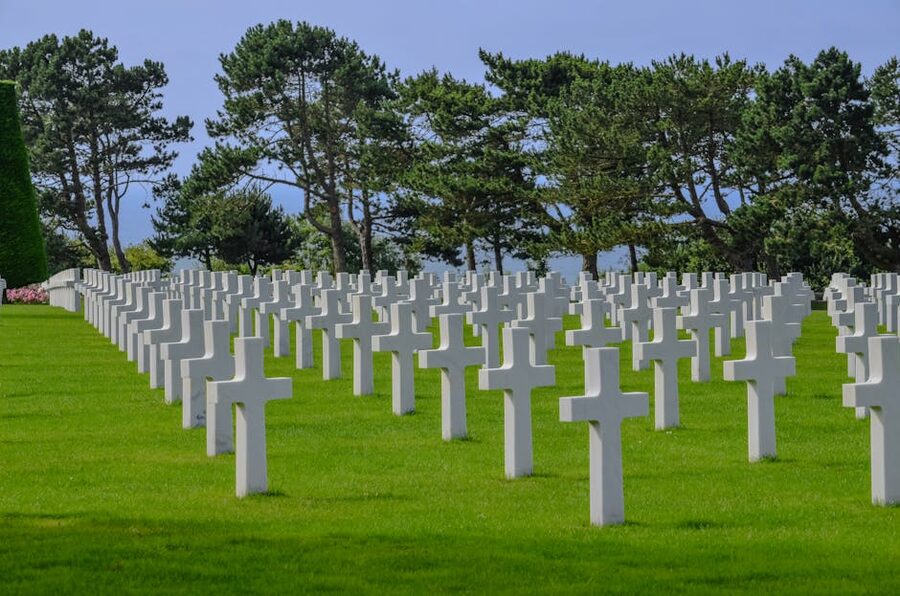
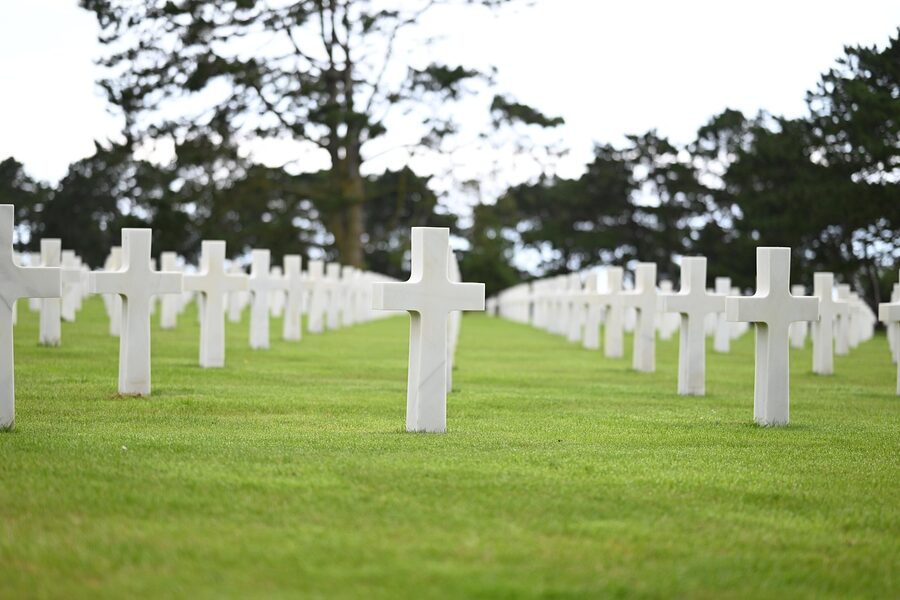
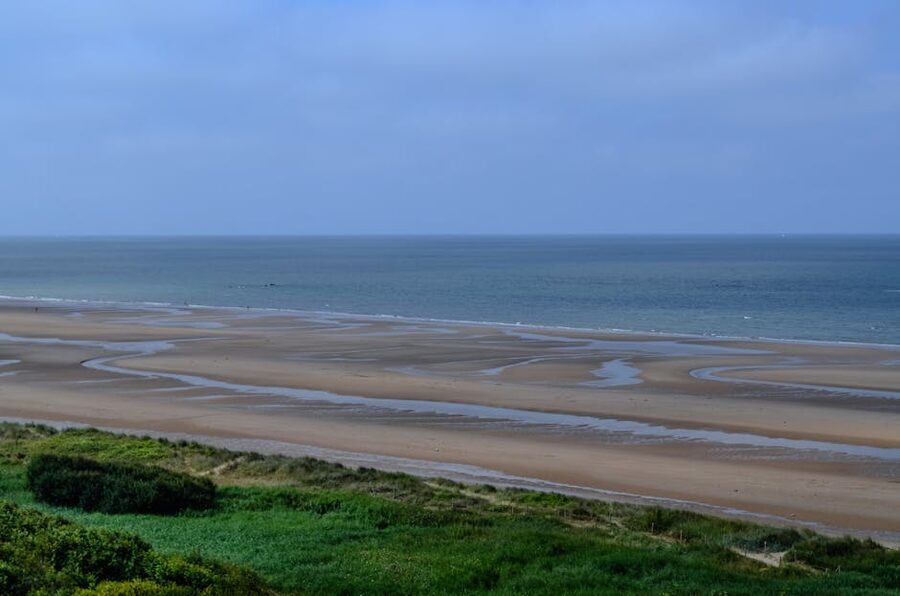
You stand at the edge of the Normandy American Cemetery on the bluff above Omaha Beach, and the first thing you notice is the silence. Not quiet. Silence. Nine thousand three hundred and eighty-eight white marble crosses and Stars of David, all facing west toward home, all in formation, all the same height. Below you, through the pines, you can see the beach where most of these men landed on the morning of 6 June 1944.
This is the part of the day-trip that the brochures undersell. The Caen Peace Memorial gives you the why. The bunkers at Pointe du Hoc give you the engineering. The American Cemetery is what people actually remember a year later. It rearranges your morning.
A Normandy D-Day day-trip from Paris is one of the most-emotional pilgrimages in European travel, and most coverage handles it badly. It either gets jingoistic, like a movie trailer, or it goes detached and museum-textbook. The day itself is neither. It’s specific people, specific places, specific weather, and an Atlantic horizon that hasn’t changed since 1944. If you do this trip right, you will be tired, you will be moved, and you will not regret the 17 hours.
In a hurry? Three Paris-to-Normandy day trips worth booking
Best overall, $117: Paris D-Day Sites Guided Day Trip with Lunch. Caen Memorial, Omaha Beach, American Cemetery, Pointe du Hoc, Arromanches. Lunch included. The flagship.
Premium small group, $312: Full-Day Tour from Paris. Smaller bus, expert historian guide, more time at each site, often includes the Overlord Museum.
Solid mid-tier, $199: Paris D-Day Beaches Day Trip. Same big-five circuit, lunch in Arromanches. The “I just want to do this once and do it right” pick.
The day in real time: what 17 hours from Paris actually looks like
If you’ve already done a long day-trip out of Paris, like Mont Saint-Michel or the Loire Valley castles, you know how these go. The Normandy run is at the longer end. Most coaches leave central Paris between 06:30 and 07:00. You get back somewhere between 21:30 and 22:30. That’s 15 to 17 hours door-to-door, and roughly five of those hours are on the road.
This is not a hidden complaint, by the way. It’s the trip. Normandy is 230 to 280 km west of Paris, depending which beach you’re heading to, and the autoroute has a speed limit. If you want a relaxed schedule with three sites instead of five, you need to base in Bayeux or Caen for one or two nights. If you want the full sweep in a single day, you accept the bus.
Here is the timing most flagship tours follow, give or take twenty minutes per stop depending on traffic:
- 06:30 to 07:00: Pickup in central Paris. Usually Pullman Tour Eiffel area, sometimes Gare Saint-Lazare or Place de la Concorde.
- 10:00 to 10:30: Arrive Caen. The Caen Peace Memorial museum opens at 09:00. Most tours give you 90 minutes to two hours inside.
- 12:30 to 13:30: Lunch. Sometimes at the Memorial cafeteria, sometimes at a brasserie in Bayeux or Port-en-Bessin.
- 14:00 to 15:30: Omaha Beach and the American Cemetery. You will get roughly 90 minutes here, total. It is not enough.
- 15:45 to 16:30: Pointe du Hoc. The cratered cliff. About 45 minutes.
- 17:00 to 18:00: Arromanches. The Mulberry harbour ruins. Quick stop, often photo-only.
- 21:30 to 22:30: Drop-off in Paris.
Some operators reverse the route, doing Pointe du Hoc and Omaha first and the Memorial after lunch. The end of your day is the same either way.
Caen Peace Memorial: the why before the where
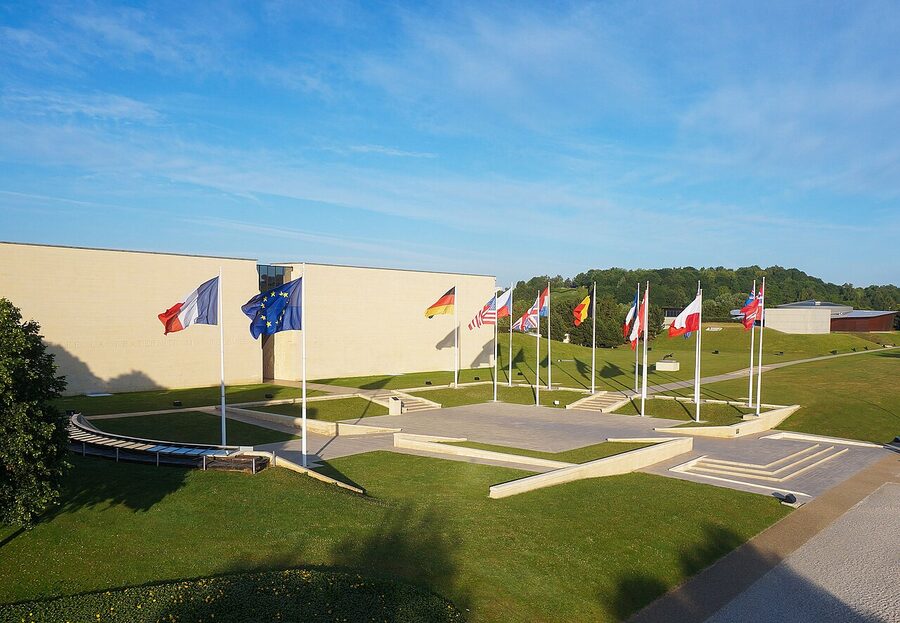
The Mémorial de Caen is the most-recommended starting point on any Normandy day-trip, and once you are inside you understand why. It is not a beaches museum. It is a Europe-in-the-1930s, war-of-ideas, then-the-landings, then-the-cold-war museum. You walk a downward spiral past Hitler’s rise, the fall of France, the occupation, the Resistance, the bombing of Caen, and only then are you ready for D-Day. Without that runway, the beaches are just sand.
Plan on 90 minutes inside if your tour gives you that long. Two hours if you have it. The 19-minute immersive D-Day film is worth queueing for. Standard adult ticket is around €25 at the door, less for groups. The ticket on most flagship Paris day-trips is bundled into the price, which is a real saving when you compare to the gate.
Where the Caen Memorial gets a slight knock from independent travellers is layout. It is a big building. If you have a stroller or a mobility issue, ask at the desk for the elevator route. The downward spiral is gentle but it is long, and the bunker section under the building involves a few steps.
Omaha Beach and the American Cemetery: the emotional centre
Omaha was the bloodiest of the five Allied beaches on 6 June 1944. The first wave of the 1st and 29th US Infantry Divisions landed at low tide, in the open, against German bunkers cut into the bluff. American casualties on Omaha alone that morning were roughly 2,400. The other four beaches, taken together, came in lighter.
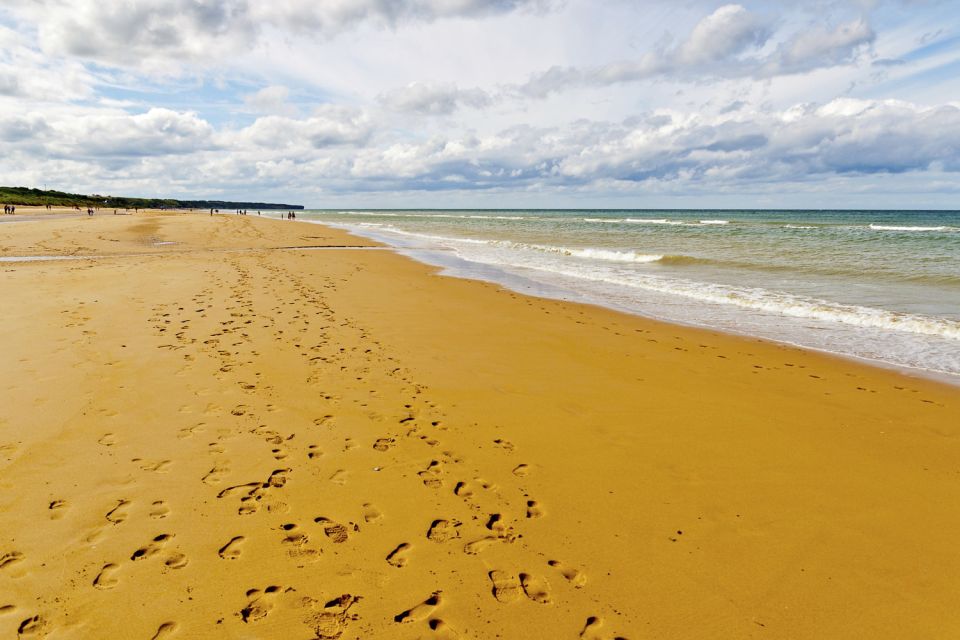
You can drive directly onto the sand at Vierville-sur-Mer if your operator allows it. Most do not, because the beach is now a working public beach with kite-surfers and dog walkers, and the optics of a tour bus on the sand are not great. What most groups do instead is park at the Les Braves memorial above the beach, walk down through the bluff path, stand on the sand for ten minutes, and walk back up. That walk is the one most travellers remember.
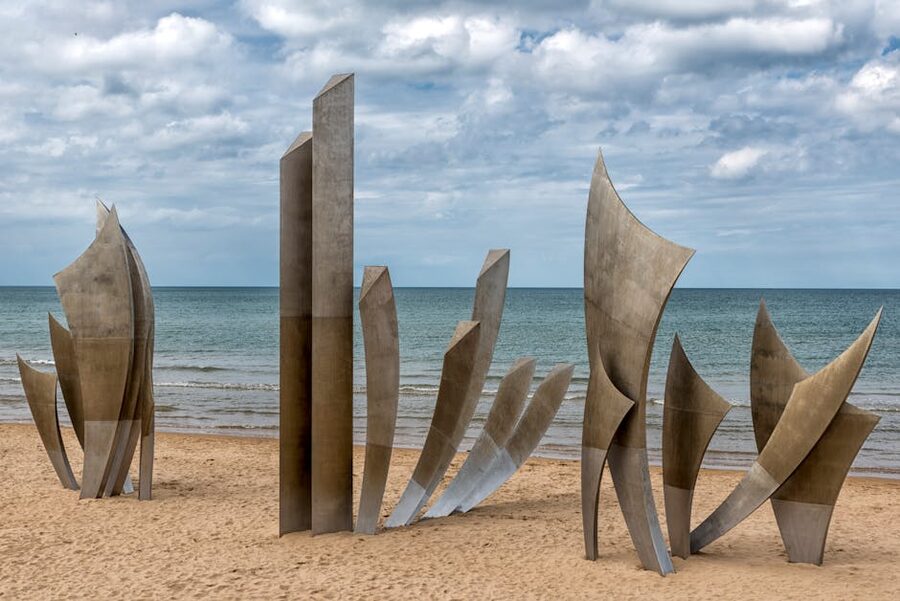
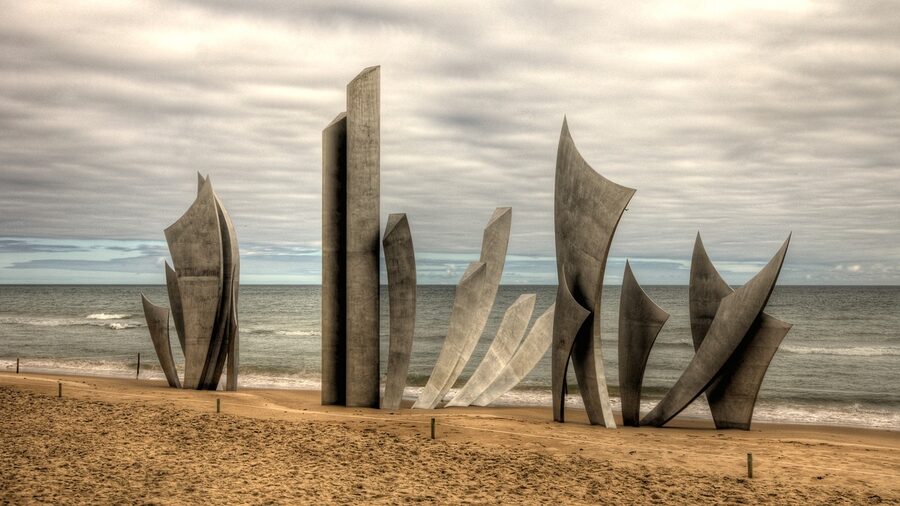
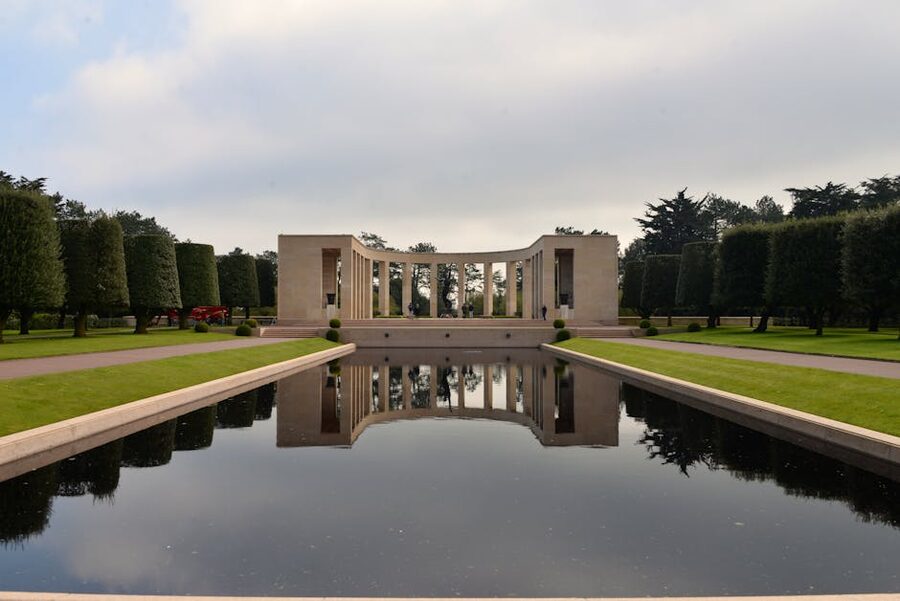
From the beach, the cemetery is a five-minute drive up the bluff. Free entry, bag check at the security gate, then through a visitor centre that is itself a small museum. You walk past the chapel, around the reflective pool, and out into the cross fields. There is a marked grave for Theodore Roosevelt Jr, son of the president, who landed at Utah Beach with the 4th Infantry Division and died of a heart attack five weeks later. He is buried beside his brother Quentin, killed in 1918 in WWI.

The Wall of the Missing, behind the chapel, lists 1,557 names of soldiers whose remains were never recovered or never identified. The bronze rosettes mark men who have been identified since. New rosettes still get added every few years.
If you have time, walk down to the eastern end of the cemetery, past the last cross row, and look back. From there you can see the full geometry of the layout: the crosses radiating out from the central chapel like rays. That perspective is what almost no first-timer notices because the path leads everyone straight down the middle.
Pointe du Hoc: the cliff the Rangers scaled
If the cemetery is the emotional centre of the day, Pointe du Hoc is the engineering centre. This is where 225 men of the US 2nd Ranger Battalion landed in the dark on the morning of 6 June 1944, fired rope-launched grappling hooks up a 100-foot cliff, and climbed under fire to silence a battery of six 155mm German guns positioned to shell both Omaha and Utah beaches.
The guns were not in the bunkers when the Rangers got there. They had been moved a kilometre inland a week before. A Ranger patrol found them in an apple orchard, unguarded, and destroyed them with thermite grenades. The entire action took about two hours. Of the 225 Rangers who started the climb, only about 90 were still standing two days later when they were finally relieved.
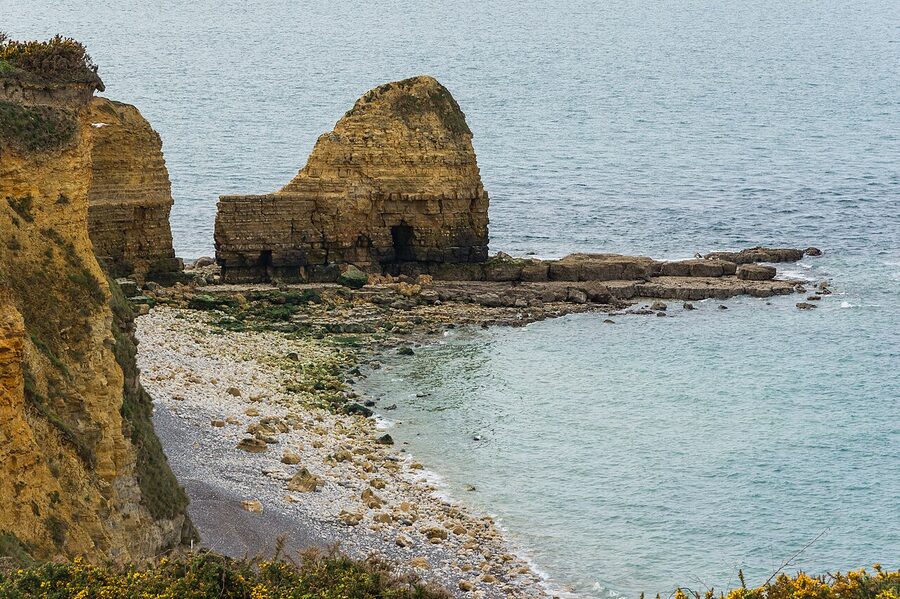
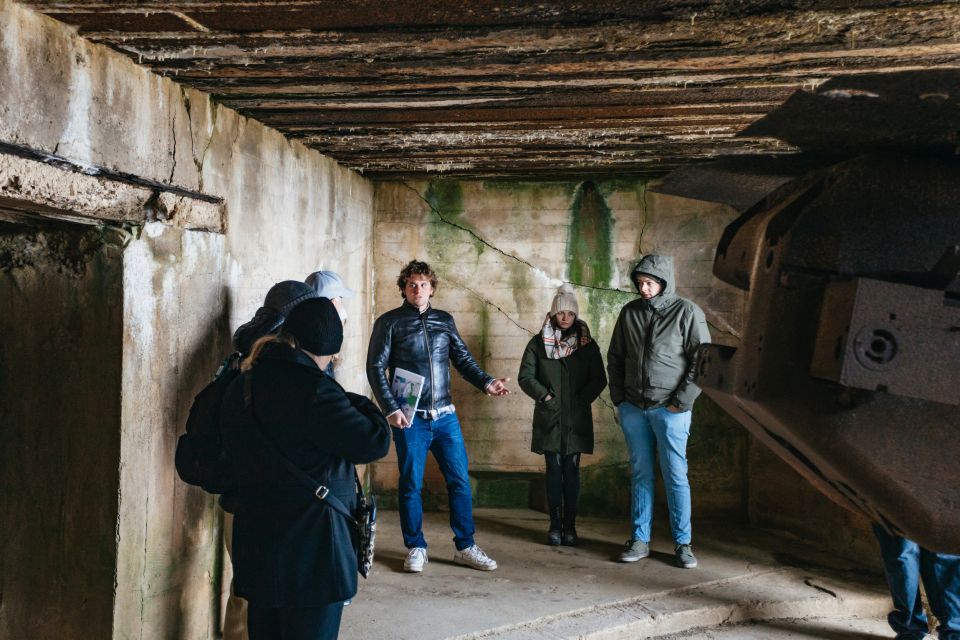
The site is now run by the American Battle Monuments Commission. Free entry. The bunkers are open. You can walk into the observation post on the cliff edge, look out at the beach where the landing craft came in, and stand inside the 155mm gun emplacements. Allow 45 minutes minimum, and wear shoes that can handle wet grass and uneven concrete.
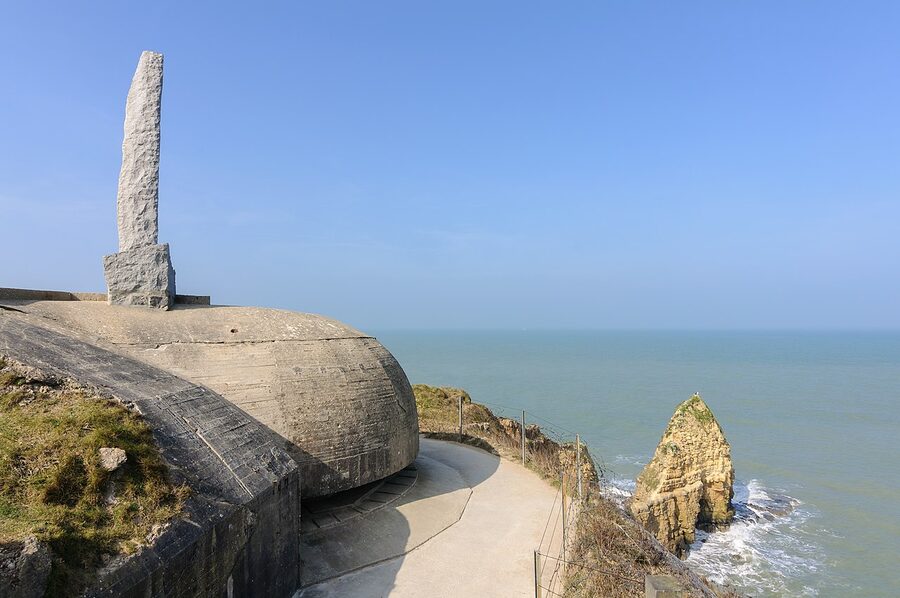
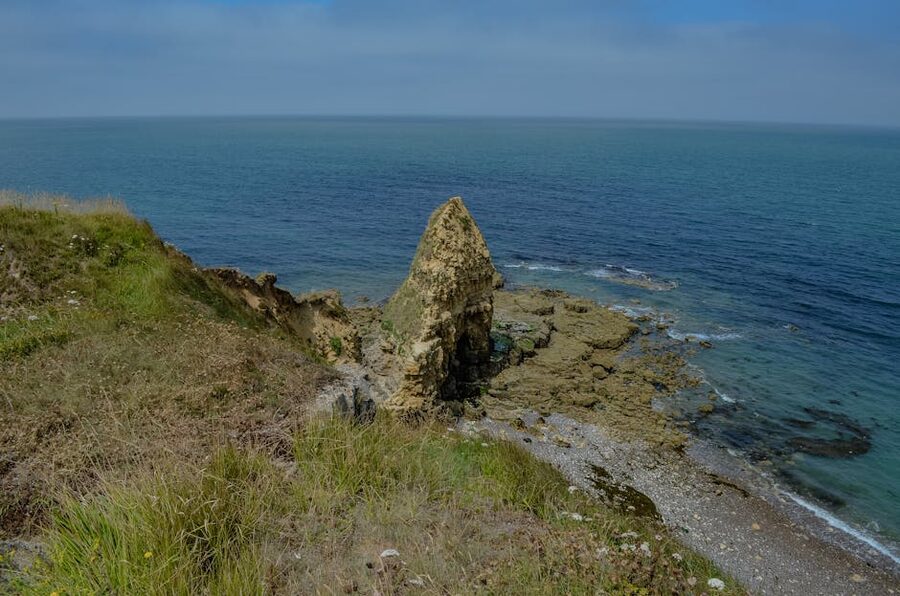
One thing the typical day-trip will not tell you: the entire promontory is being eroded by the Atlantic. About a metre of cliff is lost every decade. The forward observation bunker has been stabilised, but other concrete fragments have already collapsed into the sea since the 1980s. You are visiting a site that is, slowly, going away.
Arromanches and the Mulberry harbour
By 17:00 most flagship tours roll into Arromanches-les-Bains for the last stop. This is Gold Beach, where the British 50th Infantry Division landed, and where the Royal Engineers built the artificial Mulberry harbour in the days after D-Day. The remains of the harbour are still in the water.
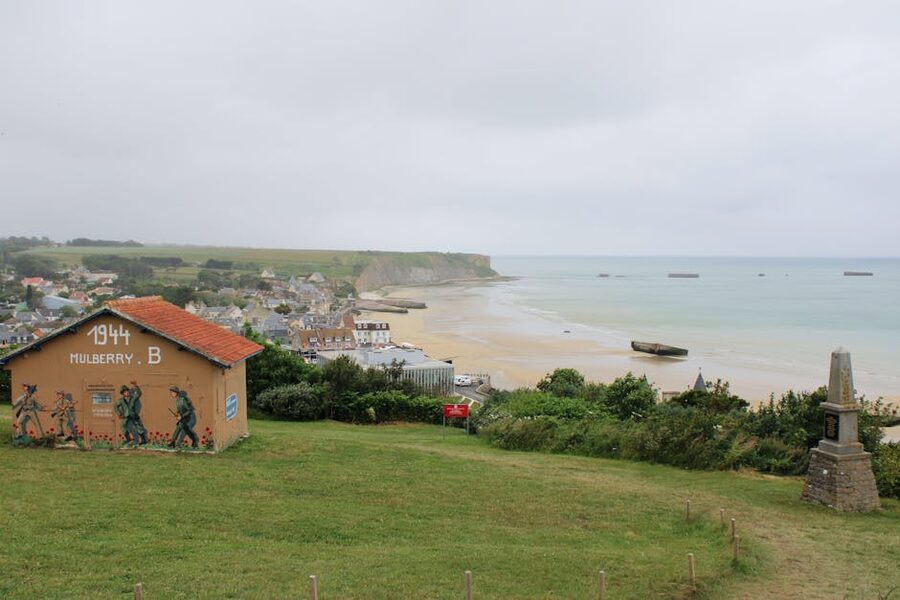
This is the part of the day where the engineering becomes ridiculous. The Allies needed a deep-water port to land tanks, fuel, and 60,000 men a day. They didn’t have one. So they built two harbours in England, towed the parts across the Channel in pieces, and assembled them on the Normandy coast in twelve days. Mulberry A at Omaha was destroyed by a storm on 19 June. Mulberry B at Arromanches survived and operated for ten months. Two and a half million men, half a million vehicles, and four million tonnes of supplies went through it.
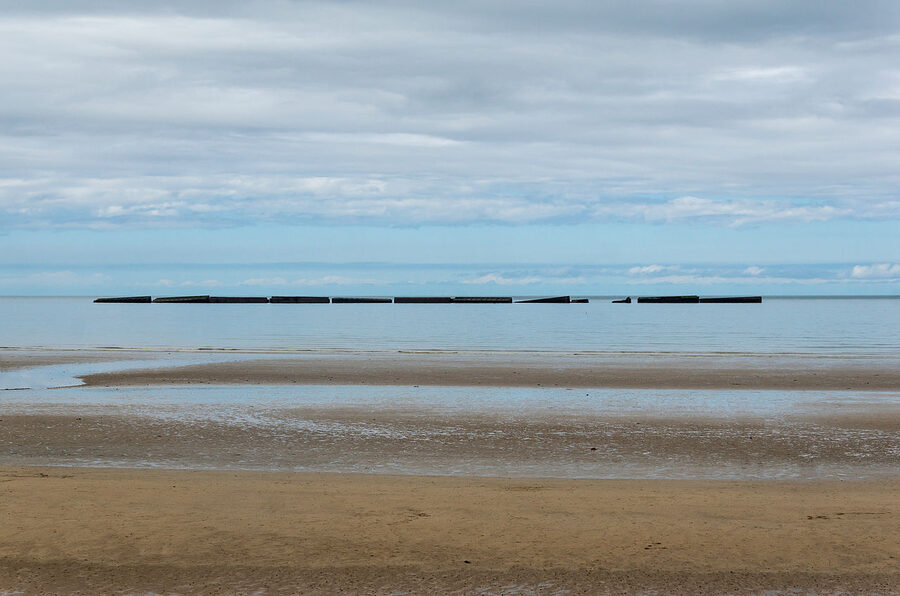
Most day-trips give you 45 minutes to an hour here. That is enough to walk down to the seafront, photograph the caissons, and visit the small Musée du Débarquement on the front if your tour includes it. The Arromanches 360 cinema, on the bluff above town, runs an excellent 25-minute archival film called “The 100 Days of Normandy” that uses ten synced screens around you. If your tour stops there instead, take it.
The five beaches, in plain English
If you are reading about D-Day for the first time, the names of the beaches can blur. Here is the cheat sheet, west to east along the Normandy coast:
- Utah (American). 4th Infantry Division. Landed roughly two kilometres south of the planned spot, by accident, into a quieter sector. Casualties under 200 on the day.
- Omaha (American). 1st and 29th Infantry Divisions. The hardest beach. Casualties around 2,400.
- Gold (British). 50th Northumbrian Infantry Division. Linked up with Juno and pushed inland to take Bayeux on D+1.
- Juno (Canadian). 3rd Canadian Infantry Division. Pushed the furthest inland of any beach on D-Day. Casualties about 1,000.
- Sword (British). 3rd British Infantry Division. The eastern flank, with airborne support from the 6th Airborne to seize the Pegasus Bridge inland.
The standard Paris day-trip covers Utah and Omaha, with the cemetery and Pointe du Hoc, and finishes at Gold. Most do not include Juno or Sword unless you specifically book a Canadian-themed or British-themed tour. If your family has a Canadian or British connection to D-Day, that’s the version to book, and you should base in Bayeux for two nights.
What the three Paris day-trips actually buy you
The flagship Paris D-Day day-trips on GetYourGuide and Viator are doing roughly the same circuit with the same five sites and the same lunch break in Bayeux or Port-en-Bessin. What changes is bus size, guide quality, and how much time you get at each stop.
1. Paris D-Day Sites Guided Day Trip with Lunch: $117

This is the right pick if it’s your first time and you just want the full sweep done well. Our full review covers the pickup logistics and what’s actually included in the lunch (it’s a real plated meal, not a sandwich). The trade-off is bus size: this one runs a 50-seater, so allow extra time at every stop for the walk-down and the head-count.
2. Full-Day Tour from Paris (Premium Small Group): $312
This is the right pick if you’ve read three books on the campaign and want a guide who can answer the second question. Our full review goes into the historian credentials and which months the small-group format is actually worth nearly tripling the price. The real catch: at $312, the maths only works if you genuinely want the deeper context.
3. Normandy D-Day Beaches Day Trip: $199
This is the right pick if the $117 flagship is sold out and you don’t want to jump to $312. Our full review covers the cider stop and where this operator’s lunch sits relative to the Memorial cafeteria option on the cheaper tour. The middle slot has a habit of being a real value pick when summer dates fill up.
How the British and Canadian beaches stack up
The American story dominates the day-trip, partly because Omaha and Pointe du Hoc are the most-photographed sites and partly because the cemetery is the largest American military burial ground in Europe. The British and Canadian story is just as much the day-trip you didn’t take.
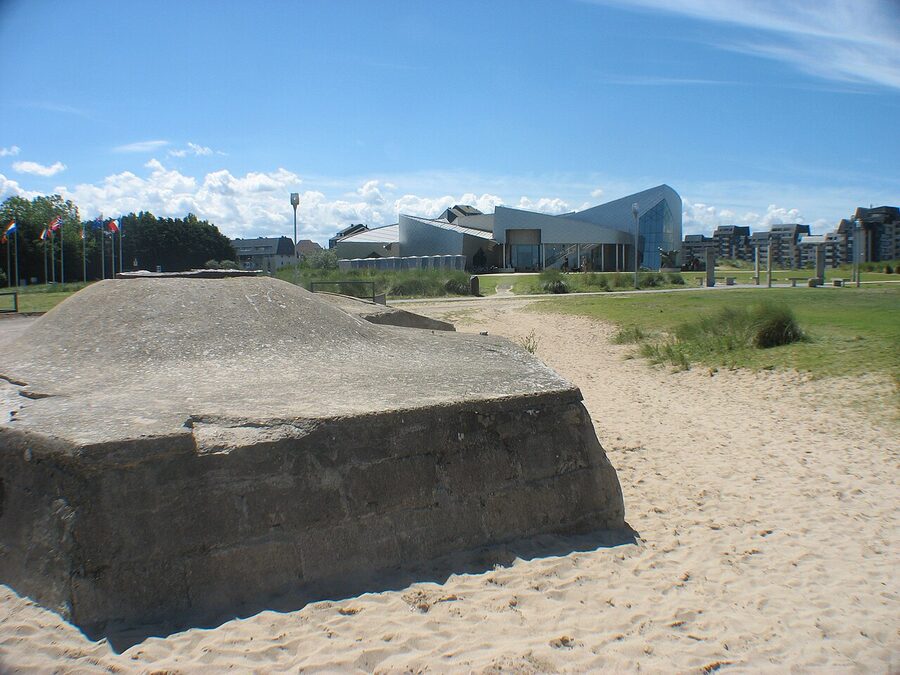
The Juno Beach Centre at Courseulles-sur-Mer is the best Canadian-perspective museum on the coast. It tells the story of the 3rd Canadian Infantry Division landing on Juno on 6 June 1944, but it also tells the story of Canada in 1939 to 1945 generally. The “Faces of Canada Today” room is unexpectedly moving. If you want the British side, the Pegasus Bridge memorial east of Caen and the British war cemetery at Bayeux, the largest Commonwealth cemetery in France, are the two stops to add.
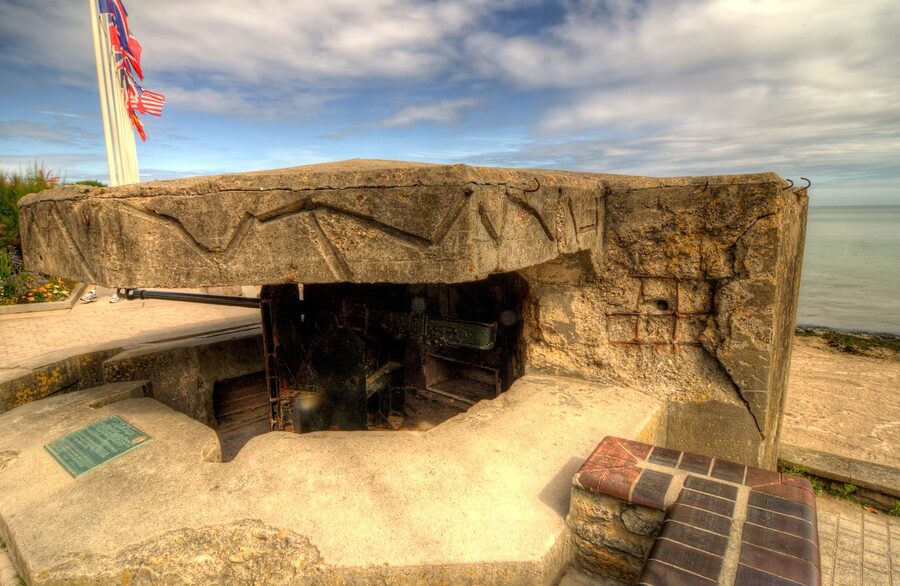
None of this fits in a single day from Paris. If you have any family connection to the Canadian or British landings, base in Bayeux for two nights and book a half-day Juno-and-Bayeux tour out of Bayeux itself. The Bayeux station is a 2h50 train from Paris Saint-Lazare, and the town is small enough to walk. Bayeux also has the Bayeux Tapestry, which tells a completely different war story (the 1066 Norman invasion of England), but if you’re already there, you’ll regret skipping it. The Loire Valley further south has its own castle circuit if your itinerary leaves room for the Renaissance after the medieval and the modern.
The German artillery side: bunkers, batteries, and the Atlantic Wall
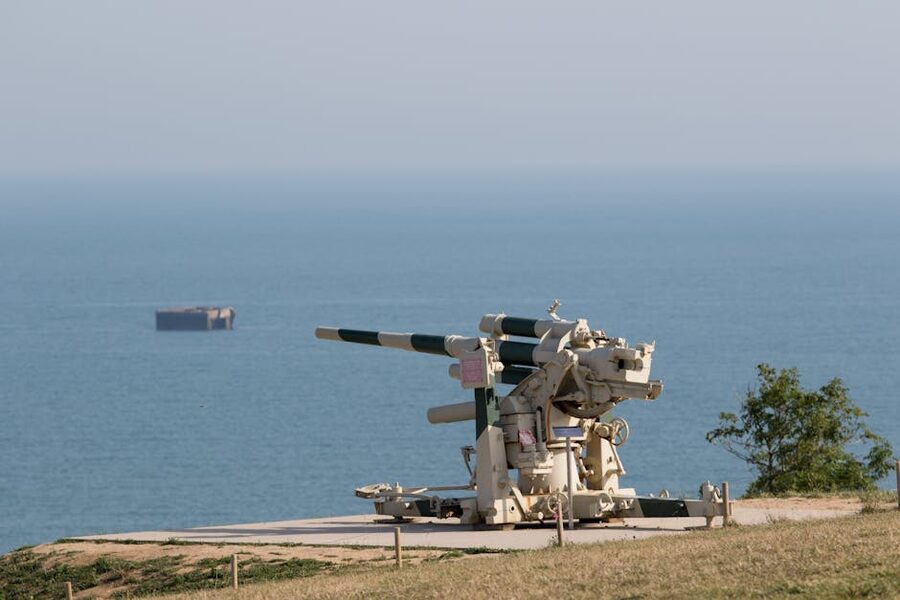
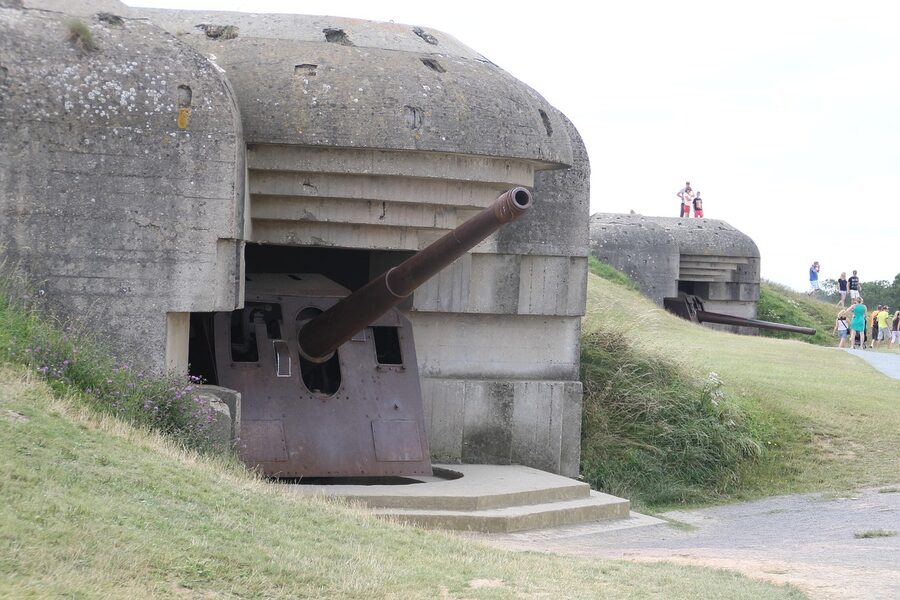
If you find yourself drawn more to the engineering than the human story, base your day at Longues-sur-Mer instead of the cemetery. The Longues-sur-Mer battery is the only German coastal battery in Normandy that still has its guns in place. Four 152mm naval guns inside concrete casemates, with the original observation post at the cliff edge.
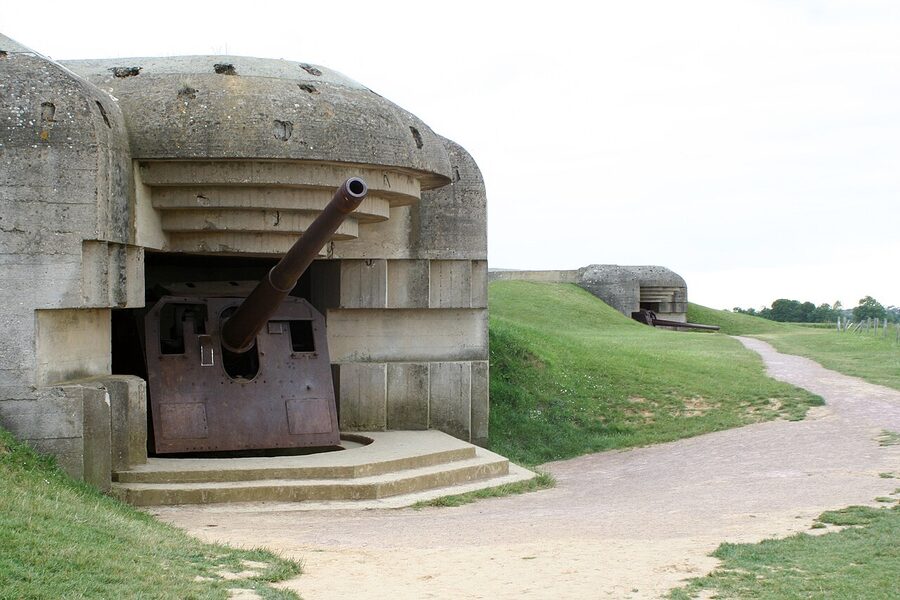
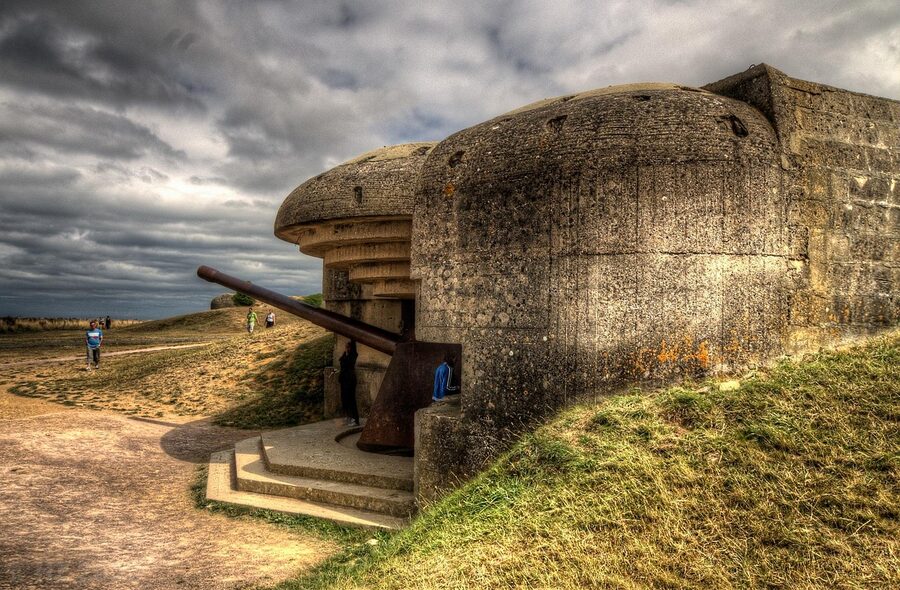
Most flagship Paris day-trips do not include Longues-sur-Mer. It’s a 20-minute drive from Bayeux and a perfect first stop on a self-driving day. If you want a Pointe du Hoc-style cliff fortress without the cemetery emotional weight, this is the alternative.
Sainte-Mère-Église and the airborne story
Most flagship day-trips do not stop in Sainte-Mère-Église, but if you have a family connection to the 82nd or 101st Airborne, this is the village. American paratroopers dropped here in the early hours of 6 June 1944, before the seaborne landings. One of them, John Steele, snagged his parachute on the church steeple and hung there for two hours, playing dead, before being captured. He survived, escaped, and returned to the village every June for decades.
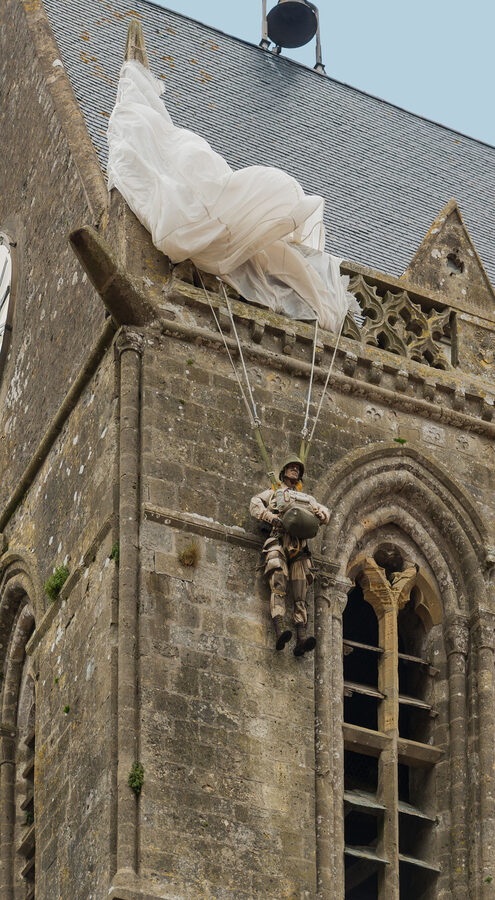
The Airborne Museum in the village is small but very good. It has a real C-47 Skytrain, a real WACO glider, and a walk-through diorama of the night of the drop. If your tour visits Utah Beach, ask whether Sainte-Mère-Église is on the route. It usually is.
What the actual D-Day morning looked like, in archival photographs
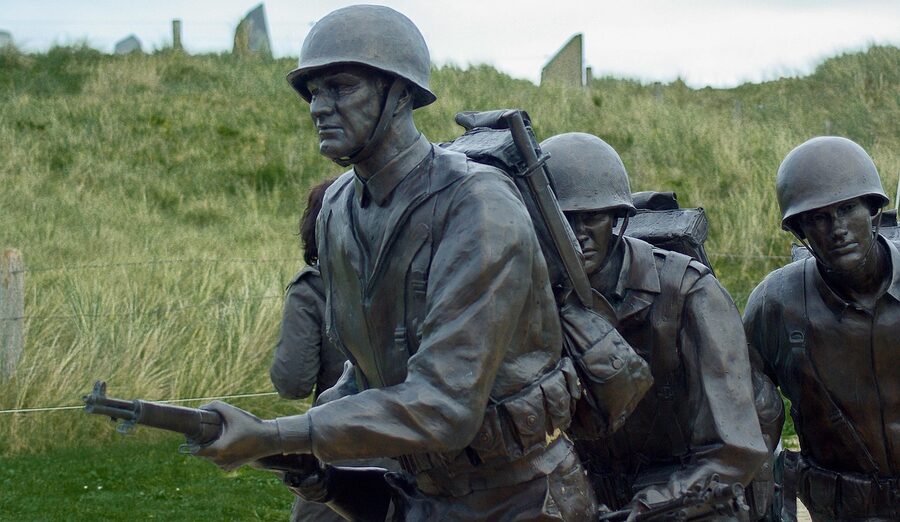
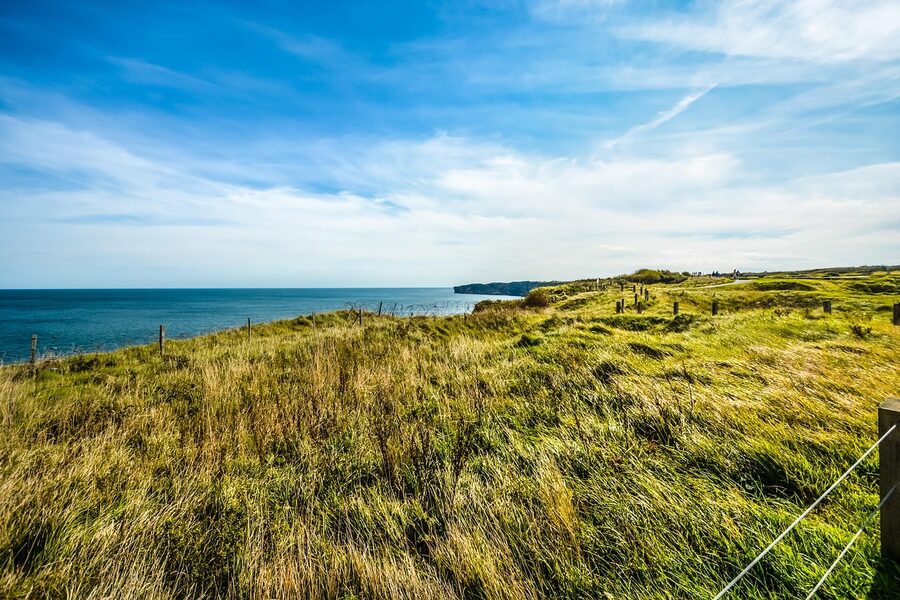
One of the strange things about visiting the beaches today is how peaceful they look. The bluff above Omaha is a cemetery. The cliff at Pointe du Hoc is a memorial. The bay at Arromanches is a holiday town. The contrast with the photographs from 6 June 1944 is the part that moves people most.
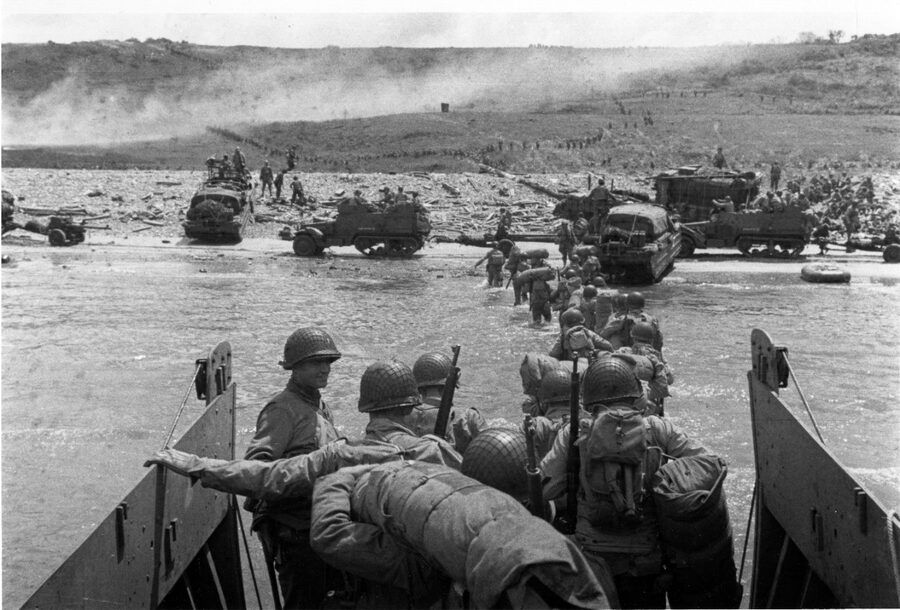
The Higgins boat in the photograph above is an LCVP, Landing Craft Vehicle Personnel. Each one carried 36 soldiers or one jeep. The Allies built more than 23,000 of them. Eisenhower later said: “Andrew Higgins is the man who won the war for us.” The boats were designed in New Orleans, built in Louisiana, and sailed across the Atlantic in pieces.
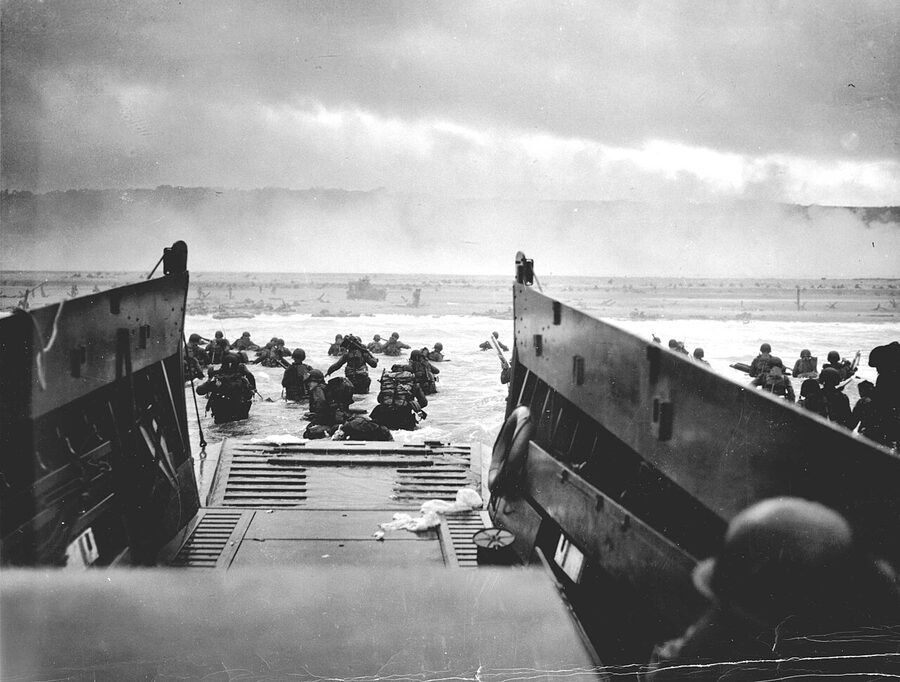
Day-trip guides will sometimes show you the bigger picture in numbers, and the numbers are worth holding in your head as you stand on the beach. 156,000 Allied troops landed across the five beaches on 6 June 1944. About 10,000 were killed, wounded, or missing on the day itself. About 4,400 were confirmed dead. Five thousand ships and 11,000 aircraft supported the operation. The Atlantic Wall, the German fortification line that the landings broke, ran 4,000 km from Norway to the Spanish border.
Practical things the booking page won’t tell you
A few things I wish I’d known before my first Normandy day-trip:
- Bring layers in any season. The wind off the Channel is steady. Even in July the cemetery and Pointe du Hoc can be ten degrees colder than central Paris.
- Wear waterproof shoes. Pointe du Hoc is a grass-and-mud field with concrete bunkers. Arromanches involves walking on sand or wet stones. Sneakers will do, but they will get wet.
- Bring tissues. Not joking. The cemetery does this to a lot of people.
- Eat a real breakfast. The pickup is at 06:30, lunch is at 13:00 at the earliest, and you do not want low blood sugar in the cemetery.
- Phones lose signal in chunks. The cliff at Pointe du Hoc and the Mulberry breakwater at Arromanches have spotty coverage. Download your reading material in advance.
- The 6 June anniversary week is not the time to go. The site is overcrowded with veterans, families, media, and President-of-the-United-States detail. Unless you’re attending the ceremony specifically, pick literally any other week.
If you are already in Paris for the rest of the trip and trying to fit Normandy into a packed itinerary, the day-trip slot most travellers use is the “third or fourth full day.” The first day is jet lag, the second day is the Eiffel Tower and central Paris, and Normandy goes somewhere in the middle when you’re acclimatised but not yet exhausted. Save the lighter days, like a Seine river cruise or Giverny and Monet’s garden, for the day after Normandy. You will need it.
If you want the full pilgrimage instead of a day-trip
The plain version of this article is: a single day from Paris is the right answer for 80 percent of travellers, but it is not the version of Normandy that gets people writing journals about it for years afterwards. If you have any family or personal connection to D-Day, do two nights in Bayeux instead.
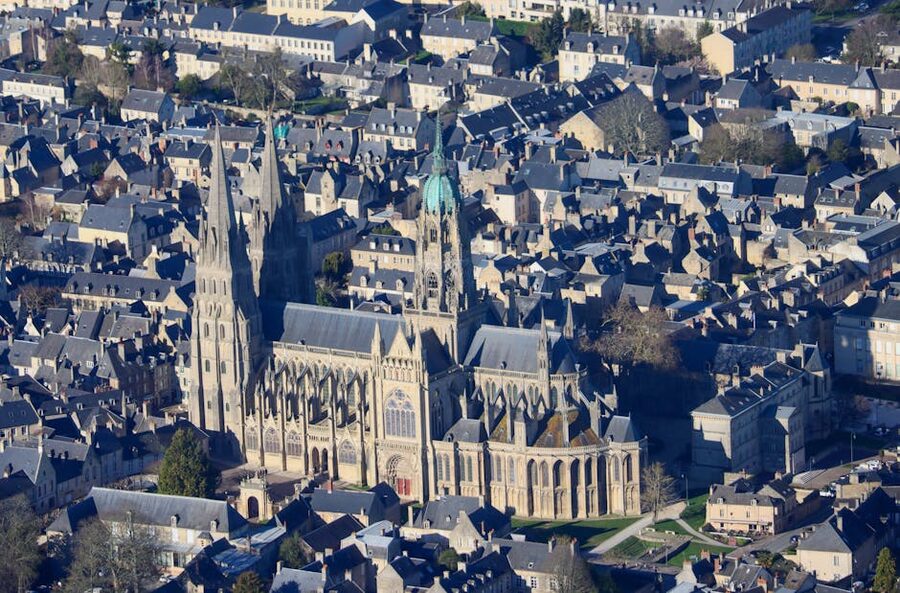
Bayeux is the small medieval town the Allies took on D+1 and deliberately spared the bombing that flattened Caen. The train from Paris Saint-Lazare is 2h50, which is about the same as the bus drive but you arrive rested. The hotels are walkable to the cathedral, the British war cemetery, the Bayeux Tapestry museum, and the bus to the beaches. Two days lets you see Sainte-Mère-Église and Utah on day one, the American Cemetery and Omaha and Pointe du Hoc on day two morning, and Arromanches and Juno on day two afternoon. That is the full sweep at human pace.
For travellers comparing this trip to other military pilgrimages, the natural cousin is Les Invalides and Napoleon’s tomb in Paris itself. Napoleon’s military empire and the Allied liberation of France two centuries later both end in the same line of remembrance: France honouring the soldiers who fought across its soil. Visit Les Invalides on the day before or after Normandy, and the connection is obvious. The Dutch counterpart sits at the other end of the same war: the Anne Frank walking tour through the Jordaan in Amsterdam, which tells the story of the people the Normandy landings were ultimately racing toward. The two trips together (Normandy and Anne Frank, in either order) are the most coherent two-stop WWII itinerary in western Europe.
The Bayeux Tapestry, briefly
While we are on Bayeux: the Bayeux Tapestry deserves a one-paragraph mention. It is a 70-metre embroidered cloth, made around 1077, telling the story of William the Conqueror’s invasion of England in 1066. It hangs in a dark, climate-controlled gallery at the Centre Guillaume le Conquérant. You walk past it slowly with an audio guide. The whole visit takes about 90 minutes.
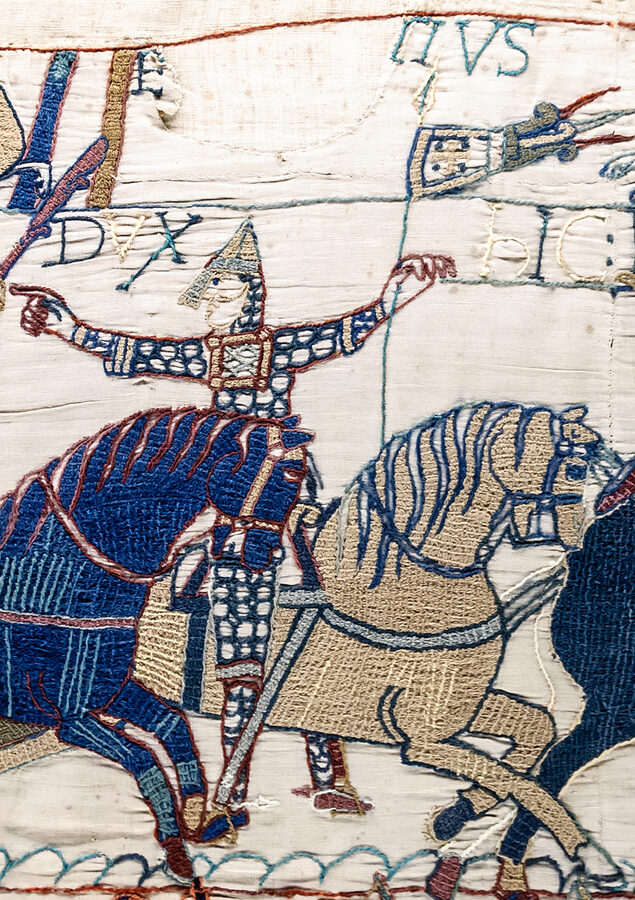
It is a completely different war from D-Day. Almost the opposite, in fact: 1066 was a French invasion of England, 1944 was an Allied invasion liberating France. But standing in front of an 11th-century battle scroll the morning after standing in front of a 20th-century military cemetery is one of those Normandy experiences that you cannot replicate anywhere else.
Best months and what each season actually looks like
The day-trip operates year-round, but the experience changes with the season:
- April to mid-June: The classic time. Long days, cool weather, fewer crowds. Avoid the week of 6 June itself.
- Late June to August: Warm, but the cemetery and bunkers absorb heat. Crowds peak in late July. Pre-book your day-trip at least two weeks ahead.
- September to October: The best month, in my opinion. Atlantic light is softest, crowds drop, and the cemetery roses are still blooming.
- November to March: Winter day-trips run on a reduced schedule. Some operators close completely from December to February. The sea is grey, the wind is stronger, and the cemetery in low December light is one of the most haunting things you can see in Europe. Pack like you mean it.
If you want a single recommendation: a sunny weekday in mid-September, two weeks after the schools go back. Light traffic, light crowds, light backpack. That is the version that makes the 17-hour day worth it.
One last thing: what to actually feel
I think the question that hangs over the day, especially for first-timers, is “how am I supposed to feel about this?” The real answer is: you don’t have to decide in advance. You don’t have to be moved on cue. You don’t have to be reverent in every minute. Some people walk the cemetery in silence and cry quietly; some walk it talking quietly with a friend; some walk it methodically, photographing names and dates because it gives them something to do with their hands. All of those responses are fine.
What does not work is jingoism. The Allied dead are buried beside German dead in plenty of cemeteries on this coast. The Caen Memorial spends as much time on French collaboration and the Resistance as it does on the landings. Pointe du Hoc commemorates 225 American Rangers, but it also marks where 200 of them died in two days. The day is about specific people in a specific moment, and the more specific you let it be, the more it will land.
If you have read three other Normandy guides and one of them told you to “step into the pages of history,” ignore that one. This is a bus ride, a museum, a walk on a beach, and a long trip back to Paris with nobody on the coach saying very much. That is the trip. That is enough.
Where to go from here
Normandy pairs naturally with the other big France day-trips. The day-trip cousin of D-Day, in pure travel-logistics terms, is Mont Saint-Michel. Both are on the Normandy and Brittany coast, both are long-haul out of Paris, and a savvy two-night base in Bayeux or Caen can fit both into the same trip. If you have a longer France itinerary, Loire Valley castles and Versailles are the next natural day-trips, both south of Paris, both in the Île-de-France direction. Inside Paris itself, the strongest pairing with Normandy is Les Invalides and Napoleon’s tomb, which closes the French military pilgrimage circle in a way no other Paris site does. For a quieter, more contemplative Paris day after the bus ride home, Sainte-Chapelle and the Conciergerie on Île de la Cité is the right pace.
If your travels take you further south or across the Mediterranean, Normandy’s WWII-pilgrimage rhythm has cousins worth visiting. Italy’s Matera Sassi tour covers the post-war Italian neorealist depopulation of the cave city, the same era seen from a different country’s wound. Spain’s Gibraltar from Málaga is the strategic-territory cousin: the Rock was the Allied southern command base for Operation Torch in 1942, two years before D-Day, and is still British soil today. Both pair sensibly with Normandy if you are stitching a longer European itinerary together. For a Paris-area sister trip, Giverny and Monet’s house is the natural day-after, and a Seine river cruise in the evening is the right way to stop thinking about anything for an hour. If your Paris time is short and you need a single tower view to anchor the city, the Eiffel Tower at sunset is still the answer. For a full single-day medieval-castle south detour, Carcassonne is the one. For Lyon, Lyon city tour covers the gastronomic capital. For Madrid sweeps, Segovia and Ávila from Madrid mirrors the long-coach-day-trip rhythm out of a different European capital.
The Normandy day-trip is not the trip you take to tick a box. It is the trip you take when you want to leave Paris feeling like you actually went somewhere. Book the early coach. Sleep on the way home.