
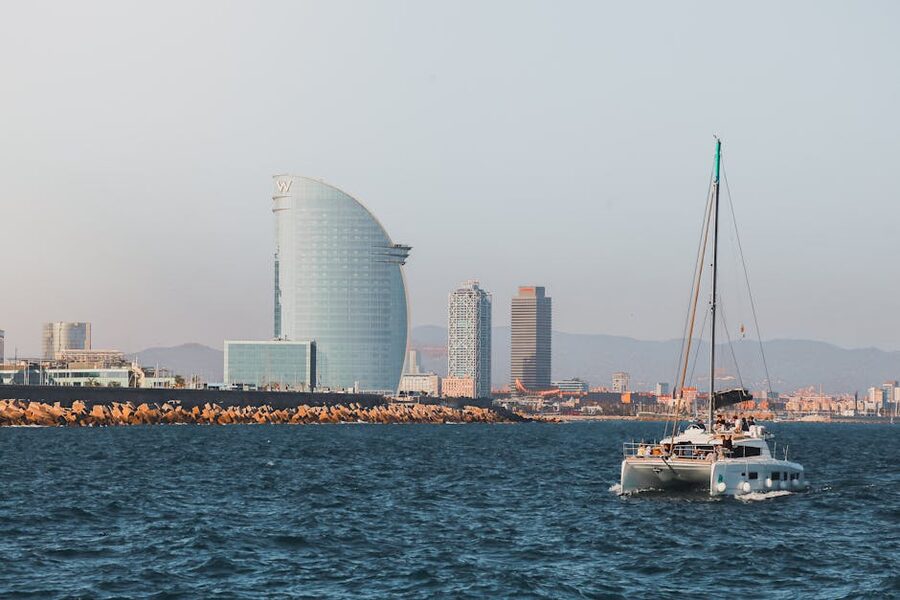
Three minutes after the catamaran clears the breakwater the engines cut. The big sails go up, the boat tilts a little to port, and Barcelona rearranges itself behind you. The Sagrada Familia spire is suddenly the tallest thing in your eye line, framed not by other buildings but by sky and the W Hotel’s blade of glass at the harbour mouth. Tibidabo sits on its hill in the far distance with the basilica catching the last of the afternoon light. You have seen the city from the cable car, from Park Güell, from the top of the Sagrada itself. None of those views look anything like this one.
This is a guide to booking a catamaran cruise from Barcelona without overpaying, picking the wrong departure, or buying a “sailing tour” that turns out to be a motorised tin can with a Ronaldo flag. The good versions of this experience are very good. The bad versions exist too. Here’s how to tell which is which, when to go, and which three tours I’d actually book.
In a Hurry: Three Picks
1. Cheapest, fastest, fine: Daytime or Sunset Catamaran with Music: $15
One hour out and back, music on deck, decent for a quick first taste of Barcelona from the water. The least committal way to find out whether you actually like sailing.
2. The one most people should book: Sunset Catamaran Cruise With Live Music: $33
Ninety minutes, live jazz on a 78-foot boat, an actual net hammock area at the bow, sunset timing. This is the trip your friends will ask about.
3. Bigger spend, more on board: Sunset or Day Cruise with Tapa and Drink: $32
Two hours, a swim stop on the day version, and a paella tapa plus a drink included. Picks up the slack if you skipped lunch and don’t want to land back hungry.
What “Catamaran from Barcelona” Actually Means
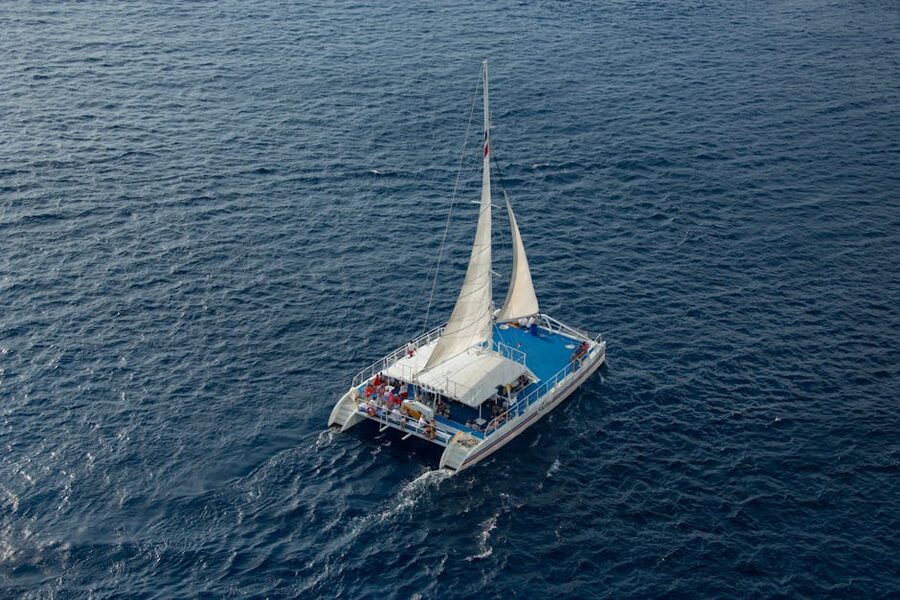
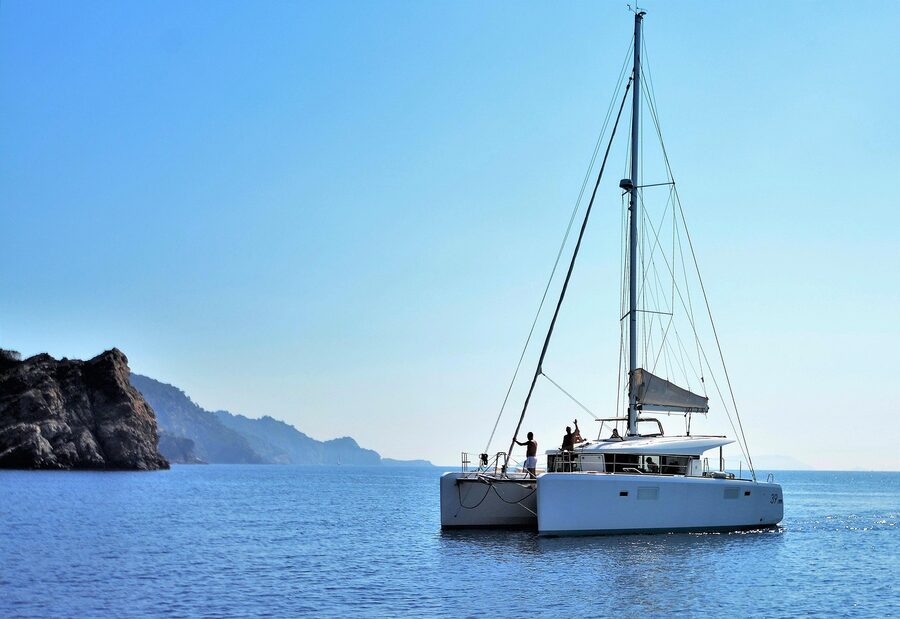
The word covers more types of boat than you might expect. The cheapest tours run on twin-hull motor catamarans with a sail that mostly stays furled and an electric or diesel engine doing the actual work. The mid-range ones are real sailing catamarans, 60 to 80 feet long, with sails that go up once you’re out of the port traffic zone. The top end is a private charter on a Lagoon or similar, ten to twelve people maximum, with a captain and sometimes a chef.
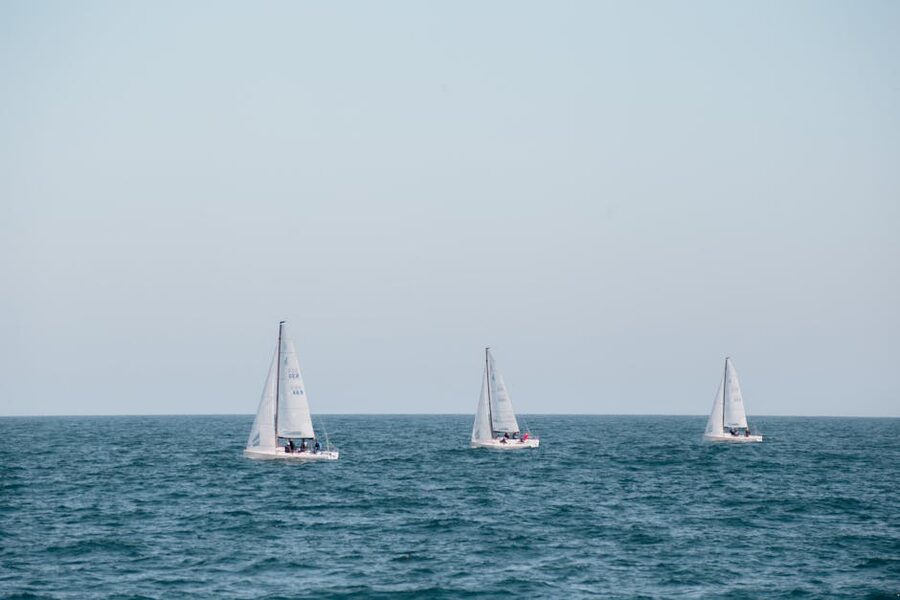
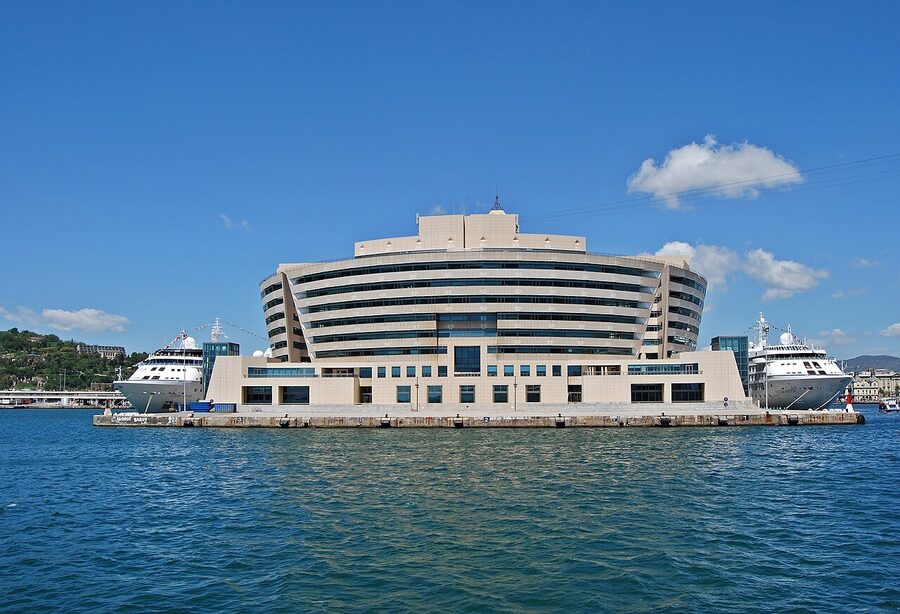
The route is roughly the same across all three. You leave from Port Vell, the marina at the bottom of La Rambla, motor through the working harbour past the cruise terminals and the World Trade Center, clear the breakwater that runs out from the port mouth, and then turn left along the coast toward the Forum. Sails up. Music if there is music. Open bar if there’s an open bar. About forty minutes of sailing parallel to the coast at a couple of nautical miles offshore. Then back in the same direction.
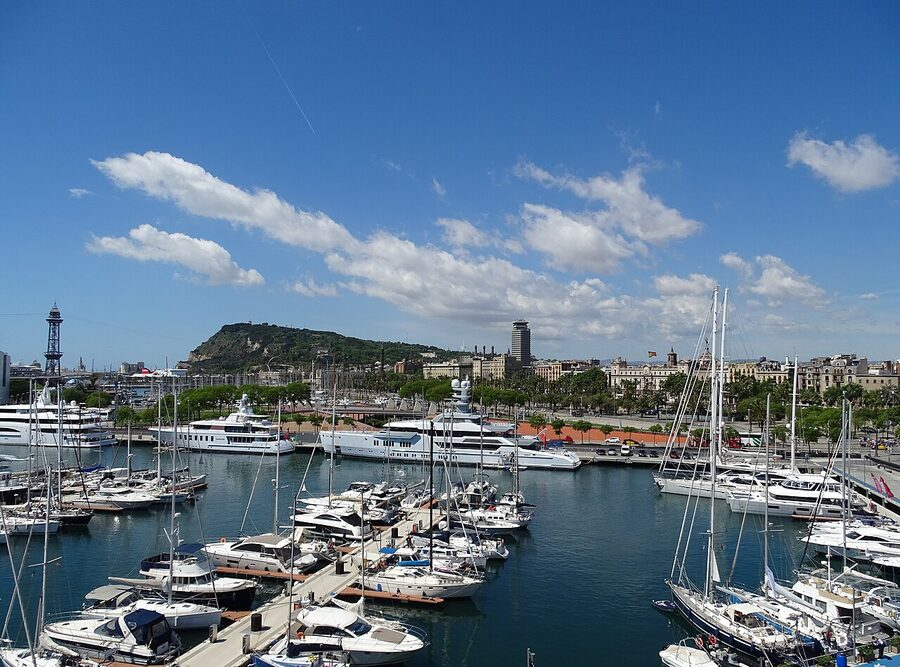
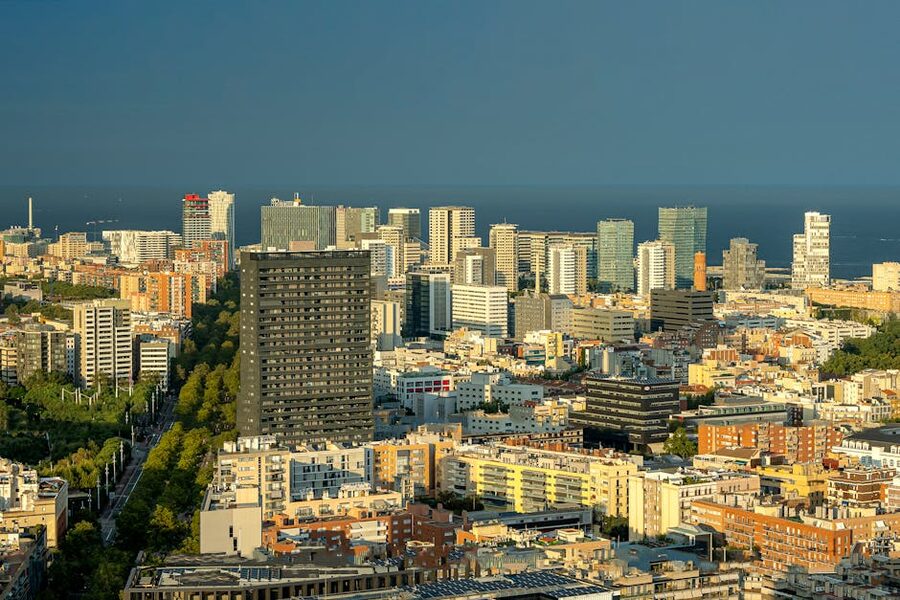
The whole loop is between one and two and a half hours depending on which tour you pick. Nobody goes far. You don’t need to. The point isn’t distance. The point is the angle. From the deck, looking back, you can see the entire city compressed into one frame: Montjuïc on the left with the Castell on top, the W Hotel like a glass spinnaker at the harbour mouth, Barceloneta’s grid of fishermen’s blocks, the Sagrada’s spires poking up out of the Eixample, and Tibidabo back behind everything. You cannot see this from the Montjuïc Cable Car. You cannot see it from a hotel rooftop. You can only see it from out here.
Which Boat Type Is Right For You
The motor catamaran with a token sail:
This is the $15 to $20 bracket. Boats hold sixty to a hundred people. You’ll be on deck shoulder to shoulder if it’s full, but the boats are wide enough that you can usually find a corner. The sail goes up for show, the engine does the work. The trip is short, an hour total, and the music is canned reggae or chill house.
This is fine if you have one afternoon and just want to see the skyline from the water. It is not “sailing.” If you have set a hard ceiling at twenty euros and you accept that this is a sightseeing motorboat with a marketing department, you’ll have a perfectly good time. If you wanted the wind-and-water version, spend more.
The proper sailing catamaran:
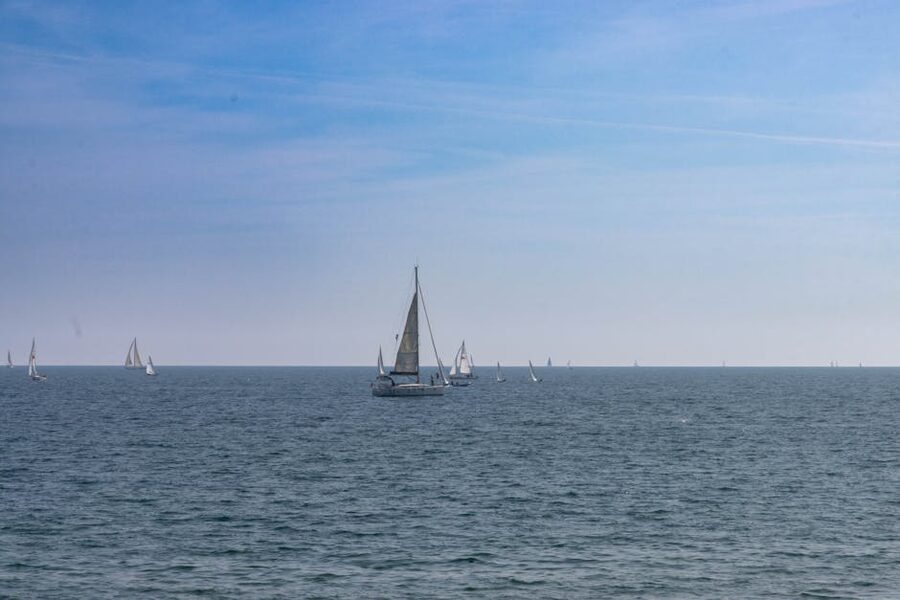
Thirty to forty euros, ninety minutes to two hours, fifty to seventy passengers on a 70 to 80 foot boat. These are the ones with the bow netting (the trampoline area between the two hulls) where you can lie flat and watch the water rush past four feet beneath you. There’s almost always a bar, often live music, sometimes a swim stop on the day cruises.
This is the sweet spot. You’ll feel the boat actually sail, the engine cuts properly once you’re out, and the photos look like sailing photos rather than a packed deck. If you only book one boat tour in your trip, this is the bracket to pick.
The private charter:
From around two hundred euros for a small group up to nine hundred plus for a full charter on a Lagoon 50. Six to twelve people, a real Captain, sometimes a chef on board. You pick the route and the duration. You can swim wherever you want.
The maths only works if you have the people to fill it. A six-person charter at three hundred and sixty euros is sixty per head, which is competitive with a per-person sunset cruise but you get the boat and the captain to yourselves. If you’re a couple, the open cruises are better value. If you’re a family of six on a special occasion, the charter is better than three hotel meals.
Where the Boat Goes (and What You’ll Actually See)
The route isn’t long. Barcelona’s coastline is a gentle curve that runs more or less north-east from the port mouth, past Barceloneta’s old fishermen’s blocks, past the Olympic Port marina with its Frank Gehry fish sculpture, past the Forum, and on toward Badalona if anyone still has the appetite for it. Nobody goes that far. The standard catamaran turn-around is between Port Olímpic and the Forum, which is about three kilometres of coast.
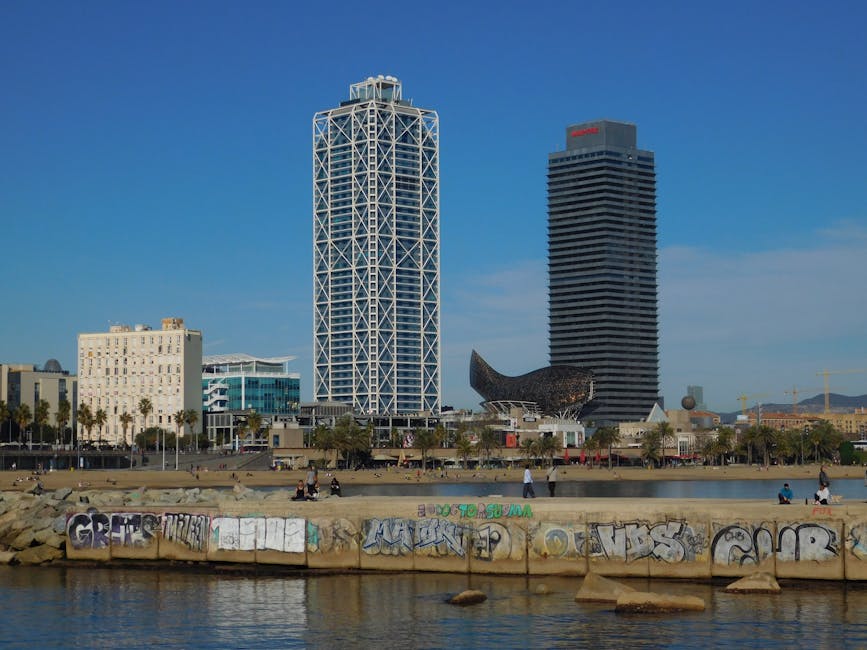
What you’ll see in order, leaving Port Vell:
- The Maremàgnum and the cruise terminals on your right hand side. Mostly machinery and concrete, but you’ll get a close look at the giant cruise ships that visitors at the aquarium are seeing the back of from the rambla.
- The Statue of Columbus at the foot of La Rambla, dead ahead from the boat as you wait for the breakwater gap.
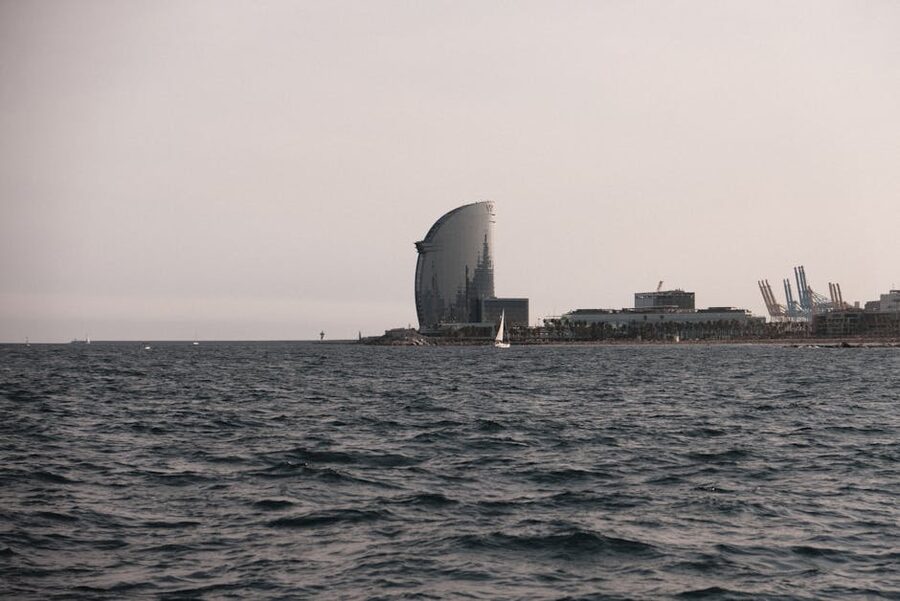
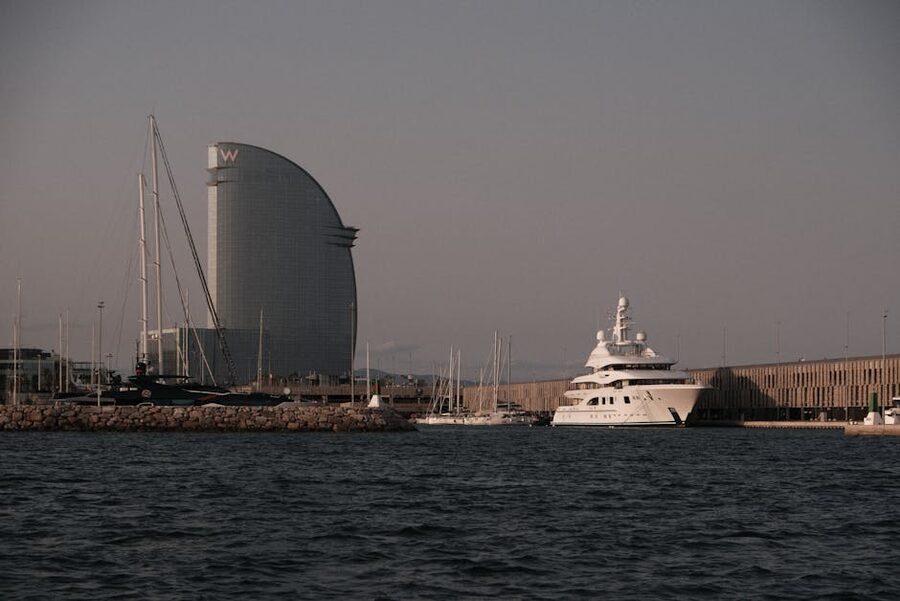
- The W Hotel rising on your left like an enormous glass sail of its own. From the water it’s the most photographed building in the harbour, weirdly more striking than from land.
- Barceloneta beach, the long sand strip that becomes the obvious frame for the city skyline shots. Look at the buildings behind, not the beach. The square grid of low fishermen’s blocks dates to 1753 and is the oldest planned neighbourhood in Barcelona.
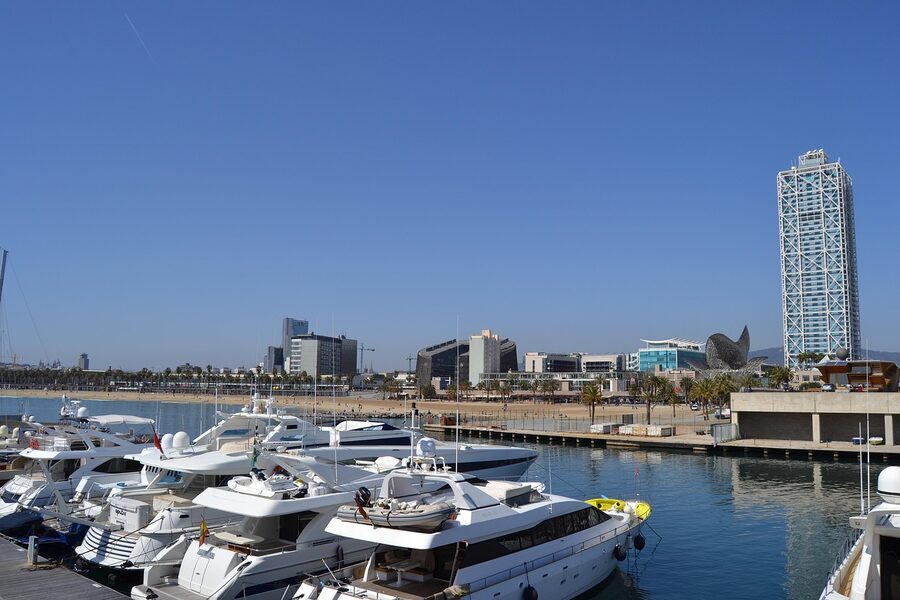
- The Olympic Port, with Gehry’s Peix sculpture (the giant golden fish) glinting on the headland. This is roughly the halfway point of most cruises.
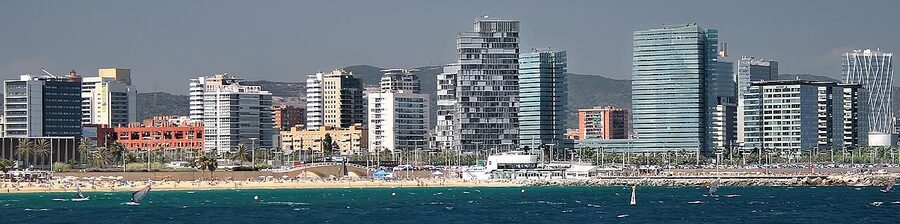
- The Forum and Diagonal Mar at the far end. These are the modern apartment blocks and the photovoltaic panel that looks like a piece of folded paper. Most cruises turn around just before this.
- Behind the city, the green hill of Tibidabo with its basilica, and on a clear day the jagged shape of Montserrat visible on the far horizon to the north-west. The horizon shot of the city with both Tibidabo and Montserrat behind it is the sailor’s photograph that most visitors never get.
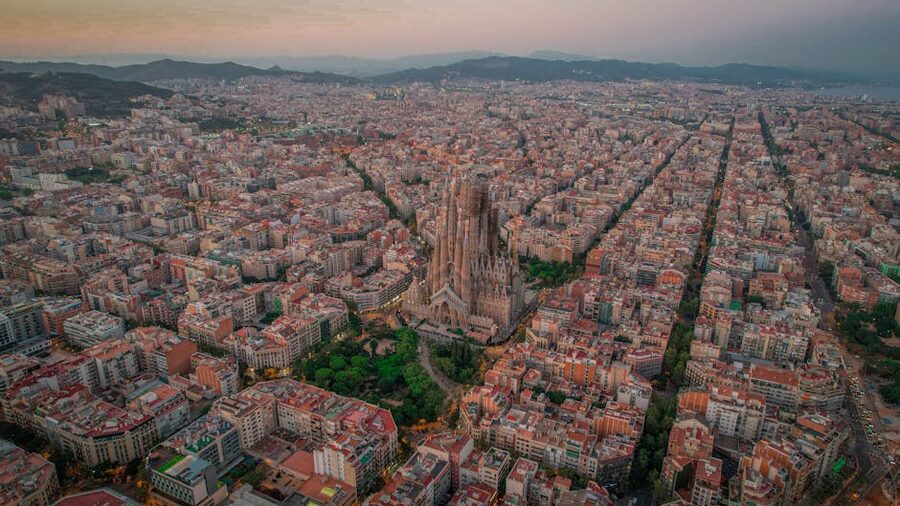
The Sagrada Familia view from the water:
This is the angle people get on the boat and not anywhere else, and it’s worth understanding before you sail so you actually look for it. The Sagrada is two kilometres inland, but the way Barcelona’s grid runs, certain streets line up perfectly with the basilica. From the right point off Barceloneta the Avinguda Diagonal opens straight inland and the spires sit in the gap. You won’t notice the alignment unless you’re watching for it. I missed it the first time and only saw it on the way back.
If you’ve already done the climb up the Sagrada towers or stood under the Passion façade looking up, this offshore angle reframes the whole thing. From inside the basilica it’s a forest of stone. From the deck of a catamaran two kilometres away it’s a piece of urban geometry, the tallest thing in the city, framed by sea and sky.
When to Go: Time of Day Matters
The two real options are daytime and sunset. They’re different trips.
Daytime cruises (10am, noon, 2pm departures):
These are bright, hot, and good for swimming. Most day cruises include a swim stop where they cut the engine, drop a ladder off the back, and let people jump in. The water in summer is around 24 degrees and clean enough for the swim to be pleasant. You’ll see the city in flat midday light, which is fine for orientation but flat for photographs. The W Hotel looks like a flat blue square instead of the silver mirror it becomes at golden hour.
Pick a day cruise if it’s your only window, if you’re travelling with kids who want to swim, or if you’ve already burned the sunset slot on something else. Avoid them in May and early June if there’s any chance of cloud, because the sea looks grey and the city looks washed out.
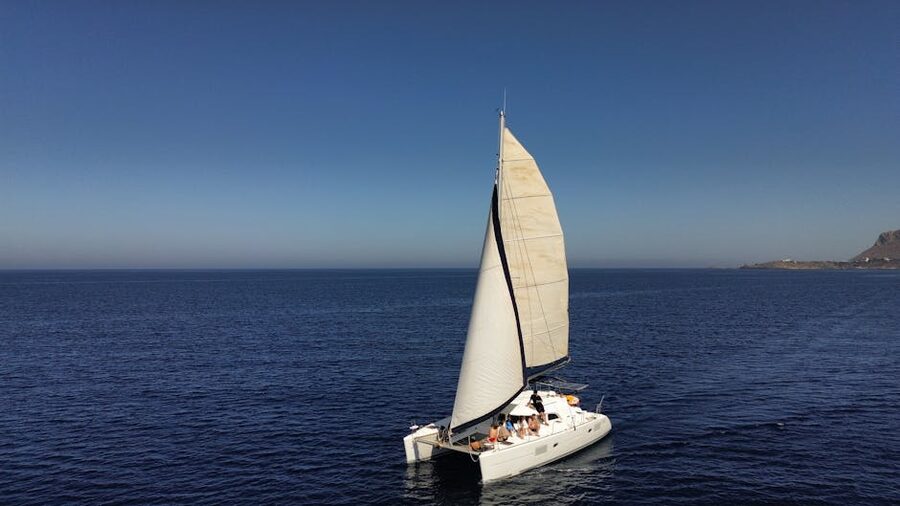
Sunset cruises (departures from about 6pm to 8pm depending on the month):
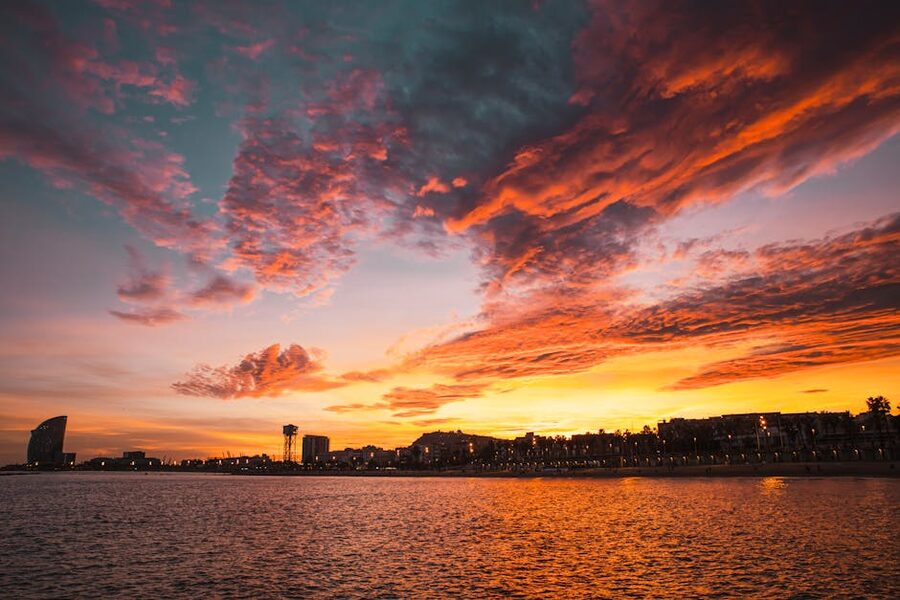
These are the ones I’d book. Departure times follow the actual sunset, so in June you’re sailing at 8pm and getting back in the dark, and in October you’re sailing at 6pm. The light goes from white to gold to pink in the hour you’re out, the W Hotel turns into a mirror, and Montjuïc’s lights come on as you head back to port.
Two practical notes. First, the wind drops at sunset. The boat sails less and motors more on the way back in, especially in summer. The sails go up for the outbound leg and come down for the return. Second, the bar gets busy at 7pm. If you want a drink, get it before the sun starts going down.
Should you do dinner on board?
Some operators run “dinner cruises” with a paella or a Mediterranean buffet on deck. Skip them. You’re paying double for food that’s been kept warm in a small galley while the boat moves. Eat on land, where there are about a thousand better options. A proper tapas crawl in Gràcia or El Born the night before or after will run you about the same money and feed you actual food. The boat’s job is the view, not the kitchen.
How Much Does It Cost
What you’ll pay as of writing:
- $15 to $20: short motor catamaran, one hour, music on deck, no food, drinks for purchase. The Daytime or Sunset Catamaran with Music sits in this bracket.
- $30 to $45: real sailing catamaran, ninety minutes to two hours, sometimes a tapa and drink included, sometimes live music. The Sunset Catamaran with Live Music ($33) and the Sunset or Day Cruise with Tapa and Drink ($32) are both in here.
- $50 to $80: smaller-group sailing tours, often with cava and snacks, sometimes longer (three hours+). Worth the jump if you’re allergic to crowds.
- $200 to $1,000+: private charters, by the boat. Maths works above six people.
Prices have crept up about 15% since 2023. If you booked a $25 sunset cruise pre-pandemic, the same boat is now $33. That’s still cheaper than a couple of cocktails at a rooftop bar with a worse view.
The Three Tours I’d Actually Book
1. Daytime or Sunset Catamaran Cruise with Music: $15
If you want the cheapest decent way to see Barcelona from the water, this is it; our full review covers what to expect on the boat and which departure slot is worth queueing for. Don’t expect proper sailing or food, do expect a one-hour skyline cruise that costs less than two beers in El Born. Pick the sunset slot if it’s available; the daytime version is fine but the photographs work harder at golden hour.
2. Sunset Catamaran Cruise With Live Music: $33
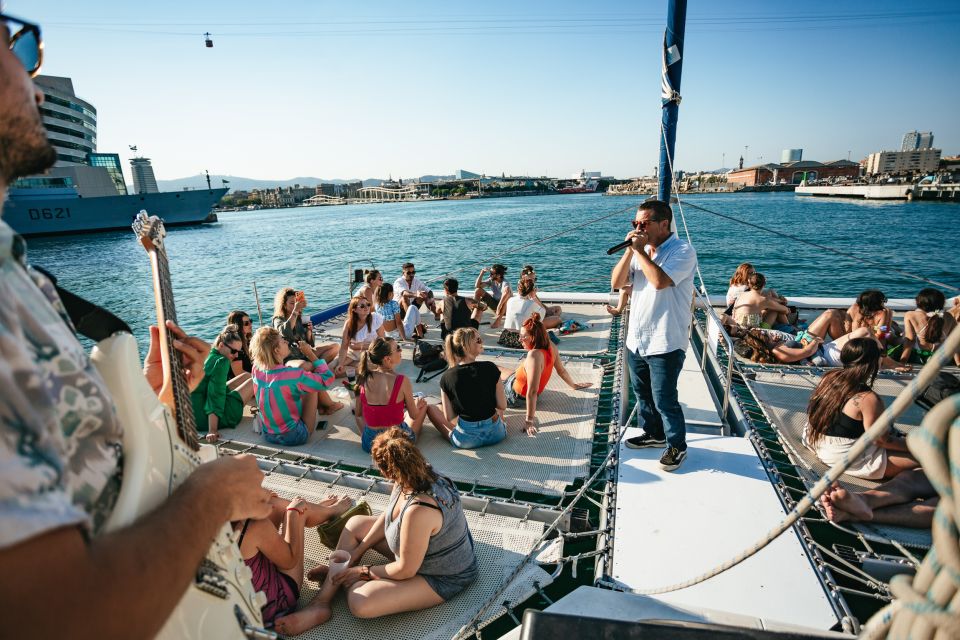
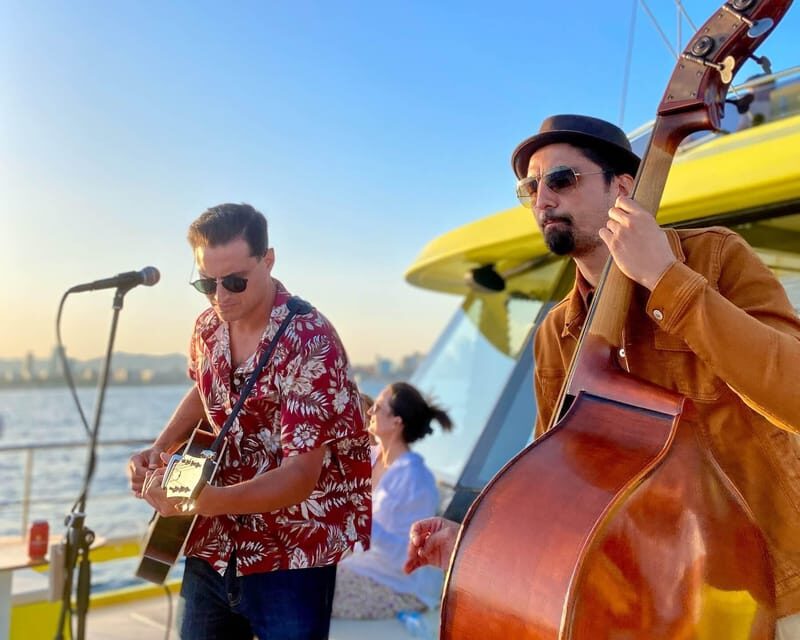
This is the one I’d book if I had to pick a single Barcelona boat tour, and our review walks through which deck spot to grab when you board. The bow nets are first-come, first-claimed. The jazz is genuinely live, not a Bluetooth speaker; it’s two musicians who don’t try to compete with the wind.
3. Sunset or Day Catamaran Cruise with Tapa and Drink: $32
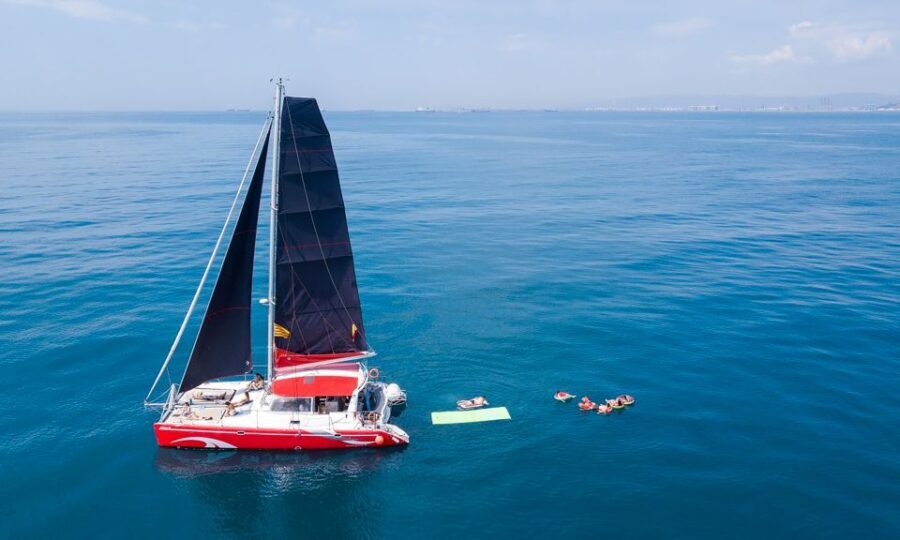
If you want the longer trip with a swim stop and a taste of paella included, this one earns its keep, and our review covers the day-vs-sunset trade-off. The day cruise is the better swim trip; the sunset version skips the swim and gives you the full golden hour instead. Pick by what you actually want from the trip.
Where the Boats Leave From and How to Find Yours
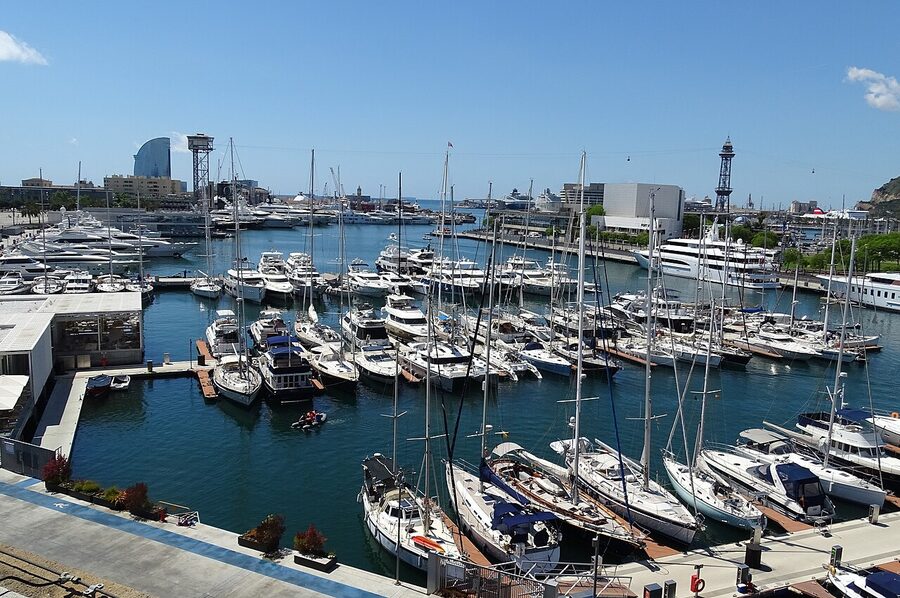
All catamaran tours in Barcelona depart from Port Vell, but Port Vell is bigger than it looks. Most boats use one of three docks:
- Moll de Drassanes: the closest dock to the Columbus statue and La Rambla. Walk straight from the rambla over the wooden footbridge and you’re there. Most music catamarans depart here.
- Moll de la Fusta: the long stone quay that runs along the inland side of the basin. Live-music sailing catamarans tend to dock here.
- Port Olímpic: a separate marina about two kilometres along the coast at the foot of the Olympic district. A handful of charter and tapa-cruise boats depart from here, not from Port Vell.
Read your booking carefully. The dock name is in the small print, not the headline. If your tour says “Port Olímpic” and you walk to Port Vell, you’ll miss it; the marinas are a 25-minute walk apart along Barceloneta beach.
Getting to Port Vell:
Metro to Drassanes on the L3 (green) line, two minutes’ walk from there. Or get off at Barceloneta on the L4 (yellow) line and walk back along the harbour. The Barcelona hop-on hop-off bus stops at Port Vell on the maritime route, which is the one situation where the bus is genuinely useful for getting to a tour. If you’re on a multi-transport day, the Hello Barcelona Card covers the metro both directions.
For Port Olímpic, get off at Ciutadella – Vila Olímpica on the L4. The marina is a five-minute walk past the Frank Gehry fish sculpture.
On the Day: What to Expect at the Dock
Arriving:
Check-in is usually 15 to 30 minutes before departure. The dock attendant ticks you off a clipboard list and points you at the boat. There is rarely a queue, but turning up five minutes before departure means the good seats (the bow nets, the back-of-stern bench with the view of the city) are already taken.
What to bring:
- A light jacket for sunset cruises, even in July. The wind drops the temperature noticeably once you’re sailing.
- Sunglasses and a hat that won’t blow off. The wind is real on the bow.
- Cash for the bar (most accept card now, but small denominations help with tips).
- If you’re on a day cruise with a swim stop: swimsuit underneath, plus a small towel. They don’t provide either.
What not to bring:
- A drone. Most operators ban them, and the harbour authority doesn’t allow flying over the cruise terminals.
- Heels. The deck is slippery, and the boat moves.
- Anything you can’t afford to drop in the sea. People lose phones and sunglasses every cruise.
Seasickness:
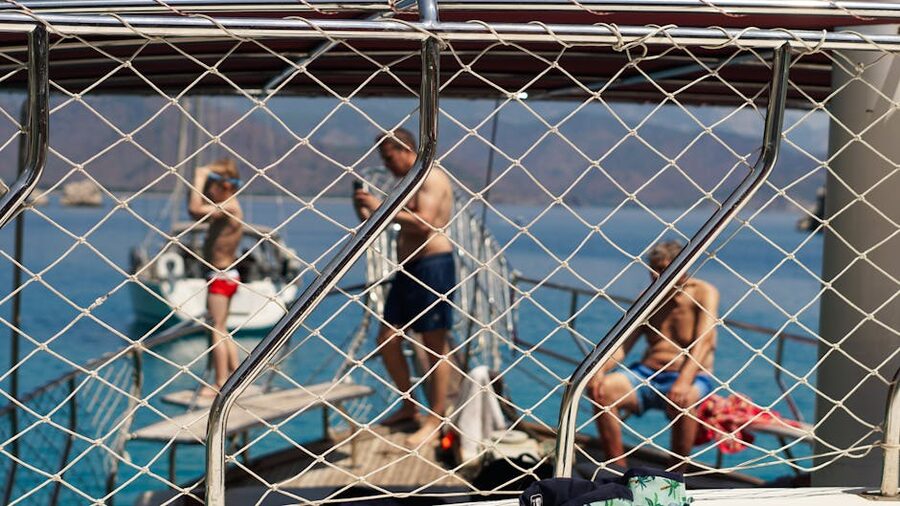
Catamarans are stable. They don’t roll like a single-hull yacht; the two hulls keep them flat. The chance of seasickness on a Barcelona harbour cruise in summer is low. If you do get queasy, the back of the boat (the stern, behind the cabin) is the steadiest spot. Avoid the bow if waves pick up.
Out-of-season cruises (October to April) can be choppier. The Mediterranean isn’t pacific, despite the name, and a south-easterly wind can stir the harbour mouth. If the forecast is for waves over 1.5 metres, the operator will usually cancel and refund. They don’t sail in genuinely bad conditions.
Photography From the Boat
The best shots aren’t the ones you think they’ll be. Here’s what actually works:
- The first ten minutes outbound, looking back at the city as you clear the breakwater. This is the postcard shot. Get to the back of the boat (the stern) for the unobstructed view.
- The W Hotel mirror shot at golden hour, when the building turns into a vertical mirror and you can see the whole harbour reflected in it. You need to be roughly half a kilometre offshore for the angle to work.
- The Sagrada through Avinguda Diagonal, when the boat is at the far end of its outbound leg near the Olympic Port. The street opens straight inland and the spires are in the gap. You only get this for about ninety seconds, then the angle changes.
- The bow netting from underneath, looking up through the mesh at the sails. This is the boat-as-art photograph, not the city photograph.
- The other people on your boat enjoying themselves. Documentary shots beat skyline shots for memory value six months later.
What doesn’t work: long lenses (the boat moves too much for a steady frame), filters (the light changes every two minutes at sunset), and tripods (forbidden on most boats anyway). A phone on a wrist strap and a willingness to take 200 photos is better gear than anything fancier.
Eco Cruises and the Solar Catamarans
A handful of operators run electric catamarans now, with solar panels on the roof powering the motor. The Orsom Eco Catamaran is the most visible of these, and the city-tour bus combo bundles a ride on it. They’re quieter than diesel boats, which makes the music sound better and the sea sound more like sea. The trip is otherwise identical.
If quiet matters to you, or you specifically want the lowest-emission option, the eco boats are the pick. They’re priced about the same as the comparable music catamarans. The trade-off is that they’re slower and the sails are smaller, so you spend more time motoring. Personally I’d take a real sailing boat over an electric one, but it’s a fair preference call.
Common Mistakes (and How to Avoid Them)
Booking the wrong departure time:
The word “sunset” on a Barcelona boat-tour booking page can mean an hour before sunset, fifteen minutes before, or anything from a 6pm to an 8pm push-off depending on the month. Open the booking page, scroll to the dates, and look at the actual departure times for the date you want. In June your sunset is at 9.30pm and the boat leaves at 7.30pm. In December it’s 5.45pm and 4.30pm. If you turn up at “the sunset cruise” expecting golden hour and the sun has already set thirty minutes before you board, you booked wrong.
Confusing Port Vell with Port Olímpic:
Already covered above, but it’s the single most common mistake. The marinas are 25 minutes apart on foot. If you can’t find your boat, you’re probably at the wrong port.
Booking a “private” tour that isn’t:
Some listings say “small group” or “intimate” and then deliver fifty people on a 70-foot boat. Read the fine print. If the tour doesn’t specify a maximum head count, assume it’s a public sailing. Real private charters say “private” in the title and have a per-boat (not per-person) price.
Underdressing in shoulder season:
April, May, October, and early November can feel summery on land and feel cold on the water. The wind on a moving catamaran is at least 10 km/h faster than the wind on the harbour, and the temperature drops 4 to 6 degrees once the sun is down. A summer dress and a t-shirt is not enough for a 7pm October sail.
Overpaying for cava:
The “cava and tapas” cruises charge a premium for one glass of mediocre cava and three or four bites of room-temperature paella. If the included food matters to you, pick the Tapa and Drink tour above (the value is real). If it doesn’t, save the spend and pick the Sunset with Live Music; eat ashore.
Catamaran versus Other Barcelona Boat Options
The catamaran isn’t the only way to get on the water in Barcelona. The other options:
Las Golondrinas (the harbour ferries):
Forty minutes around the inner harbour on a wide flat motor ferry, no sails, six euros per person. Cheap, kid-friendly, frankly a bit boring. You stay inside the breakwater the whole time, so you don’t get the offshore reveal. Skip unless you have small children and a tight budget.
Speedboat or jet-boat:
Loud, wet, fun, fast. Twenty-five euros for a thirty-minute thrill. The opposite of a catamaran trip in tone. Pick this if your group is under 30 and the words “relaxed sail” make you yawn.
Sailing yacht (single-hull):
About the same money as a sailing catamaran but a smaller boat (15-20 passengers), more pitch and roll, more “real” sailing feel. Good if you actually like sailing as an activity. Worse for photographs because the boat tilts more, and worse for the seasickness-prone.
Helicopter (yes, really):
For about 150 euros you can do a 12-minute helicopter loop over the harbour. The view from above is amazing for about ninety seconds, then it’s just hot inside the cabin. The catamaran wins on time-on-the-water-per-euro by a mile.
If you’ve done the boat trips elsewhere on the Mediterranean coast and want to compare: the Capri boat tour from Naples is the cliffs-and-grottoes version, completely different in mood; the Polignano a Mare cruise is the cave-and-limestone version, half the price; the La Maddalena boat from Sardinia is the swim-and-snorkel version, longest day on the water. Barcelona’s catamaran trips are the urban-skyline version. None of the others give you a city skyline behind the boat. If you’ve already done the Italian coastal cruises, the Barcelona one isn’t a repeat; it’s a different category. The French Mediterranean cousins are the Sainte-Marguerite ferry from Cannes and the Ajaccio Corsica boat tour: same blue water, different shore profile, both useful comparison points if you’re choosing one Mediterranean boat day.

If You’re Pairing With Other Barcelona Things
The catamaran fits naturally with the architecture day. Sagrada Familia in the morning, Casa Batlló at midday, La Pedrera mid-afternoon, sunset catamaran. You’ll have seen the city’s skyline at street level, then close-up at the buildings, then from out at sea, all in twelve hours. Eat tapas afterwards in El Born or Gràcia (we’ve broken down the tapas-tour vs DIY question separately).
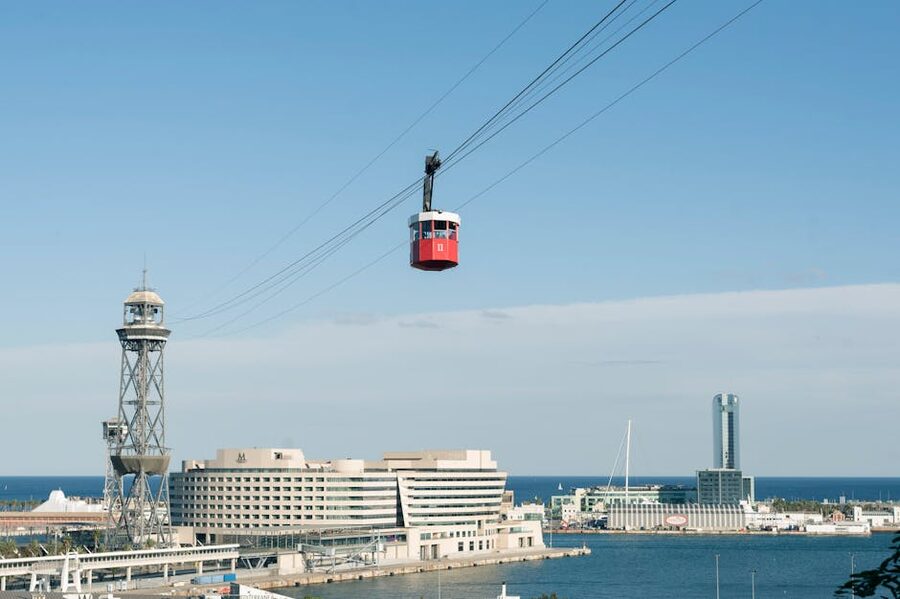
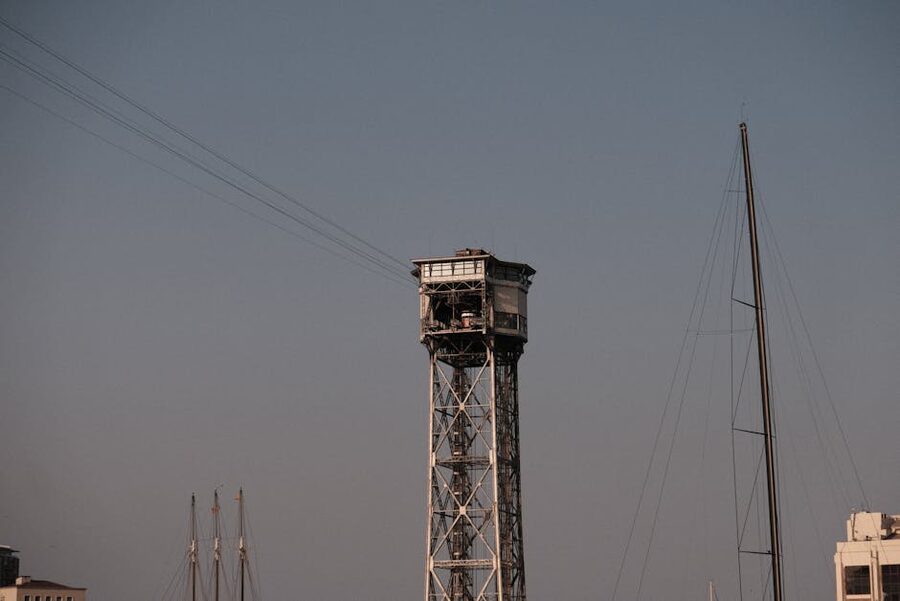
If you’re stacking with the Montjuïc visits: the cable car in the morning gives you the high-up city view, and the catamaran in the evening gives you the low-down sea view. They pair beautifully, and the cable car is the one stop where you can see your boat passing below. The Montjuïc-then-catamaran day is the best non-architecture single-day Barcelona itinerary I know.
An evening pairing: catamaran at sunset, then flamenco at one of the small Born tablaos at 10pm. You leave the boat at 9.30, walk eight minutes through Barceloneta to El Born, sit down for the show. Two of the most-Barcelona experiences in the city, both happening in their proper light: the boat at golden hour, the flamenco at full dark.
Booking Through GetYourGuide vs Viator vs the Operator Directly
The three booking routes:
- GetYourGuide: usually the cleanest customer experience. Mobile vouchers, easy cancellation 24 hours out, customer service responds in English. Slightly higher commissions baked into the price (about 5% over the operator’s direct price).
- Viator: similar, sometimes a few dollars cheaper, sometimes a few dollars more, customer service variable. The mobile experience is fine.
- Booking direct with the operator: cheapest by 10-15%. The trade-off is that if there’s a problem (you missed the boat, the weather cancellation refund is delayed), you’re dealing with a small Spanish company in their second language. Worth it on the cheap motor cruises where the savings outweigh the friction. Not worth it on the bigger sailing cruises where you want the cancellation flexibility.
The smart move on a $15 boat is to book direct from the dock the day of, paying cash, on a sunny afternoon. The smart move on a $33 sunset cruise is to book through GetYourGuide a week in advance, because the good slots sell out and the cancellation buffer is worth the small premium.
Cancellation rules:
Most catamaran tours allow free cancellation up to 24 hours before. Some require 48. None refund less than 12 hours out. If the weather cancellation is the operator’s call (high winds, storm warning), they refund regardless. Read the small print before booking, especially if you’re chained to a non-refundable hotel and there’s a chance you’ll change your dates.
Is It Worth It?
Yes, in the right slot. Barcelona is a city you can experience perfectly well without ever getting on a boat. The Sagrada, the Picasso Museum, the tapas, the Gaudí walk, none of it requires the sea. But the catamaran adds something none of the other things do; it gives you the city as a single composition, framed by water. That angle pays off most at sunset, on a real sailing catamaran, with a glass of cava in your hand and an hour and a half before you have to be back on land.
The $33 Sunset Catamaran with Live Music is the easy recommendation. If you’re on a hard budget, the $15 day or sunset music cruise is genuinely fine. If you’re with a group of six or more on a special trip, the private charter beats anything else for the per-head price.
If you’re trying to decide between this and another boat day in Spain on the same trip, the answer depends on which coast you’ll be on. A catamaran cruise from Mallorca is more about coves and clear water, less about a city skyline; an Ibiza beach cruise is the party version. Barcelona is the urban version, and on most short visits the catamaran out of Port Vell is the one to do because you’re already in the city. The Mallorca and Ibiza boats are better, but only if you have a separate trip to the islands. Northern-Europe travellers comparing options will find the closest urban-skyline parallels in Amsterdam canal cruises (slow, narrow, indoor most of the year) and the working-port version on a Rotterdam harbour cruise.
One Last Thing: The Music Question
Two of the three tours I’d recommend involve music on the boat. People react differently to this. If you wanted a silent contemplative sail, you’ll be annoyed; the live jazz cruise has a duo playing for an hour, the music cruise has DJ-driven house and reggae. If you wanted a party-like atmosphere, the music will be the part you remember. There is no silent catamaran in the Barcelona public market. The closest thing is a private charter where you tell the captain to leave the speaker off, and even then the city is loud enough that you’ll hear it.
My bias: the live jazz on the $33 boat is good. The duo plays standards over the engine drone and the wind, and the music is at the volume of a good restaurant, not a club. The DJ on the $15 boat is louder and more generic, fine for a single hour. If music ruins the trip for you, book the private charter or skip the catamaran and do a Venice gondola on a different trip; that’s the silent boat tour the Mediterranean is famous for.
Final Practical Notes
A few things that don’t fit anywhere else but matter:
- Children: most catamarans take kids from 4 or 5 upward. Toddlers usually allowed but no high chairs and no specific kid programming. Lifejackets available on request.
- Wheelchair access: limited. The Daytime music catamaran has a flat boarding ramp at Drassanes; the bigger sailing boats require stepping over a guardrail. Email the operator to confirm.
- Pets: not allowed on any of the public boats. Service dogs are an exception, on request and with paperwork.
- Drinks on board: beer, cava, soft drinks, water, sometimes a basic cocktail menu. Prices roughly twice land prices.
- Toilets: yes, all the bigger sailing catamarans have at least one. The smallest motor catamarans don’t. Use the marina toilets before boarding.
- Wifi: don’t count on it. Phone signal is fine within two kilometres of shore on Movistar and Vodafone. Beyond that, patchy.

The Trip You’re Booking
You’re booking ninety minutes of perspective. Not adventure, not a destination, not a meal. Perspective. The thing you’ll remember six months later is not the music or the cava. It’s the moment about ten minutes after the breakwater when the city compresses into a single image and you realise you can see the Sagrada, Gaudí’s Casa Batlló roofline (just barely), Montjuïc’s castle, the Olympic Port and Tibidabo behind it all in one glance. That’s the photograph you’ll print.
For thirty-three dollars and ninety minutes, that’s a fair trade. Pick the sunset slot. Get there fifteen minutes early. Take the back-of-stern bench, with the city behind you and your phone ready for the moment the breakwater clears.