
Somewhere behind the wall of the Salone dei Cinquecento, possibly painted over by Giorgio Vasari in 1563, is what might be the most important lost painting in art history. Leonardo da Vinci’s Battle of Anghiari was started in 1503 directly onto a 17-metre wall in this room. He gave up halfway. Vasari was hired sixty years later to redecorate, and the working theory is that he built a false wall over Leonardo’s unfinished battle scene rather than destroy it. Modern art historians have spent decades trying to confirm whether the original is still back there. Nobody knows for sure.
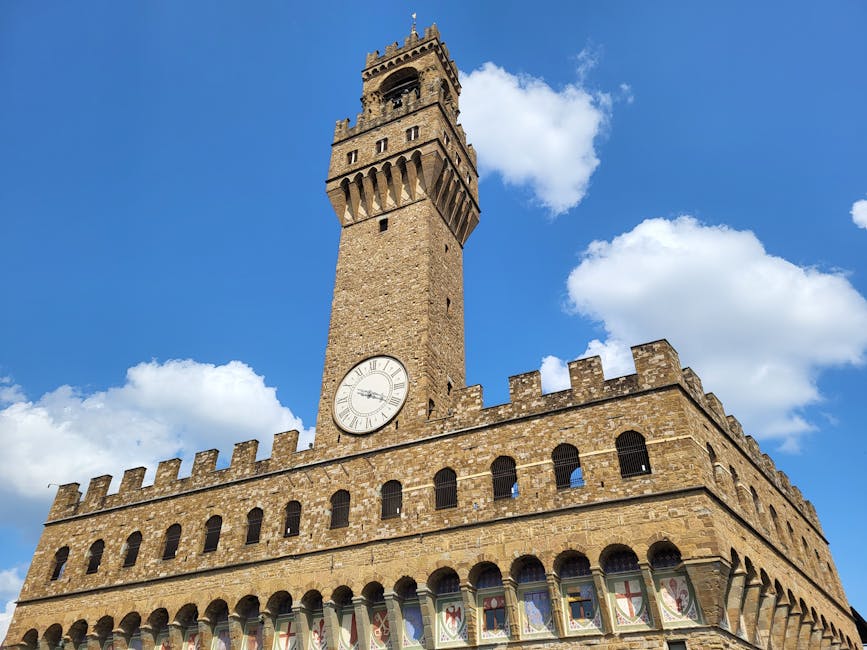
This is a guide to actually visiting Palazzo Vecchio, the medieval town hall that became a Medici palace, became a museum, and is still the working seat of Florence’s mayor. Below is what to book, the rooms worth seeing, and how to climb the tower without paying for a tour you don’t need. Other European civic-and-residence palaces follow the same dual life: Amsterdam’s Royal Palace still hosts state dinners on the same floor where civil servants once ran the city, and Casa de Pilatos in Seville is a working aristocratic residence that opens part of itself to the public.
In a Hurry — Just Tell Me What to Book
- Best overall: Palazzo Vecchio Entrance Ticket + Audioguide ($37) — covers the museum, the Salone dei Cinquecento and the Studiolo, with audio that’s better than the official one
- Want a guide: Palazzo Vecchio Guided Tour ($52) — 90 minutes with a real Florentine guide, much better for the political history
- For the Vasari secret passages: Skip-the-Line + Secret Passage Tour ($37) — the only way to see the hidden stairwells the Medici used to move around the palace unseen
Tickets, Hours and the Free Bits Most People Don’t Know About
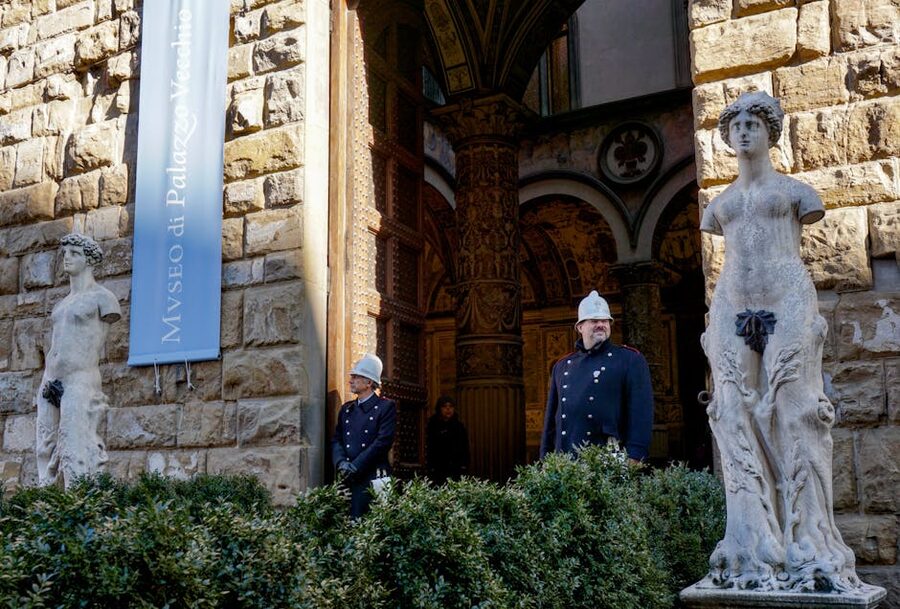
The official admission to the museum is around €12.50 for adults, with under-18s free. The tower climb is a separate ticket at €12.50, or €17.50 combined with the museum. The archaeological route under the building is another small upcharge.
Hours are quirky. The museum is open 9am to 7pm Friday through Wednesday, but on Thursdays it closes at 2pm. The tower closes earlier than the museum (last admission usually around 5pm). Closed January 1 and December 25.
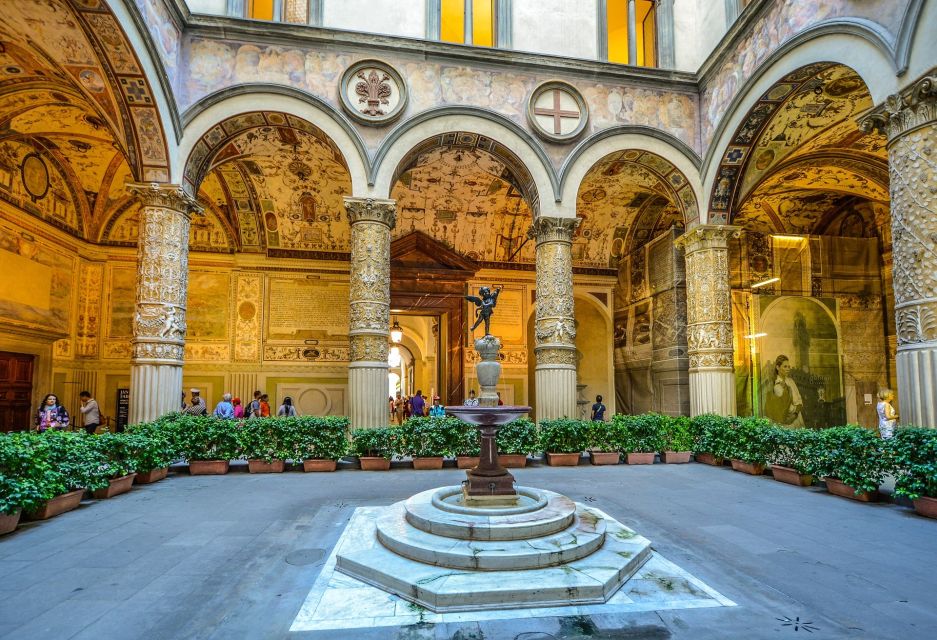
The free part nobody mentions: the Michelozzo Courtyard inside the entrance is free to enter. You can walk in past the ticket desk, look at Verrocchio’s Putto with Dolphin fountain (well, the copy — the original is upstairs), photograph the frescoed walls and the gilded cherubs on the columns, and walk back out. The whole courtyard takes 10 minutes. If you only have an hour in Florence, this is the one stop you can do without a ticket.
The other thing to know: the building still works as Florence’s town hall. The Sala Rossa (Red Room) on the first floor is where civil weddings happen. If you visit on a weekend, you’ll likely see people in formalwear gathering in the courtyard. They’re not travelers; they’re a wedding party. Free for residents, €1,000+ for non-residents — popular enough that there are usually two or three a day in summer.
The Three Tickets Worth Booking
The official Florence Civic Museums platform sells the entrance ticket but the timed-entry system is bare-bones — you book a slot, you turn up, no audio, no commentary. The third-party reseller versions add audio guides or guides at small markups, which is usually worth it for a building this dense with historical context.
1. Palazzo Vecchio Entrance Ticket + Audioguide — $37
This is the right pick for self-guided visitors. You get the standard museum entrance with a downloadable audio guide on your phone, walking you through the Salone, the Studiolo, the Apartments, and the Mappamondo Hall. The audio commentary on the Vasari frescoes is the highlight — it identifies who’s who in the battle scenes and explains the Medici propaganda angle that’s otherwise invisible.
2. Palazzo Vecchio Guided Tour — $52
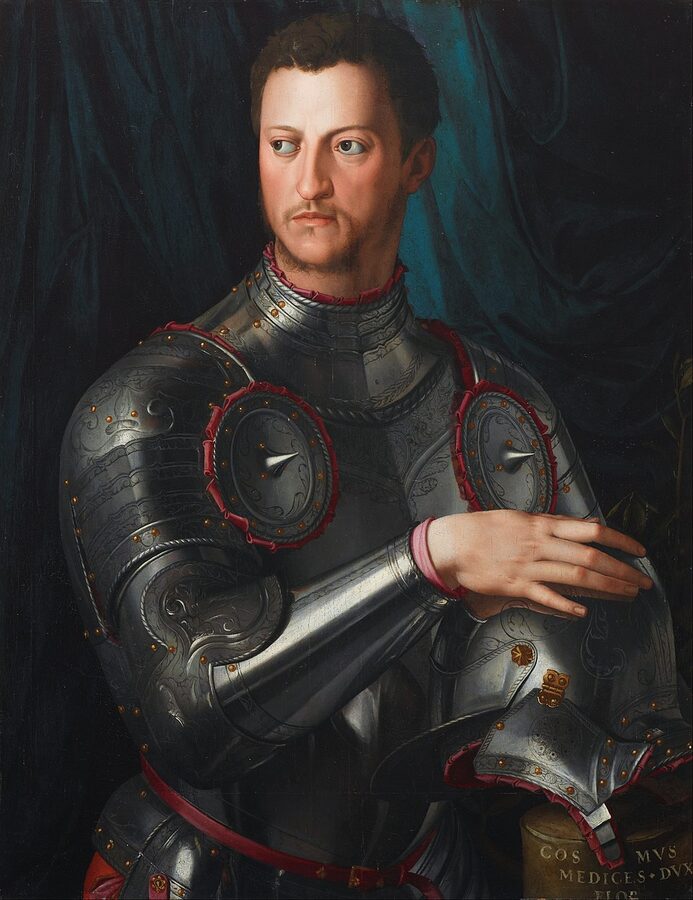
For first-time Florence visitors, the live guided tour is worth the extra cost. Palazzo Vecchio is a building where context is everything — knowing who Cosimo I was, what Savonarola did to the city, why the David got placed where it was placed, and what the Vasari frescoes are actually trying to say transforms a confusing maze of rooms into a coherent story. The guide also covers the rooms most self-guided visitors skip — including the Mappamondo with its 16th-century maps of the world as the Medici understood it.
3. Skip-the-Line Entry + Secret Passage Tour — $37
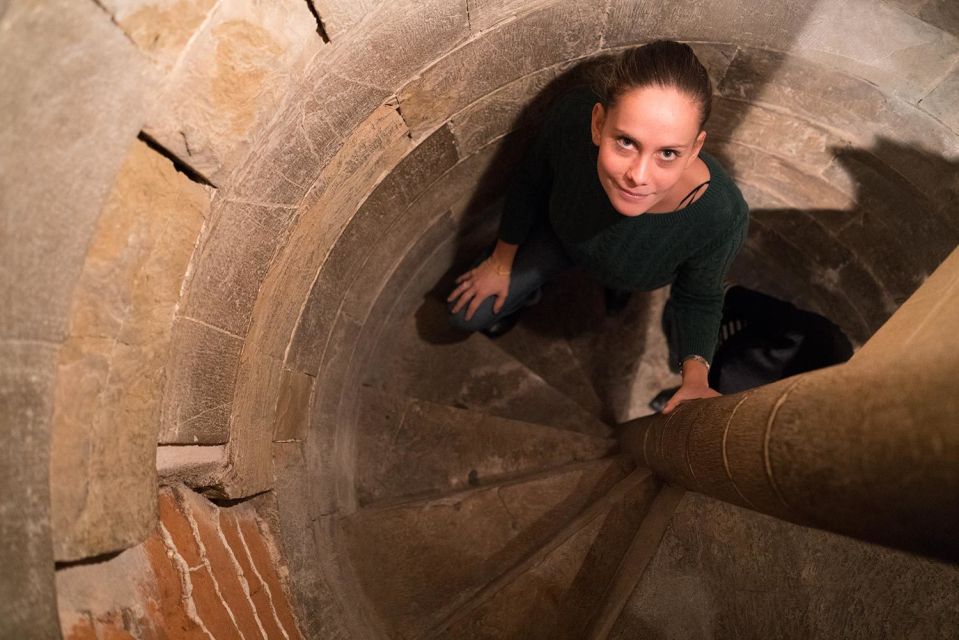
The headline experience that doesn’t appear on any other ticket. The Secret Passages are a network of hidden stairwells, between-floor corridors, and concealed rooms that the Medici used to get around the palace privately. This 75-minute tour walks you through the Studiolo of Francesco I (with the famous spy peephole), then takes you behind the walls. A breakdown of what the passages actually contain — including a section under the roof of the Salone where you can see the original wooden trusses Vasari built.
The Salone dei Cinquecento
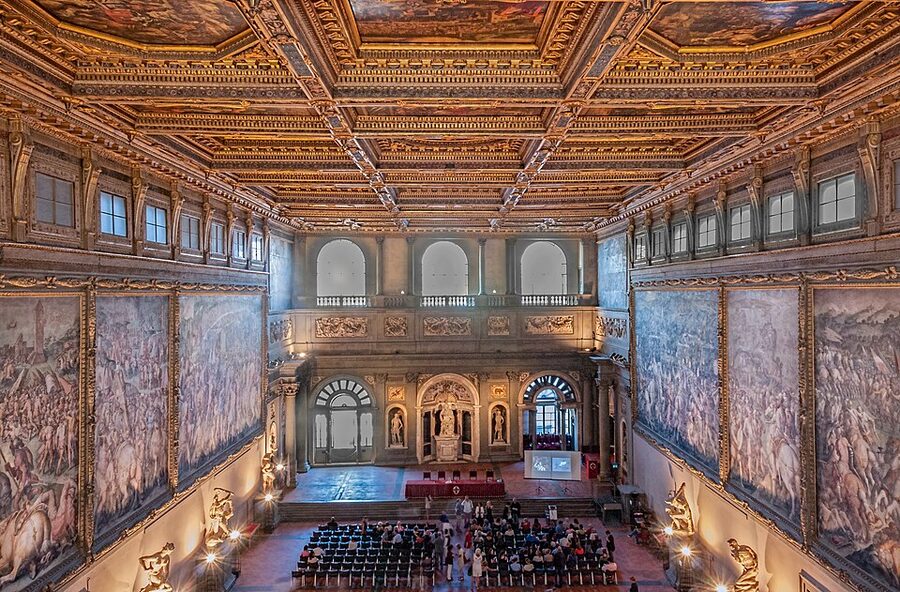
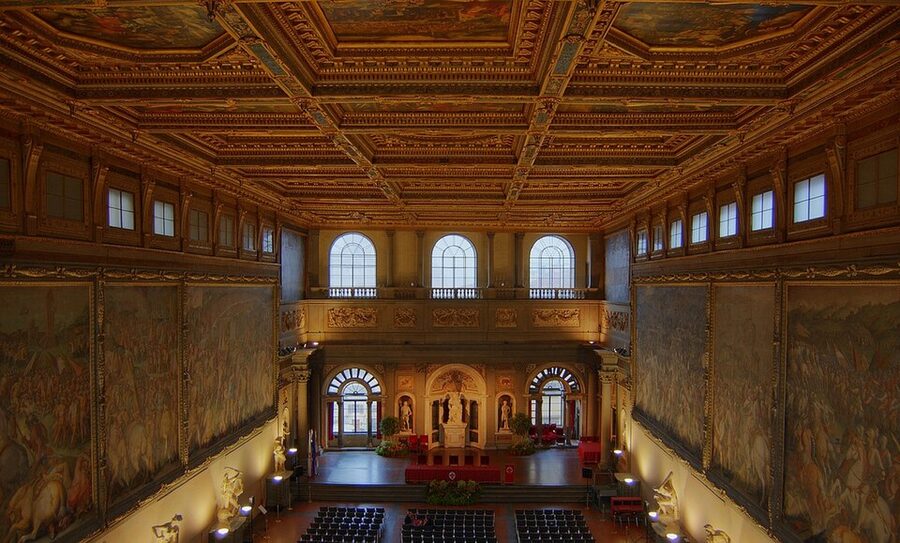
This is the room. Built in 1494 by Simone del Pollaiolo for Savonarola’s Grand Council of 500 citizens (hence the name), then enlarged by Vasari in the 1560s for Cosimo I, the Salone dei Cinquecento is one of the most spectacular interior spaces in Italy. The walls are covered floor to ceiling in frescoes. The ceiling has 39 panels celebrating Cosimo’s life and military victories. There are massive marble sculptures along the walls, including Michelangelo’s Genio della Vittoria (Genius of Victory), usually facing the long west wall. Few civic halls match this scale of self-mythologising decoration, though the Hall of Mirrors at Versailles and the throne room at Madrid’s Royal Palace work the same propaganda-through-paint trick.
The east wall battle scenes are Vasari’s work, painted between 1563 and 1571. They depict Cosimo’s victories over Pisa and Siena. They’re competent, ornate, and absolutely massive — each scene is roughly 7 metres high and 17 metres wide. Renaissance art historians don’t rate them highly. They’re considered Mannerist propaganda, made to glorify Cosimo rather than say anything original about painting.
What’s interesting about the east wall isn’t what’s painted on it. It’s what might be under it.
The Lost Leonardo
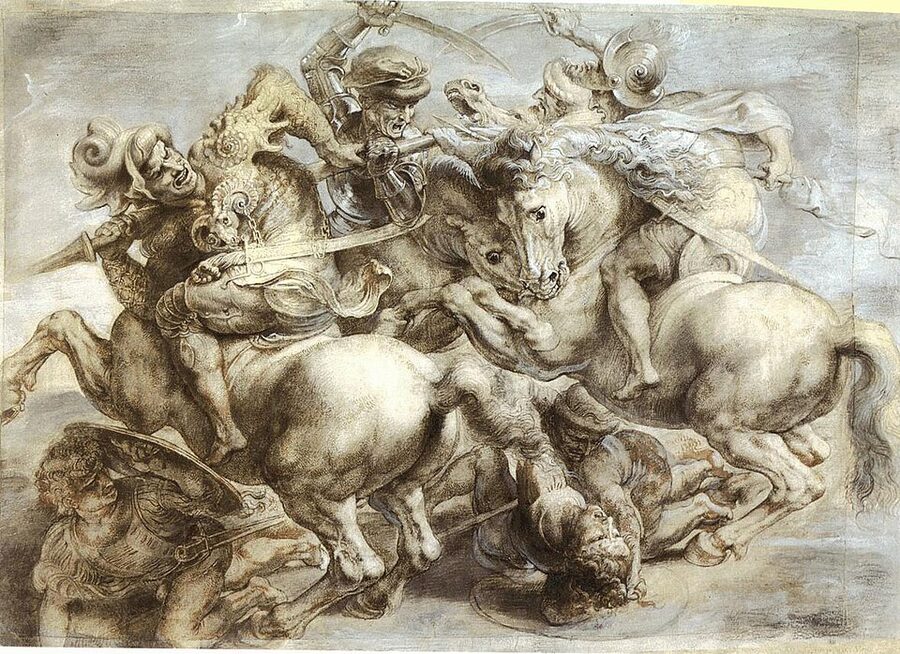
In 1503, Florence’s republican government commissioned Leonardo da Vinci to paint a giant battle scene on the east wall of the Salone. They commissioned Michelangelo to paint another one on the west wall. The two greatest artists alive, working at the same time in the same room, on competing walls. Florence was about to have the most spectacular interior in Europe.
Neither finished. Leonardo experimented with an oil-and-wax technique he’d read about in a Roman text, started painting, and the wax wouldn’t dry. He tried to fix it with charcoal braziers — the heat melted the wax and the entire upper section ran down the wall. He gave up and left for Milan. Michelangelo never even started; the Pope summoned him to Rome to paint the Sistine Chapel ceiling instead. Both men’s preparatory cartoons were lost or destroyed.
What Leonardo had completed — the central battle scene of charging horsemen — survived on the wall for about sixty years. Then in 1563, Vasari was hired to redecorate the Salone. There’s no documentary evidence that he destroyed Leonardo’s work; nor is there evidence that he didn’t. The current theory, advanced by art historian Maurizio Seracini, is that Vasari built a false wall a few centimetres in front of Leonardo’s panel, painting his own battle scene on it but leaving the Leonardo intact behind. The clue is a tiny green flag in Vasari’s painting that reads “Cerca, trova” — “Seek, and you will find.”
In 2012 a research team drilled a small hole through Vasari’s wall and inserted a probe. They detected what looked like organic material consistent with oil and pigment. The Italian government halted the investigation under pressure from cultural heritage groups; nobody wants to risk damaging the Vasari fresco to confirm something that may or may not be there. The Leonardo, if it exists, is still in the wall.
The Studiolo of Francesco I (And the Peephole)
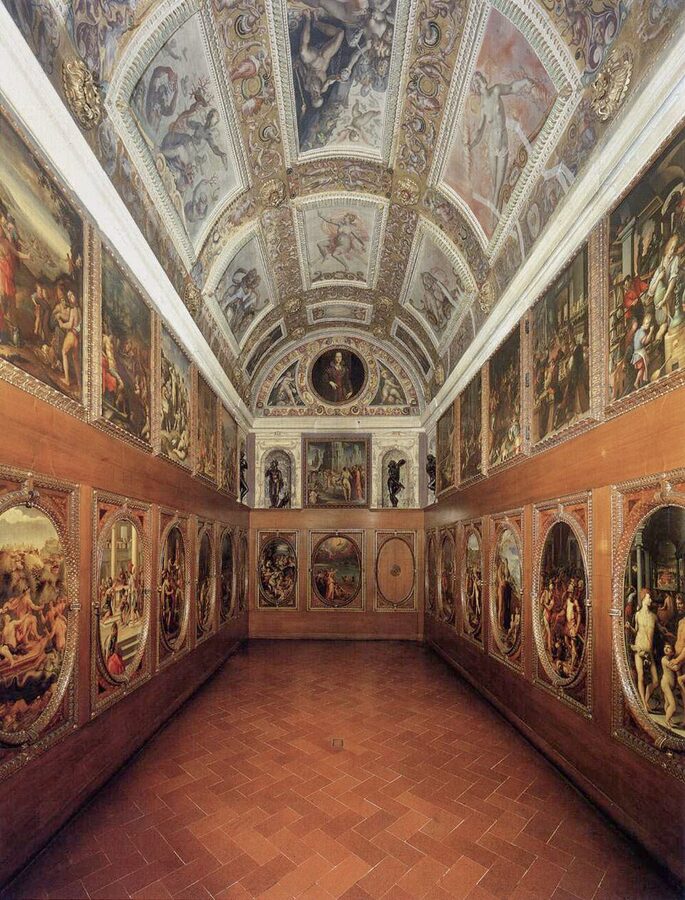
Off the Salone is one of the strangest small rooms in Renaissance Italy. The Studiolo of Francesco I is a windowless 8-metre-long study designed by Vasari in 1570-75 for Cosimo’s son Francesco. Every wall is covered with paintings; every ceiling panel has a scene; the whole space is a Mannerist art-room covering the classical four elements (earth, water, air, fire) interpreted through Francesco’s personal obsession with alchemy, mining and natural science.
The room has two famous secrets. First, behind one of the wall panels is a hidden cupboard — the entire wall opens. Francesco kept his alchemical equipment, his rare gem collection, and reportedly several books that the Inquisition would have considered heretical. The Vasari design hides the hinges so cleverly that the wall looks completely solid until the staff demonstrate the opening.
The second is more famous. There’s a peephole through one of the walls connecting directly to the Salone dei Cinquecento next door. From inside the Studiolo, Francesco could watch his ministers debating without them knowing he was there. The peephole is small — about a centimetre across — and the painting on the Studiolo side conceals it inside an ornament. From the Salone side it’s visible if you know where to look (your guide will point it out).
Whether Francesco actually used the peephole for political surveillance or whether it was just a piece of architectural cleverness is up for debate. He had a reputation for being aloof and spending more time in his alchemy lab than in the Council. The peephole exists; what he did with it is unclear.
The Tower of Arnolfo
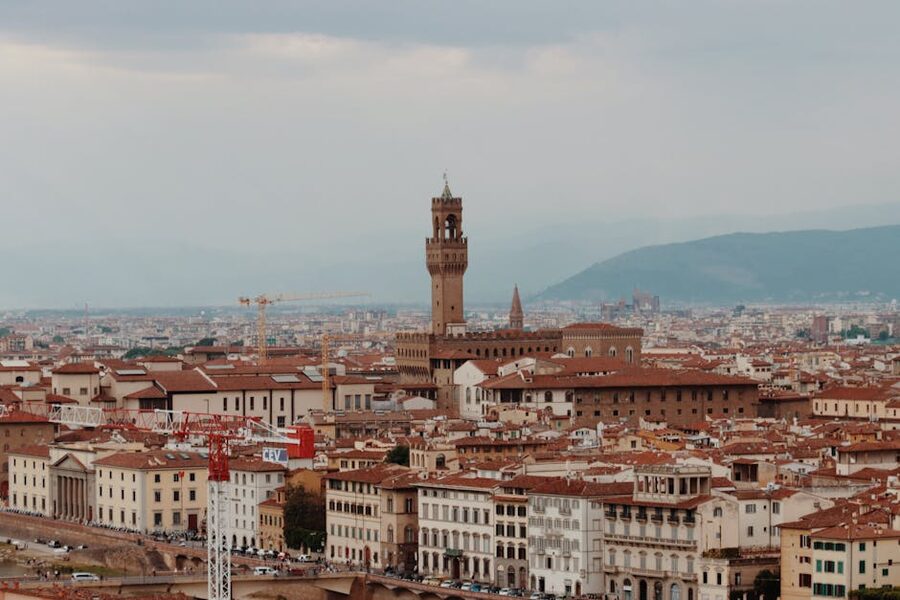
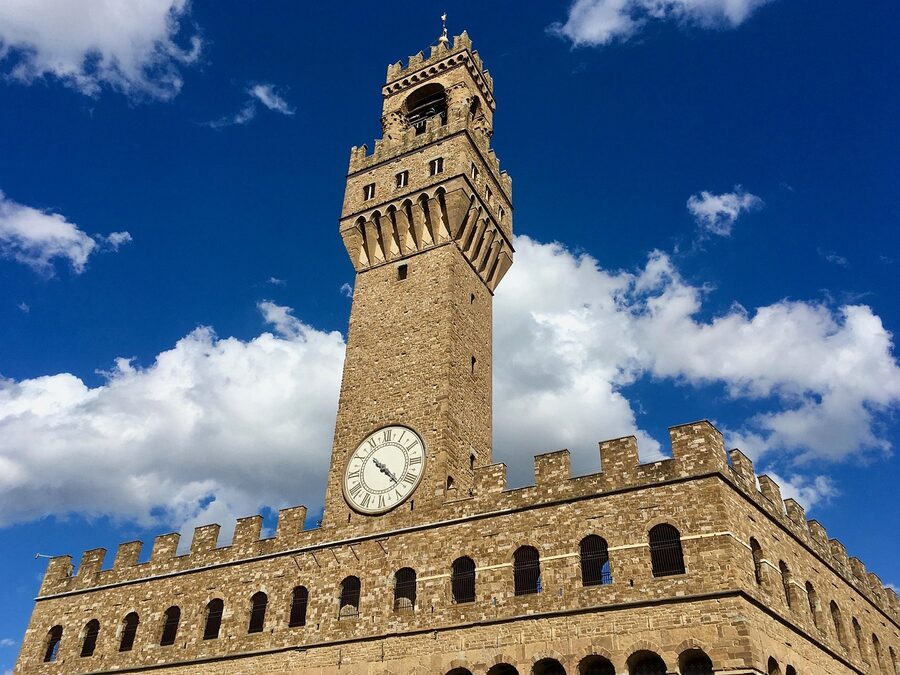
The Torre d’Arnolfo is 94 metres tall and the only tower in central Florence (other than Giotto’s Campanile) that you can climb. The view from the top is dead level with the dome of the Duomo across the rooftops, with the Arno visible to the south and the Tuscan hills beyond. It’s one of the best free climbs in Italy — well, free with the museum ticket plus the tower upgrade, which together cost about €17.50.
The climb is 233 steps, partly inside the building and partly up a narrow exposed spiral at the top. There’s no lift. The final third runs through one of the original 14th-century watchtower corridors — narrow, low-ceilinged, and faintly claustrophobic. The platform at the top is small (maybe 12 people maximum) and the view is unobstructed on three sides.
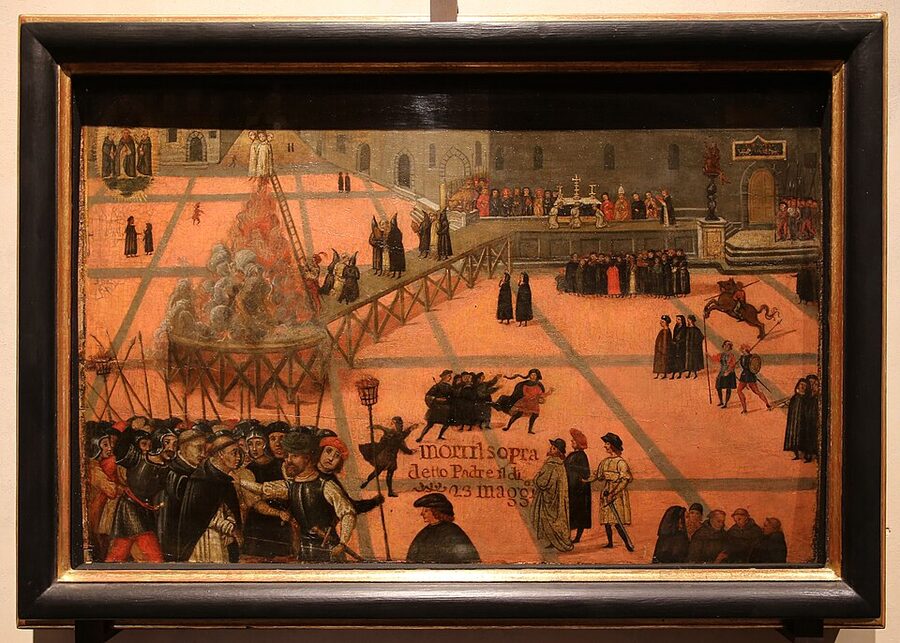
The tower has two cells inside it from the medieval period. Both Cosimo de’ Medici (the elder, before he became powerful) and the priest Girolamo Savonarola were imprisoned in them. Savonarola was held here in 1498 before being burned in the piazza below — the spot is marked by a brass roundel in the ground that travelers walk past without noticing.
The Apartments and Why They Look Like a Palace
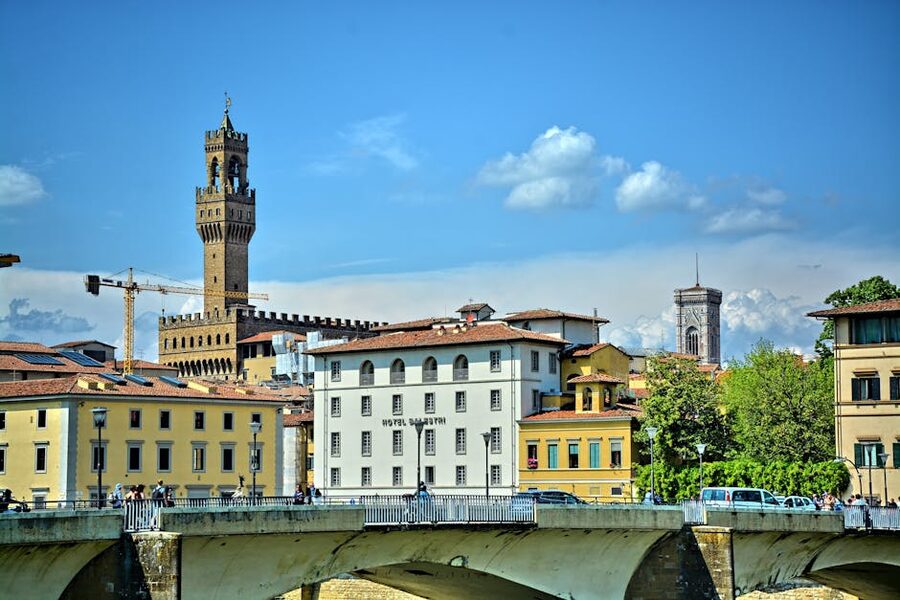
The second floor of Palazzo Vecchio is the Quartiere degli Elementi and the Quartiere di Eleonora di Toledo, the personal apartments of Cosimo I and his wife Eleonora. These are essentially Renaissance palace rooms grafted onto the inside of a medieval town hall. The Medici took over the building in 1540, lived here for almost 30 years until they moved across the river to Palazzo Pitti, and turned every personal room into a frescoed celebration of either themselves or the gods they wanted to be associated with. The same logic shapes the apartments at Seville’s Royal Alcázar and the imperial-residence wing of Paris’s Les Invalides.
Eleonora’s chapel, off the south end of her apartments, is the most intimate room in the palace. The walls are covered with frescoes by Bronzino — small, jewel-coloured, and clearly painted for one person to pray in alone. It’s about the size of a walk-in wardrobe and you can stand in roughly the same spot Eleonora stood in 1545.
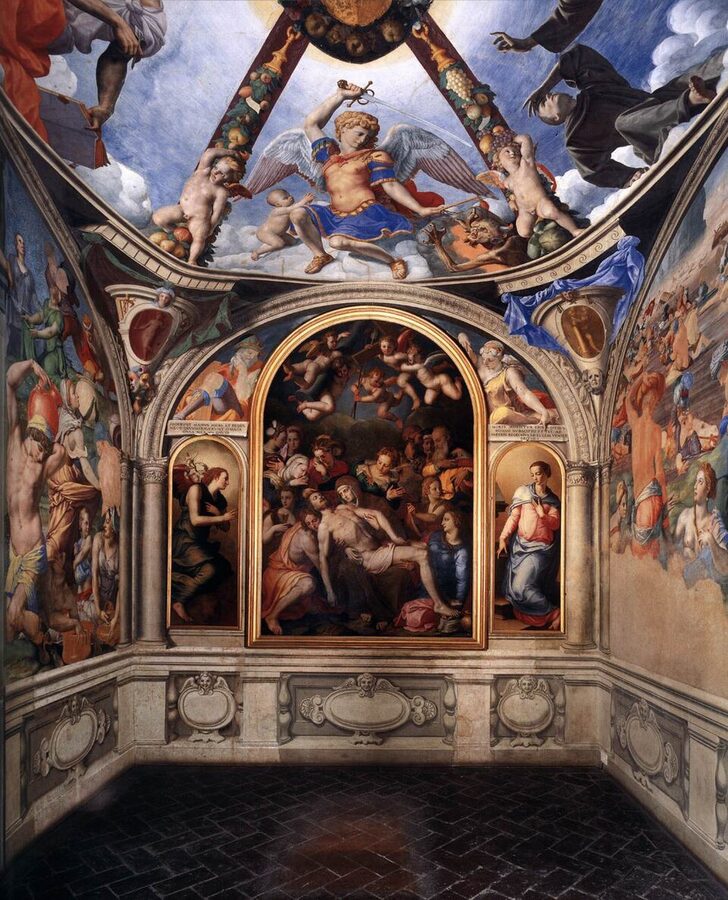
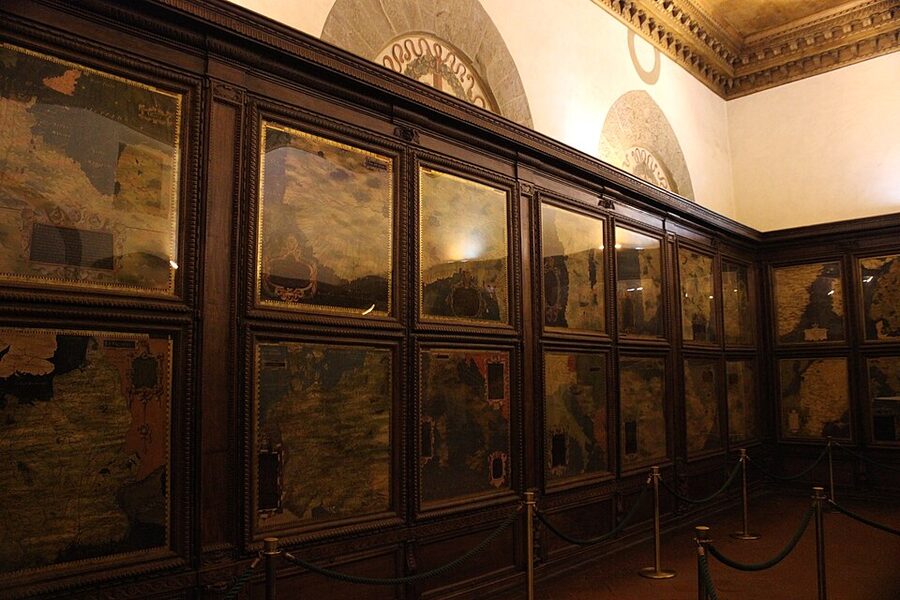
The Mappamondo Hall on the same floor has a giant Renaissance globe in the centre and 53 paintings of countries on the walls — the world as the Medici knew it in 1563. The maps were considered cutting-edge intelligence at the time; they showed regions Florence’s bankers were doing business in (or planning to). The America panels are particularly interesting because the New World had only been mapped for about 70 years when this room was decorated.
The Courtyard (Free Even Without a Ticket)
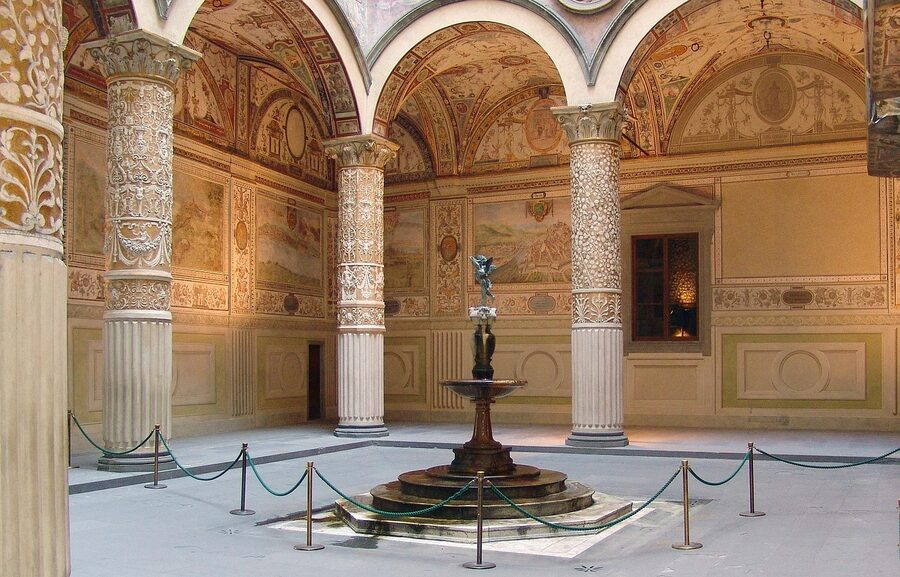
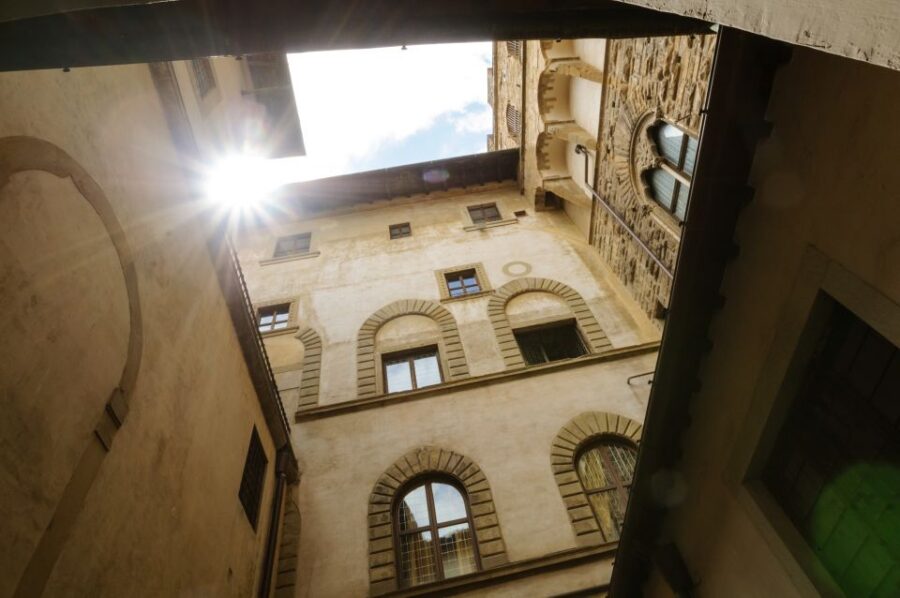
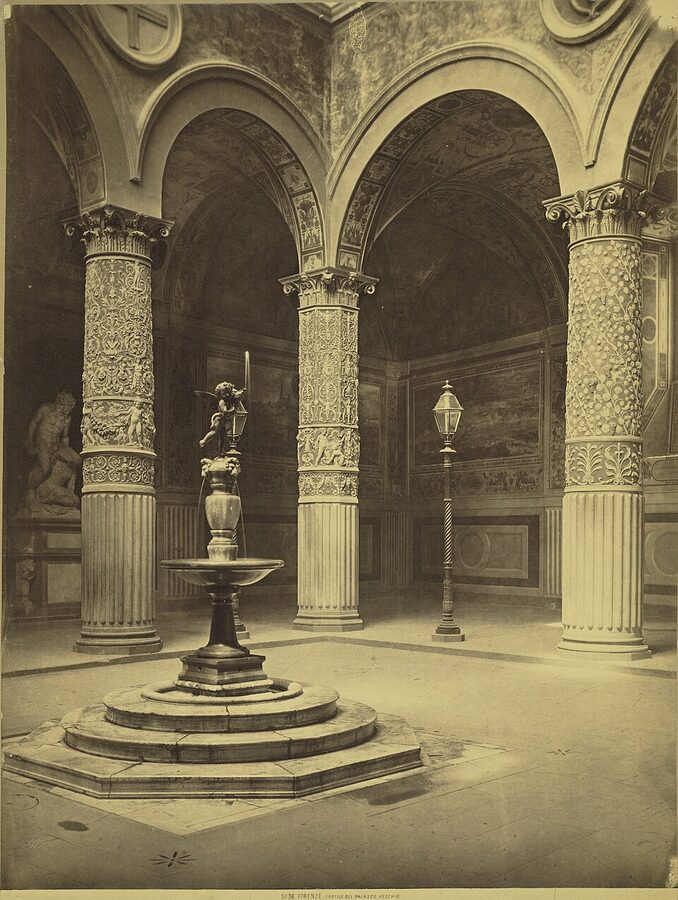
The first courtyard inside the palace is the Cortile di Michelozzo, redesigned in 1453 by Michelozzo (who also designed the Medici Palace on Via Larga, where the Medici lived before moving here). The columns are decorated in gold and grotesques painted by Marco Marchetti from Faenza in 1565, on the occasion of the wedding of Francesco I and Joanna of Austria. Look closely — there are tiny scenes of Austrian cities painted into the column decoration, a wedding gift from the bride’s homeland.
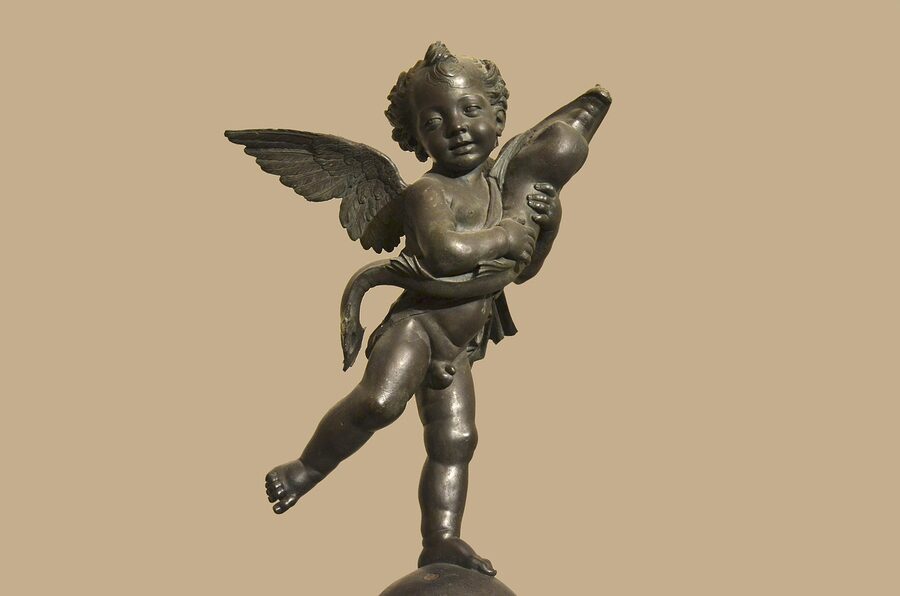
The fountain in the centre is topped by a bronze cherub by Andrea del Verrocchio — Leonardo da Vinci’s teacher. The original bronze is upstairs in the museum (you’ll see it if you’ve paid for the museum ticket); the courtyard version is a 19th-century copy. Verrocchio’s original is the kind of small Renaissance bronze that influenced everything that came after — including the way Leonardo composed figures.
The courtyard is open to anyone who wants to walk in. You don’t need a ticket. There are usually a few visitors taking photos, the staff are accustomed to people wandering in for the painted columns, and you can leave the way you came in. It’s one of the great free moments in central Florence.
How a Town Hall Became a Palace (Then Stayed One)
Construction started in 1299. The architect was Arnolfo di Cambio, the same man who designed the original Florence Cathedral two blocks north (he died in 1302 and didn’t live to see either finished). The brief was to build a fortified meeting hall for the Florentine Republic’s nine-member ruling council, the Priori delle Arti. They needed a defensive position; Florence was a city of warring families with private towers, and the council was a frequent assassination target.
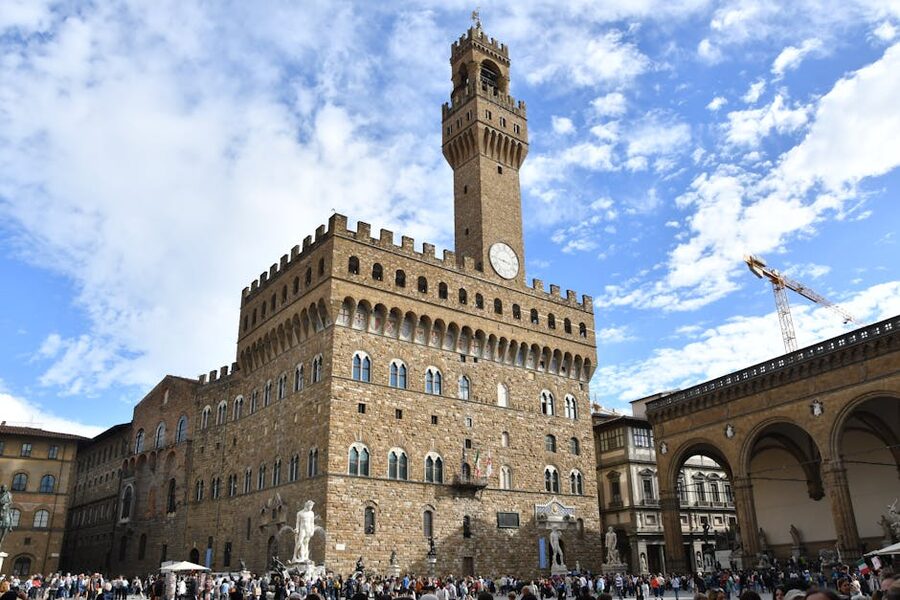
Arnolfo’s design was deliberately fortress-like. The lower walls are 4 metres thick. The narrow windows are positioned for archers. The crenellated parapet at the top isn’t decorative; it’s defensive. The Torre d’Arnolfo had a lookout permanently stationed in the watch chamber. The whole building was a statement: this is where the Republic governs from, and you don’t get in without permission.
It worked. The building was attacked multiple times over the next 200 years and never fell. Then in 1540, Cosimo I de’ Medici simply moved in. He’d been elected Duke of Florence in 1537 and decided his official residence should be the same building from which the Republic had once tried to keep his family out.
The Medici remodelled it ferociously. Giorgio Vasari was the chief architect — every fresco, every chamber redesign, every sculpture placement was Vasari’s plan, executed by his enormous workshop between 1555 and 1572. The building today is essentially Vasari’s vision of what a Medici palace should look like. The original 1299 structure is buried inside it.
Cosimo’s son Francesco moved the family across the river to Palazzo Pitti in 1565. Palazzo Vecchio became a secondary residence, then a government building, then the seat of the Italian Republic for six years (1865-1871) when Florence was briefly the capital of unified Italy. King Victor Emmanuel II had his throne in the Salone dei Cinquecento. The building is still the working town hall — the mayor’s office is on the second floor — but the public museum operates around the official functions.
When to Visit and How to Avoid the Crowds
The single best slot is 9am opening. The museum opens an hour before most other Florence museums, which means the early-morning visitors are mostly people who specifically wanted to come here. By 11am the place fills with overflow from the David and the Uffizi.
Late afternoon (4pm onwards) is the second-best window. Last museum entry is around 6pm so you have a real two-hour window, the tour groups have thinned out, and the light through the upper-floor windows hits the Salone frescoes at the right angle.
Avoid Thursday afternoons. The museum closes at 2pm on Thursdays, which catches visitors who didn’t check the schedule and turn up at 3pm to find the doors locked. The piazza will still be full of confused people peering at the entrance.
Off-season (November to February, excluding Christmas week) is dramatically quieter. You can usually walk up at 11am on a Wednesday in January and get in within 5 minutes. The trade-off: the tower can be uncomfortable in winter rain because the upper section is exposed.
Getting There
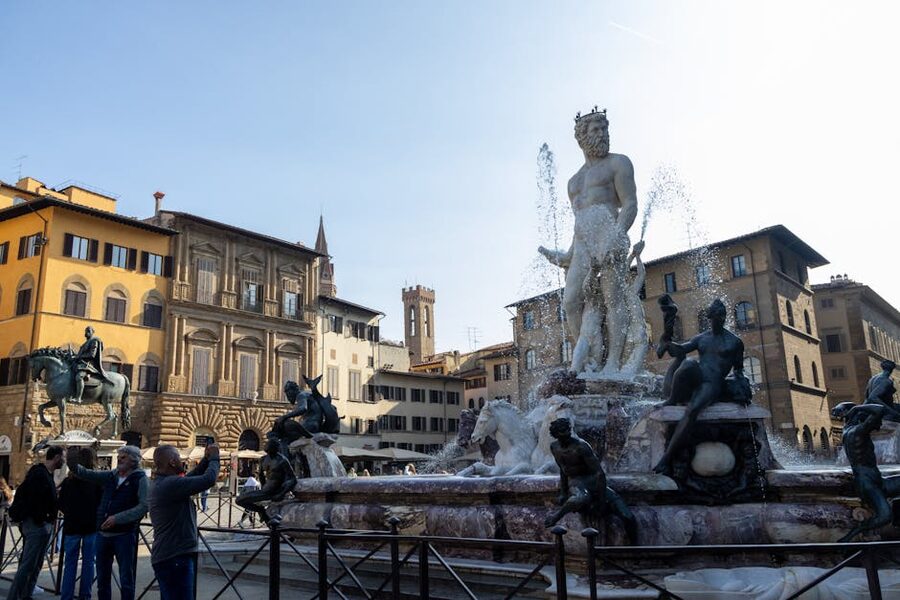
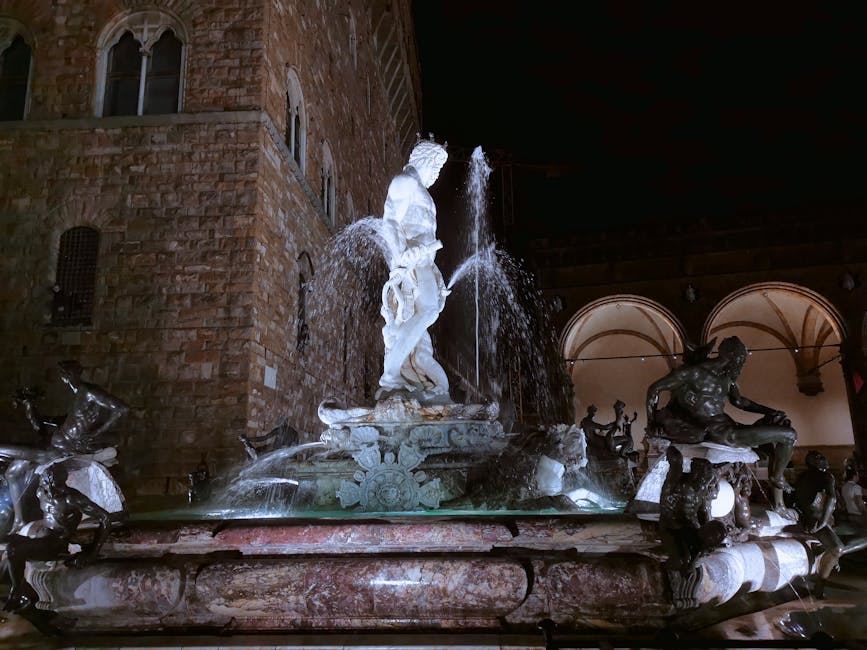
The address is Piazza della Signoria, 50122 Firenze — the same piazza as the Loggia dei Lanzi, the Neptune fountain, and the marble copy of Michelangelo’s David that everyone photographs. From the Uffizi, walk 30 seconds north — they share a wall. From the Duomo, 5 minutes south. From Santa Maria Novella station, 12 minutes south-east. From the Ponte Vecchio, 4 minutes north.
The piazza is a pedestrian zone — no buses, no taxis, no parking. Walk in. The museum entrance is in the centre-left of the facade, under the loggia. There’s a small line for ticket holders and a bigger one for ticket buyers; if you’ve booked online, look for the “prenotati” (reserved) sign and skip ahead.
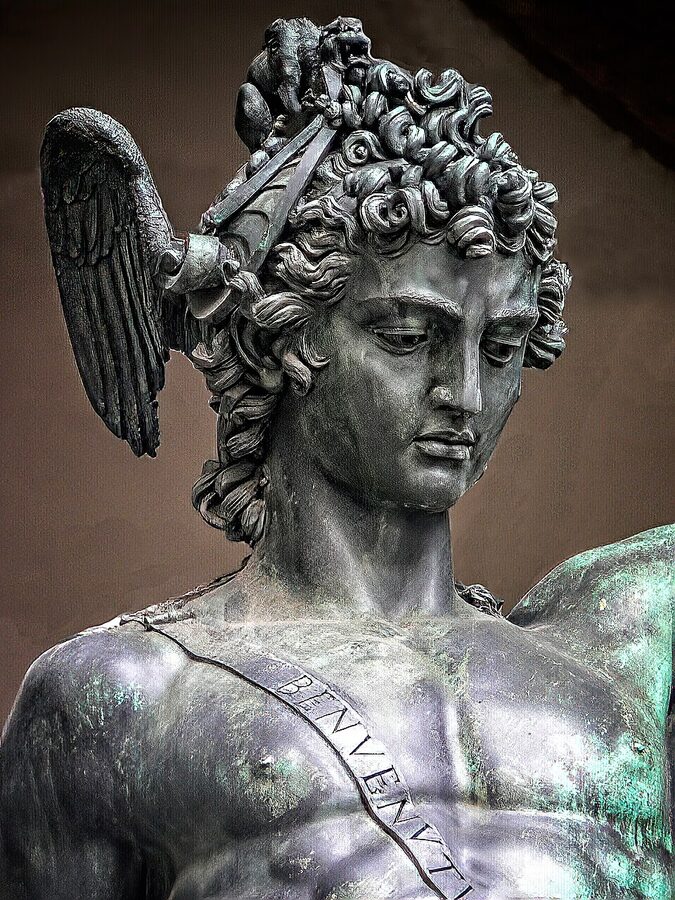
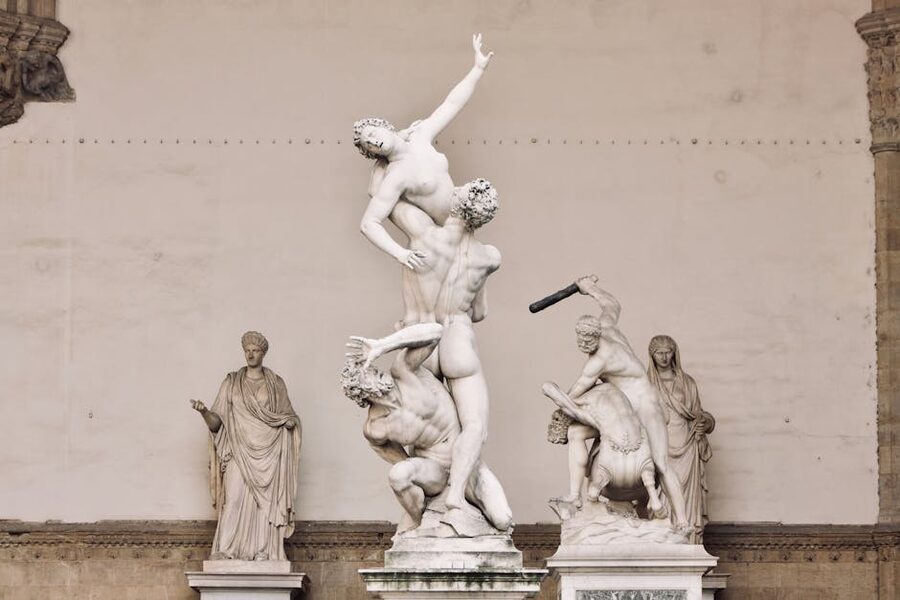
The marble David in the piazza is the copy installed in 1873 when the original moved to the Accademia Gallery. The original spot Michelangelo chose for it in 1504 — the corner of the platform — is exactly where the copy stands today. The other large statue in the loggia is Cellini’s bronze Perseus (1545); the Sabines plaster cast is at the Accademia while the original Giambologna marble is in the Loggia next door.
Practical Things Worth Knowing
Photography is allowed in the museum, no flash. Tripods need a permit. Phone shots are fine. The Salone is the most photographed room.
The tower has a strict shoe code — no flip-flops, no high heels. Closed-toe walking shoes only. They’ll turn you away at the tower base if you’re not properly shod.
Backpacks bigger than a daypack have to be checked at the cloakroom inside. Free, but the cloakroom is a 5-minute walk from the entrance and you have to come back for your bag. Bring as little as possible.
Toilets are inside the museum, near the audio guide pickup point. The tower has no toilet at the top — go before you start the climb.
Eating nearby: Piazza della Signoria itself is a tourist trap (€8 espressos, mediocre pasta). Walk three blocks south to All’Antico Vinaio for the famous Florentine sandwich (the queue moves fast), or four blocks east for proper trattorie around Borgo dei Greci. The piazza-side cafés are for people who don’t know better.
What to Pair It With
The natural pairing is the Uffizi Gallery next door. Both buildings were built by Florence’s medieval government — the Uffizi was originally the administrative offices, while Palazzo Vecchio was the political assembly. Cosimo I commissioned both buildings to be remodelled by Vasari at the same time, and the architectural language matches. Plan to do the Uffizi in the morning and Palazzo Vecchio in the afternoon, or split across two days if you want to give each its full time.
The other natural pairing is Palazzo Pitti across the river — the building Cosimo’s son moved into when he abandoned this one. Visiting both lets you see the full arc of the Medici’s residence: the medieval town hall they took over, then the larger Renaissance palace they bought when they outgrew it. The Vasari Corridor between the two is closed for restoration but reopens periodically.
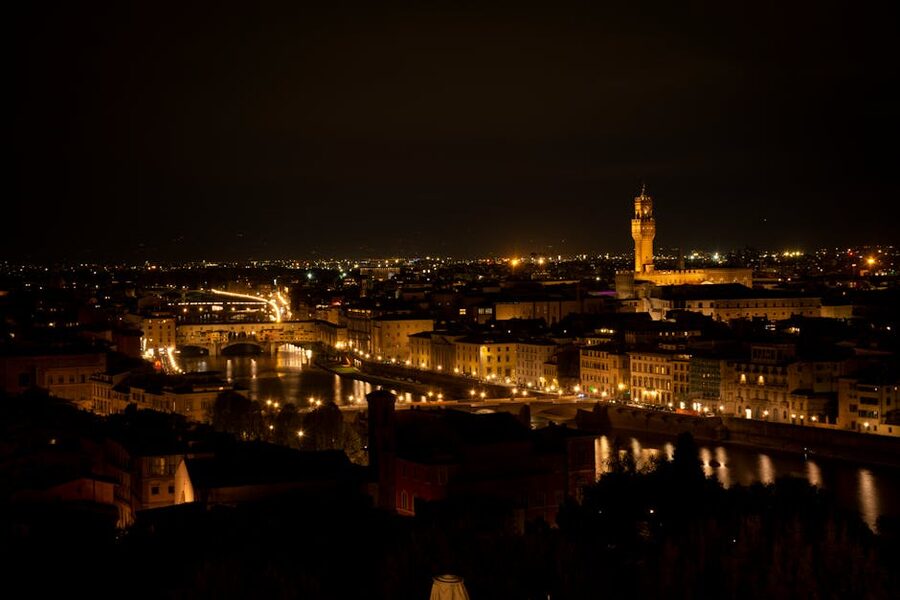
If you’ve climbed the tower, you’ve earned a sit-down meal and a glass of wine. Walk south across the Ponte Vecchio to the Oltrarno neighbourhood for proper Florentine cooking — the food scene south of the river is better than anything in Piazza della Signoria. The cooking class circuit runs in this area too if you want to learn what you’re eating.
For Rome onwards, the Palazzo Vecchio’s closest historical cousin is the Borghese Gallery in Rome — another fortified Renaissance building remodelled into a private noble residence with frescoed rooms designed to project political power. Different city, different family, same playbook.