
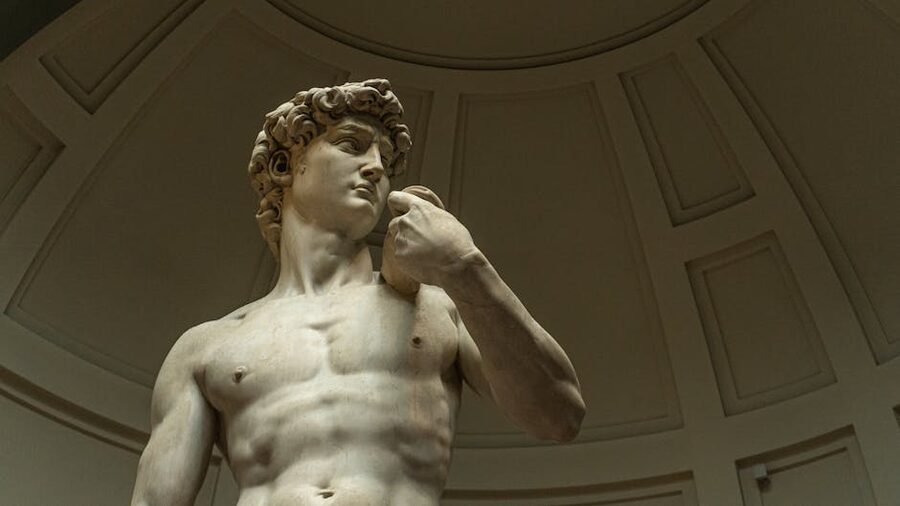
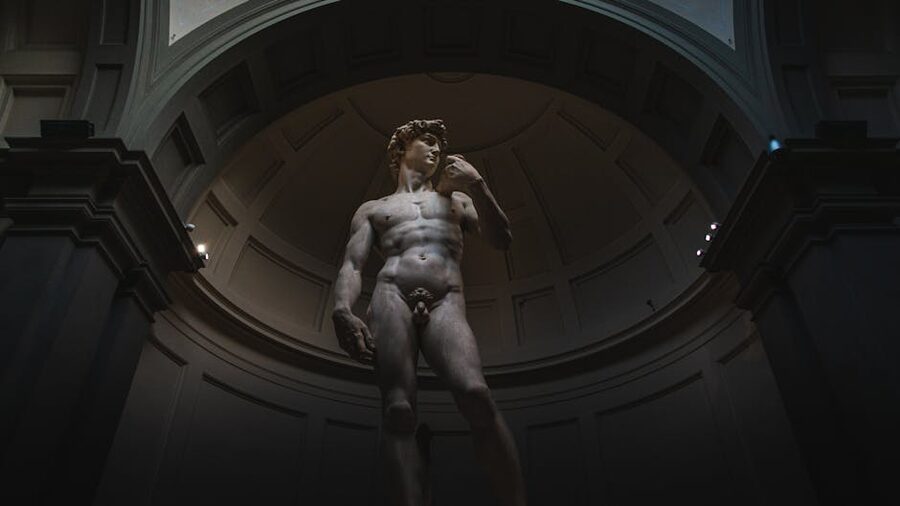
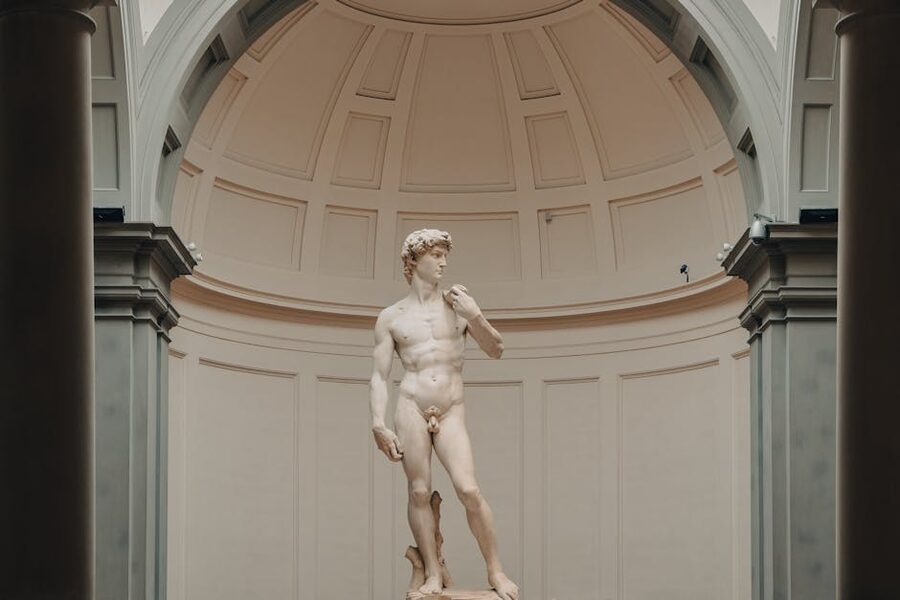
There are three Davids in Florence and only one of them is by Michelangelo. The marble version that thousands of travelers photograph in front of Palazzo Vecchio every day? A copy. The bronze David staring down from Piazzale Michelangelo? Also a copy. The real one — 17 feet tall, 8.5 tonnes, carved from a single block of Carrara marble between 1501 and 1504 — sits behind a quiet green door on Via Ricasoli, in a custom-built room with a domed skylight that competitors don’t have.
This is a guide to actually getting through the door. The Accademia sells out almost every day in summer, the official ticket portal is a maze, and the line for walk-ups can stretch around the block by 9am. Below is what to book, what to skip, and what to look at once you’re inside besides the obvious. The same one-icon dynamic plays out at Madrid’s Reina Sofía, where most visitors come for Picasso’s “Guernica,” and at the Orangerie in Paris, where everyone is there for Monet’s eight water-lily ovals.
In a Hurry — Just Tell Me What to Book
- Best overall: Timed Entry + Audio App ($33) — straight into the museum, free phone audio guide that’s better than the official one
- Cheapest: Timed Entrance Ticket ($26) — same skip-the-line entry, no audio, perfect if you’ve already done your homework
- If you booked too late: Skip-the-Line Entry ($45) — partner office a block away, picks up tickets that the official portal already sold out
Tickets, Hours and the Three Things Everyone Gets Wrong
The official admission is €16 for adults during high season, with under-18s free (you do still need to claim a free ticket for them). The museum is open Tuesday to Sunday, 8:15am to 6:50pm, with the last entry at 6:20pm. Closed Mondays — that’s mistake number one. Don’t fly into Florence on a Sunday night planning a Monday morning David visit.
Mistake number two is assuming you can walk up. You can’t. Or rather, you can, but you’ll spend two to three hours in line in summer, and on busy weekends they sometimes turn away walk-ups before closing because the timed slots are full. Book a timed entry ticket. Even at €4 above face value, the time you save more than pays for it.
Mistake number three is the booking platform itself. The Firenze Musei official site is slow, frequently sells out three to four days in advance, and the confirmation emails sometimes don’t arrive. The third-party platforms (GetYourGuide, Tiqets) buy bulk allocations and resell them — that’s why you can often find a 10am slot on GYG when the official site says “sold out.” It’s not a scam; it’s how the museum’s own reseller agreements work.
The Three Tickets Worth Booking
I’d skip guided tours for the Accademia. It’s a small museum — you can do it thoroughly in an hour, and the audio guides cover the same ground at half the price. Save the guided tour budget for the Uffizi or the Vatican Museums, where there’s a serious case for having an expert. Here, just get in.
1. Timed Entry to Michelangelo’s David + Audio App — $33
This is what I’d book if I were planning the trip today. The €4 premium over the bare entry ticket gets you a downloadable audio guide that runs on your phone, which works out cheaper than renting the museum’s audio guide on site. Our full review of this exact ticket walks through how the audio app installation works (it’s a one-time download, not a streamed thing).
2. Timed Entrance Ticket to Michelangelo’s David — $26
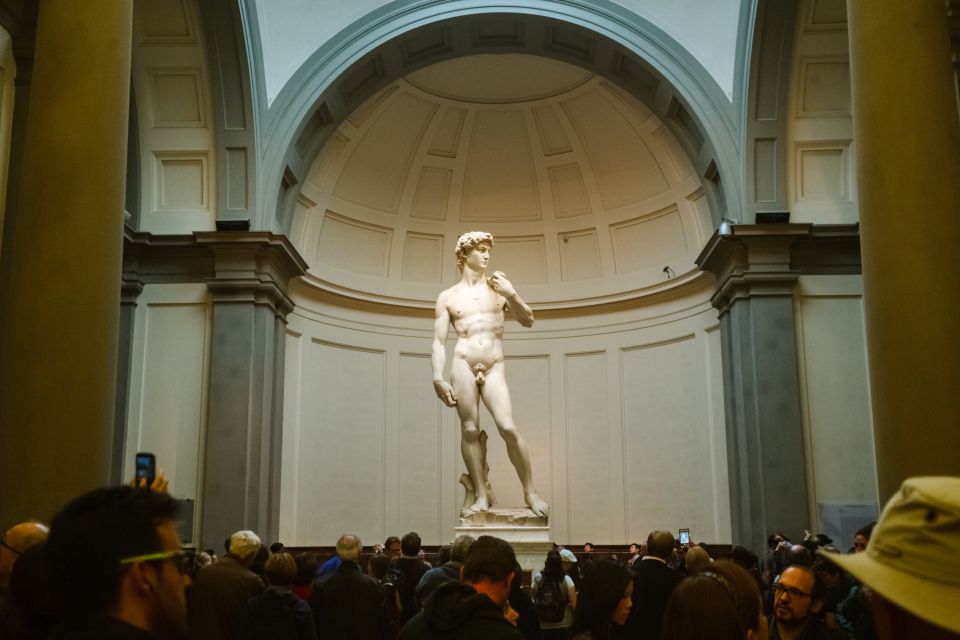
Same priority entry as Tour 1, just without the audio. You’ll get an email with a QR code; show it at the door, walk past the queue. A look at how the redemption process works on the day — including a handy tip on which entrance is faster when there’s a queue split.
3. Michelangelo’s David Skip-the-Line Entry Ticket — $45
This costs more because of the office collection step — you don’t get an email QR code, you pick up a physical ticket from an office on Via Cesare Battisti, then walk to the museum. Worth it only if you booked late and the cheaper options have sold out for your dates. The office pickup logistics are easier than they sound — opens at 9am, queue moves fast.
What You Actually See Inside
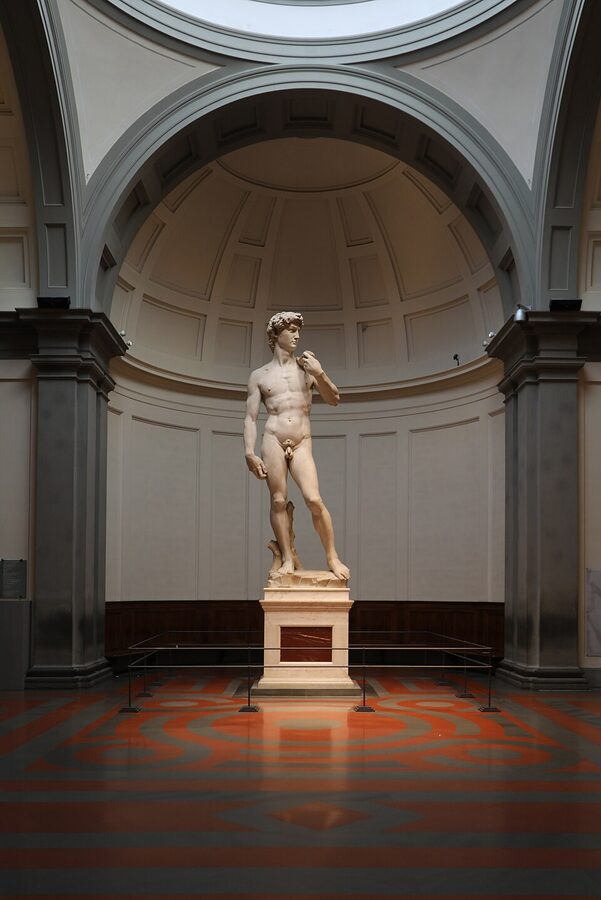
The Accademia is small. That’s the first thing to know. Most visitors are in and out within 60 to 90 minutes, and a thorough visit with the audio guide is two hours, max. You’re not going to “lose a day” here the way you can at the Uffizi. The whole museum is one floor (with a small upstairs of 14th-century gold panels), and the route forms a natural loop.
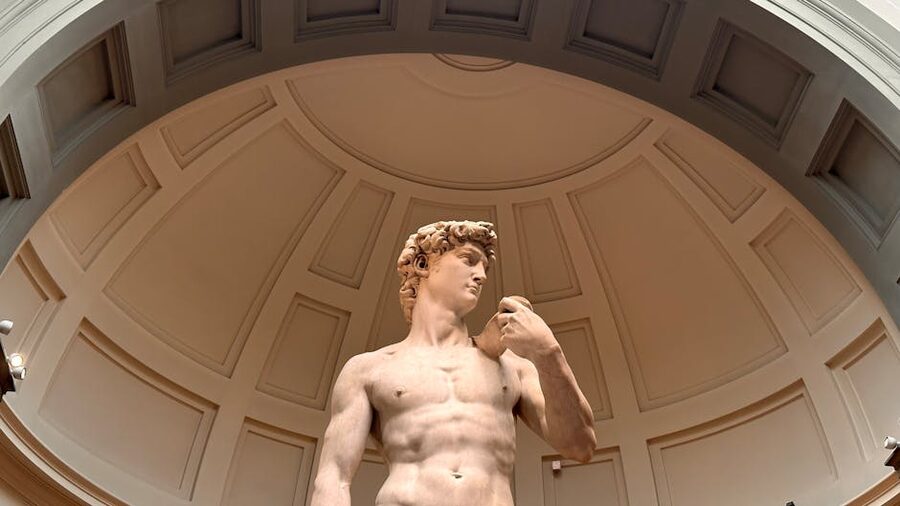
The walk to David is the showpiece. From the entrance hall (Sala del Colosso, with the Giambologna plaster cast as the centerpiece), you turn left and find yourself in a long corridor — the Galleria dei Prigioni. Lining the walls are Michelangelo’s four unfinished Slaves, half-emerged from raw marble. They face each other across the corridor, leading your eye toward the dome at the end. He’s there, under the skylight, exactly where the architect put him 150 years ago.
Looking at the David Properly
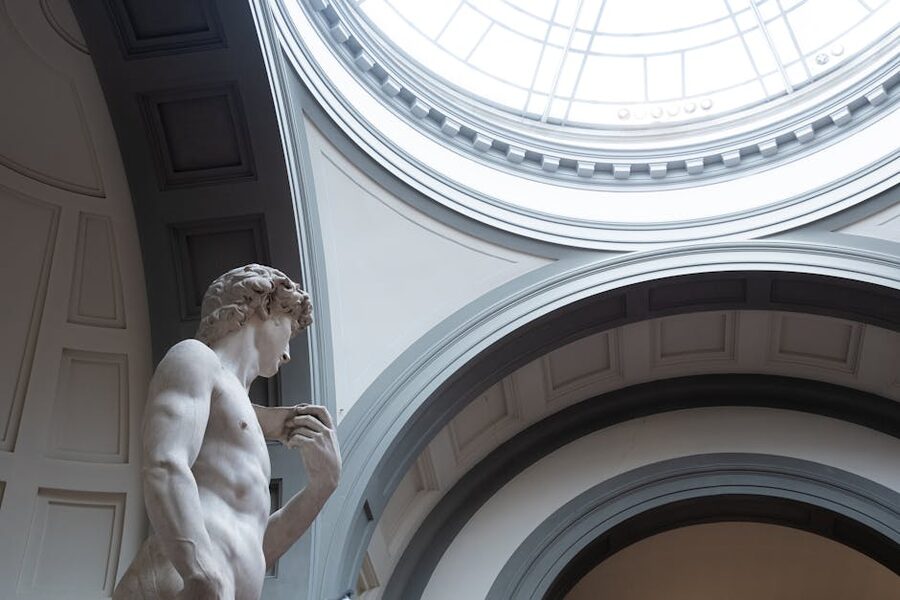
Most visitors spend three minutes in front of David, take a phone photo, and leave. That’s a waste, the same way three minutes in front of “Guernica” or with the early sketches at Málaga’s Picasso Museum doesn’t do justice to a defining work. Here’s what to actually look for, in roughly the order it’s worth noticing.
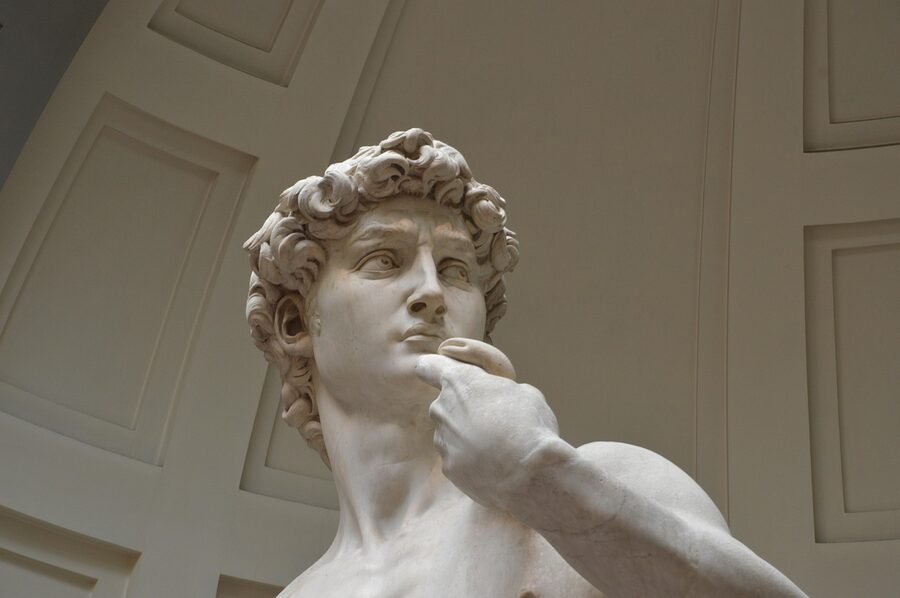
Walk a full circle around him first. The Accademia lets you do this — there’s space behind the statue, and the lighting works from every angle. The back is rougher than the front because Michelangelo originally carved this for a high niche on the Florence Duomo where you’d never see the rear. He had to abandon his polish-the-back habit because of where it was supposed to live.
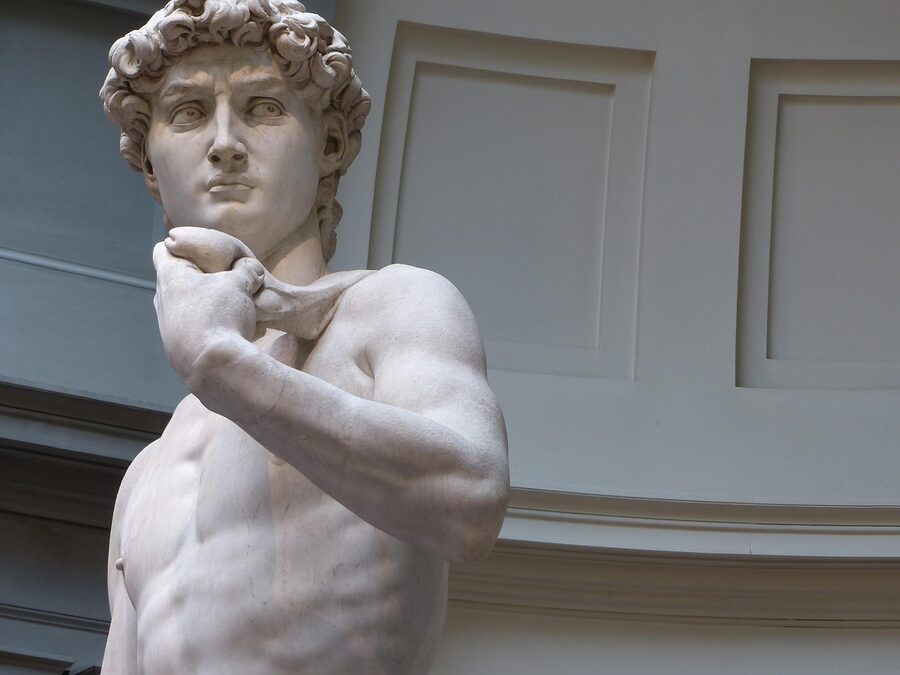
Look at the right hand. It’s deliberately oversized — about 25% bigger than anatomically correct. From the original intended viewing angle (looking up at a roofline figure 30 metres above your head), the hand would have read as proportional. From eye level it looks slightly off, and once you see it you can’t unsee it.
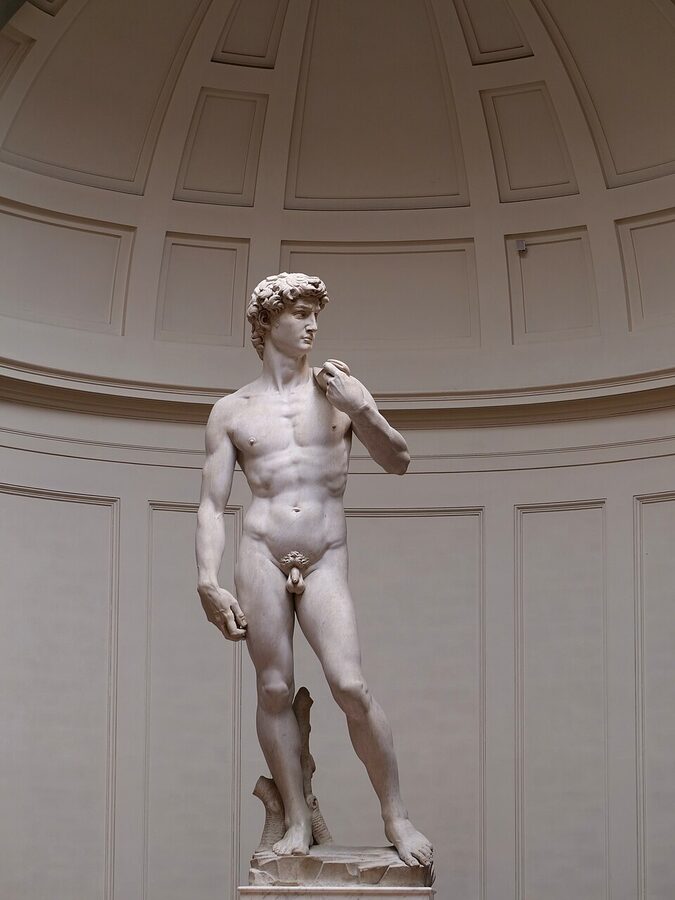
The veins on the right arm and hand are physically raised in the marble. They’re not painted on; Michelangelo carved each one by sweeping away the surrounding stone. Get close (you can — the barriers are about 2 metres back) and look at the back of the hand and the inside of the wrist. They look like they’re pumping.
The sling. It runs over David’s left shoulder and down his back. A lot of visitors miss it because they’re looking at the front. Walk around to the back and you’ll see the strap — that’s how Michelangelo telegraphs which moment in the David and Goliath story you’re looking at.
The Slaves Are the Hidden Masterpiece
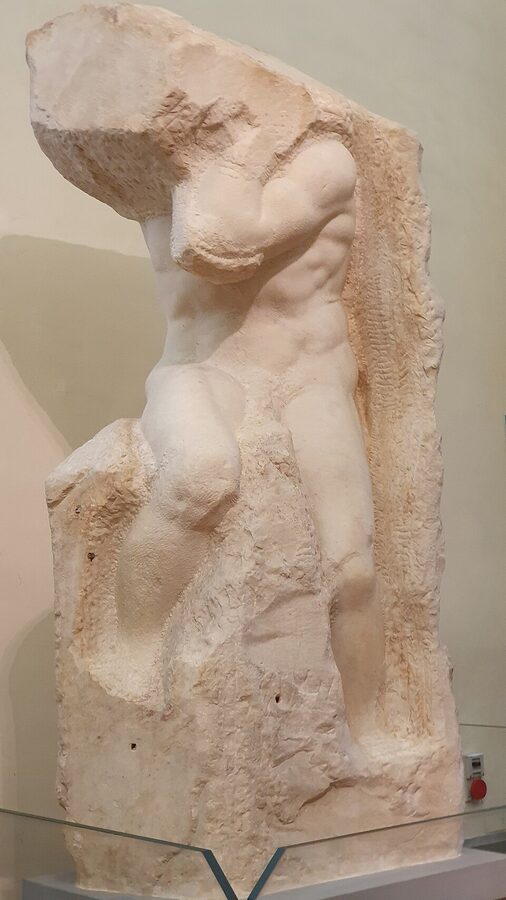
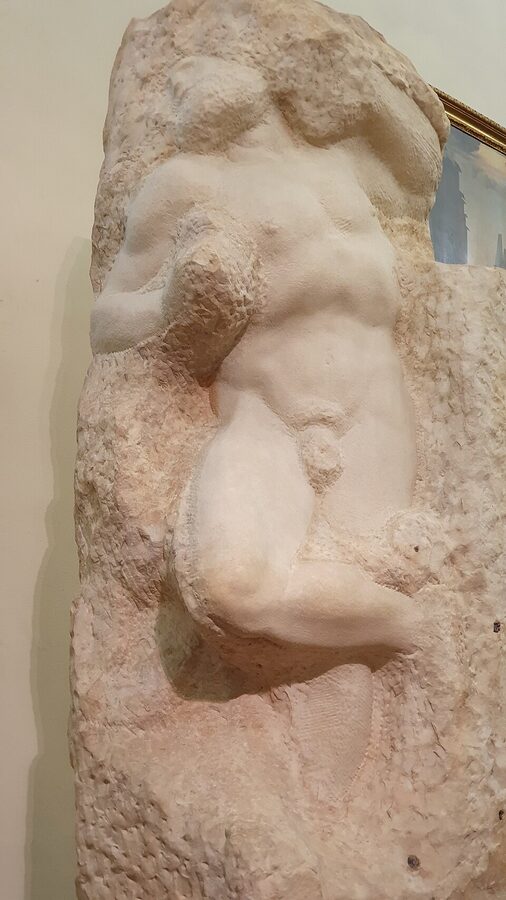
Don’t rush past these on your way to the David. The four Prisoners (sometimes called the Slaves) are arguably the most fascinating things in the museum, partly because they’re unfinished. Pope Julius II commissioned a tomb in 1505 that was supposed to have around 40 marble figures including 16 of these slave statues. The pope died, his heirs scaled the project back, and Michelangelo abandoned six of these figures in various states of completion.
The four here in the Accademia (the other two are in the Louvre) are at different stages — one is mostly emerged, one looks like he’s still trapped in the rock. There’s a school of art history (and Michelangelo himself wrote about it in his sonnets) that argues he chose to leave them like this. The Italian term is non-finito, “unfinished” by intent, the figure liberating itself from the stone. Whether that’s genuinely what he meant or whether they’re just half-done because the project collapsed is one of those debates art historians have been having for 500 years.
What you can absolutely see is his sculpting process. Michelangelo carved with a single point chisel, working from one face of the block at a time, treating the figure as already inside the stone and his job as removing the excess. Look at the chisel marks on the rough sections, you’re looking at the actual gouges he made in 1530, in real time, frozen halfway. There’s no other place in the world where you can see that, the closest equivalents being Monet’s late palette and process visible at Giverny or Van Gogh’s brush-loaded canvases at the Van Gogh Museum.
The Sala del Colosso and the Giambologna Plaster Cast
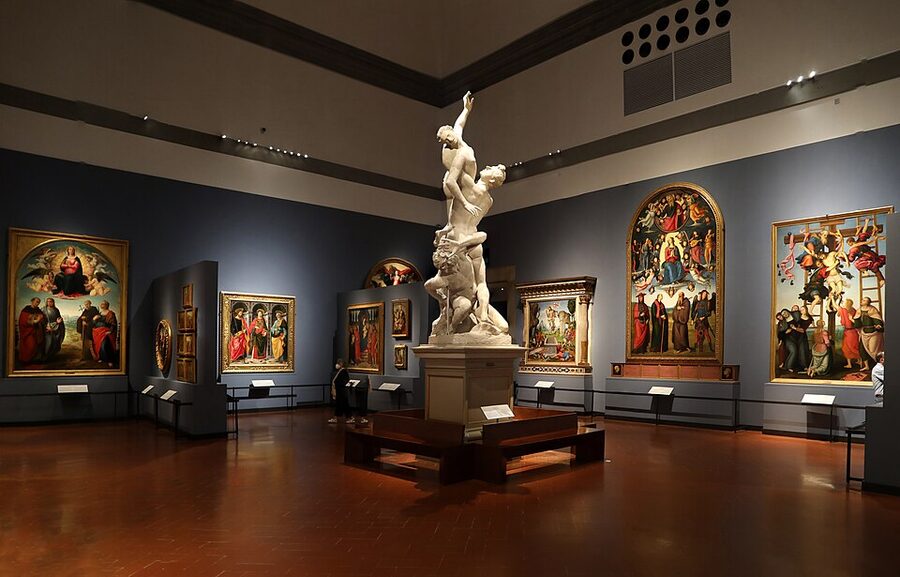
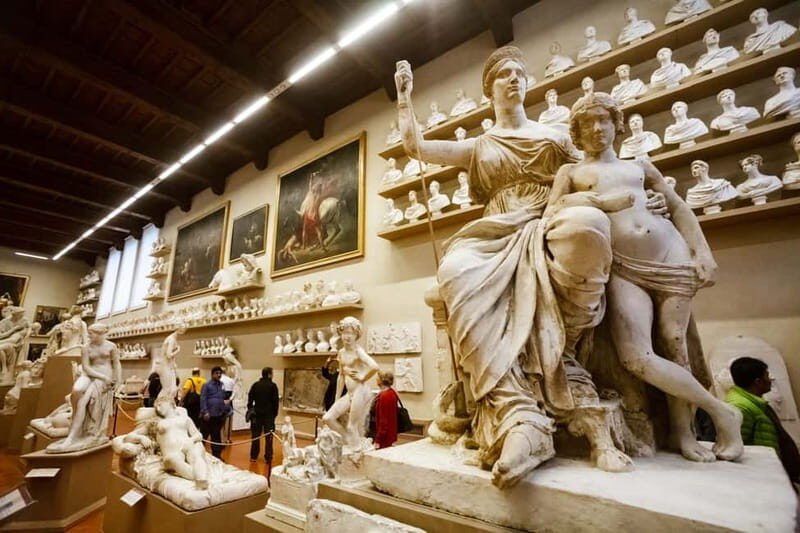
The first room you enter is the Sala del Colosso, and the centerpiece is a full-size plaster cast of Giambologna’s Rape of the Sabine Women. The original marble (1582) is the one you can see for free outside under the Loggia dei Lanzi in Piazza della Signoria. This is the working model the sculptor made first.
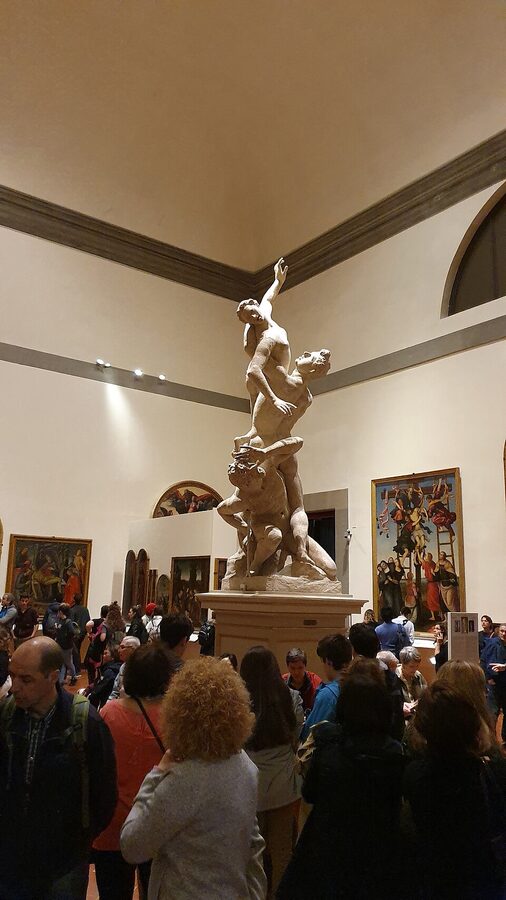
What you’re looking at is essentially a 3D draft. Sculptors of that era worked in clay or plaster first, then transferred the design to marble using a network of measurement points. The black dots you can see on the plaster surface are the original reference points — you can spot them on the figures’ shoulders, hips, and knees. Photographers love this room because the pure white plaster takes light differently from polished marble.
The Musical Instruments Museum You’ll Probably Skip
Down a side corridor off the Sala del Colosso is the Museum of Musical Instruments, which most visitors walk straight past. Worth ten minutes if you have any interest in the history of the piano. The collection was assembled by the Medici family across the 17th and 18th centuries.
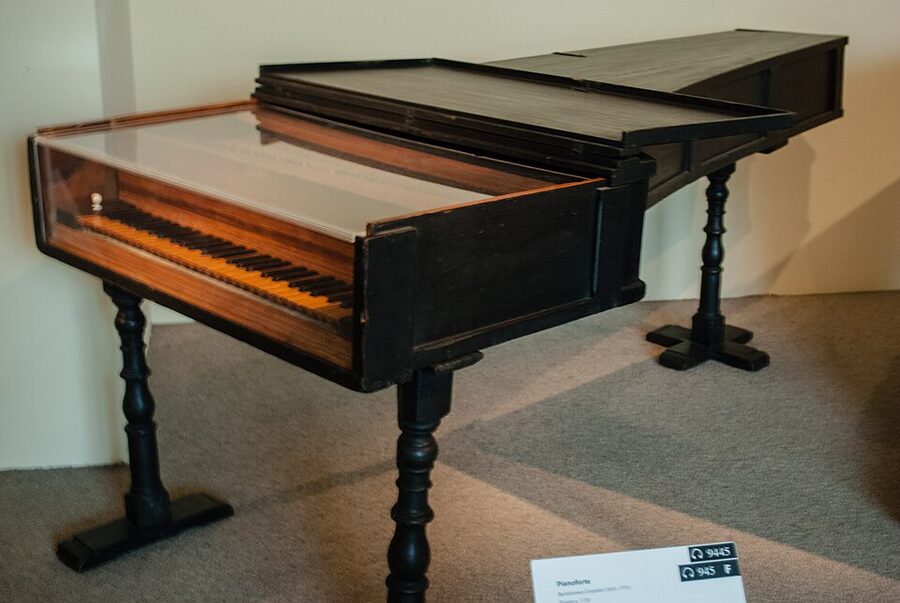
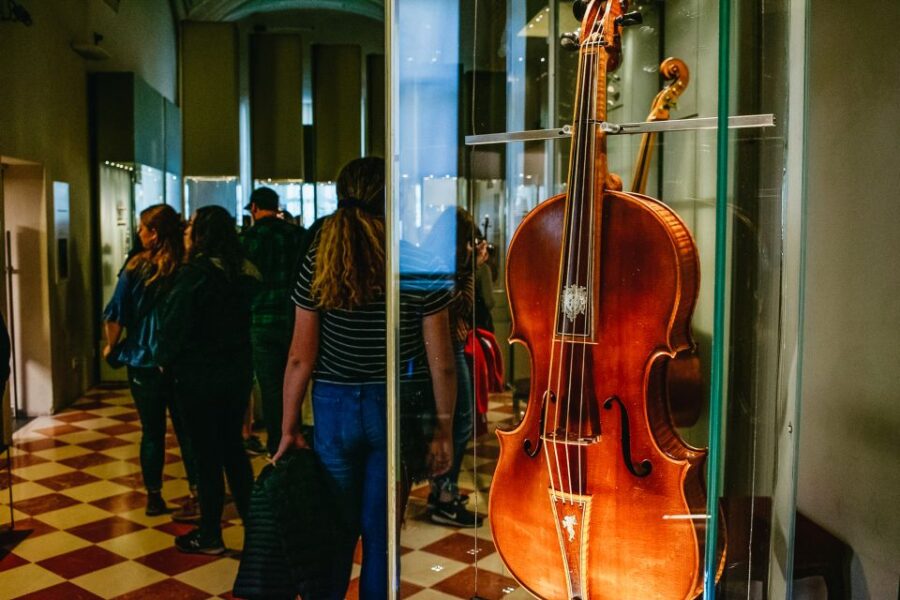
The headline pieces are by Bartolomeo Cristofori, who invented the piano (technically the pianoforte) around 1700. Two of the three earliest surviving Cristofori pianos in the world are here. There’s also a Stradivarius violin, a Stradivarius cello called the Medicean, and a viola from the same set. If you’ve ever been curious what an actual Stradivarius looks like, it’s about ten minutes of walking off the David route, a hidden-room rewards approach you also get with the Banksy basement at Amsterdam’s Moco Museum.
The Upstairs Hall of Gold Panels
There’s an upstairs at the Accademia and most travelers never go up there. They should. The first floor holds the Florentine and Tuscan gold-ground paintings from 1370 to 1430 — the period right before the Renaissance breaks through. The walls are lined with altarpieces in deep gold leaf, mostly painted on wooden panels with scenes from saints’ lives.
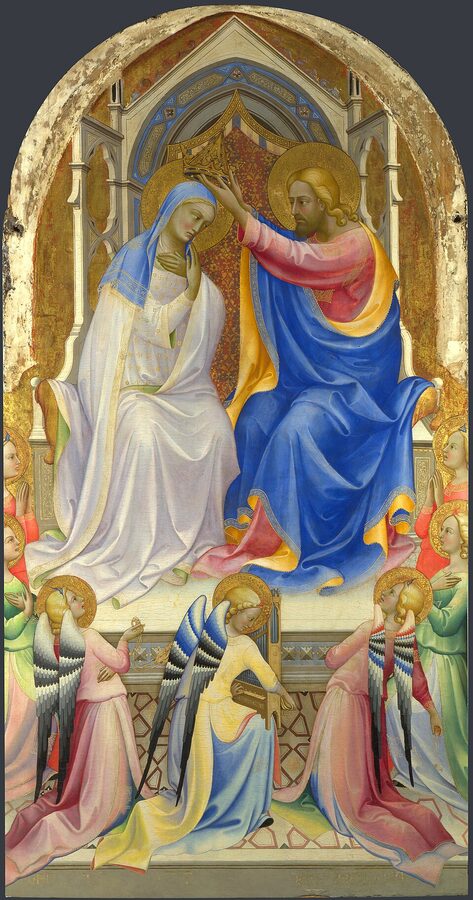
This is the period the Uffizi covers more famously downstream — Giotto, Cimabue, and the early Renaissance breakthrough. What the Accademia gives you is the before: the late Gothic and International Gothic styles that the Renaissance was reacting against. The gold backgrounds, the flat perspective, the stylised faces — everything Botticelli and Da Vinci would later abandon. If you’ve already done the Uffizi, this room makes the contrast vivid.
Cennino Cennini, who you’ll see represented here, wrote Il Libro dell’Arte in the 1390s — the first practical handbook on how to be a painter, including recipes for grinding pigments and laying gold leaf. The techniques you can see in these panels are exactly what he wrote down.
How a Statue Outside Ended Up Inside (1873)
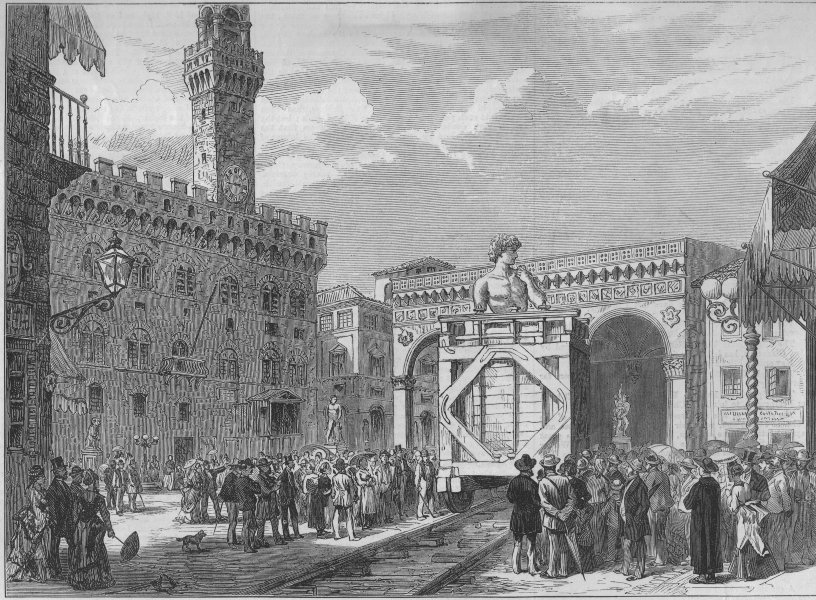
The statue you’ll see today only ended up indoors thanks to a slow Florentine panic. From 1504 (the year Michelangelo finished it) to 1873, David stood outside in front of Palazzo Vecchio, exposed to weather, pigeons, and the occasional riot. In 1527, during a political uprising, someone threw a bench out of an upstairs window and broke off the statue’s left arm. They glued it back. Decades of acid rain ate at the marble surface. By the mid-19th century the statue was visibly degrading.
In 1872, the city decided to move it. The Accademia building (which had housed Florence’s art academy since 1784) was chosen as the new home, and the architect Emilio De Fabris designed a custom Tribuna with a domed skylight to shelter it. The actual move, in July and August 1873, took 41 days. The statue was wheeled along a wooden railway in a custom timber crate, 700 metres through the streets of Florence, with crowds watching. The original photo above is one of the earliest news photographs of an art relocation.
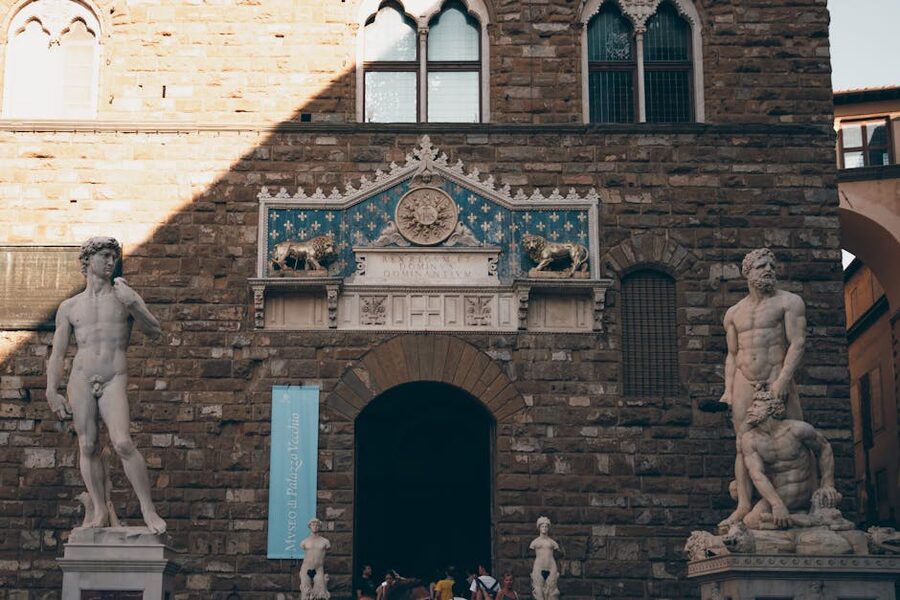
What stood in Piazza della Signoria from then on is the marble copy you can still photograph for free today. The bronze copy on Piazzale Michelangelo (south of the river, the famous viewpoint) was added in 1875 as a memorial to Michelangelo himself.
When to Visit and How to Avoid Crowds
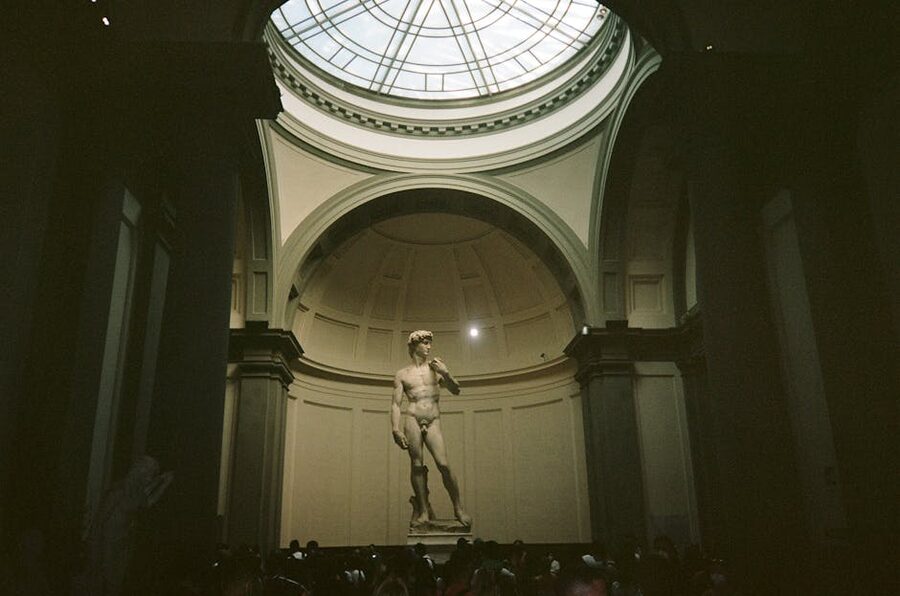
The single best slot is 8:15am opening on a Tuesday. Tuesday is the first opening day after Monday’s closure, and the morning slots are mostly bought up by tour groups, but the very first 8:15 entry catches a 15-minute window where the Tribuna is genuinely uncrowded. By 9am there are already 200 people in the corridor.
Late afternoon (4pm onwards) is the second-best window. The tour groups have moved on by then, and you’ll get the Tribuna with maybe 20 to 30 other people in it — calm enough to walk a full circle around David without bumping anyone. The catch is the museum closes at 6:50pm with last entry at 6:20pm, so don’t show up at 6:15.
Avoid: 10am to 2pm, every day. That’s the cruise-ship-day-trip window when groups bus in from the coast. Also avoid the first weekend of every month (free admission Sunday) — it’s the worst combination of free + busy.
Off-season (November through February, excluding Christmas week) is dramatically quieter. You can walk up at 11am on a Wednesday in January and get straight in. The catch is everything else in Florence is also quieter, the days are short, and you’ll want to plan around museum opening hours.
Getting There
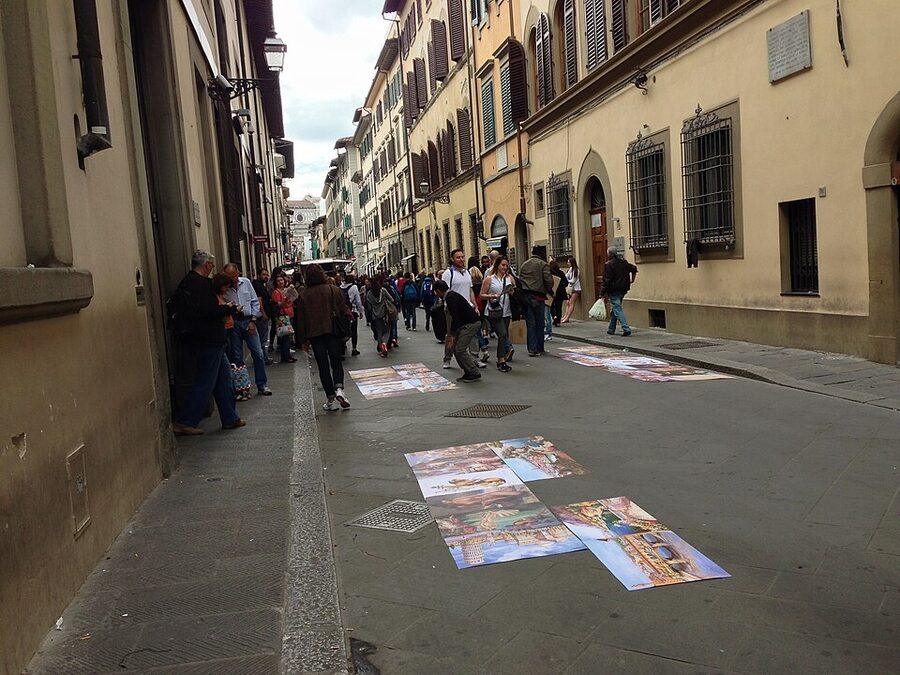
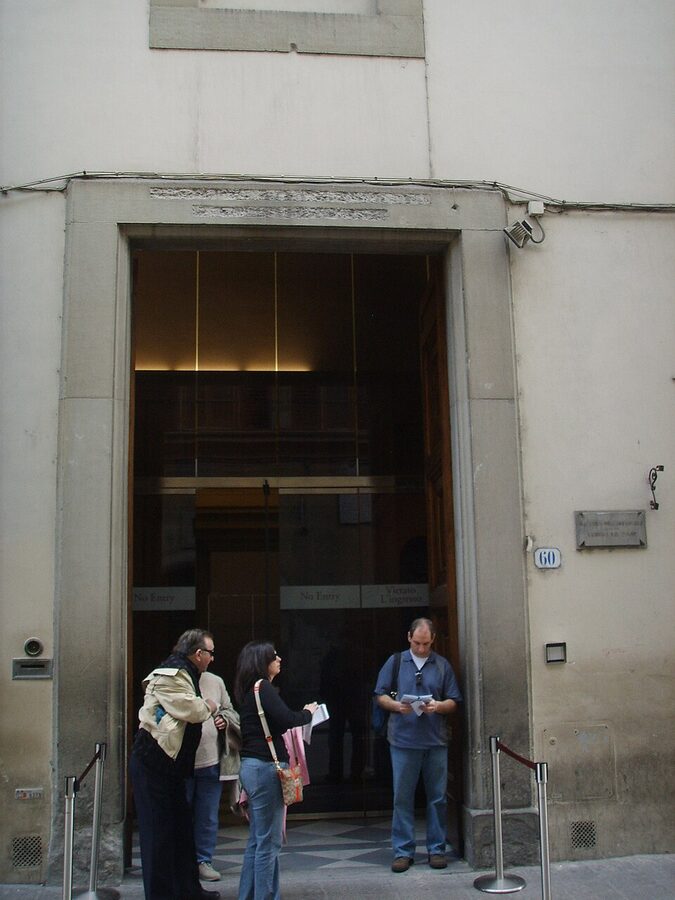
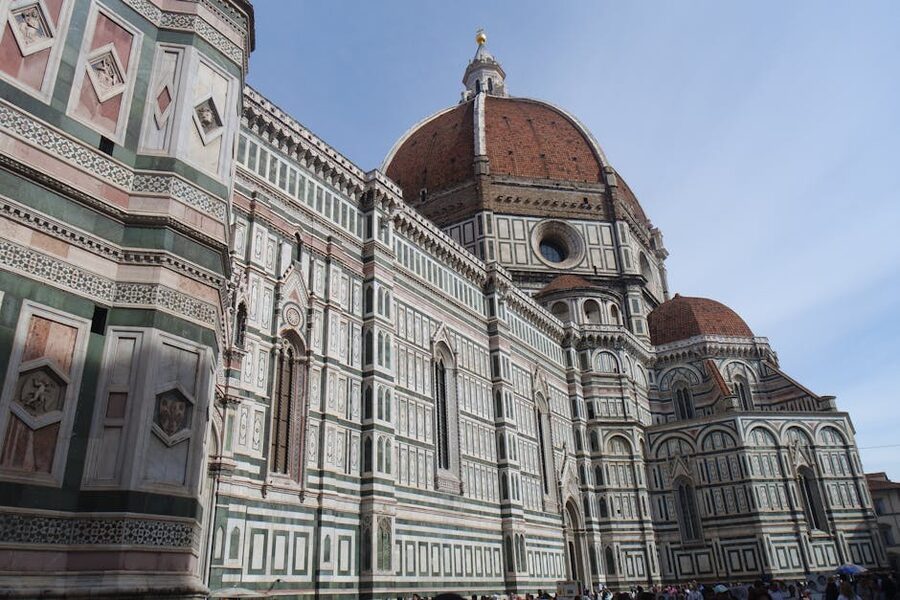
The address is Via Ricasoli 58/60, 50122 Firenze. From the Duomo (the giant red-domed cathedral that anchors central Florence), it’s a five-minute walk north. From Santa Maria Novella train station, about 12 minutes on foot. There’s no direct bus line that gets you closer than walking from the Duomo, so unless you have mobility issues, just walk it.
If you’re booked on a tour that starts elsewhere, give yourself an extra 10 minutes to find the entrance. Via Ricasoli is a narrow street and the museum facade is plain — no grand portico, no signs visible from a block away. Look for the green awning and the queue.
Toilets are inside, after the ticket check, on the right. The cloakroom (free, mandatory for anything bigger than a small bag) is also inside, right after the entrance. Don’t bring large backpacks — they’ll send you back out to leave them at a separate luggage storage on the next street.
Practical Things Worth Knowing
Photography is allowed without flash. Tripods, selfie sticks, and video are not. Phone photos are fine and you’ll see hundreds being taken.
The museum is small but not tiny. Plan for 90 minutes if you’re using the audio guide and want to see the Slaves, the David, the Sala del Colosso, the Musical Instruments room, and the upstairs gold panels. 60 minutes if you’re zooming through. Two hours if you’re a slow looker.
Skip the gift shop unless you want a fridge magnet. The Uffizi has a much better book selection if you’re after a serious art catalogue. The Accademia shop is small and overpriced.
Eating nearby: the streets around the Accademia are decent for lunch. Trattoria Mario is a 4-minute walk away — cash only, no reservations, queue from 11:30am for the noon opening. It’s also worth pairing the visit with a cooking class — the food tour and cooking class circuit covers Florence too, and the pasta classes near San Lorenzo are within easy walking distance.
Combining with the Uffizi: Don’t try to do both museums in one morning. The Uffizi is the kind of museum where you can spend four hours and still leave wanting more, and adding the Accademia after is a fast way to museum fatigue. Split them across two days. Do the smaller Accademia in the morning of one day, leave time to walk and eat, and save the Uffizi for a longer slot on a different day.
What to Pair It With
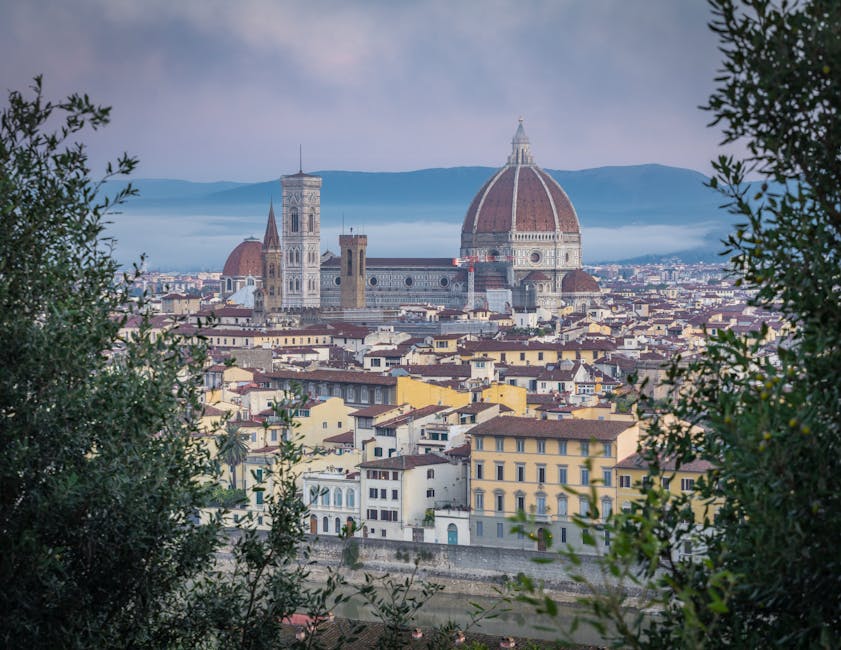
If you’ve only got a half day in Florence, the David visit pairs naturally with a walk to the Duomo (5 minutes south) and a climb up Brunelleschi’s Dome — the same architect who finished David’s home and the same neighbourhood. With a full day, add the Uffizi the day before, and a sunset walk up to Piazzale Michelangelo to see the bronze copy of David where the Florentines installed it as a memorial. From there you’ve seen all three Davids in 24 hours.
The Borghese Gallery in Rome is the closest cousin in spirit — small, focused, sculpture-led, with one absolute showstopper at the centre. If David is the Florentine Renaissance breakthrough, Bernini’s Rape of Proserpine is the Baroque answer 130 years later. Our Borghese tickets and tours guide walks through the same kind of pre-booking strategy because they cap visitor numbers in roughly the same way.
And if you’re heading on to Rome, the same Renaissance arc continues at the Vatican Museums and Sistine Chapel. Michelangelo painted that ceiling between 1508 and 1512, three years after he finished David. Seeing the David first and the Sistine second is the natural chronological way to do it — you watch him grow up as an artist across two cities.