
Most travellers asking about a “Bordeaux wine tour” picture themselves at one famous Médoc château with a long avenue, a cellar door, and someone in a tweed waistcoat handing them a glass of Cabernet. That’s not how a Bordeaux day is actually built. The version that locals and repeat visitors put together looks like this: a city walking tour of the 18th-century quays, a 90-minute Garonne river cruise with a glass of wine on the deck, and an afternoon either at Saint-Émilion’s medieval village or inside the Cité du Vin tasting museum. Pick the wrong shape for the day and you spend three hours on a bus seeing one driveway. Pick the right one and Bordeaux turns into one of the better single days in France.
The Bordeaux day in three pieces
- Garonne river cruise with wine and canelé ($22): the 90-minute boat ride that gets you on the water with a glass in hand. Check availability
- Guided walking tour of the old town ($17): covers Place de la Bourse, the Miroir d’Eau, and Quartier Saint-Pierre with a local. Check availability
- Saint-Émilion half-day from Bordeaux ($129): the afternoon in the medieval UNESCO village with two château visits and tastings. Check availability
Why Bordeaux became a wine city in the first place
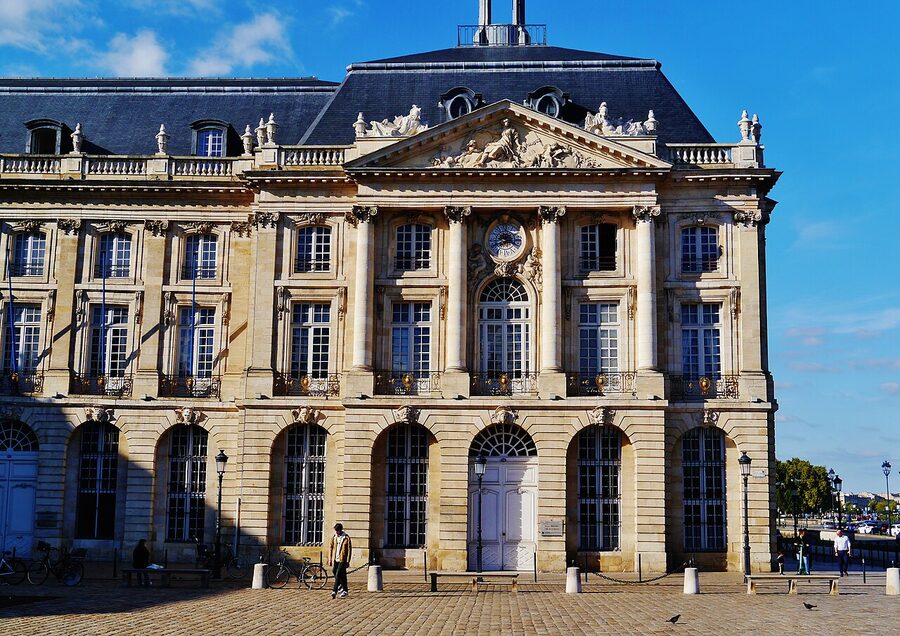
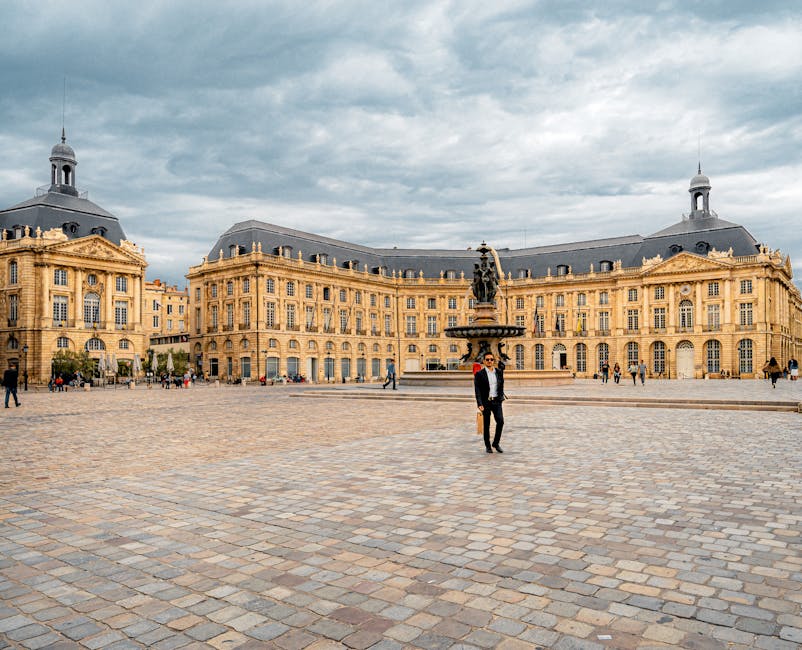
This is the part that most operators skip in their intro spiel, and it’s the part that explains everything else. Bordeaux became wine-famous because of the British. In 1152, Eleanor of Aquitaine married Henry II of England, and her dowry included most of southwest France. For three hundred years after that, Aquitaine sat under English rule, and London drank Bordeaux’s red wine, called claret in English, faster than the city could ship it. By the 13th century the harbour you can still see today, the great curve of quays now framed by Place de la Bourse, was Europe’s largest single export point for wine.
That long British thirst is why Bordeaux’s cellars exist at the scale they do. It’s also why the 1855 Classification, the system that ranks Médoc châteaux into five growths from premier cru down to cinquième cru, was set up under Napoleon III. The Universal Exhibition in Paris that year asked Bordeaux merchants to put their best estates on show, and the resulting list, almost untouched in 170 years, still appears on every bottle of Lafite, Latour, Margaux, and Mouton Rothschild you’ll see. The northern parallel for an export-driven drink shaping a whole city’s economy is Amsterdam, where the Heineken Experience on Stadhouderskade tells the same colonial-era trade story for Dutch beer.
The structural decision: Saint-Émilion or Médoc?
This is the choice that makes or breaks the day. Most first-time visitors pick Médoc because the names are familiar, and most of them come back saying the day didn’t quite work. Here’s the actual split:
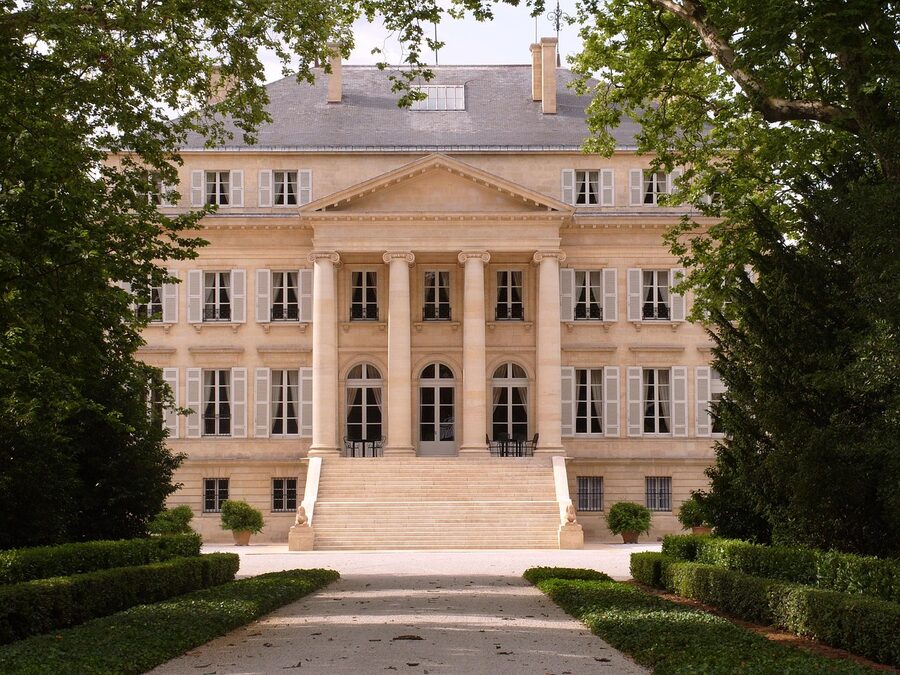
Médoc sits north of the city, runs along the Gironde estuary, and grows mainly Cabernet Sauvignon. The châteaux are big, formal, often gated, and a good number of them don’t take walk-ins. A typical Médoc tour drives you 90 minutes each way, stops at two estates, and gives you a tasting at each. The wine is famous. The day, for many people, feels like a long bus ride to a long driveway.
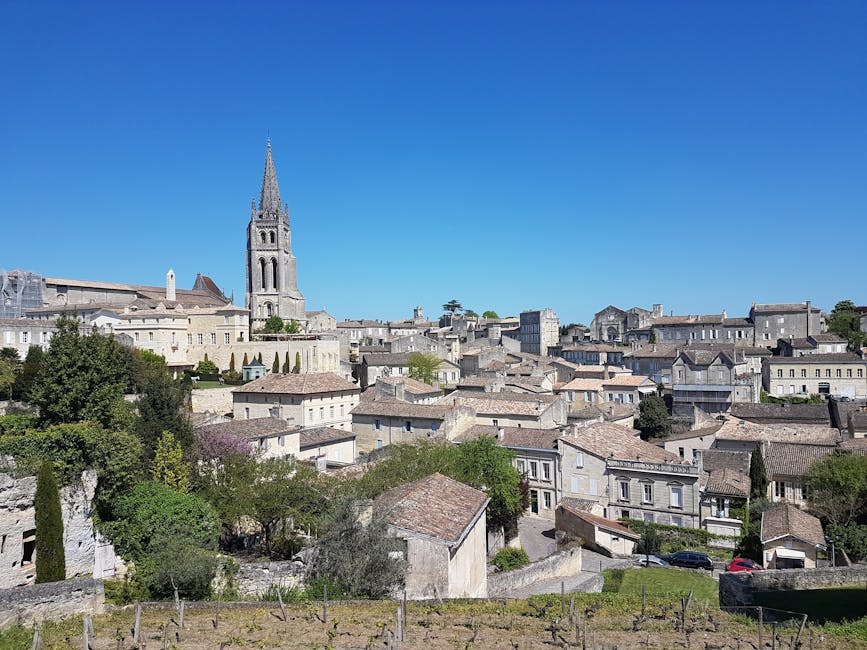
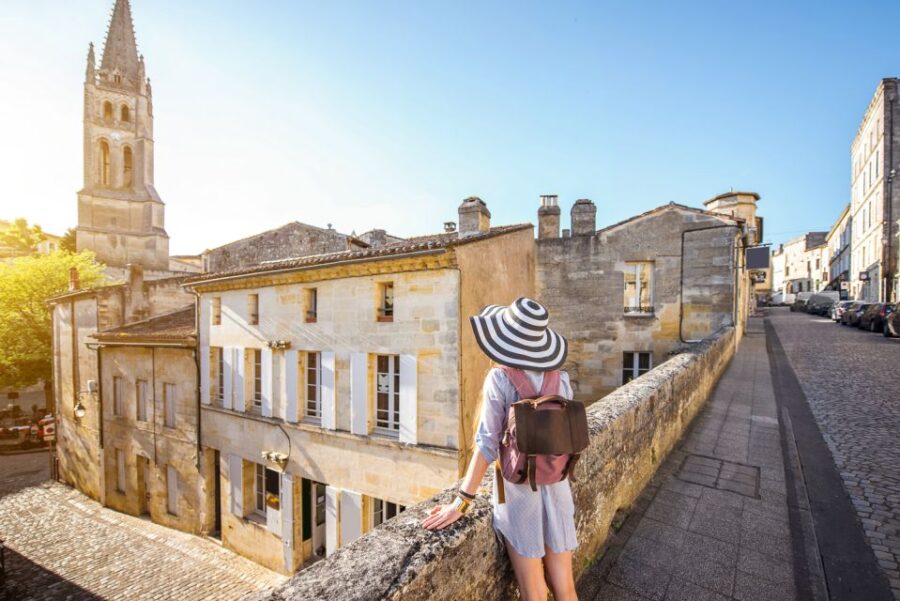
Saint-Émilion sits 40km east of the city, grows mainly Merlot, and the town itself is the visit. Since 1999 the entire village and its 7,800 hectares of surrounding vineyards have been a UNESCO World Heritage Site, the first wine region in the world to get that protection. The estates here are smaller, often family-run, and you can walk into the village in fifteen minutes and be drinking wine out of a glass that hasn’t moved further than 200m from the vine it came from. It’s the day-shape that travellers tell their friends about afterwards.
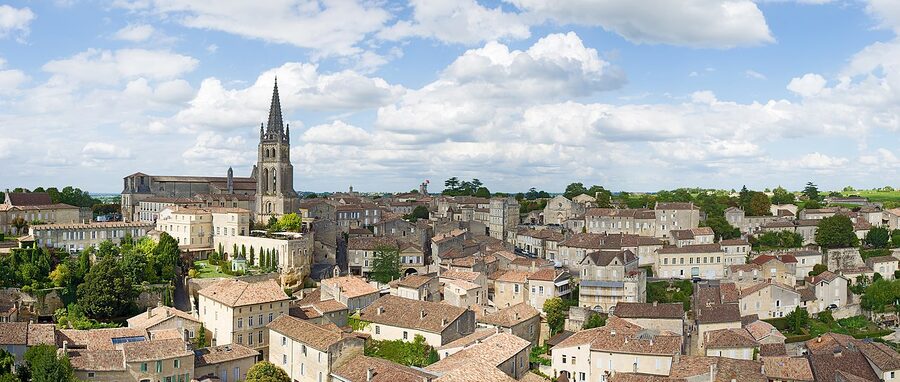
The first time I went, I climbed the Tour du Roi just before noon. From the top you can see the whole village, the limestone bell tower of the Église Monolithe rising above the roofs, and the green of the vineyards starting where the houses end. A Belgian couple in front of me said almost nothing for the first thirty seconds, then the woman pointed at the bell tower and said to her partner, “we picked the right one, didn’t we.” That’s about the size of it. Saint-Émilion is the right one.
If you’ve already made the day-trip choice in the other direction (Loire over wine country), the structural lesson transfers: Loire Valley castle days work the same way, where the village-and-vineyard combo beats the long-bus-to-one-driveway version every time.
The shape of the day, hour by hour
Here’s the rhythm that actually works, assuming you’ve got one full day in Bordeaux. You don’t have to do all three pieces, but if you do, the order matters.
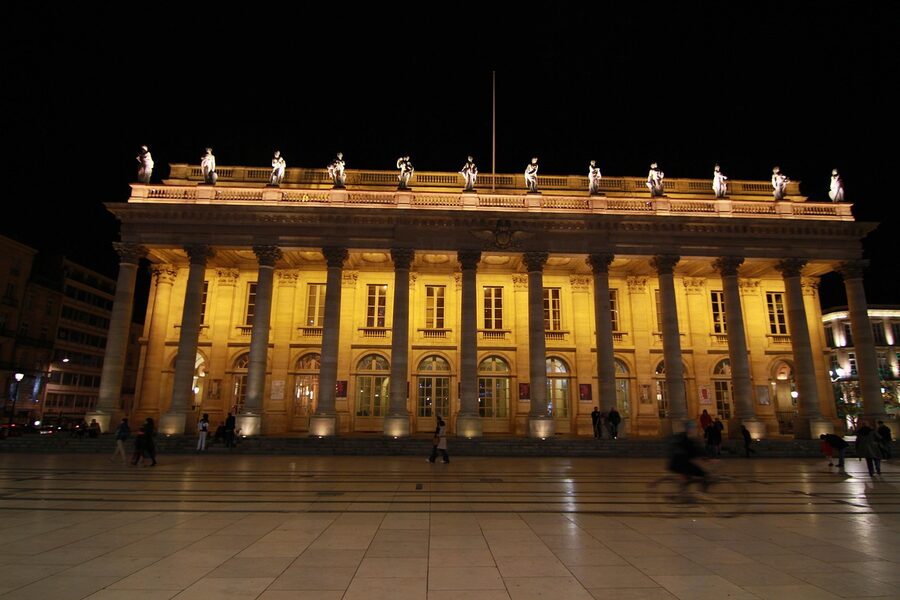
9:30 to 11:30: walking tour of the old town. Start at the Office de Tourisme on Rue du 30 Juillet. A guided tour covers Place de la Bourse, the Miroir d’Eau, the medieval Quartier Saint-Pierre, the Grand Théâtre, and ends near the river. Two hours, in English, $17 a head. You can do this on your own with a printed map but you miss the British-period stories that tie everything together, and those stories are half the point.
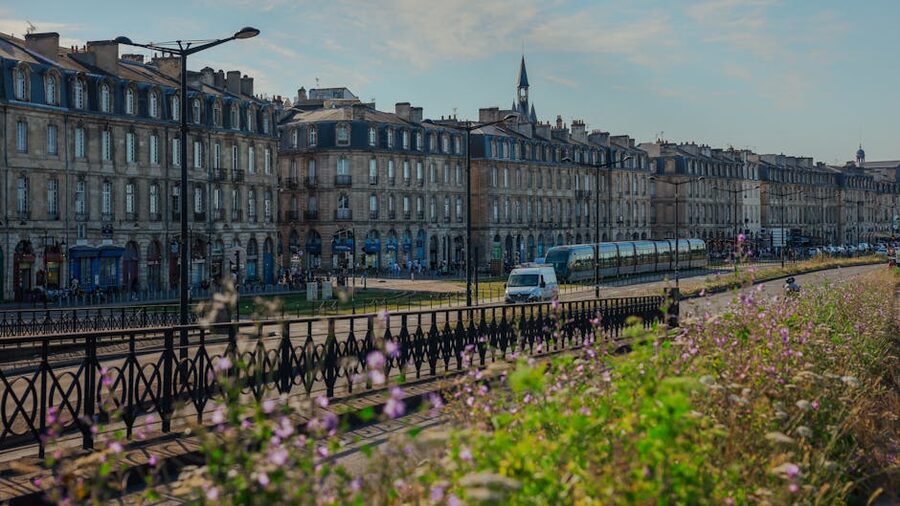
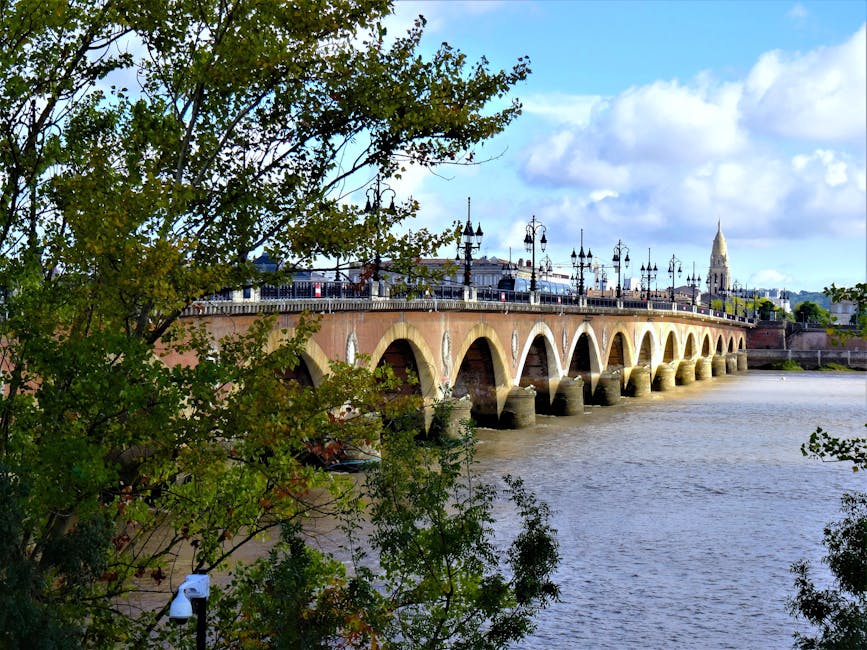
12:00 to 1:30: Garonne river cruise with a glass of wine. The Bordeaux River Cruise leaves from the quays at Quinconces, takes you upstream past the Pont de Pierre, the Cité du Vin, and back. 90 minutes on the water with a guide, a glass of red, and a canelé (the rum-and-vanilla pastry Bordeaux invented in the 16th century, originally so the nuns of the Annonciades convent could use up the egg yolks left over from clarifying wine). $22, runs three to four times daily April through October. Amsterdam runs the equivalent format on its canal-belt cruises along the Herengracht, where 75-minute boats with a glass and a cheese plate are the same midday-rhythm reset.
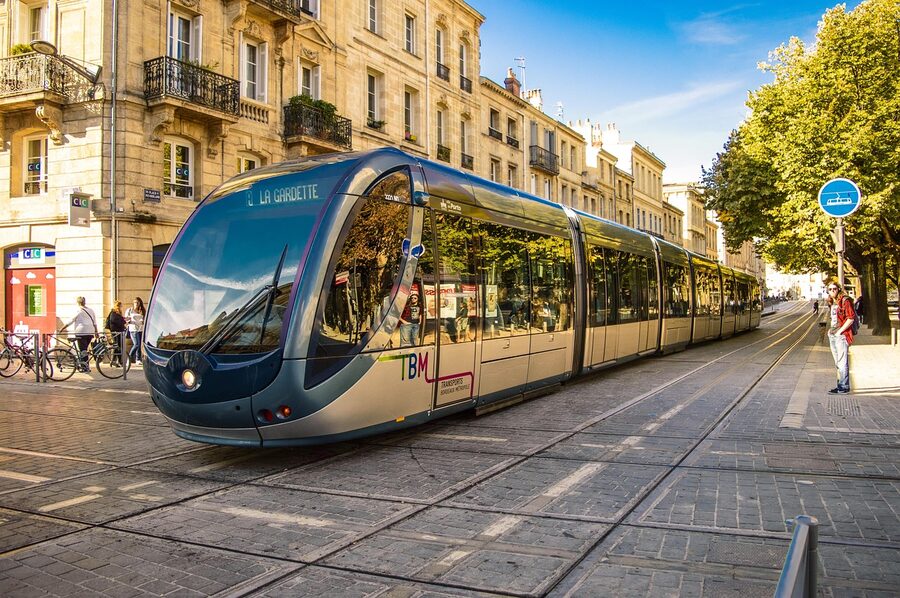
2:30 to 6:30: Saint-Émilion half-day or Cité du Vin. This is the structural choice. If you went with the half-day to Saint-Émilion, the van leaves Bordeaux around 1:30, you’re in the village by 2:15, and you’ve got a guided walk plus two château visits with tastings before the van turns around at 6pm. If you went with Cité du Vin instead, the museum is a 12-minute tram ride (line B) from the centre and gives you about three hours of self-guided exhibits ending in a glass of wine on the rooftop with a view back over the Garonne.
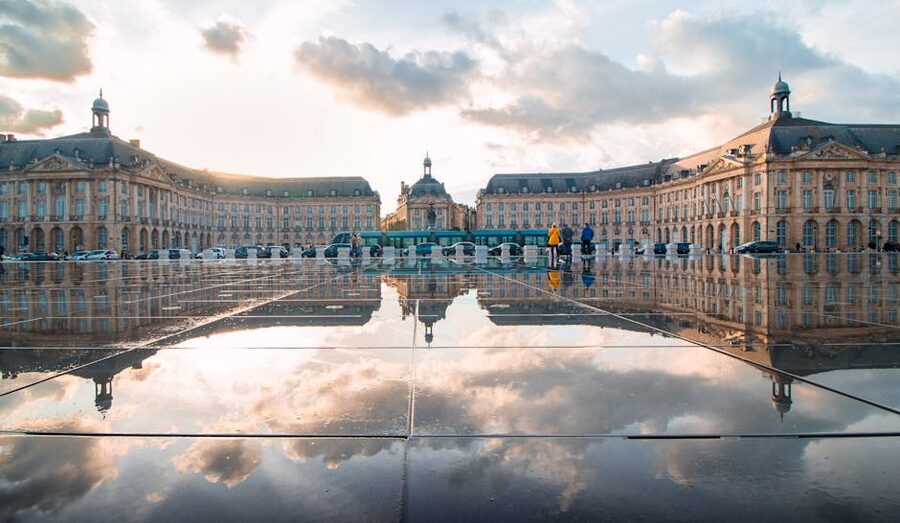
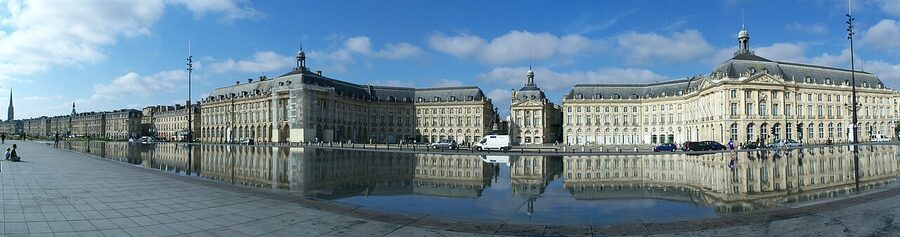
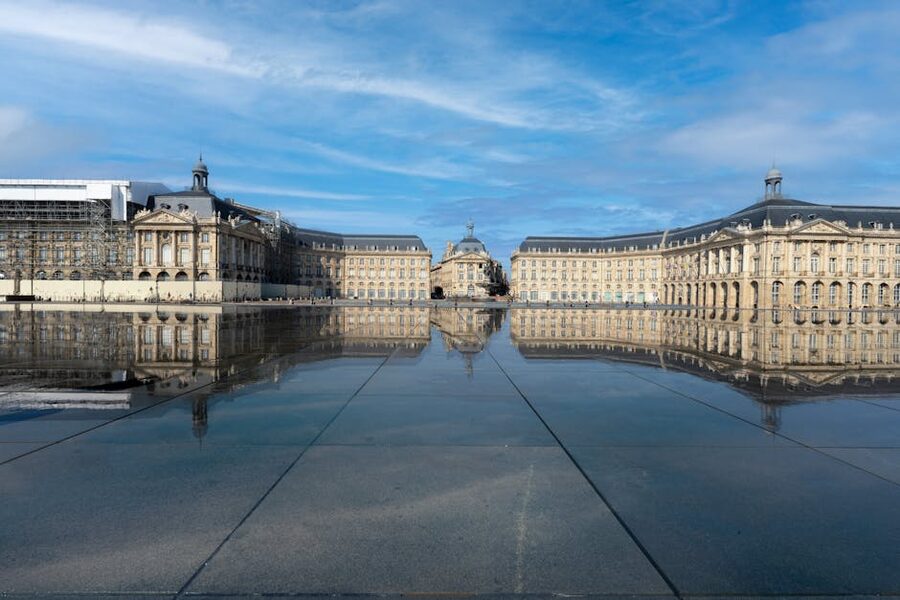
7:30 onwards: dinner and the Miroir d’Eau at sunset. Whichever afternoon you pick, you’re back in the centre by 7. The Miroir d’Eau in front of Place de la Bourse switches its three-minute cycle between mirror, mist, and dry until late, and the building doubled in 2cm of water at sunset is the Bordeaux photo people show their friends.
The Miroir d’Eau, in detail
It’s worth understanding what you’re looking at, because most travellers walk past assuming it’s a fountain. It isn’t. The Miroir d’Eau is the largest reflecting pool in the world, 3,450 square metres of black granite paving with a thin film of water that pumps up from below. Built in 2006 by the landscape architect Michel Corajoud, it was designed to give the city back the river view that traffic and parked cars had eaten for decades. The cycle runs every 23 minutes: two centimetres of water for the mirror effect, then a 25-second mist that drops visibility to almost zero (children love this part), then it dries back to bare stone before refilling.
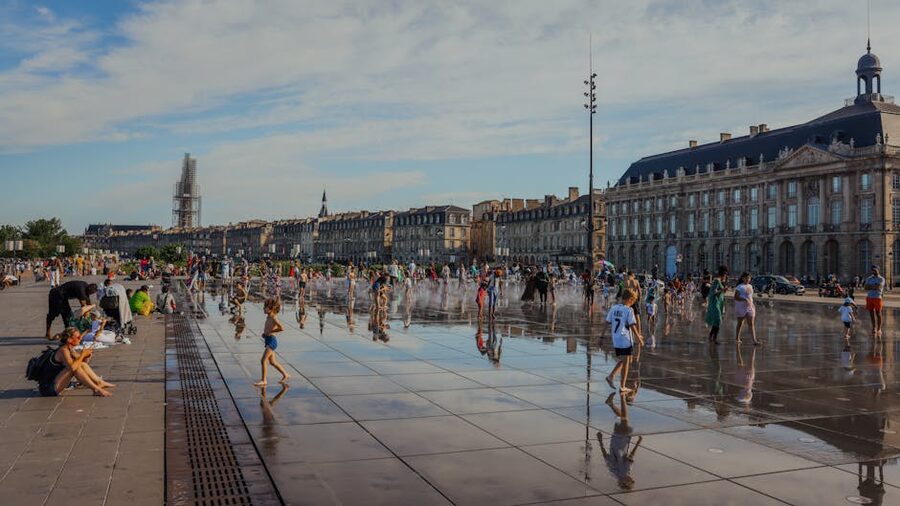
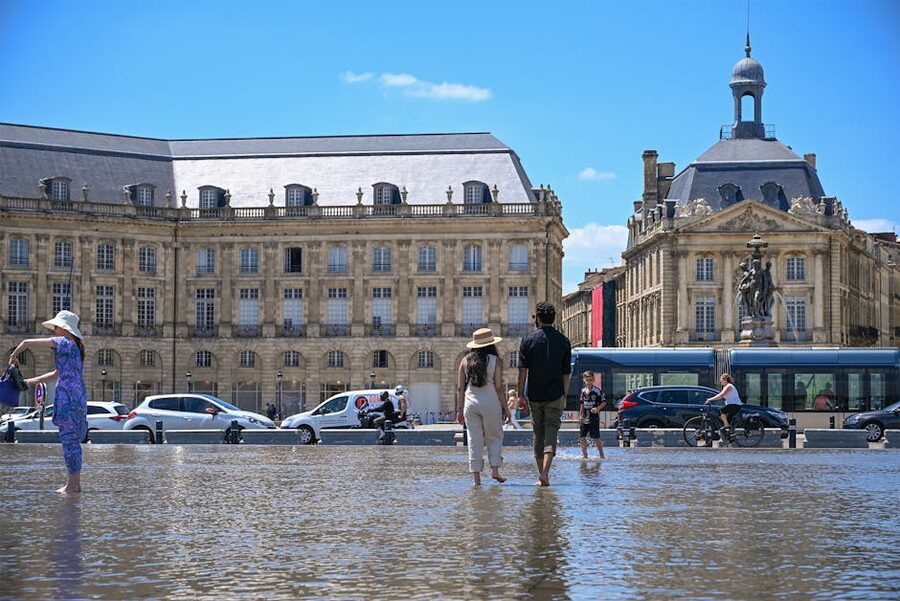
The same kind of public-realm gesture is what the city of Paris keeps trying to pull off with its banks of the Seine. Seine river cruises in Paris give you the river from the boat, but the riverside has nothing on Bordeaux’s quays for sheer pedestrian volume on a warm evening. If you’ve done both, you’ll know.
Garonne river cruise: what 90 minutes on the water gives you
Worth being specific about, because cruise products in Bordeaux are wildly varied in quality. The one most people end up on is the 90-minute round trip from Quinconces with a glass of wine and a canelé. It’s the cheap option ($22) and it’s also the right one for a first day in the city. The boat is a flat-bottomed 60-seater with an open upper deck, the guide does a running commentary in French and English, and the wine is a perfectly drinkable Bordeaux Supérieur, not a marketing pour.
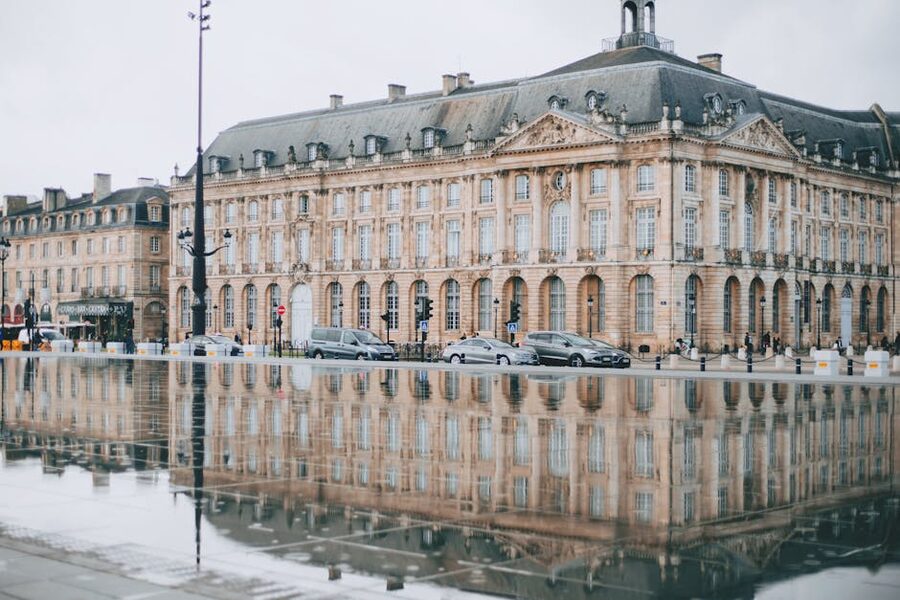
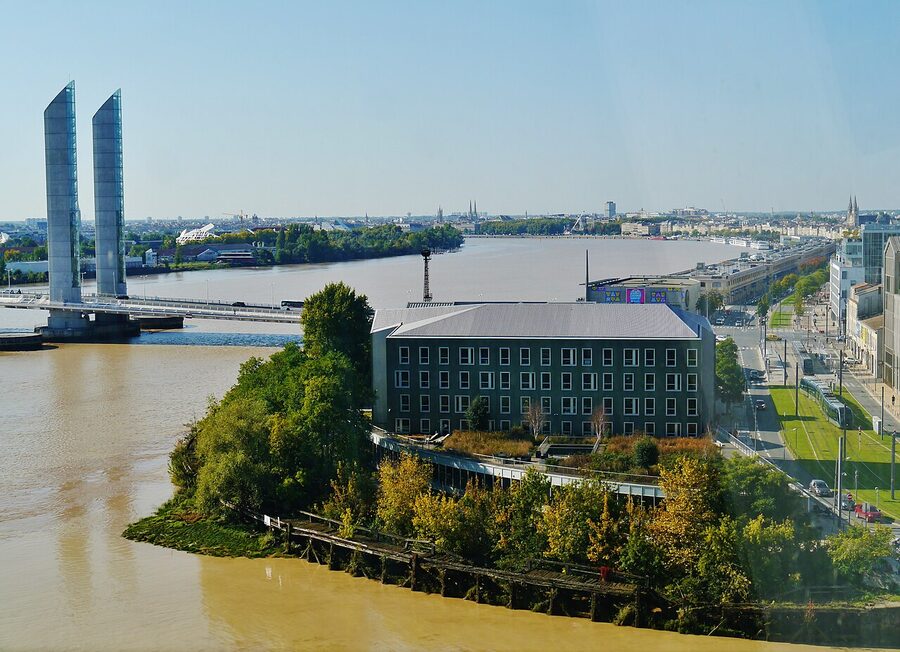
What you actually get for 90 minutes: the boat heads upstream past the Place de la Bourse and the Miroir d’Eau, turns just before the Pont de Pierre, comes back down, then continues downstream past the Cité du Vin and the Bassins de Lumières (a digital art installation in a former WW2 submarine bunker), and turns again at the Pont Jacques Chaban-Delmas, the city’s vertical-lift bridge. The guide times the wine pour for the upstream leg so you’ve got something in your hand for the best of the riverfront. The canelé arrives roughly when the boat passes the cathedral.
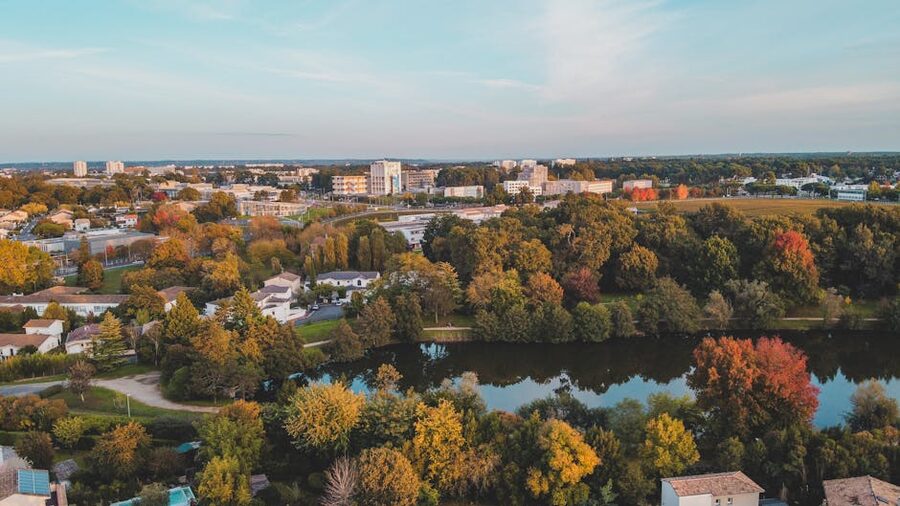
The longer two-hour cruise with three wines is also out there ($45 ish), but for most people the 90-minute single-glass version is the right buy. You’re not on the boat to taste seriously; you’re on it to see Bordeaux from the water. Save the serious tasting for Saint-Émilion or Cité du Vin.
Cité du Vin: the museum-as-tasting alternative
If Saint-Émilion isn’t your shape (you’ve only got an afternoon, you don’t want a 90-minute van each way, you have small kids who’d rather press buttons than walk a vineyard), the Cité du Vin is the better choice. It’s not a Bordeaux-specific museum, despite the location: the exhibits cover wine globally, from ancient Egypt to California, from Argentina to Tokaj. It earned its place in Bordeaux because of the city’s role in shipping wine to the world, not because the museum is about Bordeaux wine.
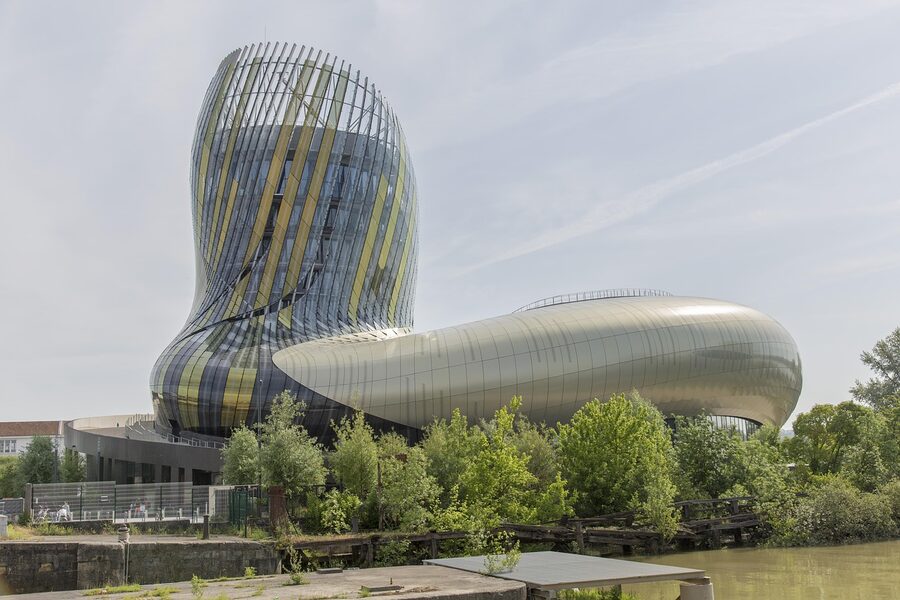
The good bit: the rooftop tasting at the end. Your ticket includes one glass of wine on the 8th-floor terrace, and the staff let you choose from about a dozen wines from around the world, not just France. The view across the river back to the old town is the best urban view in Bordeaux, full stop. If you go, give yourself three hours: two for the exhibits and one for the rooftop. We have a separate guide to booking Cité du Vin tickets and the rooftop tasting; the short version is, book online a day ahead, pick the morning slot, beat the school groups.
Saint-Émilion: the day-shape most travellers don’t pick first, and should
I’ll be straight: I think this is the better afternoon. The price is steeper than Cité du Vin ($129 vs maybe $30) but you’re getting a 4-hour return trip, a guided village walk, and two château tastings. You’re also getting one of the most photogenic medieval villages in France, and a UNESCO designation that covers not just the village but the surrounding 7,800 hectares of vines, the only wine region with that kind of protection.
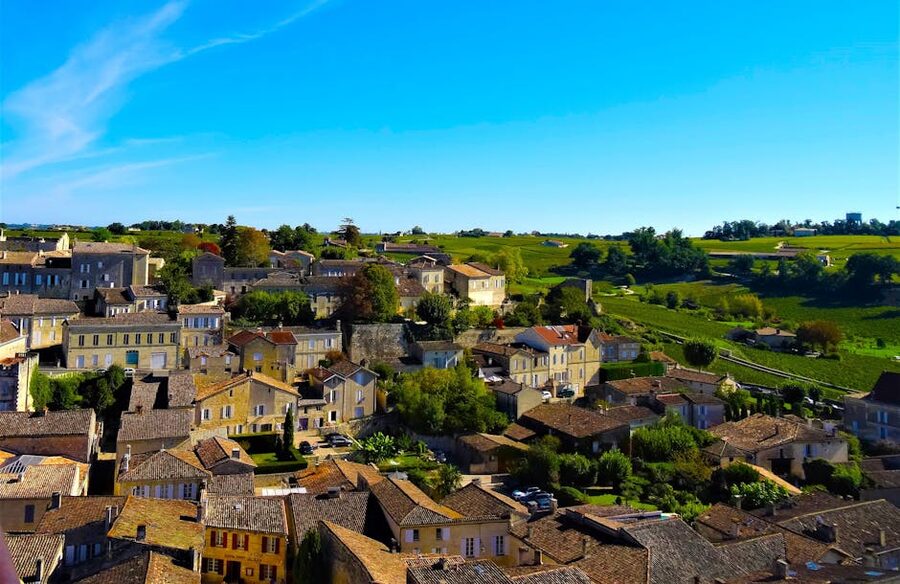
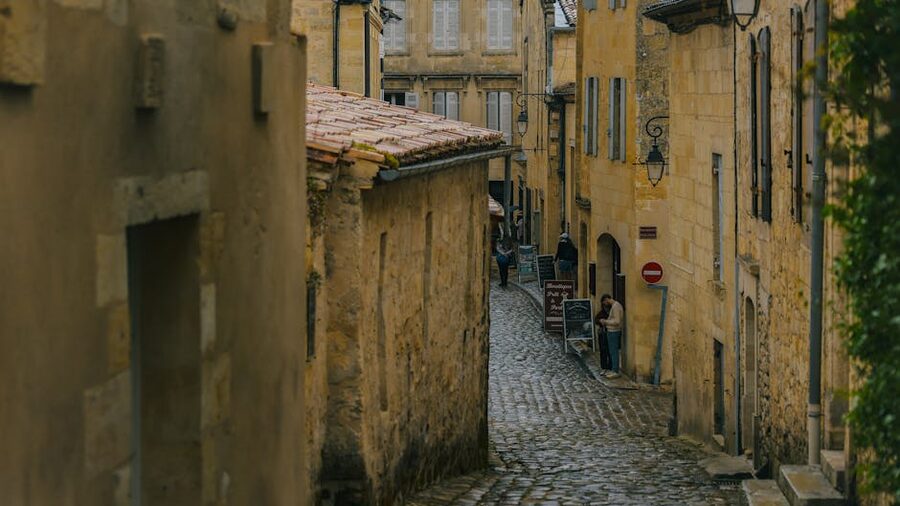
What you typically do on the half-day: a 50-minute van ride east, a 45-minute guided walk through the village (Église Monolithe, Tour du Roi, the macaron shop on the Place du Marché where the recipe goes back to 1620), then two 45-minute tastings at family châteaux that the operator has a relationship with. You’ll usually try four to six wines per estate, paired with a short walk through the cellar and a quick look at the vines. You’re back in Bordeaux by 7pm.
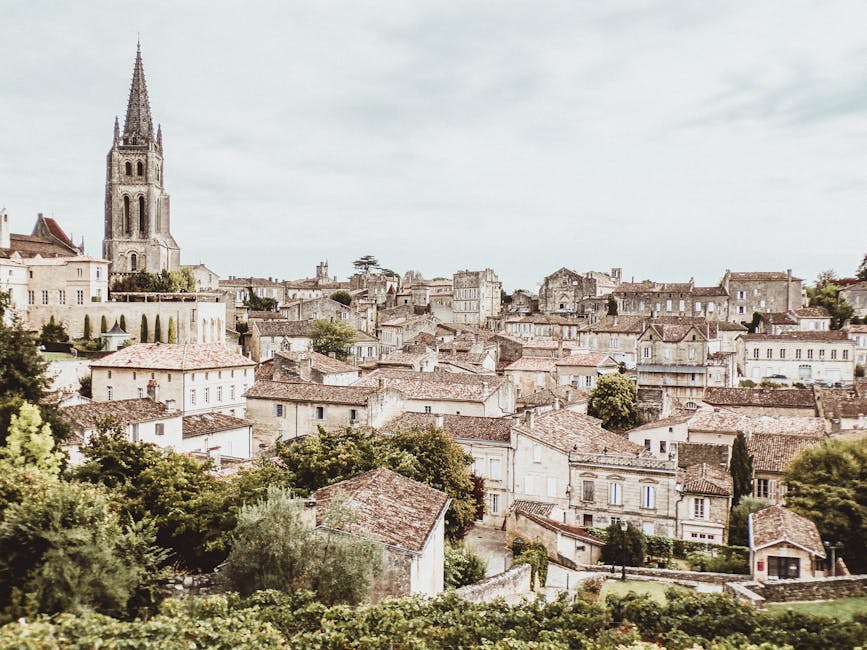
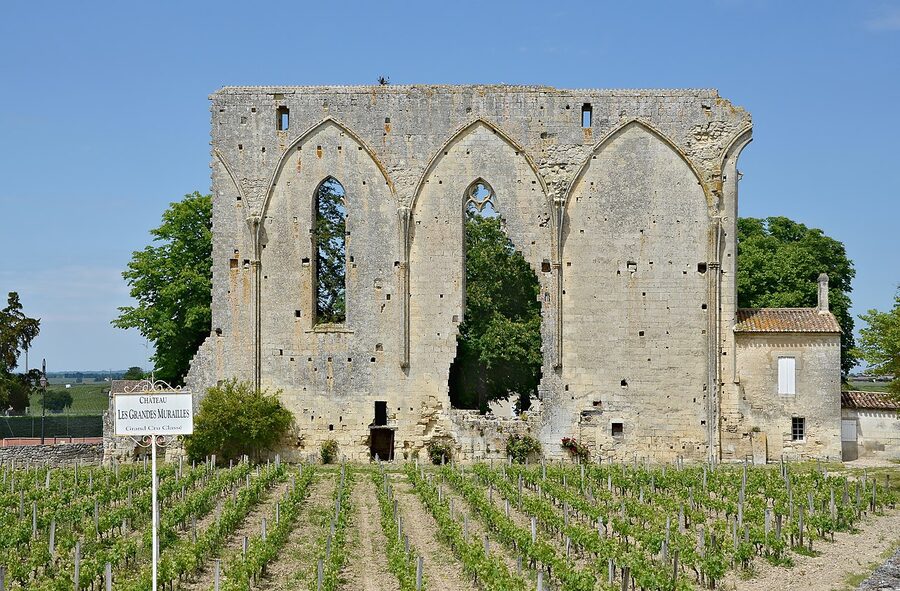
One thing to know: Saint-Émilion has its own internal classification, totally separate from the 1855 Médoc one. It’s reviewed every 10 years (the next revision lands 2032), and ranks estates as Grand Cru, Grand Cru Classé, or Premier Grand Cru Classé. It’s more dynamic than Médoc’s frozen-in-amber list, which means a great estate can rise into the top tier on quality alone. The half-day tour usually takes you to a Grand Cru Classé and a smaller family estate so you taste the contrast.
If you’re someone who travels for food and wine more than for monuments, the Saint-Émilion afternoon and the Chianti from Florence half-day are the two most-recommendable wine excursions in Western Europe. They’re built the same way: small village as the heart of the visit, family estates around it, the food and the architecture as much the point as the wine itself.
Booking the three pieces: practical detail
The walking tour, the cruise, and the Saint-Émilion half-day are three separate operators. There’s no single combo ticket. Buy them individually online, ideally a day ahead in shoulder season and three days ahead June through August. Here’s how each one tends to work:
The walking tour meets at the Office de Tourisme on Rue du 30 Juillet (200m from the Grand Théâtre). The morning slot is 10am, two hours. English versions run April through October daily, November through March two days a week. $17 a head, free for under-12s. You can show up with a printed voucher.
The Garonne cruise boards at Quai Louis XVIII near the Quinconces tram stop. Boat times depend on season: April through October there are usually three to four daily slots between 10:30 and 6:30. November through March it drops to one or two midday sailings. Book online and arrive 15 minutes early; boarding closes 5 minutes before sailing.
The Saint-Émilion half-day picks up from a meeting point at the Bordeaux tourist office or your hotel (operator dependent). One afternoon departure, usually 1:30pm pick-up, back by 7. $129 per person, includes transport, the guided walk, two château visits, and tastings of about 5 to 6 wines total. Lunch is not included; eat in the centre of Bordeaux before you go.
How Bordeaux compares to France’s other day-trip cities
Worth being clear about what Bordeaux is and isn’t. It’s not Paris, and the comparison is unfair to both. Paris has the major museums (the Eiffel Tower, the Louvre, the Orsay), Bordeaux has the river. Paris has 20 million annual visitors, Bordeaux gets about 4 million. The Bordeaux centre is also small enough that you can walk it edge to edge in 25 minutes; the Paris centre is not.
If you’ve been to Lyon, the comparison is closer. Both are mid-size French cities (Lyon is bigger, around 520,000 to Bordeaux’s 250,000) with strong food and wine identities and UNESCO-listed centres. Lyon’s old town is denser and more medieval; Bordeaux’s centre is grander and more 18th-century. Both run good walking tours and good food cultures. The wine is the differentiator: Bordeaux does it at a scale Lyon doesn’t.
The other comparison people make is to Champagne. A Champagne day trip from Paris is its own animal: longer (an hour and a quarter on the TGV plus the day in Reims and Épernay), more focused on cellar tours, and structurally about cellars rather than villages. Bordeaux’s day-shape is village + city + river. Champagne’s day-shape is town + cellar + tasting. They’re both excellent. They’re not interchangeable.
The recommended tours
1. Garonne River Cruise with Wine and Canelé: $22
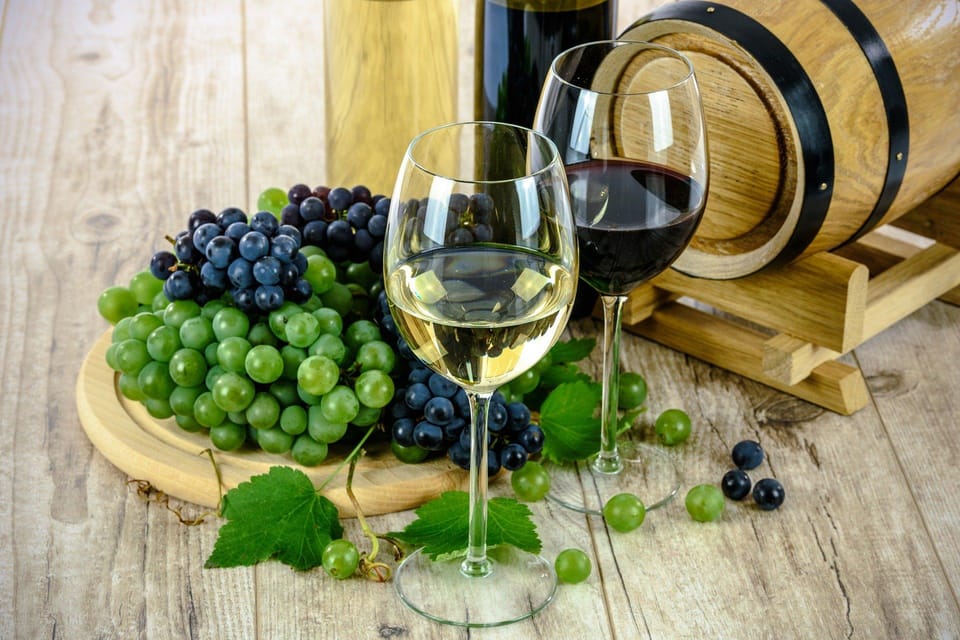
This is the cruise we tell people to book first. Our full review covers the boarding logistics and the seasonal sailing windows. The wine is a Bordeaux Supérieur and the canelé is the genuine local thing, baked in copper moulds with beeswax.
2. Bordeaux Guided Walking Tour: $17
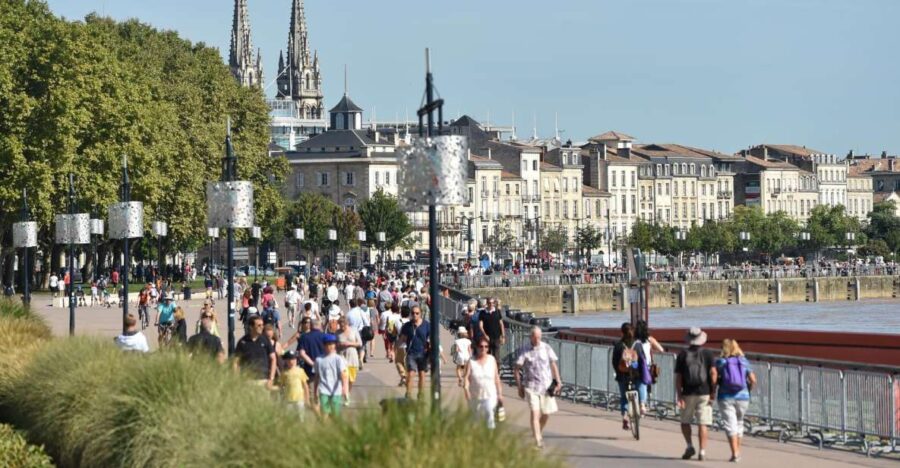
Cheap, dense with history, and the right way to anchor your morning. Read our take on which times work best: the 10am English slot is the smallest group and the freshest guide.
3. Saint-Émilion Half-Day from Bordeaux: $129
The most-booked Saint-Émilion half-day from Bordeaux, and the one we recommend over the Médoc alternative. Our full review explains why this beats Médoc on day-shape, even if Médoc has the bigger names.
When to come
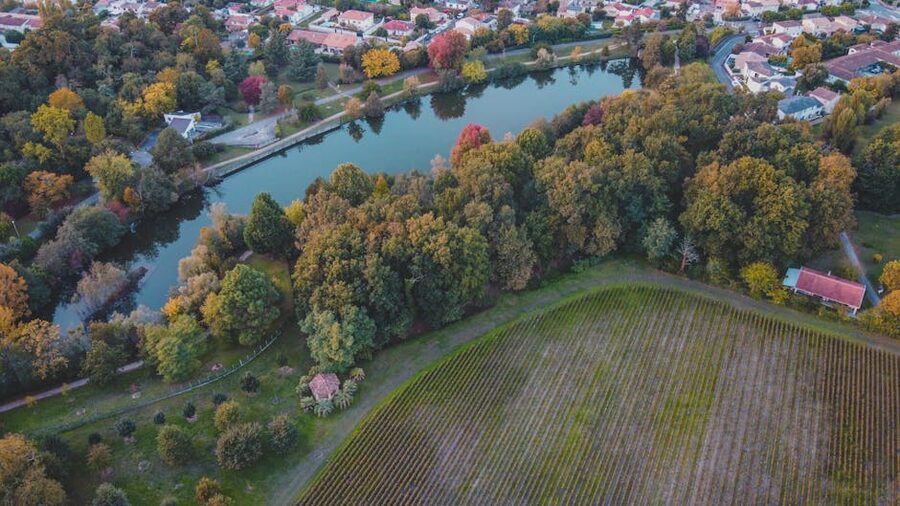
Best months are May, June, September, and October. The summer (July and August) is hot, sometimes uncomfortably so (35°C+ days are normal now), and the city is full of school groups on tour. October catches the harvest, mid-September through mid-October across most of Gironde, which is the only time of year you can stand in a cellar and watch fermentation actually happening. The vines change colour in late October, which gives Saint-Émilion a different look from the spring postcard.
Avoid the Bordeaux Wine Festival period (last weekend of June, every two years) unless you specifically want it. The riverfront becomes one long open tasting and prices for hotels triple. It’s a good festival, just not a relaxed one. The off-equivalent in odd years is the Bordeaux Fête le Fleuve, more about boats than wine, which can be lovely.
Winter (December through February) is quiet, prices drop, the river-cruise schedule shrinks to a midday sailing, and Saint-Émilion runs reduced château hours. Some of my favourite Bordeaux days have been in February with hot chocolate from one of the cafés on Place du Parlement and a long walk along the empty quays. It’s a different city in winter. Just don’t expect to do the full three-piece day-shape.
Getting there and where to stay one night
Paris-Bordeaux on the LGV Atlantique is 2 hours 4 minutes from Gare Montparnasse. SNCF tickets from €40 booked a month out, €120 booked the day before. The TGV puts you at Bordeaux Saint-Jean station, which is a 20-minute walk or a 10-minute tram ride (line C, direction Les Aubiers) into the centre. The airport is an option from outside Europe but the train beats it on timing for anyone already in France.
For a one-night stay the right base is anywhere within 10 minutes’ walk of Place de la Bourse: the Triangle d’Or, Saint-Pierre, or the Chartrons. The InterContinental Le Grand Hôtel is on the Place de la Comédie facing the Grand Théâtre and is the splurge call. La Course in the Chartrons is a smaller, design-led pick that’s our usual recommendation. Anything around the train station is too far from the action; don’t book there for one night.
Day-trips beyond the Bordeaux day
If you’ve got two or three nights and you’ve done the wine day, the second day in Bordeaux is usually a longer half-day in Médoc (now optional rather than substitute), or the Bay of Arcachon (an hour west by train, oysters and the Dune du Pilat). The Dune is the highest sand dune in Europe at 110m and surreal at sunset; book the Cap Ferret oyster cabins for lunch the same day. None of these need an organised tour, although several are sold as one-day excursions from Bordeaux.
And if Bordeaux is one stop on a longer France trip, the natural next move depends on what you’ve already done. Travellers coming from Paris who’ve already covered Versailles and Monet’s house at Giverny usually pair Bordeaux with the south: an overnight train or a TGV transfer down to Avignon and then on to the French Riviera from Nice. The Camargue from Arles works as a wildlife counterpoint to the wine days; a Camargue half-day from Arles puts you in front of pink flamingos and salt marshes that look like nothing else in France.
Eat and drink: where to actually go
Three places, all walkable from Place de la Bourse, all the kind of names a friend who lives there would give you. Le Petit Commerce on Rue du Parlement Saint-Pierre does the seafood the city is known for, especially oysters from Arcachon and grilled sardines, and the queue is always long but moves fast. Miles on Rue du Cancera is the modern French place to book if you want to eat well one night and aren’t on a hurry. Cafe Lavinal in the Médoc itself (15 minutes from Pauillac) is a winemaker’s bistro that runs a great €25 lunch menu, useful if you do end up doing a Médoc half-day. None of these are tourist traps; all of them are usual choices for a long Bordeaux weekend.
For wine bars: Aux Quatre Coins du Vin on Rue de la Devise lets you taste 32 wines from a self-serve dispenser, useful if you want to compare three different Saint-Émilions side by side. The Wine Bar du Boutique Hôtel near Place Pey-Berland is the more formal pick. Both are within 200m of the cathedral.
What to skip
Worth being direct about a couple of things travellers often book and shouldn’t. Skip the long full-day Médoc tours unless you’re a serious Cabernet drinker who’s read about specific châteaux you want to visit; the day-shape doesn’t work for casual wine interest. Skip the river cruise that’s billed as “wine and dinner”; the food is mediocre and the wine pairing is rushed. Skip the bus tour of Bordeaux itself; the walking tour covers the same ground in the same time, costs less, and gets you off the road.
Worth doing instead: an evening walk from Place de la Bourse to the Pont de Pierre and back along the quay, with a stop for a glass of wine on a terrace. Free, the best view, and the way the city looks at its own water at the end of a hot day.
If you’ve got more days in France
Bordeaux works as a single stop or as part of a southwest itinerary. If you have more time, the natural pairings are the Loire Valley (TGV change in Paris, about 5 hours total but worth it for the châteaux), or the south coast. The Loire Valley castles have the same village + estate + history rhythm as Saint-Émilion does for wine, just with kings and Renaissance architects instead of Merlot. Down south, both the French Riviera from Nice and the Camargue from Arles are a few hours away by TGV change in Marseille. Outside France, Bordeaux is a natural pre-Spain stop: there are direct trains to Barcelona’s tapas neighbourhoods via Marseille, and a Bordeaux-Madrid corridor via San Sebastián that doubles as a Basque Country detour. If your map has any food-and-wine focus at all, the Jerez sherry country in Andalusia and the Florence food and wine tours are the two strongest peers; the same kind of small-village + family-cellar rhythm Saint-Émilion does.
One last thing. If you take only one piece of advice from any of this, take this one: don’t try to do all three pieces in a single day if you’ve arrived from Paris that morning. The TGV gets you in around midday, you’ll be tired, and the cruise + walking tour is plenty for an arrival day. Save Saint-Émilion for a full second day and you’ll thank yourself.