
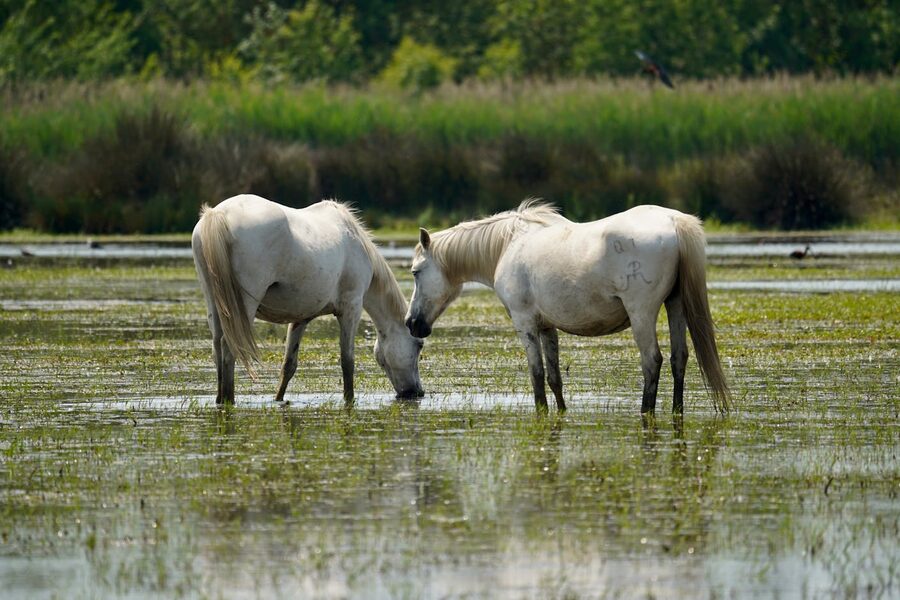
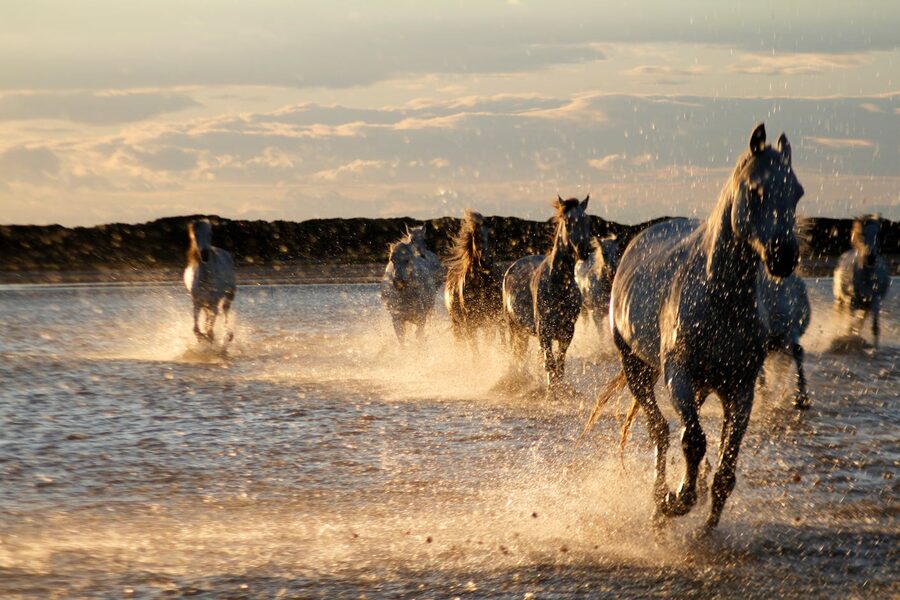
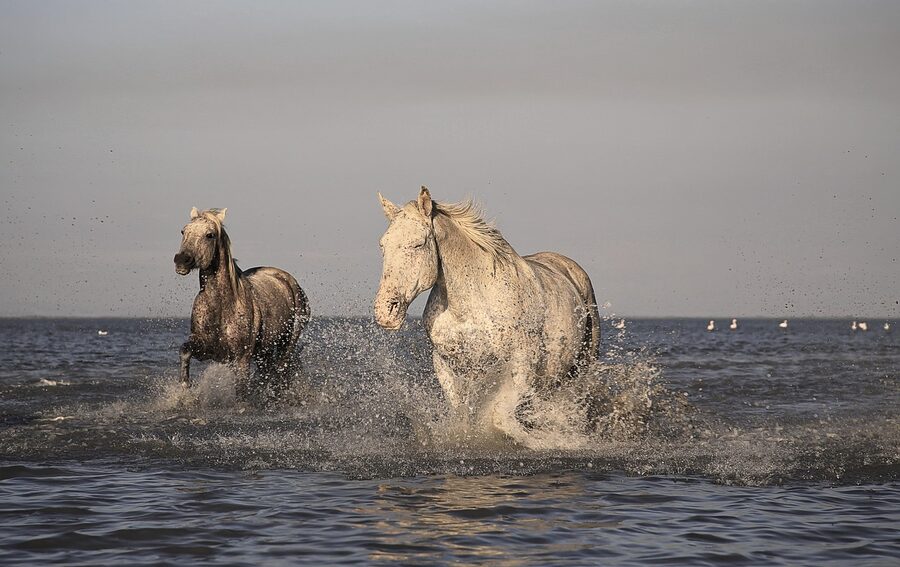
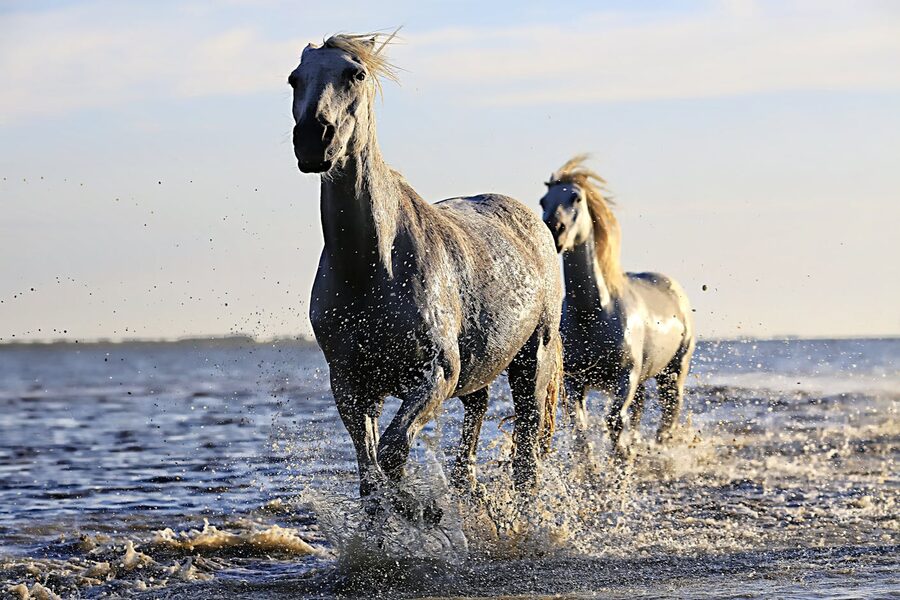
The horses come out of the reeds in single file, fifteen of them, white against the dark water. They wade in up to their knees, drink, and then cross the salt-marsh pool toward us with the late sun behind them. The driver cuts the engine. Nobody in the 4×4 says anything for about a minute, which is a long time when you’re sitting in a vehicle full of strangers. Then somebody whispers foals are dark grey, because two of the smaller horses in the back of the herd haven’t turned white yet, and we’re watching the part where Camargue horses become Camargue horses.
That’s the trip. You came for that, even if you didn’t know it when you booked it.
In a Hurry? Three Picks
Best overall (from Arles): From Arles: Half-Day 4×4 Camargue Safari ($69). The flagship. Picks up in the old town, four hours, fits the schedule of someone basing in Arles.
If you’re already in the Camargue: Camargue Half-Day 4×4 Guided Safari ($75). Adds a vineyard stop with wine tasting. Slightly longer route, slightly different angle.
Coming from the Languedoc side: 3.5-Hour Camargue 4×4 Safari from Le Grau-du-Roi ($77). Departs the western edge near Aigues-Mortes. Includes a snack with a bull breeder and wine tasting.
What the Camargue actually is
Most of France is heavily managed. The fields are small, the hedgerows are pruned, the cows are named, the woods are owned by someone who knows how many trees are in them. The Camargue is the part of France that broke that rule.
It’s the delta of the Rhône. The river splits into two arms about 50 km north of the Mediterranean: the Petit Rhône to the west, the Grand Rhône to the east. Between those two arms is a triangle of about 930 square kilometres of salt marsh, lagoon, rice paddy and pasture. It’s the only natural river delta in France. The soil is too salty in most places to farm intensively, so the land got used for the things salt-tolerant animals do best: cattle, horses, salt itself.
About 100,000 hectares are inside the Camargue Regional Nature Park, set up in 1970 to keep the cattle ranches and salt-pans operating while protecting the wetland. That’s the bit most visitors miss. The Camargue isn’t a national park where humans were removed and nature took over. It’s a working agricultural region where the agriculture is medieval enough that the wildlife never had to leave. Black bulls. White horses. Pink flamingos. Rice. Salt. Wine. All happening on the same square kilometre. The Dutch parallel for that working-farmland-with-protected-wildlife rhythm is Zaanse Schans north of Amsterdam, where the windmills and farmland still operate as a 17th-century preserve while spoonbills and storks nest in the surrounding polders.
The 4×4 safari exists because most of this isn’t reachable by paved road. The big manades (cattle ranches) own thousands of hectares of pasture and marsh, with dirt tracks running through them, and gates that the gardians open for tour vehicles. You can drive your own car along the D570 and see flamingos in the roadside ditches, sure. But the herds of horses and the working salt-pans and the bull pastures are inside private land and reached by sand tracks. That’s what you’re paying for.
Why a 4×4 and not your own car
This is the question I’d ask if someone tried to sell me a “safari” in southern France. Three reasons it works.
One, the geography is genuinely roadless in places. The road network in the Camargue is sparse. The D570 runs north-south from Arles down to Saintes-Maries-de-la-Mer. There’s a coastal road that hits Salin-de-Giraud on the eastern arm. Between those two corridors there’s about 60 km of marsh with sand tracks, levees, and gates. A regular car gets stuck.
Two, access. The tour operators have agreements with three or four manades to bring vehicles onto the property. You can’t replicate that as an independent visitor. You’d need to know the family, speak French, and turn up at the right time. The flagship Arles tours have been running this circuit for twenty years and the gates open for them.
Three, the guide does the work of telling you what you’re looking at. The Camargue without a guide is “lots of marsh, some birds, hot.” The Camargue with a guide is “that egret eats the same crayfish as the flamingos so the egrets stake out the brackish edges, the bulls in this manade are five-year-olds being trained for the next razets, and that low-walled stone pen is where the salt boats used to load in 1850 before they cut the new channel.” It’s the difference between a museum with a wall text and one without.
The white horses (and why they’re not wild)
Camargue horses are a recognised breed. Officially registered as a breed in 1978, although the population in the Rhône delta predates the registry by at least a thousand years. They’re small (between 1.35m and 1.50m at the withers), broad-chested, and adapted to standing in saltwater for most of the day without their hooves rotting. Roman writers mentioned them. Caesar may have ridden one.
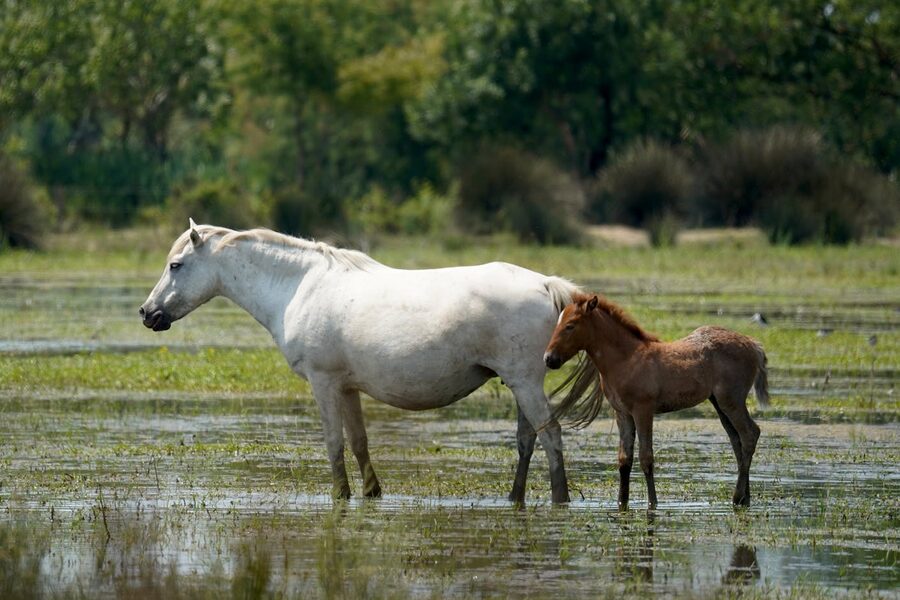
The semi-feral part is what makes them strange. There are about 12,000 Camargue horses in the world, owned by roughly 30 manades plus private owners. They live free-range in the marshes most of the year, in herds of mares and foals, with one or two stallions. Once a year the gardians round them up to brand the new foals, check the older ones for injuries, and pick out animals to be trained. The rest of the time the horses look after themselves. They eat the salt-tolerant grasses, drink from the marsh, foal in the open, and die in the open.
That’s why “wild horses of the Camargue” is technically wrong. They’re owned. Every horse in the marsh has a brand on its left hindquarter naming the manade. But they’re not domesticated in the way a stable horse is. Most of them have never worn a saddle. The ones the gardians ride for cattle work are a small minority that got picked out as foals and trained.
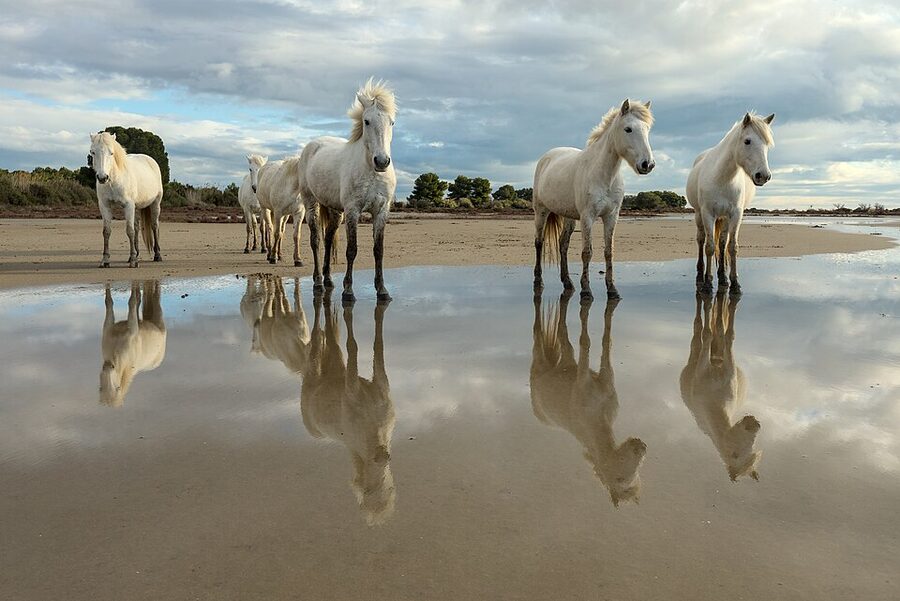
If you’ve already done the Jerez horse show in Andalusia, the contrast is instructive. The Andalusian horses there are dressed up in baroque tack, schooled to do doma vaquera, performing inside an arena built in 1972. Camargue horses are wearing nothing, schooled by the marsh itself, performing nothing. Same Iberian root stock more or less, completely different relationship with humans.
The black bulls and the course camarguaise
The bulls are the other half of the Camargue. There are about 1,500 working Camargue bulls, smaller than Spanish fighting bulls, almost always solid black, with tall lyre-shaped horns. They’re raised in the same manades as the horses, on the same pasture. The herds graze freely until the day they’re trucked to an arena.
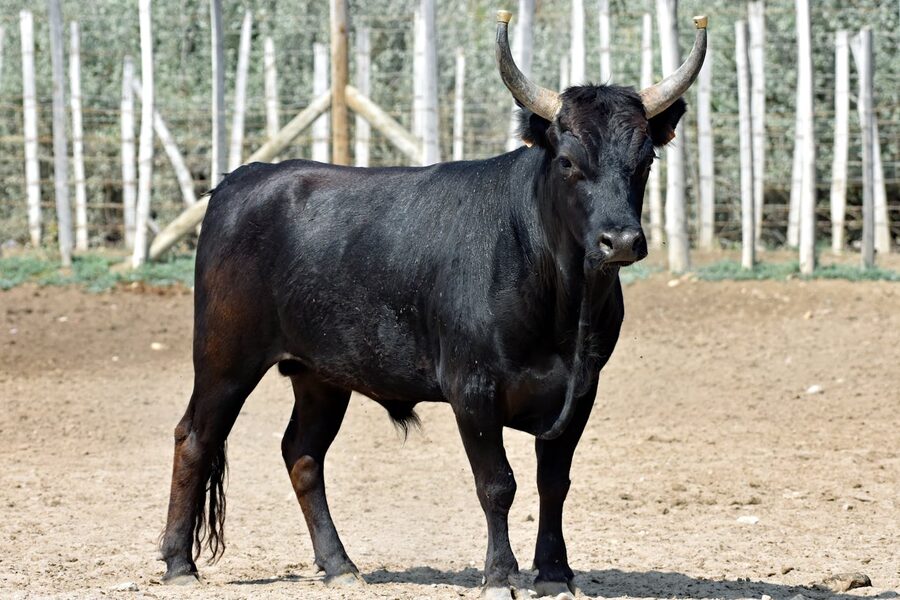
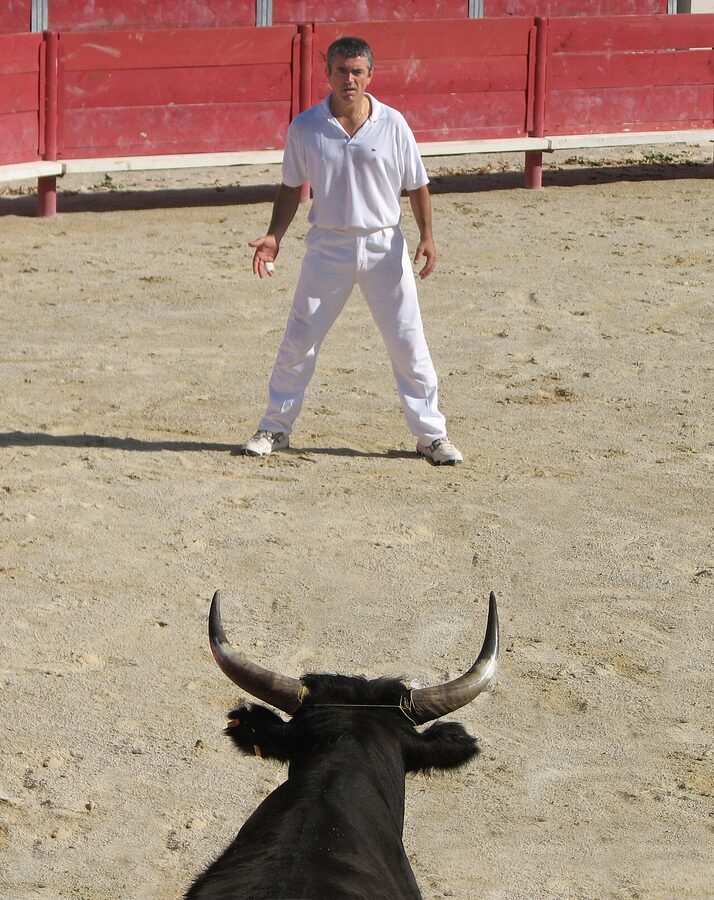
What makes them not Spanish bulls is the course camarguaise. It’s the local non-lethal bullfighting form. A bull enters the arena with rosettes and tassels tied to its horns. Twenty raseteurs in white shirts try to remove the rosettes and tassels using a small steel comb called a crochet, while running, jumping the barrier, and not getting hooked. The bull is the protagonist. The bull lives. The bull comes back next week. Famous bulls have careers spanning ten years and are remembered by name; the most decorated, a bull called Goya, has a statue in Beaucaire.
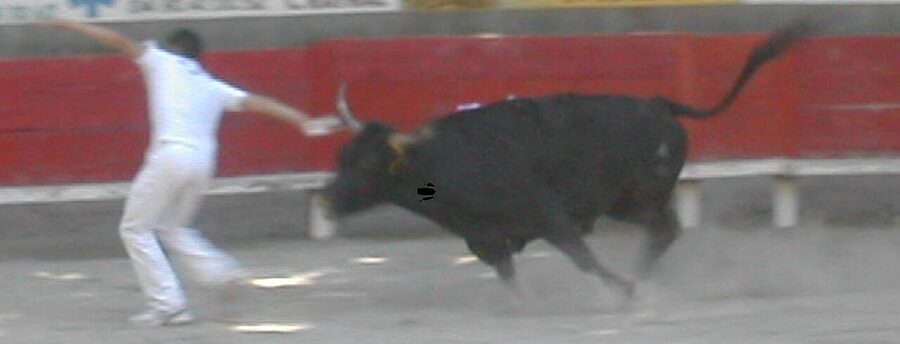
If you’re squeamish about Spanish-style bullfighting, the course is the version you can sit through. Arles has the largest arena (the Roman amphitheatre, used for both the course and the occasional Spanish-style corrida during the Feria d’Arles in April and September). Smaller fixtures happen all summer in towns across the Camargue. The 4×4 doesn’t take you to a course, but every guide I’ve ridden with talks about it because it’s how the bulls in front of you make a living.
Flamingos: the only place in France they breed
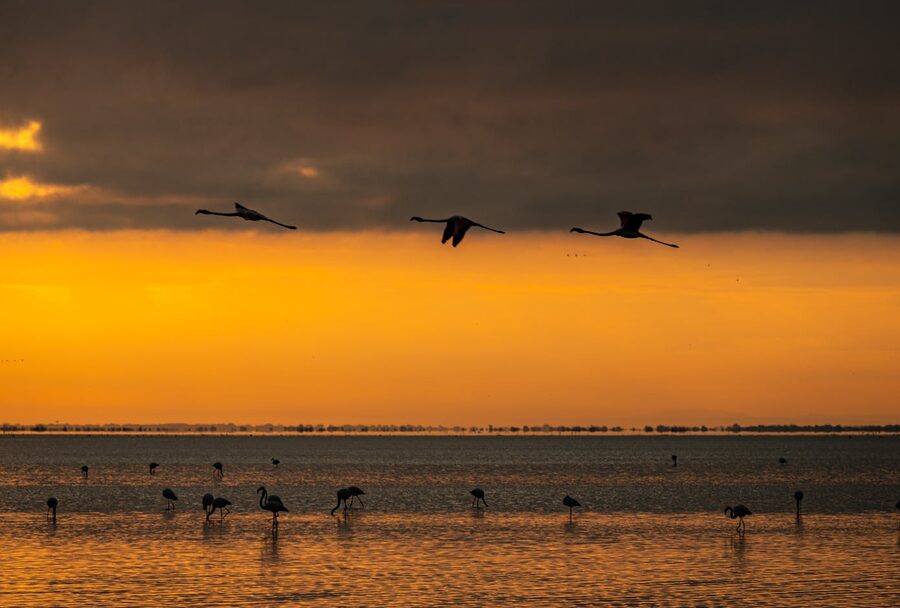
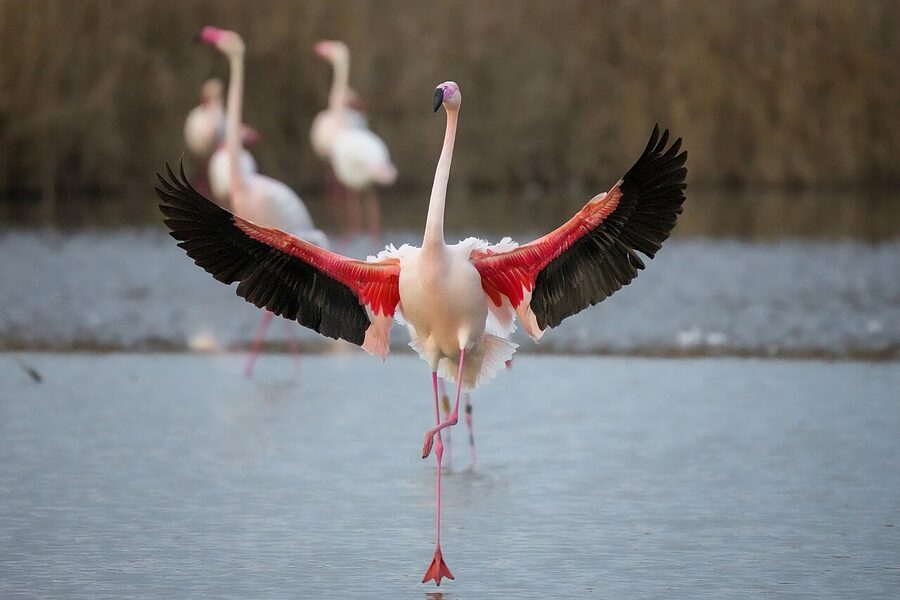
The Camargue is the only place in France where greater flamingos (Phoenicopterus roseus) reproduce. About 10,000 breeding pairs in a normal year, plus another 50,000 birds wintering and passing through. They concentrate at one specific saline lake called the Étang du Fangassier, near Salin-de-Giraud, where the water is salty enough that nothing competes with them for the brine shrimp and algae they feed on.
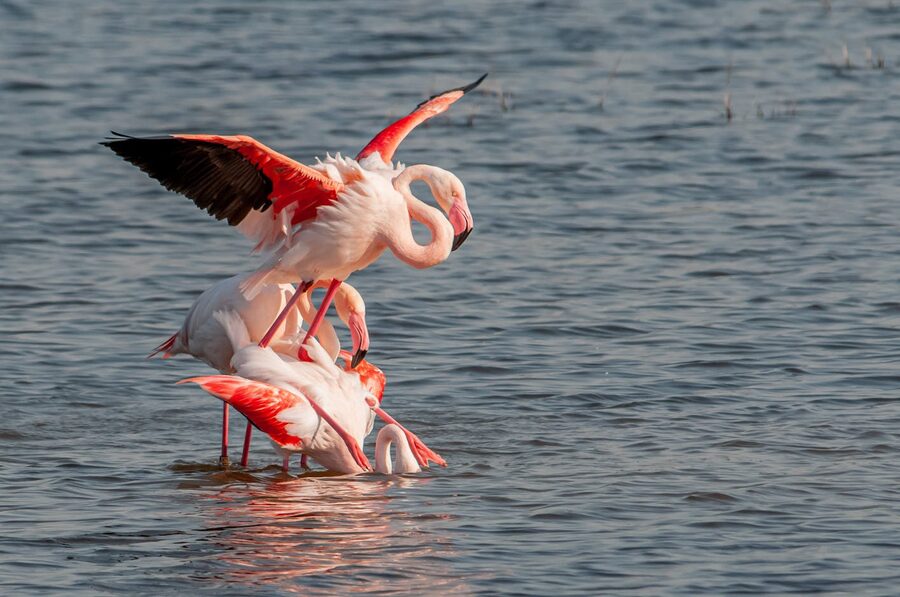
The pink comes from carotenoids in the brine shrimp. Captive flamingos in zoos that don’t eat shrimp turn white over a few seasons and have to be fed pigment supplements. Wild Camargue flamingos eat shrimp daily and stay vivid pink. The deepest pink birds are the breeding adults; juveniles are pale grey-pink for the first three years.
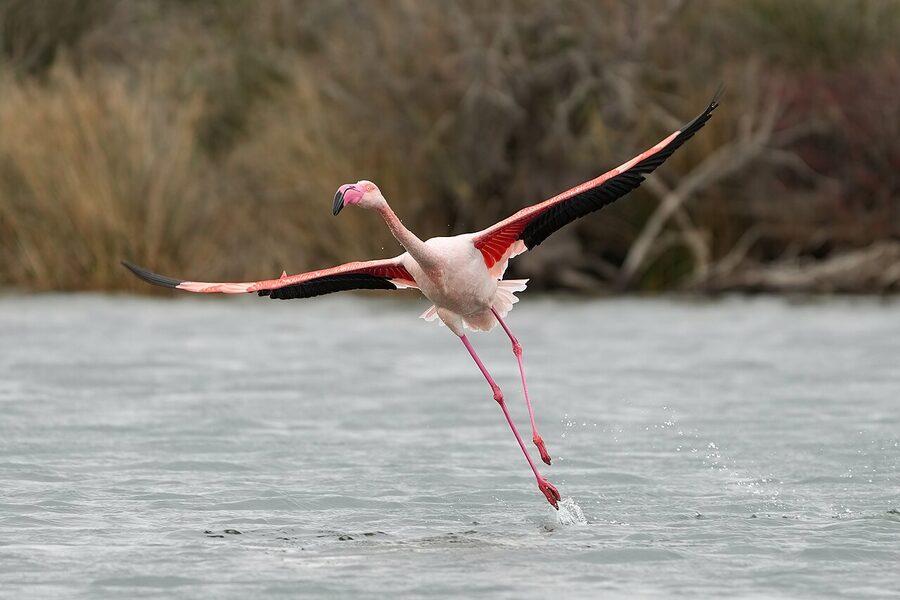
The 4×4 won’t get you close to nesting birds. That’s a deliberate ornithological-reserve rule. What you get is the sight of a few thousand birds at perhaps 100-200 metres in the shallows, and the flight overhead when something spooks part of the flock. If you specifically want a hide and a long lens, the Parc Ornithologique de Pont de Gau on the D570 (about 4km north of Saintes-Maries-de-la-Mer) is built for that, and most 4×4 tours either pass it or include a stop. For a similar concentrated-nature-pilgrimage seasonal experience without the long lens, Keukenhof outside Amsterdam hits the same April-and-October-only timing rule, only with seven million tulip bulbs instead of breeding flamingos.
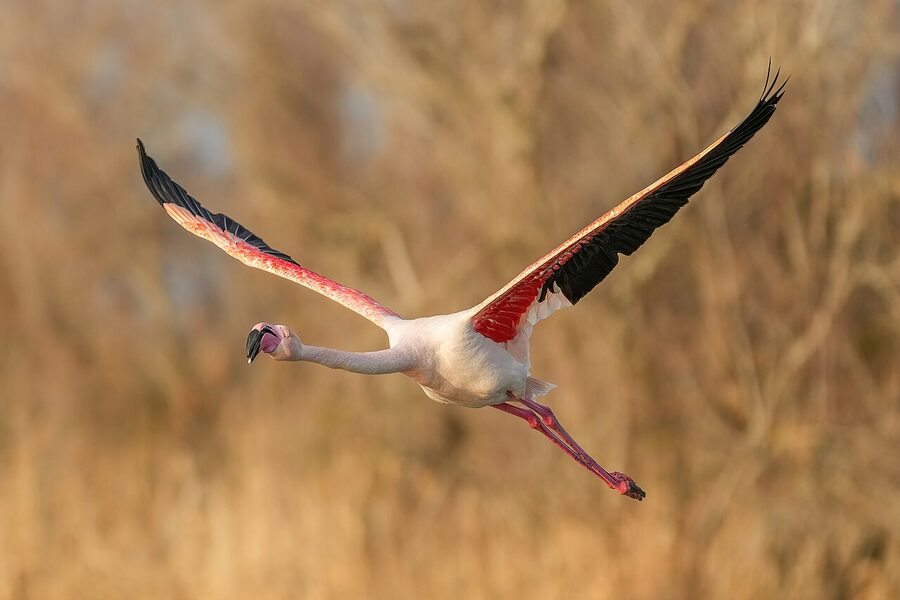
The salt: where the pink water comes from
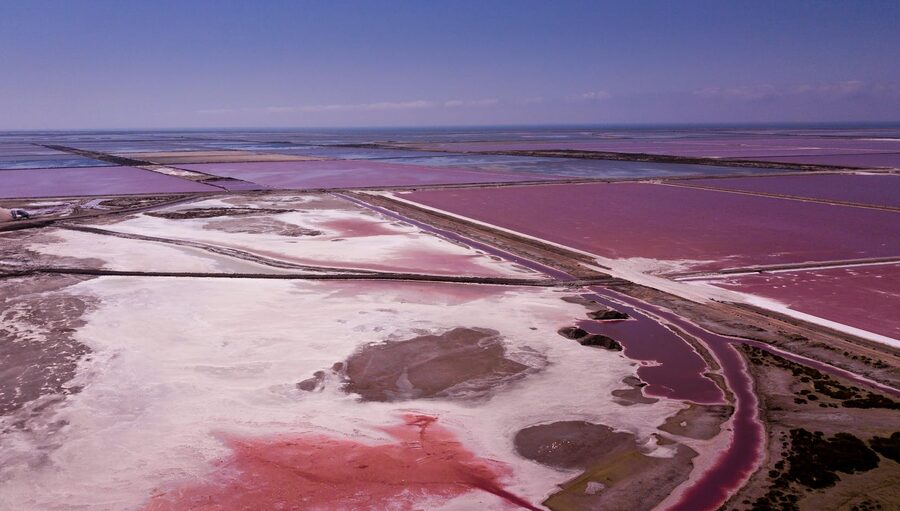
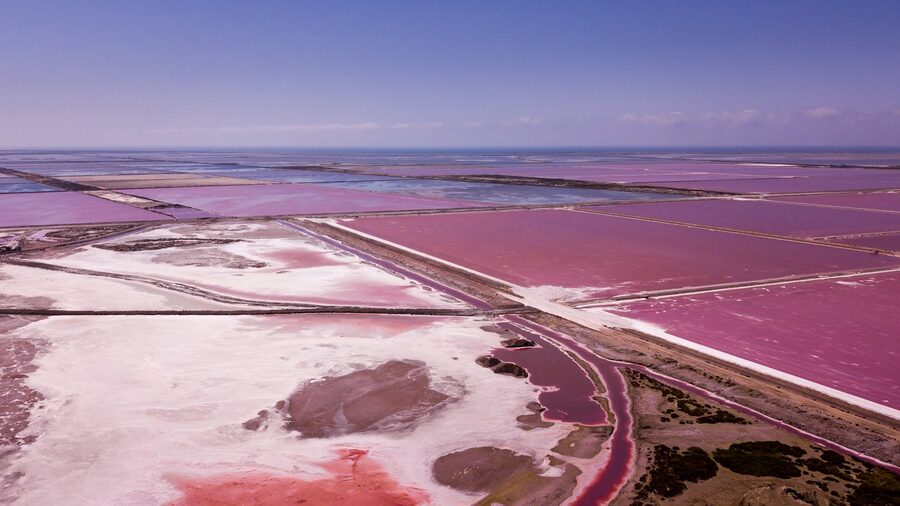
The pink isn’t dye and it isn’t flamingos. It’s an algae called Dunaliella salina, which thrives in hypersaline water and turns brick-pink under summer sun. When the water in a salt-pan reaches a certain salinity (around 250 g/litre, about seven times the salinity of seawater) the algae blooms and the whole pan turns the colour of strawberry milk. The flamingos eat the algae and the brine shrimp that eat the algae. That’s where the pink in the birds comes from too. It’s the same pigment moving through three steps of the food chain.
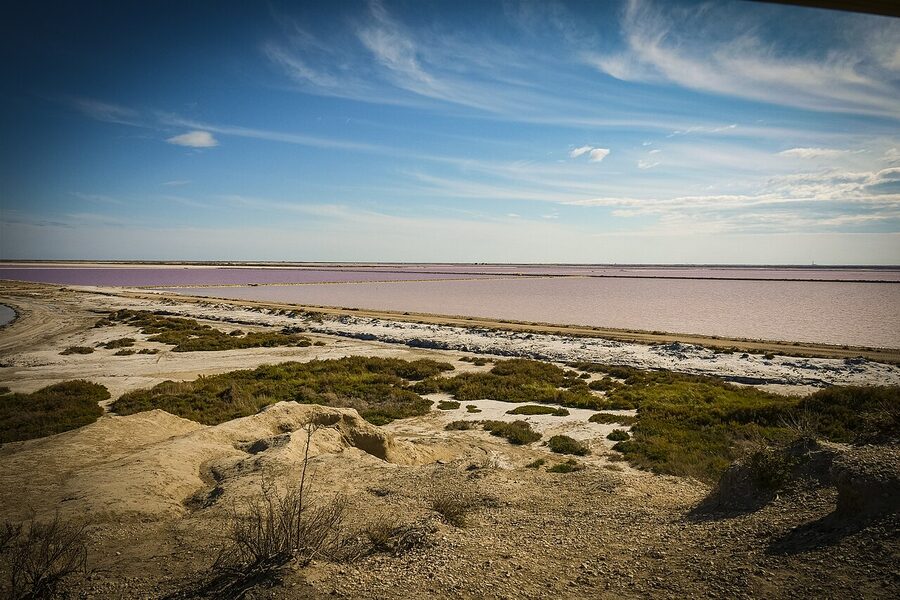
Salt has been worked here since the Romans. The current operation at Salin-de-Giraud covers about 200 hectares of pans, run by Salins du Midi, and produces both industrial salt (for de-icing roads, water softening) and food-grade fleur de sel sold in jars at every supermarket in France. The harvest happens in late summer, late August into September, when bulldozers scrape up the salt into white pyramids called camelles. Some of the camelles get up to 15 metres tall and you can see them from miles away. They look like snow. They’re the most photographed feature of the eastern Camargue.
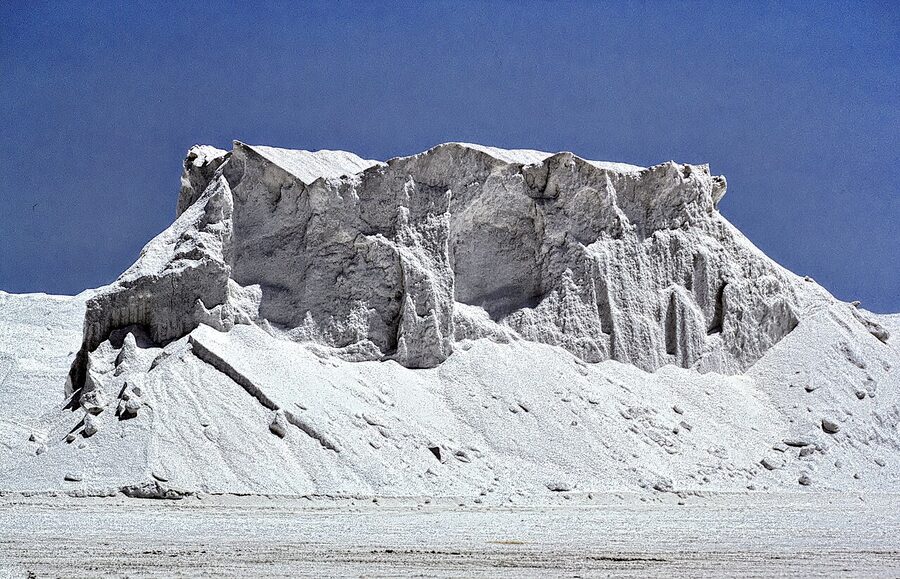
If you want a more concentrated salt-pans experience, the second cluster is at Aigues-Mortes, about 35 km west of Saintes-Maries-de-la-Mer, where the colour is even more vivid pink and the medieval walled town sits right next to the working pans. That’s a different day trip and a different operator. The 4×4 from Arles usually does Salin-de-Giraud because it’s inside the Camargue proper. The 4×4 from Le Grau-du-Roi can do either side depending on the operator.
The gardians (the cowboys still working)
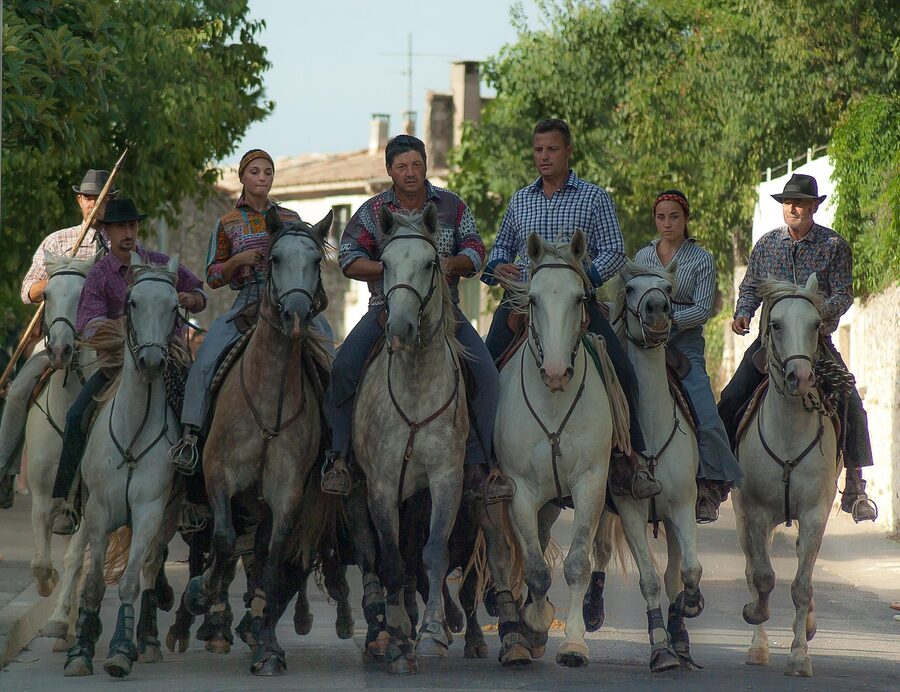
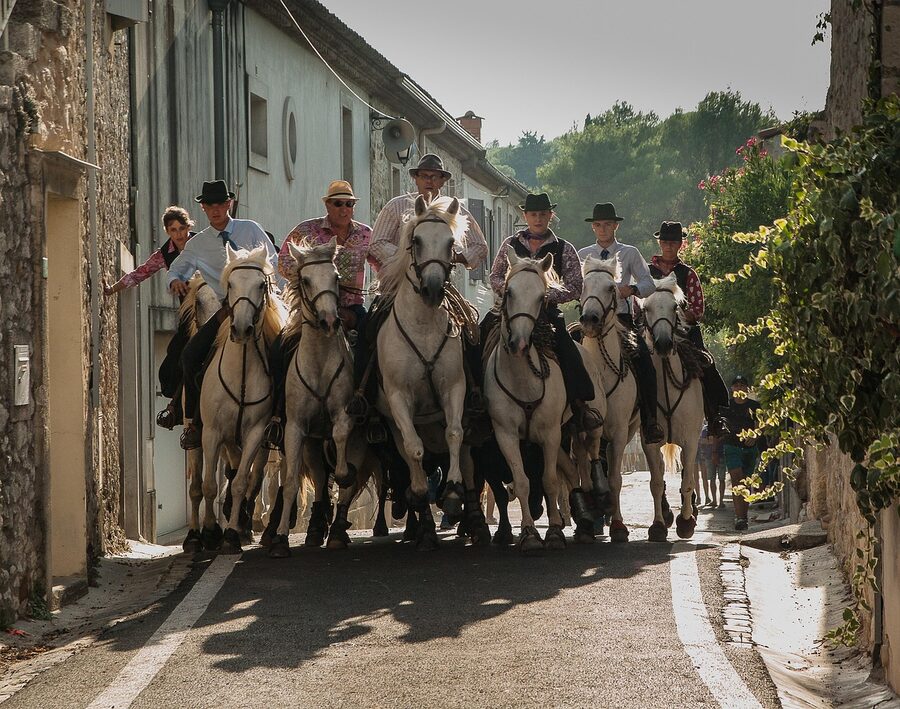
Every manade has at least one gardian. They wear a flat black felt hat (the chapeau de gardian), white shirt, sometimes a checked Provençal shirt, ride a Camargue horse, and carry a long wooden trident called a ficheiroun. The trident is for moving cattle. They use it to point, prod, and pen, never for combat. There’s a working Confrérie des Gardians founded in 1512 that still meets in Arles every May Day for a horseback procession through the old town.
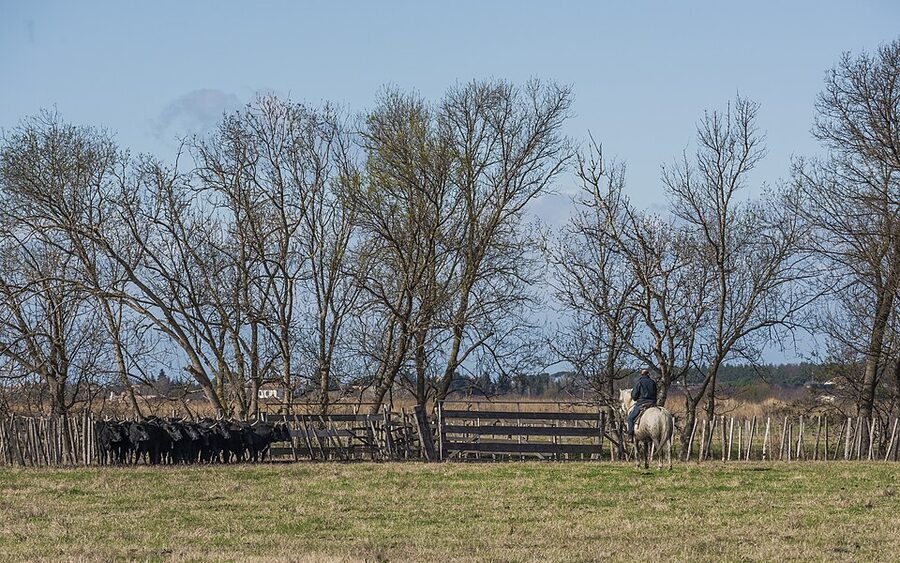
The 4×4 drivers will introduce you to a gardian if the manade you’re visiting has one out working. It’s not a costume. The job pays poorly and is mostly done by people whose families have been doing it for several generations. Two of the manades I’ve passed through (Manade Jacques Bon, Manade Aubanel) still operate as working ranches with three or four gardians each. The Bon family has been ranching cattle in the Camargue since 1925.
Saintes-Maries-de-la-Mer and the pilgrimage you might miss
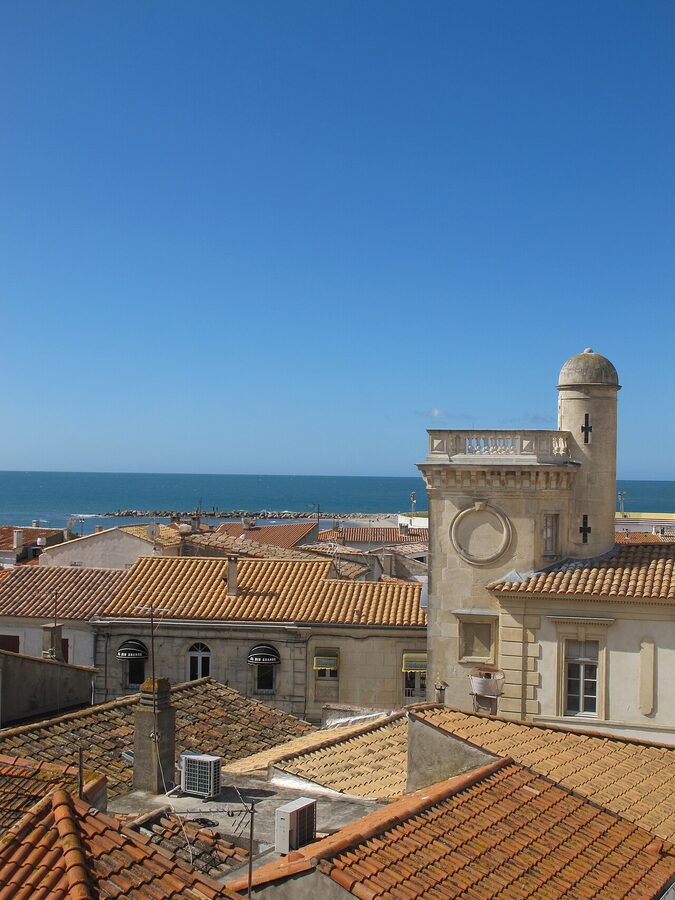
The town at the end of the road is a pilgrimage site that runs unusually quietly outside one specific weekend. Saintes-Maries-de-la-Mer, population about 2,500, sits where the Petit Rhône meets the Mediterranean. The fortified Romanesque church dates from the 9th century and was built on top of an older oratory. Inside, in a crypt under the altar, is the relic that draws Roma pilgrims from across Europe every May 24-25: a wooden statue of Sara la Kâli, the Black Madonna, considered the patron saint of the Roma people.
The legend: Sara was the Egyptian servant of three women called Mary, including Mary Magdalene and Mary Salome, who fled Palestine after the crucifixion in a boat with no oars. The boat washed ashore in Provence around AD 42. The two Marys are buried under the church (hence Saintes-Maries-de-la-Mer, “Holy Maries of the Sea”); Sara is venerated separately by the Roma. The pilgrimage has been documented since at least the 15th century.
If you’re in the Camargue around 24-25 May, the town is full. Tens of thousands of Roma arrive in caravans, the church is wall-to-wall candles, gardians on horseback escort Sara to the sea, and the bullfights and gypsy music run for three days. The rest of the year it’s a quiet beach town. The 4×4 tours from Arles often loop through and stop here for the church. Tours from Le Grau-du-Roi may or may not reach it depending on time.
What the day actually looks like
A typical Arles half-day 4×4 runs four hours and covers between 60 and 80 kilometres. The route varies by operator and by which manades are open that day, but the structure tends to be: drive out of Arles south on the D570 (10-15 minutes), enter the first manade (gravel and sand tracks for the next 90 minutes), watch horses and bulls, see the salt-pans on the eastern side, swing past flamingos at the Étang du Fangassier or one of the lagoons near Salin-de-Giraud, and head back via the D570 with a stop at the Saintes-Maries church or the Pont de Gau bird park.
Drinks and a snack (a slice of pâté, bread, sometimes a glass of local rosé from the Sables du Camargue appellation) are usually included around the halfway point. Some operators add a longer stop at a manade with a full meal. Those are the six-hour tours rather than the four-hour ones, and the price goes up accordingly.
Group size matters. The Arles flagship runs as small group (max 8) or private. The private upgrade is worth it if you have specific interests, mainly photography or birding, because the driver will linger at one location instead of keeping the schedule. Otherwise the small-group is fine; the vehicles are typically Land Rover Defenders or Toyota Land Cruisers with two or three rows of bench seats and a roof you can stand up in for photos.
Where the safari starts versus where you stay
The three pickup options correspond to three completely different bases.
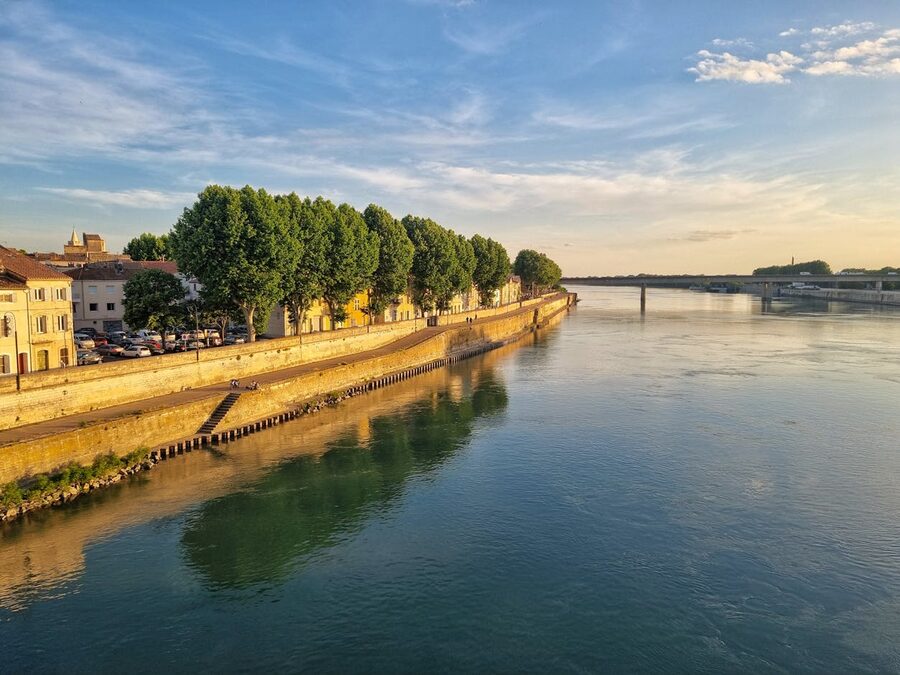
Arles is where most travellers start. It’s a 25,000-person Roman town on the eastern Rhône arm, with hotels, a TGV station, the amphitheatre, the Saint-Trophime cloister, and Van Gogh’s old neighbourhood. If you’re doing the Camargue as one piece of a Provence trip, Arles is the right base. The 4×4 from Arles picks up at a meeting point in the old town. The pickup is included in the price.
Saintes-Maries-de-la-Mer is the inside-the-Camargue option. Smaller, more focused, beach access. The “Camargue Half-Day” tour is the one that starts here or nearby and adds a wine-tasting stop at a Sables du Camargue vineyard. Good if you want to spend two days in the wetland rather than commute.
Le Grau-du-Roi is the western edge of the Camargue, in the department of Gard rather than Bouches-du-Rhône. It’s a working fishing port plus a long sandy beach, geographically closer to Aigues-Mortes than to Arles. The 4×4 from here goes onto the western Camargue and the pink salt-pans of Aigues-Mortes. Worth picking if you’re staying in Montpellier or Nîmes.
The three tours, ranked
1. From Arles: Half-Day 4×4 Camargue Safari: $69
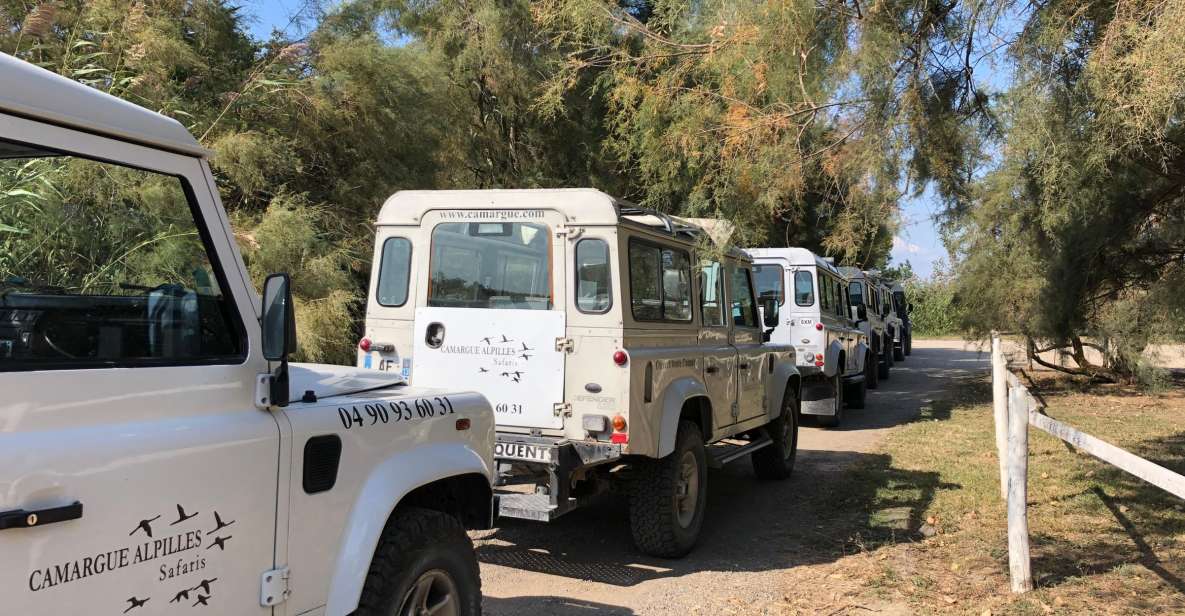
This is the right pick if you’re basing in Arles and want one half-day in the Camargue. Our full review covers the small-group versus private upgrade, the typical itinerary including the Salin-de-Giraud salt pans, and which manades the tour rotates through. Pickup at the meeting point in the old town, back in time for dinner.
2. Camargue Half-Day 4×4 Guided Safari Adventure: $75
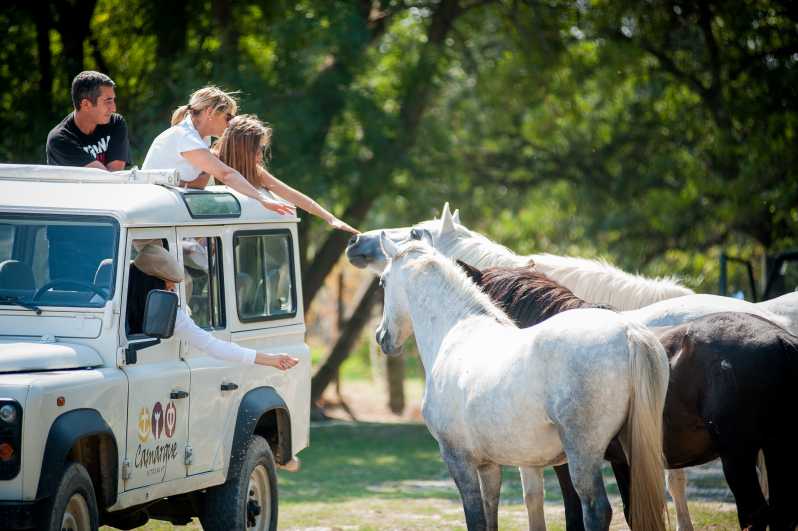
Three and a half hours covering the same horses-bulls-flamingos circuit but with a longer stop at a Sables du Camargue vineyard for wine tasting. Our full review goes into how the wine break changes the rhythm of the tour, which is worth knowing if you’re doing this with kids who don’t want a 40-minute tasting in the middle of the day.
3. 3.5-Hour Camargue 4×4 Safari from Le Grau-du-Roi: $77
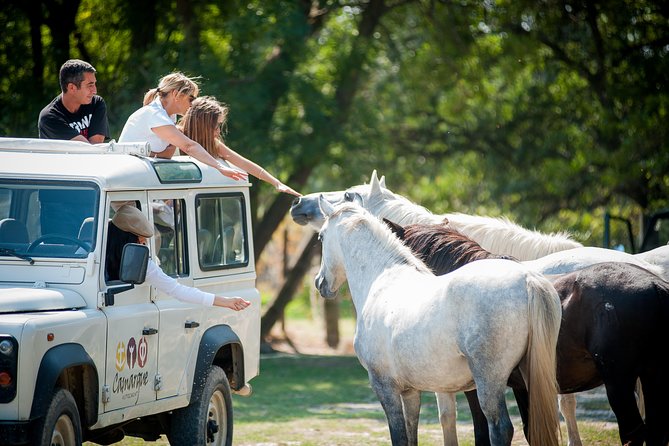
Different angle on the same wetland. Includes a snack with a Camargue bull breeder and a wine tasting at a local estate, both unique to this operator. Our full review compares it directly with the Arles departures so you can pick the right pickup point for your trip.
When to go
April through October is the only sensible window. Outside that, the Mistral wind picks up, the temperatures drop into the single digits at dawn, the flamingo numbers thin out (most birds head to Sardinia or Tunisia for winter), and the manades scale back the tours.
Within April-October, two sub-windows matter.
April to mid-June: temperatures comfortable, flamingos at peak breeding density at the Étang du Fangassier, foals on the ground in the manades, mosquitoes manageable. Probably the best month overall is May. The Roma pilgrimage to Saintes-Maries weekend (24-25 May) is the one date to either deliberately attend or deliberately avoid.
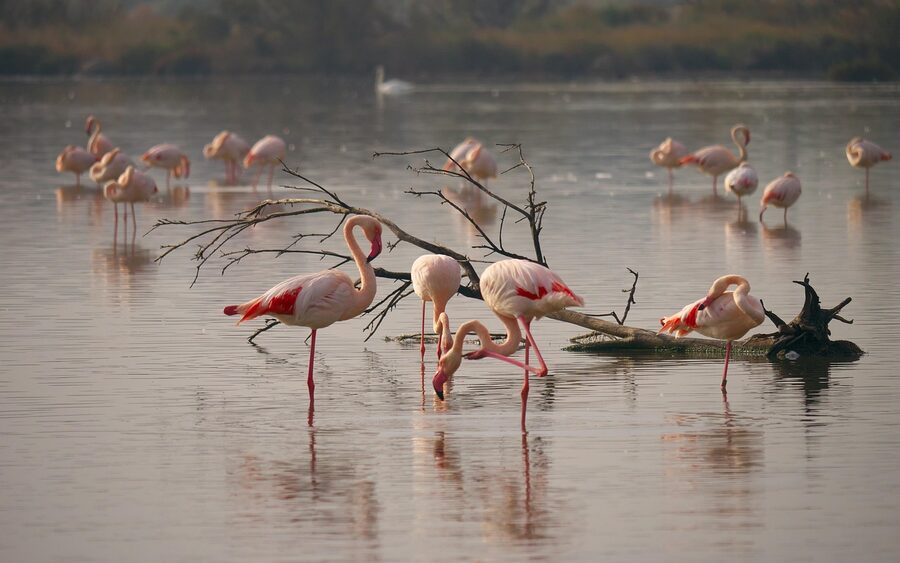
September and October: salt harvest peaks (the camelles get their full size), the Mistral starts kicking up but isn’t constant, and the autumn migration brings new bird species through (purple herons, glossy ibis, sometimes pelicans). Light is softer and the manades less crowded.
July and August work but it’s hot. 35°C in the open marsh is normal, and the Camargue has no shade. The 4×4 has a roof but no air conditioning when you’re stopped. Mosquitoes are bad in the evening. The Camargue has more mosquitoes per hectare than basically anywhere else in mainland France because the standing brackish water is paradise for them. Bring repellent (the one with DEET, not the citronella plant-extract version).
Practical bits
The 4×4 tours run rain or shine within reason. Heavy rain doesn’t stop them but means muddier tracks and grumpier horses. Booking a day ahead is usually fine in shoulder season, two or three days ahead in high summer, more for the May pilgrimage weekend.
What to bring: closed-toe shoes (sand and animal manure on the tracks), a sun hat, water (some tours provide it, some don’t), insect repellent in summer, a light jumper for late afternoon if there’s any wind. Cameras are fine; long lenses are better for the flamingos but the herds of horses are close enough that a phone works for those.
Cancellation: the major operators on GetYourGuide give you free cancellation up to 24 hours ahead. Viator’s policy on the Le Grau-du-Roi tour is similar but check the specific listing because some products have stricter terms.
Children: the standard tours take kids over six. Younger and the four hours in a 4×4 with limited stops becomes a problem. The animals are visible but the day involves a lot of driving with the engine off so the wildlife doesn’t bolt; small kids get bored. Some operators have shorter family-specific tours running two hours rather than four.
Combining with the rest of Provence
The Camargue is one wedge of a bigger Provence trip. The two natural pairings are with the Verdon Gorge (for landscape contrast: the canyon is the dry Alpine south, the Camargue is the wet Mediterranean south, and they’re 90 minutes apart) and with Marseille (for urban contrast: the working port versus the working wetland). The Verdon Gorge from Nice is the day trip that pairs neatly with this one if you’re loop-driving Provence; the Marseille hop-on bus is the right way to do the city in a half-day before or after.
Further afield, this article’s natural cousins are the rural-Italy and rural-Andalusia day trips. Matera’s Sassi works the same way the Camargue does as a “wait, this isn’t the Italy you thought you knew” reframe (cave dwellings instead of marble piazzas). Ronda and the white villages from Seville is the equivalent rural-Andalusia village circuit, also done as a half-day from a base city. And the equestrian comparison is genuinely instructive: the Jerez horse show in Andalusia is everything the Camargue isn’t (groomed stallions in baroque tack, indoor arena, choreographed dressage), while the Camargue horse is everything the Jerez horse isn’t (loose in the marsh, no tack, no choreography).
The Arles part most visitors skip
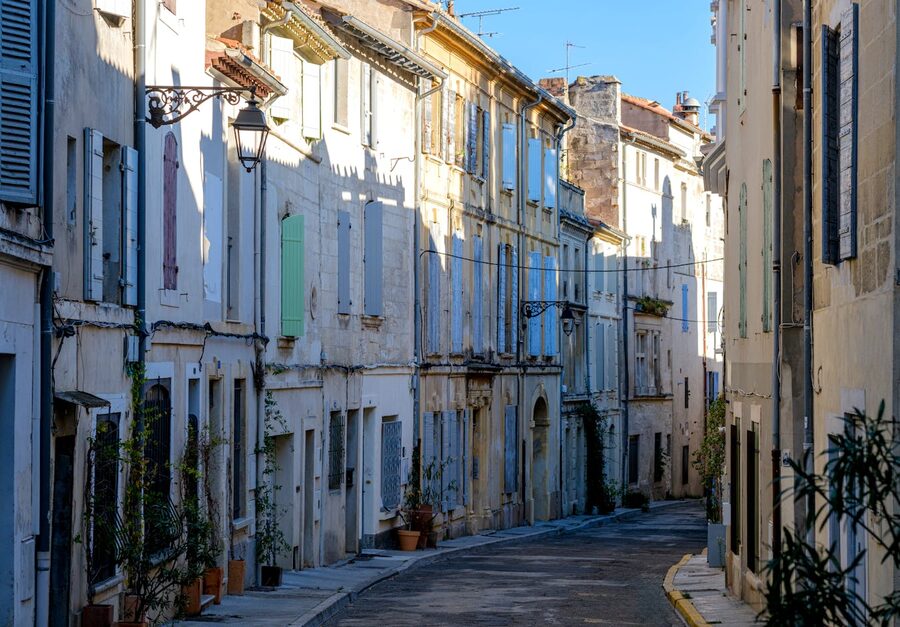
Almost everyone who books this tour spends some hours in Arles itself. The town deserves a half-day on either side of the safari, not as filler but because Arles is a serious Roman city with two of the best-preserved monuments in France.
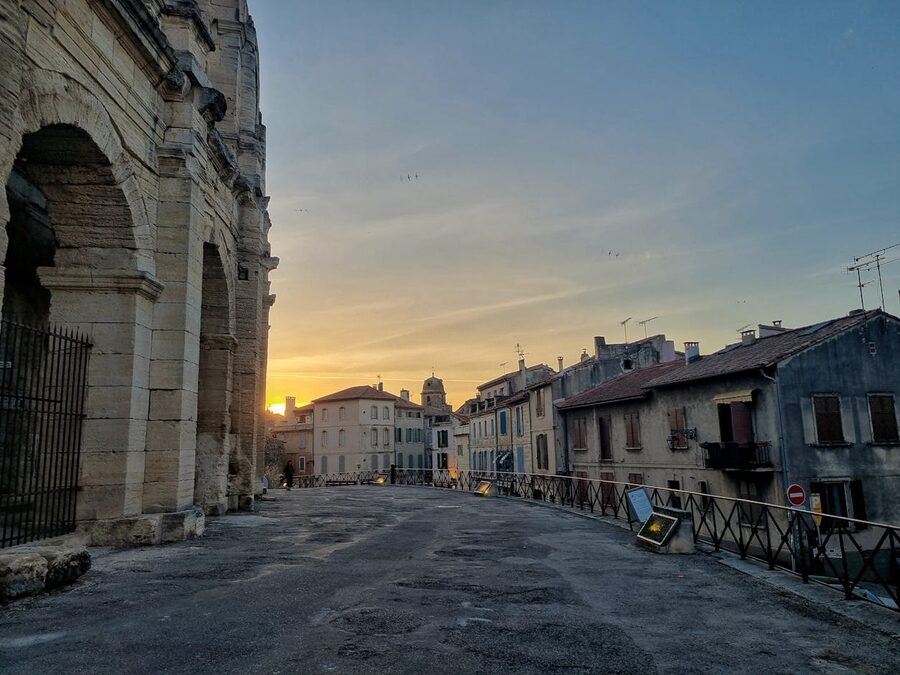
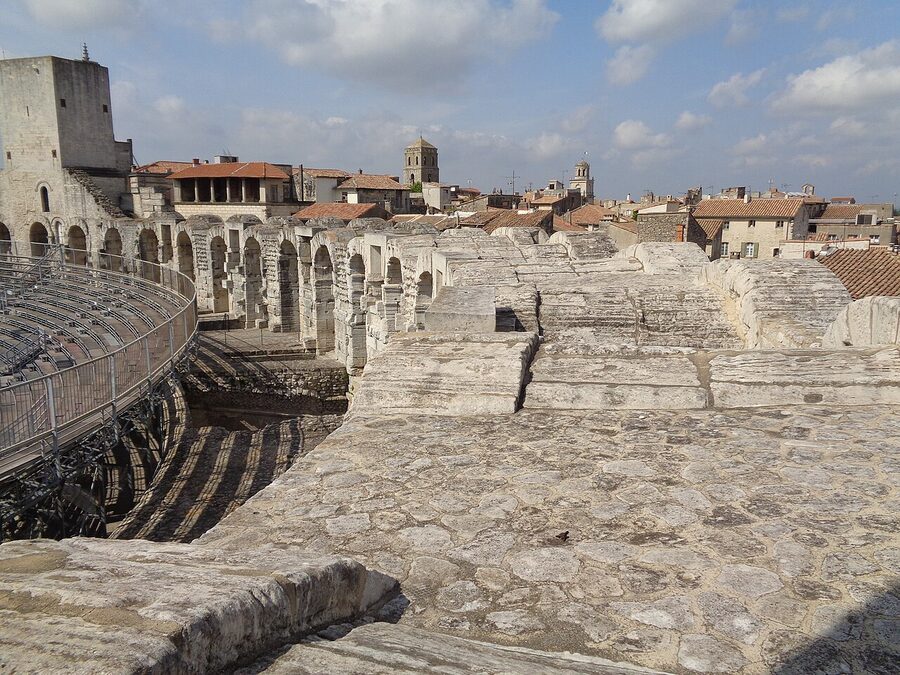
The Roman amphitheatre (Arènes d’Arles) was built around 90 AD for 21,000 spectators. Two tiers of arches, full elliptical plan, used continuously: gladiator games until the late 5th century, then converted into a fortified neighbourhood for 700 years (200 houses and two churches inside the arena), cleared out by Napoleon in 1825, and bull-fights twice a year ever since. You can climb the medieval defensive towers built into the upper ring for about €9.
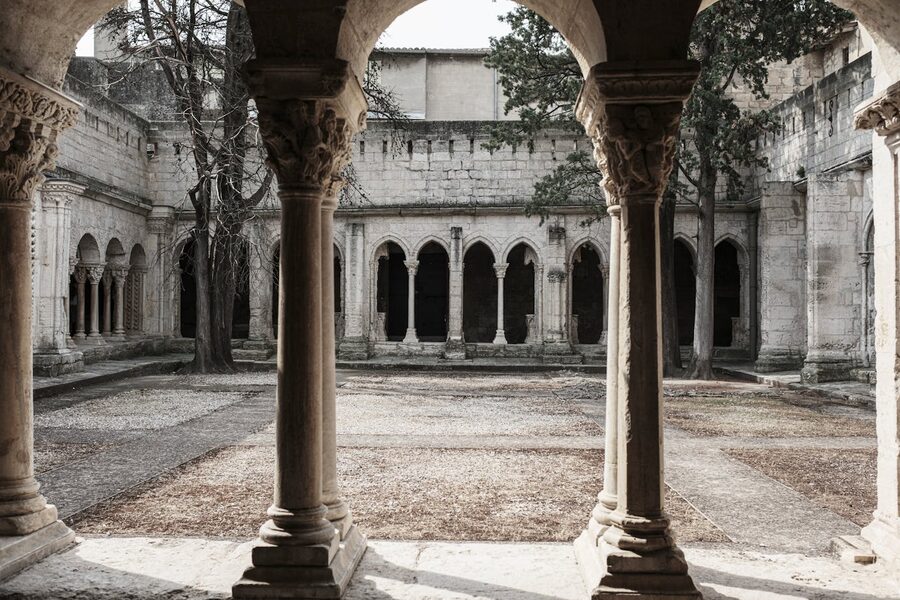
The Saint-Trophime cloister, two minutes’ walk away, is one of the most complete Romanesque cloisters surviving in southern France. Built between the 12th and 14th centuries, four covered galleries around a square garden, with capitals carved with biblical scenes that you can read like a comic strip. It’s tiny (about 25m square), quiet, and €5.
And then there’s Van Gogh. He spent fifteen months in Arles between February 1888 and May 1889, painted around 300 works, cut off part of his ear here in December 1888, and left for the asylum at Saint-Rémy. The Yellow House (his rented studio at 2 Place Lamartine) was destroyed by Allied bombing in 1944. Only the foundations remain, marked with a small plaque. The Café Terrace at Night is on Place du Forum and is now a Van Gogh-themed restaurant painted yellow on the outside in slightly aggressive imitation of the painting. It’s a tourist trap. Don’t eat there. Walk past, take the photo, eat at one of the bistros on Rue du Refuge instead.
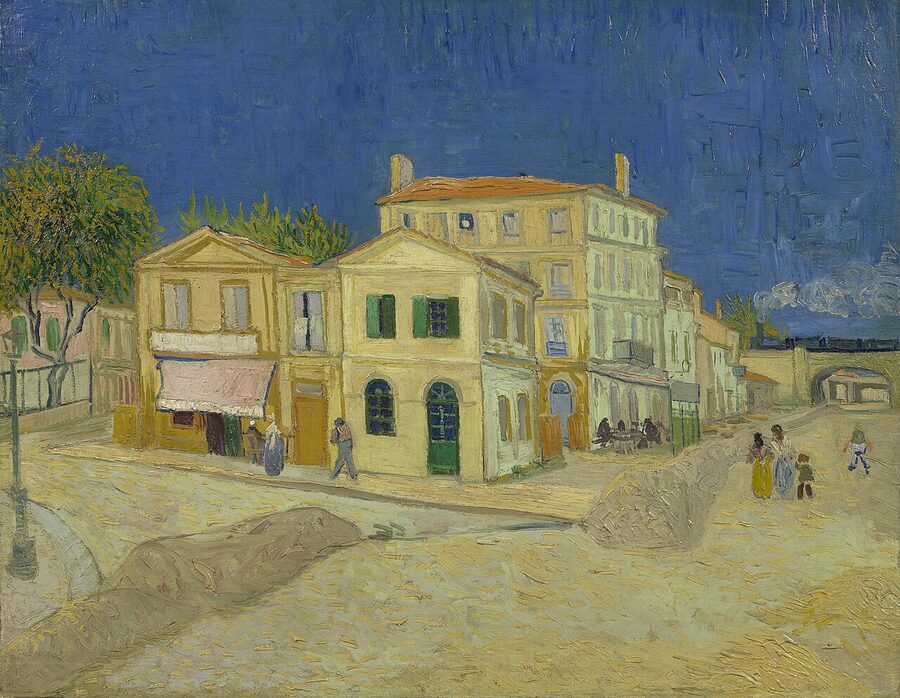
Almost no Van Gogh paintings hang in Arles itself. The Fondation Vincent van Gogh on Rue du Docteur Fanton runs rotating exhibitions and usually has one or two real Van Goghs on loan, but the bulk of the Arles paintings are at the Musée d’Orsay in Paris, the Van Gogh Museum in Amsterdam, and the Kröller-Müller in the Netherlands. If you’re going to Paris, the Orsay has the densest collection of Arles-period work, including Starry Night Over the Rhône painted from the riverbank in Arles itself. The Orangerie next door is the right pairing for the late landscape work.
Other day trips from Arles
Arles works as a Provence base. The Pont du Gard Roman aqueduct is 25 minutes north by car. Avignon, with the Palais des Papes, is 30 minutes northeast by car or train. Les Baux-de-Provence, the cliff-top village with the Carrières de Lumières light shows, is 20 minutes east. Aix-en-Provence is 70 minutes east. The Cannes Sainte-Marguerite ferry and the rest of the Côte d’Azur are 2-2.5 hours by train or car if you want to combine Provence with the Riviera.
If you’re arriving from Paris, the TGV runs Paris Gare de Lyon to Arles in about 4 hours direct, or 3.5 hours with a change at Avignon TGV (the Avignon TGV station is 25 minutes north of Arles by frequent train). Coming from Spain, the easiest entry is via Avignon or Nîmes from Barcelona/Girona. From the Riviera side, Marseille TGV is 50 minutes from Arles by regional train.
What surprises people
Three things that I always end up explaining on these tours.
First: the rice. The Camargue grows about 100,000 tonnes of rice a year. That’s roughly 75% of French rice production. The paddies are flooded by Rhône water, which leaches the salt out of the soil and lets the rice grow, then the salt percolates back as the paddy dries. The whole agricultural system is basically a salt pump. You’ll see rice fields on the way in and out of the wetland; they’re inside the Regional Park and they support a different bird community (egrets, storks, harriers) than the saline lagoons. Camargue rice (the IGP “Riz de Camargue” label since 2000) is short-grain and slightly red-tinted; it’s in every Provençal kitchen and you can eat it in any Arles restaurant.
Second: the wine. There’s a wine appellation here. Sables du Camargue is an IGP for wines made from grapes grown in sandy coastal soils that Phylloxera couldn’t penetrate (the louse can’t tunnel through pure sand), so the vines are ungrafted, on their original European rootstock, which is rare. The wines are mostly crisp rosés (the local style is called vin gris, a very pale rosé from black grapes) and a few whites. Listel is the dominant producer. If your 4×4 stops at a vineyard, this is what you’re tasting. It pairs with everything Camargue: rice, beef, salt cod, fleur de sel.
Third: the guardians of memory. Frédéric Mistral, the Provençal poet who won the Nobel Prize in 1904, is the reason the Camargue’s regional identity got formalised when it did. He founded the Félibrige movement in 1854 to preserve Provençal language and culture, including the gardian tradition. The Museon Arlaten in Arles, which he set up in 1899, is the local ethnographic museum, full of gardian gear, costumes from the Sainte-Maries pilgrimage, and Mistral’s manuscripts. It reopened in 2021 after a long restoration. Worth an hour if you have the morning before the safari.
Honest downsides
The Camargue is not Yellowstone. It’s not Etosha. The wildlife density is high but the encounters are quieter and more intimate than dramatic. You’ll see horses every time. You’ll see flamingos every time. You may or may not see large numbers of bulls (depends which manade you’re at and what the rancher’s doing that day). You won’t see anything dangerous, you won’t see anything chase anything, and the closest analogue is probably an English nature reserve scaled up.
What you will get: a sense of a working landscape that hasn’t been homogenised by industrial agriculture. The smell is mud and salt and horse. The sound is birds and wind. There’s no fence between the marsh and the road for most of the area; the horses cross the D570 occasionally and the cars stop. That’s the Camargue.
The 4×4 is the only sensible way to do it as a half-day. If you have a week and a four-wheel drive of your own, you can rent a bicycle in Saintes-Maries-de-la-Mer and explore the levees independently, but a single visit needs the guide. Going on horseback (a promenade équestre at one of the manades) is the alternative experience: slower, lower, no engine noise, but you cover less ground and you have to be comfortable on horseback. Most visitors do a half-day 4×4 and feel they’ve seen the place.
If you only have one afternoon
Take the 4×4 from Arles. It’s the most-booked option for a reason: it’s run by people who’ve been doing this for twenty years, the route covers all four headline things the Camargue actually does (horses, bulls, flamingos, salt), and you don’t need to relocate from your Provence base to do it. Pick the late-afternoon slot if you have a choice; the light at golden hour over the salt-pans and the marsh is what the photographers come for, and the horses come out to drink at exactly that hour.
The Monet at Giverny day trip and the Loire Valley castles are the cultural rural-France equivalents if you’re building a French itinerary. Cinque Terre and Vesuvius from Pompeii are the Italian “real coast / real landscape” parallels worth pencilling in. Caminito del Rey in Andalusia is the Spanish narrow-canyon-walk equivalent of seeing a wild place that isn’t a national park, and the Ibiza beach cruise is the same idea applied to a Mediterranean island. The French Riviera from Nice is the urban-coastal opposite of the Camargue if you want the variety.
One more thing. Don’t try to do the Camargue and Arles in the same day if you’ve taken the train from Paris that morning. You’ll be in the wetland with sand in your shoes and your eyes barely open. Sleep in Arles the night before. Wake up, walk to the amphitheatre, eat lunch, do the 4×4 from 2pm, be back by 7pm for dinner on the Place du Forum. That’s the right rhythm. The Camargue rewards a half-day done properly more than two half-days done in a hurry.