How do you build a concrete dome 43 meters wide, with no steel reinforcement, no internal supports, and a 9-meter hole in the top, and have it last 1,900 years? The Romans figured it out in 125 AD, and nobody has fully explained how. The Pantheon in Rome is the best-preserved building from the ancient world, and standing inside it remains one of the most disorienting architectural experiences you can have anywhere, on a level with stepping into the horseshoe-arched Mezquita-Catedral of Córdoba or the carved interiors of Granada’s Alhambra for the first time.
Until July 2023, the Pantheon was free to enter. It’s now €5 for adults, still the cheapest major monument in Rome by a wide margin. The ticket system is straightforward, but there are a few things worth knowing before you show up. Paris went through the same shift at its own Panthéon, where what was once a church-turned-mausoleum now charges its own modest entry fee.
Short on Time? My Top Picks
Pantheon Fast-Track Ticket & Audioguide — Skip the queue and explore with an official audio guide. The most popular option with 21,000+ bookings.
Pantheon Guided Tour With Entry — $21. A human guide for under $25. Forty-five minutes of context that transforms a round room into the most impressive engineering achievement of the ancient world.
Pantheon Entry Ticket & Interactive App — $13. Budget-friendly reserved entry with an app-based guide. Good enough if you’ve already done some reading.
How Pantheon Tickets Work
The Pantheon uses timed-entry tickets. You book a specific date and a 15-minute entry window. Once inside, you can stay as long as you want.
Standard ticket (€5) — Booked through the official site at direzionemuseiroma.cultura.gov.it. Timed entry, no guide, no audio. This is the base ticket.
Third-party skip-the-line tickets ($10-15) — Available through GetYourGuide and Viator. These include reserved timed entry (so you skip the walk-up queue) plus extras like audio guides or interactive apps. The premium over the official €5 ticket buys you queue-skipping convenience and cancellation flexibility.
Guided tour tickets ($18-25) — Include entry plus a knowledgeable guide who walks you through the building’s history, engineering, and art. These are the ones I’d recommend if you’ve never been — the Pantheon looks simple from inside, but the engineering behind every surface is extraordinary and you won’t appreciate it without context.
Free entry: Under 18s enter free. The first Sunday of each month is free for everyone, but the lines are significant. Mass is held on Sundays and holy days — during services, entry is free but you’re attending a religious ceremony, not sightseeing.
When to Visit
The Pantheon is open daily from 9 AM to 7 PM (last entry 6:30 PM). It’s closed on January 1, May 1, and December 25.
The best time to visit is early morning — the first slot at 9 AM — or late afternoon after 4 PM when the tour groups have moved on. Midday is worth considering for a specific reason: between about 11 AM and 1 PM, the beam of sunlight coming through the oculus creates a dramatic spotlight effect on the interior walls. On June 21st (the summer solstice), the beam hits the entrance doorway at noon — a detail that may have been intentional in the original design.
The Best Pantheon Tours
The Pantheon is small enough to visit in 20 minutes if you just want to look around. But spending 45 minutes with a guide who can explain what you’re actually looking at is a completely different experience. Here’s what I’d book.
1. Pantheon Fast-Track Ticket & Official Audioguide
The most booked Pantheon experience on GetYourGuide. Fast-track entry bypasses the general queue, and the official audio guide walks you through the key features at your own speed. Over 21,000 visitors have used it and the consensus is clear: the audio adds genuine value to what otherwise looks like a simple round room. We break down what the audio guide actually covers and whether it’s worth the upgrade from the basic €5 ticket.
2. Pantheon Guided Tour With Entry — $21
This one punches well above its price. For $21, a local guide walks you through 45 minutes of engineering marvels and 2,000 years of history. The 4.9 rating across 4,000+ reviews is the highest of any Pantheon tour — the guides clearly know their material and care about making it accessible. I’ve put together a detailed look at what the guides actually focus on and why the human commentary makes such a difference here compared to audio.
3. Pantheon Entry Ticket & Interactive App — $13
The budget-conscious option. Reserved entry plus an interactive app that serves as your guide. The app uses location-based triggers to serve up commentary as you walk through different areas of the Pantheon. Not as rich as a human guide, but at $13 it’s a solid middle ground between the bare €5 ticket and the full guided experience. More on how the app compares to the traditional audio guide in terms of depth and usability.
What You’ll See Inside
The Pantheon is a single circular room beneath a perfect hemisphere dome. That simplicity is deceptive — the engineering required to build it is staggering, and nearly every surface tells a story.
The Dome
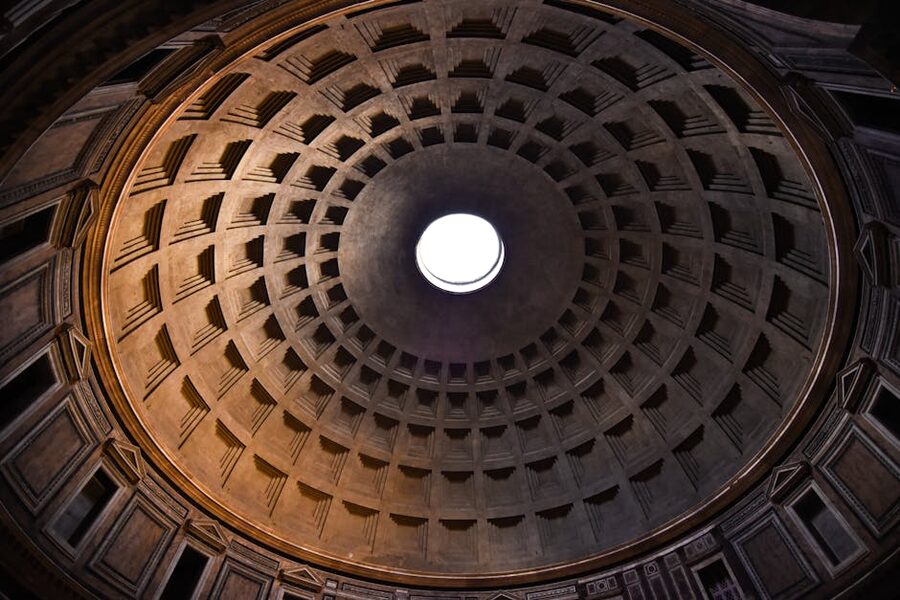
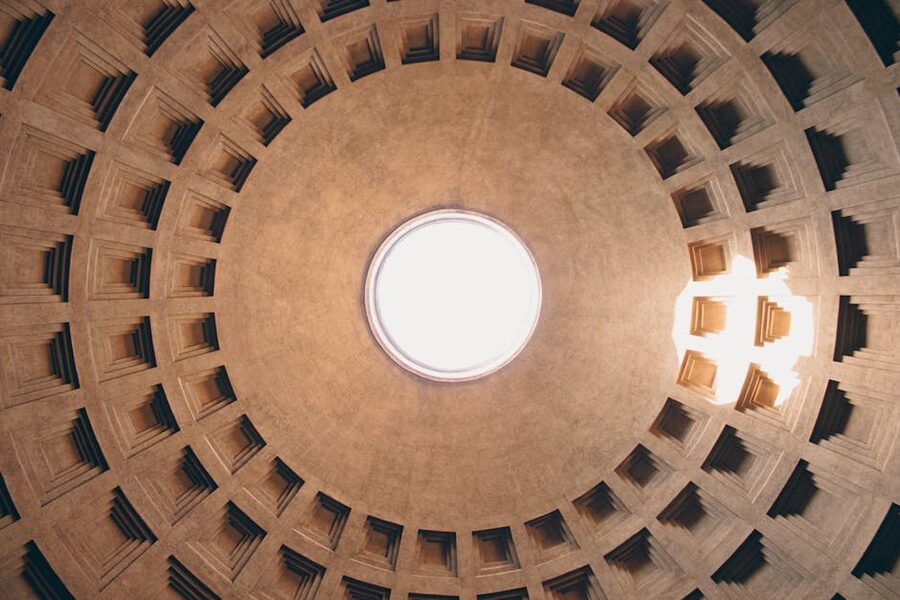
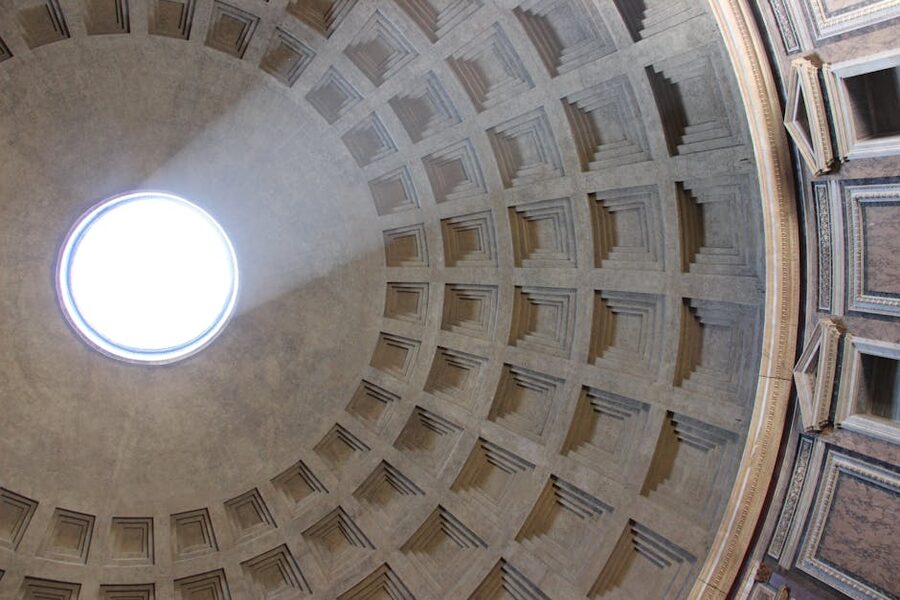
The dome’s internal diameter is 43.3 meters — exactly equal to its height from floor to oculus. This creates a perfect sphere that would fit precisely inside the building if placed on the floor. Whether this was symbolic (a perfect sphere representing the heavens) or purely structural remains debated.
The concrete dome is unreinforced — no steel rebar, no internal framework. It’s the largest unreinforced concrete dome ever built. The Duomo in Florence is larger but uses internal support chains. St. Peter’s dome uses a double-shell construction with a gap between layers. The Pantheon’s dome is a single solid shell, and nobody has matched it in 1,900 years.
The Oculus
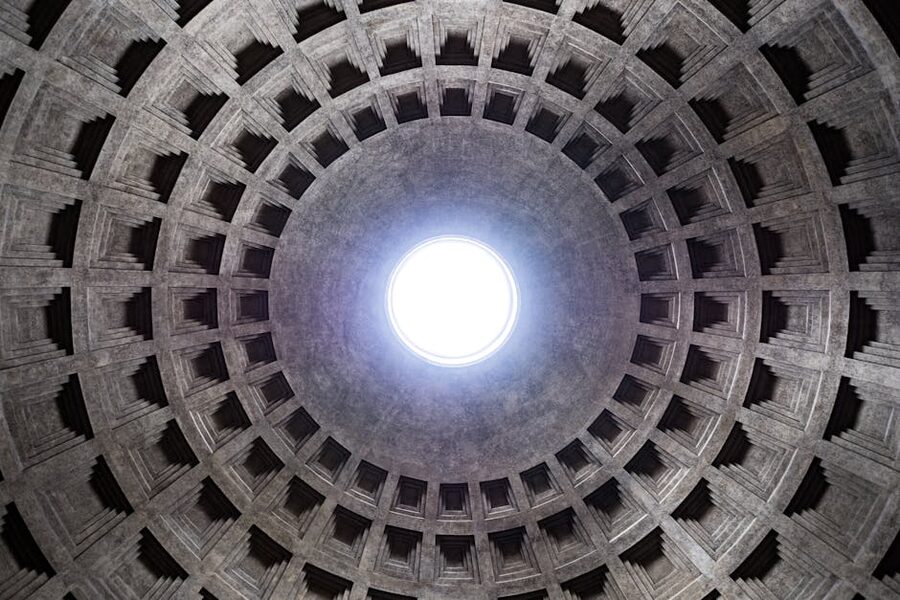
The 8.7-meter circular opening at the top of the dome is open to the sky. There’s no glass, no covering — it’s been open for nearly 2,000 years. When it rains, water falls directly onto the floor below. The slightly convex floor and a system of drainage holes handle the runoff.
This design choice seems impractical until you stand inside and realize the oculus does something no window can: it creates a beam of light that moves across the interior like a clock hand, illuminating different sections throughout the day. The effect is hypnotic. At noon, the beam hits the entrance — whether this was intentional remains one of the Pantheon’s many unsettled questions.
The Tombs
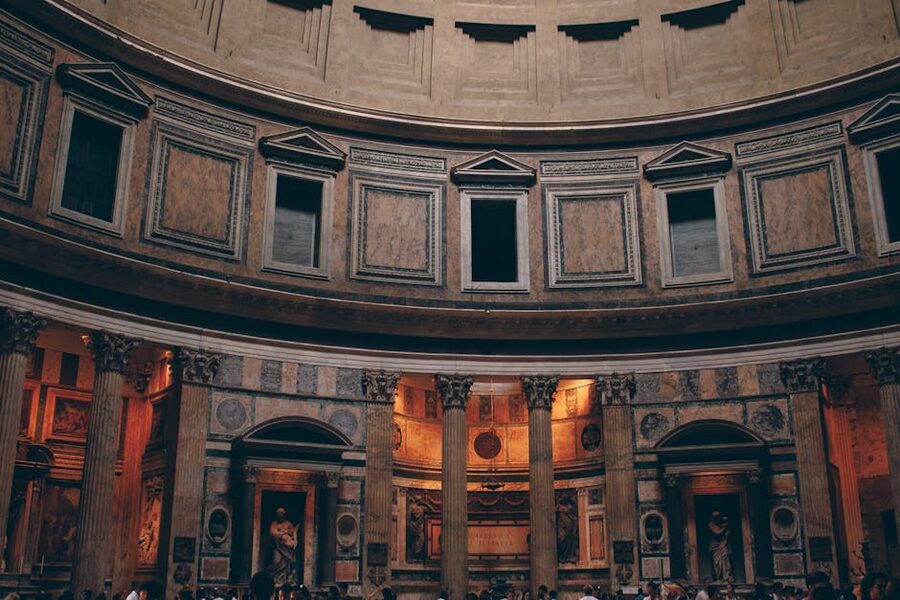
The Pantheon contains the tombs of several Italian kings and the Renaissance painter Raphael. Raphael’s tomb, in the third niche on the left, is marked with a marble inscription and his 1520 epitaph composed by Pietro Bembo. The inscription translates roughly to: “Here lies Raphael, by whom Nature herself feared to be outdone while he lived, and when he died, feared she herself would die.”
King Vittorio Emanuele II (first king of unified Italy) and King Umberto I are also buried here, in massive bronze-and-marble tombs that flank the altar, the same temple-as-mausoleum pattern that turns Paris’s Les Invalides into Napoleon’s resting place.
The Floor
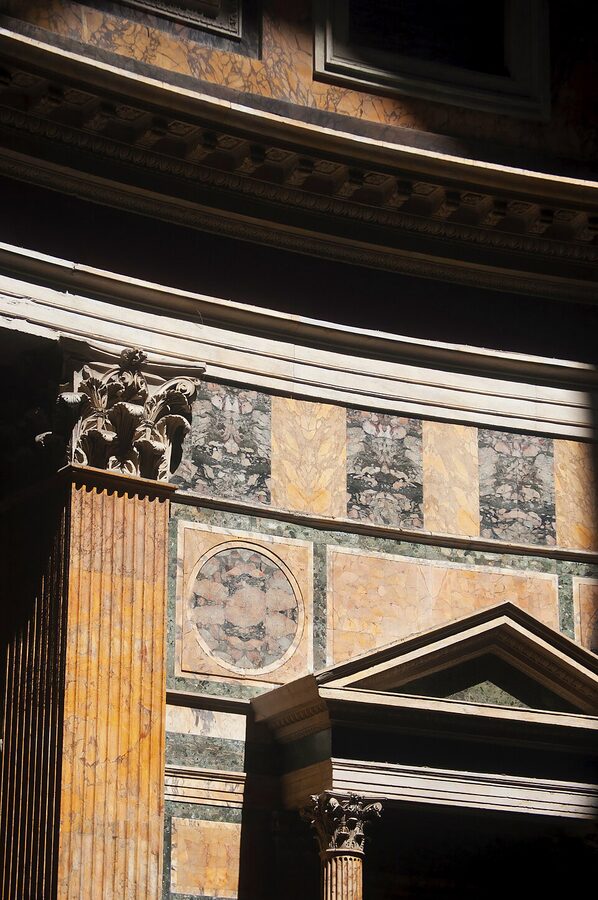
The marble floor is one of the Pantheon’s most overlooked features. The geometric pattern of circles and squares in colored marble — giallo antico, porphyry, and grey granite — is largely original from the 2nd century. It’s designed to slope very slightly toward the center, where the drainage holes handle rainwater from the oculus. The mathematical precision of the pattern mirrors the geometry of the dome above — circles within squares, reflecting Hadrian’s love of Greek geometry.
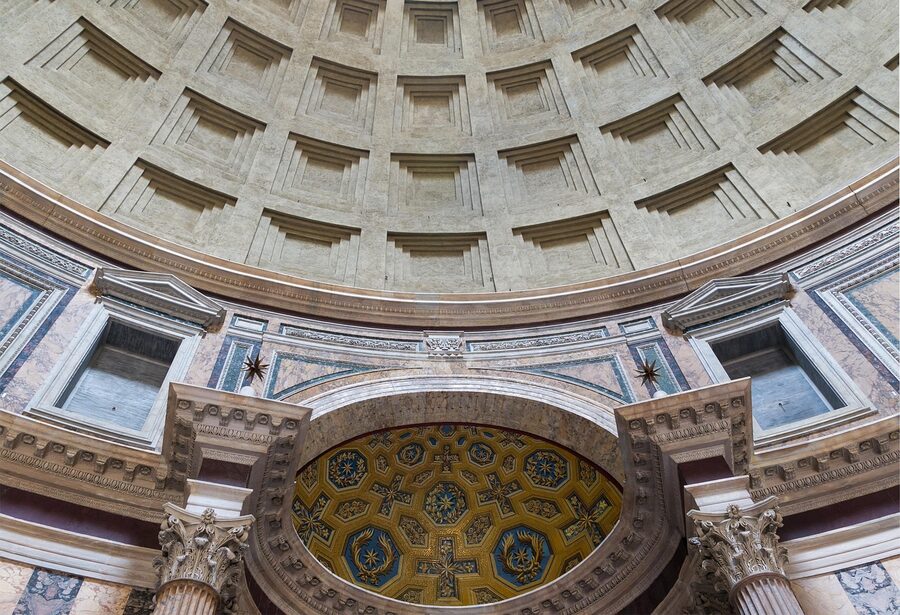
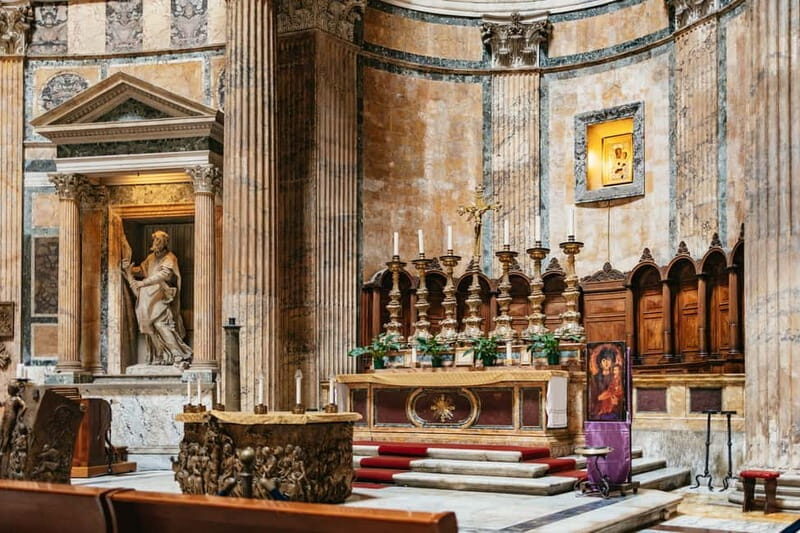
Look for the seven niches around the circular wall, alternating between semi-circular and rectangular openings. These originally held statues of the Roman gods — Jupiter, Mars, Venus, and others. Today they contain Christian altars and the tombs of Italian kings, but the architectural framework hasn’t changed.
The Portico
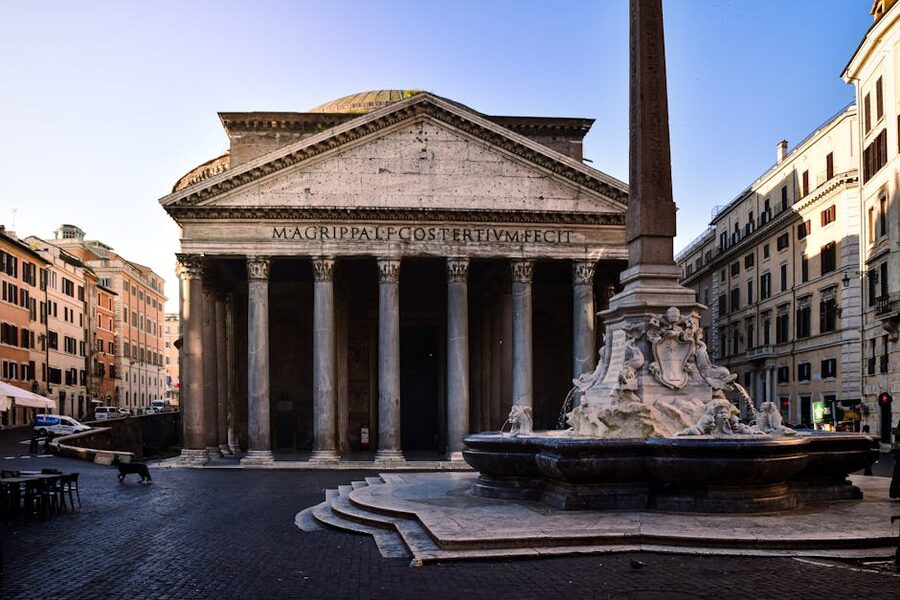
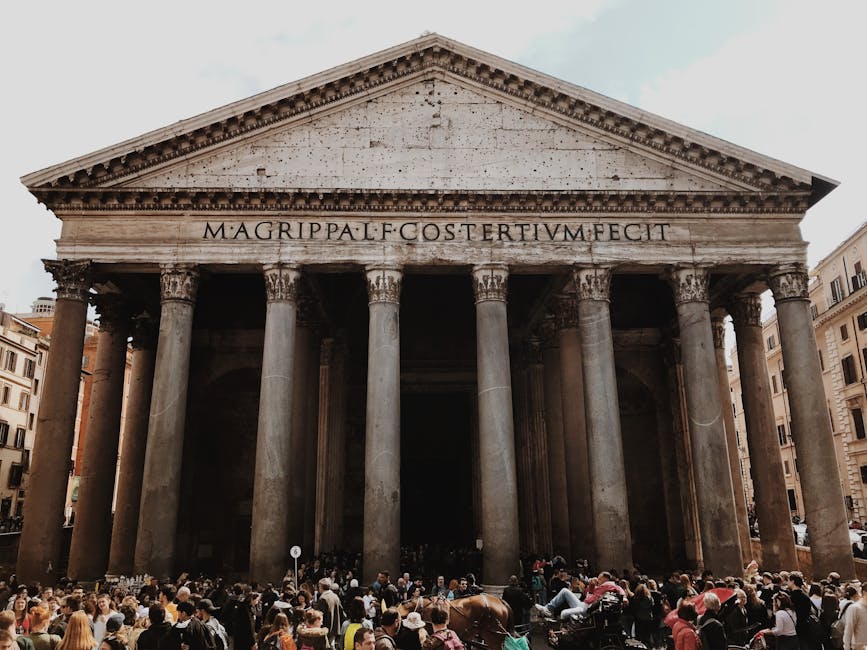
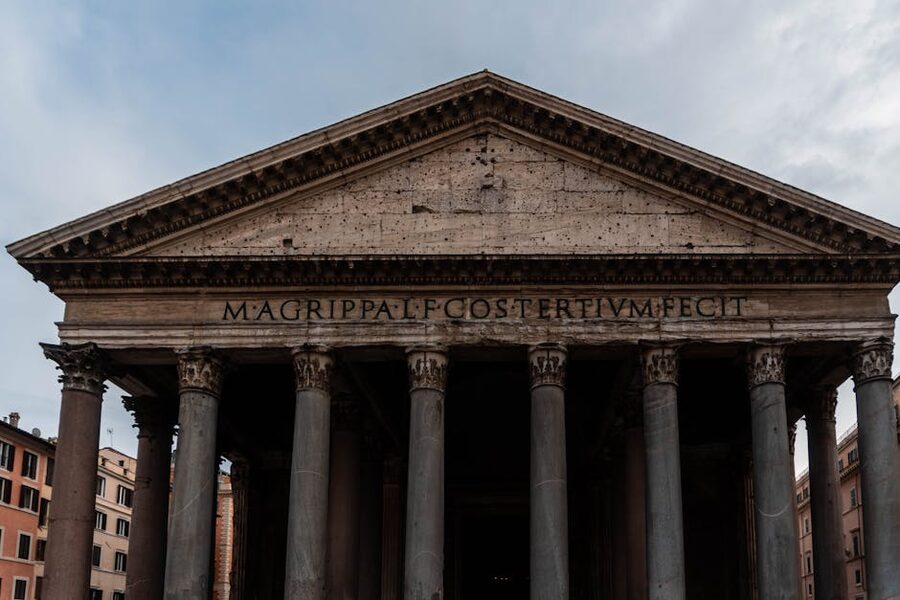
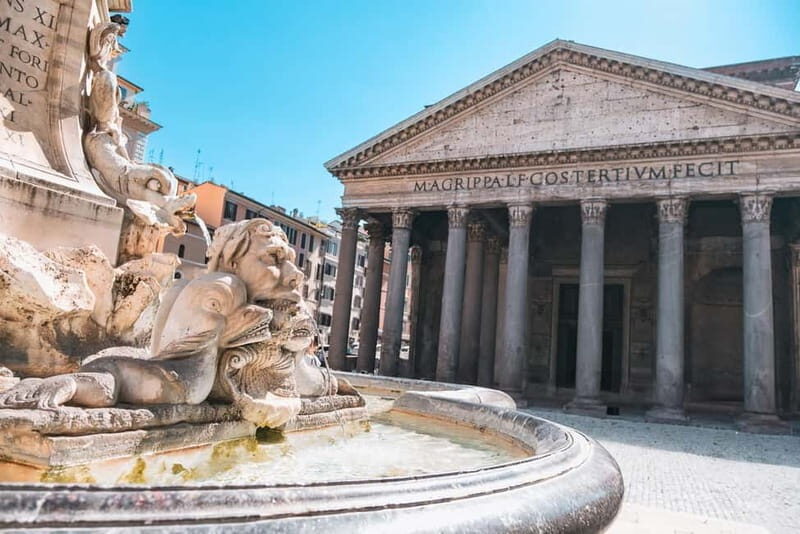
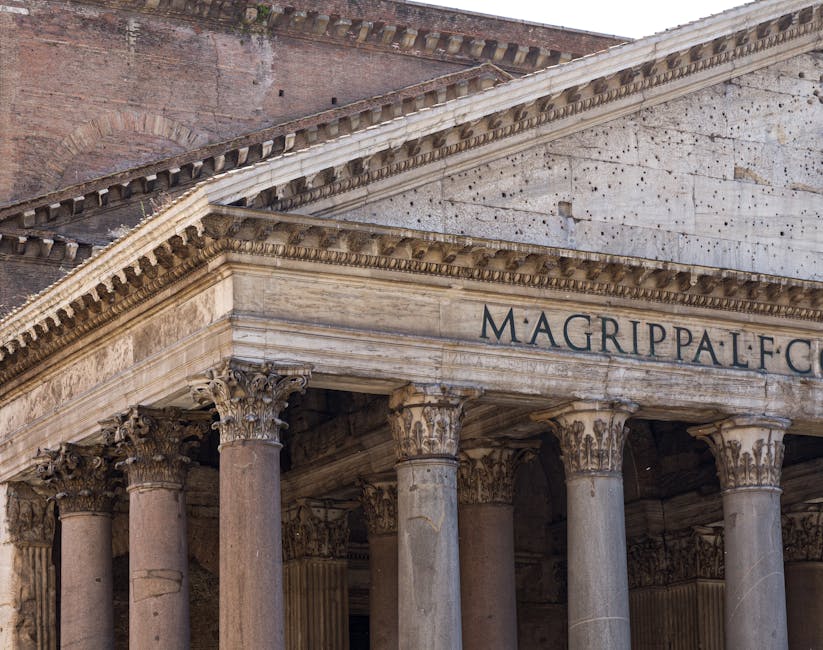
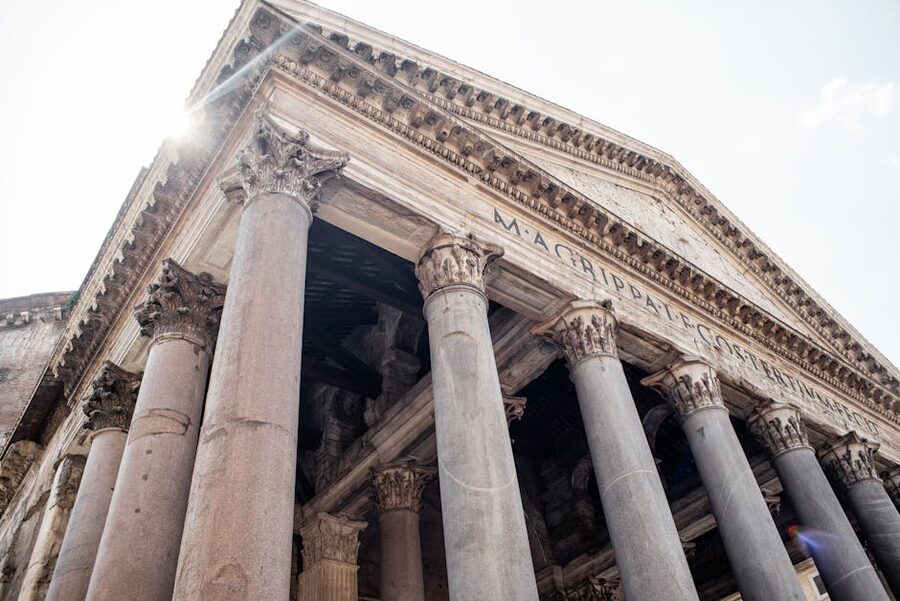
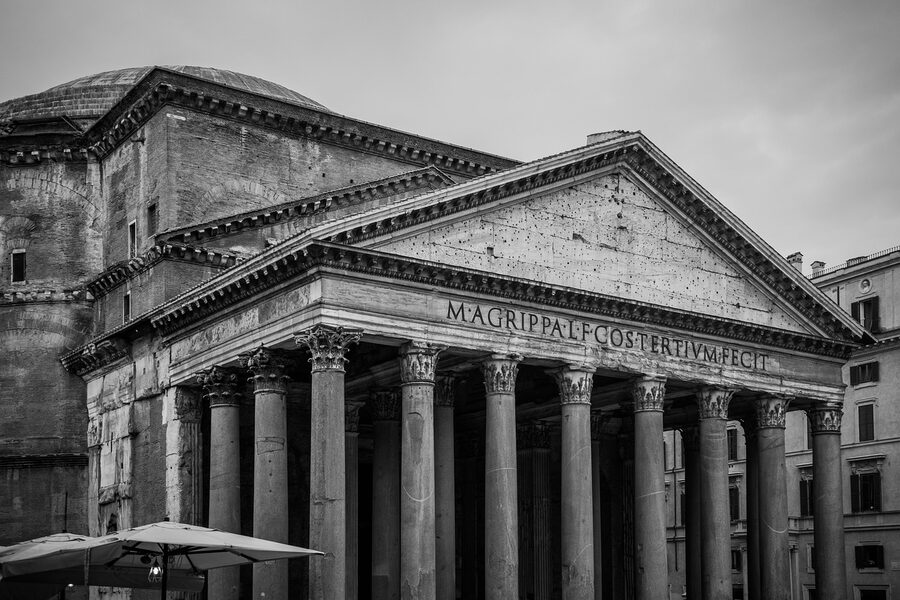
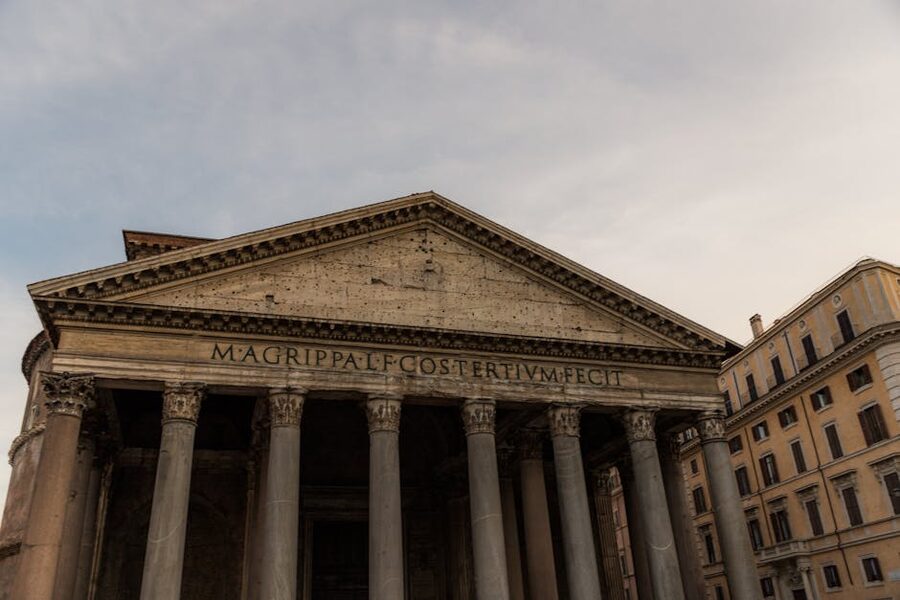
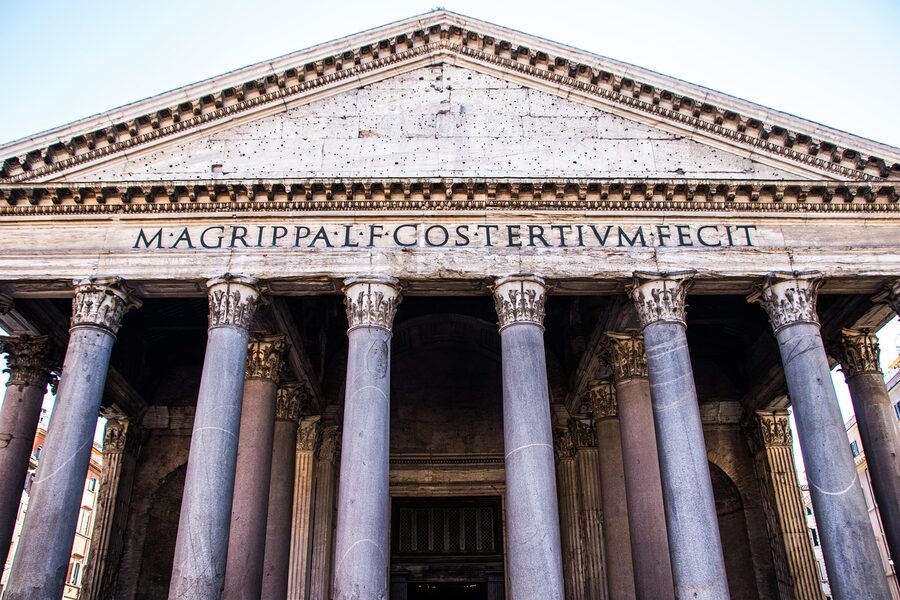
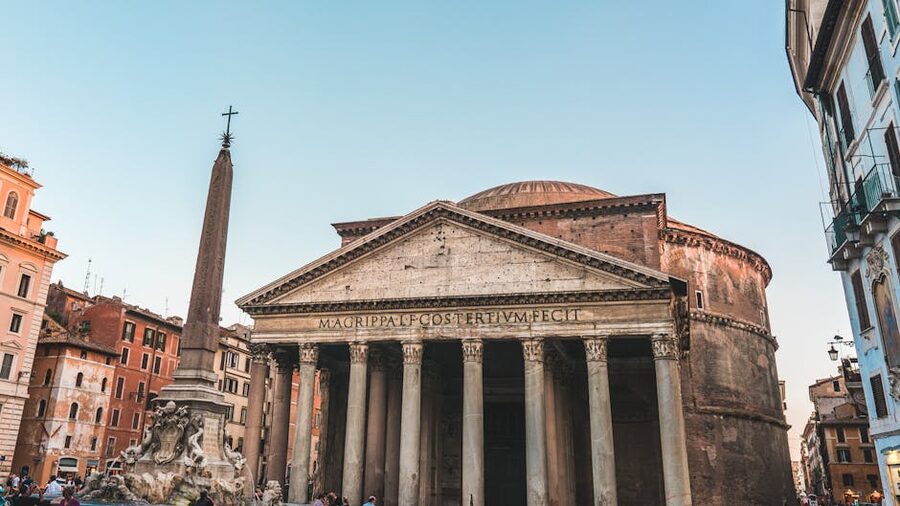
The front porch of the Pantheon is held up by 16 massive granite columns, each 12 meters tall and carved from a single piece of Egyptian granite quarried at Mons Claudianus in the Eastern Desert. Shipping these columns across the Mediterranean and up the Tiber was one of the ancient world’s great logistical feats — each column weighs approximately 60 tonnes.
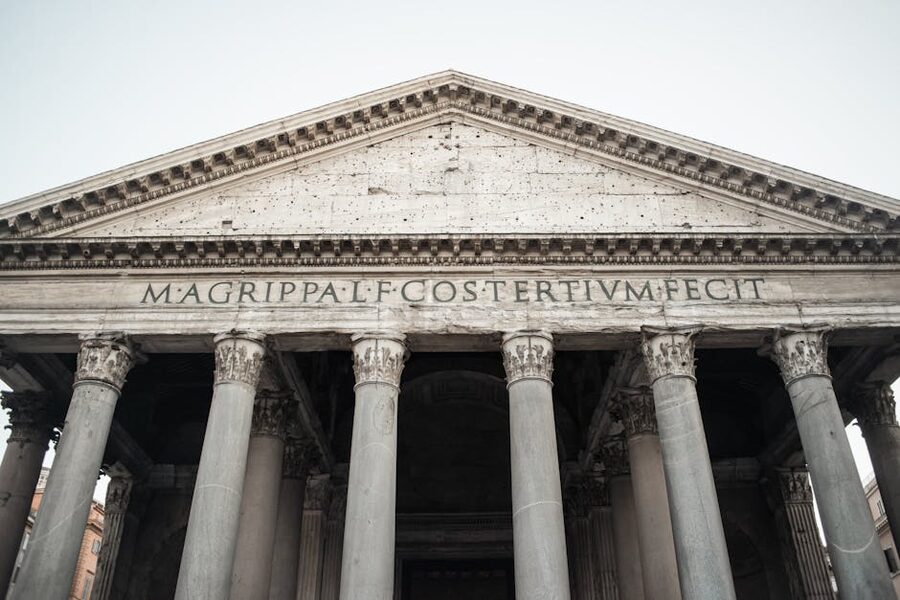
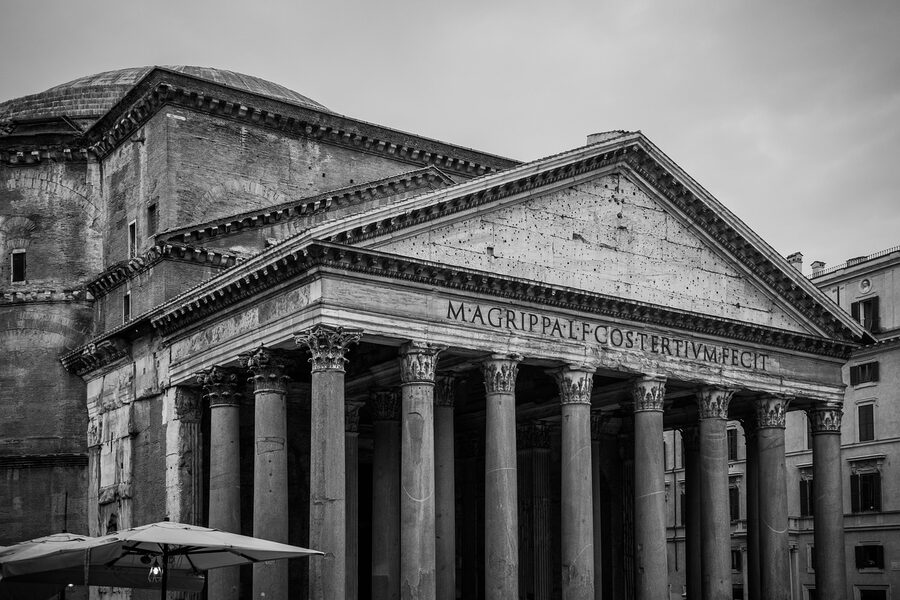
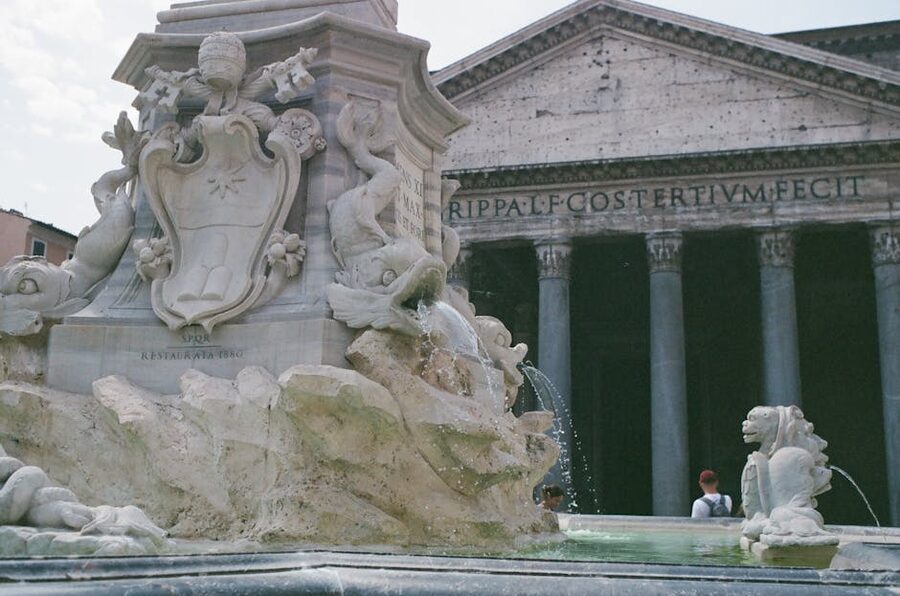
The inscription on the facade reads “M·AGRIPPA·L·F·COS·TERTIVM·FECIT” — “Marcus Agrippa, son of Lucius, consul for the third time, built this.” This refers to Agrippa’s original temple from 27 BC, which burned down. The current building was constructed by Emperor Hadrian around 125 AD, but Hadrian kept Agrippa’s inscription — an unusual act of modesty for a Roman emperor.
A Brief History
The original Pantheon was built by Marcus Agrippa in 27 BC as a temple to all the gods of Rome (“pan” = all, “theon” = gods). It burned down in 80 AD, was rebuilt by Domitian, burned again in 110 AD, and was finally rebuilt in its current form by Emperor Hadrian around 125 AD.
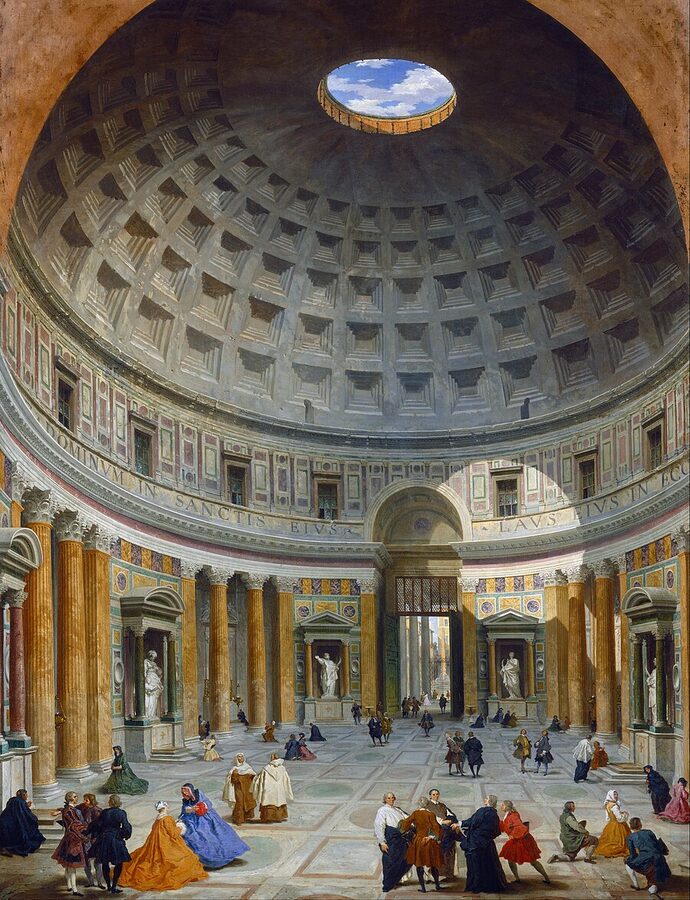
In 609 AD, Emperor Phocas gave the building to Pope Boniface IV, who converted it into a church dedicated to St. Mary and the Martyrs. This single act probably saved the building from being dismantled for its materials — a fate that befell virtually every other Roman temple. The Pantheon’s bronze roof tiles were stripped by Emperor Constans II in 663 AD, and the bronze portico ceiling was removed by Pope Urban VIII in 1625 to make Bernini’s baldachin in St. Peter’s Basilica. But the structure itself survived.
The building has been in continuous use for nearly 2,000 years, first as a Roman temple, then as a Catholic church. Services are still held here every Sunday. The fact that you can walk into a working building that was already 400 years old when the Roman Empire fell is difficult to process. Amsterdam’s Royal Palace, by comparison, is a youthful 17th-century newcomer, and the medieval fortress walls of Anne Frank’s old neighbourhood only date to a few hundred years ago.
Why the Pantheon Still Matters to Engineers
The Pantheon isn’t just historically important — it’s scientifically important. Modern materials scientists have been studying its concrete for decades, trying to understand why it’s so much more durable than anything we build today. Standard modern concrete has a lifespan of about 50-100 years before it begins to crack and degrade. The Pantheon’s concrete has been standing for 1,900 years and is still gaining strength.
Recent research published by MIT has identified a key ingredient: lime clasts — small chunks of calcium that were once thought to be impurities from poor mixing. In fact, they’re the secret to the concrete’s self-healing ability. When cracks form and water seeps in, these lime deposits dissolve and recrystallize as calcite, filling the crack. The material literally heals itself.
The dome also uses a variable-density concrete mix. Near the base, the aggregate contains heavy basalt and travertine. As the dome rises, the mix transitions to lighter materials — brick fragments, then volcanic tufa, and finally lightweight volcanic pumice near the oculus. This gradient reduces the dome’s overall weight while concentrating strength where it’s needed most, at the base where the load is greatest.
These techniques were lost after the fall of Rome and weren’t rediscovered until the 20th century. The Pantheon isn’t just a monument — it’s a textbook that took 1,900 years for modern science to read.
Practical Tips
Budget 30-45 minutes. The Pantheon is a single room — you can see everything in 15 minutes if you rush. But the engineering details, the tombs, the light effects, and the portico warrant at least half an hour. With a guided tour, plan for 45-60 minutes.
No dress code. Unlike the Vatican sites, the Pantheon as a functioning church is relatively relaxed about clothing. Shoulders and knees don’t need to be covered, though excessively casual beachwear may attract a comment from the guards.
No large bags. There’s a bag check but it’s small. Avoid bringing anything larger than a daypack.
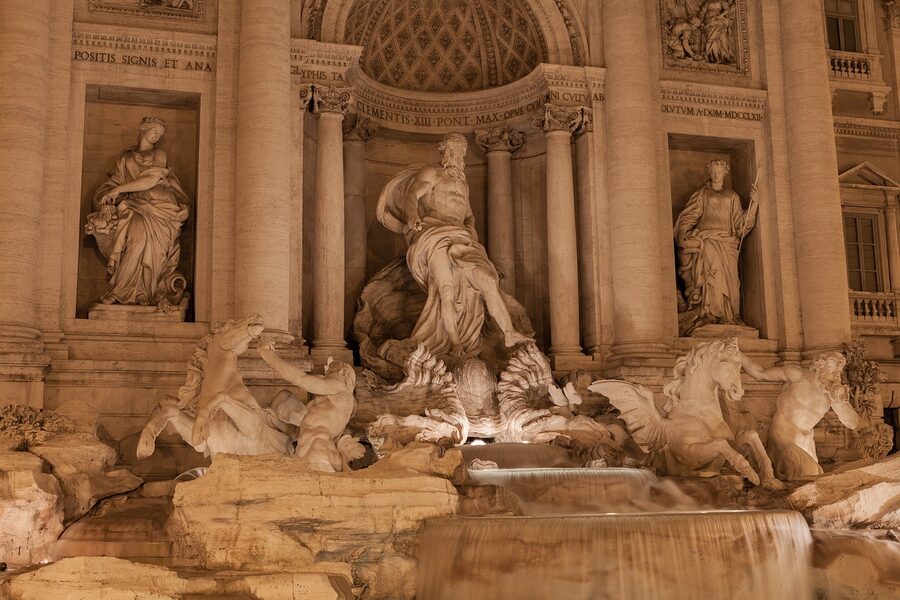
Combine with nearby sights. The Pantheon sits in the historic center, within walking distance of almost everything. Piazza Navona is 5 minutes north, the Trevi Fountain is 10 minutes east, Piazza Venezia and the Victor Emmanuel Monument are 10 minutes south. You can easily slot a Pantheon visit into a morning walking loop.
When it rains, go. Seriously. The Pantheon interior when rain is falling through the oculus is one of the most magical things in Rome. The water hits the floor in a perfect circle directly beneath the opening and drains away through the ancient floor system. Tourists flee rain; this is when you should lean into it.
Getting There
The Pantheon is in the heart of Rome’s historic center. There’s no metro station nearby — the closest is Spagna (Line A), about a 15-minute walk south through the shopping streets. Most visitors walk from other central attractions.
From the Colosseum, it’s a 20-minute walk through the historic center via Via dei Fori Imperiali and Piazza Venezia. From the Vatican, bus 64 to Largo di Torre Argentina, then a 5-minute walk north. From Trastevere, cross the Tiber at Ponte Sisto and walk 10 minutes through the cobblestone streets.
More Booking Guides for Rome
If you’re ticking off Rome’s major monuments, the Pantheon fits perfectly between the Colosseum in the morning and a late lunch in the historic center. The Vatican Museums and Sistine Chapel are a separate half-day on the other side of the Tiber. And if you have time for a dome climb at St. Peter’s Basilica, that pairs well with a Vatican Museums morning — the views from Michelangelo’s dome are the best in the city, and the €22 elevator ticket is one of Rome’s great bargains.