
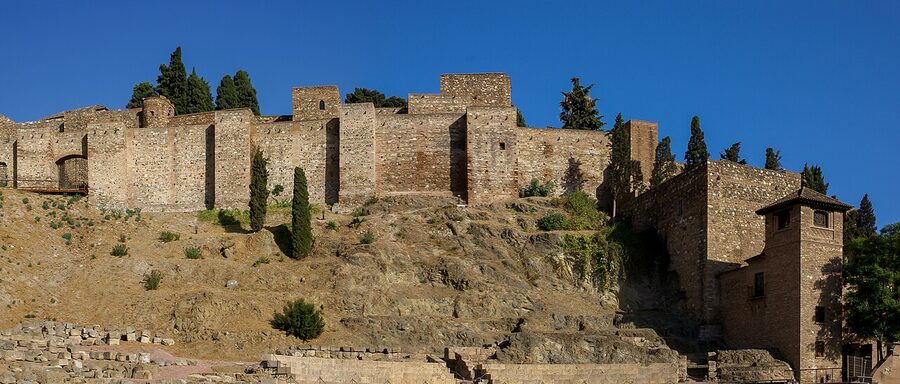
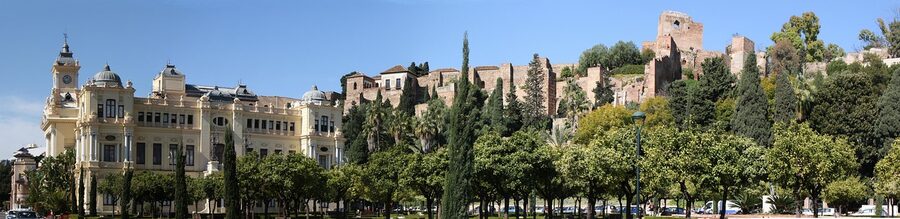
Late afternoon. The limestone walls of the Alcazaba hold the day’s heat the way old stone always does, and the orange trees in the inner courtyard throw a small sharp shadow across the path you’ve just walked up. Look down over the parapet and the Roman theatre is right there, thirty metres below your feet, its half-circle of stone seats opening towards the sea. The trick of the place is that the theatre and the fortress aren’t two separate sites. They’re the same hill, four centuries apart, with the older one dismantled to build the newer one. The Romans cut the limestone for the seats. The Moors took those same limestone blocks, in the 11th century, and walked them up the slope to build the walls you’re now leaning on.
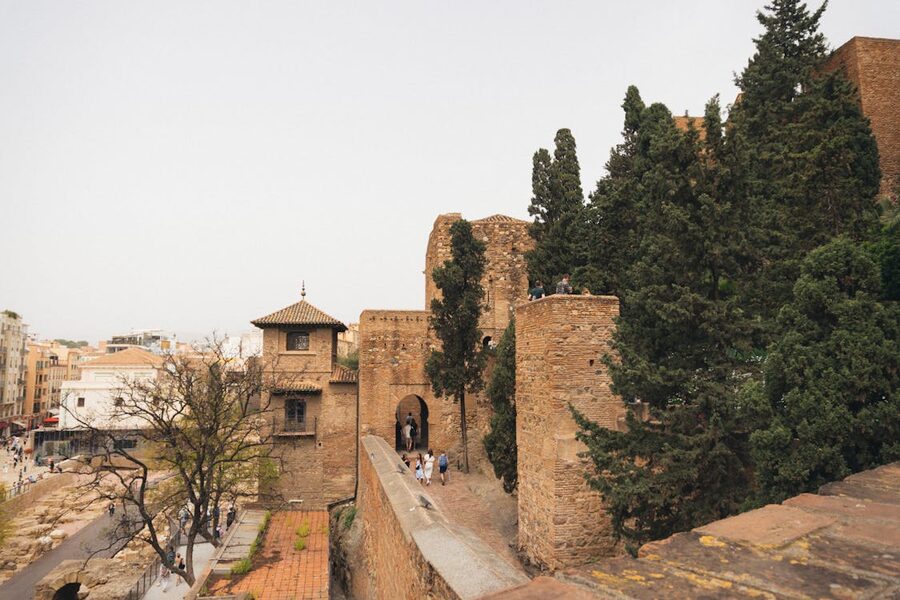
If you’ve already done the Nasrid Palaces in Granada or the Royal Alcázar in Seville, the Alcazaba sits in the same family but does something none of the others do quite this nakedly: it shows you the foundation underneath. The Roman city is right there, exposed, with the Moorish fortress balanced on top of it. You can stand on the Alcazaba’s lower battery and look straight down into a 1st-century theatre stage. That’s the article. The rest is logistics, history, and which of the three guided tours actually pays for itself.
In a hurry? Three picks.
- Alcazaba + Roman Theatre Guided Tour ($14): the cheapest expert-led visit, 1.5 hours, covers both monuments. Book on GetYourGuide.
- Alcazaba Malaga Guided Tour ($21): Viator’s flagship, 80 minutes, slightly smaller groups. Book on Viator.
- Cathedral + Alcazaba + Roman Theatre walking tour ($45): three hours, pulls in the cathedral too, the only reason to go upmarket. Book on Viator.
The hill, layered
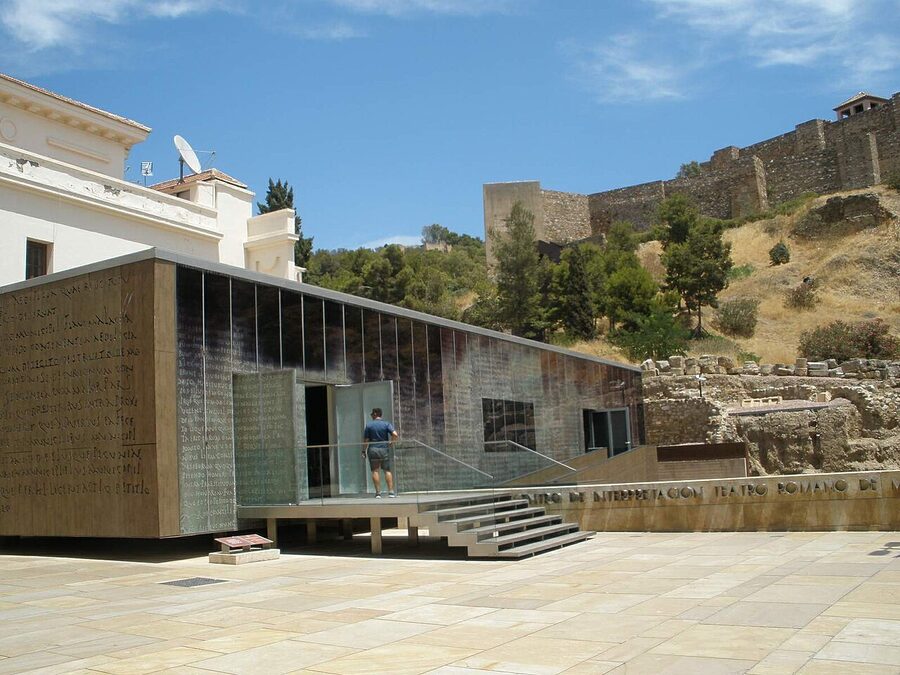
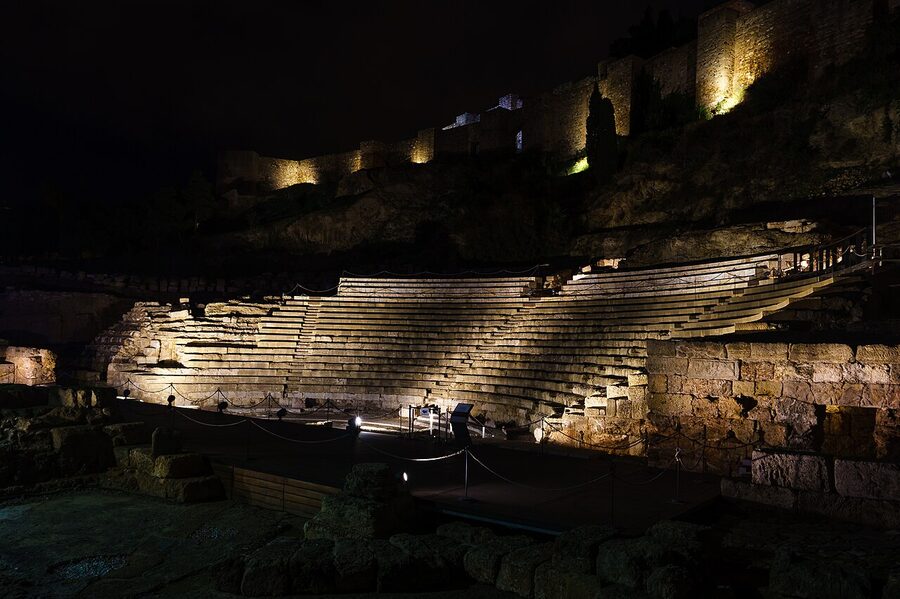
Before you decide which ticket to buy, it helps to know what you’re looking at. The Romans came first. Around the 1st century BCE they built a port-and-fish-salting town here called Malaca, and the theatre on Calle Alcazabilla was its civic centrepiece. It was used for about 250 years and then abandoned, slowly buried under silt and rubble, then forgotten so completely that the Moors who arrived in the 8th century built right over it without realising it was there. The theatre wasn’t rediscovered until 1951, when workers digging foundations for a new municipal building hit Roman stone.
The Alcazaba you climb today is mainly 11th-century, built by the Hammudid dynasty when Málaga was its own short-lived taifa kingdom after the collapse of the Caliphate of Córdoba, on the same kind of civic-royal scale that produced Dam Square and the Royal Palace of Amsterdam centuries later. Most of what stands now dates from a major rebuild around 1057-1063 under Badis ibn Habus, the Berber king of Granada. He inherited Málaga and reinforced the fortress as a military base. The upper palace inside the second ring of walls was added later and reads more like a smaller, plainer cousin of the Alhambra’s Nasrid Palaces: same stucco arches, same patio-with-fountain layout, just a fraction of the scale. The big Andalusian-Islamic monuments form a clear hierarchy: the Mezquita of Córdoba is the cathedral of the lot, the Alhambra is the masterpiece palace, the Real Alcázar is the lived-in royal residence, and Málaga’s Alcazaba is the working military citadel. Each one tells you a different chapter of the same 700-year story.
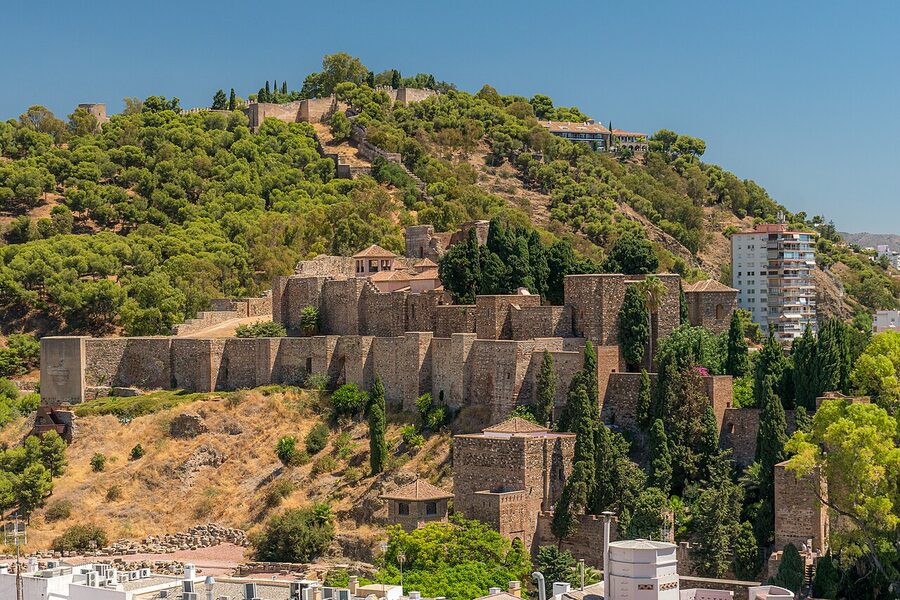
Above the Alcazaba sits the Castillo de Gibralfaro, a 14th-century watchtower castle that once connected to the lower fortress through a fortified corridor called La Coracha, on the same defensive logic that turns a Loire site like Chambord into a series of nested towers and corridors. The corridor is gone now and you can’t walk between the two monuments directly, which surprises a lot of visitors who plan a single climb. To do both you either trudge back down to the city, walk around the base, and climb the long path up the other side, or you take the No. 35 city bus from Avenida de Cervantes. We’ll come back to that.
Tickets, hours, and the free Sunday afternoon
The booking situation is actually generous. A single Alcazaba ticket is €3.50. The combined Alcazaba + Gibralfaro ticket is €5.50, which is the right buy if you have time and legs for both. Reduced (students, pensioners, groups) is €1.50 for either monument. On Sunday afternoons from 2pm onwards, both monuments are free. No reservation, just walk in.
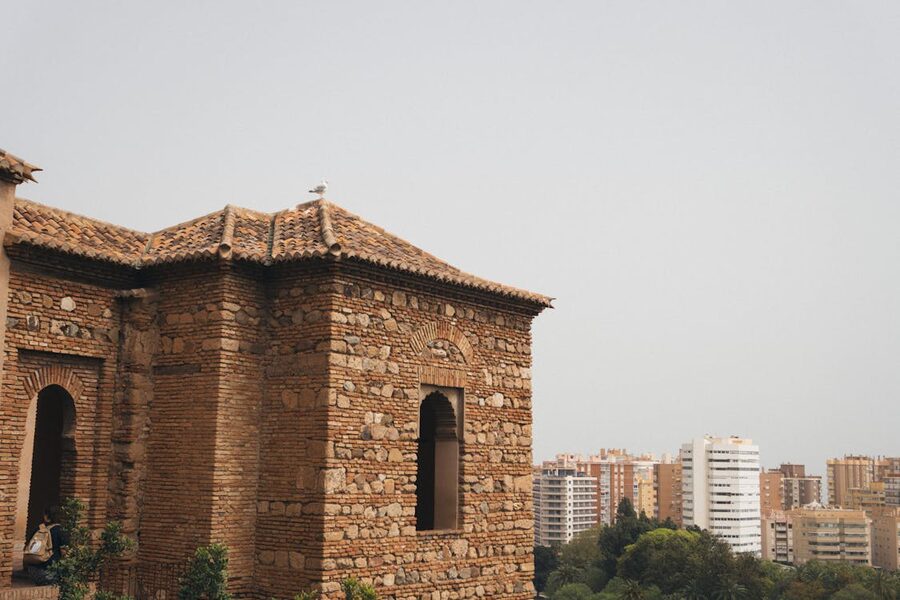
Hours follow the Spanish summer/winter split:
- Summer (1 April-31 October): 9:00 to 20:00, last entry 19:15.
- Winter (1 November-31 March): 9:00 to 18:00, last entry 17:15.
- Free Sunday window: from 14:00 to closing.
Two hours is enough for the Alcazaba alone. Three to four covers Alcazaba + Gibralfaro with the bus connection. Five if you want to add the Roman theatre (which is free and self-guided, ten minutes if you’re moving, twenty if you’re reading the panels). I’d block out half a day and not feel rushed about any of it.
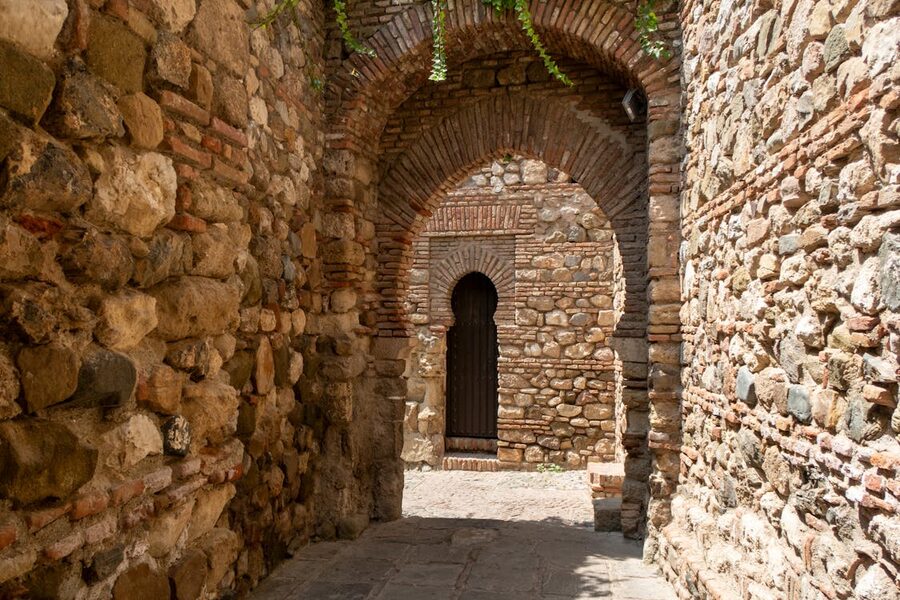
One real warning: the Alcazaba is not wheelchair-accessible and isn’t really pram-friendly either. The path is cobbled, steep in stretches, with frequent shallow steps. There’s a glass lift up the side of the rock from Calle Guillén Sotelo that gets you onto the upper terrace and skips the climb, but the lift only solves part of the problem. The inner palace and the upper walks still involve stairs once you’re inside. If mobility’s a concern, you can do the lower courtyard and the views from the first ring without the climb, or skip to the Picasso Museum instead. That one’s on flat ground in the same neighbourhood.
Which gate, which entry, which queue
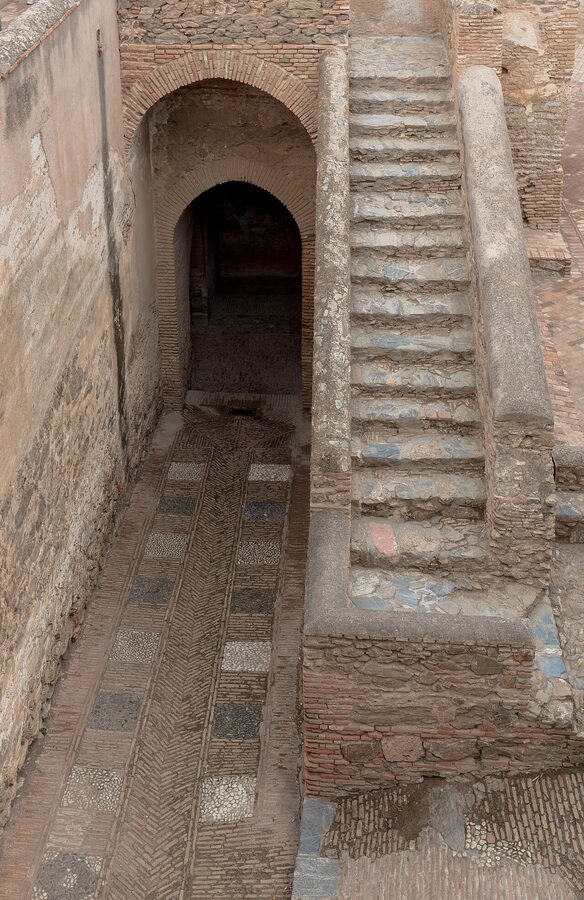
There are two ways in. The lower entrance is on Calle Alcazabilla next to the Roman theatre. This is the proper visit: you enter at the bottom and climb through every layer of the fortress in order. It’s the longer walk, maybe twenty-five minutes from gate to top, and it’s how the architecture is designed to be read. Each successive gate doubles back on itself so attackers couldn’t charge straight up. You’ll see why the Christian armies of the Reyes Católicos took three months to conquer this place in 1487.
The upper entrance is the lift on Calle Guillén Sotelo, behind the Town Hall. It runs from about 9:30 to 19:30 in summer, costs nothing, and drops you on a terrace near the upper palace. From there you visit the fortress in reverse: palace first, then descend through the gates. It’s the move if you’ve got knees that don’t like climbing or if you’re on a tight schedule. You miss the ascending narrative but you also save forty minutes of effort. I’ve done it both ways and the lower entrance is the better visit by some distance, but only if you have the time.
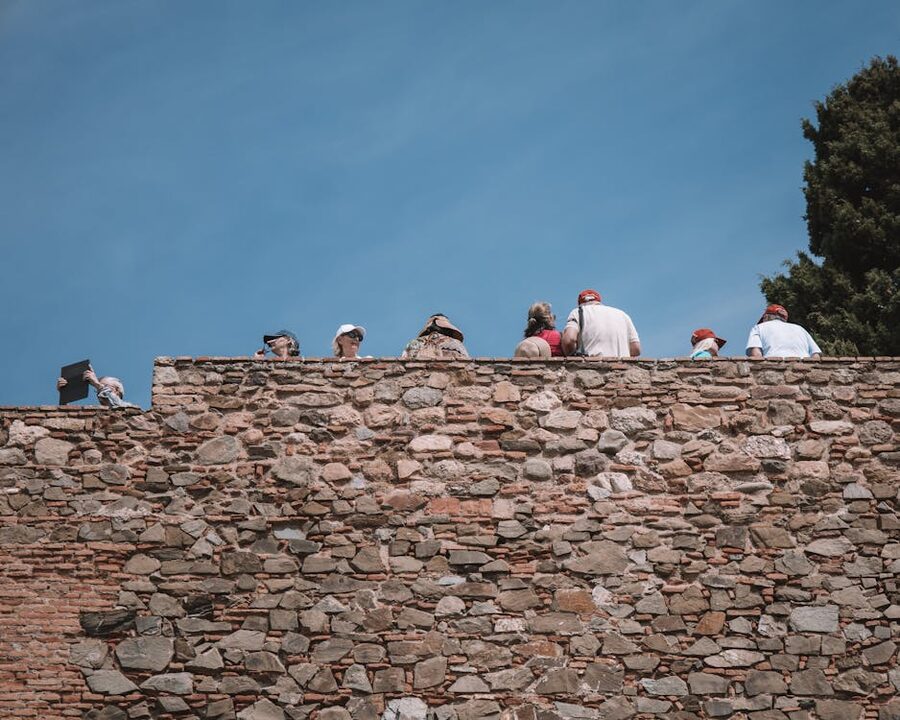
Queues at the lower gate get long around 10:30am in summer. They peak at 11:30 and stay heavy until the lunch dip at about 1:30. If you’re a 9am person, go on opening; otherwise the late-afternoon window from 5pm onwards is reliably emptier and gives you better light for photography. The Sunday free hours from 2pm are the busiest the place gets all week. Locals show up with kids, school groups, the lot. I’d take the €3.50 ticket on a Tuesday over a free crush on a Sunday.
What you actually see, in order
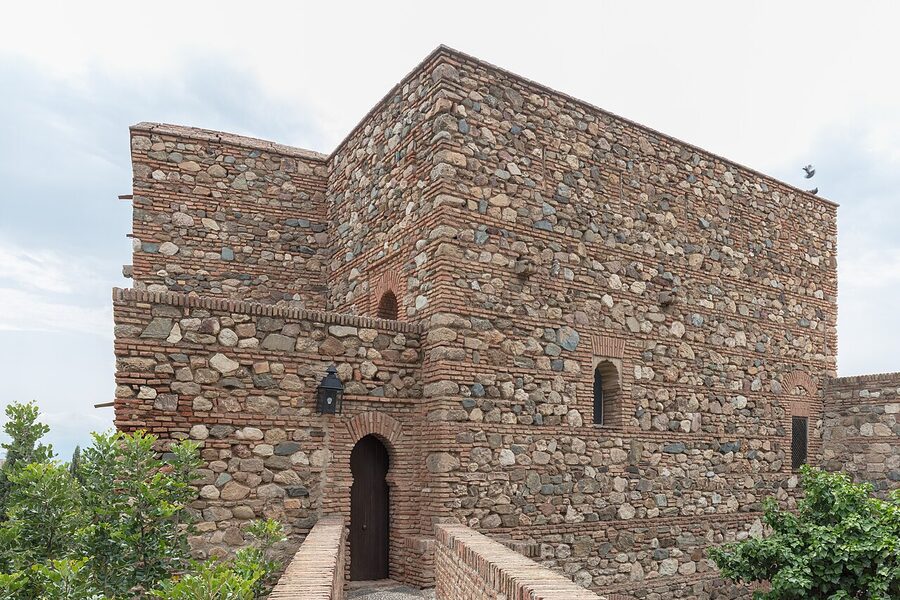
The Alcazaba is structured as concentric rings. You enter through the Puerta de la Bóveda (Vault Gate) at the base, which opens into a courtyard with a small museum about the recovered Roman material (capitals, columns, fragments) that the Moors quarried for their walls. Worth ten minutes. Then you climb through the Puerta de Cristo (Christ’s Gate, named for a niche where mass was said after the 1487 conquest), the Puerta de los Cuartos de Granada, and finally the Puerta de los Arcos.
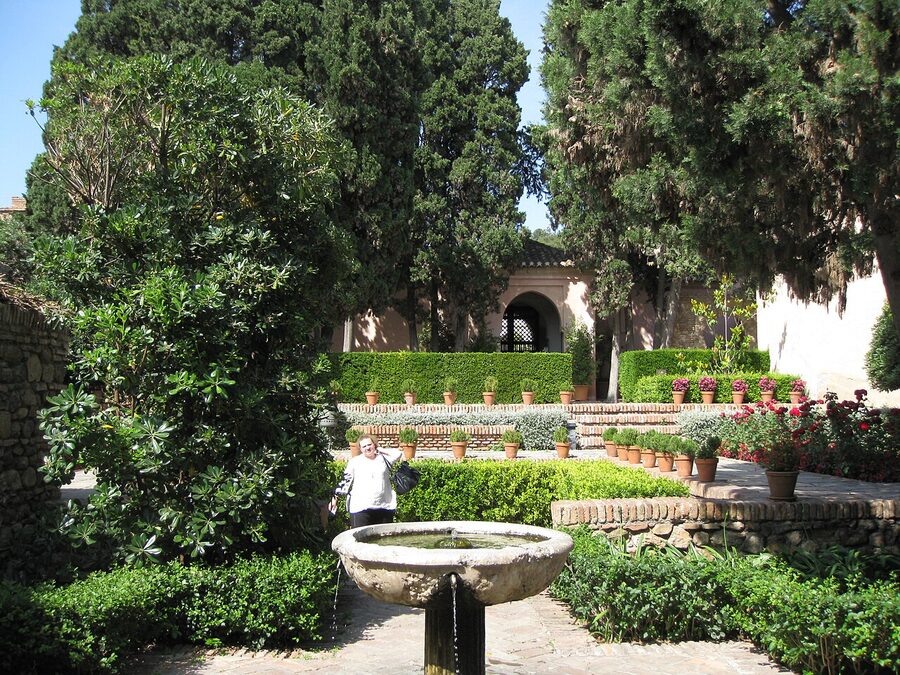
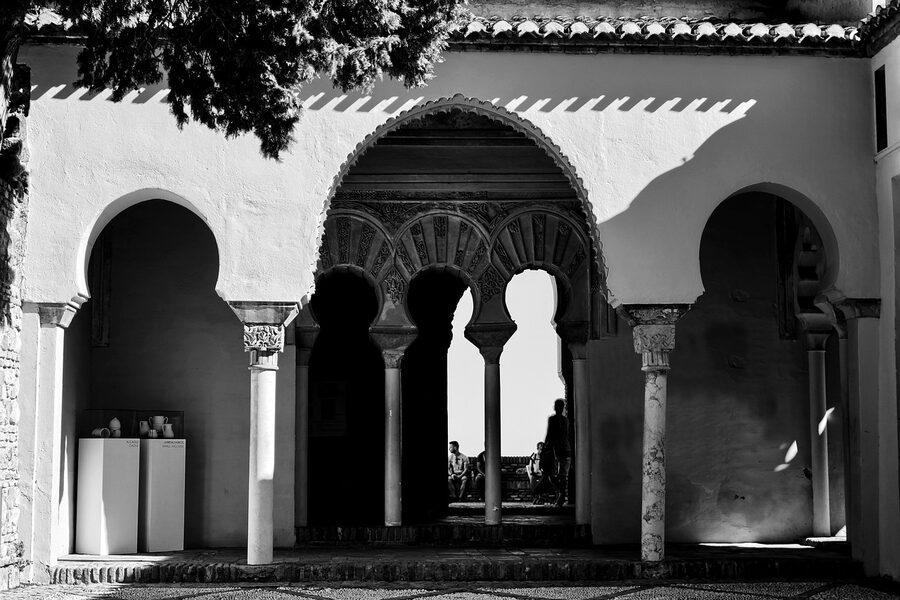
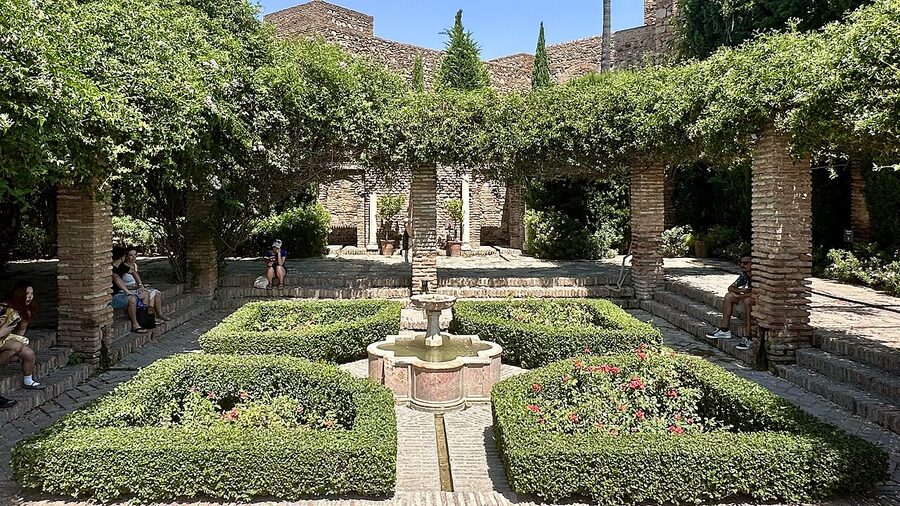
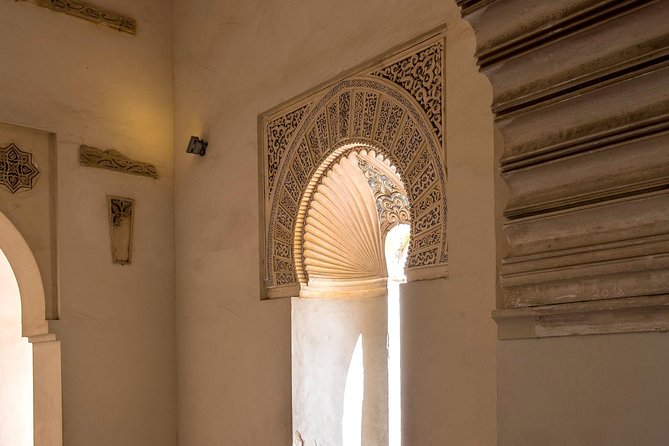
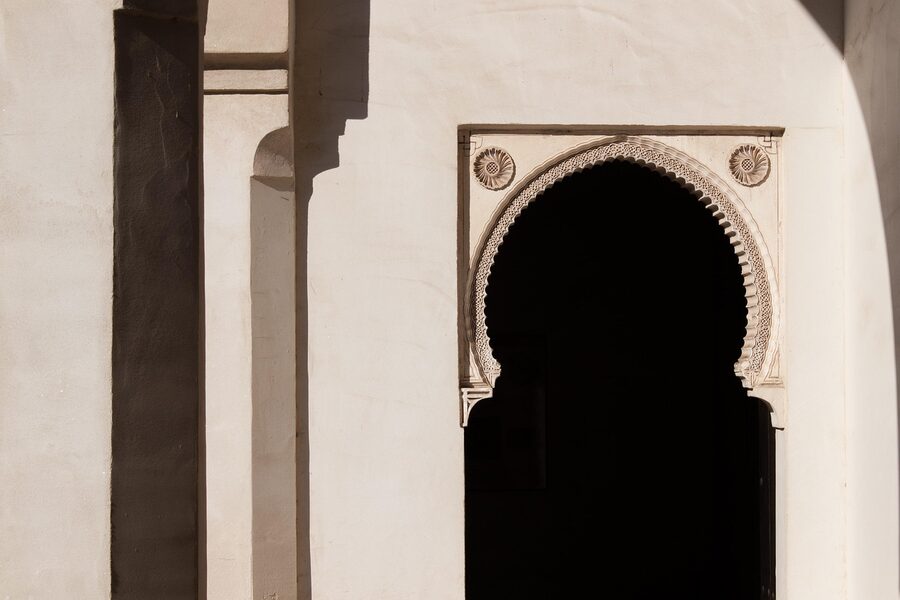
Inside the upper palace you’ve got three small patios: the Patio de los Surtidores (Patio of the Fountains), the Patio de los Naranjos (Patio of the Orange Trees), and the Patio de la Alberca (Patio of the Pool). Each is a scaled-down version of what you’ll see if you ever get to the Nasrid Palaces in Granada: the same vocabulary of horseshoe arches, sebka stucco, and reflecting pools, just simpler and more military. This is the working older sibling of the Alhambra, not the dazzling royal one. If you came here after the Nasrid Palaces you’ll find Málaga’s palace charming-but-modest. If you come here first, the Alhambra later will hit much harder because you’ll know what to look for.
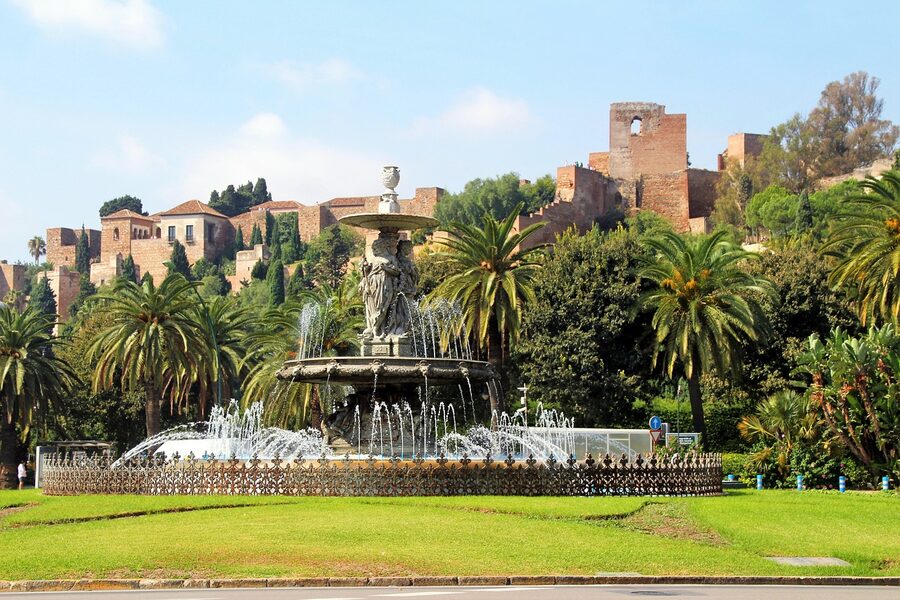
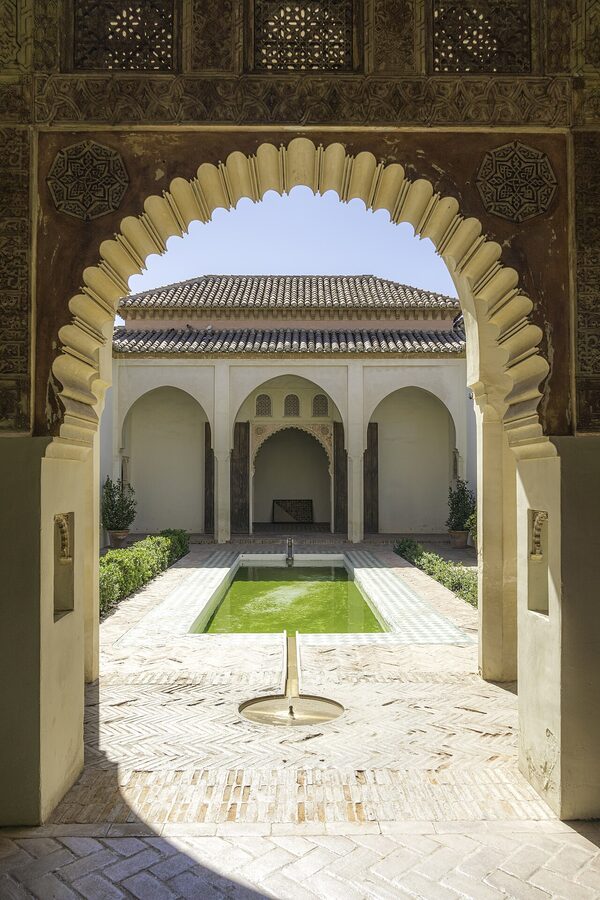
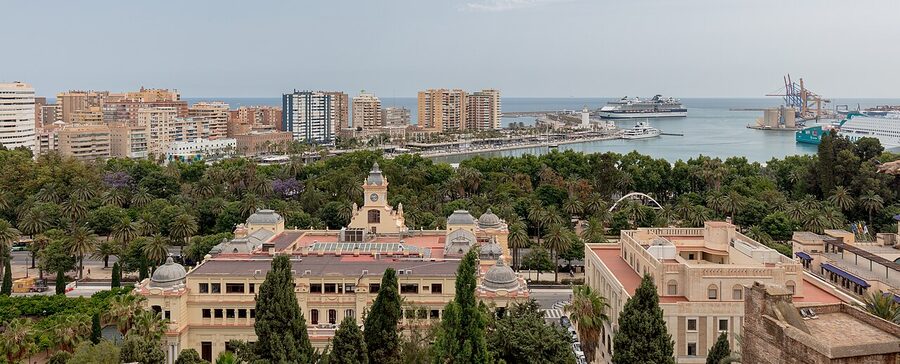
The single best view in the fortress is from the Torre del Homenaje (Keep Tower) on the upper west side. From here you can see straight down into the Roman theatre, across the port to the Mediterranean, and up the hill to Gibralfaro. It’s where every guidebook puts the wide-angle photo, and it earns the spot. Bring your phone or camera fully charged, you’ll fill it.
Roman theatre below: read it before or after
The Roman theatre at the foot of the Alcazaba is free, open, and currently underrated by visitors who blow past it on the way to the fortress. There’s a small interpretation centre on Calle Alcazabilla 8 (also free) with a 12-minute video and a model of how the theatre fitted into Roman Malaca. Watch it before you climb the Alcazaba and the layered hill makes far more sense.
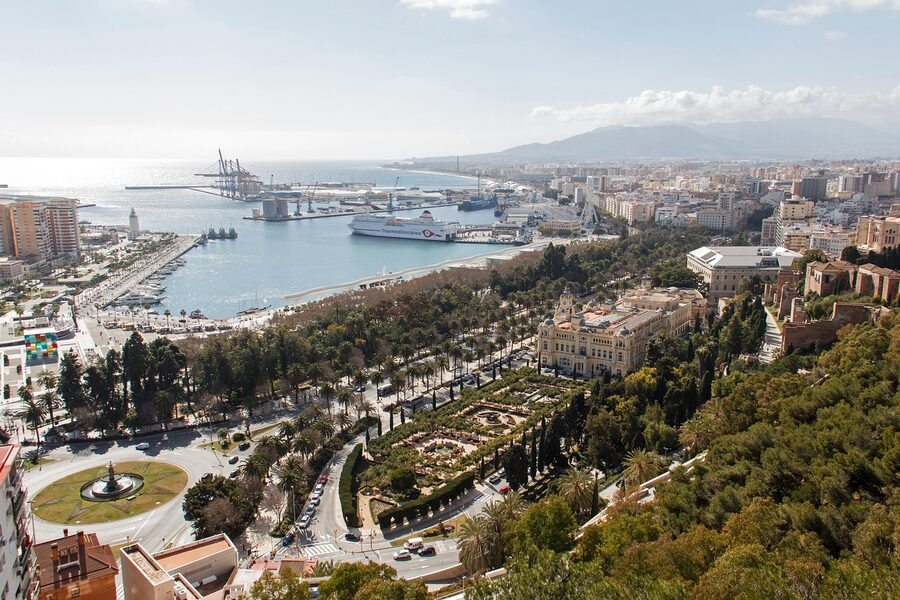
Built in the 1st century BCE during the reign of Augustus, used heavily for about 250 years, then partially dismantled for the construction of fish-salting tanks (you can still see the surviving Roman garum tanks at one end). When the Moors arrived in the 8th century the whole thing was already underground. They quarried stone from what they could reach without realising they were taking it from a Roman building. You can see column drums recycled into the Alcazaba’s lower walls if you know where to look. There’s a cluster of them near the Puerta de Cristo, marked with a small plaque.
This isn’t the Colosseum and shouldn’t be sold as one. It’s a small provincial theatre, beautifully preserved by its accidental burial, that exists to tell you Roman Malaca was a real city long before there was a Spain. Twenty minutes is enough for a self-guided visit. An hour if you watch the centre’s video and read the panels.
Booking the guided tours
The Alcazaba is very visitable without a guide. Paths are signed in English and Spanish, there’s a free downloadable audioguide at the gate (Spanish only at the time of writing, sadly), and the architecture explains itself if you’ve read this article. But guided tours pay off here for two specific reasons. They let you skip the ticket queue at the lower gate. And the guides know the Roman-Moorish overlap story in detail, which is genuinely the central thing to understand about this site. If you’re not a pre-reader, hire someone.
1. Alcazaba and Roman Theatre Guided Tour: $14
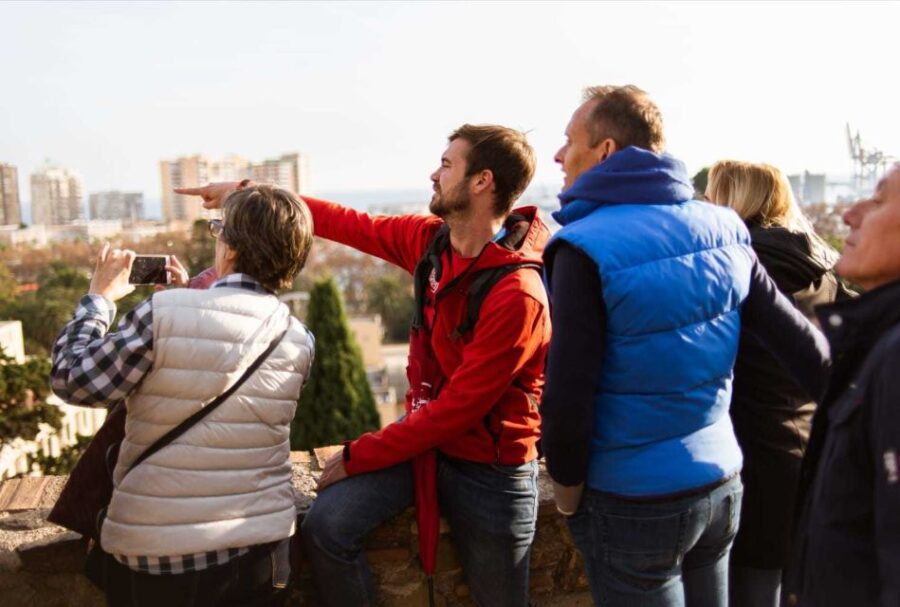
This is the right pick for almost everyone: 90 minutes, English-speaking guide, both monuments in one ticket, at a price barely above the entrance fee on its own. The trade-off is group size, which can hit 25 in peak season. Our full review covers the meeting-point logistics and which days the morning slot books out first.
2. Alcazaba Malaga Guided Tour (Viator): $21
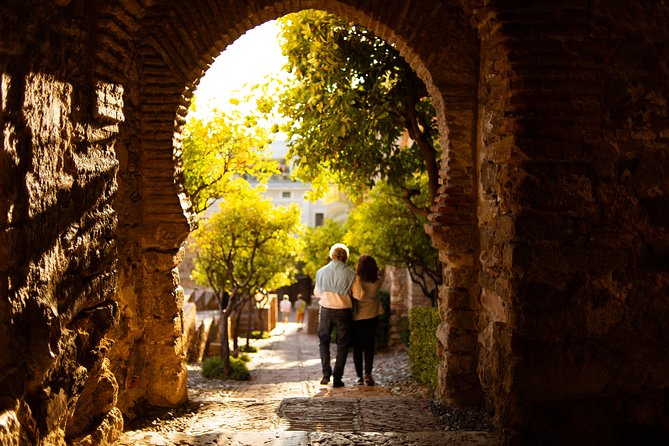
Pick this if the GetYourGuide slot is sold out or if you’d rather skip the Roman theatre and spend the full 80 minutes on the fortress alone. Same booking flow, same calibre of guide. Our review of the Viator option covers the cancellation policy difference, which matters more than the price gap.
3. Cathedral, Alcazaba and Roman Theatre walking tour: $45
This is the only reason to go upmarket. The cathedral on its own is worth an hour of your time and isn’t covered by the cheaper Alcazaba tours. Our review flags the one weak link, which is that three hours is just barely enough for all three sites and you’ll feel slightly rushed inside the cathedral.
Adding Gibralfaro: worth the climb?
Gibralfaro is the 14th-century castle on the hilltop above the Alcazaba. Same Moorish defensive system, larger footprint, fewer interior chambers. The reason to go up is the view, which is genuinely the best in Málaga: port, bullring, cathedral, the long line of Costa del Sol coast running east. The reason to skip it is your legs, because the walk up is a steep zigzag and takes a sweaty 25 minutes from the Alcazaba lower gate.
The smarter way is the No. 35 bus from Avenida de Cervantes. It costs €1.40, runs every half hour, and drops you at the castle gate in about ten minutes. Walk down to the Alcazaba afterwards via the path through the Jardines de Puerta Oscura. That way gravity’s on your side. Plan that as the second monument of the day, after the Alcazaba, and it works as a graceful descent into dinner in the old town. Doing both monuments justifies the €5.50 combined ticket easily.
What to bring, what to skip
It’s an outdoor visit. Cobbled paths, very little shade in the lower fortress, brutal sun in summer. A few small things matter more here than they do at most monuments:
- Real shoes. The cobbles are uneven and shiny in places where centuries of feet have polished them. Skip the flip-flops, skip the heels.
- Water. There’s a vending machine inside at the lower courtyard and another by the upper palace, both reliable. The little café in the lower courtyard is overpriced for what it is. Bring an empty bottle and refill from the fountain by the entrance.
- A hat in summer. June through September the upper terrace is exposed and the limestone reflects heat back at you.
- A real camera if you’ve got one. The light at golden hour in the inner palace courtyards is one of the better photographic moments in Andalucía. Phone is fine but a wider lens makes the courtyards work.
- Don’t bring a pram. The lift gets you to the upper terrace but the rest of the visit defeats wheels. Carriers work. Prams don’t.
The 1487 siege, briefly
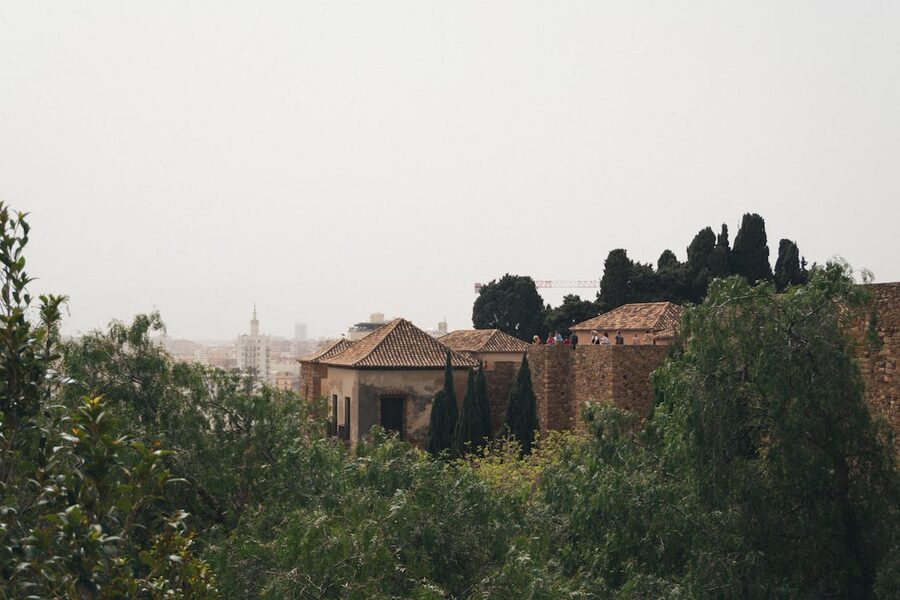
The Christian Reconquista took Málaga in 1487, five years before Granada finally fell. Ferdinand and Isabella spent three months camped at the foot of the Alcazaba, eventually starving the city into surrender after a defence led by the Berber commander Hamet El Zegrí that lasted longer than anyone expected. The terms were brutal. Most of the Muslim population was sold into slavery, the largest such enslavement on the Iberian peninsula during the Reconquest. The Alcazaba surrendered intact and was used as a Christian fortress for the next three centuries.
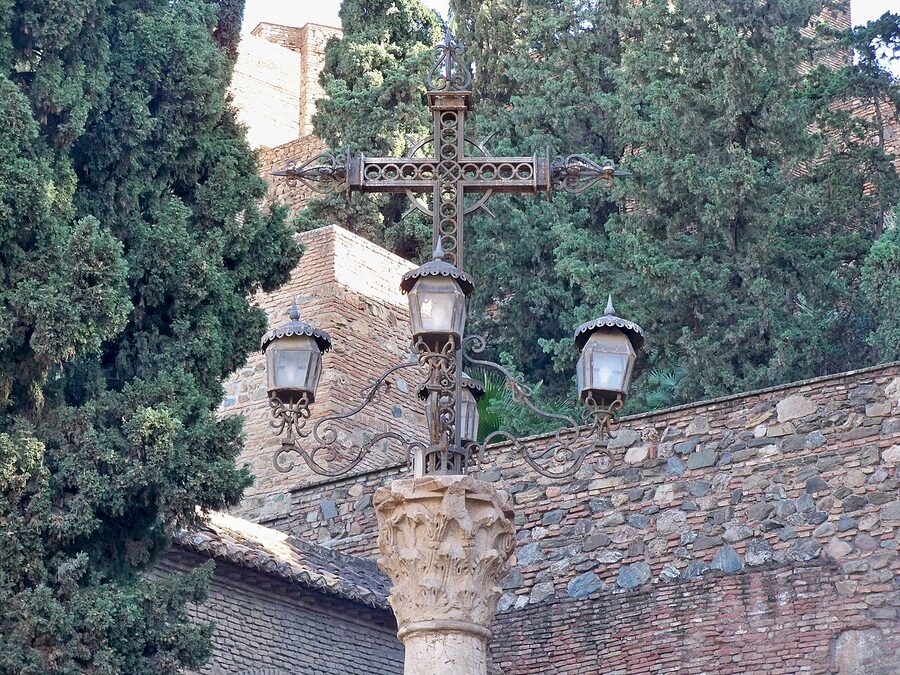
Knowing this changes the inner palace. You’re not looking at a monument frozen at the height of Moorish power. You’re looking at the spot where it ended. The cross on the keep tower marks the moment Ferdinand’s banner went up; the Catholic chapel inside the lower fortress was where the first mass was said the morning after surrender. The Alcazaba reads as a victory, but it’s actually the older civilisation’s defeat preserved in stone, and that lens makes the visit weightier, the way the Jordaan streets you walk on an Anne Frank walking tour read as everyday Amsterdam until you know what happened in them.
Where the Alcazaba sits in the Andalusian-Islamic trio
If you’ve got two weeks in Andalucía and you’re fitting in the four big Moorish monuments, here’s the order I’d recommend. Start with Málaga’s Alcazaba. It’s small, it’s the easiest to read, and it gives you the architectural vocabulary you’ll need for everything that comes after. Then the Mezquita of Córdoba for the religious dimension and the famous forest of double arches. Then the Royal Alcázar of Seville for the lived-in palace experience and the Mudéjar-Christian fusion the Christians built after 1248. Finish with the Alhambra’s Nasrid Palaces in Granada: the masterpiece, the climax, the last of its kind.
Most travellers do them in the wrong order. They book the Alhambra first because it’s the famous one, then come to Málaga and feel let down because it’s smaller. Reverse it and the Alhambra hits twice as hard. The Alcazaba is the warm-up that teaches you the language. Caminito del Rey sits inside the same scenic axis if you’re already based in Málaga and want a non-monument day in the mountains; the Picasso Museum is the obvious afternoon pairing if you’re staying in town.
What’s nearby for the rest of the day
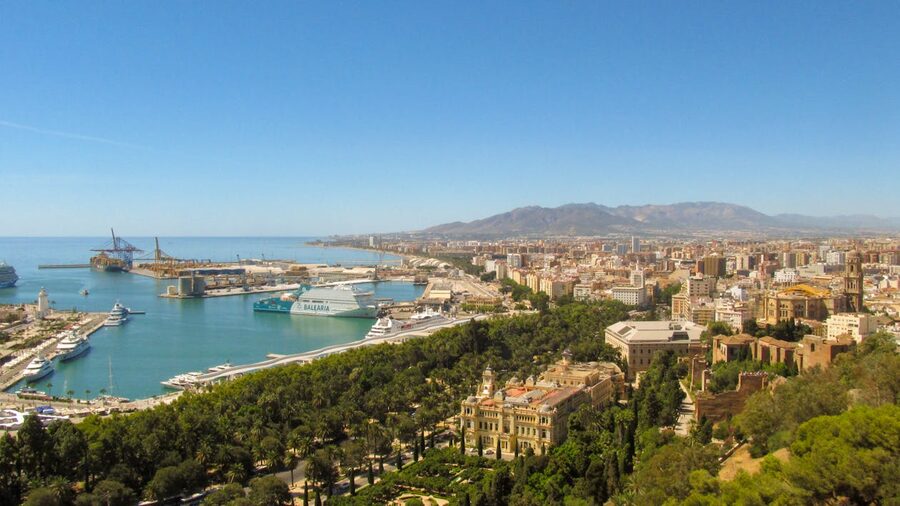
The Alcazaba sits in the dead centre of the old town, which makes the rest of your day easy. The Museo Picasso Málaga is six minutes’ walk through the lanes and a perfect afternoon-after pairing. The cathedral is ten. Málaga’s flamenco scene is smaller and cheaper than Seville’s or Granada’s and the early-evening tablao at Teatro Flamenco Málaga makes a good cap on an Alcazaba day. If you’ve got a car, the white village of Mijas is 35 minutes west; Caminito del Rey is an hour north for a serious half-day in the gorge.
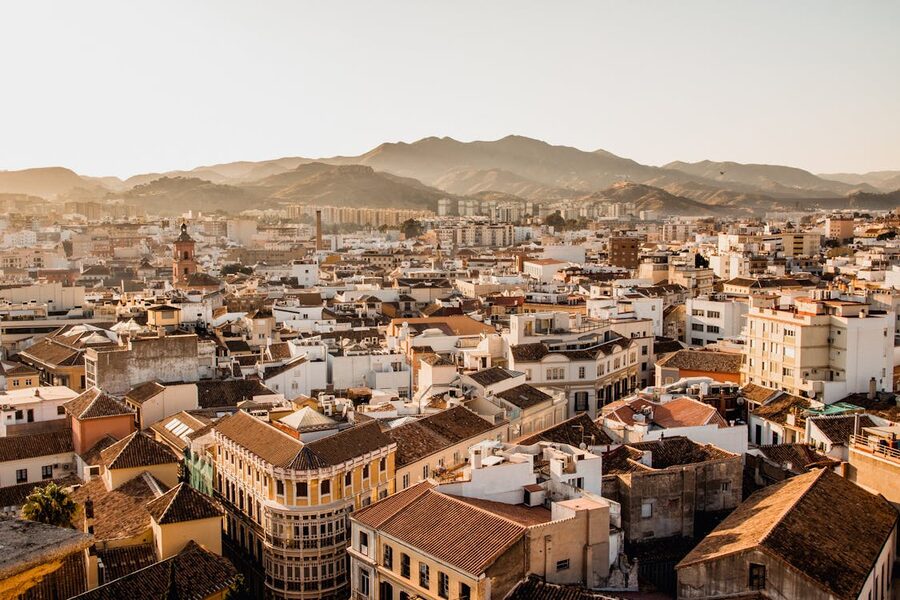
For dinner, walk down Calle Granada or Calle Marqués de Larios into the old town’s restaurant grid. Avoid the places with menus posted in five languages and pictures of paella; head for the Mercado de Atarazanas neighbourhood for tapas the locals actually eat. Cazón en adobo (marinated dogfish), boquerones fritos (small fried anchovies, a Málaga speciality), and a glass of cold Málaga sweet wine if you can find a bar that still serves it. Two hours of wandering, and the day ends about a kilometre from where it started.
Other Andalusian booking guides
If the layered-hill thing intrigued you, the Mezquita of Córdoba does a similar trick at religious scale: Christian cathedral built inside the Moorish mosque, not over it but through it. The Alhambra’s Nasrid Palaces are the next level up architecturally and need their own day. The Royal Alcázar in Seville is the lived-in royal version. The closest French parallel is Carcassonne, the medieval citadel in Languedoc whose double ring of walls works exactly the same defensive trick as the Alcazaba’s two enclosures. Caminito del Rey is the obvious natural-landscape day from the same Málaga base. And if you’re heading north afterwards, the Giralda tower at Seville Cathedral is the only other place in Spain where you climb a Moorish minaret as part of a Christian visit. They all stack on the same trip and they cross-reference each other in ways that make every monument bigger than it would be on its own.