
So where does this bus actually pay off? Not in the centro storico. You’ll walk Spaccanapoli on foot, pizza in hand, and you wouldn’t take a bus through that warren if someone paid you. The honest answer is up the hills and along the coast, where the geography stops doing you favours and Naples spreads out across cliffs and ridges that on foot would eat half a day.
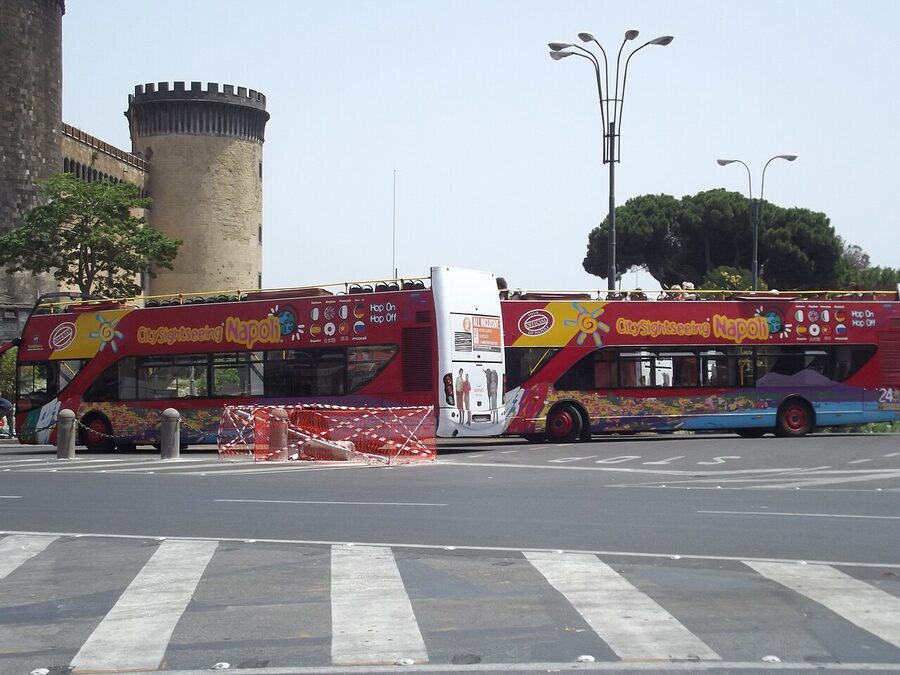
The bus is the right tool for three things: the Posillipo coastal drive, the Capodimonte museum on its hilltop, and the Vomero overlook. Outside that, you can probably skip it. This is the same honest framing I gave the Milan hop-on bus and arrived at “mostly no”, but Naples earns a different verdict because the city’s shape genuinely fights you on foot in a way Milan’s flat grid never does.
In a hurry: the picks
- City Sightseeing 24-hour ticket ($30): the standard red-bus pass, both routes, free Wi-Fi onboard. Book on GetYourGuide.
- Naples City Hop-on Hop-off Tour ($31): same routes booked through Viator if you keep your tours in one place. Book on Viator.
- From Salerno with train ($55): the cruise-day combo if your ship docks in Salerno not Naples. Book on GetYourGuide.
The two routes, and which one to ride
There are two lines, both starting and ending at Piazza Municipio. Line A is the Art route through the historic centre. Line B is the Views of the Gulf route along the coast. They each take about 75 minutes for a full circuit, and they each run roughly every 45 to 60 minutes from morning to late afternoon.
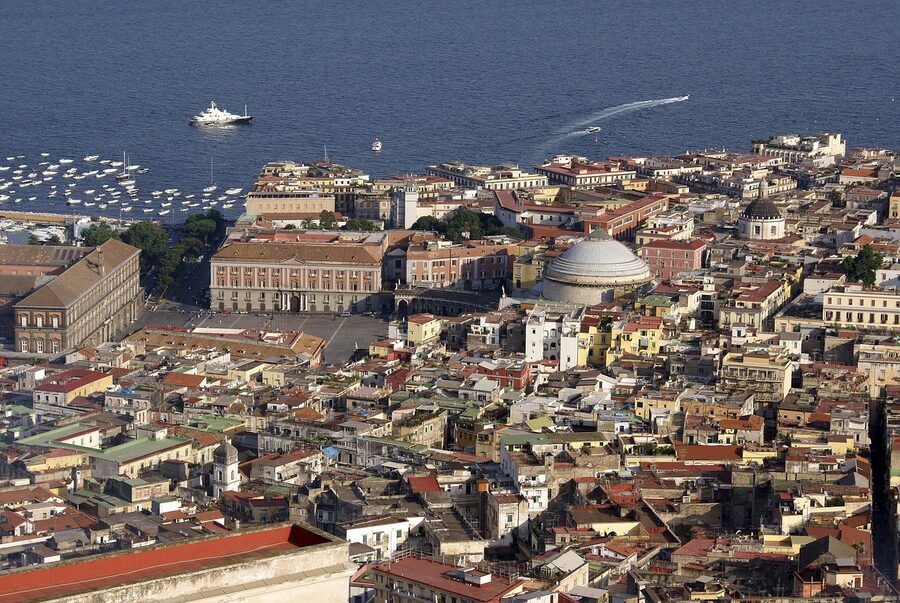
If you’ve only got time for one, ride Line B. The historic centre stops on Line A are mostly places you should be walking to anyway: the Cathedral, the Archaeological Museum, the Spaccanapoli area. Spaccanapoli is the most famous street in Naples and is wider than a bus is long for parts of it. The bus has to skirt the edges. Line B goes where you actually need a vehicle: out along the Lungomare, around the Mergellina harbour, up onto the Posillipo headland.
Line A: Art route
The Art route does eleven stops around the historic core. The big ones are the Archaeological Museum (more on this in a minute), the Cathedral, the Piazza Bellini area for the conservatory and university, and Piazza del Plebiscito for the Royal Palace.

Here’s the catch with Line A. The Archaeological Museum is genuinely worth the bus ride if you’re not staying near the centre, because it’s about 25 minutes uphill on foot from Piazza Municipio and the walk goes through a stretch of Naples that isn’t particularly rewarding. But once you’re at the museum you’ll spend at least two hours inside, which means by the time you come out you’ve burnt half your 24-hour ticket waiting for the next bus or queueing back at the stop. If you want to combine the museum with anything else on Line A, you’re going to spend a real chunk of the day on bus stops rather than in places.

The honest framing: ride Line A only to get to and from the Archaeological Museum. Don’t try to use it as a sightseeing tool through the centro storico. The grid of the old town is a walking grid. The Spanish Quarters are right there, the San Gennaro catacombs are a short metro hop, and you’d get a better day on foot.
Line B: Views of the Gulf
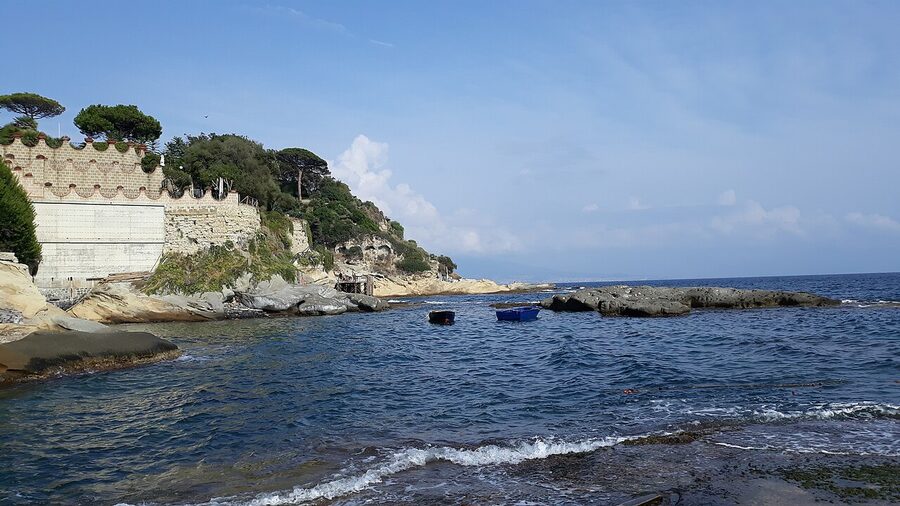
Line B is the one I’d put a 24-hour ticket on if I had to pick. Twelve stops, and most of them have a reason to exist. The route runs along the Lungomare past Castel dell’Ovo, swings around Mergellina, climbs onto the Posillipo headland for the famous view, and loops back through Piazza Sannazzaro. From the top deck you sit above the parked cars and the bay opens up the whole way. Nothing on Line A comes close to that visual payoff.
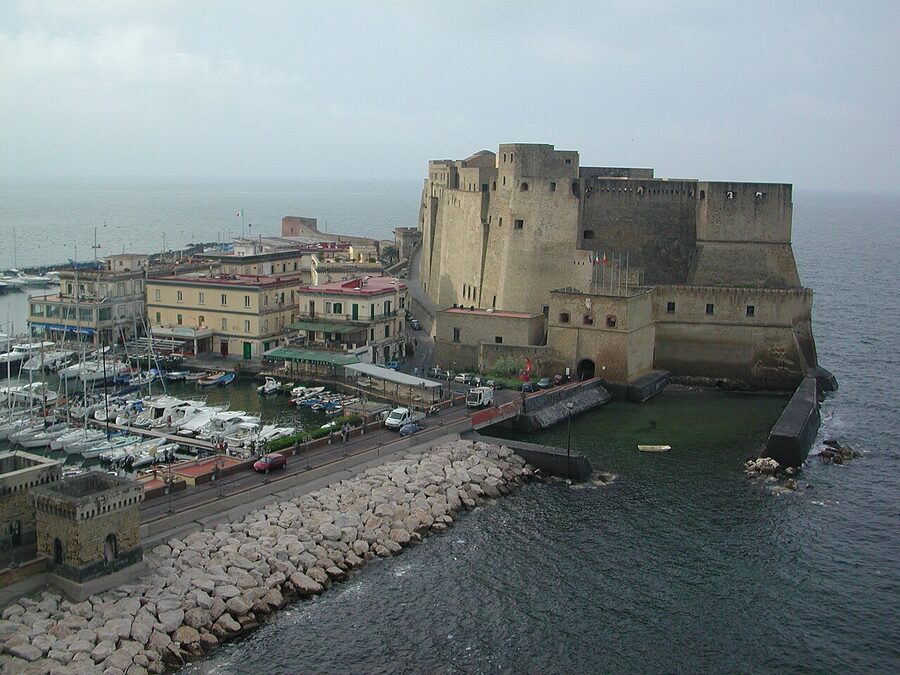
The trick with Line B is to ride it as a single loop, not as a hop-on-hop-off tool. Get on at Piazza Municipio in the late morning, ride the entire 75-minute circuit without getting off, and you’ve seen the whole coastline of Naples from the best vantage point in the city. Then if you want to spend a couple of hours at one stop later, hop off on the second loop. Treating the first run as a guided ride solves the problem most people have with these buses, which is that hopping off resets your wait time and you blow the day on transitions.
Where the bus genuinely earns it: three places

The Posillipo coastal drive is the first one. You can get to Posillipo on a regular city bus, but the open top deck makes a real difference here, and the Posillipo road is genuinely a road built around the view. The Romans had villas up there for the same reason. From late spring through October the bus runs the route in good light through the early evening.
The second is Capodimonte. The royal palace and museum sit at the top of a long hill north of the centre, and getting there on foot is unrealistic from anywhere a tourist would be staying. The standard bus options are circuitous. The hop-on bus runs straight up. The museum itself is one of the great picture galleries in Italy: Caravaggio, Titian, the Farnese collection. Spend two hours and the climb pays itself back.

The third is Vomero. Vomero is the residential plateau that sits above the historic centre, and it has two things worth seeing: Castel Sant’Elmo and the Certosa di San Martino. Both have the best panoramic views of Naples there are, including the views you see in every photograph. You can also reach Vomero by the funicular, which is faster and cheaper if it’s the only thing you’re doing. But if you’re already on the bus, the climb up takes you past parts of the city you wouldn’t otherwise see, and the open top deck makes the ascent itself part of the experience.

If you only do one of those three, do Vomero. If you only do two, add Posillipo. Capodimonte is the third because it eats two hours inside the museum, and most people on a one-day Naples trip don’t have those two hours to give.
Where it doesn’t earn it

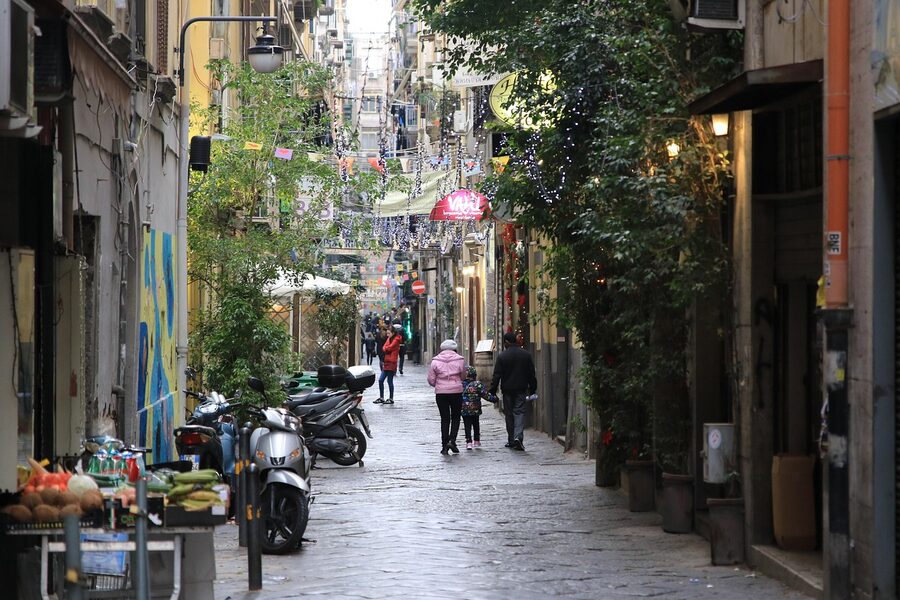
The historic centre is the easy “no”. Spaccanapoli, San Gregorio Armeno with the nativity-scene workshops, the Cathedral, the via Tribunali pizza row: all of it is walkable in an afternoon, and the streets are genuinely too tight for the bus to do anything useful. The bus does come close on a couple of edges, but if you’ve ridden a hop-on bus through any other Italian centro storico you know how this plays out. You see roof lines, not buildings. The atmosphere of Naples lives at street level, and at street level you want your feet on it. If your day is centro-storico-only, eat at a few of the spots in our eating pizza in Naples guide and skip the bus altogether.
The other “no” is Pompeii. People do ask whether the hop-on bus runs there. It doesn’t. Pompeii is half an hour out of town on the Circumvesuviana train, and there’s a ticket-and-guided-tour ecosystem documented in our Pompeii tickets and tours guide that you should use instead. Same for Vesuvius (see the Mount Vesuvius from Pompeii route) and the Amalfi Coast (the Amalfi Coast day trip guide). The hop-on ticket is a city pass, not a regional one.
How the ticket actually works
The 24-hour ticket starts the moment they stamp it, not at midnight. You can buy on board, online ahead of time, or at one of the kiosks at the major stops. The price is the same everywhere; buying ahead just saves the queue and locks in availability on busy cruise days. Both routes are on the same ticket. There are concessions for kids under 16. There are no senior discounts, which is a recurring complaint and worth knowing if you were expecting one.

Onboard there’s recorded commentary in eight languages including English, free Wi-Fi, and step-free access. The headsets are clean enough but bring your own earbuds with a 3.5mm jack if you want to last more than the first stop. The audio is informative without being chatty, which is a fair trade for not being able to ask questions. The recorded commentary is also why the Salerno cruise version exists: the whole product is designed for you to step on, get oriented, and step off rather than ride a guided tour with a person.
The cruise question

If you’re on a cruise that docks in Naples for the day, the calculation changes. You’ve got six to eight hours, you don’t want to mess about with public transport, and you probably want one good photograph of the bay. The hop-on bus is genuinely the right tool here. Walk five minutes from the cruise terminal to Piazza Municipio, ride Line B as a complete loop without hopping off, hop off only at one stop on the second pass for lunch and a wander, ride back. You’ll be on board your ship by 4pm with the whole coast seen and Vomero or Posillipo bookmarked for next time.
If you’re docking in Salerno on an Amalfi-coast itinerary instead, the combination ticket with the train from Salerno is the version of this that exists for you. It’s more expensive but it solves the “how do we get from Salerno to a Naples bus stop” problem in one purchase. Worth it for cruise passengers, not worth it for anyone else.
The recommended tickets
1. City Sightseeing Naples 24-Hour Ticket: $30

This is the one to book if you’re not sure which one to book; our full review covers what you actually use Line A and Line B for once you’re on board. Both routes, eight-language commentary, valid 24 hours from first stamp. Free cancellation if your day shifts.
2. Naples Hop-On Hop-Off via Viator: $31

Functionally identical to the GetYourGuide version, which our review covers in detail. Same 24-hour validity, same two routes, same recorded commentary. Pick this one only if your other Naples bookings are already on Viator.
3. Naples Hop-On Bus With Train From Salerno: $55
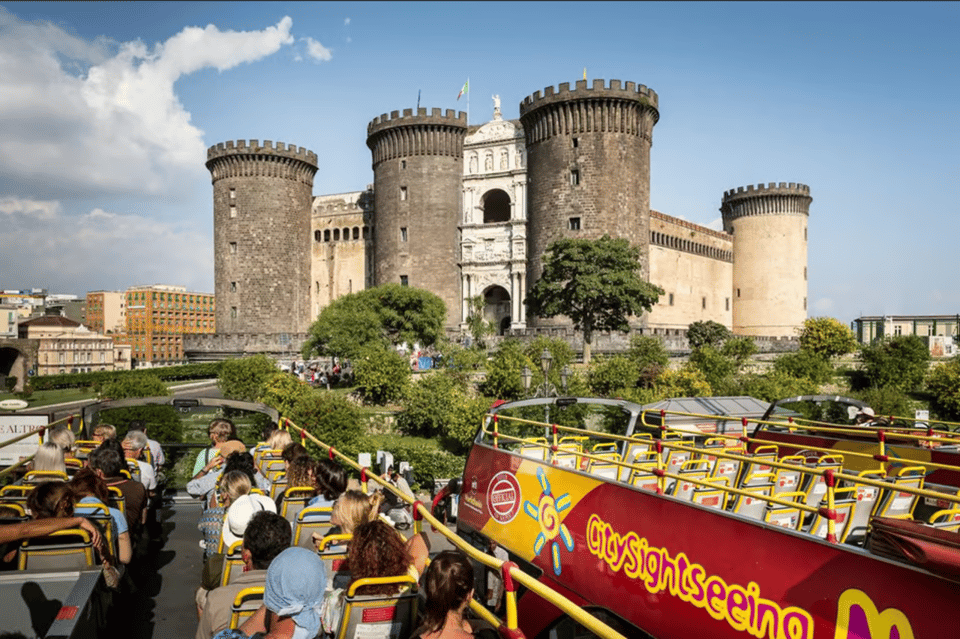
This one only exists for a specific reader: cruise passengers whose ship docks in Salerno but who want a full Naples day instead of an Amalfi Coast one. Our review walks through the train interchange and how to time the return. Skip if you’re not coming in from Salerno.
How Naples compares to other Italian hop-on buses

Florence, Milan and Rome each have their own hop-on bus story, and the same calculus runs across the bigger European cities, from the Paris loop through Barcelona’s two-line system to Amsterdam’s canal-bus combo. Florence’s old town is pedestrian-only so the Florence hop-on bus doesn’t reach the headline attractions either; the verdict there is “skip unless you’re going up to Piazzale Michelangelo or Fiesole”. Milan’s bus has the same problem in a different shape; the Milan version mostly fails because Milan’s metro is faster than the bus through traffic and the city’s real distances aren’t huge. Rome is the one that actually works at full city scale; the Rome HOHO connects landmarks that are genuinely far apart on foot, and the Roman geography spreads out enough that the bus removes a real walking burden.
Naples sits between Florence and Rome on this scale. The historic centre is a Florence-shaped problem (walkable, dense, the bus is in the way), and a similar verdict shows up on the Seville hop-on circuit, where the Santa Cruz alleys defeat any bus the moment it tries. The wider Naples city is a Rome-shaped opportunity (Posillipo, Capodimonte, Vomero, all genuinely far from the centre and worth seeing), the way Marseille’s coastal corniche route earns its 24 hours and Palma’s bay route on Mallorca earns its. Buy the ticket for the second of those problems, not the first.
Practical micro-details

A few things I’d want to know if I hadn’t been:
- The first bus is around 9.30am on both routes year-round, with a slightly later start in winter. The last departure is mid-afternoon in winter and around 5.30pm in summer. Don’t plan a 6pm sunset ride; you won’t get one.
- Sun on the top deck is brutal in July and August. Bring a hat, sit on the shaded side. The seats fill up.
- Rain happens. The buses are open-top with a covered lower deck. If it’s raining you’ll be downstairs, which means most of the visual point is gone. Check the forecast before buying.
- Cruise day surcharge: on busy cruise days the buses fill up at Piazza Municipio and you may end up standing for the first leg. Boarding at the stop after Municipio is a workaround.
- The app is genuinely useful and shows you where the buses are in real time. Free download, no sign-up. This alone saves 15 minutes off most days.
If you have one day

Here’s the version of the day I’d actually do. Walk the centro storico in the morning: Spaccanapoli, the Cathedral, a stop at Naples Underground if you’ve pre-booked, lunch on Via dei Tribunali. After lunch, walk down to Piazza Municipio and pick up Line B. Ride the entire 75-minute loop without hopping off so you can see the whole coastline in good afternoon light. Then on the second loop, get off at the Vomero stop, take the funicular up the last bit if you want to save your legs, see the view from Castel Sant’Elmo and the Certosa, and ride the bus back down. You’ll be back at the port by sunset and you’ve used the bus for exactly the part of Naples it’s good at.

The 48-hour version, which exists but I’d rarely recommend, makes sense only if you’re doing both Capodimonte and a thorough Vomero day. Otherwise the 24-hour stamp is plenty.
The Archaeological Museum, more carefully

I keep coming back to Capodimonte as the “use the bus for this” pick over the Archaeological Museum, and that’s deliberate. The Archaeological Museum is closer in, the bus stop is right outside, and yes Line A goes there directly. But the museum is also reachable by metro stop Museo, which puts you at the entrance in fifteen minutes from anywhere with a metro stop. If you’ve already got a metro day-ticket, the bus doesn’t add anything for the Archaeological Museum specifically. Capodimonte is harder to reach without the bus, which is why it’s the better justification.
This is also why I’d push back gently if a hotel concierge tries to sell you the bus ticket as your one-stop solution for the Archaeological Museum. It works, but it’s not what the bus is good at. Save the bus ticket for the parts of Naples that don’t have a metro line. Use the metro for the parts that do, and the daily ticket combos for that are documented at most station entrances.
Worth it or not

Worth it if: you’re on a cruise day, you want the Posillipo coast, you’re going to Capodimonte, or you want the Vomero panorama without doing the climb on foot in summer heat. Not worth it if: you’ve got two days plus, you’re staying in or near the centro storico, you’re metro-comfortable, or your day plan is mostly Pompeii and Vesuvius rather than Naples itself.
If your day shape is the second category, the money is better spent on a couple of metro day-tickets, a good walking pair of shoes, and a sit-down lunch at one of the pizzerias on Tribunali. The bus is a tool; it’s not the trip.
What else to plan around it
If you’ve decided the bus is for one half of your day and you want the rest of Naples filled in, my reach-for guides are eating pizza in Naples for lunch direction, Naples Underground for the morning before the bus loop, and the San Gennaro catacombs if you want the half-day archaeology hit and you’ve already done the Rome version. For the wider Campania region, the Pompeii guide and the Capri boat tour cover the day-trip side. The bus does none of those, which is fine; it does what it does, and you do the rest.